Why Britain cannot deliver SSN-AUKUS on schedule
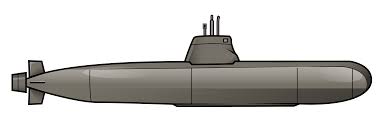
Australia is pinning its strategic future to an overburdened, fiscally constrained UK industrial baseline.
Peter Briggs, October 1, 2026, https://pearlsandirritations.com/post/2026/10/why-britain-cannot-deliver-ssn-aukus-on-schedule/
Britain says SSN-AUKUS remains on track. But its shipyards are already stretched while new reactor and workforce capacity is still being built. Australia is betting heavily on that gap being closed in time.
The public relations narrative of AUKUS Pillar 1 rests on a singular, untested premise: that the United Kingdom can seamlessly transition from its current Astute and Dreadnought submarine programs to deliver a brand-new, complex, 10,000-tonne nuclear-powered attack submarine, SSN-AUKUS, on schedule.
Recent developments in the UK demonstrate that this political optimism is fundamentally disconnected from the physical, contractual, financial and industrial realities on the ground at BAE Systems’ shipyard in Barrow-in-Furness.
In September 2025, King Charles formally commissioned HMS Agamemnon, the sixth Astute-class submarine, into the Royal Navy. Press releases heralded a major defence milestone. Yet, far from entering active service, Agamemnon remained tied up inside the Devonshire Dock Basin at Barrow for another full year, only departing for initial contractor sea trials on 24 September 2026.
The early commissioning reverses standard Royal Navy procurement. Laid down in July 2013, Agamemnon took 13 years and two months simply to leave the dock. Her actual entry into service will not occur until mid-to-late 2027 – a 14-year construction timeline.
This ceremonial exercise illustrates a broader pattern of political messaging substituting for industrial output. Claims that steel will be cut for the first SSN-AUKUS hull at Barrow in 2027 follow the same pattern. Embarking on physical hull fabrication before completing a preliminary design review (PDR) and freezing the 3D spatial design model risks severe engineering setbacks. For SSN-AUKUS, detailed design funded under a £3.95 billion development contract running through 2028 remains under way. Without a stable PDR baseline, internal layouts, reactor integration and pipework remain in flux. ‘Cutting steel’ in 2027 will merely involve cutting test rings or material qualification modules rather than assembling an operational warship.
Yard saturation and uncontracted infrastructure
The physical state of Barrow shipyard exposes the impossibility of fast-tracking SSN-AUKUS.
The heart of Barrow’s manufacturing capability is the Devonshire Dock Hall (DDH). Currently, the DDH is full. It houses the first three Dreadnought-class ballistic missile submarines (Dreadnought, Valiant and Warspite) alongside the final Astute hull, HMS Achilles (Boat 7), while initial fabrication for the fourth SSBN (HMS King George VI) proceeds off-site. There is no physical bay space inside the primary hall to establish an SSN-AUKUS production line.
The severity of this spatial bottleneck was underlined in a recent planning application submitted by BAE Systems Marine Ltd for its North Quay site, immediately adjacent to the DDH. BAE sought municipal approval to erect a 125-metre-long temporary enclosed scaffold structure on the open quay to house overflowing component manufacturing and outfitting. In its official filing, BAE acknowledged the improvised structure was explicitly required “as a result of capacity constraints within the Devonshire Dock Hall (DDH)”.
When a major nuclear shipyard must resort to 125-metre fabric sheds on quayside aprons to handle current workloads, absorbing a new 10,000-tonne attack submarine line strains credibility.
To bypass this bottleneck, BAE Systems purchased an 18-acre former gas site at Ramsden Dock. The plan is to manufacture hull cylinders on this port land and barge them via a roll-on/roll-off (Ro-Ro) quay to the main dock basin. However, the site requires extensive clearing, re-grading and deep piling before shed construction can begin.
Crucially, while the initial £3.95 billion contract covers preliminary 3D design and basic enabling works, primary contract packages required to build these sheds and construct the Ro-Ro wharf remain unexecuted or fragmented across future budget cycles. Furthermore, in July 2026, the UK MoD awarded a £5.9 billion delivery contract strictly prioritised for the Dreadnought-class SSBN. Because Britain’s continuous at-sea deterrent takes total strategic precedence, primary nuclear engineers, dry docks and yard resources at Barrow are contractually locked into Dreadnought through to the delivery of the fourth boat in the late 2030s.
Reactor supply and logistics bottlenecks
The industrial choke point extends beyond Barrow to the nuclear supply chain at Raynesway in Derby, where Rolls-Royce Submarines manufactures all Royal Navy reactor cores.
To support both Dreadnought and SSN-AUKUS, Rolls-Royce began work to double the footprint of its Raynesway site in July 2026. Once assembled, complete PWR3 reactor modules must be transported over 150 miles by road in heavy-duty, radiation-shielded containers under armed police escort along the M6 and A590 corridors directly into the Barrow yard.
While the PWR3 reactor has been lowered into lead boat HMS Dreadnought inside DDH, manufacturing and delivering reactors for follow-on SSBN hulls alongside initial SSN-AUKUS units creates a severe industrial queue. Raynesway remains constrained by strict nuclear licensing oversight and an acute shortage of specialised nuclear-certified welding technicians.
The human and civil bottleneck
The physical sheds at Barrow may eventually be erected; however, the civil infrastructure required to support the workforce does not exist in the numbers required.
BAE Systems has expanded its Barrow workforce from 11,000 to approximately 16,000, aiming for over 18,000. In 2026, the UK House of Commons Defence Committee warned that infrastructure investment at Barrow “has already faltered”. BAE Systems formally advised local government that the shipyard requires 900 new homes to be built annually in Barrow to house incoming technicians. Current local construction struggles to deliver 200 units per year. Thousands of contractors commute daily along the single-carriageway A590, creating severe transport gridlock.
In response, the UK Government established ‘Team Barrow’ with a £200 million regeneration fund. However, Team Barrow leadership has publicly acknowledged that this seed allocation falls far short, stating that £400 million to £800 million in combined investment will be required to tackle the town’s infrastructure deficit. Furthermore, this funding is designated for general municipal upgrades – schools, healthcare and roads – rather than industrial shipyard tooling.
Britain lacks the localised housing, transport capacity and specialised nuclear-certified trade workforce to operate two concurrent submarine construction lines.
Strategic imperatives: NATO vs Indo-Pacific overreach
This industrial overstretch must be viewed through the unforgiving lens of Britain’s fiscal deficit and shifting strategic priorities.
Under mounting financial pressure, the UK Ministry of Defence faces a multibillion-pound structural budget shortfall. The UK Strategic Defence Review has formalised a mandatory ‘NATO-first’ posture, directing military resources, capital investment and force readiness primarily toward European defence and deterrence against Russian aggression. Facing a security crisis on its continental doorstep, Whitehall cannot afford to bankroll massive, long-horizon industrial expansions designed to project power into the Indo-Pacific.
Sustaining Britain’s continuous at-sea deterrent via Dreadnought consumes the lion’s share of UK capital expenditure. Coupled with urgent demands to re-arm land and air forces in Europe, attempting to design and build a bespoke 10,000-tonne attack submarine for Australia would appear to be a lower priority.
Industry is striving to recover from decades of systemic neglect that has left operational SSN capability immobilised and the continuous at-sea deterrent under strain. Political ambition cannot overrule the laws of industrial capacity, national economics and engineering physics.
Australia is pinning its strategic future to an overburdened, fiscally constrained UK industrial baseline. The physical and financial evidence at Barrow – an unbuilt off-site facility, a saturated main assembly hall requiring temporary outdoor work space, unfinalised contracts for primary manufacturing sheds, acute housing deficits, severe reactor supply chain queues, and a UK defence budget deficit whilst pivoting back to Europe – demonstrates that Britain cannot deliver SSN-AUKUS on the promised timeline.
Relying on ‘schedule-free’ assurances while ignoring these constraints guarantees a severe capability gap for Australia. It is time for Washington, London and Canberra to acknowledge these ground realities and undertake a fundamental reappraisal before industrial overreach turns into operational and political catastrophe.
Peter Briggs
Peter Briggs retired from the RAN in 2001 after a 40-year career, specialising in submarines. This included two submarine commands, command of the RAN Submarine Squadron, director of Submarine Policy and Warfare and Head of Submarine Capability Team, established to rectify Collins introduction into service issues. He was the president of the Submarine Institute of Australia from 2006-09 and is a frequent contributor to public debate on Australian submarine matters.
Australia’s West Bank Abdication: The Comfort of Complicity
Twelve nations put a price on Israel’s illegal settlements. Canberra sat at the table for months, then remembered it had a Security Council seat to win.
URBAM WRONSKI WRITES, 29 Sept 26
Do we have principles?
Strutting what it sees as the high moral ground of the world stage, Australia is wont to pose as the honest broker, champion of the underdog and even warden of the mystical rules-based order, a form of words that rivals the Nicene Creed for opacity and is chanted with the same glazed piety, loudest by those least inclined to live by it.
Hypocrisy? If we don’t like our principles, as Groucho almost said, we have others.
This month twelve nations put their names to trade sanctions on Israel’s illegal settlements in the West Bank: the UK, France, Canada, Denmark, Finland, Iceland, Ireland, Norway, Poland, Portugal, Spain and Sweden.
Four diplomatic sources told the ABC that Australia stayed in the talks until close to the end. One EU official had seen an earlier draft with Australia written in.
Whether Canberra ever agreed to be there, nobody will say.
Then the pens came out and Australia remembered a pressing engagement elsewhere.
Two EU officials were “surprised”. Another was “disappointed”. A Nordic official said Canberra had “missed an opportunity”.
That is how you talk about a mate who didn’t show.
We are not so much walking back our stance against illegal settlements as not walking the talk at all.
Before we go there, let’s look at what hides behind the benign euphemism of the word settlement.
What the word hides
The settlements are Israeli civilian towns built on land Israel captured in 1967.
Article 49(6) of the Fourth Geneva Convention forbids an occupying power to move its own civilians into the territory it occupies. In July 2024 the International Court of Justice found the occupation itself unlawful and said the settlements must be evacuated.
Some settlements are cities with shopping malls and council rates. Others are one caravan, one flag and a flock of sheep on a hilltop.
Both do the same job.
Take Ras Ein al-Auja, a Bedouin village in the Jordan Valley. This is innovation. Who needs a bulldozer?
In late December 2025 settlers set up an outpost beside it. They ploughed the village land, tore up the road and cut the power cables. They blocked the canal and the grazing grounds.
They drove their herds to people’s doorsteps and gathered in groups at night.
On 8 January, 26 households, more than 100 people, left in a single day, +972 Magazine reports.
“They threatened to kill us, chased us, beat us,” said Abu Taleb al-Omari, 75. “In the end, they said they would slaughter us here if we didn’t leave.”
Muhammad Eshaq Rashid, 55: “I’ve never cried in my life until today.”
The settlers’ parting words, as one resident recalls them: “You lost. Wherever you go, we’ll come.”
Ras Ein al-Auja is not an aberration.
Amnesty International counts 117 herding and Bedouin communities fully or partly driven out between January 2023 and April 2026. That is 5,910 people. Of 363 unauthorised outposts, 212 went up under the present government………………………………………………………………………………………………………………………………….
Penny Wong told the Senate that Australia would pursue “further targeted measures in coordination with international partners.”
Which measures. Against whom. By when. The Senate was not told. Neither were we.
A touch of the reverse Robin Hood. We won’t tax the people taking Palestinian land, out of tender concern for the Palestinians whose land is being taken.
No-one’s buying the government guff………………………………………………………………….
Targeted measures. The very thing Canberra says it prefers. They were on the table. Canberra left them there.
And the targeted measures we already have?
In June 2025 Australia joined Britain, Canada, New Zealand and Norway in sanctioning Itamar Ben-Gvir and Bezalel Smotrich. Good.
Now look at what that leaves. We sanction the man who runs the settlement project, then decline to touch the project.
The foreign policy equivalent of thoughts and prayers.
Wong is not confused about the stakes. She has said that settlement growth, E1 and “flagrant settler violence” are “extinguishing the possibility of a two-state solution.”
The Foreign Minister has read the death notice. She is still deciding on flowers.
Nor is the law in doubt. The ICJ told every state to refrain from aid or assistance in maintaining the occupation, and to take steps to prevent trade or investment relations that help keep it going.
Trade relations. The Court named the lever. Twelve nations have pulled it.
The domestic alibi
So why walk? The ABC’s sources point home.
On 14 December 2025, gunmen killed 15 people at a Hanukkah celebration at Bondi Beach. That was antisemitic terror and the grief is real.
A royal commission followed. Its report is due on 18 December.
Several diplomats told the ABC that the pressure on Albanese since Bondi may have shaped Canberra’s decision.
Here is what the government will not say.
Jewish Australians are not the Israeli cabinet. A Hanukkah gathering on Bondi Beach is not a caravan on a hilltop in the Jordan Valley. A tariff on settlement goods is not an act against a faith.
Treat it as one and you accept the settlers’ own case: that the settlements belong to every Jew, everywhere.
Plenty of Jewish Australians see the difference. The Jewish Council of Australia, a progressive group sharply critical of Israeli government policy, wants settlement goods banned.
“Once again,” said its executive officer Bart Shteinman, “Australia is at the back of the pack when it comes to upholding our international law obligations.”
Jewish Australians call for the ban. The government cites Jewish Australians as its reason to refuse it.
Canberra is choosing which Jews to hear.
In London, Ed Miliband announced Britain’s measures and was promptly called antisemitic. Miliband is Jewish, as Rachel Withers notes in Crikey.
A charge that fits everyone is no guide to policy………………………………………………… https://urbanwronski.com/2026/09/29/australia-west-bank-abdication-comfort-of-complicity/
Submission to AUKUS Inquiry – Unwise to integrate Australia into USA’s military power -David Jonathan Beardsmore.

147 – extract of a long submission
“…………………………………My submission advances three core arguments. First, that AUKUS operationally integrates
Australia into United States power projection in a way that serves US strategic interests rather
than Australian ones, and exposes Australia to risks it cannot control.
Second, that the
opportunity cost of AUKUS is indefensible, the soft power strategy that would actually serve
Australian regional security is being systematically underfunded while $368 billion is
committed to submarines that may never arrive on schedule, if at all.
Third, that a right-sized,
conventionally capable, agile defence force, including the asymmetric and drone capabilities
that have proven decisive in recent conflicts, oriented toward genuine Australian territorial
defence and regional partnership would serve Australian security better and at a fraction of the
cost.
AUKUS Was Conceived in a Strategic Environment That No Longer Exists
AUKUS was announced in September 2021 under a specific set of assumptions about the
international environment: that the United States was a reliable, rules-based actor committed
to multilateral institutions; that the primary strategic challenge was Chinese military
expansionism requiring a conventional military counterbalance; and that deep operational
integration with the United States would enhance rather than constrain Australian strategic autonomy. Each of those assumptions has been fundamentally called into question by subsequent events.
The United States has withdrawn from or undermined multiple international agreements and
institutions. It has used economic coercion against allied trading partners including Australia. It
has made explicit territorial claims over allied and sovereign territory, including Greenland and
assertions about the Panama Canal. Its current National Defense Strategy includes explicit
assertions of US dominance over the Western Hemisphere that echo 19th century Monroe
Doctrine thinking, with implications for how it would expect allied military assets to be
deployed.
I put a direct question to the inquiry that has not been adequately answered in public debate:
how does Australia procuring nuclear-powered submarines align with the actual current US
defence strategy? That strategy, as articulated under the current administration, appears to
prioritise the Western Hemisphere and Latin America as the primary zone of US strategic
concern, while effectively ceding leadership in Southeast Asia. If the US is reorienting toward
its own hemisphere, the strategic rationale for Australia acquiring submarines designed to
operate in partnership with US forces in the Indo-Pacific requires urgent re-examination. We
may be purchasing a capability designed to serve a US strategic posture that the US itself is
abandoning.
I put a further direct question: if Australia were to have a Virginia class submarine operating
under shared protocols with the United States Navy today, would Australia be in a position to
refuse if the United States requested operational support for naval activities in the Caribbean,
the Gulf of Mexico, or the waters around Venezuela or Cuba? The deeper the operational
integration, the harder the answer to that question becomes. AUKUS does not merely procure
submarines, it structurally commits Australia to follow the United States wherever its strategic
interests lead, for the next fifty years.
I also note that the AUKUS commitment appears to have been made without the standard due
diligence that would be required of any comparable major public or private investment. There
is no publicly available independent cost-benefit analysis. There is no published risk
assessment. The business case, to the extent one exists, has never been released. A
commitment of this magnitude made without this foundational work did not follow due process
by any reasonable standard, and the inquiry should name that failure directly.
A $368 billion commitment made on the basis of strategic assumptions that have demonstrably
shifted, without adequate due diligence, deserves to be revisited. That is not an anti-American
argument. It is the most basic principle of prudent risk management. I note in this context that
the terms of the deal have already changed significantly, Australia will now receive three
second-hand Virginia class submarines rather than the originally planned mix of new and used
boats. The goalposts have moved before a single submarine has been delivered. This ought to
raise serious questions about what further changes lie ahead over a fifty-year programme.
The Difference Between Alliance and Operational Integration
I wish to draw a distinction that has been largely absent from the public debate on AUKUS.
There is a meaningful difference between maintaining an alliance relationship with the United
States and being operationally integrated into US power projection.
Australia has maintained an alliance with the United States for over eighty years. That alliance
has served Australian interests in some respects and has drawn Australia into conflicts that did
not serve Australian interests in others, Vietnam, Iraq, and Afghanistan being the most obvious
examples. In each case, the alliance logic made refusal politically costly even when the
strategic case for participation was weak or non-existent.
AUKUS takes that logic and embeds it in steel and nuclear reactors. Nuclear-powered
submarines operating under shared US protocols, based at HMAS Stirling near Perth, are not
a defensive capability for protecting Australian territory and maritime approaches. They are a
contribution to US power projection across the Indo-Pacific and potentially beyond. That is a
fundamentally different strategic posture, and it has been adopted without the Australian
people being given the opportunity to debate or decide it.
I submit that Australia can and should maintain its alliance relationship with the United States
while declining to be operationally integrated into US power projection. New Zealand has done
exactly this, maintaining its alliance relationships while exercising greater strategic
independence, and it has not been invaded or left without allies. The argument that Australia
must choose between full operational integration with the United States and strategic isolation
is a false binary that serves the interests of the defence industry and alliance managers, not
the Australian people.
The Opportunity Cost: Soft Power Is Australia’s Greatest Strategic Asset
Australia’s greatest strategic asset in the Indo-Pacific is not military capability. It is trust,
proximity, shared vulnerability to climate change, and a history of engagement with Pacific and
Southeast Asian nations that cannot be replicated by either the United States or China. That
asset is being systematically squandered while $368 billion is committed to submarines.
The Pacific Islands Forum member nations have been explicit about their strategic priorities.
Their existential threat is climate change, not Chinese military aggression. When Australia
commits $368 billion to nuclear submarines while cutting development assistance and climate
finance to Pacific Island nations, it sends a clear message that Australian strategic priorities
have nothing to do with their actual needs. That message drives Pacific nations toward China,
not because they embrace Chinese authoritarianism, but because China is building ports,
hospitals, roads and renewable energy infrastructure while Australia is buying submarines.
China’s Belt and Road Initiative has created genuine dependency across the Indo-Pacific, in
Southeast Asia, and in Africa. That dependency is not the same as military conquest, but it
represents a form of strategic influence that shapes the decisions of governments and
peoples. The way to counter it is not submarines, it is offering a genuine alternative at scale.
Australia, in partnership with Japan, South Korea, India and European allies, has the capacity
to offer such an alternative. What has been lacking is the political will and financial commitment
to do so. AUKUS forecloses that option by consuming the resources that would make it
possible.
I submit that every dollar committed to AUKUS is a dollar not available for the development
finance, climate adaptation support, educational exchanges, diplomatic engagement, and
multilateral institution-building that constitute genuine soft power, and that would do more to
advance Australian security and regional influence than any number of nuclear submarines.
A Considered Assessment of the Chinese Strategic Challenge
I wish to be clear that I do not dismiss the Chinese strategic challenge. China’s militarisation of
disputed features in the South China Sea, its coercive economic behaviour toward trading
partners including Australia, its dismantling of Hong Kong’s democratic institutions in breach of
the Sino-British Joint Declaration, its treatment of the Uyghur population in Xinjiang, and the
ongoing military threat to Taiwan are all matters of genuine concern that deserve serious policy
responses. However, I submit that the appropriate Australian response to these challenges is
not submarines. It is the consistent application of international law, multilateral diplomatic
engagement, support for regional institutions, economic diversification to reduce dependency on any single trading partner, and the kind of soft power investment described in the previous section.
ASEAN, the ten-nation Southeast Asian bloc that sits between Australia and China, has
explicitly and consistently rejected the framing of a binary choice between Washington and Beijing. ASEAN’s strategic preference is for a rules-based regional order maintained through
multilateral institutions, not through US or Chinese military dominance. AUKUS cuts across
that preference and makes Australian diplomacy in ASEAN more difficult, not less. A
submission from Australia to the region that says ‘we are deploying nuclear-powered
submarines under US protocols’ is not the same as a submission that says ‘we are investing in
your development, your climate resilience, and your institutional capacity.’
On the question of Taiwan specifically, I acknowledge the genuine complexity of its historical
and legal status, and I recognise the democratic character of its 23 million people and their
right to determine their own future free from military coercion. However, the question for
Australian strategic policy is not whether Taiwan matters, it is whether AUKUS submarines
would meaningfully alter the outcome of a conflict over Taiwan without catastrophic
consequences for Australia. The answer to that question is clearly no. A war between the
United States and China over Taiwan, fought with Australian submarines alongside the US
Navy, would not save Taiwan and would expose Australia to retaliatory strikes against facilities
including HMAS Stirling, making Perth one of the first targets in a conflict that would threaten
the survival of Australian society as we know it.
This risk is compounded by the observable instability of United States policy on Taiwan itself.
The recent Trump administration’s engagement with China, including high-level diplomatic
contact and signals of reduced commitment to Taiwan’s defence, demonstrates that US
Taiwan policy is subject to rapid reversal depending on the domestic political calculations of
any given administration. Australia should not be structuring a fifty-year strategic commitment
around the reliability of US Taiwan policy when that policy has demonstrably shifted within a
single presidential term. We risk being entangled in a conflict the United States itself may
choose to step away from.
A Right-Sized Defence Force for Australia’s Actual Security Needs
Australia’s genuine defence needs can be summarised as follows:
- Maritime patrol and surveillance capability sufficient to monitor Australia’s vast
exclusive economic zone and maritime approaches. - Cyber capability, the most likely domain of future conflict affecting Australian interests,
which is chronically underfunded relative to conventional platforms. - Rapid response forces capable of responding quickly to crises across the Indo-Pacific,
including disaster relief, humanitarian assistance, and peacekeeping operations that
build regional relationships. - Conventional deterrence sufficient to make any direct attack on Australian territory
prohibitively costly for any potential adversary. - Space-based intelligence, surveillance and reconnaissance capability that provides
genuine strategic awareness without dependence on US systems. - Advanced asymmetric capabilities, including drone swarms, loitering munitions,
electronic warfare, and autonomous underwater vehicles, that represent the cutting
edge of modern warfare at a fraction of the cost of conventional platforms.
None of these requirements needs nuclear submarines. All of them could be funded at world-
class levels for a fraction of $368 billion, with substantial funds remaining for the soft power
investment that is Australia’s most effective strategic tool………………………….
The Unresolved Nuclear Waste Question and True Cost of AUKUS
I note with serious concern that no credible answer has been provided to the question of where
the high-level nuclear waste generated by AUKUS submarines will be stored. This is not a
minor administrative detail. It is a fundamental question about the use of sovereign Australian
territory that affects First Nations communities, environmental values, and Australia’s
international standing as a non-nuclear-weapons state.
I wish to draw the inquiry’s attention to a question about the $368 billion cost estimate that I do
not believe has been adequately addressed in public debate: does that figure include
decommissioning costs? For nuclear facilities, decommissioning costs typically exceed the
original capital cost of construction, sometimes by a significant multiple, and extend across
decades after the facility ceases operation. If the $368 billion figure does not include the full
lifecycle cost of nuclear waste storage, management, and eventual decommissioning of the
submarines themselves, the true cost to Australian taxpayers and their descendants is
substantially higher than has been publicly stated. The inquiry should require a full lifecycle
cost disclosure before any further commitments are made.
Australia has ratified the Nuclear Non-Proliferation Treaty as a non-nuclear-weapons state. To
be clear, the AUKUS submarines will be nuclear-powered but conventionally armed, the
nuclear technology is in the propulsion system, not in the weapons they carry. The Australian
government and its AUKUS partners argue that this arrangement complies with the written
terms of the NPT because the treaty relates only to nuclear materials associated with nuclear
weapons, not propulsion. However, this compliance is genuinely contested and unresolved.
The arrangement involves the transfer of tonnes of highly enriched uranium to Australia, the
same material used in nuclear weapons, and cooperation in developing capabilities for nuclear
submarine operations that IAEA safeguards were not expressly designed to cover.
The Arms
Control Association and independent non-proliferation experts have noted these concerns.
Australia would become the first non-nuclear-weapons state to acquire nuclear-powered
submarines, setting a precedent that could significantly undermine the global non-proliferation The Arms
Control Association and independent non-proliferation experts have noted these concerns.
Australia would become the first non-nuclear-weapons state to acquire nuclear-powered
submarines, setting a precedent that could significantly undermine the global non-proliferation
I submit that the AUKUS commitment should not proceed, and certainly should not consume
further public resources, until the full lifecycle cost, including waste storage and
decommissioning, has been publicly disclosed, and until the waste storage question has been
answered transparently and publicly with full community consultation including First Nations
communities on whose land nuclear waste storage may ultimately be proposed.
The Democratic Deficit
Regardless of one’s view on the strategic merits of AUKUS, the process by which it was
decided represents a democratic failure that this inquiry should name clearly.
A commitment of up to $368 billion, extending obligations across multiple generations of
Australians who have not been consulted and cannot consent, was made in secret, announced
without prior parliamentary debate, and has been shielded from meaningful parliamentary
scrutiny by bipartisan political agreement. The argument that bipartisan support makes
parliamentary scrutiny unnecessary inverts the purpose of parliamentary democracy.
Bipartisan agreement between major parties is precisely the circumstance in which
independent scrutiny becomes most essential.
I submit that this inquiry should recommend that no further commitments under AUKUS be
made without a full parliamentary debate and vote, that the complete terms of existing
agreements be made public, and that an independent cost-benefit analysis, including full
lifecycle costs, be commissioned and publicly released before the submarine acquisition
proceeds further.
Conclusion and Recommendations
I summarise my recommendations to the inquiry as follows:
- Suspend further AUKUS commitments pending independent review of the changed
strategic environment, including the altered behaviour and reliability of the United
States as an alliance partner and the shift in US strategic focus toward the Western
Hemisphere. - Commission and publicly release an independent full lifecycle cost-benefit analysis,
including decommissioning and nuclear waste storage costs, comparing AUKUS
against alternative defence capability options and against redirecting equivalent
resources to soft power, development finance, and regional engagement. - Resolve the nuclear waste storage question transparently and with full community
consultation, including First Nations communities, before any further nuclear-related
commitments are made. - Require a full parliamentary debate and vote before any further AUKUS commitments
are entered into. - Develop and resource a comprehensive Indo-Pacific soft power strategy, including
development finance, climate adaptation support, educational engagement, and
multilateral institution-building, as Australia’s primary tool for countering Chinese
regional influence and building genuine security relationships. - Commission a comprehensive review of Australia’s defence capability mix in light of
the lessons of the Ukraine and Lebanon conflicts, with specific assessment of investment in asymmetric, drone, autonomous, and cyber capabilities as alternatives to or complements of conventional platform spending. - Right-size Australia’s defence force around its actual security needs, territorial defence, maritime surveillance, cyber capability, rapid response, asymmetric deterrence, and regional partnership, rather than around the requirements of US power projection.
- Maintain the alliance relationship with the United States while declining operational integration that commits Australia to US military adventures beyond its own strategic interests.
US looks to Australia to help solve its nuclear-powered submarine problem
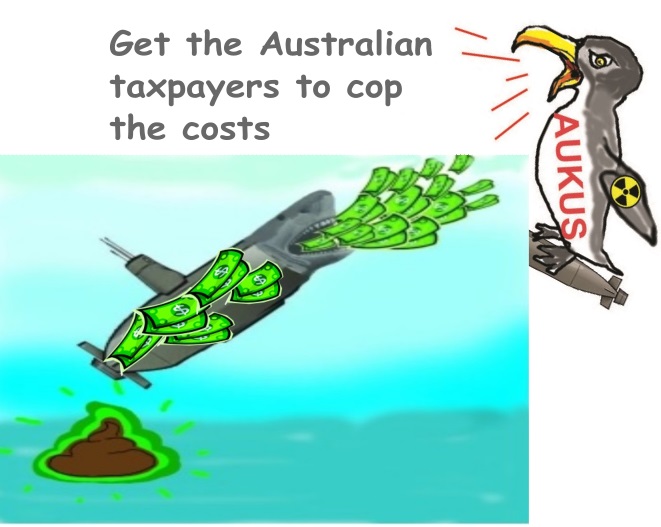
former deputy US secretary of state Kurt Campbell warned at a US Studies Centre forum in Sydney that there were sceptics at the Pentagon who would “love a stumble” on AUKUS.
After a US report found the country is losing billions on idle submarines, a top AUKUS ally in Congress pointed out Australia is happy to help.
Anton Nilsson, Sep 25, 2026, https://www.crikey.com.au/2026/09/25/aukus-us-congress-nuclear-powered-submarines-report-henderson-defence-precinct/
A top AUKUS supporter in Washington has pointed to Australia’s contribution to the alliance as a way to solve America’s problems with maintaining its submarine fleet.
Democratic representative Joe Courtney, a co-chair of the Friends of Australia caucus in the US Congress, issued a statement on Wednesday in response to a damning report on the USA’s ability to maintain its submarines.
The report by the US Government Accountability Office (GAO), published last month, found the US Navy had “lost more than 15,000 operational days due to maintenance delays and idle time on active attack submarines” over the past decade.
“Inactive idle time describes when an attack submarine designated for decommissioning cannot be inducted into a dry dock in a shipyard,” the report said. “As a result, the submarine and its crew must remain pier-side until a shipyard has the capacity in a dry dock to defuel their nuclear reactor.”
Virginia-class submarines — the type Australia hopes to purchase through the AUKUS agreement — cost US$237,080 per day to operate, and had been idle or in “depot maintenance delay” for a total of 3,522 days between 2016 and 2025, the report said. That meant the total cost for those idle vessels was US$835 million, equivalent to $1.1 billion in Australian currency, in that time period.
Another type of submarine the report looked at, the Los Angeles-class, had a total cost of US$3.3 billion over 15,165 idle days. The problem with inactive idle time was projected to worsen, and could cost the US $3.1 billion through 2030 if solutions aren’t found.
The GAO recommended the Navy try new ways of decommissioning submarines, including defueling outside of dry docks and reducing the crew numbers required on boats waiting to be decommissioned.
In his statement, Courtney pointed out that the “swift authorisation of the AUKUS security agreement” would mean “the US Navy’s submarine fleet will have new intermediate repair capacity” at a new Australian Defence Force site at Henderson, WA.
Courtney also pointed to Australia’s US$8.5 billion investment in “repair availability for Virginia-class submarines and the future SSN-AUKUS submarines”, a planned new class of nuclear-powered submarines that forms a cornerstone of the agreement between the US, Australia and the UK.
Australia’s government has said the under-construction Henderson Defence Precinct site will include dry docks and other infrastructure for maintaining the country’s future submarines. Royal Australian Navy personnel have in the past participated in maintenance work on US nuclear-powered submarines on Australian soil, work that Canberra has described as a “significant leap in Australia’s journey to acquire a sovereign capability to operate and maintain conventionally-armed, nuclear-powered submarines”.
Not everyone in Washington is viewing the AUKUS agreement with such positivity: former deputy US secretary of state Kurt Campbell warned at a US Studies Centre forum in Sydney that there were sceptics at the Pentagon who would “love a stumble” on AUKUS.
“I still think there are probably people at the [US] Department of Defence that would love a stumble [on AUKUS] to be able to say, ‘Ah, gee, this is something we need to reevaluate.’ It’s going to be very important to keep those folks on their back heels, and I believe that we’re doing that,” Campbell said on Wednesday, according to The Australian.
“So, you know, we have many hurdles ahead, and this is going to continue to require consistent, high-level application, challenges and training operations. But I think, so far, I would give us better than a pass grade [on AUKUS].”
Submission to the AUKUS Public Inquiry – Australia’s diplomatic relations – John Leslie Lander

The strategic rationale for AUKUS is founded on the patently false premise that China presents a kinetic threat to Australia.
The executive power of the Commonwealth under Section 61 of the Constitution,
does not extend to granting any foreign nation operational control of Australian
defence or intelligence facilities, or territory,
I am making this submission of the basis of long-term professional involvement in
diplomatic relations with China…….China is likely to become an enemy only if Australia insists on making it one.
In 1971-72 I was actively engaged in the process of establishing diplomatic
relations with the Peoples Republic of China and dismantling diplomatic relations
with the Republic of China. I was Deputy Ambassador to China 1974-76 and
subsequently Head of the China Section of DFAT on three separate occasions over
the course of thirty years. In that capacity, I was personally responsible for
negotiating the arrangements for the establishment of Consular Relations with
China. After retirement from DFAT, I have been a frequent visitor to China,
especially since 2001.
Dubious Rationale of AUKUS
The strategic rationale for AUKUS is founded on the patently false premise that
China presents a kinetic threat to Australia. Across the millennia of its history,
China has not invaded any other country, and certainly not since WW2, although it
was itself invaded by Imperial Japan, whose attempt to invade Australia was, to a
significant extent, thwarted by Australia’s ally – China. At no time in the past 80
years has China ever evinced the slightest inclination to attack Australia, let alone
expressed a policy of hostility towards Australia. It has consistently expressed a
policy of encouraging mutually beneficial relations, even during the brief period of
so-called “economic coercion”, where China was quite clearly reacting to the overt
hostility expressed by the Morrison government.
China is only likely to become an enemy if Australia insists on making it one. The
current Australian attitude of antipathy includes frequent actions of antagonism
towards China, (e.g. military incursions into China’s sovereign territory of the
province of Taiwan, which Australia is legally bound to observe as One China).
These stem especially from AUKUS and other aspects of US militarisation of
Australia, and push inexorably towards war.
The economic growth of China, where it now equals the US in terms of Purchasing
Power Parity, and China’s concomitant growth in military strength, to counter the
threat from the US military bases and naval forces ranged against it, have often
been cited as indicators of the potential threat from China.
Part of the rationale for AUKUS is the requirement to protect Australia’s sea lanes
from possible interdiction by China, ignoring the fact that China has an existential interest in keeping those same sea lanes open, because it is the largest trading
partner of the vast majority of the world. The only country poised to blockade
them is the US. Australia’s prosperity depends on trade, a full third of which is with
China and most of it carried on Chinese ships. To argue that AUKUS is necessary
for war against China in order to keep open Australia’s trade with China is
paradoxical and schizophrenic.
The US antagonism towards China is based on the US desire for global supremacy,
which is evidently being undermined by China’s growing ability to provide an
alternative source of finance and economic development to the Global Majority,
who lie outside the small group of Western countries. The US has made no secret
of its intention to embroil China in a debilitating war conducted by the US proxy
network of Japan, South Korea, Taiwan, the Philippines and Australia, in order to
derail China’s economic growth and impede its ability to cooperate with the
countries of the Global Majority.
Far from seeking to undermine a genuine rules based international order, China
has constantly reiterated its policy of promoting reform and strengthening of the
United Nations system to make it more effective and fairer to all member States. AUKUS forms a
key part of Australia’s increasingly futile attempt to uphold the US version of the
international rules based order, designed by and for the benefit of the US and its
Western allies. This is an order whose rules are frequently flouted by the US and
Australia, whenever they might hamper the pursuit of US geopolitical ambitions.
China’s policy towards Australia has consistently been one of amity. Even if
nefarious intentions are attributed to China, going to war against it is
counter-productive, in terms of preserving Australia’s security. Countless
simulations by the Rand corporation of a US/China war have without exception
demonstrated that the US would lose. Australia, even if part of the network of
proxies, would have even less chance of emerging intact from war against China.
Any pragmatic assessment of the respective military capabilities of Australia and
China would demonstrate that China is immensely more powerful than Australia,
which will never be able to match it. Given the time-frame in which the US insists
the war against China is to occur, Australia would have already been devastated
long before the delivery of the putative benefits of AUKUS.
The only guarantee of security for a small nation like Australia is the nurturing of
mutually beneficial relations with China and the countries in Australia’s region, all
of whom have engaged in economic development projects with China and none of
whom share Australia’s antipathy towards China. AUKUS makes Australia’s
neighbours very nervous about its intentions and isolates it from the region which espouses constructive relations with China.
Legal/Constitutional Dubiety of AUKUS
The system of governance in Australia, under the Constitution, requires the
Executive to work through the Parliament, not independently of it. International
Treaties – and Agreements having the force of treaty – require ratification by
Parliament in order to have effect in Australian domestic law. The legal question is
not whether the Agreement exists as an international instrument. The real
question is whether the Australian government has valid domestic legal authority
for the specific acts required to give effect to it inside Australia.
The executive power of the Commonwealth under Section 61 of the Constitution,
does not extend to granting any foreign nation operational control of Australian
defence or intelligence facilities, or territory, or to committing Commonwealth
expenditure in connection with such arrangements, without statutory authority
conferred by the Parliament.
The government may argue that the executive has inherent power to spend
without a specific Act of Parliament, since Parliament had appropriated funding in
the budget. The High Court, in Williams v. Commonwealth (2012)248 CLR 156,
disagreed unanimously with this view. Appropriation alone does not authorise the
executive to spend on whatever it likes. For significant executive acts with real
domestic legal consequences, there must be a lawful source of authority.
That principle applies directly to AUKUS, which is adjunct to the even more
egregious Force Posture Agreement with the US, which also runs counter to the
principle established by the High Court. Committing billions in expenditure;
granting operational control of Australian facilities to a foreign military force (e.g.
Stirling Naval Base); authorising construction works; permitting prepositioning of
foreign materiel within Australian territory: all of these are acts with significant
domestic legal consequences. For each, the Commonwealth must identify a valid
legal source of authority.
The central and unanswered problem is that no one has identified that statute. The
Defence Act 1903 does not expressly authorise the grant of operational control to
a foreign military force. Neither does any other Commonwealth law. This is a real
gap in the law which the Commonwealth would have to answer if challenged in the
High Court.
Three Constitutional Questions
The constitutional case focuses on three questions that must each be answered.
First: does the executive have authority to commit Australian bases and resources
in domestic law? Signing an international agreement does not automatically
produce domestic legal consequences. The operational control, the prepositioning
rights, and the expenditure obligations all require a domestic legal foundation. No
treaty can shortcut that requirement.
Second: can the defence power fill the gap? The Commonwealth may argue that
section 51(vi) of the Constitution supports the arrangements. That argument must
be taken seriously. But while the defence power is a legislative power, which
empowers Parliament to make laws about defence, it does not automatically
authorise ministers to act without legislative backing. If specific infrastructure
works, access arrangements, and expenditure decisions are to rest on the defence
power, there must still be a valid legal pathway, a statute or regulation that
properly authorises each particular act.
Third: if neither executive power nor the defence power supplies the necessary
authority, are the implementation measures vulnerable? Under Williams v.
Commonwealth, yes. Executive spending and domestic legal commitments cannot
rest on appropriation and ministerial preference alone.
A successful High Court challenge by a Parliament unwilling to authorise in public
what has been done without its knowledge, would affirm the principle of
responsible government, by ensuring that agreements of strategic and
constitutional significance are subject to prior Parliamentary approval and public
scrutiny. It would be a major reassertion of an independent Australian foreign
policy. It would no longer mortgage Australian treasure, Australian territory and
Australian lives to American strategic preferences without the Australian people
ever having been asked.
The constitutional challenge to AUKUS is not anti-American. It is pro-Australian. It
is a demand that decisions of this magnitude be made by the Parliament of
Australia, in public, with accountability to the people who would bear the
consequences.
WikiLeaks founder Julian Assange returned to X on Thursday, more than two years after his release from prison as the AI crisis dominates the headlines

By Joe Lauria, Consortium News, September 17, 2026, https://consortiumnews.com/2026/09/17/assange-returns-to-x-in-midst-of-ai-crisis/
Julian Assange returned to X on Thursday 25 months after being released from London’s Belmarsh Prison and eight and a half years since he last posted on the social media site.
“I’m back,” Assange posted at 9:02 a.m. EDT.
His return comes amidst an expanding crisis of Artificial Intelligence, which captains of the AI industry have warned in recent days is slipping out of control and endangering human society.
Assange has remained away from the public since his freedom in June 2024 recovering from his five-year prison ordeal, which was preceded by seven years of confinement in the Ecuadorian embassy in London.
He made his first post-release public appearance in Strasbourg, France on Oct. 1, 2024 at the Parliamentary Assembly of the Council of Europe’s Committee on Legal Affairs and Human Rights to discuss his case and its implications for press freedom.
Assange next appeared at the head of a march of an estimated 300,000 people over the Sydney Harbour Bridge on Aug. 3, 2025 to protest Israel’s genocide in Gaza. At the end of July he attended a concert in Sydney in support of pianist Jayson Gillham after the Melbourne Symphony Orchestra cancelled his 2024 concert over comments he made about journalists killed in Gaza.
Assange’s technical expertise could put him in position to weigh in on the AI crisis. It is a non-partisan issue that lacks the controversy of comments on U.S. foreign policy.
OpenAI AI agents escaped testing environments this year and coordinated cyberattacks on other AI systems, revealing that humans were losing control. Anthropic CEO Dario Amodei called for slowing AI development so security measures can catch up, warning swarms could seize the internet within a year. OpenAI’s Sam Altman agreed development “should be slower,” and Elon Musk, who runs Grok AI, posted “Dario is right.”
Assange had not posted on Twitter, later X, since March 2018 when the Ecuador government, which hosted him in its London embassy, cut his internet access after he tweeted about Catalonia’s independence referendum.
After his June 2024 plea deal and release, Assange stayed off social media and his wife, Stella Assange, said publicly he wasn’t on any platforms and that accounts claiming to be his were fake.
Joe Lauria is editor-in-chief of Consortium News and a former U.N. correspondent for The Wall Street Journal, Boston Globe, and other newspapers, including The Montreal Gazette, the London Daily Mail and The Star of Johannesburg. He was an investigative reporter for the Sunday Times of London, a financial reporter for Bloomberg News and began his professional work as a 19-year old stringer for The New York Times. He is the author of two books, A Political Odyssey, with Sen. Mike Gravel, foreword by Daniel Ellsberg; and How I Lost By Hillary Clinton, foreword by Julian Assange.
Submission to AUKUS Public Inquiry – Australia needs regional co-operation, not coercion -Erik D Nielsen

Submission no.84, SUPPLEMENTARY SUBMISSION TO THE PUBLIC INQUIRY INTO AUKUS
Subject: The Definition of “Stability” and Regional Perception
Context and Purpose
Following my initial submission regarding the lack of a coherent strategic vision for AUKUS, I wish to
provide a supplementary analysis specifically addressing the Inquiry’s scope question: “What are the
implications of AUKUS for regional peace and security?
The core issue lies in the definition of “stability”. While the Australian government frequently invokes
the need for a “stable Indo-Pacific,” recent foreign policy actions suggest a definition that diverges
significantly from the understanding held by Australia’s neighbors in ASEAN and the Pacific Islands.
The Gap Between Rhetoric and Action
The government’s stated vision of stability implies a region governed by international law,
cooperation, and mutual security. However, the government’s recent conduct in the Middle East
provides a contradictory signal:
Alignment in Gaza: Australia’s consistent diplomatic and material support for Israel during
the ongoing crisis in Gaza, despite widespread international condemnation and evidence of
severe humanitarian catastrophe, signals that Australia prioritizes alliance loyalty over
international humanitarian law.
Alignment with US Military Actions: Australia’s alignment with US military posturing and
operations in the region (including recent escalations involving Iran) reinforces the
perception that “stability” is synonymous with the projection of force by the US-led alliance.
The Regional Interpretation of “Stability”
When Australia calls for “stability” in the context of AUKUS, it is crucial to recognize how this message
is received by the nations of the Indo-Pacific.
Dominance vs. Cooperation: Given the government’s track record, neighboring nations are ikely to interpret Australia’s call for “stability” not as a desire for peace, but as a demand for
acquiescence to a US-dominated order.
The Coercive Nature of AUKUS: If “stability” means maintaining the status quo where the US
and its allies retain military supremacy, then AUKUS is not a defensive measure for Australia,
but a tool for enforcing that hierarchy.
Erosion of Trust: For Pacific Island nations and ASEAN members who have historically
advocated for nuclear-free zones and non-alignment, the combination of AUKUS and
Australia’s Middle East posture confirms that Australia is willing to sacrifice regional
sovereignty and international law to serve the strategic interests of Washington.
The Logical Conclusion
If the Australian government’s concept of stability is indeed based on dominance rather than
cooperation and adherence to international law, then:
- AUKUS is a destabilizing force: It introduces nuclear-capable assets into a region that has
explicitly rejected them, directly challenging the Treaty of Rarotonga and the aspirations of
the Global South. - The “Rules-Based Order” is a euphemism: It becomes clear that the “rules” being enforced
are those that benefit the dominant powers, not the collective security of the region. - Security is Illusory: A nation that bases its security on the coercion of others cannot expect
to be secure in the long term. It invites resistance, arms races, and diplomatic isolation.
Recommendation for the Inquiry
The Inquiry must not accept the government’s definition of “stability” at face value. It must explicitly
investigate:
How the government’s recent foreign policy actions in the
Middle East influence the
perception of Australia’s intentions in the Indo-Pacific. Whether the “stability” AUKUS promises is actually a mechanism for enforcing a specific
geopolitical hierarchy rather than fostering genuine regional peace.
How the Inquiry can account for the regional fear that AUKUS represents a shift from
cooperative security to coercive dominance.
Conclusion: Real security cannot be built on a foundation of selective adherence to international law
and the projection of force. If Australia’s vision of the future is one where “stability” means the
continuation of US hegemony and the suppression of dissent, then AUKUS is a commitment to a
future that the rest of the region rightly fears.
The Inquiry must ask: What kind of stability Australia wants to foster in the region and how has this
been supported by Australia’s recent actions in a way that our neighbors understand this in the
same way?
What Australia has spent so far
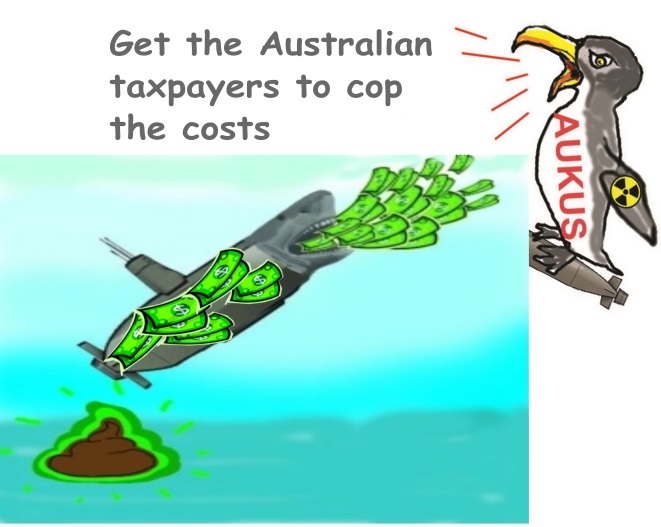
Five years into AUKUS, what do we have to show for it? We’ve measured progress on three key metrics
Thomas Corben and Esther Soulard, The Conversation, 15 Sept 26,
“. What Australia has spent so far.…………………………………………………………Australians are justified in wanting to know how much money their government has invested in AUKUS, and where it has gone.
When the Optimal Pathway was announced in 2023, the Albanese government costed it at 0.15% of GDP annually over the life of the program. This would amount to roughly A$268 billion to A$368 billion over three decades.
Since then, the A$368 billion figure has been widely cited by the media as the ultimate price tag.
Crucially, at the time, a third of this total – around A$122.9 billion – was set aside as contingency funding to absorb the delays and cost pressures that come with a 30-year program. In other words, it may not actually be spent.
Accurately tracking Australia’s overall spending to date is difficult. Since 2023, there has been a flurry of government statements announcing or promising funding to support various aspects of AUKUS over different time frames. These figures are scattered across portfolios, and are sometimes announced and then folded into the forward estimates of the federal budget. Some are projections, rather than down payments.
Both the Liberals and Greens have pressed the government to share updated costings for AUKUS. Budget papers do not offer an itemised account nor a consolidated overall figure for the program so far.
With no central database for AUKUS spending, we set out to build one.
We went through public announcements, portfolio budget statements, annual reports and strategy documents, and attempted to trace everything that’s been spent, announced, promised or projected.
What we’ve come up with hardly qualifies as a ledger. Still, it reveals three important things.
First, the bulk of the funding announced in Australia has gone to infrastructure, across three main sites:
- A$12 billion on the Henderson Defence Precinct, a shipbuilding and submarine maintenance hub on the west coast
- A$8 billion to expand HMAS Stirling so it can host US and UK submarines under SRF-West from 2027, and Australia’s own fleet of submarines from the early 2030s
- A$8.5 billion to the Osborne Nuclear-Powered Submarine Construction Yard, where Australia’s nuclear submarines will be built.
Second, Canberra is investing in the UK and US submarine industrial bases to support the delivery of the Virginia-class and future AUKUS-class submarines to Australia. This reflects the additional demand Australia’s submarines will put on production and maintenance capacity in both countries.
This has included US$2 billion (about A$2.8 billion) to the US in three instalments, with a further US$1 billion (A$1.4 billion) in instalments pledged over the next decade.
Canberra has also paid A$310 million to the UK for components needed to build nuclear submarines and has committed an additional £2.4 billion (about A$4.6 billion) over a decade to expand the UK’s submarine production capacity.
Third, AUKUS will consume a growing share of the Australian defence budget, even if the government follows through on its commitment to increase spending to 3% of GDP by 2033.
In 2023, the Parliamentary Budget Office projected annual AUKUS spending to be roughly A$2.2 billion per year over the program’s first four years, rising to more than A$8 billion annually for the next three decades. This means most of the spending is still to come.
There’s a long list of various capabilities required to meet Australia’s future defence requirements. If the Defence budget does not grow sufficiently and AUKUS eats into those programs, the overall investment in these capabilities could become lopsided.
2. A new submarine base in WA
Until the Virginia-class submarines arrive, we still need to make sure our near-term defence needs are being met. We also need to be ready for when our subs show up.
This is where Submarine Rotational Force-West comes in.
The first phase of the AUKUS program involves frequent visits by US and UK submarines to HMAS Stirling in Perth from next year. These subs won’t be formally based in Australia; they will rotate in and out.
But these aren’t mere pitstops. Australians are being trained in how to maintain the ships and handle their weapons. Some US submarines already have Australians serving onboard. These initiatives are helping to prepare Australia to maintain our own nuclear-powered submarines when they come online.
The US is also setting up local operations to provide services, logistics and operational support to these rotating submarines and their crews. This will be the only location outside US and UK territories in the Indo-Pacific where these subs can receive sophisticated maintenance support.
Crucially, these facilities will be beyond the range of most (though not all) of China’s growing missile capabilities…….
3. US submarine availability
Sceptics in both the US and Australia have expressed doubt about Washington’s willingness to sell at least three submarines to Australia beginning in the 2030s, given how much it relies on them and how long it takes to build them.
Indeed, the speed of US submarine production has been under particular scrutiny. The conventional wisdom is production needs to hit around 2.33 boats per year to meet both US and Australian requirements.
There are no consistent public records for the actual production rate, but the estimates are sobering.
New builds have averaged 1.1–1.3 submarines per year since the COVID pandemic, down from a high of 1.9 per year from 2016–19. US Navy leaders anticipate reaching two subs per year by 2032 – still short of the 2.33 goal.
Yet, production rates only tell part of the story. If Australia is supposed to receive in-service submarines from the US, understanding the state and size of the existing fleet is just as important.
In 2016, the US Navy declared it needed a force of 66 submarines to counter growing Chinese and Russian threats – up from a previous requirement of 48.
But since then, the US’ submarine fleet size has gradually declined, with older submarines retiring at a marginally higher rate than their modern replacements (the Virginia-class subs) have been introduced.
This reflects the difficulties Washington has had speeding up production, even with US$15 billion (about A$21 billion) in navy investments since 2018, contributions from the Australian government, and a growing number of Australian companies supporting US shipbuilding.
What’s more, since 2016, between 25–33% of the US submarine fleet has been undergoing maintenance, at significant financial and operational cost. For Australia, addressing that backlog will be as important as boosting US production rates.
Australia is already helping to ease these challenges with investments at Submarine Rotational Force-West and its own shipyards. If the AUKUS partners take full advantage of these developments, this could increase the number of boats available to the US Navy – and, by extension, to Australia.
So, while the US has a mountain to climb to boost sub production, that won’t be the only factor that determines the timeline for Australia’s AUKUS fleet………………………………………………………. https://theconversation.com/five-years-into-aukus-what-do-we-have-to-show-for-it-weve-measured-progress-on-three-key-metrics-289885?utm_campaign=the-daily-39531&utm_content=the-daily-39531_au%7C1%7C39531%7Cc3c55007&utm_medium=email&utm_source=braze&utm_term=whether+our+investments+to+date+are+worth+it
Wrong way. Australia’s expanding embrace of Israel
by Kellie Tranter | Sep 13, 2026, https://michaelwest.com.au/wrong-way-australias-expanding-embrace-of-israel/
Despite the ongoing illegal Israeli activities in Palestine, the Albanese government refuses to stop trading with a state credibly accused of genocide. Kellie Tranter of Declassified Australia.
The depth and breadth of Australia’s ongoing political and economic relationships with Israel and Israeli businesses can’t be viewed as anything but a deliberate and brazen disregard for our legal obligations under international law.
The Albanese government’s latest decision not to follow Britain’s lead and sanction products from occupied Palestine reveals an unwillingness to take any substantive steps to economically isolate the Jewish state.
In its Advisory Opinion of 19 July 2024, the International Court of Justice (ICJ) identified a range of obligations arising for states in dealings with Israel, including a duty of distinguishing between its own territory and the Occupied Palestinian Territory (OPT).
The ICJ said this included an obligation to abstain from entering into economic or trade dealings with Israel concerning the OPT (or any part of it) which may entrench its unlawful presence in the territory and to take steps to prevent trade or investment relations that assist in the maintenance of the illegal situation created by Israel in the OPT.
In his December 2024 legal opinion, Dr Ralph Wilde, Professor of International Law at University College London, confirmed that:
In his December 2024 legal opinion, Dr Ralph Wilde, Professor of International Law at University College London, confirmed that:
“The Israeli presence in the OPT is linked to the Israeli state, including its military, and the Israeli economy and society, including cultural, sporting and educational life, in a complex and multifaced manner so as to be factually and legally inextricable. In consequence, when it comes to the behaviour of third States, and the EU, and all other actors, in their relations with the Israeli state, including the Israeli military, the Israeli economy, and other Israeli actors, including Israeli companies, and universities, it is impossible, because of the way things operate, to meaningfully disaggregate relations that are, one way or another, connected to the Israeli presence in the OPT, and relations that are entirely free of such a connection…” [Emphasis added]
This is consistent with the original UK Foreign Office view that “it [is] impossible to distinguish between products emanating from illegal settlements and those from Israel. The UK officially regards all Israeli civilian settlements built on territories captured during the 1967 Six-Day War as illegal under international law.”
Never an objective player in Middle East politics, even the UK is prepared to respond to public pressure, and risk incurring Israeli Prime Minister Benjamin Netanyahu’s inevitable wrath, by banning at least the import of products from illegal West Bank settlements.
Given the incredible turnout for the Harbour Bridge protest in Sydney in support of Palestine on 3 August 2025, any similar proposal by the Australian government would probably enjoy even greater public support here.
Australia embraces trade with Israel
As a proponent of and claimed adherent to international law, the Australian government would or at least should be well aware of its obligations under the ICJ Opinion, which are separate from and quite independent of its duties in relation to the genocide in Gaza, yet it repeatedly has done nothing beyond imposing personal sanctions on a few lawless ‘settlers’.
At the same time, it has repeatedly breached its obligations by participating in or encouraging activities that flagrantly breach them.
Examples abound, but perhaps the most extraordinarily egregious is that on 25 March 2025 the trade and commercial arm of the Israeli Embassy in Australia, TradeIL Australia – headquartered in Sydney but without a published street address – was permitted to
“call for Australian investment in Israeli war bonds.“
In its media release, ‘Strengthening Ties: Investing in Israel’s Bonds from Australia,’ TradeIL states:
The phrase “war bonds” conjures images of national unity and financial mobilization, reminiscent of the UK’s efforts during World War II. These instruments served a dual purpose: fuelling the war effort and allowing citizens to actively participate in their nation’s defence. Today, Israel’s increased issuance of government bonds to fund its ongoing conflict draws a clear parallel, albeit with a crucial distinction.
Like their historical counterparts, these Israeli bonds are fundamentally designed to finance the escalating costs of conflict. This includes substantial military expenditures, critical infrastructure repairs, and the broader financial burdens of a nation at war. However, unlike the WW2 models, which primarily targeted domestic populations, Israel is actively marketing its bonds on a global scale, seeking investment from international markets.
Beyond the immediate context of conflict financing, Israeli government bonds present a compelling proposition for investors seeking diversification and stability. In a climate of economic uncertainty, these bonds offer a potential alternative to term deposits, promising attractive yields, capital preservation, and a hedge against market volatility. Their consistent income streams can surpass domestic cash rates, acting as a defensive bulwark during downturns.
For Jewish Australian investors, incorporating these bonds into a portfolio can enhance diversification. By spreading investments across different currencies and economic cycles, reliance on a single market is reduced, bolstering overall resilience. Israeli bonds, with their solid credit ratings (A, A, Baa1), exemplify this potential, offering exposure to global markets while mitigating localised risks.’ [Emphasis added]
The Australian government has taken an equally appalling approach to attempts by Israelis to sell ‘homes’ on unlawfully occupied Palestinian land as reported in the The West Report by doing nothing to outlaw the acts of local groups pursuing these acts.
Turning to more conventional financial dealings, in November 2025 the Australia Israel Exchange (AUXiL) – an initiative of a group called CBD Chabad Sydney (which functions as a registered charity) – officially launched as ‘an open-sourced, collaborative marketplace where Australians and Israelis can meaningfully engage across investment, entrepreneurship, defence innovation, and R&D. [AUXiL aims] to become one of Sydney’s leading gateways into Israeli innovation and commercial partnership.’
Uni protests prevail at UTS
At the AUXiL launch, former Israeli Trade Commissioner Ohad Blumberg’s is reported as ‘underscoring AUXiL’s strong collaborative partnerships with the Israel Trade Commission and Technion Australia…a leading public research university located in Haifa, Israel’.
It is worth remembering that in June 2025 the University of Technology Sydney (UTS) cut ties with Technion – the Israeli Institute of Technology – after almost a year of consistent pressure, campaigning, and coordinated actions by students and staff.
UTS campaigners argued that, ‘Technion has been a core part of Israel’s military and weapons development since 1948. It is deeply enmeshed with the Israeli arms industry, contributing to the ongoing genocide in Gaza through helping Israeli weapons companies such as Elbit and Rafael develop military technology. Technion helped develop the remote controlled D9 bulldozers used to demolish Palestinian homes in the occupied territories.’
Also presenting at AUXiL’s official launch was Jonathan Hulaty, Senior Director at Elbit Systems Australia, a leading Israeli arms manufacturer, who ‘offered an inside look at both national and global achievements of Elbit’s Australian operations, providing rare insight into the technological and defence capabilities that define Israel’s contribution to global innovation.’
In February 2026, Ohad Blumberg, the same former Israeli Trade Commissioner, was interviewed in a SBS Hebrew podcast in which he highlighted that he was an Israeli diplomat who formed part of Israel’s Ministry of Economy and Industry, which manages the country’s economic policy, trade relations, industry growth, and labour regulations.
He said: “We promote Israeli businesses, technologies and commercial partnerships in the geographies where we are positioned and what we do in the day to day is we are actually the face of Israeli industry in Australia or in New Zealand, in my case, and we are actively promoting the Israeli technologies, founders and companies in order to enter the Australian market, engage more with the Australian corporate world and to attract investments into the Israeli economy…
“So think of us as business development managers of the entire Israeli technology economic ecosystem. So what we do on a daily basis, we scout for opportunities for the Israeli companies – they are our, if you want to call it, our customers – and we provide them with business opportunities and we can do that in very different ways…”
Israeli company surge in Australia
In response to a specific question about attitudes towards Israeli trade post October 7, 2023, Blumberg expressed very little concern:
Obviously October 7 was a turning point in terms of Israel in general and in the Israeli economy more broadly and it did affect our activity because in any conflict it’s not good for business, however, I would have to say we were able to navigate and adjust our activity to make it more appropriate in how we do things for example because we couldn’t take a lot of delegations from Australia to Israel, we put a focus on bringing more delegations from Israel to Australia and we have managed to do a lot of things virtually or to substitute things that were supposed to be physical in Israel to virtual activity.
We saw a surge of Israeli companies coming to tour around Australia and we assisted them with business introductions and with their meetings here and around Australia…. Obviously there were very, very minimal resentment, and I have to say minimal resentment, but the vast majority of interactions and introductions that were made were very, very much welcomed.
Blumberg made special mention of Israeli companies that are market leaders operating in Australia such as Netafim, Monday.com and SodaStream but also referred to
“more than 400 Israeli companies every year that are active in the Australian market.”
Netafim was specifically criticised in the 2025 report ‘From economy of occupation to economy of genocide’ by UN Special Rapporteur, Francesca Albanese:
“Netafim, a global leader in drip irrigation technology, now 80 per cent owned by the Mexican company Orbia Advance Corporation, has designed its agritech in concert with the expansion imperatives of Israel. While maintaining a global image of sustainability, Netafim technology has enabled intensive exploitation of water and land in the West Bank, further depleting Palestinian natural resources, while being refined through collaboration with Israeli military-technology firms.
I”n the Jordan Valley, Netafim-aided irrigation systems have facilitated Israeli crop expansion, while Palestinian farmers – denied water and with 93 per cent unirrigated land – are pushed out, unable to compete with Israeli production. Furthermore, such irrigation techniques threaten to exhaust the Jordan River and Dead Sea.
“Companies such as Netafim continue to manufacture food security for Israelis, while the food system to which they belong causes food insecurity – and even famine – for others. Netafim brands itself as a sustainable innovator, while perfecting age old techniques of colonial exploitation.”
Corporate links to oppression of Palestinians
Monday.com has been named by the BDS movement and others as being indirectly linked to the OPTs because it pays taxes that fund the Israeli Army (IDF), ultimately contributing directly to the occupation of Palestinian territories and ongoing instances of violence, discrimination, and oppression of the Palestinian people .
As to SodaStream, in November 2025 the International Centre of Justice for Palestinians (ICJP) wrote to four major UK-based suppliers alerting them to potential legal and regulatory exposure arising from its continued sale of its products linked to illegal Israeli settlements in the occupied Palestinian territory, noting that:
“Until 2015, its principal manufacturing facility was located in Ma’ale Adumim, an illegal Israeli settlement in the occupied West Bank. Following sustained international criticism, the company relocated operations to the Negev (Naqab) region inside Israel. However, multiple independent reports indicate that the current facility is situated adjacent to, and benefits from, the displacement of unrecognised Bedouin communities, whose homes have been demolished to make way for industrial expansion, including SodaStream’s plant.
“Palestinian workers at SodaStream factories have also highlighted exploitative labour practices, lack of religious accommodations and discriminatory treatment. Workers have been fired when raising these concerns.”
Genocide is no barrier to investment in Israel
In a July 2026 interview just prior to the conclusion of his four-year term as Israel’s Trade Commissioner, the same Ohad Blumberg confirmed that ‘bilateral trade between Israel and Australia now sits at $US1.9 billion – an eight per cent increase on the previous year and higher than pre-war 2022 levels.
Of the current figure, he revealed that about 87 per cent of that trade flows from Israeli exports to Australia and of that, some $US1.2 billion worth is in services, mostly in high-tech … Australia now ranks as the sixth-leading destination globally for Israeli tech companies….more than 150 Israeli companies now have local operations in Australia, describing it as an all-time peak, alongside the trade figure total itself.
Cyber security remains “by far” the largest area of activity and deal flows, followed by agTech, healthcare services and medTech…’ [Emphasis added]
He identified those as the next frontier in the trade relationship’s potential, while noting that Israel and Australia are both founding members of the Pax Silica treaty, aimed at streamlining the AI value chain, from critical minerals to data centres.
Pax Silica Declaration is a United States-led international partnership launched on December 12, 2025, to secure supply chains for artificial intelligence (AI), semiconductors, and critical minerals among allied nations.
The initiative was originally signed in Washington, D.C. by representatives from the United States, Australia, the United Kingdom, Japan, South Korea, Singapore, and Israel. It is an agreement [emphasis added] ‘to partner on building secure, prosperous and innovative global technology supply chains. Secure supply chains are critical to ensuring technological progress and economic security in Australia’s interests.’
The Australian government continues to grapple with the AI era, and putting aside questions of some partners’ trustworthiness, partnering with Israel at all on artificial intelligence (AI) and surveillance technologies creates severe legal and ethical risks under international law due to their widely reported deployment in military targeting and mass surveillance across the occupied Palestinian territories.
Little has changed since 7 October 2023 in reducing the business interest between Israel and Australia. For example, it’s currently being advertised that The Jerusalem Post Group’s Asia-Pacific Summit is set to take place in Sydney later in the year, to ‘convene senior business leaders, investors, entrepreneurs, policymakers, philanthropists, community leaders, and innovators from Australia, Israel, and the broader Asia-Pacific region for a high-level gathering focused on strengthening economic, strategic, and communal ties between Australia and Israel.’
The listed speakers include Lt Col (res) Jonathan Conricus, former IDF International Spokesperson, Ayelat Shaked, Israel’s former Minister of Justice (who was denied a visa by the Australian government in 2024), Jacob Nagel, former Israeli acting National Security Adviser, Admiral Michael S Rogers, Former Director of the US National Security Agency (NSA), Commander of US Cyber Command and Chief of the Central Security (and now a partner in Israeli venture capital group Team8 and advisory committee chairman for cyber unicorn Claroty).
It is astounding that all of this can be occurring on Australian soil when one considers Australia’s obligations under international law.
Global government responses
“Spain has taken a more principled stance.“
In September 2025, it enacted bans on imports of all products from illegal Israeli settlements in the Palestinian territories, along with bans on defence materials and technologies.
In May, the Council of Ministers in the Netherlands agreed to ban the trade in goods from illegal Israeli settlements and is investigating whether a ban on services and investments is also possible.
In June, Norway put forward a proposal for a bill banning trade with Israeli settlements in Palestine which is now being circulated for general consultation.
In July, France warned companies that doing business in illegal Israeli settlements in the Occupied Palestinian Territory could expose them to being found responsible for violations of international law.
Also in July, Ireland – another European Union country – passed legislation banning the import of goods from illegal Israeli settlements in the occupied West Bank and East Jerusalem, following the 2024 International Court of Justice (ICJ) advisory opinion declaring Israeli settlements illegal under international law
The UK government has this week unveiled a ban on the trade of goods and some services from Israeli settlements in the West Bank after promising to take a tougher stance in support of Gaza. The decision also comes in response to plans in the occupied West Bank, in which Israel issued tenders for 1,200 homes as part of the E1 settlement project.
Is Australia doing anything?
Instead of legislating like Ireland or Spain, or even issuing guidelines like the UK or France, the Australian government is not openly doing anything to comply with its obligations under international law. In fact, as the representative illustrations above show, it is actively encouraging or tacitly facilitating behaviour that contravenes it.
The Treasury Laws Amendment (Divesting from Illegal Israeli Settlements) Bill 2024 was introduced by Senator Lidia Thorpe (co-introduced with Senator Fatima Payman) in the Australian Senate on 28 November 2024 for the purpose of amending the Future Fund Act 2006 and other legislation to stop financial investments by Australia’s sovereign wealth fund and registered charities in companies operating within illegal Israeli settlements.
“The bill failed to proceed due to a lack of support from the major political parties.“
Declassified Australia wrote to the Department of Foreign Affairs and Trade asking it to confirm whether DFAT has issued any notices, advice or guidelines to Australian businesses following the findings of the International Court of Justice in 2024 about the illegal occupation of Palestinian land. If so, what was the advice or guidelines and when was it issued?
DFAT did not respond to our questions.
Social cohesion, far-right astroturfers and the Royal Commission

Right-wing astroturfers were given a platform at the Bondi Royal Commission, their history concealed and their testimony uncontested. Wendy Bacon reveals what the Commissioners ignored.
by Wendy Bacon | Sep 16, 2026 , https://michaelwest.com.au/social-cohesion-far-right-astroturfers-and-the-royal-commission/
The last hearing block of the Royal Commission focused on social cohesion, defined as the “national consensus in support of democracy, freedom, and the rule of law”.
Counsel assisting Zelie Heger SC explained that the block would present “measures currently contributing to strengthening social cohesion” and “advancing the interests of all Australians” by promoting “respectful discussion of difficult issues”.
Amongst those chosen by Counsel Assisting were Roz Mendelle and Simonne Whine, co-directors of the Australian Cohesion Forum
The Australian Cohesion Forum
ACF is a national not-for-profit connecting communities across Australia. It claims to be apolitical,
“… we don’t advocate for parties, candidates, or geopolitical positions, and we don’t promote stances on international conflicts. However, we recognise that politics is often central to lived experience. Our focus is on how global events affect Australians here, and our programs create structured, safe spaces to discuss difficult topics with openness, respect, and healthy boundaries.”
In explaining how ACF came into being, Mendelle and Whine told the Commission that in the wake of Hamas’s attack on Israel on October 7 2023, they had separately organised to support the Jewish community.
Marketing manager and Israeli citizen Roz Mendelle explained how she moved to Brisbane with her Australian wife Hava, who had ‘made Aliyah’ to Israel.
After October 7, Mendelle felt a
“wall of hate” from protests against Israel.“
She started organising pro-Israel events which were supported by Iranians and Hindus who supported Israel. She realised “this is the trick … these are the people that I need to expand relationships with.”
Meanwhile, Whine had founded a grassroots network in Melbourne called J-United to support the Jewish community.
Whine told the Commission that she kept hearing about Mendelle’s work, telling the Commission, “We want to fill a gap. And so we came up with the Australian Cohesion Forum.”
The ACF organises ‘Impact nets’, ‘coLabs’ and virtual storytelling through which they collect data from attendees to analyse how they can partner together in a “fully collaborative, agile” way.
“As long as “none of us endorses violence against another community, and we don’t wish the elimination of another community, we can work together, we can create beautiful things together,” Mendelle told the Commission.
None of the lawyers present or the Commissioner had any questions, and so Mendelle and Whine were excused.
Astroturfing campaignsThere is an easily identifiable gap in Mendelle and Whine’s evidence about how they came to work together, which in turn raises questions about how they were selected as witnesses who are said to be “advancing the interests of all Australians” by promoting “respectful discussion of difficult issues”.
Mendelle and Whine collaborated in well-funded political astroturfing campaigns in 2024 and 2025 aimed at defeating Greens and Teals. (Astroturfing is the practice of making a top-down political campaign look like a spontaneous grassroots movement.)
Deep Cut News, The Guardian and Australian Jewish News also reported on these campaigns.In March 2025, Whine and Mendelle appeared in a webinar staged by the far-right Australian Jewish Association, then led by David Adler, who was a founder of Advance Australia. Advance campaigned strongly against the 2023 Voice Referendum in terms that many saw as racist.
On this occasion, Mendelle and Whine gave a different version of how they came to work together.
Earlier still, in 2024 Mendelle and her wife Hava began the third party campaigning organisation the Queensland Jewish Collective (QJC). Their strategy was to defeat the Greens by recommending voters put them last on the ballot papers.
Asked how she developed her messaging, Mendelle explained that she chose
“what was screaming in her head”,
which was that the Greens support terror groups and are anti-semitic.”
It was that simple. Australia has no truth in political advertising laws, so it didn’t matter that the Greens completely rejected the allegations.QJC claimed credit for defeating Queensland Greens MP Amy McMahon in October 2024. They then set their sights on the Federal election and established a new third-party organisation called Minority Impact Coalition (MIC) to campaign in Queensland, NSW and Victoria. MIC describes itself as “minority and refugee lead grassroots advocacy“.
MIC and ACF operate from the same address in Apsley, Queensland. Roz Mendelle was an MIC director until January 2026.
J-United director Sharon Kuper later told the pro-Israel L’Chaim radio program that QJC were happy for J-United to replicate their messaging campaign that the Greens were “misinformed, dishonest, fostering hatred and harming social cohesion” and “disregard for human life.”Enter Advance Australia
When J-United needed funds to emulate the QJC campaign in the 2025 Victorian Prahran by-election, they reached out to Advance Australia. Kuper told the L’Chaim radio program that the Advance organisers said, “We’re happy to support you. What do you need? How about if we just support your whole campaign?”
Kuper described this as a “huge boost that they paid for our entire campaign… it took away the security concerns we had, with them endorsing and authorising our campaign.”
Advance went on to work with MIC and J-United on the Federal election under the brand name Put the Greens Last.
In the AJA webinar, Whine confirmed Kuper’s account of Advance providing assistance to J-United, describing it as a “fantastic, efficient, strategic and resource” which was “totally transparent. Very helpful…I think we’ve now built a really good relationship.”
The QJC’s Queensland campaign cost $30,000. Mendelle realised that they needed more funds for the Minority Impact Coalition’s Federal campaign from “people with slightly bigger means”. MIC sought help from Advance, who she found to be “absolutely honest, transparent, direct, and easy to deal with.”
ZIonist astroturfing organisations were not the only Zionists to embrace Advance. Jillian Segal’s husband John Roth donated $50,000 to Advance through a family foundation.
Any hint of this intense political campaigning was missing in Mendelle and Whine’s Royal Commission version of how they came to join forces in ACF.
Women’s International Zionist Organisation
In June, ACF featured in a plenary at the Women’s International Zionist Organisation (WIZO) Australia conference on the Gold Coast. WIZO works in partnership with the Israeli government to strengthen the resilience of Israeli society and raises funds for Israel.
The panel discussion “Cohesion in Action: Strength and Friendship featured Jewish, Iranian, Druze and Torres Strait Islander Australians”, Led by Roz Mendelle, the five speakers each expressed support for Israel.
Minority Impact Coalition
In introducing the Social Cohesion hearings at the RC, Senior Counsel Assisting Richard Lancaster SC explained that staff had already reviewed all submissions and that these informed the choice of witnesses. We can assume then that Counsel were aware of MIC’s 122-page submission.
The key contact for the MIC submission is Roz’s wife, Hava Mendelle, and the submission team includes Roz Mendelle, fellow ACF director Iranian Azin Naghibi, messianic Christian Zionist preacher and lawyer Warren Keir and extreme pro-Israel supporter Joshu Turier.
MIC’s recommendations to the Royal Commission are hard-line, in some cases going beyond Special Envoy Jillian Segal’s recommendations.
Far from showing respect for other Australians, MIC wants Australians who do not support Israel to be penalised and shut down.
According to MIC, accusing Israel of genocide is a “blood libel” sustained through “fabricated casualty figures and weaponised by elected officials, protest organisers and venue operators” to justify the exclusion of Jewish Australians.
“Anti-Zionism is antisemitism“
According to MIC, those who amplify anti-zionist narratives should face enforceable consequences including loss of funding. Institutional silence in the face of documented antisemitic conduct should be considered a failure of duty of care.
Elected officials who promote statements that do not meet the IHRA definition or who operate official Parliamentary events featuring such content are in breach of their duties and should be accountable.
The ABC and the Federal Court should both be investigated for antisemitism for accepting the existence of a ‘lobby’ that pushes pro-Israeli perspectives.
Duties of Counsel Assisting
Counsel assisting Royal Commissions play a key role in developing investigation strategies and ensuring evidence is presented impartially and in a way that does not obscure the truth.
Mendelle and Whine were introduced by Counsel Assisting Tamara Phillips whose manner throughout the Royal Commission has been empathetic.
In December 2023, Phillips was one of more than 450 lawyers who signed a letter which defended Israel and its military tactics against criticism by 1400 lawyers who had signed a letter calling for a ceasefire.
Mark Liebler of law firm Arnold Block Liebler, which represents Federal and State Zionist organisations at the Royal Commission, was a top signatory to the pro-Israeli letter.
All the material in this piece is on the public record. MWM alerted the Royal Commission to published material about their astroturfing activities shortly before Mendelle and Whine gave evidence.
Has the evidence changed?
MWM has been asking for the exhibit of Roz Mendelle for three weeks, and has been told that there are delays “to ensure accuracy is maintained, and legal sensitivities are addressed.” We have responded and asked
how an exhibit once tendered could be changed?
Commission lawyers are now summarising evidence and developing final arguments. The Commissioner alone will then make findings. Meanwhile, the Commission staff continues to hold meetings with selected individuals where no details are published.
In the name of ‘procedural fairness’, those who were called as witnesses will be given a chance to respond to final submissions of Counsel Assisting.
Not so the groups and unnamed but identifiable individuals in the pro-Palestinian movement whom witnesses have accused of antisemitism, including those who wanted to give evidence but were not invited.
For them, there is no right of reply.
Editor: this is Part One in Wendy Bacon’s series on the Royal Commission. In Part Two Advance Australia denies support for astroturfers. Where do they get their money?
Data centres have existed for decades. So why are they so controversial now?

The Conversation, September 14, 2026, Johanna Lim, Research Associate, Strategic Technologies, University of Sydney
Until recently, data centres attracted relatively little public attention. They were largely treated as invisible pieces of digital infrastructure: essential but rarely discussed outside technical and industry circles.
But over the past 12 months across Australia, data centres have become the subject of intense political debate, community opposition, planning disputes and parliamentary inquiries.
Questions are being raised about how much electricity and water they use, where they should be built, who should pay for the infrastructure needed to support them, and whether Australia benefits from their continued expansion.
These questions are feeding into government policy. Following Prime Minister Anthony Albanese’s speech at the University of Sydney in July, a National Cabinet meeting in August reaffirmed plans to legislate nationally consistent mandatory standards for large data centres by early next year. These will include requirements around their energy, water and land use.
So how did a piece of digital infrastructure that once attracted relatively little public attention become such a prominent policy issue? Data centres themselves are not new. What has changed is their scale, purpose and the resources required to support their growth………………………………………………………………………………………………………………………………………………………………………..
Australia currently has over 160 operational data centres, with most located in New South Wales and Victoria. There are at least another 90 facilities in the development pipeline.
The data centres now being proposed are also considerably larger than many existing data centres.
Data centres in Australia
A non-exhaustive list of 283 data centres in Australia. Many do not publicly declare their power capacity nor their intended use – not all data centres are used for AI. [MAP HERE on original]……………………….
Data centres in Melbourne
There are at least 58 data centres online or in development in the Melbourne area. Points sized by capacity, the largest being the proposed 2.4GW Plumpton Data Centre. [MAP HERE on original]………………..
Data centres in Sydney
There are at least 82 data centres online or in development in the Sydney area. Points sized by capacity, the largest being the 1.2GW Kemps Creek data centre. [MAP HERE on original]…….. For example, the proposed 1.2 gigawatt Mamre Road Data Centre in Sydney would cover an area equivalent to the size of 52 rugby fields.
If built to its maximum capacity, it would become Australia’s largest single electricity user.
Why AI is driving bigger data centres
Hyperscale data centres typically contain at least 5,000 servers, occupy at least 10,000 square feet of physical space, and can draw over 100 megawatts of power. That’s enough to meet the annual electricity needs of more than 50,000 households.
In 2025, hyperscale operators accounted for 48% of global data centre capacity.
Cloud computing and the growth of everyday digital activity initially drove the expansion of these large, centralised facilities. But since OpenAI launched ChatGPT in late 2022, AI has rapidly accelerated this growth.
AI workloads are far more computationally intensive than traditional digital services. They are expected to account for approximately 70% of data centre demand by 2030.
Training advanced AI models requires dense arrangements of specialised chips working simultaneously to process large volumes of data. This can run continuously for weeks or months.
Once trained, AI models also require computing power to respond to users. This process is known as inference. While a single interaction requires considerably less computing power than training a model, that demand adds up across millions of users………………………………….
What comes next for Australia?
The growth of Australia’s data centre market is unlikely to slow anytime soon.
Australia remains a competitive destination for data centre investment, with strong government support, continued interest from major technology companies and an estimated A$150 billion in data centre buildouts by 2030.
But community opposition is emerging as a significant risk for new developments. This opposition is, in part, because of the land, power and water data centres consume.
But it’s also because there is uncertainty over whether the significant investment in AI infrastructure will truly generate sufficient economic returns – and who will benefit from those returns.
The future growth of Australia’s data centre sector may therefore depend less on whether there is demand or capital to build them, and more on where they can be built, who bears the costs, and whether communities benefit from hosting them. https://theconversation.com/data-centres-have-existed-for-decades-so-why-are-they-so-controversial-now-290253?utm_campaign=the-daily-39522&utm_content=the-daily-39522_au%7C1%7C39522%7C1888424b&utm_medium=email&utm_source=braze&utm_term=explaining+why+we%E2%80%99re+all+talking+about+data+centres+now%2C+and+what+they%E2%80%99re+actually+for
AUKUS — controversial, secretive but given a bipartisan blank cheque
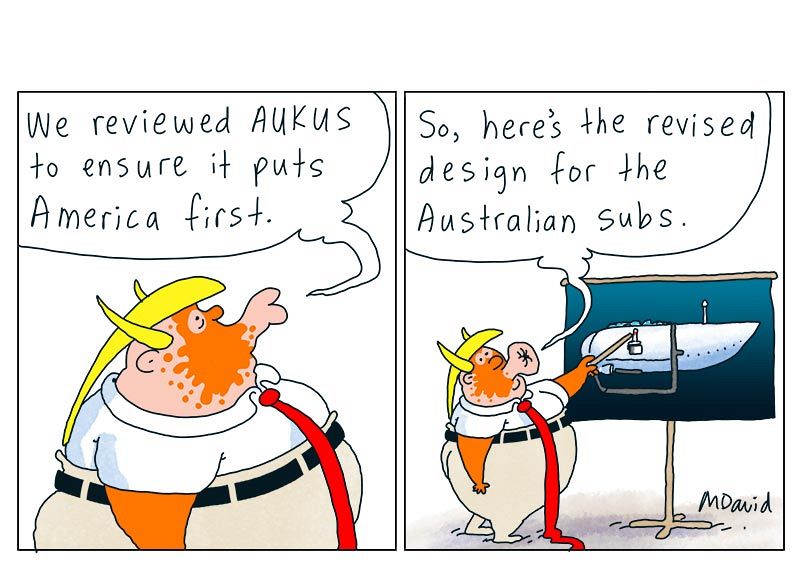
By Dave Sweeney | 12 September 2026, https://independentaustralia.net/politics/politics-display/aukus–controversial-secretive-but-given-a-bipartisan-blank-cheque,21546
This week marks the fifth anniversary of the AUKUS announcement, a $368 billion defence project shrouded in secrecy with major party bipartisan support that fundamentally changed the Australian political landscape, writes Dave Sweeney.
FIVE YEARS AGO THIS WEEK, the Australian political landscape fundamentally changed when then Prime Minister Scott Morrison announced on September 15 2021, that our nation would join a defence pact with the U.S. and the UK based around the acquisition of nuclear submarines.
The decision was made without scrutiny, consultation, evidence or any Parliamentary process or review.
It was an idea conceived in secrecy and delivered in a highly politicised context, with then Labor Opposition leader Anthony Albanese given negligible time or information before positioning to avoid being wedged and portrayed as “soft” on national security ahead of the looming federal election.
Without clear detail, analysis, or consultation, the Labor leadership signed off on the deeply flawed plan, and since then a short-term political tactic has set the path for a long-term national error.
The years since have seen federal Labor inexplicably defend and extend AUKUS despite growing concerns and multiple opportunities to take an exit ramp.
State premiers in the frontline states of SA and WA have become project promoters, with talk of Class A predators and triple AAA economic ratings, while many trade unions have been seduced or enmeshed with the promise of union jobs.
The Australian Federal Police (AFP) have been granted special powers and the Canberra song sheet is tightly scripted and enjoys bipartisan major party support
The intervening years since have also seen profound political changes here and with our AUKUS partners. The U.S. in particular has become increasingly unreliable and petulant.
The U.S. has also become increasingly enmeshed in Australian military positioning, with a recent Guardian report highlighting unfettered access to over 50 per cent of Australia’s military bases.
Of particular concern to many is the fact that Australia currently accepts America’s policy of nuclear ambiguity or “don’t ask, don’t tell” in relation to the presence of nuclear weapons.
The American B-52 bombers now based at RAAF Tindal near Katherine in the Northern Territory and Virginia-class submarines set to become a regular presence at HMAS Stirling near Fremantle have the potential to carry nuclear weapons.
There is currently no policy or legal protection for Australia against our nuclear-armed AUKUS partners bringing nuclear arms to our skies or seas.
Federal Labor has a national platform commitment to sign the UN Treaty on the Prohibition of Nuclear Weapons and this is urgently needed to provide clear guardrails and a red line against our nation drifting towards being either a nuclear weapons enabler or target.
To date, Federal Labor has proven far more adept at managing AUKUS perceptions and protest than in managing the AUKUS program.
There are growing concerns over whether submarines will ever arrive and over the capacity of U.S. and UK shipbuilding yards. These are amplified by wider concerns including spiralling costs and the government’s continued refusal to detail either plans or processes around weapons-grade radioactive waste management.
And it’s not just the usual suspects — many military hawks are questioning the literal bang for the buck or surge in autonomous weapons while fiscal conservatives are aghast at the lack of scrutiny, constraint and the poor track record of Defence in delivering major projects.
Ahead of the July ALP national conference in Adelaide, which was masterfully curated to hide AUKUS concerns, the internal advocacy group Labor against War was joined by over one hundred Labor branches in a call to scrap AUKUS.
In the absence of a Parliamentary inquiry into the plan, a citizen-crowdfunded public inquiry headed by former Labor minister and Midnight Oil frontman Peter Garrett has toured the country, taking hundreds of submissions and detailed evidence and is due to make recommendations and findings later this year.
Pacific Civil Society Groups have joined their Australian partners and allies, with over 170 formally endorsing a new civil society Declaration against nuclear weapons in Australia.
At the moment, these concerns are a slow burn compared to the fast rate of AUKUS, but the planning problems are growing and there is only so far that political spin can cover deep structural flaws.
Against a backdrop of cost-of-living pressure and escalating global tensions, more Australians are asking why this controversial and secretive process is being given a blank public-dollars cheque.
The concerns and questions are likely to grow — and as Australians know, a change in the wind can see a slow burn quickly turn into a firestorm.
Yesterday in Melbourne, a packed house gathered at the MCG to watch two American NFL clubs, but there was no such media attention or scrutiny of the wider American game.
Not all touchdowns are cause for celebration and when it comes to nuclear weapons, Australians have both the right to know and to say no.
First nuclear-capable B-52s deploy to Australia

By Bill Gertz – The Washington Times – Thursday, September 10, 2026
A task force of nuclear-capable B-52 bombers has deployed for the first time to Australia in a show of regional force located to the south of China.
The bombers arrived last week at an upgraded Royal Australian Air Force Base Tindal. Local reports called it a new era in Australia’s military alliance with the U.S.
A Pacific Air Forces spokesman confirmed to Inside the Ring that the bomber task force is underway Down Under………….
The exact number of the strategic bombers from the 2nd Bomber Wing at Barksdale Air Force Base, Louisiana, was not disclosed. Most task forces include up to six B-52s.
An Air Force photo of the deployment stated in a caption that the bombers arrived Sept. 1. “Operating from RAAF Base Tindal marks our ability to project, sustain, and regenerate decisive airpower across an expanding extended network,” the caption stated.
The long-range bombers can deliver nuclear bombs or conventional precision-guided weapons.
The Tindal base has been upgraded with new hangars and ramps for the bombers. It is located in northern Australia about 200 miles south of the northernmost coastal city of Darwin and about 2,000 miles from the tense South China Sea.
The base also hosts Australian F-35 stealth jets and MQ-4C Triton surveillance drones.
Currently, U.S. Marines are based in Darwin and a submarine rotational force was set up near Perth, with about 1,000 Navy personnel set to deploy in support of Virginia-class submarine deployment. https://www.washingtontimes.com/news/2026/sep/10/first-nuclear-capable-b-52s-deploy-australia/
US turning Australia into military base

“Over more than a decade, the United States has been preparing the capacity for high-tempo warfighting operations with China, springboarding from Australia. From a Chinese perspective, Australia is not so much hosting US bases on its territory, it’s a US base in its own right… Australia is a serious piece of real estate in the US warfighting machine.”
Wed, 09 Sep 2026 , https://www.sott.net/article/508329-US-turning-Australia-into-military-base-Guardian
USA • Australia military eventThe US is turning Australia into a forward base for potential military operations in the Pacific, with American forces and defense contractors controlling or having access to roughly two-thirds of the country’s military facilities,The Guardian reported on Sunday.
Citing data compiled by the Nautilus Institute for Security and Sustainability, the newspaper identified 110 facilities across Australia with some form of US military or corporate presence out of 168 surveyed.
The US military directly controls 17 facilities, including the Pine Gap intelligence complex in central Australia, which plays a major role in US surveillance and military operations. The facility tracks missile launches, intercepts communications and provides targeting information for American forces around the world.
Other installations include a naval communications station in Western Australia used to communicate with submerged US submarines and RAAF Base Tindal in the north, which is being expanded to accommodate nuclear-capableB-52 Stratofortress bombers.
The Guardian wrote:
“These aircraft are able to land on Australian soil carrying nuclear weapons. The US government won’t tell Australia if and when they are. The Australian government won’t ask.”
Beyond the facilities it directly controls, the US military has access to dozens of Australian installations, while American defense contractors, including Lockheed Martin and Northrop Grumman, operate at others. According to the Nautilus data, 41 of the 168 facilities surveyed have no significant US presence, while the status of another 17 remains unresolved.
The American footprint is also expanding. In June, AFP reported that the US was preparing to establish a permanent stockpile of battle-ready weapons, ammunition, and equipment for the Marine Corps in Australia, with the facility expected to reach full capacity by 2028.
An honorary professorial fellow at the University of Melbourne, Richard Tanter, the author of the Nautilus database, told The Guardian:
“Over more than a decade, the United States has been preparing the capacity for high-tempo warfighting operations with China, springboarding from Australia. From a Chinese perspective, Australia is not so much hosting US bases on its territory, it’s a US base in its own right… Australia is a serious piece of real estate in the US warfighting machine.”
Canberra maintains that the growing American presence strengthens Australia’s security.Defense Minister Richard Marles said in June that the expanding US footprint was important both for building the country’s military capabilities and for its national security.
Marles also argued that the US presence helped counter what he described as China’s “very significant military buildup” in the region.
Former Australian Defense Minister Christopher Pyne has similarly said the 2021 AUKUS pact between Australia, the US, and UK goes beyond Canberra’s acquisition of nuclear-powered submarines. He described the arrangement as establishing “a new United States submarine base in the Indian Ocean” that would provide Washington with a “massive strategic advantage.”
Tanter criticized Canberra’s approach, calling it:
“A massive institutional failure in Australia, a kind of learned incapacity at a political, parliamentary and bureaucratic level.”
Comment: Tanter is right: Trust and comfort never convey the total picture, nor be they the appropriate guardians of sovereign control.
Skidding Pacts: An AUKUS Delusion Update
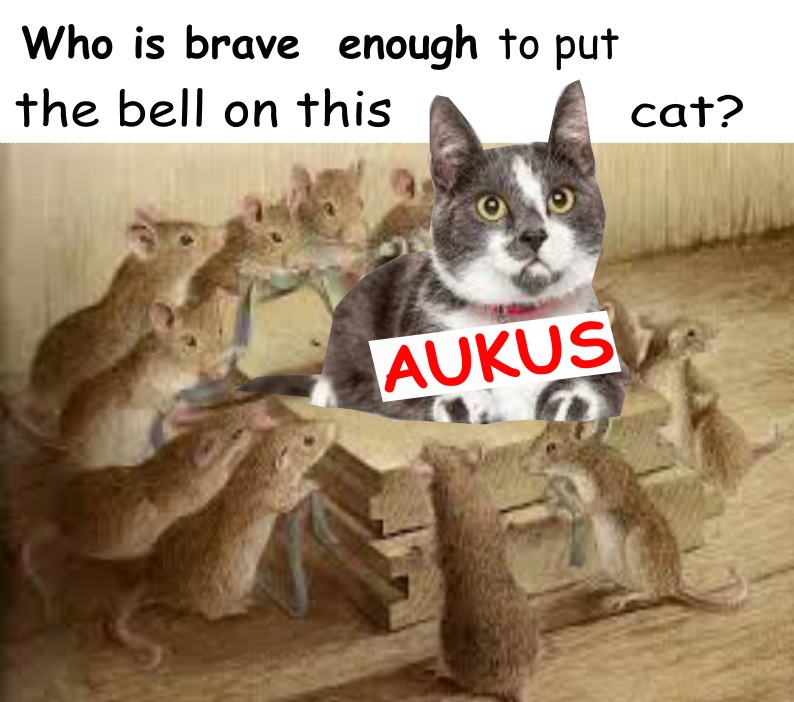
9 September 2026 Dr Binoy Kampmark, https://theaimn.net/skidding-pacts-an-aukus-delusion-update/
In the unpardonable ecosystem of graft, favours and corruption that is defence contracting, defence conferencing and all matters tanking over the thinking – in short, the world of defence – the convenient delusion will always have truck over the inconvenient empirical. Phantoms are elevated and celebrated; bogeymen are treasured by the entire security apparatus that links obeisant academics, overpaid consultants and waxwork politicians. Budgets of criminally unaccountable proportions are approved, not least because the fictional threat is so impressive as to scare the living daylights out of an imbecilic political class.
Even as the Australian public inquiry into the tripartite security pact with the United States and the United Kingdom known as AUKUS rumbles along, the devotees of delusion continue to be busy in Canberra and beyond. For them, defence is not a reality so much as a style: the need to be seen on the circuit, the necessity of keeping the wheels of alliances greased. The Australian establishment hankers to be clubbable, and that club is known as the Anglosphere. On September 2, Michael Pezzullo, a figure disgraced by his conduct when Secretary of the Home Affairs Department, took the stage as sage and pontificator before that very same inquiry. In addressing its members, he was convinced about the Chinese threat. “It’s an aggressive and assertive combination of Marxist-Leninist politics, Chinese nationalism, and aggressive positioning in Asia, that is as terrifying to Japan and the Philippines and other countries in Asia as it should be to us.”
The following comments, published in the Australian Strategic Policy Institute’s outlet The Strategist, are even less guarded and worthy of mention. While the publication claims them to be an edited version of Pezzullo’s address, those edits were made with some muscle. In essence, “Australia would favour fighting an offensive campaign, without having to call on the combat forces of the United States or anyone else.” Expressed like a true hardboiled warmonger. Given its limitations, Pezzullo suggests that Australia would find itself going on the defensive “until allied help arrived, until the United States prevailed to the point where it could dictate terms or until conflict was contained in an uneasy truce that arrested a slide into the nuclear abyss of planetary destruction.”
After this febrile nonsense, the sort that makes Tom Clancy’s unspeakable prose passable, Pezzullo hits his stride. Previous submarine plans were not pursued. He has pleasant words for the Rudd government’s 2009 submarine plan that never eventuated, largely because this mirror-gazing bureaucrat was, at the time, deputy secretary of defence. But never mind. “The AUKUS program puts us back on track.” As with so much writing on defence strategy, the language resembles that of a narcotics addict awaiting that cathartic hit: the gift is just around the corner, even if that corner is excruciating in distance. “Acquiring submarines of the US Virginia class and then the Anglo-Australian SSN-AUKUS class – or if the latter fails, joining the USN SSN-X program – will give us a pathway to undersea warfare dominance.” This is playground posturing at its worst.
The logistics of acquiring these needless hulks is not explained, because their relevance is assumed. Pezzullo is a self-styled Ur-warrior, drinking from ancient wells of numbing power. “More crucially, by integrating our submarine industrial and technology base with those of the United States and Britain, we will forge an exclusive club of undersea dominance.” It would be far more accurate to recast dominance as subservience, with the Australian taxpayer providing enormous sums to the submarine industrial bases of both the US and the UK without any enforceable undertaking of returns.
It is worth noting that Pezzullo’s appearances in the media as a specialist – a term so stretched as to have lost meaning – are never qualified by the spoiling conduct that demonstrated his inadequacy as a fair-minded public servant giving advice on the issues of the day. It would be good for audiences to know that one of Australia’s formerly most powerful bureaucrats was a meddlesome sot crazed by visions of war and a shaky grasp of history, not least the US-Australian relationship. He was sacked in November 2023 after revelations that he had used WhatsApp to communicate at length with former New South Wales Liberal Party deputy director Scott Briggs, offering gobbets of advice on party room politics. Frank views about various cabinet ministers were also offered, hardly in keeping with the best traditions of a supposedly uncorrupted public service. An inquiry into Pezzullo’s conduct, a redacted version of which was obtained under Freedom of Information in April, identified 14 breaches of the government code of conduct. Instead, we find his biography on the United States Studies Centre website making no mention of his reputational soiling. “He is now retired, after almost 37 years of service, principally in the areas of defence, national security, immigration, and border protection.”
While Pezzullo was making his interventions in the AUKUS debate, the toadying Defence Minister Richard Marles, whose significance in the AUKUS relationship never rises above that of implausible water carrier, made a journey to the United Kingdom to catch up with the unnervingly chilly Wes Streeting. While Australia’s politicians delude themselves about American submarines they will never receive in the form of their choosing, if at all, the UK side of the bargain, which envisages the construction of the SSN-AUKUS, is even more dubious. In terms of boat production, the British submarine base has proven even tardier than their US counterparts. Sharp reservations have also been expressed about the nuclear reactor core project of the SSN-AUKUS, notably by the Infrastructure and Projects Authority (IPA), incarnated as the National Infrastructure and Service Transformation Authority (NISTA). IPA’s report released at the start of 2025 is grave on the subject: “Successful delivery of the project appears to be unachievable.” It identified“major issues with project definition, schedule, budget, quality and/or benefits delivery, which at this stage do not appear to be manageable or resolvable. The project may need re-scoping and/or its overall viability assessed.”
The British proved keen to assure the press – and a credulous Marles – that AUKUS had continued standing and vitality. “AUKUS,” according to Streeting, “says to our adversaries that if you attack one of us, you are challenging a coalition that is willing to stand together to defend the values we cherish and to fight alongside one another.” With little by way of justification, Streeting went so far as to suggest that AUKUS was “global” in nature, able to deliver submarines “which can be deployed everywhere from the Euro-Atlantic to the Mediterranean to the Indo-Pacific.” (Australian personnel, take note.) The US ambassador to the UK, Warren Stephens, was also keen to chant the mantra. “We should be under no illusion,” he stated, “that there are many who do not want this partnership to succeed. It’s not a secret.”
What is also not a secret is that the pact is skidding. The defence establishment operates a permanent, around the clock rinsing facility for the sketchy and mediocre, fostering a tribalism by seeking enemies that, at best, resemble fantasy woodland creatures. On this occasion, the fictional enemy is set to be confronted by fictional nuclear-powered submarines – at enormous cost. Australia, in its remarkable fortune of location and creation, has every reason to be the congenial middleman of international relations, the sage of diplomatic partiality and cool arbitration. Instead, it has opted for the role of Freudian paralytic and emotional cripple, drunk on the terror of abandonment and keen, therefore, to be client, vassal and a sort of wretched facsimile of Jeeves. If only its representatives were as capable.
1 This month
17 October, Free Public Talk on Nuclear Issues in South Australia
David Noonan will speak on public interest concerns over the new Roxby Downs Indenture Act 2026 on BHP copper-uranium mining and ore processing in SA, and on how AUKUS may face SA with a High-Level nuclear waste agenda.
Dr Jim Green will discuss international developments in the field of nuclear power including ‘small modular reactors’ and Generation 4 ‘advanced’ nuclear reactor concepts.


Help Aunty Sue Protect Her Land and Sacred Sites From Destructive Rocket Testing.
.

Australians deserve the truth
about
AUKUS – https://aukuspublicinquiry.com/

PETITION – To: Prime Minister Anthony Albanese and the Australian Labor Government

of the week – Australians for War Powers Reform (AWPR)
To see nuclear-related stories in greater depth and intensity

