Kimba mayor Dean Johnson shows his ignorance on nuclear wastes
 Kazzi Jai Fight to Stop ma Nuclear Waste Dump in South Australia
The Federal Government had NOTHING to do with either of them!
And….BOTH produce waste ON SITE – which is NOT SENT SUBSEQUENTLY INTERSTATE!
We take care of our own waste produced in our own state – not try and SHAFT it onto another state so that it becomes THAT RECEIVING state’s problem and responsibility AS THE CURRENT PROPOSAL FOR KIMBA STANDS!
Kapeesh!
Australians recorded frog calls on their smartphones after the bushfires – and the results are remarkable
Jodi Rowley, Australian Museum and Will Cornwell,
Frogs are one of the most threatened groups of animals on Earth. At least four of Australia’s 240 known frog species are extinct and 36 are nationally threatened. After last summer’s bushfires, we needed rapid information to determine which frogs required our help.
Kimba nuclear waste dump: The government failed to show overwhelming support and the proposal to site the facility in Kimba can’t proceed.

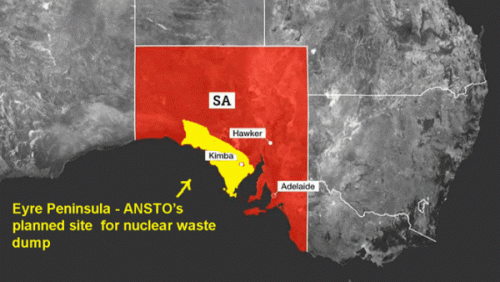
22 November 2019
Mr Dean Johnson
Mayor
District Council of Kimba
Dear Mayor Johnson
I refer to the recent ballot at Kimba to determine the level of support
for the siting of the radioactive waste facility.
The results of the Kimba ballot were:
Voting papers issued 824
Formal votes accepted 735
Yes vote 452
Did not vote ~ 283
The government are saying that the result is the percentage of yes votes of the formal votes accepted and they say this is 61.50/0.
This not a vote between two political opponents who are both free to campaign and present alternatives political views for consideration.
This is a simple yes / no vote on a proposal to establish a radioactive waste facility in a wheat field.
It is the government who are the proponent. It is they who have to get people to vote yes. They have to get 413 vote to get a simple majority.
For an overwhelming show of support they need at least a 2/3 yes vote.
You have to remember that this poll was not a genuine contest of ideas. There was only one view put and paid for by the government. There was not a no vote argument presented to voters. This places an unfair bias in any result obtained.
As if this were not bad enough the government offered a $31 million cash handout to the voters and 45 permanent jobs, manned a permanent office in the town of Kimba advocating a yes vote.
The way in which this ballot has to be interpreted is this: How many people voted yes as against how many people did not vote yes.
As a famous South Australian Mick Young the former Special Minister of State in the Hawke Government correctly put it if they don’t say yes they mean no.”
The government has been dishonest in that their figure of 61.49% as it neglects the people who didn’t vote.
The correct methodology is the ratio of people who wanted the facility (voted yes) as against those who didn’t vote yes. This is the ratio of yes votes to the people who didn’t vote yes.
The actual number supporting the facility is then 54.850/0. To achieve an overwhelming result the Yes vote would have to be 536 votes.
The government failed to show overwhelming support and the proposal to site the facility in Kimba can’t proceed.
This view is based on my experience as a federal government minister and also in local government where I am currently the Mayor of the City of Melville in Western Australia.
Yours sincerely
George Gear
Kimba nuclear waste dump – not just a local issue, but only locals were consulted
 This article includes an opinion poll at the end –
Last week, a Senate Inquiry report was released advising federal parliament to pass legislation on the establishment of the site, including the location at Napandee, 30 kilometres from Kimba.
There were three dissenters from the Senate Economics Committee – The Greens’ Sarah Hanson-Young, independent SA senator Rex Patrick and NSW Labor’s Jenny McAllister.
In the same week, SA Labor MPs Eddie Hughes – in whose Giles electorate the site sits – and Opposition spokesperson for the environment Susan Close issued a joint call for the federal government to halt the process, saying not enough was done to include the views of the Barngarla people.
Late last year, the results of a ballot of Kimba District Council was released, showing 61.58 per cent of residents were in support of the site.
There were three dissenters from the Senate Economics Committee – The Greens’ Sarah Hanson-Young, independent SA senator Rex Patrick and NSW Labor’s Jenny McAllister.
In the same week, SA Labor MPs Eddie Hughes – in whose Giles electorate the site sits – and Opposition spokesperson for the environment Susan Close issued a joint call for the federal government to halt the process, saying not enough was done to include the views of the Barngarla people.
Late last year, the results of a ballot of Kimba District Council was released, showing 61.58 per cent of residents were in support of the site.
“Instead of rushing this quick fix by dumping in SA, the federal government should do the work on a long-term plan for the management of nuclear waste in Australia,” Mr Hughes said.
“We clearly have an obligation to manage our domestic nuclear waste in a responsible way for the long-term. This proposal falls far short of meeting that obligation.”
The same week, a survey from the Australia Institute showed 60pc of its respondents believed consultation should include all of SA and not just Kimba residents, while 50pc opposed the transport of nuclear waste on SA roads and ports.
Australia Institute SA director Noah Schultz-Byard said the survey was initiated to gauge the public’s feelings about a site in SA. He said the 510 respondents were made up of a proportional representation of urban and regional residents.
Kimba District Council mayor Dean Johnson says consultation on the proposal had been ongoing for the past five years.
“It’s been completely open and well-publicised and anyone in SA could have come along,” he said………
He said the notion of statewide consultation proposed by some was not a solution.
“Kimba residents are really well-informed on this topic,” he said. “The idea that everyone is the state should get a vote is ridiculous. Does Kimba get a vote on the smelter at Port Pirie or a mine at Leigh Creek?
“This is locals making a decision on the town and the community’s future.”
No Radioactive Waste Facility for Kimba District group secretary Toni Scott said the group had long held the position the entire state should vote on this issue.
She said the release of the Senate Inquiry had again raised the opportunity for the public to share their thoughts about the site and its future.
Ms Scott said there were many parts to the legislation that needed to be approved, not just the location, and she was hopeful dissenters in parliament would continue to push for amendments.
Australia’s media disgrace – the deliberate neglect of the Julian Assange extradition hearing
 ”Fair” castigates the international media for ignoring the Assange case – the “Media Trial of the Century”. But hey ! What about the Australian media? Julian Assange is an
 Australian. When our citizens overseas commit murders and drug trafficking, it is all over our media, about their plight in the overseas justice system – pages and pages, TV and radio broadcasts. Then the benevolent Australian government bends over backwards to save their bacon. But when it comes to Julian Assange – only courageous mentions by the soon to be demolished ABC .
Our whole media – News Corpse and the ABC ran a big campaign on “Press Freedom” – Assange didn’t get a mention. Why should I expect them to? Decades ago they pillories Wilfred Burchett for reporting on Hiroshima bombing victims. Kowtowing to USA is the system here.
The media ignores Julian Assange and the Media ‘Trial of Century’
The United Nations has condemned his persecution, with Amnesty International describing the case as a “full-scale assault on the right to freedom of expression.” Virtually every story of national significance includes secret or leaked material; they could all be in jeopardy under this new prosecutorial theory.
President Donald Trump has continually fanned the flames, demonizing the media as the “enemy of the people.” Already 26% of the country (including 43% of Republicans) believe the president should have the power to shut down outlets engaging in “bad behavior.” A successful Assange prosecution could be the legal spark for future anti-journalistic actions.
Yet the case has been met with indifference from the corporate press. Even as their house is burning down, media are insisting it is just the Northern Lights.
 Julian Assange: Press Shows Little Interest in Media ‘Trial of Century’ https://fair.org/home/julian-assange-press-shows-little-interest-in-media-trial-of-century/, ALAN MACLEOD 25 Sept 20,
Labeled the media “trial of the century,” WikiLeaks founder Julian Assange’s extradition hearing is currently taking place in London—although you might not have heard if you’re relying solely on corporate media for news. If extradited, Assange faces 175 years in a Colorado supermax prison, often described as a “black site” on US soil.
The United States government is asking Britain to send the Australian publisher to the US to face charges under the 1917 Espionage Act. He is accused of aiding and encouraging Chelsea Manning to hack a US government computer in order to publish hundreds of thousands of documents detailing American war crimes, particularly in Afghanistan and Iraq. The extradition, widely viewed as politically motivated, has profound consequences for journalists worldwide, as the ruling could effectively criminalize the possession of leaked documents, which are an indispensable part of investigative reporting.
WikiLeaks has entered into partnership with five high-profile outlets around the world: the New York Times, Guardian (UK), Le Monde (France), Der Spiegel (Germany) and El País (Spain). Yet those publications have provided relatively little coverage of the hearing.
Since the hearing began on September 7, the Times, for instance, has published only two bland news articles (9/7/20, 9/16/20)—one of them purely about the technical difficulties in the courtroom—along with a short rehosted AP video (9/7/20). There have been no editorials and no commentary on what the case means for journalism. The Times also appears to be distancing itself from Assange, with neither article noting that it was one of WikiLeaks’ five major partners in leaking information that became known as the CableGate scandal.
The Guardian, whose headquarters are less than two miles from the Old Bailey courthouse where Assange’s hearing is being held, fared slightly better in terms of quantity, publishing eight articles since September 7. Continue reading
Forget the lobbying. It’s the spin that wins on climate, report finds
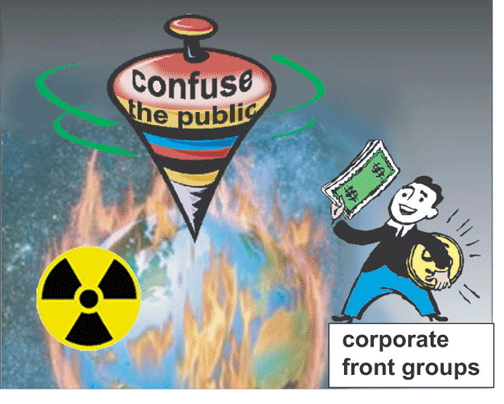 When it comes to impacting Australia’s climate wars, little can stand up to the fossil fuel industry’s public spin. GEORGIA WILKINS, SEP 24, 2020
These tactics focus on influencing public opinion and the broader political agenda rather than direct engagement with policymakers.
InfluenceMap, which is funded by environmental and investor groups, says the Minerals Council of Australia had the biggest negative influence on Australian climate-related….(subscribers only) https://www.crikey.com.au/2020/09/24/forget-the-lobbying-its-the-spin-that-wins-on-climate-report-finds/
Farmers have called out the federal government’s climate change low emissions policy as selling out an industry for profit
Farmers have called out the federal government’s climate change low emissions policy as selling out an industry for profit.Farmers for Climate Action slam Australian Government’s technology investment roadmap, Examiner, Caitlin Jarvis, 25 Sept 20
Federal Energy Minister Angus Taylor unveiled the draft technology investment roadmap this week, with steps towards low emissions.
Tasmanian farmer Brett Hall, who runs a beef property at Bronte Park, near Miena, said climate change was evident every day on his farm.
He said low emissions targets were an excellent first step, but it was a matter of too little, too late, and time was running out.
“Climate change is evident to us working on the land, but we need to see stronger initiatives because the evidence is there to suggest that we have not done enough so far and we’re past that point,” he said……… https://www.examiner.com.au/story/6938510/why-farmers-are-angry-about-low-emissions-roadmap/?cs=95
From October 6, the Australian Senate will discuss the NATIONAL ISSUE of the Napandee nuclear waste dump plan
The Senate returns on October 6th. At some time there will be a vote on what is indeed this national issue. The stakes remain high.
 The federal nuclear dump is a national issue, https://www.eurekastreet.com.au/article/the-federal-nuclear-dump-is-a-national-issue?fbclid=IwAR0zfICU9GSIJmfVdU30x9jCx847PF8ztvozbQNq0q57QCiWnhlKVtBHdJY Michele Madigan, 22 September 2020
Moreover, despite the former responsible Minister Matt Canavan’s repeated assertions that submissions from others outside the extraordinary narrow designated voting zone was a possible way to influence proceedings — there seems to have been no recorded mention of any of the 2789 submissions. With some of extraordinary length and scholarship, 94.5 per cent were against the federal nuclear waste proposal. They were seemingly ignored; one wonders were they even read?
From July 28th to August 28th, there have been four Senate Inquiry sessions concerning the Radioactive Waste Management Amendment Bill 2020, all by video link. During the Inquiry sessions it became obvious which three Senators had done their careful homework with penetrating questions to witnesses on either side of the debate.
Extreme concern about the issue was expressed by the Chair of the Barngarla Determination Aboriginal Corporation, Jason Bilney and by other Barngarla people; by Peter Woolford, farmer President of the No Radioactive waste on Agricultural Land in Kimba or SA group; by Dave Sweeney of the Australian Conservation Foundation, the single environmentalist invited to be a witness. On the other hand, there was spirited defence of the project, including every aspect of the process by the two senior government officials; by the landholder of the chosen site and by Kimba council representatives. There was an eager willingness by some Senators to positively enable these latter presentations.
On Monday 13th of September, the Senate report was released. Predictably in a Coalition led Inquiry, the report recommends the Senate proceed to vote yes to the plan on the Minister designated site on Barngarla country in agricultural land at the Kimba region Eyre Peninsula site.
However three Senators contributed separate dissenting reports released concurrently with the main report. Labor’s Jenny McAllister, formerly Centre Alliance and now Independent South Australian Rex Patrick, and the Green’s Sarah Hanson-Young SA all recommended that the legislation not go ahead. There were a number of reasons cited by the dissenting Senators.
The context of this ‘national issue’ declaration cited above by the Department was a defence of the strategy to take the Napandee (Kimba region) site to the Parliamentary vote — ensuring that if the proposed legislation is passed by the Senate, there will be no opportunity to take any aspect of the decision making to court. In the words of Labor Senator Jenny McAllister in her dissenting report: ‘In evidence to the committee, the Department confirmed that the effect of the change proposed in the legislation is to remove the requirements for procedural fairness in the selection of the site.’
As well, Senator Rex Patrick’s dissenting report included an emphasis on the heavily redacted nature of the government officials’ documentation: ‘The Department has, through its interaction with the committee, demonstrated a predisposition to secrecy—undue secrecy—in relation to provision of process information to the very people who pay them and who they are supposed to serve.’
The Greens’ summary was included in their final recommendation: ‘The Australian Greens believe the Federal Government has no mandate to situate a radioactive waste management facility in South Australia. It has mismanaged the site selection process, fallen short of international best practice and failed to secure the consent of traditional owners. For these reasons the Australian Greens recommend that this bill not be passed.’
No Dump Alliance is a group of organisations including First Nations, public health, trade union, faith and environment groups, academics and concerned individuals concerned about this matter. Revered SA theologian and international author Denis Edwards was an identified member.
On the release of the Senate report, NDA released their own media statement in which spokesperson Karina Lester (pictured), daughter of late former NDA Patron Yami Lester was clear: ‘In the 21st Century it is unacceptable to try and airbrush away Aboriginal peoples concern over nuclear risks. The Barngarla Native Title holders were excluded from the Kimba community ballot about the waste plan and now the federal government is trying to deny them the right to contest the plan in court. This is not only unfair to the Barngarla people but a clear insult to the concerns expressed by Aboriginal people from right across South Australia to any dumping and storage of radioactive waste on our traditional lands from outside the state’.
The Senate returns on October 6th. At some time there will be a vote on what is indeed this national issue. The stakes remain high.
- ’
Medical experts testify to court on Julian Assange’s precarious mental health
 Assange faces “very high risk of suicide,” medical expert tells court, WSWS, By Thomas Scripps and Laura Tiernan, 23 September 2020
Medical evidence was produced in Julian Assange’s extradition hearing yesterday detailing the terrible harm done to the heroic journalist by a decade of state-orchestrated persecution.
The day was given over to the examination of Professor Michael Kopelman who testified to Assange’s mental health. Kopelman is a psychiatrist and Emeritus Professor of Neuropsychiatry at Kings College London. He has given expert evidence in multiple extradition cases on behalf of both the defence and the prosecution. In assessing Assange, he conducted seventeen visits in 2019 and additional visits in 2020, constructed a “full family history” and a “full personal psychiatric history,” and carried out “interviews with his family and lifelong friends.”
His findings constitute a clear bar to Assange’s extradition to the United States. Under Section 91 of the UK Extradition Act (2003), extradition is prohibited if “the physical or mental condition of the person is such that it would be unjust or oppressive to extradite him.”
Under Section 87, extradition is prohibited if it is incompatible with the European Convention on Human Rights (ECHR). Article 3 of the ECHR states, “No one shall be subjected to torture or to inhuman or degrading treatment or punishment.”
Medical evidence speaking to these bars has played a critical role in previous US-UK extradition hearings, for example in the case of Lauri Love. The risk of notoriously poor conditions in US prisons exacerbating mental illness is an important factor.
Assange’s case meets these criteria. The details in today’s WSWS coverage are being reported consistent with the “sensitivity” called for by defence lawyer Edward Fitzgerald QC, on behalf of his client. Nonetheless they make overwhelmingly clear the “unjust and oppressive” treatment to which Assange has already been subjected.
Assange, Kopelman told the court, has experienced periods of serious mental illness in his earlier life. Since being confined to the Ecuadorian Embassy and then Belmarsh maximum security prison, these issues have resurfaced and worsened. Assange has suffered symptoms of severe and recurrent depression. Those symptoms have included “loss of sleep, loss of weight, a sense of pre-occupation and helplessness” and auditory hallucinations which Kopelman summarised as “derogatory and persecutory.”
They have also included “suicidal preoccupations.” Kopelman told the court, “There are… an abundance of known risk factors in Mr Assange’s case” and that Assange has “made various plans and undergone various preparations.” He gave his opinion that there was a “very high risk of suicide.”
These symptoms and risks, Kopelman explained, are exacerbated by an anxiety disorder and Post Traumatic Stress Disorder (PTSD) and by a diagnosis of Asperger’s syndrome. Kopelman cited a paper by world-leading autism expert Dr Simon Baron-Cohen which found that the lifetime experience of suicidal thoughts in those with Asperger’s “was more than nine times higher than in the general population in England.”
Explaining the impact of the US government’s persecution, Kopelman said, “The risk of suicide arises out of the clinical factors of depression and the other diagnoses, but it is the imminence of extradition and/or an actual extradition that will trigger the attempt, in my opinion.”
If Assange were to be incarcerated in the US and segregated from other prisoners, Kopelman gave his opinion that the WikiLeaks founder would “deteriorate substantially” and see an “exacerbation” of his “suicidal ideas.” This would “amount to psychological harm and severe psychological suffering.”
Kopelman’s evidence confirms the warnings made since November 2019 by Doctors for Assange, representing hundreds of medical professionals from around the world, that Assange is suffering “psychological torture” and “could die in prison.” It underlines in distressing detail UN Special Rapporteur on Torture Nils Melzer’s comment regarding Assange’s treatment that “psychological torture is not torture-lite. Psychological torture aims to wreck and destroy the person’s personality and identity… to make them break.”
Assange’s year-and-a-half long incarceration at Belmarsh has been designed to achieve this objective. It has profoundly undermined, in numerous ways, his legal right to prepare his defence against extradition. Kopelman reported yesterday that Assange has repeatedly complained that the medication taken for his mental health has caused him “difficulty in thinking, in memorising [and] in concentration.”
During the morning’s cross examination, Kopelman forcefully rebuffed prosecution lawyer James Lewis QC’s challenge to his credentials. He said solicitors had called him several times in recent years saying that Lewis himself was “keen to have your services” in an extradition case.
In the afternoon, cross-examination continued, with Lewis challenging the veracity of Kopelman’s diagnosis, and claiming that Assange’s appearance was “wholly inconsistent with someone who is severely or moderately-severely depressed and with psychotic symptoms.”
Kopelman replied, “Could we go back a step?” Having seen Assange between May 30 and December [2019], “I thought he was severely depressed, suicidal and was experiencing hallucinations.”………….. https://www.wsws.org/en/articles/2020/09/23/assa-s23.html
Australian scientists censored on speaking about climate change

 Censored: Australian scientists say suppression of environment research is getting worse
Survey finds that many researchers are banned from speaking about their work or have had their research altered to downplay risks. Nature , Dyani Lewis, 22 Sept 20, Environmental scientists in Australia say that they are under increasing pressure from their employers to downplay research findings or avoid communicating them at all. More than half of the respondents to an online survey thought that constraints on speaking publicly on issues such as threatened species, urban development, mining, logging and climate change had become worse in recent years1.
The findings, published this month in Conservation Letters, reflect how politicized debates about environmental policy in Australia have become, says Saul Cunningham, an environmental scientist at the Australian National University in Canberra. “We need our publicly funded institutions to be more vocal in defending the importance of an independent voice based on research,” he says.
Australian scientists aren’t the only ones who have reported interference in science or pressure — particularly from government employers — to downplay research findings. Scientists in the United States, Canada and Brazil have also
Scale of the problem
Two hundred and twenty scientists in Australia responded to the survey, which was organized by the Ecological Society of Australia and ran from October 2018 until February 2019. Some of the respondents worked in government; others worked in universities or in industry, such as environmental consultancies or non-governmental organizations.
The results show that government and industry scientists experienced greater constraints from their employers than did university staff. Among government employees, about half were prohibited from speaking publicly about their research, compared with 38% employed in industry and 9% of university staff. Three-quarters of those surveyed also reported self-censoring their work (see ‘Scientists silenced’)……….
One-third of government respondents and 30% of industry employees also reported that their employers or managers had modified their work to downplay or mislead the public on the environmental impacts of activities such as logging and mining. ………. https://www.nature.com/articles/d41586-020-02669-8
Medical groups are urging Greg Hunt to include climate change in 10-year health strategy
SBS, 22 Sept 20
A national preventative health strategy is useless if it doesn’t address the risks of climate change, experts have told the responsible minister.
Numerous health groups from across the country have signed a joint statement to Health Minister Greg Hunt calling for climate change to be a key part of the national preventative health strategy.
The strategy is currently being developed, with public feedback on its consultation paper open until the end of the month.
Julian Assange dragged from embassy “on the orders of the president”
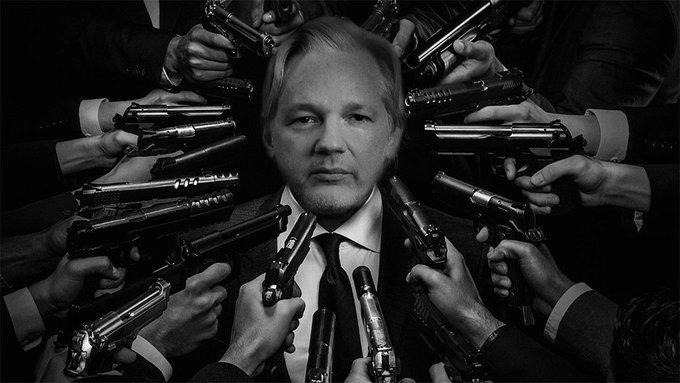 Explosive evidence from Trump insider,Assange dragged from embassy “on the orders of the president”, WSWS, By Laura Tiernan and Thomas Scripps, 22 September 2020
Alt-right media personality Cassandra Fairbanks’ witness testimony was read out in court yesterday, providing evidence that Julian Assange’s April 2019 arrest at the Ecuadorian Embassy in London was politically motivated and directed by United States President Donald Trump.
Fairbanks testified that Arthur Schwartz, a wealthy Republican Party donor and key Trump ally, had told her that Assange was taken from the Ecuadorian Embassy “on orders from the president.” The conversation between Schwartz and Fairbanks occurred in September 2019 and was recorded by Fairbanks.
Schwartz, a frequent visitor to the White House and “informal adviser” or “fixer” to Donald Trump Jr., told Fairbanks the president’s orders were conveyed via US Ambassador to Germany Richard Grenell, who brokered a deal with the Ecuadorian government for Assange’s removal. Grenell was appointed acting director of national intelligence by Trump in February this year, holding the position until May.
Assange’s lawyer, Edward Fitzgerald QC, spelled out the significance of Fairbanks’ disclosures, telling Judge Vanessa Baraitser they were, “evidence of the declared intentions of those at the top who planned the prosecution and the eviction from the embassy.”
Fairbanks, who writes for the pro-Trump Gateway Pundit, is a prominent Assange supporter who visited the WikiLeaks founder at the Embassy on two key occasions. Her evidence was read into proceedings yesterday afternoon unopposed, with Fitzgerald explaining, “My learned friend [James Lewis QC for the prosecution] reserves the right to say ‘because she’s a supporter of Julian Assange you must take that into account in weighing her evidence.’ But we say [her evidence] is true.”
Given her close connections to leading figures in the Trump administration’s fascistic entourage, Fairbanks is uniquely positioned to expose key aspects of the politically motivated vendetta against the WikiLeaks founder. Throughout the extradition hearing, lawyers for the US government have repeatedly claimed the charges against Assange under the Espionage Act are motivated by “criminal justice concerns” and are “not political.”
Fairbanks’ evidence shreds the official narrative of the Department of Justice (DoJ) that Assange was arrested on April 11, 2019 in relation to “hacking.” In a phone call with Schwartz on October 30, 2018, he made clear that Assange would be arrested as political payback for his role in “the Manning case,” i.e., the disclosure by US Army whistle-blower Chelsea Manning of US war crimes in Afghanistan and Iraq……………
Speaking outside the court, Assange’s father, John Shipton, said, “Today we had the prosecution trying to prove that water runs uphill and up is down. … The defence replied and conclusively demonstrated that it was David Leigh [who caused the unredacted cables to be released]. We can only conclude from the amount of time that the prosecution spent defending David Leigh that David Leigh is a state asset.”
At the end of the hearing’s morning session, an exchange between District Judge Vanessa Baraitser and the legal teams pointed to further restrictions being imposed on the defence’s ability to present its case.
Seizing on the delays caused by a potential COVID-19 outbreak in the first week of the hearing, Baraitser insisted that the defence prepare a timetable that allowed the hearing to “finish within two weeks.” When the defence replied that this would leave no time for closing submissions, she reacted enthusiastically to the suggestion of prosecution lawyer James Lewis QC that these could be submitted in written form and summarised in just half a day each for the prosecution and the defence. A final decision is forthcoming.
The hearing continues today……… https://www.wsws.org/en/articles/2020/09/22/assa-s22.html
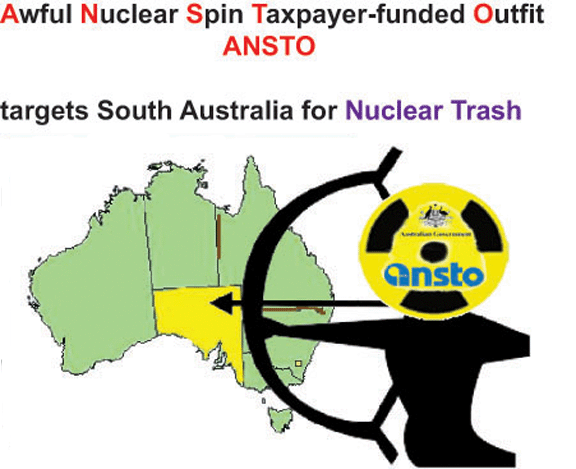
Australian Nuclear and Science Organisation distancing itself from the Napandee nuclear waste dump?
|
I wonder how many people have put TWO AND TWO together yet and realize that ANSTO is distancing itself further and further away from the dump! ANSTO will be in fact VERY HAPPY to have THEIR waste off their books!! Remember that ANSTO does NOT have to pay to use the dump – nor does any other Commonwealth entity! And ARWA has already said they will only use ANSTO for advice if necessary …
“ARWA is a Commonwealth entity, initially established with the department, and subsuming the National Radioactive Waste Management Facility Taskforce. Over the next two years, ARWA’s capability will be developed and it will become a non-corporate Commonwealth entity under its own legislation. ARWA will continue to work closely with ANSTO, who provide their support and extensive expertise.” – Sam Chard August 2020
|
|
A mixed blessing – the sudden departure of Australia’s nuclear high priest, Dr Adi Paterson
I am reminded of Hilaire Belloc’s advice to the young – ”Always keep a hold of Nurse, for fear of  finding something worse”.
Among other sycophantic tributes, Dr Adi Paterson is lauded for encouraging women into the nuclear industry.
Adi Paterson spent several years in South Africa, trying to establish Small Nuclear Reactors. It turned out to be Tan expensive and useless exercise. Then he came to Australia, with the same dream. He quietly signed Australia up to the Framework Agreement for International Collaboration on Research and Development of Generation IV Nuclear Energy Systems, without any consultation, discussion in Parliament (which rubber-stamped this later).
He quietly organised Australia’s participation with China in developing small nuclear reactors.
He rubbished renewable energy at a solar conference.
He went to Kimba to do propaganda for the nuclear waste dump plan, but admitted that there was no economic benefit in the low level waste dump, so the intermediate level waste was the real intention.
Leadership changes at ANSTO, Statement from the ANSTO Chair: Dr Annabelle Bennett 9 Sep 20, Dr Adi Paterson has resigned as CEO of ANSTO slightly ahead of time of his term. He has decided to take a period of leave before formally finishing. ……..
Mr Shaun Jenkinson will continue as acting CEO, while the Board undertakes a global search for a permanent CEO. https://www.ansto.gov.au/news/leadership-changes-at-ansto?fbclid=IwAR0cLOwne84D7XJP9UGwrf1aVAxyXgStAB6502zPYUgsqxdbjUuyUR3MYjo
Adrian “Adi” Paterson is a South African scientist and engineer best known for his work on Pebble Bed modular reactor research and development. He was appointed CEO of the Australian Nuclear Science and Technology Organisation (ANSTO) in 2009
He emigrated to Australia in 2008 and was appointed Chief Executive Officer at ANSTO in March 2009.
1 This month.
20 September –National Day of Action in Melbourne on the International Day of Peace


Help Aunty Sue Protect Her Land and Sacred Sites From Destructive Rocket Testing.
.

Australians deserve the truth
about
AUKUS – https://aukuspublicinquiry.com/

PETITION – To: Prime Minister Anthony Albanese and the Australian Labor Government

of the week – Australians for War Powers Reform (AWPR)
To see nuclear-related stories in greater depth and intensity
 Antinuclear