Global heating – Farmers can’t afford the higher insurance premiums. Fossil fuels killing agriculture
 Climate change-driven disasters making insurance premiums too dear for farmers, ABC News, Vic Country Hour, By Jane McNaughton 16 July 20
Australian farmers are facing increasingly frequent droughts, floods, hailstorms and bushfires, resulting in insurance premiums rising to the point where cancelling or underinsuring are the only options.
Key points:
- A NSW farmer says the fossil fuel industry is effectively killing the agriculture sector
- Insurance premiums are being driven to unaffordable levels by the impacts of climate change
- The Insurance Council of Australia says 80 per cent of Australian homes are underinsured — and that figure’s likely higher in the bush
Climate change has already cost farmers more than $1 billion since 2000, according to ABARES.
Third-generation lamb and cropping farmer Peter Holding said government inaction on global warming could have disastrous flow-on effects to the agriculture industry.
“Climate change poses a cataclysmic set of challenges for farmers,” the Farmers for Climate Action member said.
“It’s pretty severe and it’s getting worse…………
Fossil fuels ‘undermining’ agriculture
Financial strain is not the only issue climate change has delivered to farmers.
“Unfortunately we’re getting less good years and a lot more variability,” Mr Holding said.
“There’s a lot of impacts and I can’t see it stopping any time soon.
“The droughts are just continuing, since the turn of the century we’ve had [so many years] of drought, interlaced with floods.”…….
“The fossil fuel industry is creating emissions and that is slowly but surely making agriculture unviable.
“We’ve cut the emissions from livestock probably in half, farmers in cropping areas have done all sorts of things to reduce the use of diesel and better use fertilisers.
“So farmers are working on all of these problems to cut their own emissions, but we definitely need some quick action to reduce the emissions of fossil fuel.”
Australia’s Liberal Coalition climate deniers are at it again
 COALITION DENIERS AT IT AGAIN, MARK BUTLER. July 15, 2020
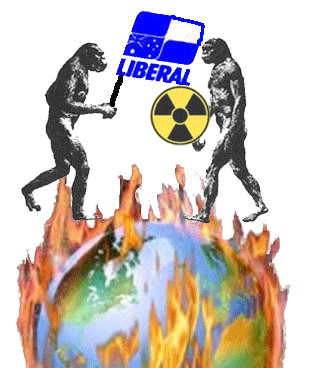
Coalition MP Craig Kelly has mounted an extraordinary attack on the Bureau of Meteorology in a Facebook post shared more than one thousand times in 36 hours.
Coalition MP George Christensen was among those who shared the post, saying: “Craig Kelly is in detective mode. Crooks within data-altering government agencies should be worried. Very worried.”
Does the Environment Minister Sussan Ley agree with these attacks on the Bureau of Meteorology? Does the Assistant Minister, Trevor Evans?
What about Mr Kelly and Mr Christensen’s backbench colleagues like Ross Vasta, Tim Wilson, Dave Sharma, Fiona Martin or Katie Allen?
If they don’t agree, what are they doing about the fact that their colleagues are using social media to spread disinformation in an attempt to discredit a government agency and undermine action on climate change?
This is beyond a joke. The Government needs to take responsibility for the actions of its own backbench.
Links to Mr Kelly and Mr Christensen’s posts:
https://www.facebook.com/CraigKellyMP/photos/a.251794581681850/1553197208208241/
https://www.facebook.com/CraigKellyMP/photos/a.251794581681850/1555461397981822/
https://www.facebook.com/gchristensenmp/posts/2988498467871728?__tn__=-R
George Gear submits on Radioactive Waste Bill – that Kimba site is totally unsuitable
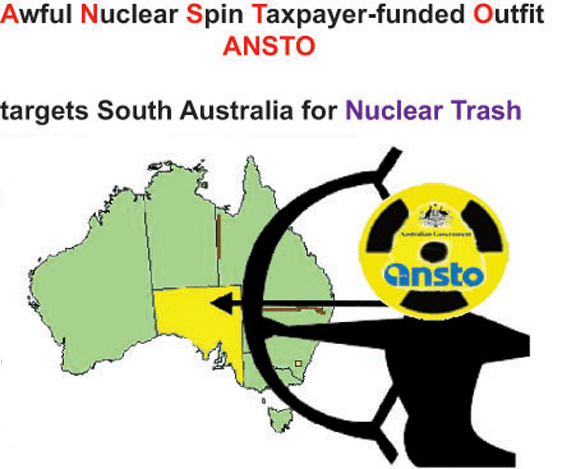
George Gear to Senate Economics Committee on NATIONAL RADIOACTIVE WASTE MANAGEMENT AMENDMENT (SITE SPECIFICATION, COMMUNITY FUND AND OTHER MEASURES) BILL 2020 [PROVISIONS] Addition to my submission. I have attached [on original] two short articles on radioactive storage which will be of assistance to the committee. As you will see the proposal by the government will not be licensed for storage in Australia. It fails to reach the International Atomic Energy Agency (IAEA) standards for the storage of Intermediate Level Waste (ILW).
Accordingly your committee must inform the senate that the Kimba proposal in the bill does not meet IAEA standards and should be withdrawn.
The first is written by Aurora who are the only company operating a (low level ) radioactive storage facility in Australia.
In it they draw attention to the following factors which are relevant to Kimba:
1. The buffer zone is inadequate, it is measured in hectares instead of kilometres. Leonora has a buffer zone of 15 kms.
2. The site should be at a location where there are “few active land uses” on surrounding land. As you know the Kimba site is in the middle of a prime wheat growing area. The site at Leonora is remote, nothing grows there and nobody goes there.
3. When the governments proposed site is finished with in 30 years and a new underground site has been established the redundant Kimba site will have to be managed (at taxpayer expense ) for 300 years.
4. Based on their experience none of the sites in SA would have been considered if it were not for the expression of interest model chosen by the government.
5. The Kimba site is unsuitable.
6. The decision to site the facility at Kimba is a political one and not based on technical or scientific considerations.The second article is by the AINS Group who are a specialist group in storing radioactive waste. They are based in Helsinki and this article is specific to the decision to establish the facility at Kimba. The main points of the article are:
1. Intermediate Level Waste (ILW) should be stored at intermediate level geological disposal. The Department already knows this. The quote below is taken straight from the “ National Radioactive Waste Management Facility Project” (NRWMFP) Facebook home page (attached). The statement that it will take several decades to site and build is wrong and they know it. The Leonora site can store the ILW at depth within a year and the NRWMFP have known this for 3.5 years.
Kimba “interim” nuclear waste site – bad news, uncannily like the misguided New Mexico waste plan
KIMBA GOVERNMENT PROPOSALS, by Peter Remta, 11 July 20 Is not the newspaper article below describing practically the same situation as with the Kimba proposals?
Should not the Australian government learn from this and the other unsatisfactory experiences overseas of which France is a main one despite being used as a successful example by the government for Kimba of community consent.
The author of this article and the former chair of the Nuclear Regulatory Commission of the USA (who incidentally has been to Kimba) would both be prepared to give evidence and their opinions to the Senate committee inquiry by video link.
However this article shows the effects of inept and incomplete planning as is the case with Kimba.
New Mexico nuclear facility is bad news, Las Vegas Sun, By Judy Treichel Monday, July 6, 2020, It may seem like good news in Nevada that an effort is underway in New Mexico to build a private storage facility for nuclear waste there.
But don’t be mistaken: This facility wouldn’t be an alternative to the disastrous Yucca Mountain nuclear waste repository. In fact, its existence depends on Yucca Mountain becoming an operating repository. That’s unacceptable, because the Nevada facility poses far too many risks for our state.
The license application for the New Mexico facility calls for it to operate over 40 years, after which the waste stored in it would go to Yucca Mountain….. today those Yucca Mountain deliberations are on an indefinite hold.
Now comes the New Mexico license application to the Nuclear Regulatory Commission, which in the opinion of the Nevada Nuclear Waste Task Force the commission should not have accepted with the assumption that Yucca Mountain would be an operating repository.
During all of the time that Nevada has been fighting the Yucca Mountain proposal, we were repeatedly assured that we could place our trust in the commission because before any license was granted for construction or operation, a thorough and unbiased process would fully play out. We were told there was no reason for questioning the fairness of the commission’s licensing process…….
Any siting of a facility that creates risk for the community should require informed consent, and the people of New Mexico do not consent.
What we see happening with this so-called interim site is that it does not solve the nuclear waste problem. In fact it increases the risks by putting the waste on the roads and rails, and requiring it to be loaded and unloaded multiple times and transported more than once. Additionally, the only way a site can be considered “interim” is to know that the waste will leave, and the assumption here is that it will leave New Mexico and come to Nevada.
The incentive for the company proposing to build the facility is purely financial — specifically, it’s to gain access to the $42 billion in the federal nuclear waste fund. An interim site does not increase or improve public safety, but rather does just the opposite. It creates one more nuclear waste site and provides more room at reactor sites for more waste. And it moves the waste closer to Nevada.
A national high-level nuclear waste repository at Yucca Mountain is an overwhelmingly unsafe idea. Nevada residents, elected officials and people across the country living near transport routes know it. For 20 years, the Department of Energy studied the site and discovered — or were forced to admit — that there were conditions present that, according to their own guidelines, disqualified the site.
If the licensing process ever restarts, how could we trust the Nuclear Regulatory Commission to fairly judge the science when it has previously assumed a licensed and operating repository at Yucca Mountain? Congress needs to reverse the action it took naming Yucca Mountain as the only site to be considered for a national repository, and take a fresh and fair look at nuclear waste disposal.
Initiatives like the interim storage site in New Mexico are simply misguided and misleading diversions.
Judy Treichel is executive director of the Nevada Nuclear Waste Task Force
Foreign nuclear waste headed to Australia
 Yes, this article is nearly 2 years old, but, sadly it is so relevant today!
Fears for indigenous lands as foreign nuclear waste headed our way, Weekend Australian, JACQUELIN  MAGNAY, LONDON
The Australian can confirm that the waste will be temporarily stored at Lucas Heights in Sydney, until the contentious new nuclear waste management centre is built, possibly at the South Australian sites of Hawker or Kimba.
But the waste will not be material from Australian spent fuel rods from the decommissioned High-Flux Australian Reactor at Lucas Heights (which was originally generated from British-sourced uranium) and reprocessed at Dounreay, Scotland, in 1996.
Instead it is considered too expensive to move that low-level waste from Dounreay, and so the nuclear waste to be transported to Australia will be “substitution waste’’ from Sellafield in England, but of a higher radioactive level.
Glasgow environmental activist Gary Cushway, who helped stop a nuclear storage plant near Coober Pedy, said there was increased awareness in Scotland that Australia didn’t have adequate storage for intermediate-level waste. He said there were fears that the new nuclear waste management facility, said to be for low-level waste, would be recategorised retrospectively to handle the intermediate-level waste.
“Once the storage facility is built for the low-level, where will they put the intermediate-level waste? It has to go somewhere and many Aboriginal owners think it will be temporarily stored with the low-level waste until that temporary status becomes permanent,’’ he said. While the Australian radioactive waste in Dounreay is believed to total about 76 tonnes and is rated low level, the grading of the waste that will be shipped to Australia is of intermediate level, but there will be less of it. It is slated to be transported by 2022 at the latest.
Britain’s parliamentary undersecretary for business, energy and industrial strategy, Richard Harrington told Parliament – “……The radioactive waste, which arose from the processing (of the Australian fuel), comprises several tens of drums of cemented waste. The substituted radioactive waste will be in the form of four vitrified residue containers holding waste that falls within the activity levels of intermediate-level waste.’’
He said the waste would be stored at Lucas Heights and then temporarily “co-located’’ at the new nuclear storage centre.
Australia accepted a 130-tonne “TN81 cask’’ of reprocessed intermediate-level waste from France in December 2015, which required extensive road closures for its transport from Port Kembla to Lucas Heights. It also required special government dispensation for the Lucas Heights centre to temporarily store the intermediate-level waste…….
ANSTO anticipates that four to five casks of intermediate-level waste will need storing in Australia in the next 40 years, much of which will be the return waste from France of reprocessed spent fuel rods of the current OPAL reactor at Lucas Heights. About 7500 200-litre drums of low-level waste is also currently stored at Lucas Heights. ….. https://www.theaustralian.com.au/nation/foreign-affairs/fears-for-indigenous-lands-as-foreign-nuclear-waste-headed-our-way/news-story/21a1027bafda79992897b676db2e71ed?fbclid=IwAR24ceIPdDhe0KCFKC_HKZwxHPkKjoAvB1yq53BCcK7v3DTVKd8qHeRQjxo
In contradiction to Angus Taylor, Australia’s Minister On Behalf of Polluting Industries, the States are leading on clean energy
 How Australia’s state energy ministers are turning the tables on Angus Taylor, Guardian Simon Holmes à Court The state energy ministers still need to deliver on their promises, but imagine if any of them held the federal portfolio @simonahac, Sat 11 Jul 202 Sometimes it just takes a bit of leadership.
Former prime minister Malcolm Turnbull likes to say that we must choose “engineering and economics” over “idiocy and ideology”. The New South Wales energy minister, Matt Kean, has been making the right choices.
In December 2018 I singled out NSW for its reckless lack of energy policy. The state, reliant on an ageing coal fleet for 80% of its power, had been shunned by energy investors……..
NSW is blessed with high-quality wind and solar resources, but lacks transmission lines between the best wind and solar areas and the state’s major population and industrial centres. In 2018, only one-in-20 proposed renewable energy projects could be accommodated into the weak grids in the west of the state, and developers were forced to turn their attention to the other states.
In a landmark speech late last year, Kean, the newly minted energy minister, made it clear his government would respond to the climate science and embrace the opportunities presented by decarbonising the economy.
“To those vested interests and ideologues who want to stand in the way of this transition, I say enjoy your Kodak moment,” he said.
Undeterred by attacks from the Murdoch media and even the prime minister, Scott Morrison, over the following months, Kean set about turning the tables in NSW……….
What’s stunning is how much ambition has shifted, and how it’s being driven by the states. Just two years ago the modelling for Josh Frydenberg’s failed national energy guarantee predicted that NSW wouldn’t build a single wind or solar farm from 2021 to 2030. Now Kean has a plan to build as much large-scale renewable energy this decade in NSW as all of Australia built over the past 20 years. …….
The Australian Energy Market Operator and CSIRO have determined that the cheapest way to “firm” the huge amounts of renewable energy is a relatively modest mix of better interconnections with neighbouring states, batteries and pumped hydroelectricity – Snowy 2.0 project and multiple smaller projects. On economic grounds alone, fossil gas is unlikely to play an increased role.
The Rezs will also open up opportunities for energy intensive industry. Flexible demand, such as hydrogen production, can help balance the grid. Instead of fracking the Pilliga forest to produce fertiliser with a huge carbon footprint, business could build a zero-carbon factory in the New England region, making fertiliser from renewable energy.
Angus Taylor, the federal minister for energy and emissions reductions, is famously no fan of renewable energy or of setting meaningful emissions reduction targets. On electricity, the state energy ministers – right across the political spectrum – are charging ahead without him, which is perhaps as it should be, given that electricity is the states’ responsibility…….
Every state and territory has now formally signed on to a net-zero emissions target by no later than 2050, a target backed by business, unions and the opposition – yet the federal government and its donors stand in the way.
Australia has three Liberal state energy ministers. South Australia’s Dan van Holst Pellekaan wants to see his state hit 100% renewables by 2030. His Tasmanian counterpart, Guy Barnett, is gunning for 200% renewables and Kean has outlined a plan for NSW to be an energy superpower.
Sure, these energy ministers still need to deliver on their promises, but imagine if any one of them held the federal portfolio. https://www.theguardian.com/environment/2020/jul/11/how-australias-state-energy-ministers-are-turning-the-tables-on-angus-taylor?utm_term=Autofeed&CMP=soc_568&utm_medium=Social&utm_source=Twitter#Echobox=1594424036
Court action in India against Adani – allegations of ‘coercion, fraud and undue influence’
 Adani power plant and coal plans threatened by land owner court action, ABC News, By Stephen Long, 11 July 20
The case filed with the court accuses Adani and its agents of using “coercion, fraud [and] undue influence” to illegally exclude thousands of people affected by the development from a required social impact assessment.
The claimants allege that a key meeting was full of labourers “from far away” who were paid to attend a crucial public hearing about the development and — in conjunction with local police — used brutal force to keep villagers opposed to Adani’s project out.
“Thousands of people gathered to go into the venue site but they were prevented both by the police, who were acting as agents of private company Adani Power Limited, as well as by their security guards,” the writ filed with the court alleges.
“The situation was so bad that the police lathi [baton] charged the affected families. When they tried to attend the public hearing were beaten mercilessly.”
Residents challenge land acquisition
The court case also challenges the forced takeover of land for the development by the State Government on behalf of Adani.
Under Indian law, a government can only acquire land for a private company if the project is for “public purpose”.
The claimants argue the project does not meet the definition of “public purpose” under the law.
Part of their argument is that the power plant will have few local benefits, since the electricity will all be exported and the coal used to generate the power will all be imported — largely from Australia.
“It is crystal clear from the various documents of Adani Power Limited that the power which shall be generated from this private project shall be exported to Bangladesh [while] the coal shall be imported from Australia … to Dharma Port and transported to the project covering a distance of around 700km causing immense pollution in transportation.
“Thus, there is not even a semblance of public interest.”….
The irony is that Jharkhand is a resource-rich state, accounting for more than 40 per cent of the mineral resources of India, and the Adani power project is situated amid some of the richest coal deposits in the nation.
Adani’s own Jitpur coal mine is just kilometres away from the project site; when the plant was first proposed five years ago, this was to be the source of the coal.
But those plans rapidly changed, apparently because under Indian law domestic coal cannot be used for thermal power projects that will export electricity to another country.
So, Adani now appears set to transport imported coal vast distances, at extraordinary expense, into a state that is home to the biggest coal reserves in India…….
‘Land is indispensable to a Santhal’
The patriarch of the Adani business empire, Gautam Adani, is one of the richest men in India, while many of the villagers affected by the Godda power project are from the other end of the wealth spectrum.
Some are from the lowest castes in the Hindu religion and others are from an Indigenous tribal group known as the Santhal.
Archaeologists estimate that the Santhal have been in eastern India for up to 65,000 years. Like Aboriginal Australians, they have an ancient and spiritual connection to the land that has long been recognised in legislation.
“Land is indispensable to a Santhal,” a local villager explained to the independent Indian filmmaker who shared her interviews with the ABC.
“It is an intrinsic part of culture. The Santhal tribe and their land are like two sides of one coin. If land exists, Santhal exists, but if the land is taken away it just means they will be totally wiped out.”
The Santhal have a practice of burying their dead in the fields they sow, which become sacred to them.
One of them says: “We belong here, this is our ancestral land. We are buried on our land. We have no problem dying on our land but we will not give it away.”
Santhal land rights have previously been protected under a long-standing law which prohibited industrial development on their farming lands, but the laws have recently been watered down…….
those fighting the project face a race against time; the High Court case, and a separate environmental challenge before India’s National Green Tribunal — scheduled for hearings in early August — will be of no consequence if construction reaches a point where the development becomes a fait accompli.
Curiously, geopolitics is working in favour of the project’s opponents.
Adani has contracts with a Chinese firm for equipment purchases and engineering work on the power plant.
With a border conflict taking India and China close to war, Adani is facing political pressure to terminate the deal, which could further delay or even jeopardise the project. https://www.abc.net.au/news/2020-07-10/adani-godda-power-plant-threatened-by-land-owner-court-action/12439624
Australia a big world player in producing greenhouse gas emissions
 Australia: an emissions super-power https://apo.org.au/node/306756, 9 JUL 2020
Not only is Australia a laggard in meeting its UN Paris emission reduction targets, it is now the world’s largest exporter of coal and gas. In fact, the emissions from Australia’s exported fossil fuels are now greater than Germany’s domestic emissions (Hein, Peter & Graichen, 2020).
Despite federal government claims that our national emissions have only a minimal impact on the global climate, Australia is, in fact, a major contributor to global climate change. The massive emissions that result from our fossil fuel exports are not counted in Australia’s national carbon budget under our UN climate obligations, nor do we take responsibility for the impact these emissions are having globally.
Key facts:
- Australia’s exported emissions have increased 4.4% between 2018 and 2019.
- In 2019, the emissions from Australian fossil fuel exports were 1.4 times greater than Germany’s domestic emissions.
- In 2019 Australia’s exported emissions were 1.4 times greater than all the CO2 emissions produced by the 2019/2020 summer bushfires.
- Every Australian is paying $1,832 per year for fossil fuel subsidies, compared to the one-off payment of around $78 for bushfire relief.
Keep Australia’s nuclear prohibition laws: it appears that nuclear is no part of climate action, not necessary

The most important group of nuclear power advocates who have consistently promoted concerns about climate change as the main reason for their advocacy have been the self-described ‘eco-modernists’. The main organizational focus of ecomodernism is the
 Breakthrough Institute, established by Michael Shellenberger and Ted Nordhaus in 2003.
Australia now the biggest exporter of global heating- the Saudi Arabia of coal and gas
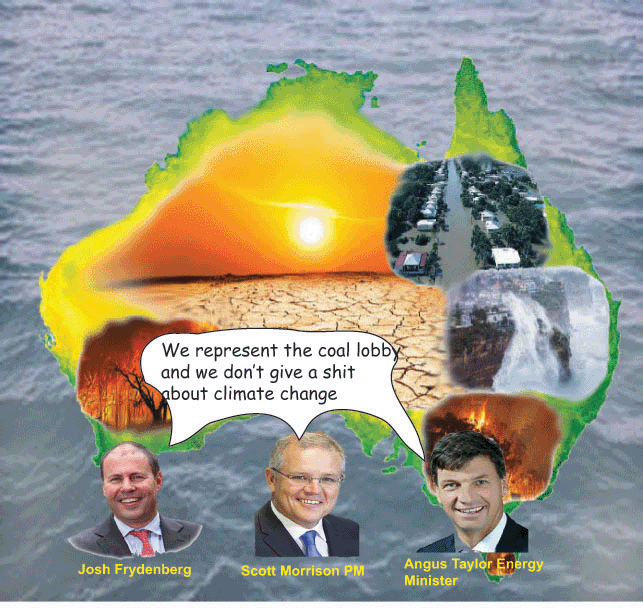 Passing the pollution: Australia becomes world’s biggest exporter of fossil fuels, https://thenewdaily.com.au/news/2020/07/09/australia-export-fossil-fuels/ Cait Kelly, Australia is now the biggest exporter of climate change, leading the world in selling fossil fuels, a new report reveals.Emissions from nations which bought our gas, coal and oil increased by 4.4 per cent between 2018 and 2019, with Australia now the world’s biggest fossil fuel producing country, the report from UNSW says. Passing the pollution: Australia becomes world’s biggest exporter of fossil fuels, https://thenewdaily.com.au/news/2020/07/09/australia-export-fossil-fuels/ Cait Kelly, Australia is now the biggest exporter of climate change, leading the world in selling fossil fuels, a new report reveals.Emissions from nations which bought our gas, coal and oil increased by 4.4 per cent between 2018 and 2019, with Australia now the world’s biggest fossil fuel producing country, the report from UNSW says.
Our exported emissions are now greater than the domestic pollution of Germany, Canada, Turkey and the UK. “Not only is Australia a laggard in meeting its UN Paris emission reduction targets, but it is also now the world’s largest exporter of coal and gas,” the authors wrote. “In fact, the emissions from Australia’s exported fossil fuels are now greater than Germany’s domestic emissions.” Australia has been on track to become the world’s bigger carbon dioxide polluter for a while, with a report from The Australian Conservation Foundation last year warning we would hit the milestone soon. Russia and Saudi Arabia were both above Australia as recently as August last year. Using new data from the Office of the Chief Economist, emissions from exported fossil fuels were 1.2 times greater than global aviation emissions in 2018 and 1.4 times greater than all the CO2 emissions produced by the summer bushfires in 2019. When Australian fossil fuels are burned overseas, the amount of carbon dioxide they produce is higher than the exported emissions of the world’s biggest oil and gas-producing nations, like Iraq and Kuwait. “Despite Federal Government claims that our national emissions have only a minimal impact on the global climate, Australia is, in fact, a major contributor to global climate change.” “The massive emissions that result from our fossil fuel exports are not counted in Australia’s national carbon budget under our UN climate obligations, nor do we take responsibility for the impact these emissions are having globally.” Australia is the world’s biggest exporter of coal and our exported emissions should be counted towards our overall emissions footprint, said lead researcher and professor of political philosophy Jeremy Moss. “We’re the Saudi Arabia of coal and gas. That’s not a good situation to be in,” he told The New Daily. “People say we’re not responsible for exports, the government spends a billion dollar to recycle our waste which otherwise would have gone to other countries. These emissions are also our problem. “Responsibility doesn’t stop at the border. We have the same view about plastic waste, uranium and live sheep exports.” The report calls for fossil fuel non-proliferation treaty, removal of the $47 billion worth of subsidies for the fossil fuel industry and phasing out production constant with climate goals,” Professor Moss said. “At least two-thirds of the known reserves of fossil fuels must be left in the ground if climate targets are to be met (IEA, 2012). “Production of fossil fuels must, therefore, be phased out rapidly. Countries such as Australia should not get a free pass to produce and export as much fossil fuels as they are able to.” The report follows the announcement that the COVID-19 economic recovery committee has made recommendations that the government underwrite a massive gas industry expansion. Australia’s Energy Minister, Angus Taylor, is proposing a gas led recovery out of the pandemic-induced recession. But a report from the Australia Institute revealed last week that fossil fuel was the worst-performing sector in the ASX 300 over the last decade. “The poor performance of fossil fuel companies is probably surprising to most Australians, who are routinely told by industry and political leaders that coal is the “bedrock” of Australia’s prosperity, or that gas will “fire” the recovery from COVID19,” it read. |
|
NUCLEAR’s WHOPPING CLIMATE LIE – theme for July 2020
 “If you tell a lie big enough and keep repeating it, people will eventually come to believe it. A lie told once remains a lie but a lie told a thousand times becomes the truth ”
Dr Goebbels would be delighted with the nuclear lobby’s lie that nuclear power is zero carbon and will fix climate change. He would be even more delighted with the current success of this lie.
“Think of the press as a great keyboard on which the government can play.”
The failing nuclear industry is fighting for its life. It now pitches its salvation on its claim to halt climate change. Even if
that were true (which it isn’t) the world would have to construct several thousand ‘conventional’ reactors, or  several millions of Small Modular Reactors (SMRs) very quickly, within a decade or two.
How is it that politicians , media, academics have swallowed this lie?

Australia seen as successful in Covid-19 response, deplorable in climate response
 Global report gives Australia an A for coronavirus response but a D on climate https://theconversation.com/global-report-gives-australia-an-a-for-coronavirus-response-but-a-d-on-climate-141982 John Thwaites Chair, Monash Sustainable Development Institute & ClimateWorks Australia, Monash University 6 July 20 The global Sustainable Development Report 2020, released this week in New York, ranks Australia third among OECD countries for the effectiveness of its response to the COVID-19 pandemic, beaten by only South Korea and Latvia.Yet Australia trundled in at 37th in the world on its overall progress in achieving the United Nations’ Sustainable Development Goals, which cover a range of economic, social and environmental challenges – many of which will be crucial considerations as we recover from the pandemic. Australia’s worst results are in climate action and the environment, where we rate well below most other OECD countries. Global report gives Australia an A for coronavirus response but a D on climate https://theconversation.com/global-report-gives-australia-an-a-for-coronavirus-response-but-a-d-on-climate-141982 John Thwaites Chair, Monash Sustainable Development Institute & ClimateWorks Australia, Monash University 6 July 20 The global Sustainable Development Report 2020, released this week in New York, ranks Australia third among OECD countries for the effectiveness of its response to the COVID-19 pandemic, beaten by only South Korea and Latvia.Yet Australia trundled in at 37th in the world on its overall progress in achieving the United Nations’ Sustainable Development Goals, which cover a range of economic, social and environmental challenges – many of which will be crucial considerations as we recover from the pandemic. Australia’s worst results are in climate action and the environment, where we rate well below most other OECD countries.
South Korea tops the list of effective COVID-19 responses, whereas New Zealand (which declared the coronavirus eliminated on June 8, albeit with a few sporadic cases since) is ranked sixth. Meanwhile, the United States, United Kingdom and several other Western European countries rank at the bottom of the list. South Korea, Latvia and Australia did well because they not only kept infection and death rates low, but did so with less economic and social disruption than other nations. Rather than having to resort to severe lockdowns, they did this by testing and tracing, encouraging community behaviour change, and quarantining people arriving from overseas. Using smartphone data from Google, the report shows that during the severe lockdown in Spain and Italy between March and May this year, mobility within the community – including visits to shops and work – declined by 62% and 60%, respectively. This shows how much these countries were struggling to keep the virus at bay. In contrast, mobility declined by less than 25% in Australia and by only 10% in South Korea. Why has Australia performed well?There are several reasons why Australia’s COVID-19 response has been strong, although major challenges remain. National and state governments have followed expert scientific advice from early in the pandemic. The creation of the National Cabinet fostered relatively harmonious decision-making between the Commonwealth and the states. Australia has a strong public health system and the Australian public has a history of successfully embracing behaviour change. We have shown admirable adaptability and innovation, for example in the radical expansion of telehealth. We should learn from these successes. The Sustainable Development Goals provide a useful framework for planning to “build back better”. The Sustainable Development Goals, agreed by all countries in 2015, encompass a set of 17 goals and 169 targets to be met by 2030. Among the central aims are economic prosperity, social inclusion, and environmental sustainability. They are arguably even more important than before in considering how best to shape our post-pandemic world. As the report points out, the fallout from COVID-19 is likely to have a highly negative impact on achievement of many of the goals: increased poverty due to job losses (goal 1), disease, death and mental health risks (goal 3), disproportionate economic impacts on women and domestic violence (goal 5), loss of jobs and business closures (goal 8), growing inequality (goal 10), and reduction in use of public transport (goal 11). The impact on the environmental goals is still unclear: the short-term reduction in global greenhouse emissions is accompanied by pressure to reduce environmental safeguards in the name of economic recovery. How do we ‘build back better’?The SDGs already give us a roadmap, so really we just need to keep our sights set firmly on the targets agreed for 2030. Before COVID-19, the world was making progress towards achieving the goals. The percentage of people living in extreme poverty fell from 10% in 2015 to 8.6% in 2018. Access to basic transport infrastructure and broadband have been growing rapidly in most parts of the world. Australia’s story is less positive, however. On a composite index of performance on 115 indicators covering all 17 goals, the report puts Australia 37th in the world, but well behind most of the countries to which we like to compare ourselves. Sweden, Denmark and Finland top the overall rankings, followed by France and Germany. New Zealand is 16th. It is not surprising, in light of our performance during the pandemic, that Australia’s strongest performance is on goal 3: good health. The report rates Australia as on track to achieve all health targets. Australia also performs strongly on education (goal 4), and moderately well on goals relating to water, economic growth, infrastructure and sustainable cities. However, we perform extremely poorly in energy (goal 7), climate change (goal 13) and responsible consumption and production (goal 12), where our reliance on fossil fuels and wasteful business practices puts us near the bottom of the field. On clean energy (goal 7), the share of renewable energy in total primary energy supply (including electricity, transport and industry) is only 6.9%. In Germany it is 14.1%, and in Denmark an impressive 33.4%. Australia rates poorly on goal 12, responsible consumption and production, with 23.6kg of electronic waste per person and high sulfur dioxide and nitrogen emissions. Australia’s performance on goal 13, climate action, is a clear fail. Our annual energy-related carbon dioxide emissions are 14.8 tonnes per person – much higher than the 5.5 tonnes for the average Brit, and 4.3 tonnes for the typical Swede. And whereas in the Nordic countries the indicators for goal 15 — biodiversity and life on land — are generally improving, the Red List measuring species survival is getting worse in Australia. There are many countries that consider themselves world leaders but now wish they had taken earlier and stronger action against COVID-19. Australia listened to the experts, took prompt action, and can hopefully look back on the pandemic with few regrets. But on current form, there will be plenty to regret about our reluctance to follow scientific advice on climate change and environmental degradation, and our refusal to show anything like the necessary urgency. |
|
Independent advice essential for Kimba community: they have received only pro nuclear dump propaganda
 Having read the Hansard transcript of Tuesday’s Senate committee hearing it becomes even more imperative that the community at Kimba opposing the facility and others who are not completely convinced must get their own independent advice and assessment on the government’s proposals
The most concerning of the evidence was that on behalf of ARPANSA which contrary to expectations suggested that any community involvement or engagement in the licensing process would be rather perfunctory
The way I understand that evidence by Dr Larsson is that the extent of the consultations with the community will really be what and how the community decides – this would suggest that they will be in a far stronger position if they have proper technical information and knowledge to argue against the government’s proposals in the course of the consultations
In view of this evidence the chairman and members of the inquiry committee should be formally requested to provide the necessary funding for the independent advice and assessment and the right to bring the results into the evidence for the inquiry
The community at Kimba opposing the facility, and others must stress the disadvantage and unfairness in their being deprived of that advice and assessment, and that is it is also equitable for the Government to pay for the independent assessment having regard to the money already given to the community to bolster approval for the government’s choice of the facility location
After all how can ARPANSA expect them to be fully and properly involved in the community consultation process if they do not have the necessary information?
AustralianGovtWatcher comments on Senate Committee enquiry hearing on Tuesday 30 June 2020
In general both the committee members and the witnesses appeared to be ill prepared and lacked knowledge of some of the pertinent issues involved
Several important factors were neither raised by questions nor otherwise dealt with by the witnesses – these included:
- details of expenditure of the whole exercise particularly the cost of the reports by AECOM
- more specific description of how the Kimba proposals and present arrangements for storage of nuclear waste comply with international standards and best practice
- no information on the radionuclides inventories and mobility
- information on examination of techniques and methods for permanent disposal of intermediate level waste – merely mentioned directional drilling which no doubt refers to the borehole technology
- no specific mention of geological burial requirements and applicable codes
- complete silence on immediate availability of the highly suitable Leonora site of the Azark Project
- no questions regarding the previous nominations
- no questioning of the ballot results yet seemed to agree with the Department’s proposition that the Barngarla peoples’ own ballot was of not much help since so many had not voted
Senator Sarah Hanson-Young pursued a couple of worthwhile points regarding consultations with the Barngarla and their lack of informed consent and the issue of double handling of the intermediate level waste by initial storage at Kimba followed by permanent disposal at some other location
The other member who pursued a number of issues with some success was Senator Jenny McAllister but again she appeared to lack the required knowledge to be really effective
However she was a butt to Senator Chris Carr who is obviously very much in favour of the Kimba proposal particularly with his references to his discussions with Dr Adi Paterson from ANSTO
Senator Rex Patrick asked some good questions but regrettably this was obviously slanted towards his present campaign to get the waste disposed of at Woomera
Perhaps the most badly prepared witness was Ms Sam Chard from the Department who simply could not answer some fairly basic questions and kept asking for them to be put on notice for subsequent provision of the necessary information – she was actually castigated by Senator McAllister
Asking for requests to be put on notice is invariably good tactics to avoid having to answer immediately an uncomfortable question and I suspect there is more use of this than necessary
However this can be reduced to some extent if the inquiry committee made greater use of its powers of production and discovery before and even during the hearings
The witness with whose answers I was disappointed – and I did see a bit of him on video – was Dr Carl-Magnus Larsson from ARPANSA who was very noncommittal and not extremely helpful by continuously claiming that ARPANSA would only become involved once it received the applications for the necessary licences for the Kimba facility
The very disappointing aspect of his evidence is that he would not provide any significant technical information and seemed too interested in shoring up the position of ANSTO
It is of course very difficult in these hearings since the members of the enquiring committee are mostly not trained in the art of forensic questioning as well as having insufficient knowledge to make the inquiry process very effective
It also seems that the research team for the enquiry did not delve sufficiently into various issues that should be investigated which only makes it more difficult for the committee considering the limited time given to each member for questions
From the submissions by the government and its agencies it is now quite clear that the community members opposing the Kimba facility must get proper independent assessment and advice to be able to be involved in the consultations with ARPANSA during the licensing process in a meaningful manner
They should ask the committee to ensure sufficient funds are available for that purpose as otherwise it will be practically impossible for the community members to deal with the technical and rather scientific aspects of the licensing applications particularly as Dr Larsson was not overly encouraging in his evidence about assisting them
The best self serving evidence was from AEMCO who simply relied on their report and very stated that quite a few of the issues raised by questions ere outside of its commission
Murdoch press enthusiastic about nuclear propagandist Michael Shellenger
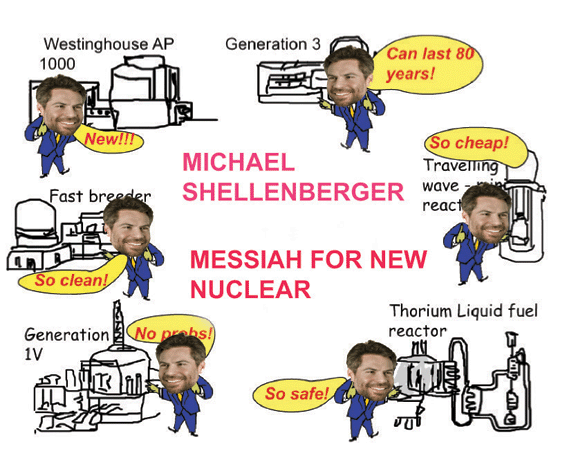
Murdoch press supports ‘reformed climate activist’ Michael Shellenberger https://independentaustralia.net/business/business-display/murdoch-press-supports-reformed-climate-activist-michael-shellenberger,14065 By Steve Bishop | 3 July 2020, The mainstream press published an attack on climate science by a supposed environmentalist who is, in fact, a nuclear lobbyist, writes Steve Bishop.
THE AUSTRALIAN misled its readers this week when it carried a major article purporting to be written by a climate activist who was, as it turned out, admitting climate science was bunkum.
Michael Shellenberger, headlined as an environmentalist in the article, is, in fact, a self-advertised nuclear power lobbyist and an advocate for nuclear weapons proliferation.
Other Murdoch newspapers and Australia’s Sky News have also carried Shellenberger’s claim that:
‘On behalf of environmentalists everywhere, I would like to formally apologise for the climate scare we created over the past 30 years.’
He may once have been an environmentalist, but the fact is he was exposed – not for the first time – for attacking climate science as long ago as 2010 by the Public Interest Research Centre which reported that along with a co-author he had restated:
‘…a plethora of half-truths, misrepresentations and outright fantasies that have lately become almost canonical in the public sphere.’
Shellenberger makes his agenda clear on various websites and elsewhere: the present approach to dealing with climate change is not working, renewable power sources won’t solve the problem and, therefore, the entire world needs to be nuclear powered.
He told the Sydney Morning Herald in 2017 that the widespread adoption of nuclear power across the world would solve the climate change problem:
“…because it basically reduces your carbon emissions to near zero in the power sector.”
The Herald described him not as an environmentalist but as a ‘nuclear power advocate’.
In 2003, he co-founded the Breakthrough Institute which says on its website:
Breakthrough’s energy work has focused heavily on the future of nuclear energy. Along with a growing cohort of scientists, journalists, philanthropists, and environmentalists, we have made the case that addressing climate change will require abundant, cheap, safe, and reliable nuclear energy.’
In 2016, he became the founder and president of an enterprise lobbying for the nuclear industry, giving it the misleading title of Environmental Progress.
He describes its aim:
‘The greatest threat to the climate today comes from the decline of clean energy as a share of electricity globally. EP is working with scientists, conservationists and citizens around the world to defend our largest source of clean energy, nuclear power.’
The website boasts:
‘He has helped save nuclear reactors around the world, from Illinois and New York to South Korea and Taiwan, thereby preventing an increase in air pollution equivalent to adding over 24 million cars to the road.’
In a major article for Forbes magazine in 2018, Shellenberger wrote:
‘Who are we to deny weak nations the nuclear weapons they need for self-defence?’
In another 2018 Forbes article under the cross-heading ‘Why nuclear energy prevents war’, Shellenberger wrote:
‘After over 60 years of national security driving nuclear power into the international system, we can now add “preventing war” to the list of nuclear energy’s superior characteristics.’
Renew Economy reported in 2017 he was:
‘…stridently pro-nuclear, hostile towards renewable energy and hostile towards the environment movement.’
At that time, Shellenberger was in Australia to speak at a major conference – not a climate change summit but the International Mining and Resources Conference – to advance the cause of nuclear power.
This is not the first time The Australian has used this nuclear lobbyist to attack renewable energy and climate science. It featured him three years ago under the headline: ‘Nuclear “must replace coal, gas”’.
He was in Australia to promote his message that wind and solar have failed, that they are doubling the cost of electricity and that:
“…all existing renewable technologies do is make the electricity system chaotic and provide greenwash for fossil fuels.”
In his article, Shellenberger gives 12 examples of scientific findings which he says are incorrect and which are climate alarmism.
Take just the first: ‘Humans are not causing a “sixth mass extinction”’.
His assertion contradicts the work of more than 1,000 scientists contributing to the Intergovernmental Science-Policy Platform on Biodiversity and Ecosystem Services (IPBES) which found ‘1,000,000 species threatened with extinction’ and warned:
“We are eroding the very foundations of our economies, livelihoods, food security, health and quality of life worldwide.”
What makes The Australian’s publishing of the article all the more risible is that in reality, it is a puff piece for Shellenberger’s new book, ‘Apocalypse Never’ and is more or less identical with what he had published on his website on 29 June.
Forbes, which has carried Shellenberger’s articles in the past, withdrew the puff piece.
National Post asked Forbes why this had happened and was told:
‘Forbes requires its contributors to adhere to strict editorial guidelines. This story did not follow those guidelines and was removed.’
Don’t expect The Australian to follow suit.
(Readers who might want to read about a real climate scientist changing his mind about global warming should read Professor Richard Muller’s story.)
1 This month.
20 September –National Day of Action in Melbourne on the International Day of Peace


Help Aunty Sue Protect Her Land and Sacred Sites From Destructive Rocket Testing.
.

Australians deserve the truth
about
AUKUS – https://aukuspublicinquiry.com/

PETITION – To: Prime Minister Anthony Albanese and the Australian Labor Government

of the week – Australians for War Powers Reform (AWPR)
To see nuclear-related stories in greater depth and intensity
 Antinuclear
