Nuclear power ‘not passing the pub test’, survey authors say
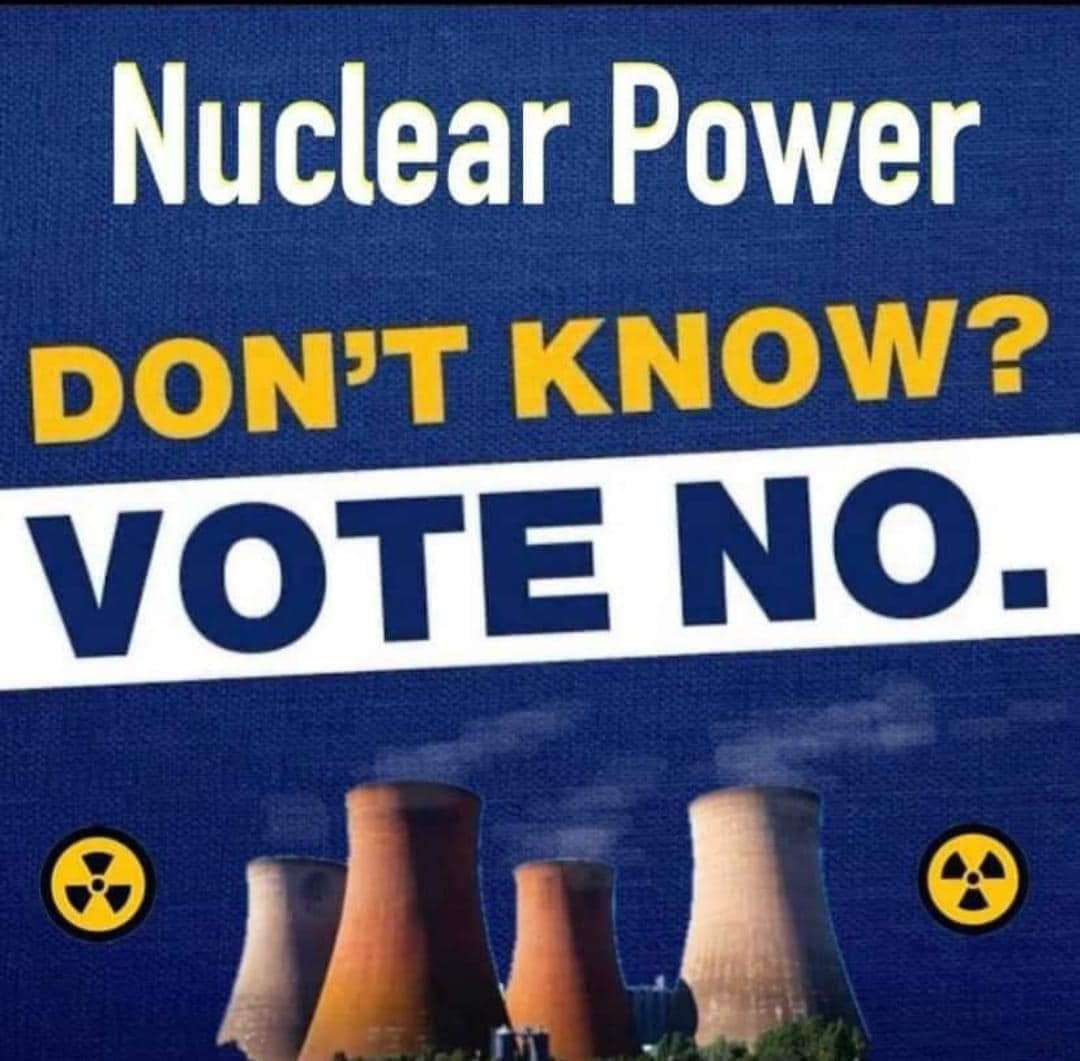
1 May 2025 , By Staff Reporter, https://www.aumanufacturing.com.au/nuclear-power-not-passing-the-pub-test-survey-authors-say
Support among Australians for nuclear power has fallen, according to a survey of more than 4,000 respondents conducted by Griffith University’s Climate Action Beacon in partnership with the Monash Climate Change Communication Research Hub.
The National Climate Action Survey was showing that “the logic of investment and risk” didn’t pass most Australians’ pub tests, according to Griffith University Associate Professor Kerrie Foxwell-Norton, a lead collaborator on the survey, which is now in its fourth year.
According to a statement from Monash University, among “key initial findings” were 59 per cent of respondents wanted to keep a ban on nuclear energy in 2024 (up from 51 per cent in 2023), 26 per cent said the risks far outweigh the benefits (up from 21.9 per cent) and over 54.8 per cent “would be very or extremely concerned” if a nuclear power plant was placed near them.
“The survey is a peerless, independent source of information about Australians’ climate actions, attitudes and beliefs as the nation – and the world – embarks upon societal transformations to a sustainable low carbon future,” according to Monash University Professor Libby Lester.”
The survey’s full findings will be released in September. Previous year’s results can be accessed here.
A major point of difference in the current election campaign, which will conclude this weekend, is in the opposition’s pledge to overturn a ban on developing any new nuclear power sites in Australia.
The Coalition plan involves two nuclear reactors beginning operation in the 2030s and, eventually, reactors in each mainland state at the site of retired or retiring coal plants.
Firefighters and nurses call on Coalition to drop nuclear energy plans

Region Canberra, 1 May 2025 | Chris Johnson
Firefighters and healthcare workers have written an open letter to Peter Dutton just a few days out from polling day, asking the Opposition Leader to drop his nuclear energy plan.
Organisations representing more than 350,000 emergency services workers this week called on Mr Dutton to dump the policy in the interests of good health.
The open letter was signed by the Australian Nursing and Midwifery Federation, Emergency Leaders for Climate Action, Climate Action Nurses, Climate and Health Alliance, Doctors for the Environment Australia, and the United Firefighters Union of Australia.
After stressing that doctors, paramedics, nurses, midwives and firefighters are among the hundreds of thousands of people the groups represent, the letter expresses “grave concerns” regarding the potential introduction of nuclear power into Australia.
“As the frontline responders to disasters and emergencies, we are uniquely positioned to assess the risks posed by nuclear energy infrastructure to public safety, worker health, and environmental security,” the letter states.
“Australia’s emergency services do not have the support or resources to respond to nuclear disasters.
“Unlike other nations with established nuclear industries, Australia lacks the necessary infrastructure, resources, and expertise to manage incidents involving nuclear reactors or radioactive waste transportation and storage.
“Furthermore, international examples have shown that populations residing in close proximity to nuclear reactors are at an increased risk of developing severe health complications.
“Existing emergency response and health frameworks would need extensive – and costly – overhauls to address these challenges effectively.
“Nuclear accidents expose emergency responders to ionizing radiation levels far exceeding safe occupational limits.
“International precedents such as Chernobyl and Fukushima demonstrate the devastating health impacts on first responders, including acute radiation sickness and long-term cancer risks.”
The letter then goes on to ask the Coalition to abandon plans for nuclear energy in Australia and prioritise safer energy solutions that “do not endanger” workers or communities, such as solar and wind backed up by storage………………………..
The backlash has been strong enough that Mr Dutton has barely mentioned nuclear energy during the election campaign.
If asked about it, however, he repeats his strong support for the energy plan.
Federal secretary of the Australian Nursing and Midwifery Federation, Annie Butler, said she was concerned about the impact that the proposed nuclear plants would have on the health of all people, but particularly nurses, midwives and carers.
“What we are still yet to see are detailed health risk assessments including how the health of nurses, midwives, carers and the community will be protected,” she said…………………..
Former NSW Fire and Rescue Commissioner Greg Mullins, who went on to found the group Emergency Leaders for Climate Action, said the Coalition’s nuclear scheme “gives rise to far more questions than answers” and in the “unlikely event it is ever actually delivered” it would result in massive amounts of dangerous, additional climate pollution.
“Firefighters and other first responders will be expected to deal with situations for which they have no training, equipment or experience, and like in Chernobyl, possibly lose their lives,” he said.
“Costs for protection from nuclear accidents were not factored into the Coalition’s vague modelling, and nobody should be fooled – this is nothing more than a ruse to continue generating profits for the fossil fuel industry who are funding the Coalition’s election campaign.”
Greg McConville, national secretary of the United Firefighters Union of Australia, said: “Much has been said about the cost of living in this election, but we should not forget the cost of lives………..
The open letter points out that current federal guidelines allow firefighters, emergency services, essential services and health workers to be exposed to radiation doses up to 500 times higher than civilian safety limits during catastrophic events.
“This is an unacceptable risk,” the letter states. https://region.com.au/firefighters-and-nurses-call-on-coalition-to-drop-nuclear-energy-plans/865191/
Dutton promises $40b debt cut as nuclear questions grow
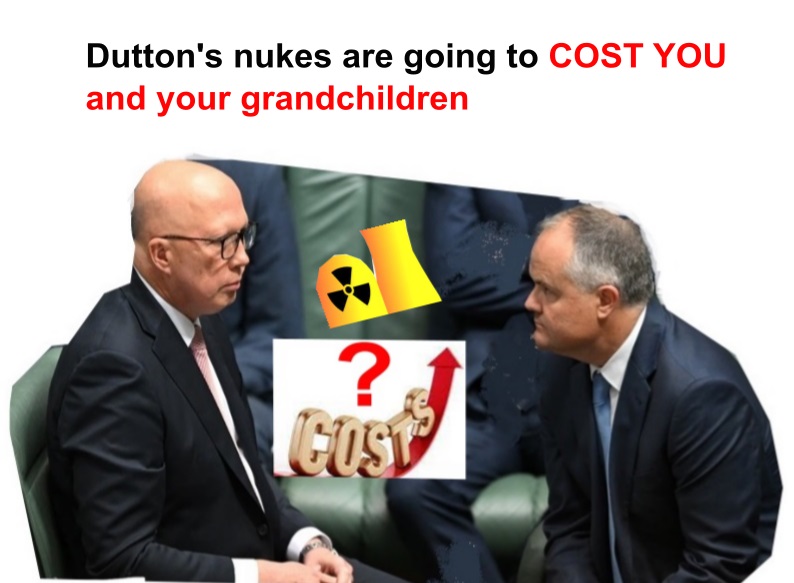
The Age, By Shane Wright and Mike Foley, April 30, 2025
The Coalition will pledge to slash at least $10 billion out of budget deficits over the next four years while bringing down government debt by $40 billion amid suggestions the cost of its signature nuclear power policy will be far more expensive than it has promised.
Shadow treasurer Angus Taylor and finance spokeswoman Jane Hume will on Thursday reveal the Coalition’s full costings, which will confirm cuts to several high-profile Labor programs, including its pledge to wipe $16 billion in student debts.
But even with its promises, both the Coalition and government will go to voters on Saturday with the budget facing deficits over the rest of the decade and gross debt soaring through the $1 trillion mark.
This week, ratings’ agency S&P Global warned Australia’s AAA credit rating could be put at risk if either of the major parties’ election promises resulted in larger structural deficits and more debt than expected.
On Monday, Treasurer Jim Chalmers and Finance Minister Katy Gallagher released the government’s own costings, which showed total budget deficits would be $1.1 billion lower than forecast in the March 25 budget.
Despite the modest improvement, the budget would show cumulative deficits of $150 billion over the next four years.
Taylor and Hume will outline cuts that will bring down the cumulative deficits by a double-digit level, with one of the biggest savings expected to come from axing up to 41,000 public servants based in Canberra. They will be reduced through natural attrition over the next five years.
It will scrap the government’s $14 billion Made in Australia production tax credits for the mining and green hydrogen sector.
The write-off of student debt, affecting both tertiary and vocational education students that the government estimates saves affected people about $5000, is due to start from June 1. But the Coalition would not go ahead with the proposal………………………………………….
Taylor and Hume will promise to bring gross debt down by $40 billion. That will be partly achieved by axing the government’s Rewiring the Nation Fund and stopping the $10 billion Housing Australia Future Fund.
The Coalition’s costings will have to include the impact of its 25¢-a-litre cut in fuel excise for the next 12 months, worth $6 billion, and its one-off $1200 tax offset to low- and middle-income earners that is estimated to cost $10 billion.
Chalmers accused the Coalition of being sneaky by holding back its costings, including key details about its nuclear policy, until the second-last day of the campaign. Chalmers did not release Labor’s 2022 election costings until the Thursday before polling day.
He said there were already black holes around the Coalition’s mortgage interest deductibility, petrol excise and small-business fringe benefits tax reduction policies while it would attempt to use heroic assumptions around productivity growth to make its numbers add up.
“They want to skate through all the way to the election, or as close as possible, without coming clean. I think that speaks volumes about the approach that they’re taking,” Chalmers said.
A key issue remains the Coalition’s nuclear policy. Peter Dutton has slammed as a lie the government’s claim that it will cost $600 billion, arguing CSIRO research shows it would cost $116 billion to deliver its planned five large-scale and two small modular reactors at seven sites across the country.
The $116 billion figure is based on construction costs for a specific type of reactor – Westinghouse’s AP1000, which is one of the most common and cheapest designs in use around the world.
Coalition energy spokesman Ted O’Brien and Nationals Leader David Littleproud have promised not to use the AP1000 if it would reduce irrigation water to local farmers.
The AP1000 requires significant amounts of water to cool its reactor.
Former Land and Water Australia chief executive Andrew Campbell found there is not enough water at least five of the seven sites nominated by the Coalition for nuclear reactors, in his recent report commissioned by the Liberals Against Nuclear lobby group.
Littleproud and O’Brien have separately raised the prospect of building what are known as dry cool reactors.
However, according to the World Nuclear Association, they cost up to four times more than a typical water-cooled reactor such as the AP1000.
Dry cooled reactors, which use air rather than water to dissipate heat from the plant’s core, are not in commercial use at large-scale nuclear plants.
Dutton confirmed on Wednesday that the Coalition had not finalised which reactors would be used.
“We will take advice from the experts on what is the best fit for those seven sites,” he said.
Littleproud told the National Press Club on April 24 that he had promised to farmers “there is nothing extra coming out of the consumptive pool” of water available to irrigators, and models would be selected based on their water consumption.
“There are other technologies in terms of dry cooling,” he said.
O’Brien in February said, “the nuclear technology for Australia is yet to be selected”………. https://www.theage.com.au/politics/federal/dutton-promises-40b-debt-cut-as-nuclear-questions-grow-20250430-p5lvei.html?ref=rss&utm_medium=rss&utm_source=rss_feed
Australian Government ignores AUKUS ‘very high risk’ warning from the Admiral in charge
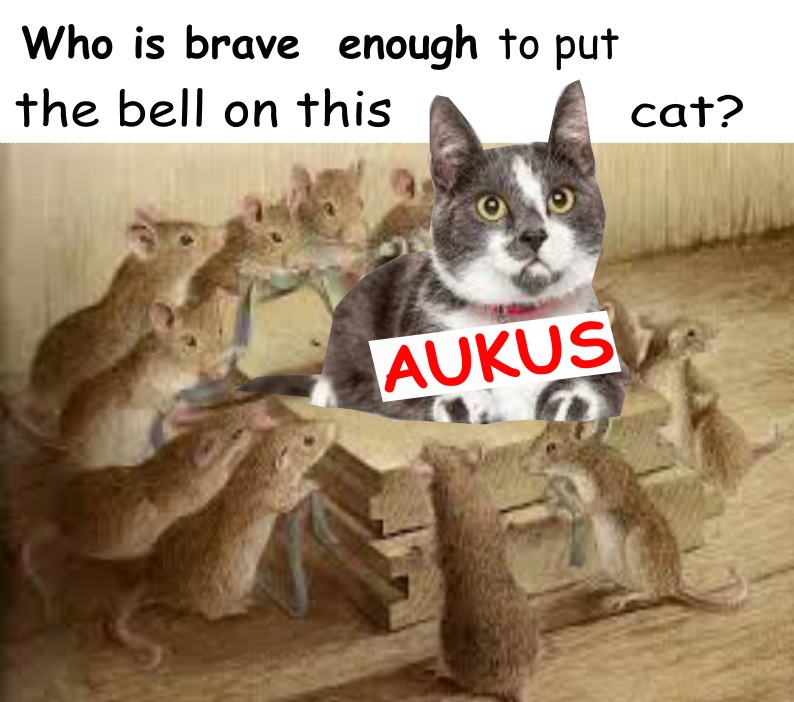
Admiral Mead sought to bell the cat while Defence Minister Marles has not been straight with the Australian people about the very high risks of AUKUS, even though he has been briefed on and appears to have informed Cabinet of those risks.
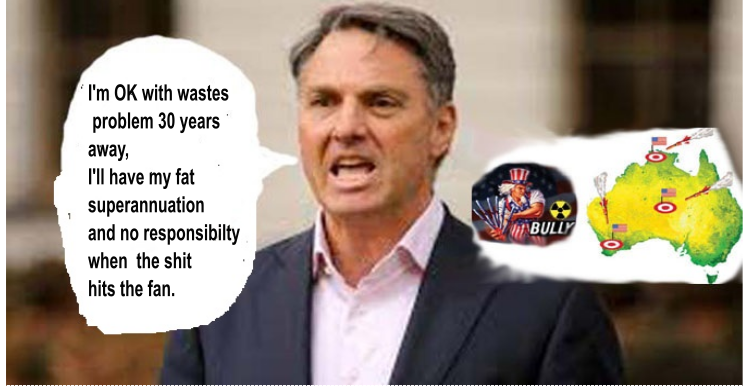
Marles should front up about this concealment without delay.
Labor not blameless
by Rex Patrick | Apr 29, 2025, https://michaelwest.com.au/government-ignores-aukus-high-risk-warning-from-the-admiral-in-charge/
The AUKUS submarine project faces huge risks, and Cabinet knows. But as the Government ships $2B of taxpayers’ money to the US this year, with much more to follow, the taxpayer is not being told. Rex Patrick reports.
On 26 February this year, Vice Admiral Jonathan Mead, the man in charge of AUKUS, advised the Senate that the AUKUS submarine program was “very high risk”. He said, “We’ve made that clear to government, and the government has made that clear to the public.”
However, it has not.
I follow AUKUS closely and had not heard that publicly before. Whilst it is absolutely the case, and something MWM has reported on extensively, this was the first public admission of the very high risk nature of the project from the Australian Submarine Agency.
Concerns about US submarine production rates and the weakness of the UK’s submarine industrial base have generated grave doubts about whether the $368B AUKUS scheme will deliver nuclear-powered submarines for Australia.
Moreover, former Prime Minister Malcolm Turnbull has revealed, after conversations with insiders, that there is no Plan B.
“Plan B is that we will not get any submarines.”
FOI ahoy
I was somewhat surprised by Admiral Mead’s unusual candour, so on 27 February, I moved to test the veracity of his remarks with an FOI application directed at the Australian Submarine Agency (ASA) seeking access to “any ministerial submission or briefing provided by ASA to the Minister for Defence … that refers to the AUKUS nuclear submarine program as involving ‘high risk’ or ‘very high risk’.”
I also sought access to ‘any statement made by the Minister for Defence or the Minister for Defence Industry and Capability Delivery that refers to the AUKUS nuclear submarine program as involving ‘high risk’ or ‘very high risk’.”
A decision on those was made this week. FOI applications can reveal the truth by what is disclosed, by what is withheld, and by confirming what doesn’t exist.
ASA confirmed the existence of a ministerial briefing characterising the AUKUS submarine program as involving ‘high risk’ or ‘very high risk’, but refused access to that briefing on national security and Cabinet secrecy grounds. Significantly, ASA’s refusal decision confirmed this document was produced for the dominant purpose of briefing a Minister on an attached Cabinet submission.
In effect, the Submarine Agency confirmed Admiral Mead’s statement that ASA has briefed the government on the ‘high risk’ or ‘very high risk’ nature of the AUKUS project, and that briefing was submitted to the Defence Minister for Cabinet consideration.
“That high-risk assessment has gone to the very top of the Government.”
Alarm bells should be ringing.
Misleading the public
But the FOI decision also reveals that Defence Minister Richard Marles has not been forthcoming with the Australian public about the full hazards of AUKUS.
In relation to statements the minister has made to the public on the risk status of the project, the Australian Submarine Agency advised that ‘no in scope documents were identified’ that show the Defence Minister has made any public statement that acknowledges the ‘high’ or ‘very high’ risk of the AUKUS scheme.
The agency was able to find only a handful of statements referring to risk management in general and assertions that the United Kingdom will carry the primary risks of the AUKUS-SSN construction.
Admiral Mead was not correct in his statement to the Senate, but more importantly, the Government has been caught red-handed fudging the risks associated with the AUKUS scheme. The public has been misled.
Admiral Mead sought to bell the cat while Defence Minister Marles has not been straight with the Australian people about the very high risks of AUKUS, even though he has been briefed on and appears to have informed Cabinet of those risks.
Marles should front up about this concealment without delay.
Labor not blameless
Last week, at a pre-polling booth, I was standing next to a Labor volunteer who was handing out how-to-vote cards for the seat of Adelaide. An elderly gentleman stuck out his hand and asked the volunteer for a how-to-vote card.
“We have to stop the Liberals getting in”, he said. “We don’t need nuclear power”.
I couldn’t resist. “But you’re taking a Labor how-to-vote”, I said. He gave me a strange look. “What about the eight naval reactors?” I queried. “A naval reactor is a reactor, and naval nuclear waste is nuclear waste”.
Many in the Labor camp think AUKUS is Morrison’s (and Peter Dutton’s) baby. But for Labor, that’s just a convenient mistruth. In September 2021, Morrison announced AUKUS. But he only announced a study. It was Prime Minister Anthony Albanese at the March 2023 San Diego “kabuki show” (as described by Paul Keating) that turned it into a formal Defence project behemoth with a projected cost of $368 billion.
Pre-polling booths are a good place to hang out for political gossip. I also held a discussion with a long-standing grassroots Labor Party member who proceeded to tell me how he had been sidelined for his opposition to AUKUS.
There’s no doubt the Labor rank-and-file have been cut out of the party’s decision-making with the Labor leadership ramming an AUKUS endorsement through the party’s 2023 national conference. Since then, the dissenting views of many, perhaps even a majority of Labor members, have been marginalised and suppressed.
AUKUS to be torpedoed
Politics aside, any project manager worth their salt would put an end to AUKUS. It’s a looming procurement shipwreck.
The US will not be able to supply the Virginia Class submarines to the Royal Australian Navy. The US Congressional Research Service has calculated a US build rate of 2.3 boats per annum is necessary to enable the US to provide boats to Australia without harming US undersea warfare capability. The current build rate is somewhere between 1.1 and 1.3 boats per annum.
The British submarine industry is one big cluster fiasco. Fruit that will flow from that program will be late, possibly rotten, and far more expensive than planned.
Meeting delivery obligations by the US and UK under the program will be really hard. And the fact that the Australian Government can’t even be up front and honest about the program
“suggests there is no chance of success.”
But Albanese need not worry, nor Marles. By the time all of this sinks in, they’ll be out of the system. It will be our children who suffer from the tens of billions wasted and the massive hole in our national security capability.
Rex Patrick
Rex Patrick is a former Senator for South Australia and earlier a submariner in the armed forces. Best known as an anti-corruption and transparency crusader, Rex is running for the Senate on the Lambie Network ticket next year – www.transparencywarrior.com.au.
Confirmed: Australian weapons sold to Israel
With the federal government covering for them, a Canberra-based company has supplied lethal weapons to a country accused of war crimes and genocide
Michelle Fahy, Undue Influence. Apr 30, 2025
This article was first published with Declassified Australia on 26.4.25
The Australian counter-drone weapons system seen at a weapons demonstration in Israel recently is actually just one of a few that were sold by Canberra-based company Electro Optic Systems (EOS) and sent through its wholly-owned US subsidiary to Israel, Declassified Australia can reveal.
It was the ABC who broke the news of the EOS weapons system being provided for the demonstration trial. In response, Prime Minister Anthony Albanese continued to insist, as he has since the war in Gaza began, that Australia does not sell weapons to Israel.
However the weapon displayed wasn’t just provided on loan for the demonstration – the weapon has been sold to the Israelis. Declassified Australia can reveal that EOS, by its own admission, sold more than one of its R400 weapons systems to the Israelis prior to the demonstration.
An EOS company presentation, titled ‘2024 Full Year Results’, describes a “potential new customer” for the R400 weapon in the “Middle East”. The presentation, prepared for EOS shareholders and lodged with the Australian Stock Exchange, is dated 25 February 2025.
EOS describes this potential new customer for its R400 being a “preliminary” stage opportunity, meaning a bid is being prepared or has been submitted (page 16).
The overall opportunity is valued at <$100 million with the company stating (page 36) that more than one weapons system has been sold:
“Sample products sold, demo held, discussions underway.” (Emphasis added.)……………………………………………………………………………………………………………………………………………………………….
Words are not enough
The Australian government and the Defence Department have continued their obfuscation of Australia’s weapons trade with Israel, as Declassified Australia has been reporting repeatedly.
ABC television has reported how the government continues to insist no weapons or ammunition had been supplied “directly to Israel” since its latest genocidal war on Gaza began. The addition of the word “directly” is a notable change to the government’s wording since this EOS news emerged.
In response to the ABC report, Prime Minister Albanese said: “We do not sell arms to Israel… We looked into this matter and the company has confirmed with the Department of Defence that the particular system was not exported from Australia. Australia does not export arms to Israel.”
Declassified Australia has previously reported on the Albanese Government’s repeated and misleading use of the phrase ‘to Israel’.
Arms companies are known for exporting their weaponry, or parts and components thereof, via third party countries in an attempt to cover their tracks.
A defence industry source told the ABC the Australian-made components of the EOS R400 remote weapons system were assembled at the company’s wholly-owned US subsidiary in Alabama USA, before being shipped to Israel without an Australian export approval.
Military exports, including ammunition, munitions, parts and components, do not need to travel ‘directly’ to Israel to be prohibited under the Arms Trade Treaty.
Governments are required to find out where their weapons will, or may, end up and then make responsible decisions that comply with the treaty. A government must consider and assess the potential ‘end users’ of its military exports.
A UN expert panel has issued repeated demands that States and companies cease all arms transfers to Israel or risk complicity in international crimes, possibly including genocide. It stated:
An end to transfers must include indirect transfers through intermediary countries that could ultimately be used by Israeli forces, particularly in the ongoing attacks on Gaza… [Emphasis added]
Greens’ defence spokesperson, Senator David Shoebridge, has said, “What we might be seeing here is the impact of what’s called AUKUS Pillar 2, the removal of any controls for the passage of weapons between Australia and the United States, and then Australia permitting the United States to send Australian weapons anywhere”.
Not the first time
EOS has a history of supplying its remote weapons systems to military regimes accused of extensive war crimes.
During the catastrophic Yemen war which started in 2014, despite significant evidence of war crimes, EOS sold its weapons systems to both Saudi Arabia and the United Arab Emirates. EOS enjoyed the full support of the Turnbull coalition government and its defence industry minister Christopher Pyne.
In early 2019, ABC TV reported, Saudi Arabia awarded EOS a contract to supply the Kingdom with 500 of its R400 Remote Weapons Systems.
EOS has also benefited from the government-to-industry revolving door. Former chief of army, Peter Leahy, was on the EOS board from 2009 until late 2022, encompassing the period of the Yemen war. He served as the company’s chair from mid-2021 until his departure.
The two longest-serving current members of the EOS board are former chief of air force, Geoff Brown (joined 2016) and former Labor senator for the ACT, Kate Lundy (joined 2018).
The release of a Human Rights Watch (HRW) report in 2023 raised serious concerns about EOS and its Saudi Arabian arms deals.
HRW’s report revealed that hundreds, possibly thousands, of unarmed migrants and asylum-seekers had been killed at the Yemen-Saudi border in the 15 months between March 2022 and June 2023, allegedly by Saudi officers.
Human Rights Watch says it identified on Google Earth what looks like “a Mine-Resistant Ambush Protected (MRAP) vehicle” near a Saudi border guard posts north of the Yemeni refugee trail in January 2023.
The vehicle has what appears to be “a heavy machine gun mounted in a turret on its roof”. This description matches the military equipment that Australia sold to Saudi Arabia a few years earlier.
Declassified Australia put a number of questions to EOS, the Department of Defence, and the offices of the Prime Minister, the Defence Minister, and the Foreign Minister. None responded to our questions on this matter. https://undueinfluence.substack.com/p/confirmed-australian-weapons-sold?utm_source=post-email-title&publication_id=297295&post_id=162393240&utm_campaign=email-post-title&isFreemail=true&r=1ise1&triedRedirect=true&utm_medium=email
Dutton’s Nuclear Meltdown: A Debate Debacle That Proves He’s Unfit for the Lodge
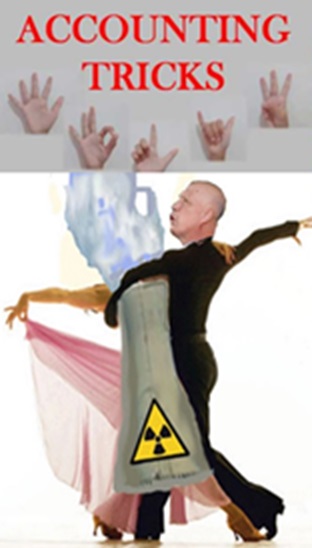
April 28, 2025 Lachlan McKenzie, Australian Independent Media
The fourth and final leaders’ debate of Australia’s 2025 election was less a clash of titans and more a masterclass in how not to audition for prime minister. Peter Dutton, the Opposition Leader whose campaign has resembled a slow-motion car crash, managed to solidify his reputation as a man allergic to facts, coherence, and basic arithmetic. Meanwhile, Anthony Albanese, while hardly flawless, emerged as the adult in the room – albeit one occasionally caught texting imaginary world leaders. Let’s dissect the carnage.
Nuclear Fantasyland: Dutton’s Reactor Roadshow Goes Nowhere
Dutton’s grand plan to build seven nuclear reactors – a policy so unserious it belongs in a SimCity game – was eviscerated yet again. When pressed on why he hadn’t visited a single proposed reactor site during the campaign, Dutton squirmed like a kid caught fibbing about homework. His excuse? “I’ve visited them before!” Sure, Pete, and I’ve “visited” the gym in my mind while eating Tim Tams. Experts have already torched his nuclear pipe dream as economically unviable and decades too late to address climate change. Albanese, ever the cheeky pragmatist, quipped: “The only gas policy the Coalition has is gaslighting the Australian public.” Mic drop.
Culture Wars: Dutton’s “Welcome to Nowhere” Moment…………………………………
………………………………………………………………………………………………………. Why Dutton Should Never Be PM: A Snarky Summary
Nuclear Delusions: His energy policy is a fairy tale. Even Simpsons writers would reject it for lacking realism…………………………..If Dutton wants a legacy, he’s welcome to build a nuclear reactor in his backyard. For now, Australia deserves better than a leader whose best idea is reheated Howard-era slogans and a calculator that’s stuck in 1995. https://theaimn.net/duttons-nuclear-meltdown-a-debate-debacle-that-proves-hes-unfit-for-the-lodge/
Labor, Liberal and National Parties all caught up in American militarism, and enriching American weapons companies

Terry McBride 14 April 2025.
A Memorandum of Understanding has been signed between the WA Government and General Dynamics Mission Systems Inc
The partnership is designed to fast-track local businesses into the Virginia-class supply chain
Part of the Made in WA plan to build more things locally, create more local jobs and diversify the economy
2025 Decnet reports Australia is launching an ambitious plan to establish a domestic Australian Weapons Manufacturing Complex (AWMC) capable of producing up to 4,000 Guided Multiple Launch Rocket System (GMLRS) missiles annually by 2029. This initiative – a partnership with Lockheed Martin as part of the Future Made in Australia. The australian gov gives a 23.5B handout to the worlds most profitable business.
What the US MIC does is spread a number of military manufacturing factories across a country to make each state dependant on them. It becomes to politically hot for politicians after they are built. The MIC knows this as they have done it in the US for decades. It also makes war inevitable because this equipment is for use. its not made to sit on a shelf. The MIC is the biggest and most profitable business in the world and leaving equipment sitting does not make money.
This is so the Americans have enough missiles for war with china and others at australian taxpayer expense.
23 april 2025 Dutton announces defence policy to spend another 21B on top of the 58B this year, on top of 32M a day for AUKUS(or 11.5B per year) plus the 1B for a missil factory in sydney, plus the above, plus other US military bases we are paying for. About 75B a year for war so far. Is this why you pay tax. Where are they getting the money? Loans from the US with interest.
If the people woke up to the fact that our 3 mains parties are completely fascist groups and actively working towards war.
Stop voting Labor, Liberal and National number 1 on the ballot. If you want a better future of your children and not war, DO something different. Simple.
Dont underestimate Labor, Liberal and Nationals commitment to put your children on the front line for american business interest
Peter Dutton’s claim about SA premier’s nuclear support misleads

Matthew Elmas, April 18, 2025, https://www.aap.com.au/factcheck/peter-duttons-claim-about-sa-premiers-nuclear-support-misleads/?fbclid=IwY2xjawJyJ2NleHRuA2FlbQIxMQABHumaAudgFry-WUdbHh6CG_Yc1zFFAjZ_IBuzZE5XtEC3LYX3IqI3WdN7jBwq_aem_0I9My22omArVRsJyCKUhyg
WHAT WAS CLAIMED
South Australian Premier Peter Malinauskas supports nuclear power.
OUR VERDICT
Misleading. While Mr Malinauskas supports nuclear power globally, he’s repeatedly opposed nuclear power in Australia due to the costs.
AAP FactCheck – Peter Dutton is misleadingly claiming South Australian Premier Peter Malinauskas has been “very clear” in his support for nuclear power.
While Mr Malinauskas has spoken of the need for nuclear as part of the global energy mix, he has repeatedly opposed nuclear power in Australia due to high costs.
Mr Dutton made the misleading claim during the leaders’ debate hosted by the ABC on April 16, in response to questions about getting states and territories on board with his nuclear plan.
The coalition will need to overturn state and territory bans on nuclear for its policy, but faces opposition from governments, including from the Liberal Nationals in Queensland.
“We can work with state governments,” Mr Dutton said (timestamp 28 minutes 33 seconds).
“The South Australian Premier has been very clear of his support for nuclear.”
Mr Dutton has made the claim before, including during a press conference on April 8, 2025, where he suggested Mr Malinauskas has been upfront about his support for “the nuclear policy”.
AAP FactCheck asked Mr Dutton for evidence to support his claims but did not receive a response.
After the coalition unveiled plans in 2024 to construct a nuclear power plant in South Australia, Mr Malinauskas held a press conference to outline his position on the policy.
He said his position on nuclear power has been consistent for more than a decade.
“Nuclear power has an important role to play in the global energy mix as we pursue a decarbonised future – that’s just an obvious truth,” Mr Malinauskas said (0:45).
“As a premier I am fine with nuclear power, as long as it doesn’t make electricity bills more expensive,” Mr Malinauskas went on to say.
“What we know from report after report is that in the Australian context, it will make power more expensive, so why on earth would we pursue it?
“I would support nuclear power if it didn’t make electricity more expensive. But it will make it more expensive… all the evidence says it will make electricity a lot more expensive.”
Mr Malinauskas reiterated his position more recently on April 1, 2025, The Guardian reported.
“Why would any premier of any jurisdiction around the country support a plan to make electricity more expensive in households, in business?” he said.
“Peter Dutton has a plan to make it more expensive. I can’t be clearer about it.
“His plan would make electricity and energy prices for South Australia more expensive and there is not a month of Sundays we would support a plan to do that.”
AAP FactCheck is an accredited member of the International Fact-Checking Network. To keep up with our latest fact checks, follow us on Facebook, Instagram, Threads, X, BlueSky, TikTok and YouTube.
Chernobyl’s shadow highlights Australia’s potential nuclear risks
April 26, 2025, Don’t Nuke the Climate
On 26 April 1986, the Chernobyl nuclear power plant in Ukraine exploded, spewing uncontrolled radiation across Europe and beyond.
Chernobyl caused massive human, environmental and economic impacts. The ongoing clean-up is set to continue for another four decades, with parts of the exclusion zone likely to remain uninhabitable for many hundreds of years.
Against the shadow of Chernobyl, Peter Dutton’s proposal to build nuclear power plants at seven sites around the country could put up to 200,000 Australians in direct danger.
Advocacy group Don’t Nuke the Climate has produced an online resource based on real world data from the Fukushima nuclear disaster in Japan. This detail has been transposed to Australia to help people understand the extent of nuclear contamination from a potential reactor accident.
The maps at www.nuclearplume.au show how far radioactive fallout from a Fukushima-sized accident would spread under different wind conditions from the seven sites identified for nuclear reactor by the federal Coalition. They highlight how a nuclear accident at one of the proposed reactor sites would affect nearby communities, including schools and hospitals.
Don’t Nuke the Climate is sharing this research to assist with evidence-based decision making that reduces nuclear risks and prioritises environmental responsibility and a safe future ahead of the coming federal election.
Dave Sweeney – Nuclear analyst, Australian Conservation Foundation says:
‘Australia should heed the lessons of Chernobyl and Fukushima and keep the door shut on domestic nuclear power. Nuclear isn’t just dangerous, it’s an irresponsible distraction from real climate action that makes no economic or environmental sense in Australia.’
‘Instead of the threat of radiation blowing in the wind we should be using the wind to generate clean electricity. Australia’s energy future is renewable, not radioactive.’
Dr Jim Green – Nuclear campaigner, Friends of the Earth Australia says:
‘Emergency Leaders for Climate Action recently warned that nuclear reactors would introduce significant and unnecessary risk to Australian communities and emergency responders, including firefighters already stretched by escalating climate fuelled disasters.’
‘The Coalitions nuclear push is risky and reckless. It is a high cost, high risk thought bubble, not a credible national energy policy.’
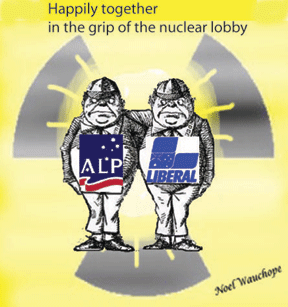
The Australian Labor Party is No Friend of the Nuclear-Free Cause.
https://theaimn.net/the-australian-labor-party-is-no-friend-of-the-nuclear-free-cause/ 26 Apr 25
I’m thinking that the nuclear lobby loves the ALP even more than it loves the Liberal Coalition opposition party.
Advance Australia, and the U.S-controlled Atlas Network are powerful and well-funded groups dedicated to molding public opinion on behalf of wealthy right-wing groups. They did a fine job in 2023 of destroying Australian support for the 2023 Australian referendum on the indigenous Voice to Parliament.
I was expecting them to pretty much run riot in support of the Liberal Coalition’s plan for a nuclear Australia. That does not seem to have happened. Why not?
Advance “kicked off with outright lies“, but has been rather quiet lately. And the Atlas Network is nowhere in sight, although its modus operandi is secretive anyway, spreading simplistic memes.
My conclusion is that Peter Dutton’s Liberal Coalition campaign is so inept, so incompetent, that it has turned out to be counter-productive to the party’s cause. There’s just so much evidence of this ineptitude – particularly when it comes to the estimated costs of setting up seven nuclear power plants around Australia. The latest of many examinations of these costs is – “Coalition’s nuclear gambit will cost Australia trillions – and permanently gut its industry.” Half-baked plans to keep old coal-power plants running for many years until nuclear is “ready”, no mention of plans for waste disposal, – the tax-payer to cop the whole cost. Even a suave sales magician like Ted O’Brien has not been able to con the Australian public. The party’s incompetence is on show in other ways, too, unconnected to the nuclear issue.
But what of Labor? They have been remarkably quiet on the nuclear issue – focussing on their own rather ha[f-baked plans for housing. It’s all cost-of-living issues – and I don’t deny that this is important. But nuclear rarely gets a mention – except when Labor finds it useful to mention the costs.
It doesn’t look as if Peter Dutton’s Liberal Coalition has a hope in hell of getting a majority win for its nuclear platform.
But does the nuclear lobby really care? I’m afraid not. You see, the Labor Party, supposedly opposed to the nuclear industry, has a long tradition of caving in on nuclear issues. From 1982 – a weak, supposed “no new uranium mines” policy became a “three mines uranium policy” 1984 then a pathetic “no new mines policy” in the 1990s. Backing for South Australia’s uranium mines further weakened Labor anti-nuclear policy.
Over decades, Labor luminary Gareth Evans has been acclaimed for his supposed stance against nuclear weapons. But he’s done a disservice to the nuclear-free movement, in his long-standing position in favour of “the contribution that can be made by nuclear energy capable of providing huge amounts of energy, and just as clean as renewables in its climate impact”. Evans has always been close to the International Atomic Energy Agency, in his complacency that nuclear power has nothing to do with nuclear weapons!
Labor has always been officially opposed to nuclear power, but at the Federal level, and some State levels, there have always been significant Ministers like Bob Hawke, and Martin Ferguson, who pushed for the nuclear industry. To his credit, Anthony Albanese for a long time held out against the nuclear industry. Even up until 2024, he was still trying .
But the crunch had already come – Albanese on Thursday, 16th September 2021 – “We accept that this technology [nuclear-powered submarines ] is now the best option for Australia’s capability.”
Why did Albanese agree to this deal, arranged between the Morrison Liberal government, and the USA and UK? Apparently, he did so, after just a two-hour briefing, with no documents provided, on the previous day. Labor Caucus was presented with it as a fait accompli. No vote was taken.
I can only conclude that Albanese’s decision was based on that time-honored fear of Labor looking “weak on security”.
In one fell swoop, Labor’s anti-nuclear policy was wrecked. The nuclear submarines will mean nuclear reactors on Australia’s coast. The will mean nuclear waste disposal in Australia, including foreign nuclear waste from the second-hand submarines. They will surely eventually mean nuclear weapons, as who can really tell if a nuclear-powered submarines has or has not got nuclear weapons? (The Chinese will be very wary about them.)
Since 2021, Australia’s nuclear submarine arrangement has been largely in the hands of Defence Minister Richard Marles, who worked with that dodgy company PWC to set it up, and who is a committed supporter of Australia’s solidarity with the USA.
March 2023 – Prime Minister Anthony Albanese, US President Joe Biden and UK Prime Minister Rishi Sunak unveiled the path to acquiring nuclear-powered submarines.
“In 2024, Australian Prime Minister, Anthony Albanese, made undisclosed “political commitments” with its AUKUS partners in an agreement for the transfer of naval nuclear technology to Australia, sparking concerns about the potential for high-level radioactive waste to be stored in the country. “
The global nuclear lobby works across national boundaries to promote its industry. It does well with Russia – as government clamp-down on dissent makes it easier to expand the industry in all its forms, and to market nuclear power to Asian ana African countries.
The nuclear industry is well aware of the problems in maintaining the belief that nuclear is clean, cheap, and climate friendly. But above all, it’s the nuclear-waste problem that its most expensive and difficult obstacle. Here’s where Australia has always looked appealing. All this nonsense about getting small nuclear reactors is just a distraction . The industry knows that small nuclear reactors are fraught with difficulties – too expensive, requiring too much security, public opposition at the local level, still needing too much water……… But to keep the global industry going, a nuclear-waste-welcoming country would be such a boost.
Well, it is early days, even for the prospect of those AUKUS nuclear submarines ever actually arriving. But in the meantime – the whole AUKUS thing has quietly introduced the Australian public to the idea that nuclear submarines are OK, and so are their wastes, and so are USA nuclear weapons based in Australia.
So, really, the Australian Labor Party has done a much better job of promoting the nuclear industry, than the fumbling Liberal Coalition could.
We are fortunate inn Australia to have proportional representation in our election. If you care about keeping Australia nuclear-free, you don’t have to vote for either of the big parties.
Toxic threat: New Greenpeace report outlines unacceptable risk of nuclear waste in Australia

| SYDNEY, Thursday 24 April 2025 — A new report from Greenpeace Australia Pacific has shown the Coalition’s nuclear plan could produce 14 billion Coke cans’ worth of radioactive waste a year, warning it is a matter of when, not if, a nuclear waste accident could occur in Australia. |
| Released in the lead-up to the 39th anniversary of the Chernobyl nuclear disaster, the report, ‘Toxic threat: The danger of nuclear waste in Australia’ shows that the Coalition has grossly understated the volume of dangerous waste its nuclear plan will produce — 14 billion times more than the ‘single coke can’ for a small modular reactor touted by Peter Dutton.The report also outlines the unacceptable risk this waste poses to Australian communities, and warns Australia’s long history of nuclear waste management failures point to a very high likelihood of future nuclear disaster. |
Joe Rafalowicz, Head of Climate and Energy at Greenpeace Australia Pacific, said: “Peter Dutton’s nuclear plan is a dangerous and expensive disaster waiting to happen. From Chernobyl to Fukushima, the devastation of nuclear disasters is a risk that Australia cannot afford to, and doesn’t need to, take.
“Australians don’t need the equivalent of 14 billion Coke cans of radioactive nuclear waste every year. The Coalition has not offered a credible plan for how it will manage nuclear waste safely, nor how it will fund this multibillion dollar effort.
“Australia’s unenviable track record of mismanaging even low-level nuclear waste, as well as a history of radioactive incidents in the US, UK and EU, reveals how complex it is to manage nuclear waste safely. Multiplying that challenge many times over by building a fleet of nuclear reactors could have devastating consequences for communities and ecosystems.
“International examples show that accidents, natural disasters, and other waste management failures occur with alarming regularity. A nuclear waste accident could lead to mass casualties, long-term health impacts, and the contamination of groundwater, farmland, and ecosystems for millennia. The clean-up bill from an incident would be astronomical, costing billions of dollars.
“Australia doesn’t need nuclear energy, which is just a smokescreen to prolong the use of climate-wrecking coal and gas for decades. We are almost halfway to powering the nation with clean, affordable wind and solar, and should be supercharging efforts to get to 100% renewables backed by storage.
“The Coalition has not asked communities like Collie, Latrobe Valley and the Hunter Valley for their consent to build nuclear reactors and waste dumps in their backyards, but the upcoming Federal Election is a chance for voters to have a say in Australia’s energy future. Peter Dutton’s nuclear plan is too dangerous to proceed, and Australians should strongly reject the idea of nuclear energy here.” https://www.greenpeace.org.au/static/planet4-australiapacific-stateless/2025/04/23ab6ee2-toxic-threat-greenpeace-australia-pacific-report.pdf
Dark Money: Labor and Liberal join forces in attacks on Teals and Greens
by Wendy Bacon and Yaakov Aharon | Apr 22, 2025 https://michaelwest.com.au/labor-and-liberal-powerbrokers-join-to-attack-teals-and-greens/
Teals and Greens are under political attack from a new pro-fossil fuel, pro-Israel astroturfing group, adding to the onslaught by far-right lobbyists Advance Australia. Wendy Bacon and Yaakov Aharon with the story.
On February 12 this year, former prime minister Scott Morrison’s principal private secretary Yaron Finkelstein, and former Labor NSW Treasurer Eric Roozendaal, met in the plush 50 Bridge St offices in the heart of Sydney’s CBD. The powerbrokers were there to discuss election strategies of for astroturfing campaign group Better Australia 2025 Inc.
Finkelstein now runs his own discreet advisory firm Society Advisory, while also a director of the Liberal Party’s primary think-tank Menzies Research Centre. Previously, he worked as head of global campaigns for the conservative lobby firm Crosby Textor (CT), before working for Morrison and as Special Counsel to former NSW Premier Dominic Perrottet.
Roozendaal earned a reputation as a top fundraiser during his term as General Secretary of NSW Labor and a later stint for the Yuhu property developer. He is now a co-convenor of Labor Friends of Israel.
The two strategists have previously served together on the executive of the NSW Jewish Board of Deputies, where Finkelstein was vice-president (2010-2019) and Roozendaal was later the chair of public affairs (2019-2020).
Better for whom?
Better Australia Chairperson Sophie Calland, a software engineer and active member of the Alexandria Branch of the Labor party attended the meeting. She is a director of Better Australia and carries formal responsibility for electoral campaigns (and partner of Israel agitator Ofir Birenbaum).
Also present was at the meeting was Better Australia 2025 member Alex Polson, a former staffer to retiring Senator Simon Birmingham and CEO of firm DBK Advisory. Other members present included another director Charline Samuell, and her husband, psychiatrist Doron Samuell.
Last week, Doron attracted negative publicity when Liberal campaigners in the electorate of Reid leaked Whatsapp messages where he insisted on referring to Greens as Nazis. “Nazis at Chiswick wharf,” Samuell wrote, alongside a photograph of two Greens volunteers.
The Better Australia group already have experience as astroturfers. Their “Put The Greens Last” campaign was previously directed by Calland and Polson under the entity Better Council Inc. in the NSW Local government elections in September 2024. The Greens lost three councillors in Sydney’s East but maintained five seats on the Inner West Council.
But the group had developed bigger electoral plans. They also registered the name Better NSW in mid-2024. By the time the group met for the first time this year on January 8, their plans to play a role in the Federal election were already well advanced. They voted to change the name Better NSW Inc. to Better Australia 2025 Inc.
Calland and Birenbaum
Group member Ofir Birenbaum joined the January meeting to discuss “potential campaign fundraising materials” and a “pool of national volunteers”. Birenbaum is Calland’s husband and member of the Rosebery Branch of the Labor Party.
But by the time the group met with Finkelstein and Roozendaal in February, Birenbaum was missing. The day before the meeting, Birenbaum’s role in the #UndercoverJew stunt at Cairo Takeaway cafe was sprung.
This incident focused attention on Birenbaum’s track record as an agitator at Pro-Palestine events and as a “close friend” of the extreme-right Australian Jewish Association. The former Instagram influencer has since closed his social media accounts and disappeared from public view.
The minutes of the February meeting lodged with NSW Fair Trading mention a “discussion of potential campaign management candidates; an in-depth presentation and discussion of strategy; a review and amendments of draft campaign fundraising materials”. All of this suggests that consultants had been hired and work was well underway.
The group also voted to change Better Council’s business address and register a national association with ASIC so they could legally campaign at a national level.
On March 4, Calland registered Better Australia as a ‘significant third party’ with the Australian Electoral Commission. This is required for organisations that expect their campaign to cost more than $250,000.
Three weeks later, Prime Minister Albanese called the election, and Better Australia’s federal campaign was off to the races.
Labor or Liberal, it doesn’t matter…
According to its website, Better Australia’s stated goals are non-partisan: they want a majority government, “regardless of which major party is in office”.
“In Australia, past minority governments have seen stalled reforms, frequent leadership changes, and uncertainty that paralysed effective governance.”
No evidence has been provided by either Better Australia’s website or campaigning materials for these statements. In fact, in its short lifetime, the Gillard Labor minority government passed legislation at a record pace.
Instead, it is all about creating fear. A stream of campaigning videos, posts, flyers and placards carrying simple messages tapping into fear, insecurity, distrust and disappointment have appeared on social media and the streets of Sydney in recent weeks.
On Easter Friday, placards warning voters, “Don’t let the Teals trick you” greeted beachgoers arriving at Bondi Beach.
Wentworth independent Allegra Spender wasted no time posting her own video telling voters she was unfazed, and for her electorate to make their own voting choices rather than fall for a crude scare campaign.
Spender is accused of supporting anti-Israel terrorism by voting to reinstate funding for the United Nations aid agency UNRWA. Better Australia warns that billionaires and dark money fund the Teal campaign, alleging average voters will lose their money if Teals are reelected.
It doesn’t matter that most Teal MPs have policies in favour of increasing accountability in government or that no information is provided about who is backing Better Australia.
Anti-Green, too
The anti-Greens angle of Better Australia’s campaign sends a broad message to all electorates to ‘Put the Greens Last’. It aims to starve the Greens of preferences. The campaign message is simple: the Greens are antisemitic, support terrorism, and have abandoned their environmental roots.
It does not matter that calls unite the peaceful Palestine protests for a ceasefire, or that the Greens have never stopped campaigning for the environment and against new fossil fuel projects.
Better Australia promotes itself as a grassroots organisation. In February, Sophie Calland told The Guardian that “Better Australia is led by a broad coalition of Australians who believe that political representation should be based on integrity and action, not extremist or elite activism.”
It has very few members and its operations are marked by secrecy, and voters will have to wait a full year before the AEC registry of political donations reveals Better Australia’s backers.
It fits into a patchwork of organisations aiming to influence voters towards a framework of right-wing values, including
support for the Israel Defence Force, fossil fuel industries, nationalism and anti-immigration and anti-transgender issues.
Advance Australia (not so fair)
Advance is the lead organisation in this space. It campaigns in its own right and also supports other organisations, including Minority Impact Coalition, Queensland Jewish Collective and J-United. Advance claims to have raised $5 million to smash the Greens and a supporter base of more than 245,000. It has received donations up to $500,000 from the Victorian Liberal Party’s holding company, Cormack Foundation.In Melbourne, ex-Labor member for Macnamara, Michael Danby, directs and authorises ‘Macnamara Voters Against Extremism’, which pushes voters to preference either Liberals or Labor first, and the Greens last. Danby has spoken alongside Birenbaum at Together With Israel rallies.
L-R Michael Danby, Ofir Birenbaum, unionist Michael Easson OAM, and Rabbi Ben Elton. Source: Together With Israel Facebook groupThe message of Better Australia – and Better Council before it – mostly aligns with Advance. These campaigns target women aged 35 to 49, who Advance claims are twice as likely to vote for the Greens as men of the same age.
The scare campaign targets female voters with its fear-mongering and Greens MPS, including Australia’s first Muslim Senator Mehreen Faruqi, and independent female MPS with its loathing.
Meanwhile, Advance is funded by mining billionaires and advocates against renewable energy.
Labor standing by in silence
Better Australia is different from Advance, which is targeting Labor because it is an alliance of Zionist Labor and LIberal interests. Calland’s campaign may be effectively contributing to the election of a Dutton government. In the face of what would appear to be betrayal, the NSW Labor Party simply stands by.
The NSW Labor Rules Book (Section A.7c) states that a member may be suspended for “disloyal or unworthy conduct [or] action or conduct contrary to the principles and solidarity of the Party.”
Following MWM’s February exposé of Birenbaum, we sent questions to NSW Labor Head Office, and MPs Tanya Plibersek and Ron Hoenig, without reply. Hoenig is a member of the Parliamentary Friends of Israel and has attended Alexandria Branch meetings with Calland.
MWM asked Plibersek to comment on Birenbaum’s membership of her own Rosebery Branch, and on Birenbaum’s covert filming of Luc Velez, the Greens candidate in Plibersek’s seat of Sydney. Birenbaum shared the video and generated homophobic commentary, but we received no answers to any of our questions.
According to MWM sources, Calland’s involvement in Better Australia and Better Council before that is well known in Inner Sydney Labor circles. Last Tuesday night, she attended an Alexandria Branch meeting that discussed the Federal election. She also attended a meeting of Plibersek’s campaign.
No one raised or asked questions about Calland’s activities. MWM is not aware if NSW Labor has received complaints from any of its members alleging that Calland or Birenbaum has breached the party’s rules.
After all, when top Liberal and Labor strategists walk into a corporate boardroom, there is much to agree on.
It begins with a national campaign to keep the major parties in and independents and Greens out.
MWM has sent questions to Calland, Finkelstein, and Roozendaal, regarding funding and the alliance between Liberal and Labor powerbrokers but we have yet to receive any replies.
Wendy BaconWendy Bacon is an investigative journalist who was the Professor of Journalism at UTS. She worked for Fairfax, Channel Nine and SBS and has published in The Guardian, New Matilda, City Hub and Overland. She has a long history in promoting independent and alternative journalism.
She is a long-term supporter of a peaceful BDS and the Greens.
Yaakov Aharon Yaakov Aharon is a Jewish-Australian living in Wollongong. He enjoys long walks on Wollongong Beach, unimpeded by Port Kembla smoke fumes and AUKUS submarines.
Earthquake with epicentre near proposed nuclear site rattles eastern Australia
Epicentre located about 36km from one of seven locations where federal opposition proposes building nuclear power plant if elected
Stuti Mishra, Wednesday 23 April 2025
The quake’s epicentre has been located about 36km from
Liddell, the site of a decommissioned coal-fired power station and one of
seven locations where the federal opposition has proposed building a
nuclear power plant if elected. Opposition leader Peter Dutton last year
named Liddell as a candidate for Australia’s first nuclear energy
facility under the Coalition’s plan to replace ageing coal infrastructure
with nuclear reactors. The site has since come to be a flashpoint in the
national energy debate.
Independent 23rd April 2025, https://www.independent.co.uk/news/world/australasia/earthquake-australia-nsw-sydney-canberra-magnitude-b2737717.html
Coalition’s nuclear gambit will cost Australia trillions – and permanently gut its industry
The modelling cited extensively by the federal Coalition to defend its
nuclear power fantasies is predicated on a massive hollowing out of
Australian industry.
Climate Energy Finance (CEF) published a report on
Thursday examining the economic implications of the nuclear pathway
modelled by Frontier Economics for Australia’s energy transition.
Frontier concludes its $A331 billion costed nuclear scenario is somehow
better than the Australian Energy Market Operator’s Integrated System
Plan’s (ISP) Step Change scenario cost, which they calculate at $594
billion by bizarrely ignoring the massive cost of the resulting cumulative
$3.5 trillion reduction in Australian gross domestic product (GDP) by 2050.
Renew Economy 24th April 2025 https://reneweconomy.com.au/coalitions-nuclear-gambit-will-cost-australia-trillions-and-permanently-gut-its-industry/
1 This month

of the week – Australians for War Powers Reform (AWPR)
To see nuclear-related stories in greater depth and intensity
 Antinuclear