New report: Coalition’s nuclear folly would cost Australian economy at least $4.3 trillion by 2050
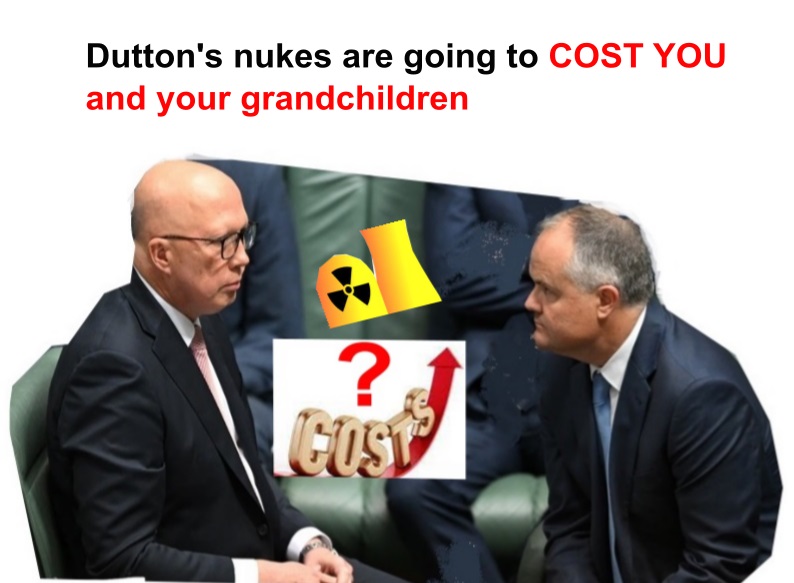
Climate Energy Finance Media April 24, 2025, https://theaimn.net/new-report-coalitions-nuclear-folly-would-cost-australian-economy-at-least-4-3-trillion-by-2050/
New analysis by independent public interest think tank Climate Energy Finance (CEF) looks at the economic implications of the nuclear pathway modelled by Frontier Economics for Australia’s energy transition – cited extensively by the Federal Coalition to defend its nuclear plan. The analysis reveals a massive hollowing out of Australian industry, permanently higher total energy costs, uncosted and unabated carbon pollution, and trillions of dollars in lost GDP.
The CEF analysis exposes damaging flow-on costs to the economy for which the Frontier modelling fails to account.
Combined with Frontier’s extreme underestimation of the capital costs of building nuclear reactors, these costs accumulate to $4.3 – 5.2 trillion by 2050, 13-16 times the $331bn price tag for a nuclear Australia assumed by Frontier Economics.
These costs include an estimated:
- $3.5 trillion in cumulative undiscounted lost GDP through to 2050;
- An $111-332bn in nuclear capex costs, which the Frontier modelling erases all but $13.5bn of by failing to both amortise nuclear’s capital investment costs incurred after 2050 and account for inevitable expensive retrofits;
- $234bn in higher fuel costs due to slower electrification meaning consumers and businesses are forced to rely on higher cost fossil fuels for longer;
- $72-720bn in economic damage from up to 2.0bn of additional tonnes of CO2 emissions;
- $100bn in lost export revenue from the aluminium industry alone, likely to collapse under the drastically reduced industrial electricity demand in the nuclear scenario.
Report author Tim Buckley, CEF Director and a former Managing Director of global investment bank Citigroup, said:
“It strains credulity that the Frontier Economics nuclear report is riddled with shortcomings which completely undermine its credibility as a work of serious energy transition analysis, given this is the central modelling being relied upon by the Opposition for its key energy and climate policy offering of the 2025 Federal election.
“The largest share of the Frontier-modelled ‘savings’ in energy transition investment comes at the cost of delivering much weaker outcomes for Australia, including an assumption the Australian economy’s GDP is $300bn lower annually by 2051. This represents an astonishing $3.5 trillion in cumulative GDP forgone.
“This is as weak as the Opposition Leader recently declining to accept the settled climate science because he is ‘not a scientist’.
It beggars belief that this is the best the party representing itself as alternative federal government can come up with, as the nation stands on the brink of an immense generational opportunity to remake itself as a global renewables superpower and green energy trade and export leader in a rapidly decarbonising world.”
Federal election 2025: Economists send open letter opposing Coalition nuclear plan

The economists said all the outlined [clean renewable energy] benefits would be delivered much faster and at a fraction of the cost of nuclear energy.
economists said the $330 billion price tag for the nuclear plan was likely to go much higher and was based on questionable modelling for the coalition.
“Major Australian firms are increasingly signing agreements to purchase electricity from solar and wind farms – recent examples include Rio Tinto, BHP Mitsubishi, Telstra, Woolworths, Coles.”
Lloyd Jones, 20 Apr 2025, https://thenightly.com.au/politics/federal-election-2025/federal-election-2025-economists-send-open-letter-opposing-coalition-nuclear-plan-c-18427749
An open letter from 60 Australian economists has rejected the coalition’s nuclear energy plan, promoting instead the subsidising of household clean energy policies, including incentives for home battery storage.
The organiser of the letter, Gareth Bryant, an associate professor in political economy at the University of Sydney, says the letter is intended as an intervention in the election campaign.
“As economists, energy analysts and policy specialists we strongly support government investment in household clean energy and industrial electrification and not in nuclear energy,” the letter says.
It says simple household clean energy upgrades can deliver immediate cost-of-living benefits and reductions in carbon emissions, and electrification can safeguard the future of industrial jobs and the communities that rely on them.
The economists, from a range of Australian universities and other tertiary institutions, said the construction of nuclear power plants would take at least 15 years at a cost of at least $330 billion.
“It would result in higher household energy costs, drain investment away from renewable energy and energy-intensive manufacturing, and leave the Australian economy precariously over-dependent on increasingly automated mineral extraction,” the letter says.
The economists said they support a nationwide program to upgrade homes and industry with clean renewable energy.
They said the technologies to fund should include large-scale home electrification with smart appliances to deliver bill savings, energy-efficiency upgrades and battery storage, which can save surplus solar for night-time use, and hot water retrofits for more efficient water heating.
“An extensive number of studies have found household electrification and energy upgrades would generate immediate household savings, helping to address cost-of-living pressures,” the letter says.
It says modelling for ACOSS found that with energy efficiency upgrades the average household would save almost $3500 a year.
The economists said their pathway would be anti-inflationary, due to less reliance on volatile international gas markets and it would benefit Australian manufacturing which requires low-cost, secure electricity.
“Major Australian firms are increasingly signing agreements to purchase electricity from solar and wind farms – recent examples include Rio Tinto, BHP Mitsubishi, Telstra, Woolworths, Coles.”
The economists said all the outlined benefits would be delivered much faster and at a fraction of the cost of nuclear energy.
The coalition’s nuclear plan proposes to build seven nuclear reactors with the first of these not operational until 2035.
The coalition plan had a number of flaws, the economists said, including higher household energy costs.
“Independent modelling by the Institute of Energy Economics and Finance found it would increase the electricity bill of an average household by $665 per year.”
The coalition nuclear plan would have detrimental impacts on the Australian economy, the economists said.
It would decrease bank and investor certainty, which will in turn increase the cost of renewable energy.
Opposition Leader Peter Dutton has defended his nuclear plan, saying it would help reduce carbon emissions and deliver lower cost electricity and gas, and reliable energy.
But the open letter economists said the $330 billion price tag for the plan was likely to go much higher and was based on questionable modelling for the coalition.
Investing in nuclear power would take away money that could be invested in more cost-effective household clean energy, they said.
“Today, with rising geopolitical tensions, trade wars, and accelerating climate breakdown, sovereign capability is even more critical,” the economists said.
“Renewables enable Australia to maintain this capability – nuclear does not.”
Renewable energy investors demand answers on Coalition nuclear plan

the Coalition’s policy costings make clear there has been no analysis of electricity price impacts.
Te Age, By Nick Toscano, April 22, 2025
Renewable energy developers are pressing Opposition Leader Peter Dutton to reveal how much more wind and solar would be allowed to join the electricity grid under his plan to embrace nuclear reactors, amid intensifying doubts about what technology mix the Coalition is targeting.
Energy has become a key battleground issue ahead of the May 3 election, with voters set to decide between the Albanese government’s plan for renewables to make up 82 per cent of the grid by 2030 and the Coalition’s push to abandon that target in favour of building seven nuclear generators across the mainland by 2050.
Dutton says his plan for taxpayers to fund and own nuclear facilities would be cheaper than Labor’s strategy. To support this claim, he cites modelling from Frontier Economics comparing the total cost of the government’s renewables-dominated proposal against the Coalition’s competing vision for a grid powered 37 per cent by nuclear generation and 54 per cent by renewables.
But when quizzed about the impact of slowing the renewable rollout to ensure it did not exceed 54 per cent of the 2050 power mix, opposition energy spokesman Ted O’Brien insisted there was “no policy we have which is capping any technology”………………………………..
…..representatives for some of Australia’s largest renewable energy companies said O’Brien’s indication that the Coalition did not intend to stick to the technology mix outlined in its own modelling raised serious questions about its case for nuclear.
The Clean Energy Council, an industry group, has demanded urgent clarification on how much additional wind, solar and batteries the Coalition intended to allow beyond 54 per cent.
“There are enormous questions as far as their plans and targets for renewable energy are concerned,” Clean Energy Council chief executive Kane Thornton said.
The Coalition had stated its nuclear plan would significantly reduce the need for “industrial-scale” renewable energy and transmission lines in regional areas, Thornton said.
“Is that no longer the case? Have they changed their policy? And if so, what level of renewable energy deployment will they be targeting?” he asked.
Whether the 54 per cent ceiling on renewables in the Frontier modelling would constitute a “hard and fast cap” is a question that has come up in recent meetings between clean energy developers and the Coalition, according to industry sources, who requested anonymity to discuss private briefings.
The share of electricity generated from sun, wind and water is expanding each year in Australia, already comprising about 40 per cent of the power grid.
“If Peter Dutton is elected, he will find out that the [renewables] market is more mature than he might have anticipated,” one source said. “Even if it wanted to, the industry’s momentum will be difficult to slow.”
As Australia’s ageing coal-fired power plants near the end of their lives, Labor has followed the Australian Energy Market Operator’s advice about the best and lowest-cost path to transition away from coal. Those measures include accelerating the build-out of renewables, backed up by transmission lines, and fast-starting gas-fired turbines and storage assets such as batteries and pumped hydroelectric dams to stash clean energy for when it’s not sunny or windy……………..
Against the urging of the energy industry, the Coalition is promoting a “coal-to-nuclear” transition, which relies on keeping polluting coal-fired power plants in the grid for potentially another 25 years until nuclear facilities are up and running.
The nation’s biggest coal plant operators, including AGL, say their ageing generators cannot continue operating that long without raising the risk of higher prices for consumers and more sudden outages.
Dutton often says his nuclear plan would lead to a 44 per cent reduction in people’s energy bills compared with what they would be under Labor. However, the Coalition’s policy costings make clear there has been no analysis of electricity price impacts.
The Frontier Economics report calculated that the Coalition’s plan for the electricity grid would be 44 per cent cheaper to build and operate than Labor’s – not that power prices would be 44 per cent cheaper.
The CSIRO and the energy market operator have cautioned that nuclear is an expensive power source, and have determined that Australia’s first nuclear plant would cost at least $16 billion and take years longer to build than the Coalition suggests. https://www.theage.com.au/business/companies/renewable-energy-investors-demand-answers-on-coalition-nuclear-plan-20250418-p5lsr4.html
Fact Check: No, Mum, Nuclear Won’t Reduce Costs By 25%

April 21, 2025 by Ronald Brakels, https://www.solarquotes.com.au/blog/fact-check-no-mum-nuclear-wont-reduce-costs-by-25/
A group called “Mums for Nuclear” has spent a lot of money on newspaper and online ads in the lead-up to the federal election, claiming that “Nuclear energy in the mix with renewables reduces cost by 25%“. I’ve investigated this claim and found it to be false. Hopefully, this will prompt all groups that have made unrealistic claims about nuclear affordability to take them back and spark a chain retraction.
“Mums for Nuclear” has made variants of this claim on multiple occasions, citing Frontier Economics as the source.
Here’s an example from March 6th:
“Nuclear in the mix alongside renewables reduces cost by 25%”
Another claim that sounds very similar but which is potentially very different depending on how it’s interpreted is:
“Nuclear energy reduces energy costs by at least 25%.”
I’m guessing they mean electricity, which is not the same as “energy”. Their source is the same — Frontier Economics.
The person who posted the above newspaper ad on unsocial media asked if the lobby group Nuclear for Australia, which is behind this supposed grassroots band of mums, should authorise it. Apparently, the Australian Electoral Commission was wondering the same thing because they had a chat with Mums for Nuclear.
I’m not going to concern myself with whether or not they’re correctly following election advertising law. I’m just going to fact check the claim itself — the one about nuclear energy reducing costs by 25%. But I do want people to be clear they are spending large amounts of money to spread their message and aren’t just a group of mums with a Facebook page.
My Verdict: False
First off, I should tell you I’m not Doctor Who. Due to this personal shortcoming, it’s not possible for me to make absolute statements about events that haven’t yet come to pass. I’m unable to say with absolute certainty that building nuclear power stations in Australia won’t reduce costs because we’ve never tried it and been able to say, “Yep, that didn’t work”.
What I can do is say whether it’s reasonable to conclude that building nuclear power will lower costs: it absolutely is not.
The Frontier Economics Report
The source Mums for Nuclear give for their claims is a pair of reports by Frontier Economics, also used by the Coalition to cost its nuclear policies. It’s not exciting reading, so luckily there’s a Renew Economy article by Alan Rai that summarises a lot of the claims and debunks some. One key issue is that despite the mums claiming that nuclear in the mix “alongside renewables” reduces costs, these reports don’t actually factor in the true cost to the people responsible for much of Australia’s renewables output — owners of rooftop solar.
Nuclear Needs More Curtailment Of Rooftop Solar
The reports assume there’ll be no change in rooftop solar or home and business battery uptake, despite the assumption that nuclear power will often curtail renewables. Something that’s unrealistic if rooftop solar and batteries will often be shut down to benefit nuclear.
On page 15 of report 2, section 3.1, it says…
“It is important to note the modelling does not include any behind the meter supply or storage options. It’s assumed that this is likely to be roughly constant across the scenarios.”
This means they’ve assumed people will install the same amount of solar and battery capacity for their homes and businesses if nuclear energy is used. The reports rely on this occurring for Australia’s electricity demand to be met. But if people are often required to shut down their solar systems, and likely home batteries, it’s not reasonable to expect them to install just as much.
Nuclear could be ramped up and down as needed, but can’t do it economically. A nuclear power station operating at 50% capacity has almost identical costs to one run at 100%. This makes it a poor partner for solar. Because curtailing nuclear instead of solar would be awful for the economics of nuclear, every report in favour of nuclear power in Australia, including the Frontier Economics ones, assumes that renewables will be shut down, and not the other way around.
You Can’t Shut Down The Sun
Curtailing rooftop solar to favour nuclear won’t only be intolerable to many Australians — enforcing it will be next to impossible. The planned curtailing of solar doesn’t only involve preventing homes and businesses from exporting surplus solar power to the grid. It also requires maintaining demand for grid electricity by having rooftop solar shut down completely and stop supplying power to its home or business. Additionally, once there’s enough home and business battery storage — which there will be well before any nuclear power stations are built — it will also involve preventing batteries from supplying power at these times.
This will not only piss off people who have invested in solar and batteries, it will be almost impossible to enforce, as most with batteries could simply go off-grid at these times and remove the electricity demand that nuclear is relying on to control its costs. Without draconian enforcement that voters are unlikely to stand for, this curtailment won’t happen. As it will be worse in regions close to nuclear power stations, it gives locals an excellent reason to block their construction.
How often home solar and batteries would need to shut down depends on how much is installed before the first nuclear power plant becomes operational. But rooftop solar can already meet all demand at times in South Australia, and all other states are heading in that direction. Even if Frontier Economics is right and we’ll have nuclear power within 11 years, a massive amount of rooftop solar and home battery capacity will be installed in that time. Eleven years ago, rooftop solar supplied under o.1% of Australia’s electricity, while over the past 12 months it supplied 13.3%. This could easily more than double by the time 2036 rolls around. So for Frontier Economics’ figures to work, solar and potentially home batteries would need to be curtailed on most days.
I’m guessing they mean electricity, which is not the same as “energy”. Their source is the same — Frontier Economics
Extending Coal Power Is Costly
The Frontier Economics reports assume coal power stations will operate well past their currently planned retirements until nuclear is ready to replace them, but makes no allowances for the extra costs of keeping them going. Australia’s coal fleet is old and worn out and can’t be reasonably expected to keep going without additional spending on either refurbishment or extra firming from batteries/open cycle turbines. If these costs aren’t paid, we will simply pay in another way through random blackouts when coal power stations break down.
This alone is enough to reasonably conclude that the Mums for Nuclear statement is unlikely to be correct. But I also think it’s reasonable for me to keep going and point out other issues that push “unlikely” into “not bloody likely” and beyond.
Transmission Savings Likely Less
Depending on which of their two scenarios are considered, Frontier Economics says either 15% or 17% of the savings from using nuclear will come from reduced transmission costs. But some of the transmission lines counted as savings are already under construction, and because we’re unlikely to get money back for work done, this is likely to reduce savings. Renewables also aren’t the only reasons for increasing transmission capacity. Even if we had zero solar and wind generation, we’d still need additional long-distance transmission to deal with a growing population and increased demand, as well as to shore up existing interconnectors as they grow older and less reliable.
Only 11 Years To Build Nuclear
Frontier Economics assumes Australia’s first nuclear power station will be fully operational by 2036, which is less than 11 years away. Another will be completed the year after that, the next in a couple more years, and so on.
Given that Australia hasn’t even decided to build nuclear power stations yet, this assumption is almost, but not quite, completely unreasonable. Here are some examples of recent construction times in countries I consider reasonably comparable to Australia:
- UK Hinkley Point C: Planning began in 2010 with approval in 2016. Construction began in 2017 with completion expected in 2025, but it’s still going and the earliest one of the two reactors will be operational is 2029 if there are no further delays. This would make it 19 years from the start of planning.
- France Flamanville 3: Construction started in 2007 with planned completion in 2012, but it’s only entering normal operation this year. So France, a country with extensive nuclear experience, took 18 years to construct their latest reactor.
- US Vogtle 3 & 4: Planning began in 2006 and construction in 2009. One reactor entered service in 2023 and the other in 2024, giving construction periods of 14 and 15 years.
- Finland Olkiluoto 3: Construction started in 2005 and it entered operation in 2023, giving a construction period of 18 years.
So, reasonably comparable countries with experience in building nuclear capacity took around 13-18 years to construct their latest reactors. As we haven’t even entered the planning stage and have no experience with nuclear generation, it’s not reasonable to expect Australia’s first nuclear power station to be operating inside of 11 years.
While things went wrong with the construction of all the above reactors, we don’t have the ability to decide not to have things go wrong. If we had magic pixie dust we could sprinkle on large complex projects to make them go without a hitch, we would have used it on Snowy 2.0.
I’m happy to acknowledge it’s possible to build reactors faster than this. Americans, plus immigrants fleeing prosecution, built one in two months. But I’m willing to bet one million dollars we won’t have an operational nuclear power station in 2036.
Operating Costs Will Be Over 3c/kWh
On page 7 of report 2, Frontier Economics gives its assumption for the running costs of nuclear power:
“variable and non-capital fixed costs of $30 per megawatt-hour, including decommissioning costs.”
This is 3c per kWh, which is very low. The only place this figure could have come from that I can think of is if they took the United States’ best year for operations and maintenance, while leaving out a number of costs. It’s not reasonable to assume Australia, a country with no nuclear experience, will exceed the best results of the Americans, who took decades to reach their operating costs.
Nuclear Won’t Be Cheaper Than Overseas
It costs a lot of money to build nuclear power and Frontier Economics’ figure isn’t high enough. On page 7 of report 2, they give their assumptions for nuclear’s capital cost…
“Capital costs are $10,000 per kilowatt of capacity”
This means a 1 gigawatt nuclear power station would cost $10 billion in Australia. But countries I consider reasonably comparable to Australia, with existing nuclear industries, haven’t been able to build them that cheaply this century. Here are examples of overseas nuclear costs in today’s dollars:
- UK Hinkley Point C: $94 billion for 3.26GW or around $28,800/kW.
- France Flamanville 3: $25 billion for 1.6GW or around $15,600/kW
- US Vogtle 3 & 4: $38 billion for 2.23GWor around $17,000/kW
- Finland Olkiluoto 3: $21 billion for 1.6GW or around $13,100/kW
As you can see, they’re all considerably over $10,000 per kW.
In case you think the figures above are all bizarre aberrations and the next nuclear plants these countries build will be far cheaper, then I’ll point out the Sizewell C nuclear power station in the UK that has just begun construction and is the same design as Hinkley C, may cost around $83 billion. That’s $25,500 per kW. This is only 11% less than Hinkley Point C before even having a chance to rack up cost overruns.
If the capital costs are around $13,000 then even if all of Frontier Economics other assumptions are true, it would wipe out their predicted savings from lower transmission costs. Even if we can build nuclear here at the same cost Finland did, and everything else in the Frontier Economics reports turns out to be right, it would only likely increase electricity costs.
Nuclear Will Be Even More Expensive Here
The countries above all had experience with nuclear, and the new capacity was built at existing nuclear power sites. But because Australia does not have a nuclear power industry and will have to decide on and develop new nuclear sites, it will cost more here.
Another factor that will have a much larger effect is Australia’s high labour costs. While the US has us beat, on average we’re paid much more than the Brits, French, and Finns. This will unavoidably raise costs because Australian workers will demand Australian-level compensation. Also, bringing in foreign nationals to do the work while paying them less than Australians is not a realistic option. It’s exactly the sort of thing that results in industrial action.
What About Less Comparable Countries?
There are also countries I consider less comparable to Australia with nuclear industries. Three of them are:
- South Korea
- China
- India
It’s difficult to work out exactly how much nuclear costs in these countries, but as all three still import large amounts of thermal coal from Australia, it’s clearly not cheap. I’d expect a much faster nuclear buildout for all three if it was saving them money.
What is clear is they’re building nuclear for less than in Europe or the US. But this doesn’t mean we can get them to build it for the same price here. Just because you can buy a curry for 50c from a street vendor in Bengaluru doesn’t mean you can get the same thing in Australia. The last time I bought a street curry in Adelaide it cost me $21.95. You won’t get Indian prices in Australia for anything with a significant labour component.
There’s No Reasonable Way Nuclear Will Reduce Costs
According to the Frontier Economics reports, many ducks have to be in a row for this statement by Mums for Nuclear…
“Nuclear energy in the mix with renewables reduces cost by 25%“
…to be correct.
I’m going to list all the duckies that will have to turn out in their favour and state whether or not I consider them reasonable:
Solar curtailed in favour of nuclear — not bloody likely- No extra cost for coal power extensions: not reasonable
- Transmission cost savings: Not reasonable — any savings likely less than figures given.
- Nuclear operational inside 11 years — just short of impossible
- Nuclear non-capital costs of 3c/kWh — not going to happen, almost impossible
- Nuclear capital costs of $10,000 — far from reasonable
That’s way too many ducks for a linear formation to be realistic. For this reason, I have no problem at all saying the Mums for Nuclear statement that there’s a 25% cost reduction from including nuclear in the mix is false. I will also say it’s not reasonable to expect any savings at all from building nuclear. It’s only likely to increase costs, no matter what your nuclear mum tells you.
For energy solutions that do actually slash your bills, take a look at our guides on solar panels and home battery storage instead.
No walk in the park for nuclear reactors at life’s end
Canberra Times, By Poppy Johnston, April 20 2025
It may feel far, far away but the energy sources getting hooked up to the grid today will eventually need to be put out to pasture.
Decommissioning is a major undertaking for any industrial facility yet for nuclear power plants – on the table under the federal coalition’s alternative pathway to net zero – Australia’s lack of experience raises a host of unknowns.
Walking through the process of dismantling a nuclear power plant, Australian National University energy transition expert Ken Baldwin says the first step is removing the used radioactive fuel and coolant to be stored safely elsewhere.
Next is dismantling the rest of the plant, with some of the components surrounding the reactor made slightly radioactive during a lifetime of operation.
That radioactivity is “relatively short-lived” compared to the human lifespan-defying decay rates of more potent nuclear waste.
“Often what happens is the nuclear plant might be left in a safe state with the fuel and the coolant removed for a number of years to allow that radioactivity to decay,” Professor Baldwin tells AAP.
After that time has lapsed, work begins on removing what’s left.
Globally, the 2024 World Nuclear Industry Status Report has 213 closed power reactors on its count and 23 fully decommissioned.
Dismantling reactors takes 20 years, on average.
Retiring nuclear plants is a “horses for courses” proposition, Prof Baldwin says, with costs and timelines dependent on the type of facility, decommissioning plans and regulations.
A rule of thumb is 10-15 per cent of the total capital cost of the facility, equivalent to somewhere between $780 million and $3 billion for a standard 1 gigawatt nuclear plant, and adding roughly five per cent to electricity bills.
End-of-life costs are covered in a variety of ways, including putting aside funds before the plant is built………………….
For the United Kingdom’s 3260MW Hinkley Point C, developers were required to set aside 7.2 billion pounds, or almost 15 billion Australian dollars, for clean-up in 2016.
However the agency noted there was uncertainty about the actual bill and taxpayers could be on the hook if the cap was exceeded.
The threat of higher-than-expected decommissioning costs was raised by mining billionaire and green steel and renewables proponent Andrew Forrest at a business breakfast in Perth earlier in the month.
“You see France spending $60 billion to bring up two gigawatts but they’re not talking about the 14 nuclear power plants they’re having to completely take down and try and return to the environment,” he said.
“I go to the best engineers in the world and they’ve got no idea what that’s going to cost.”
Opposition leader Peter Dutton highlighted the costs of dismantling wind turbines when asked for clarity on his plan for decommissioning the seven nuclear power plants his party plans to build if it wins the federal election………………………………… https://www.canberratimes.com.au/story/8946374/no-walk-in-the-park-for-nuclear-reactors-at-lifes-end/
HALF-BAKED!

Tony Webb
New Community Journal, Vol 23 (1) Issue 89 p 37
The Coalition’s plan for our energy future including Nuclear power plants is based on:
Delivering half the electricity anticipated as needed to power homes and industry
and transition to zero carbon emissions.
Assuming cost of building nukes in Australia which has no experience of doing this
will be about half what the most nuke-favourable evidence world-wide from
countries that do have the experience suggests is needed.
Assuming these can be built in less than half the time evidence suggests they take to
build.
Ignoring the evidence that current official radiation-induced cancer-risk-estimates,
on which standards for worker OH&S are based, are less than half what the evidence
from nuclear power plant workers in Europe and North America suggests is the
inevitable and unavoidable reality. Also, ignoring that the cardio-vascular and heart
disease risk from such exposures is double that expected and the childhood
leukaemia risk in the community near these plants has been similarly under-
estimated.
Not to mention that the coalition’s costings ignore the long-term costs of
decommissioning these plants, the management, and (perhaps . . . . Dutton dream
on!) eventually finding a solution for long-term storage (never ‘disposal’) of the
highly radioactive wastes –
Nor to mention the fact that state and federal legislation currently prohibits such
nuclear power plants and is unlikely to be overturned any time in the near future.
And – despite this overwhelming evidence that the whole silly idea is half-baked – in
fact a smokescreen for continuing climate denial and extending use of polluting and
planet life-threatening fossil fuels, inface of this the Coalition doubles down on it
with backing from sections of the media and the fossil fuel lobby.
Dotty and Cretinous: Reviewing AUKUS

April 20, 2025 Dr Binoy Kampmark, https://theaimn.net/dotty-and-cretinous-reviewing-aukus/
It was a deal for the cretinous, hammered out by the less than bright for less than honourable goals. But AUKUS, the trilateral security alliance between Australia, the United Kingdom and the United States, is now finally receiving the broader opprobrium it should have had from the outset. Importantly, criticism is coming from those who have, at points, swooned at the prospect of acquiring a nuclear-powered submarine capability assuming, erroneously, that Australia somehow needs it.
A report by the Strategic Analysis Australia think tank has found that AUKUS, despite the increasingly vain promise of supplying the Royal Australian Navy with nuclear powered submarines in 2032, has already become its own, insatiable beast. As beast it is, with the cost over the next four years for the submarine program coming in at A$17.3 billion, exceeding by some margin the capital budget of the Royal Australian Airforce (RAAF) at A$12.7 billion. One of the authors of the report, Marcus Hellyer, notes that “in terms of acquisition spending, the SSN [nuclear-powered attack submarine] enterprise has already become the ADF’s [Australian Defence Force’s] ‘fourth service’.”
The report notes some remarkable figures. Expenditure on SSNs is estimated to be somewhere between A$53 billion and A$63 billion between 2024-2034, with the next five years of the decade costing approximately A$20 billion. The amount left over for the following years comes in at $33 to $44 billion, necessitating a target of $10 billion annually by the end of the financial decade in the early 2030s. What is astounding is the amount being swallowed up by the ADF’s investment program in maritime capabilities, which will, over the coming decade, come to 38% of the total investment.
The SSN program has made its fair share in distorting the budget. The decade to 2033-4 features a total budget of A$330 billion. But the SSN budget of $53-63 billion puts nuclear powered submarines at 16.1% to 19.1% more than either the domains of land and air relevant to Australia’s defence. “It’s hard to grasp how unusual this situation is,” the report notes with gravity. “Moreover, it’s one that will endure for decades, since the key elements of the maritime domain (SSNs and the two frigate programs) will still be in acquisition well into the 2040s. It’s quite possible that Defence itself doesn’t grasp the situation that it’s gotten into.”
To add to the more specialist literature calling large parts of AUKUS expenditure into question comes the emergence of disquiet in political ranks. Despite the craven and cowardly bipartisan approval of Australia’s dottiest military venture to date, former Labor senator Doug Cameron, who fronts the Labor Against War group, is a symptom of growing dissent. “There are other more realistic and cost-effective strategies to protect our territorial integrity without subjugating ourselves to a dangerous, unpredictable and unworthy Trump administration.”
On the other side of the political aisle, former Liberal Prime Minister Malcolm Turnbull is pessimistically inclined to the view that Australia will never get those much heralded submarines. “There will be Australian sailors serving on US submarines, and we’ll provide them with a base in Western Australia.” Furthermore, Australia would have “lost both sovereignty and security and a lot of money as well.”
The spineless disposition of Australia’s political cadres may prove irrelevant to the forced obsolescence of the agreement, given the scrutiny of AUKUS in both the United States and the United Kingdom. The pugilistic nature of the tariff system imposed by the Trump administration on all countries, friendly or adversarial, has brought particular focus on the demands on naval and submarine construction. Senior Democrat on the Senate Armed Services Subcommittee, Virginia Senator Tim Kaine, told an AUKUS dinner in Washington this month that “We are already having trouble getting these ships and subs on time [and] on budget. Increase those prices – it’s going to be a problem.”
Taine’s point is logical enough, given that steel and aluminium have been targeted by particularly hefty rates. Given the array of products requiring exchange in the AUKUS arrangement, tariffs would, the senator reasons, “slow us down and make things harder.”
Another blow also looms. On April 9, the White House ordered the Department of Government Efficiency (DOGE) to comb through the procurement of US Navy vessels in order “to improve the efficiency and effectiveness of these processes” and contribute to the Trump administration’s Maritime Action Plan. Consistent with Trump’s near obsession of reviving national industry, the order seeks “to revitalize and rebuild domestic maritime industries and workforce to promote national security and economic prosperity.”
Australian taxpayers have every reason to be further worried about this, given the order’s emphasis that US departments and agencies pursue “all available incentives to help shipbuilders domiciled in allied nations partner to undertake capital investment in the US to help strengthen the shipbuilding capacity of the US.” Given that that US submarine industrial base is already promised $US3 billion from Australia’s pockets, with $500 million already transferred in February, the delicious exploitation of Canberra’s stupidity continues apace.
In the UK, the House of Commons Defence Committee this month announced a parliamentary inquiry into the defence pact, which will evaluate the agreement in light of changes that have taken place since 2021. “AUKUS has been underway for three years now,” remarked Defence Committee chairman and Labour MP, Tan Dhesi. “The inquiry will examine the progress made against each of the two pillars, and ask how any challenges could be addressed.”
The first pillar, perennially spectral, stresses the submarine component, both in terms of transferring Virginia class SSNs to Australia and the construction of a bespoke nuclear-powered AUKUS submarine; the second focuses on the technological spread of artificial intelligence, quantum capabilities, hypersonic advances and cyber warfare. While Dhesi hopes that the inquiry may throw up the possibility of expanding the second pillar, beady eyes will be keen to see the near non-existent state regarding the first. But even the second pillar lacks definition, prompting Kaine to suggest the need for “some definition and some choices”. Nebulous, amorphous and foolish, this absurd pact continues to sunder.
Dutton’s nuclear revival smells rotten to Gens Y and Z
By Glenn Davies | 19 April 2025, https://independentaustralia.net/politics/politics-display/duttons-nuclear-revival-smells-rotten-to-gens-y-and-z,19640
Forty years on from the first Palm Sunday anti-nuclear marches, Peter Dutton’s attempt to revive nuclear power is thankfully still a hard sell, writes history editor Dr Glenn Davies.
THIS YEAR, Palm Sunday, the traditional day of protest for peace, will occur on 13 April.
Australia has a long history of resisting uranium mining and nuclear development. During the 1980s, Palm Sundays in Australia were occasions for enormous anti-nuclear rallies all across the country, reaching a peak in 1985.
On 19 June 2024, Peter Dutton announced:
“…nuclear energy for Australia is an idea whose time has come.”
At the same time, he released “the seven locations, located at a power station that has closed or is scheduled to close, where we propose to build zero-emissions nuclear power plants”.
Nothing announced by Peter Dutton today changes the fact that nuclear energy is, according to reams of expert analysis, economically unfeasible in Australia. This is as true today as it was in the 1970s and 1980s.
The Palm Sunday peace march is an annual ecumenical event that draws people from many faith backgrounds to march for nonviolent approaches to contentious public policies. The event is based on the account of Jesus’ procession into Jerusalem, which some see as an anti-imperial protest — a demonstration designed to mock the obscene pomp of the Roman Empire. Palm Sunday is now considered an opportunity to join together to demonstrate for peace and social justice.
A major focus of activism in Australia during the anti-nuclear movement in the 1980s was the campaign against uranium mining, as Australia holds the world’s largest reserves of this mineral.
The Australian anti-nuclear movement emerged in the late 1970s in opposition to uranium mining, nuclear proliferation, the presence of U.S. bases and French atomic testing in the Pacific.
During the 1980s, Palm Sundays in Australia saw enormous anti-nuclear rallies all across the country.
The annual Palm Sunday rallies were organised by the People for Nuclear Disarmament (PND), beginning in 1982 and reaching a peak in 1985.
On Palm Sunday in 1982, an estimated 100,000 Australians participated in anti-nuclear rallies in the nation’s biggest cities. In Melbourne, more than 40,000 people marched to call for nuclear disarmament and highlight the multiple dangers associated with uranium mining and nuclear power. They were joined by a similar sized rally in Sydney. During the same week 5000 marched in Brisbane while numerous other protests were held across Australia.
While 1984 was the year of George Orwell’s dystopian future, the 1980s were less about a surveillance society than nuclear fear. In 1984, Labor introduced the three-mine policy as a result of heavy pressure from anti-nuclear groups. This was also a time when many Australians were concerned that the secret defence bases at Pine Gap, North West Cape and Nurrungar, run jointly with the United States on Australian soil, were “high priority” nuclear targets.
An estimated 250,000 people took part in Palm Sunday peace marches in April and the Nuclear Disarmament Party gained seven per cent of the vote in the December 1984 Election and won a Senate seat. In addition, the election of the Lange Labor Party Government in New Zealand in July, resulted in New Zealand banning visits by ships that might be carrying nuclear weapons and were also considered targets in a nuclear war
The refusal of New Zealand to permit a visit by the USS Buchanan in February of that year threatened the future of the ANZUS alliance.
Australia did not follow the example of New Zealand.
In 1985, more than 350,000 people marched across Australia in Palm Sunday anti-nuclear rallies demanding an end to Australia’s uranium mining and exports, abolishing nuclear weapons and creating a nuclear-free zone across the Pacific region. The biggest rally was in Sydney, where 170,000 people brought the city to a standstill.
In 1985, I was a first-year James Cook University student living at University Hall. JCU students in Townsville supported the massive Palm Sunday rallies by our southern cousins in a public protest by tagging on the end of the May Day (Labour Day) march along The Strand.
As we marched behind the Townsville unionists with their hats and placards, remembering and publicly affirming the sacrifices their forebears had made – the mateship, the loyalty and the determination to build and protect the freedom and rights we now enjoy – we realised this march was about empowerment in a world where individuals still too often have little control over their own destiny when it comes to the workplace. And this was the lesson we young students learned on that day from our older working brothers, as we also were desperately looking for more say in the safety of our world.
May is a beautiful time of the year in Townsville, with breezy, high-skied blue days. Marching along The Strand, we were proclaiming our concerns for ensuring a better and safer world for all our futures.
It would be irresponsible for us not to chant:
Two, four, six, eight. We don’t want to radiate.
One, two, three, four. We don’t want no nuclear war.
By the late 1980s, the political, social and economic mood had swung firmly in favour of the anti-nuclear movement. Though it was clear that the three already functioning mines would not be shut down, the falling price of uranium, coupled with the 1986 Chernobyl disaster, ensured that there would not be a strong effort to broaden Australia’s nuclear program.
During the 1980s, there was a mushroom cloud shadow cast over Australia. The protests of the anti-nuclear movement were successful in linking the horror of nuclear war to the zeitgeist of the 1980s. The anti-nuclear movement served an important function in Australian politics, where it visibly prevented any further pro-nuclear policies from being enacted by the Australian Government.
Former Labor Environment Minister Peter Garrett is the lead singer of rock band Midnight Oil and a prominent nuclear disarmament activist since the 1980s.
He recently stated in a Sydney Morning Herald op-ed:
Younger voters understandably won’t know that a generation their age once packed the Sidney Myer Music Bowl with Midnight Oil, INXS and other friends to “Stop the Drop”.
They won’t remember our Nuclear Disarmament Party campaign, which won Senate seats in Western Australia and NSW in the ’80s.
They can’t know what it was like to grow up during the Cold War era or live through horrific meltdowns at the Three Mile Island, Chernobyl and Fukushima nuclear power plants, which were also “completely safe” until the day that they weren’t.
But generations Y and Z can still smell a rotten idea when they give it a good sniff.
The use of nuclear energy as a solution to Australia’s future energy needs is still a hard sell.
Times have obviously changed since the 1970s, but significant political and economic barriers remain — and the problem of cost is still unsolved. This is compounded by apocalyptic visions of global destruction as part of our contemporary zeitgeist. It’s just that in its modern incarnation, the apocalypse has become more varied.
Gone is the single event; now we have a multiple-choice-question-sheet worth of ways to end our time on Earth. In the 2020s, the apocalypse continues to figure heavily in social life with constant references to wild weather, global financial crises, lone wolf terrorism, environmental collapse and zombie plagues.
And perhaps the greatest fear of all is that in this fracturing of fear may come complacency.
Opposition Leader Peter Dutton will continue to struggle to get traction, not only during the current Federal Election campaign but as long as the spirit of the 1985 Palm Sunday protest march lives.
10 reasons why nuclear energy is a bad idea for Australia
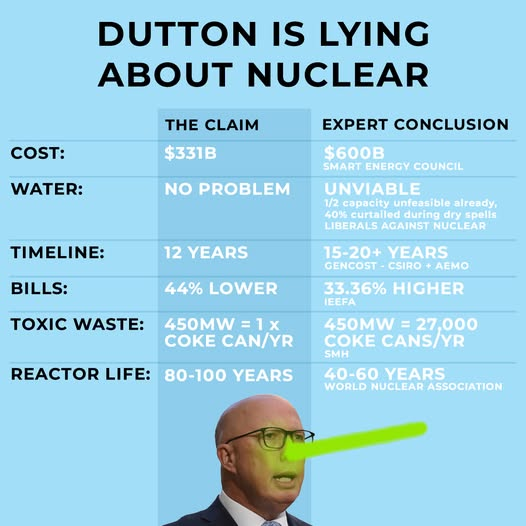
There’s a lot of information and disinformation out there on nuclear energy. These are my 10 reasons why nuclear energy would be a bad idea for Australia
By Arthur Wyns, University of Melbourne, https://pursuit.unimelb.edu.au/articles/10-reasons-why-nuclear-energy-is-a-bad-idea-for-australia 16 April 2025
As always seems to be the way, energy and climate policy is proving to be an area of contention between the major parties in Australia’s 2025 election.
One issue that’s provoked a lot of discussion and confusion is the Liberal-National Coalition’s proposal to build seven nuclear power plants across Australia.
It’s a controversial idea that’s opposed by Labor, the Greens, many independent MPs and some Liberal groups.
Both the Climate Change Authority and Australia’s Commonwealth Scientific and Industrial Research Organisation (CSIRO) concluded that the deployment of nuclear energy in Australia would significantly increase the country’s energy prices and cause us to miss our climate change targets.
1. Too expensive
It’s extremely expensive to build and operate nuclear power plants anywhere in the world. Independent analysis by the Institute for Energy Economics and Financial Analysis (IEEFA) found that building nuclear power in Australia could see average household electricity bills rise by $AUD665 a year.
Estimates by CSIRO and the Australian Energy Market Operator (AEMO) for the 2024-2025 GenCost Report also found renewables are the cheapest option for any new electricity generation.
2. Too slow
Even if we drop everything else and throw all our weight behind nuclear energy, it wouldn’t play a role in Australia’s energy grid for more than a decade.
It took an average of 11 years to build the nuclear reactors that came online around the world in 2023 – largely in countries with a well-established nuclear industry, like China.
In Australia, CSIRO estimates it would take at least 15 years before we’d reach the first nuclear generation.
3. Too risky
Nuclear accidents are rare but they have devastating consequences.
The Chernobyl disaster in 1986 and the Fukushima disaster in 2011 contaminated large areas and continue to impact the health of hundreds of thousands of people. Both disasters caused a rise in anti-nuclear sentiments in the Australian public.
They also led to the majority of German citizens supporting an end to nuclear power in the country, with the three last remaining nuclear power plants in Germany taken offline in 2023.
4. Hard to build
Nuclear power stations are huge and complicated infrastructure projects that almost never stay on schedule.
The UK’s Hinkley Point C nuclear plant construction is now running 14 years late and is costing three times more than it was estimated: a whopping $AUD90 billion.
Smaller nuclear power plants, known as Small Modular Reactors (SMRs), have been proposed as an alternative, but there are no known commercial SMRs operational anywhere in the world.
The only company to have a small modular nuclear power plant approved in the US has since cancelled its first project due to rising costs.
5. Produces nuclear waste
Once in operation, nuclear reactors continuously produce radioactive waste. Generally, this waste is buried underground, where it remains radioactive for thousands of years.
Australia already produces a relatively small amount of low-level radioactive waste for some medical and research activities.
However, Australia currently doesn’t have any waste storage facilities to process high-level radioactive waste that would be produced by nuclear reactors – and recent efforts to build the country’s first radioactive waste storage facility have failed.
6. Uses lots of water
Nuclear reactors need to be cooled constantly, which requires high volumes of water.
It might not make sense to switch to a water-intensive energy source in the driest inhabited continent in the world, which is already facing increasing droughts and extreme heat.
Even countries like France and Sweden – with dramatically cooler climates compared to Australia – are increasingly being forced to shut down their nuclear power plants during warm periods when their cooling water heats up.
This means they then have to import energy from neighbouring countries.
7. No energy security
Australia’s remaining coal-fired power stations are old and increasingly breaking down, with over 60 per cent of our coal-generating capacity now more than 40 years old.
Even in the most optimistic scenarios, nuclear power is unlikely to come online before 2040, by which time all of Australia’s coal plants will have retired, according to the National Electricity Market.
In other words, the timelines for a coal-to-nuclear transition don’t add up.
Extending the life of these ageing coal-power plants would mean spending billions to prop up coal rather than investing in updating the electricity grid and expanding more cost-effective and readily available forms of energy like renewables.
8. No expertise
While nuclear generation is well established in many countries, it has never been deployed in Australia.
We currently lack the trained workforce and technical capability required for building a large-scale nuclear reactor.
Any attempt to go nuclear would leave Australia reliant on foreign companies and expertise. This is something we’re seeing play out in building and maintaining the nuclear submarines Australia agreed to host as part of the AUKUS deal.
In comparison, the renewable energy industry already creates more than 25,000 local jobs in Australia and this is expected to grow.
9. We’ll miss our climate goals
While nuclear energy is a form of low-emissions energy in many countries with established pre-existing nuclear facilities, focusing on the development of new nuclear energy in Australia is a diversion from taking real climate action.
Australia’s Climate Change Authority (CCA) recently released a detailed analysis concluding that a nuclear pathway for Australia would result in an additional two billion tonnes of greenhouse gas emissions.
It would extend the use of some coal-fired generators, slow down the uptake of clean technologies, and obstruct existing national plans to deliver 82 per cent renewable electricity by 2030.
10. Illegal in Australia
In the late 1990s, the Australian Federal Government introduced several new laws banning nuclear energy, including the National Radiation and Nuclear Safety Act (1998).
This Act prohibited the development of any new nuclear power sites in Australia.
The Commonwealth Environment Protection and Biodiversity Conservation Act (1999) also introduced rules preventing the construction or operation of any facilities that generate nuclear power.
Building nuclear reactors is currently illegal in every Australian state and territory.
Ultimately, pursuing a lengthy, expensive and potentially harmful energy source is a misguided step for Australia, particularly when we have all the resources and potential to make us a renewable energy superpower.
Arthur Wyns is a research fellow at Melbourne Climate Futures, University of Melbourne. He has written widely on climate change and global health issues, and regularly advises national governments and UN agencies. In 2023-2024, Arthur was the senior health advisor to the government of the United Arab Emirates as the host of the COP28 UN climate conference. He was a climate change advisor to the World Health Organization during 2019-2023, where he represented WHO at the UN climate negotiations, authored several UN reports on climate change and health, and acted as WHO’s speechwriter on climate change. Arthur is an editor of the Journal of Climate and Health and sits on the editorial board of ClimaHealth, the knowledge platform of the WHO-WMO Joint Office for Climate and Health.
The Australian investors betting big on fusion – the “holy grail” of nuclear tech
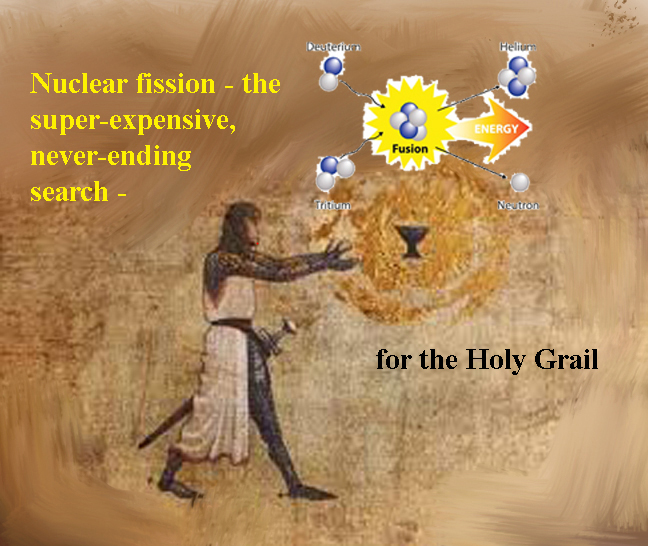
ReNewEconomy, Rachel Williamson, Apr 17, 2025
One of Australia’s biggest super funds is backing nuclear tech – but not the kind being pitched by the federal Coalition.
Hostplus is investing in fusion energy.
CIO Sam Sicilia says a combination of tech advances in the last five years and a youthful member base means fusion is now a real option for big, patient investors…………………
Fusion power is the holy grail of energy technologies: it makes more energy than nuclear fission, produces less waste, doesn’t create anything that could be used in a weapon, and has zero risk of meltdown.
The truth is more complicated, not least because the longest ever sustained reaction was only achieved in January, when China’s “artificial sun” reactor in Heifei managed a whole 17 minutes. …………………..
And with almost half a billion dollars of funding sunk into the industry last year, the race is on for companies ranging from Commonwealth Fusion Systems – the MIT spinout that is leading so far and Hostplus’ investment pick – to Australian startup HB11………………………………………………………………………………
If this sounds ambitious for a technology that just five years ago was still wrestling with major functional problems, it isn’t to people in the industry – even in Australia.
Patrick Burr leads the student project to build a donut-shaped tokamak fusion reactor – just a little one – at University of New South Wales (UNSW). He also works with Australia’s only home-grown fusion company, HB11 Energy.
He says commercialisation of fusion energy is now an engineering problem that requires money and people…………………………………………………………………………..
Australia as a fusion power? Maybe
Matt Bungey is taking a bet that fusion energy will be ready for launch – in Australia – by the late 2030s.
Bungey is a partner at Western Australian venture fund Foxglove Capital and an investor in another fusion frontrunner, Type One, which recently set up an Australian subsidiary.
He believes fusion should be part of a diverse energy strategy even if by the late-2030s renewables and storage are the dominant generators.
But he does admit there is a deadline.
“There’s a timing element here, if you don’t get it right before the mid 2040s there’s a question of whether you really need it,” he says.
The other view is that Australia’s energy needs will scale in unimaginable ways as the demands of decarbonisation and AI require more electricity……………………………………………………………..
Today the global industry has attracted $US7 billion ($A11 billion) in funding, according to the FIA.
But even the $A130 billion Hostplus is merely dipping a toe in – its CFS investment is worth $US136 million.
Still, CFS CEO Bob Mumgaard says there is enough curiosity in the technology from within Australia to warrant a look here – even if nuclear power generally is still illegal. ……………………………………………………………………………………
Australia enters the chat, with HB11
Australia does have its own fusion startup in HB11. It is forging a technology path quite different to those pursued by CFS (a tokamak design) or Type One (a stellarator).
HB11 is using lasers and a proton-boron fuel, rather than the more common deuterium/tritium, deuterium/deuterium, or deuterium/helium3 combos.
“The key difference between what we’re doing and what most of the other private fusion companies are doing is we’re using [boron] which does not produce neutrons,” McKenzie says.
Boron is abundant and costs about a dollar a kilogram, and the method of firing a laser at small pellets to create an ongoing reaction doesn’t make the materials around them radioactive – more on this later.
McKenzie gently negs the tokamak and stellarator players, saying none have produced a net gain – more energy out than in – whereas laser fusion has, in December 2022 at the National Ignition Facility in California.
“The catch is it’s much harder to produce. Essentially we’ll need much bigger lasers [than we have now],” McKenzie says.
How big, you might ask?
Computer simulations suggest that, right now, they may need to be several football fields long and multiple storeys high. The National Ignition Factory’s laser is in a 10-story building about the size of three American football fields; China’s version in the southwest city Mianyang will be 50 per cent larger again, a size MxKenzie says “is about right”.
HB11 has a plan for its version of fusion to be widespread by the mid-2050s but it has a long way to go.
“When we achieve a neutronic hydrogen-boron fusion energy gain we’ll be on our way to Stockholm to pick up a Nobel prize,” McKenzie says.
Is it illegal or not?
Australia’s ban on nuclear fission technology for energy might apply to fusion – but also might not.
Experts spoken to by Renew Economy say there isn’t much interest within federal government to revisit nuclear rules and carve out a new area for fusion, somewhere between legal nuclear medicine and illegal fission.
But the UK and USare showing how fusion might be introduced, without dumping it in with fission.
Both countries say they won’t regulate fusion technology like fission, but instead treat the new reactors more like a particle accelerator.
That’s a framework that advocates like Bungey are pinning their hopes on, given almost every major hospital in Australia houses a particle accelerator to make nuclear medicines. These are controlled by the Australian Radiation Protection and Nuclear Safety Agency (ARPANSA) as well as a suite of other regulators.
McKenzie says the deuterium-tritium fuel might be difficult for nations to support, given both are fuels used in nuclear weapons, but generally fusion should not be affected by national bans on fission energy.
“My legal understanding is that it will not come under Australia’s nuclear ban. But yes … what the rest of the world is doing, fusion is a relatively new field with no regulations,” he says.
“The US and the UK very recently passed legislation where the nuclear fission and fusion regulators are different and they require different standards, so you’re starting to separate the two technologies and that makes a big difference.”
But it’s Italy that might be the most appropriate model for Australia because it’s coming from a total ban on nuclear energy as well, Mumgaard says.
But Italy is also un-banning fission technology after a 40-year hiatus, producing a draft law in March to set up both fission and fusion technologies.
Pros and cons
Fusion is now such a small sector in Australia that it’s hard to find one person who isn’t connected to one of the local or global companies competing to be first, cheapest, or most realistic.
UNSW’s Patrick Burr is involved with HB11 but happy to also cut through the marketing speak. Every technology, as Burr says, has its drawbacks.
The main problem today is talent. Burr says companies are already cannibalising each other’s staff, from fusion engineers, scientists, down to people in the supply chain, and educating new talent was one reason why UNSW launched the student-led tokamak project.
But there are some practical problems as well which are high on the ‘to solve’ list of the engineers.
One of the first dot points on any ‘why fusion is better’ powerpoint slide is the tiny amount of waste it produces from a reaction.
But this is misleading. The irradiated waste of a fusion plant is the whole internal structure, albeit with a hundreds of years half life instead of a thousands of years half life.
Dealing with concrete or equipment that is toxic for hundreds of years is manageable for a society, Burr says. The challenge will be figuring out how to handle the higher volumes of radioactive material.
Another drawback is the source of fuel.
The most common fuel pairing is deuterium and tritium – the former is abundant in nature, the latter is not and has a short half life. Other fuels have their own challenges, such as HB11’s boron-hydrogen method, which right now requires giant lasers to activate.
Taking a position on nuclear energy in a country like Australia, where it doesn’t exist outside the medical sector, is a bet on the distant future.
For Burr, it’s a question on whether Australia will have won the fight with hard-to-decarbonise sectors in 50 or 100 years’ time. And whether the country wants to make a bet today on a technology that may – or may not – be that solution. https://reneweconomy.com.au/the-australian-investors-betting-big-on-fusion-the-holy-grail-of-nuclear-tech/
The Coalition Nuclear Policy is a Fake
Arena Online, Darrin Durant, Jim Falk, Jim Green, 17 Apr 2025, https://arena.org.au/the-coalition-nuclear-policy-is-a-fake/
Calls for commercial nuclear power in Australia have historically all featured the Liberal National Party (LNP) promising nuclear power but later quietly shelving such plans. With a looming federal election date, that pattern seems to have returned with the Coalition running silent on nuclear power, despite the election being only weeks away. Why?
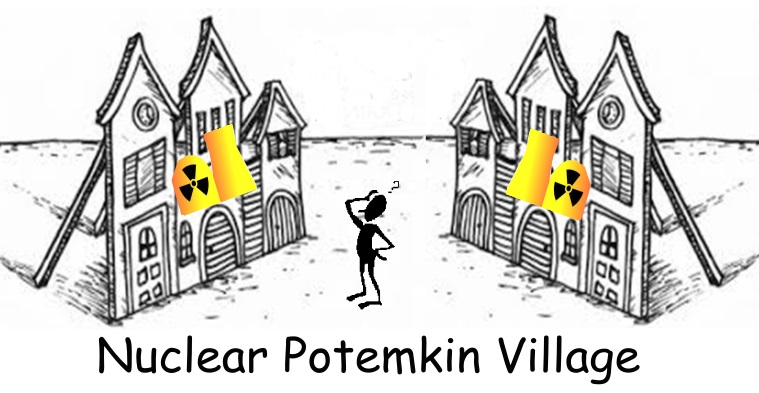
The Coalition’s policy is a bit like a Potemkin Village anyway—the fake villages said to be erected by Grigory Potemkin to impress Catherine the Great. Like them, the nuclear proposal is at best a facade, lacking essential content but acting to distract attention from division within the Coalition on emissions reductions.
Nuclear Potemkin villages
The Coalition has an electricity plan, but it is highly unlikely to actually involve nuclear reactors. The idea of nuclear reactors (large or small) with their low life-cycle emissions (at least compared to fossil fuels) provides a facade for misdirecting public attention. Behind the facade are continuing placeholders for fossil fuels, a stalling of renewables development, and a plan to keeping coal plants running as long as possible—probably switching to gas when those coal-fired power stations become technologically and economically unviable.
The long-promised Coalition nuclear plan was eventually outlined with minimal detail in June 2024 as seven reactor-site locations across New South Wales, Victoria, Queensland, South Australia and Western Australia, producing 14 gigawatt, or 38 per cent of electricity, with the first reactor supposedly coming on line by 2035–37. The claim was for an outcome ‘significantly’ cheaper than the Australian Labor Party (ALP) renewables plan. It invoked the myth of baseload power as the only route to grid reliability, and claimed it would ‘responsibly’ integrate with renewables.
On Friday 13 December 2024, when most news outlets would have already filed their stories, the Coalition released actual costings of their nuclear plan, using modelling by Frontier Economics. These costings were roundly criticized for sins of omission:
- mass under-estimations of the cost of keeping coal-plants running, the amount of planned curtailment of renewables, how much transmission nuclear would need, and the implications of not meeting net zero commitments;
- poor market-design assumptions, with the low projected cost ($263 billion less than the ALP renewables plan) being incompatible with lived experience of contemporary reactor costs. The claim of smooth renewables integration was undermined by Frontier’s own modelling suggesting solar would be curtailed to create room for nuclear;
- obfuscation of emissions, including the issue that the Coalition plan would emit more than 1.7 billion extra tonnes of carbon dioxide up to 2050 compared to the ALP renewables plan;
- assumptions about a contracted not expanded industrial manufacturing base (the Frontier scenario assumes 40 per cent less electricity use);
- systematic under-estimation of full costs of nuclear reactors (estimated in the Coalition plan to be $10 billion per gigawatt while real experience shows $15–28 billion per gigawatt).
Economic analysts have confirmed that the Coalition nuclear plan rests on accounting tricks, hiding the true cost of nuclear, ignoring the cost of petrol and gas, neglecting the cost of replacing coal-fired power stations—which will otherwise be permitted to pollute for decades—and failing to cost the damage from those higher emissions.
Astroturfing nuclear support
There is a strategic vagueness in the Coalition’s nuclear plan, which replicates a key pattern in the history of nuclear power proposals in Australia: make promises, provide insufficient detail, then walk away (rinse and repeat so long as nuclear can pretend to be a climate policy). The vagueness is strategic because the lack of essential detail in the LNP nuclear plan encourages other social actors to read their ideas into the plan. It is a form of astroturfing where the proponents of an orchestrated message attempt to hide its actual sponsors but make it appear that it is supported by unsolicited grassroots individuals.
The Frontier Economics Report purports to compare the ALP’s renewables and LNP’s nuclear plans, yet in fact compares apples to oranges, based on quite different energy-demand scenarios. The ALP scenario costs more because it serves a much higher energy consumption projection. Despite it being three years since the nuclear policy was first suggested, we have been offered no idea of what the socio-political contours of a nuclear industry would look like in Australia.
There are constitutional questions. How would the LNP garner parliamentary support to overturn both federal and state bans on nuclear facilities or impose nuclear on states? There are waste disposal questions: what confidence can publics have that vastly increasing the stock of nuclear waste to be managed would succeed, given a history of failed repository siting at Kimba, Muckaty and Woomera and a legacy of Indigenous distrust of government sowed by atomic bomb testing and the extractive industries?
There are proliferation questions. When will uncertainties in Small Modular Reactor designs be resolved in a way that permits open assessment of the proliferation risks in the nuclear fuel cycle for a nuclear-juvenile nation like Australia? There are integration questions: the Coalition assumes smooth integration of nuclear and renewables but research suggests nuclear does not ‘ramp’ well, that nuclear undermines carbon emissions mitigation strategies, and that cycling limitations and the high capital costs of nuclear make nuclear power poor fits within renewables-heavy grids.
Only half-baked answers by a flood of interest groups attempt to fill the empty policy space. Thus, the Minerals Council of Australia (MCA) has engaged in disinformation in their support of nuclear power, attacking renewables seemingly because adopting nuclear would diminish investor confidence in renewables. Whereas the MCA engages in corporate and parliamentary lobbying, media networks such as The Australian and Sky News have populated the mainstream media with repackaged climate denial and delay talk: renewables are economic black holes, solar and wind are unreliable, and decarbonization transitions need to be managed (glacially).
Popup nuclear groups, including Nuclear for Climate and WePlanet (an offshoot of the UK fossil-fuel funded RePlanet) litter the online social media spaces with new denialism. Old denialism denied anthropogenic warming. New denialism, a ‘regime of obstruction’, throws sand in the gears of the decarbonization transition to keep fossil capital in the driving seat. The effects and urgency of climate mitigation are sidelined, disarming the objection that nuclear is too slow and piecemeal. Renewables-based climate solutions are discredited. These popup public groups reinvent the rationalist critique of environmentalism, deriding anti-nuclear critics as emotional. The scientism of the popup nuclear groups is palpable.
The astroturfing effect—creating a perception of broad public support where little exists—is in part explained by an effect discussed by the experimental psychologist F.C. Bartlett in his Remembering (1932). His argument was that the complexity of a response is a function of the complexity of the responding agents, not the stimulant. Audiences fill a simple message with missing meaning. With the LNP plan, plural, polarized publics have loaded up the vague nuclear proposal (closer to a meme than a policy) with meanings. The LNP simply prodded audiences with rhetoric about ‘renewables will not cut it’ and ‘we need reliable power’, then let the existing regime of obstruction interest-groups jump in. In this way, public support for nuclear is manufactured. It’s astroturfing, via experimental psychology and the politics of division.
The Coalition nuclear plan: A Claytons policy
The Australian Coalition government has repeatedly advanced nuclear as the solution to a problem, falling in love with nuclear publicly, and then ghosting it after a brief flirtation.
The John Gorton-led Coalition Government sought to build a reactor at Jervis Bay in 1969, but the idea floundered by 1971. The John Howard-led Coalition government introduced legislation in 1998 to ban nuclear facilities in Australia, ostensibly to secure support for a new research reactor at Lucas Heights but also reflecting bipartisan agreement that commercial nuclear power lacked political legitimacy in Australia.
Yet in 2006 the Howard government commissioned a task force to spruik the potential for commercial nuclear power. The Report, authored by Ziggy Switkowski and released in 2007, suggested Australia could start in 2020 to build twenty-five reactors that by 2050 would supply one-third of Australia’s electricity. However, by 2007 the Coalition again tried to run dead on nuclear power. Having announced reactor siting would be decided according to commercial decisions, community backlash saw the Coalition first backtrack by promising binding local plebiscites for any proposed location, then shelve any nuclear legislation until after the election. Howard lost his seat, and the Coalition did not raise nuclear again.
Until they did. The South Australian (SA) Liberals pushed for a nuclear power royal commission and the SA Labor Party obliged in 2016. In 2017 the New South Wales Liberals called for a debate on nuclear power. In 2019, the federal Liberals established a parliamentary commission to canvas what would be needed to introduce commercial nuclear power into Australia. In May 2022, Peter Dutton, then in government and (supposed) fan of nuclear power, stated that nuclear was ‘not on the table’, citing concerns to reduce costs rather than raise them. Yet in October 2022 the Liberals (now from opposition) introduced a bill to remove nuclear prohibitions.
What changed? One suggestion is to be found in a podcast that emerged in 2023, where the Coalition’s Minister Matt Canavan (who introduced the bill) admitted his colleagues were ‘not serious’ about nuclear power and only engaging with it ‘because it fixes a political issue for us’.
The Australian LNP has a plan for commercial nuclear power reactors in Australia that is a Claytons energy policy. Some may recall that Claytons was a non-alcoholic beverage, marketed in the 1970s and 1980s, and promoted as ‘the drink you have when you’re not having a drink’. To refer to ‘a Claytons’ means to refer to a shadow of the real thing, a substitute, an imitation. Nuclear power in Australia is the energy policy you have when you do not have a viable energy policy.
Forget nuclear, Australia is on fast lane to 100pc renewables
by Andrew Blakers | Apr 11, 2025 https://michaelwest.com.au/forget-nuclear-australia-is-on-fast-lane-to-100pc-renewables-solar/
Gas is the talk of the town, while nuclear is not, but a massive increase in solar power generation capacity has already put Australia on the fast track to a 100% renewable energy future. Solar cell engineer
Andrew Blakers explains.
An academic living in cold Canberra retired his gas heaters a few years ago and installed electric heat pumps for space and water heating. His gas bill went to zero. He also bought an electric vehicle, so his petrol bill went to zero.
He then installed rooftop solar panels that export enough solar electricity to the grid to pay for electricity imports at night, so his electricity bill also went to zero. That Canberra academic will get his money back from these energy investments in about eight years.
I am that academic.
Solar energy is causing the fastest energy change in history. Along with support from wind energy, it offers unlimited, cheap, clean and reliable energy forever.
With energy storage effectively a problem solved, the required raw materials impossible to exhaust — despite some misconceptions in the community — and an Australian transition gathering pace,
“solar and wind are becoming a superhighway to a future of 100 percent renewable energy.“
While the technological arguments for solar and wind power are compelling, it’s clear renewables have to overcome obstacles.
One is the division over the impact of the rollout of renewable energy infrastructure. It has divided affected communities across the country and needs to be addressed. Generous compensation and effective education about large regional economic opportunities are good ways forward.
There is also the political debate about what form Australia’s energy transition should take.
Solar surge
Yet, beyond those issues, solar offers unlimited energy for billions of years and provides the cheapest energy in history with zero greenhouse gases, zero smog and zero water consumption.
That explains why solar energy generation is growing tenfold each decade and, with support from wind, dominates global power station construction markets, while global nuclear electricity generation has been static for 30 years and is largely irrelevant.
In 2024, twice as much new solar generation capacity — about 560 gigawatts — was added compared with all other systems put together. Wind, hydro, coal, gas and nuclear added up to about 280 gigawatts.
There will be more global solar generation capacity in 2030 than everything else combined, assuming current growth rates continue. Solar generation will pass wind and nuclear generation this year and should catch coal generation around 2031.
About 37 percent of Australia’s electricity already comes from solar and wind, with an additional 6 percent from hydroelectric power stations that were built decades ago.
“More solar energy is generated per person in Australia than in any other country.”
Solar is by far the best method of removing fossil fuels, which cause three-quarters of global greenhouse gas emissions, from the economy.
In Australia, 99 percent of new generation capacity installed since 2015 has been solar and wind, and it is all private money. The energy market is saying very clearly that solar and wind have won the energy race and energy policies are consistent with reaching the government target of 82 percent renewable electricity by 2030.
Solar on the roof coupled with energy storage in a hot water tank, an EV battery and a home battery allows a family to ride through interruptions to gas, petrol and electricity supply and that energy resilience can apply at domestic, city, state and national levels.
Managing the balance
Balancing high levels of solar and wind energy to avoid supply interruptions is straightforward at low cost using off-the-shelf technology available from vast production lines. New transmission brings new solar and wind power into the cities and also smooths out the vagaries of local weather by transmitting solar and wind electricity to where it is needed.
For example, if it is raining in Victoria and sunny in New South Wales, then electricity can be transmitted south. Storage comprises batteries for short-term storage of a few hours and pumped hydro energy storage for hours to days.
“Together, batteries and pumped hydro solve the energy storage issues.“
Pumped hydro energy storage provides about 95 percent of global energy storage. It typically comprises two reservoirs located a few kilometres apart and with an altitude difference of between 500 and 1,000 metres.
On sunny or windy days, renewable sources like solar or wind power are used to pump water into the uphill reservoir, and during the night, the water flows back downhill through the turbine to recover the stored energy.
The same water can go up and down between the reservoirs for 100 years. Global potential pumped hydro energy storage is equivalent to two trillion electric vehicle batteries.
Australia has about 300 times more pumped hydro energy storage potential than needed to support 100 percent renewable electricity. It already has three pumped hydro systems, with two more under construction.
Globally, the world has more than 820,000 potential pumped hydro sites, which is about 200 times more than we need to support a 100 percent renewable energy system.
When eventually complete, Snowy 2.0 will provide 85 percent of energy storage in the national energy market at a cost 10 times lower than equivalent batteries and with a lifetime that is five times longer.
Myths and misconceptions
There are those — often vested interests — who throw up arguments against solar energy, regardless of what the facts say about its merits.
Here are a few:
- It takes up valuable farmland. Most of the area in solar and wind farms remains in use for agriculture. The area withdrawn from agriculture to generate all our energy from solar and wind is very small, equating to about the size of a large living room per person.
- The rural landscape can’t fit in any more solar and wind farms. Heat maps developed by researchers at the Australian National University show the vast number of good locations for solar and wind farms.
- Renewable infrastructure is a blight on the landscape. Hosts of solar and wind farms (and their neighbours) are generously compensated, while hosts of transmission lines are paid more than $200,000 per km. All the solar farms, wind farms, transmission and pumped hydro are in regional areas, which means that vast amounts of money and employment are flowing into regional areas. Solar farms are usually invisible from other properties. Open-cut roads, buildings, open-cut coal mines and gas fields are also visible in the landscape. People in cities have a far more cluttered view from their windows than rural people.
- We will run out of critical minerals. No critical minerals are required, only substitutable minerals. Solar panels require silicon for the solar cells, glass, plastic and conductors, which are made from extremely abundant materials.
- We will drown in solar panel waste. The amount of solar panel waste generated when all energy (not just electricity) comes from solar amounts to about 16 kg per person per year (mostly glass). Panel waste is a small and solvable problem.
Victorian Liberal leader distances state party from Peter Dutton’s nuclear proposal: ‘Our focus is gas’

Brad Battin says he had a conversation with the federal opposition leader about the ‘language’ he would use about plans to build a nuclear reactor in eastern Victoria
Benita Kolovos Victorian state correspondent, https://www.theguardian.com/australia-news/2025/apr/15/victorian-liberal-leader-brad-battin-distances-state-party-from-peter-dutton-nuclear-proposal
The Victorian opposition leader says he discussed the language he would use to distance the state party from the federal Coalition’s campaign to build a nuclear reactor in the Latrobe Valley, telling Peter Dutton “it’s your campaign”.
The Loy Yang coal-fired power station in the Latrobe Valley east of Melbourne is one of seven proposed sites for the federal Coalition’s proposal to build nuclear reactors, the centrepiece energy policy the federal Liberal leader will be taking to the 3 May poll.
But in his first interview with Guardian Australia since becoming the state Liberal leader in December, Brad Battin was clear to separate his team from the proposal, saying: “Our focus is gas, let the feds get on with what they’ve got to get on with.”
He confirmed he had not spoken to anyone in the federal Coalition about its two-and-a-half-year consultation plan for each proposed nuclear site, with the issue “barely raised” at all on the campaign trail.
However, Battin said a conversation had taken place with Dutton and his office about how he would handle questions on the policy.
“I’ve had the conversation with Dutton and his office around what my language is going to be, which is basically saying, ‘We’re happy to have a conversation at the right time. But for us, it’s your campaign at the moment. Our priority, our focus, is on gas,’” he said.
Battin said the federal Coalition would need state parliament to overturn Victoria’s Nuclear Activities (Prohibitions) Act of 1983, which bans the construction and operation of nuclear facilities in the state. Asked if he would be happy with that law being overturned, he said: “I’ll let you know on 4 May.”
Without the support of state parliament, Battin said a Dutton government would face a “difficult process” under section 109 of the constitution, which allows federal law to override state law in the case of conflict.
At his campaign launch on Sunday, Dutton vowed that Australia would become a “nuclear-powered nation” under the Coalition if elected. He said nuclear energy would reduce the need for “sprawling solar and windfarms or laying down 28,000km of transmission lines”.
Battin, however, said most Victorians wanted cheaper energy but “don’t know what the answer to that is yet”.
He said that as existing gas fields in Victoria’s Gippsland and Otway basins continue to deplete, the state should prioritise expanding onshore gas exploration instead.
The comments mark a shift in tone for Battin, who has spent months sticking to a carefully worded position that the Victorian Coalition was open to an “adult conversation” about the policy. He has also repeatedly refused to provide a personal view on nuclear energy.
Dutton’s nuclear push will cost renewable jobs
by Charlie Joyce, https://australiainstitute.org.au/post/duttons-nuclear-push-will-cost-renewable-jobs/
As Australia’s federal election campaign has finally begun, opposition leader Peter Dutton’s proposal to spend hundreds of billions in public money to build seven nuclear power plants across the country has been carefully scrutinized.
The technological unfeasibility, staggering cost, and scant detail of the Coalition’s nuclear proposal have brought criticism from federal and state governments, the CSIRO, the Climate Council, the Electrical Trade Union (ETU), the Climate Change Authority, the Australia Institute, and independent energy experts.
The CSIRO, among others, has refuted the Coalition’s claim that nuclear will be cheaper than renewables; instead, they have shown the energy produced by Australian reactors would cost approximately eight times more than the same amount of energy produced by renewables. If this cost is passed on to consumers, the average household would pay $590 per year more on their power bill. Unsurprisingly, Australia Institute polling has found that fewer than one in twenty Australians (4%) are prepared to pay this nuclear premium.
The cost alone should be enough to bury this nuclear proposal. But it is also important to recognise how the Coalition’s plan will impact – and fail – workers.
False promises
The Coalition has proposed that large nuclear reactors would be built on the sites of five operational or recently decommissioned coal fired power stations: Liddell and Mount Piper in New South Wales, Tarong and Callide in Queensland, and Loy Yang in Victoria. In doing so, the Coalition has promised that nuclear energy would be a source of stable and plentiful work for the communities where coal-fired power plants are phasing down.
This is a false promise. Six coal fired power stations have already closed in the past decade, with 90% of Australia’s remaining coal-fired power stations set to close in the next decade. These communities are already undergoing structural adjustment, and they need new sources of employment now. But this is not what the Coalition’s plan delivers. The Coalition outlines that the first two nuclear reactors would not come online until the mid-2030s – more than a decade from now – while the remainder would be completed by 2050.
And energy and technology experts agree that even this timeline is impossible. On average, a nuclear reactor takes 9.4 years just to build in countries with established and capable nuclear industries. Former Australian Chief Scientist Alan Finkel has estimated that it would take until the mid-2040s at the earliest for Australia to build an operational nuclear reactor. Moreover, analysis from the Institute for Energy, Economic & Financial Analysis (IEEFA) has found that, in economies comparable to Australia’s, every single nuclear reactor project experienced multi-year delays and cost blowouts of up to three and a half times over budget. It is hard to see how Australia, which lacks the experienced workforce, training and research base, or regulatory framework, would buck this trend.
Lost jobs
While the Coalition’s nuclear plan would not bring jobs to the communities that need them, it might have the real effect of depressing investment in renewables.
Renewable energy already generates approximately 40% of Australia’s energy and is by far the cheapest form of electricity. Renewable energy industries already account for the employment of tens of thousands of workers, and Jobs and Skills Australia estimates that approximately 240,000 new workers will be required in industries associated with clean energy by 2030.
But this requires ongoing and expanding investment in renewables, which the Coalition’s nuclear policy is likely to derail. The Clean Energy Council has estimated that by capping renewable energy to 54% of total use (as the Coalition’s modelling has assumed), 29GW of renewable energy generation projects would not be built – squandering an expected 37,700 full-time-equivalent construction jobs and 5,000 ongoing jobs in operations and maintenance. By limiting renewables investment, prolonging fossil fuel usage, and diverting investment towards nuclear energy, the full employment opportunities of the renewable energy transition are lost.
Scarce and dangerous work
If the Coalition’s nuclear plan does come to fruition it will hardly create any ongoing jobs for the communities that have undergone structural readjustment. According to analysis from the Nuclear Energy Agency, while the peak period of construction of the average 1GW nuclear power plant can demand up to 3,500 workers, ongoing operations and maintenance will only require about 400 workers – with only a quarter of these being onsite blue-collar jobs that might provide work for the people who will have lost jobs with the closure of coal-fired power stations. Most jobs will be in administration, regulatory compliance, energy, marketing, sales, science and emergency personnel – and many of them are likely to be located away from the nuclear facility itself.
Disturbingly, any jobs on-site may put the health of workers at risk. Recent analysis of multiple studies of the health impacts of nuclear power plant employment across multiple countries found that workers have a significantly higher risk of mesothelioma and circulatory disease due to exposure to radiation. Nearby residents also exhibit a significantly higher risks of cancer, with children under the age of five at particular risk. And this does not even factor in the risk of sudden plant failure and reactor meltdown on workers and communities – a risk sharpened by the Coalition’s plan for these reactors to be built on geological fault lines with heightened earthquake risk.
Australian workers have much to gain from the renewable energy transition, including cheaper power, new clean technology industries, and hundreds of thousands of new jobs. The Coalition’s nuclear plan only brings false promises, lost jobs, and – if the plan comes to fruition – few jobs and potentially dangerous work.
1 This month

of the week – Australians for War Powers Reform (AWPR)
To see nuclear-related stories in greater depth and intensity
 Antinuclear