Just prior to the election being called, Nationals leader David Littleproud was pressed on ABC’s Radio National breakfast on whether insurance costs were included in the modelling exercise putting a dollar figure on the Coalition’s nuclear plans.
It has been tough for the Coalition: nuclear power is notoriously expensive, and so trying to present a narrative of it being cheap has been tricky. Littleproud had a confident answer in response to being challenged about insuring nukes:
“Well, as many countries around the world do that is actually factored in and in fact, self insurance is normally what they undertake. So it’s not a significant amount of anything that goes into the running cost”.
The majority of the Coalition’s claims regarding nuclear power come from a December 2024 report published by Frontier Economics, which itself has been widely criticised by experts.
It pulls off the trick of presenting an expensive approach to energy transition as cheap by a variety of accounting tricks, previously covered at RenewEconomy. But what it doesn’t seem to do is actually incorporate the costs of insurance, as claimed by Littleproud.
In fact, the Frontier Economics modelling does not mention insurance at all. Not in any context, or even in passing, or in footnotes (nor is it mentioned in the Coalition’s ‘blueprint‘). The Frontier report simply declares an assumption about the capital costs of nuclear power ($10,000 per kilowatt). RenewEconomy emailed Frontier asking for more details, but received no response.
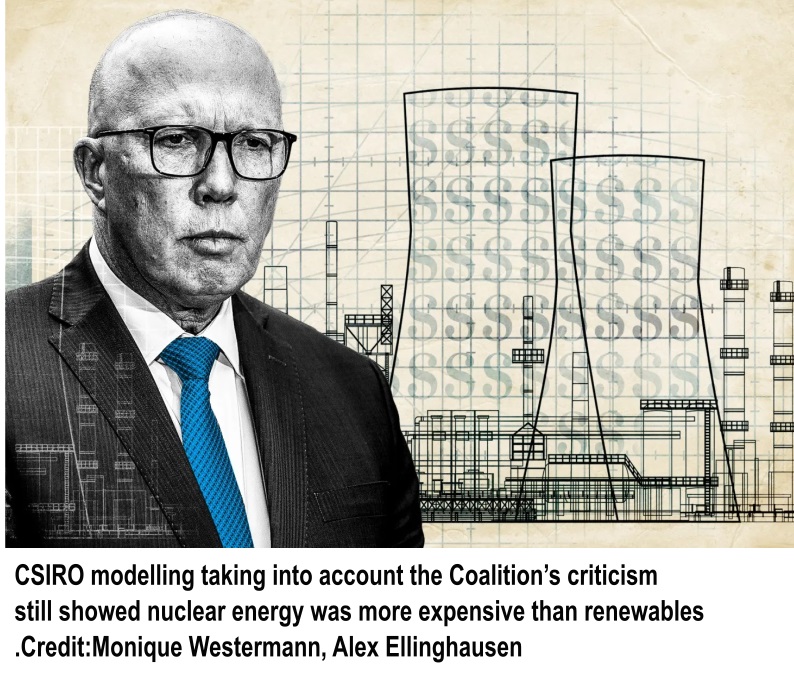
The 2024-25 CSIRO GenCost consultation draft does contain an assumption around the insurance costs of nuclear, and ultimately concludes that “nuclear power does not currently provide the most cost competitive solution for low emission electricity in Australia”, and that “while nuclear technologies have a long operational life, this factor provides no unique cost advantage over shorter-lived technologies”. Notably, GenCost actually assumes a problematically low cost for nuclear power, as discussed here recently.
It is bad enough that Littleproud seems to be making a false claim about it being ‘factored in’ to the modelling, but insuring extremely risky technologies prone to massive cost blowouts and very vulnerable to worsening climate disasters is not going to be cheap.
These communities weren’t asked if they want nuclear reactors in their backyard, and have been told it’s happening whether they like it or not.
“Proposed nuclear communities are asking key questions about nuclear reactors which have not been answered: Where is the water coming from? Where is the waste being stored? Where is the detail?“
These communities weren’t asked if they want nuclear reactors in their backyard, and have been told it’s happening whether they like it or not.
“Proposed nuclear communities are asking key questions about nuclear reactors which have not been answered: Where is the water coming from? Where is the waste being stored? Where is the detail?
Nuclear support has melted down in proposed nuclear communities, new polling released by a not-for-profit organisation working with regional communities for more than a decade, RE-Alliance, revealed today.
Energy attitudes polling by respected research firm 89 Degrees East and commissioned by the Renew Australia for All campaign has revealed support for building nuclear reactors at just:
27% in Gladstone
24% in the rest of Central Queensland
24% in Bunbury
22% in Central West NSW which includes Lithgow
32% in Hunter
31% Gippsland.
Further, the same polling showed just 13% of people polled thought nuclear reactors would bring down their bills the fastest (see table below on original ).
The sample size for the polling was 200 local residents in Gladstone, 151 in Central West NSW, 151 in Bunbury, 145 in Central Queensland excluding Gladstone, 301 in Hunter, 300 in Gippsland. Those polled were asked: How do you feel about developing large-scale nuclear energy infrastructure?
RE-Alliance National Director, Andrew Bray, said he was not surprised support for nuclear had bombed, because community engagement is key.
“RE-Alliance stands by the principle that all energy developments in regional Australia need broad community support – whether it’s for solar, wind, batteries, coal, coal seam gas or nuclear reactors,” Mr Bray said.
“Support for nuclear reactors seems to be melting down in the regions who’ve been told they are hosting them.”
These communities weren’t asked if they want nuclear reactors in their backyard, and have been told it’s happening whether they like it or not. Community engagement is by no means easy, but you’ve got to at least try. It’s no surprise support is so low.
“Proposed nuclear communities are asking key questions about nuclear reactors which have not been answered: Where is the water coming from? Where is the waste being stored? Where is the detail?
“Communities also don’t believe that nuclear power is capable of bringing down their energy bills anytime soon and see renewable energy solutions as a better bet. 72% of people said renewables would bring down bills faster, compared to just 13% who said nuclear.
“We see multiple polls from Porter Novelli, CSIRO, 89 Degrees East and more showing strong support for renewable energy on local farmland, between 66% and 71%. Now the polling shows us support for nuclear reactors in these regions is between 22% and 32%.
“Regional communities have enough uncertainty already. Let’s stop with the whiplash and stay the course on a shift to renewable energy which is already almost halfway done.”
Full results of the two poll questions can be found in the Appendix below (on original).
Note: The difference between a poll and a survey is survey respondents select themselves whereas respondents to a poll are selected by the pollster, weighted so the sample accurately represents the population being sampled, by gender, age group, occupation, and so on.
“Editors and reporters should carefully evaluate whether to report online surveys, having regard to their scope and methodology. They should be cautious of open-access online polls where the sample size and the exact questions asked are unknown and the results have been generated by self-selecting respondents.”
The polling was administered online with recruitment sourced from a consumer opt-in panel provided by Pure Profile, weighted to ensure a representative sample in line with ABS proportions for age, gender and location.
This study was conducted by the research firm 89 Degrees East as part of a larger poll with a total sample size of 5,952 Australians. The sample included a nationally representative poll of 2,014 Australians, with an additional boost sample of 1,900 Australians residing in Renewable Energy Zones (REZs). To ensure robust representation within each REZ, quotas and targeted postcode sampling boosts were applied.
The confidence level of the general population sample is +/- 2.14% at the 95% confidence level. Fieldwork was conducted by 89 Degrees East in March 2025. 89 Degrees East is a member of The Research Society of Australia and the Australian Polling Council.
If you’re a middle aged female with an interest in solar power, nuclear campaigners want you.
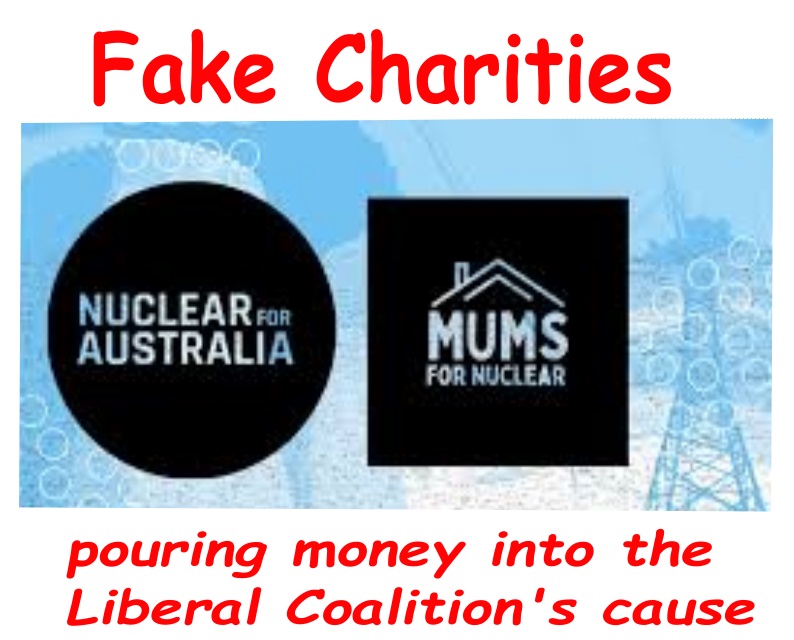
In the week 15th to the 21st of March, Nuclear for Australia and its offshoot astroturfing group, Mums For Nuclear, spent a combined $89,233 on Meta ads, according to online political database WhoTargets.Me.
Mums for Nuclear targets mothers with claims that nuclear power will reduce power bills and is essential to a “clean energy future for our children”. The ads claim “We’re not activists or lobbyists, but we know nuclear is our future”. Nuclear for Australia, which is backed by mogul Dick Smith, is the contact email address on the account.
Download the browser extension at WhoTargets.Me to see if you’re being targeted by political advertisers
While men and women saw the ad, around 18% of the budget was spent targeting women only. The group is also running print ads and issued a media release.………………..
Belinda Noble, founder of climate communications group, Comms Declare said, “Targeting mums with false promises of cheap power bills and climate solutions is as manipulative as it is cynical. The CSIRO has confirmed that only renewables can provide the cuts in climate pollution that we need this decade.”
Dutton has not visited Australia’s only nuclear reactor and has not received a brief from our country’s expert agency on the policy area he was developing. For completeness, I also asked the Government’s nuclear safety regulator, ARPANSA, if Dutton had visited them or sought advice from them. FOI came up with the same answer from them. Nothing at all.
Is Peter Dutton’s proposed ‘rollout’ of modular nuclear reactors real policy or just politics? What research has he done to develop the policy? Not much, it seems. Rex Patrick reports.
In September 2020, the Morrison Government released a Low Emissions Technology Statement that placed Small Modular Reactors (SMR) on a list of watching brief technologies. SMR developments were to be monitored to see if they might play a part in Australia’s energy future.
Consistent with that listing, the Government directed the Australian Nuclear Science and Technology Organisation (ANSTO) to join an International Atomic Energy Agency (IAEA) Coordinated Research Project focused on the Economic Appraisal of SMRs to provide information to assist in evaluating the technology’s economic viability.
ANSTO assembled a team to prepare, among other things, a case study on Australia’s potential to adopt SMR technologies in the future and analyse financing options for the technology. As part of that project, ANSTO even supported a University of Queensland PhD thesis on SMRs.
Flip flop politics
Peter Dutton, a minister in the Government that commissioned the ANSTO work, came out mid-way through 2023 with a proclamation of the Coalition’s plans for Australian to adopt SMRs as a preferred tool in our movement towards net zero carbon emissions.
In doing so Dutton opened himself up to a political battering because of the nascent state of SMR development around the world and huge questions around costs.
As Peter Dutton talks up nuclear power, it is not surprising to see Andrew Liveris shifting his pitch from a ‘gas led recovery’ to a call for Small Modular Reactors (SMRs) to be considered for the 2032 Brisbane Olympics. Dutton is engaged in politics, Liveris in fantasy. Rex Patrick reports on the nuclear distraction.]
Undeterred, in early March Dutton doubled down on nuclear power, switching his thinking to large nuclear power plants scattered about the country. As public controversy raged about the new plans, Dutton has started reinjecting SMRs into the total mix.
There are now to be a mix of economic and taxation incentives for the local communities targeted by the Coalition to host a nuclear reactor.
“Somewhere in a Coalition back office, there’s a whiteboard with a map waiting to be unveiled.”
In response to their hip flip to a larger nuclear power plant and his small flop back to SMRs, I thought MWM set out to see if Dutton has visited ANSTO or taken a brief from them in relation to his plans.
After all, there’s no shortage of precedent for parliamentary oppositions to seek factual briefings from government agencies, especially on complex and specialised subjects.
Missing homework
In response to their hip flip to a larger nuclear power plant and his small flop back to SMRs, I thought MWM set out to see if Dutton has visited ANSTO or taken a brief from them in relation to his plans.
After all, there’s no shortage of precedent for parliamentary oppositions to seek factual briefings from government agencies, especially on complex and specialised subjects.
In a recent nuclear estimates brief prepared for the CEO of ANSTO, the first two paragraphs stated:
“As the custodian of Australia’s nuclear expertise and capabilities, ANSTO is well positioned to advise governments, Australian parliaments, and members of the public on the technical aspects of nuclear power and nuclear power developments globally.”
“ANSTO has significant insight into what other countries and jurisdictions are doing around the world in terms of nuclear power.”
As mentioned above, ANSTO was specifically engaged by the former Coalition Government to take a look at SMRs. So, I was left gobsmacked when a Freedom of Information request I made to ANSTO to find out what Dutton’s interactions with ANSTO had been over the past five years returned nil information.
Dutton has not visited Australia’s only nuclear reactor and has not received a brief from our country’s expert agency on the policy area he was developing. In some measure, it explains the flip-flopping and limited detail in many of his announcements.
For completeness, I also asked the Government’s nuclear safety regulator, ARPANSA, if Dutton had visited them or sought advice from them. FOI came up with the same answer from them. Nothing at all.
Politics, not policy
You can’t develop policy just by chin-wagging at party room meetings and with briefs from vested business interests. That’s not how it works. You have to get independent and expert advice, and in the case of nuclear matters, a vital place to get that advice in Australia is ANSTO and ARPANSA.
So, just what policy work has Dutton done? In large part, he appears completely dependent on the Google skills of his little-known Climate Change and Energy spokesperson, Ted O’Brien.
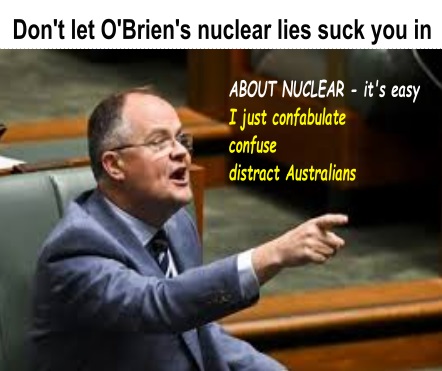
With a background in marketing, O’Brien has no ministerial experience, so the practicalities of major project implementation may be quite novel for him. He did once chair a parliamentary committee inquiry into nuclear energy, but as so often is the case, the research there was largely done by the committee secretariat, with O’Brien just adding a thin layer of pro-nuclear evangelism on the top.
It’s pretty safe to say that, in the absence of comprehensive briefs from and engagement with Australia’s leading experts, Dutton is not engaging in serious policy development. Rather it’s a manoeuvre to achieve political differentiation and keep the anti-renewals, climate-change-denying core of his Coalition happy.
Dutton’s approach to policy development, in this instance, says just as much about him as it does about his nuclear plans.
Rex Patrick is a former Senator for South Australia and earlier a submariner in the armed forces. Best known as an anti-corruption and transparency crusader, Rex is running for the Senate on the Lambie Network ticket next year – www.transparencywarrior.com.au.
come May 3, if Peter Dutton gets elected, this work will not be available to the Australian Submarine Agency or other Government Departments. At that point the review will be locked away at the National Archives of Australia, unavailable until at least 2044.
The Federal Government has successfully managed to bury, for twenty years, a report into how high-level AUKUS nuclear waste will be stored, and where. Transparency warrior Rex Patrick reports.
The circumstances of this case are extraordinary, as is the outcome. A report of very high public interest has effectively been hidden from view by the bureaucracy’s misrepresentation of the report’s nature and origin.
In early 2023, the Cabinet made some sort of direction for the Department of Defence to look into AUKUS’ high-level nuclear waste storage.
Ms Alexandra Kelton, a then Defence Department official and now Acting Deputy Director-General of Program and Policy in the Australian Submarine Agency (ASA) contracted a commercial company, SG Advice, to prepare a report.
This is despite the Cabinet Handbook expressly prohibiting external contractors from seeing or handling Cabinet documents.
The Cabinet Handbook states, “It is inappropriate to provide copies of, or access to, final or draft Cabinet documents to sources external to government.”
There was no evidence that a direction was made to produce a report for Cabinet. The February 2023 letter of engagement explains that the role of SG Advice would be advisory in nature and that any decision related to the storage and disposal of radioactive waste is “a decision for the Australian Government.”
Ms Kelton later deposed that the words “Australian Government” mean “Cabinet”. Administrative Review Tribunal (ART) Deputy President, Peter Britten-Jones, swallowed that.
Insecure and unsecured
Consistent with a document that is not a Cabinet document, the nuclear waste review was prepared on unclassified computers and transferred on unclassified networks across multiple agencies.
The Cabinet Handbook, which sets out Cabinet rules and is signed by the Prime Minister and Attorney General, states that in preparing Cabinet documents, such documents must be prepared on a separate secure Cabinet System called CabNet.It further states that Cabinet Division manages and maintains the CabNet+ system, which is the real-time, secure, whole of Australian government information and communications technology system used to support the Commonwealth’s end-to-end Cabinet process.
The system provides electronic access at the PROTECTED and SECRET security classifications from approved networks across government.
It is likely that Ms Kelton and perhaps others engaged in breaches of security by not enforcing this rule. Lawyers for the Australian Submarine Agency suggested that Ms Kelton’s statement, “as a matter of practicality for communicating and formatting parts of the draft, that process occurred outside the CabNet system,
“should be given more weight than the rules set by the Prime Minister and Attorney-General.”
RoboDebt conduct, eat your heart out. Britten-Jones referred to these as “irregularities”, and then just moved on.
Bad decisions by ART – the Administrative Review Tribunal
………As things now stand, any mid-ranking bureaucrat can unilaterally declare that a report was intended for Cabinet and Cabinet secrecy will apply, shrouding failures, scandals and politically awkward problems from public scrutiny for decades.……………
This latest decision is a bad one, too. It’s a very bad decision.
………………………..High public interest
When the nuclear waste review was completed in November 2023 and sent to Defence Minister Richard Marles with a bureaucratic proposal, the review was included as an attachment to a submission to the National Security Committee (NSC) of the Cabinet.
In the brief that recommended it be attached to an NSC submission Admiral Jonathon Mead warned Marles that the report would be of high public interest. The bureaucrats in the Australian Submarine Agency were clearly worried about public reactions if the review were ever released, so they belatedly wanted it shrouded in Cabinet secrecy……………………………………………………………
A waste of money
The contract for SG Advice to produce the report was $360,000. Four Agencies were involved in compiling the report: ANSTO, ARWA, Geoscience Australia, and the Australian Submarine Agency. The work was conducted over nine months. This document is a million-dollar document.
The nuclear waste review was described by Ms Kelton as a “significant piece of policy advice and [t]he subject matter for the Review report remains current and relevant to forward Government decision-making.”
Legally, at least for now, the report is a Cabinet document.
But the Cabinet Handbook states Cabinet documents are considered to be the property of the Government of the day. They are not departmental records. As such they must be held separately from other working documents of government administration.
That means, come May 3, if Peter Dutton gets elected, this work will not be available to the Australian Submarine Agency or other Government Departments. At that point the review will be locked away at the National Archives of Australia, unavailable until at least 2044.
So as soon as the Government changes, sooner or later, it will be a case of “start again”.
Who in their right mind would nominate that a significant piece of work should be a cabinet document? It’s a costly move. But then again, the Australian Submarine Agency did decide to give the United States $4.7B to upgrade their shipyards with no clawback if those same shipyards don’t ever deliver us a submarine. Before that, the Defence Department spent $4B not buying French submarines.
It’s stuff you wouldn’t normally read about, except here at MWM.
The Electrical Trades Union is targeting Peter Dutton’s nuclear plan with a $2 million ad campaign focusing on key federal electorates, including the opposition leader’s own seat of Dickson in Queensland.
Running under the slogan “Dutton’s Nuclear Plan: Why?”, the campaign seeks to deliver a powerful message through TV, radio, and digital platforms.
Featuring electricians, farmers, and policy experts, the ads question what the union says are “serious flaws in the nuclear plan around cost, timelines, and value for money”.
“The campaign highlights nuclear power’s enormous water consumption, which is 1.4 times greater than coal, a point that will resonate strongly in water-stressed areas like Western Australia,” ETU national secretary Michael Wright says.
Wright says the campaign will make voters aware of the costs, “impractical timelines, and job-killing consequences of Peter Dutton’s nuclear energy proposal”.
“Peter Dutton’s nuclear proposals are an expensive, impractical fantasy,” he says.
“Australia needs a new generation to keep the lights on today, in 2025. A nuclear power plan for 2045 is worse than useless – it is killing energy workers’ jobs. With 40% of the grid already powered by renewables and batteries, ETU members are building the energy transition today.
“Every day that Dutton pushes his nuclear fantasy for the 2050s is a day spent destroying and delaying real jobs and projects in 2025. Dutton’s plan would cost $600 billion, take more than 20 years to get off the ground, and provide only four percent of our energy needs.
“This isn’t a plan—it’s a delay tactic that puts thousands of jobs and the nation’s energy security at risk.”
Dutton last year announced he will go to the upcoming federal election promising to build seven nuclear power stations. He has promised the first sites could be operational between 2035 and 2037, years earlier than what the CSIRO and other experts believe is feasible.
Australia will head to the polls on 3 May for the federal election.
Today’s voter has it tough, especially younger Australians who get much of their information from apps. It’s daunting to sort fact from fiction in the Wild West world of online media, where hidden agendas and speculative opinion are rife. All the more so when a party’s policy only truly makes sense if viewed through a wider lens.
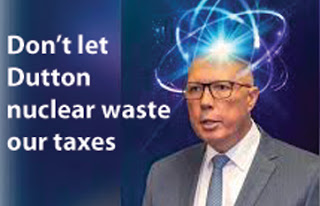
Opposition Leader Peter Dutton’s promise to build seven small-scale nuclear reactors, ostensibly to help meet future energy needs while keeping carbon emissions at bay, therefore needs to be seen for what it really is: a staggeringly bad idea, a stunt and a con. It is a backdoor attempt to pander to the fossil-fuel lobby – and under the electoral spotlight, more people will figure that out.
Younger voters understandably won’t know that a generation their age once packed the Sidney Myer Music Bowl with Midnight Oil, INXS and other friends to “Stop the Drop”. They won’t remember our Nuclear Disarmament Party campaign, which won Senate seats in Western Australia and NSW in the ’80s. They can’t know what it was like to grow up during the Cold War era or live through horrific meltdowns at the Three Mile Island, Chernobyl and Fukushima nuclear power plants, which were also “completely safe” until the day that they weren’t. But generations Y and Z can still smell a rotten idea when they give it a good sniff.
One example is the fanciful assumption that nuclear plants could be built in 12 years. Twenty years would be more likely – if they are built at all. Cost overruns and safety issues are equally certain. And the carbon consequences of prolonging our old coal-fired power generators are dire.
This deceptive proposal has all the Trumpian hallmarks: a quasi policy announcement intended to serve sectional interests – in this case, fossil-fuel conglomerates – while simultaneously serving up a cartoon enemy as ideological whipping boy, namely renewable energy.
Australia has abundant sunlight, plenty of wind, plus lots of pumped hydro resources that can all be converted by increasingly efficient technologies. Stored batteries are ramping up, too. The butterfly has emerged from the chrysalis and taken to the skies – the renewable energy transition is well under way. Construction costs will keep coming down. Supply will keep going up. The future is already here.
By wrenching the country off this course, Dutton’s plan would leave old, dirty, coal-fired power stations staggering on at increasing risk of breakdown, putting off the day of reckoning when we finally stop polluting and heating our world and get on with using affordable, reliable energy that does not cause more climate chaos.
What possible reason is there for Australia to embark on building a completely new, expensive energy infrastructure we don’t need and which, incidentally, is already illegal in states where the reactors are meant to go?
Nuclear energy features eye-watering costs, which history repeatedly shows blow out. It features risks associated with managing radioactive waste for tens of thousands of years. It is also a massive safety risk from both accidents and attacks.
To cap the charade, this policy comes from the parties that supposedly champion free enterprise and want to reduce government spending, yet the hundreds of billions of dollars needed to fund the Coalition’s nuclear plan are to be borne by all of us, the taxpayer. Go figure!
Australian Independent Media March 29, 2025, By Denis Hay
Description
Why the US Australia alliance needs a rethink. The U.S. is no ally. Discover why Australia must distance itself to avoid war and reclaim its sovereignty.
How Australia Can Safely Distance Itself from U.S. Hegemony
Introduction – The US Australia Alliance: Myth vs Reality
Picture this: You’re sitting in a Brisbane café, sipping a flat white while reading the headlines – Australia has just signed another defence pact with the United States. More American troops, military hardware, and diplomatic praise about our “unbreakable alliance.” Yet, beneath the headlines lies a growing discomfort – are we allies, or are we just a strategic pawn in U.S. global dominance?
Joh Bjelke-Petersen once said that this is just politicians “feeding the chooks.” Empty words. The truth is, the U.S. government doesn’t respect its people, let alone Australia. It sees nations – including its own – as resources to be mined for profit. This article will explore how Australia can break free from this exploitative alliance without putting itself in harm’s way.
The U.S. Government’s Track Record: A Global Power Without Respect
Exploiting Its Own Citizens
Visit Detroit, Michigan – a city once bustling with manufacturing pride. Now, it stands as a ghost town of forgotten promises, where basic water access has become a luxury. Millions of Americans are homeless or working two jobs or more just to survive. U.S. billionaires soared in wealth, while 45 million Americans live impoverished.
Internal reflection: “If they treat their own citizens this way, what hope do allies have?”
Exploiting Other Nations
Let’s take Iraq. The 2003 invasion, sold on lies about weapons of mass destruction, cost hundreds of thousands of lives, all to secure oil. In Libya, a once-stable nation descended into chaos after U.S.-led intervention. This is not defence—it’s corporate imperialism.
When the U.S. backs coups in Latin America or imposes sanctions on countries like Venezuela or Cuba, the motive is always clear: control the global economy for U.S. corporate gain.
The U.S.–Australia Relationship: Not What It Seems
Political Rhetoric vs Reality
Australian and U.S. politicians often repeat phrases like “shared values” and “strong friendship.” But how many Australians were consulted when Pine Gap was set up or when AUKUS was signed?
Dialogue: “This isn’t a partnership. It’s a surrender of our sovereignty,” says a former Australian diplomat.
The Cost of Loyalty
Australia’s blind support for U.S. policy has real consequences:
• Trade tensions with China – our largest trading partner
• Environmental destruction from military exercises on Australian soil
• Loss of independence as U.S. bases expand here without public debate.
Why China Matters More Than Ever
60% of Australia’s exports go to Asia, with China alone accounting for over 25%. Australia’s economy is tightly linked to Chinese demand, from iron ore to wine. Trade disruptions – often driven by political antagonism encouraged by the U.S. – have already cost farmers, winemakers, and miners dearly.
The Danger of Choosing Sides
We risk becoming collateral damage in a U.S.-China conflict. Australia should not repeat its mistakes from Vietnam or Iraq – wars that had nothing to do with our national interest but cost us dearly in blood, treasure, and reputation. This has been the outcome of the US Australia alliance.
Thought: “Must we always fight other nations’ wars? When do we stand up for ourselves?”
Pathways Toward Australian Independence………………………………………..
Phasing Out US Australia Alliance and Military Influence
Start with transparency:
• Conduct a national audit of U.S. bases and agreements.
• Establish parliamentary oversight.
• Hold a public referendum on AUKUS.
Dialogue: “Our security must not come at the cost of our sovereignty,” says Senator David Shoebridge.
A ‘non-partisan’ pro-nuclear lobby group has ramped up its spending ahead of the federal election — but has not declared what spending is on ‘electoral matters’.
Australia’s election regulator has reminded a Nuclear for Australia-affiliated group of its legal obligations, as the pro-nuclear lobby group spends hundreds of thousands of dollars to support a policy promoted by the Coalition.
In the past week, “Mums for Nuclear” ran more than $16,000 of Facebook and Instagram advertisements, in addition to a newspaper advertisement in The Age. None featured electoral authorisations, although the digital advertisements were classified as pertaining to “social issues, elections or politics” on Meta’s platform.
The group is an offshoot of Nuclear for Australia (NfA), a purportedly “nonpartisan” group started by then 16-year-old Will Shackel in 2022. Last year, Crikey reported that the group’s website listed Liberal Party-linked “digital political strategist” James Flynn as an author on some of its content. Flynn had also liked the group’s tweets on his personal account and criticised Labor’s energy policy on Sky News.
Nuclear for Australia did not respond to repeated requests for comment.
Since then, there have been other connections between NfA and Liberal politicians. Tony Irwin, one of its “expert working group” members, appeared at an August Liberal Party state fundraising event. Lenka Kollar, who featured in Mums for Nuclear’s newspaper advertisement and is also on NfA’s expert group, leads a firm that reportedly ran a “grassroots community engagement program” for shadow minister for climate change, energy, energy affordability and reliability Ted O’Brien.
In the lead-up to the federal election, NfA has emerged as one of the loudest advocacy groups on energy and climate policy, kicking off a blitz of advertising. In the past 90 days, the group has spent more than $156,575 on Meta ads on its account (out of $195,002 spent since it started). In January, the group paid for Miss America 2023, Grace Stanke, to come to Australia and do a publicity tour promoting nuclear energy. The campaign was promoted by PR agency Markson Sparks!’ Max Markson.
The group says it received charity status in March 2024 and that, up to that point, its primary funding was from patron Dick Smith, “who covered establishment legal fees and our founder’s trip to COP28”. In March this year, Smith claimed he had donated “more than $80,000” to the group and previously said in July 2024 that it was “more than $100,000”.
Since NfA received charity status, it has accepted donations from the public. Shackel says the group does not “accept funds from any political party, nor any special interest group, including the nuclear industry, including any think tanks”.
A financial statement filed with the charity regulator states that the group received $211,832 in donations and bequests between October 31, 2023, and June 30, 2024. In that time, the group spent $125,489 on “other expenses/payment”, which does not include employee salaries or payments.
However, the group did not file an AEC third-party return for this period. According to the AEC, any group that spent more than $12,400 on “electoral expenditure” in the 2023-24 financial year would be required to disclose its expenditure and donors. Whether NfA would qualify is unclear. The group has an electoral authorisation on its website and social media accounts.
Out of the $125,000 the group spent that year, it’s unknown how much — if any — is considered “electoral expenditure”. The AEC defines this as expenses with the dominant purpose of creating and communicating electoral matters to influence the way electors vote in a federal election. Complicating this further, charities like NfA are allowed to advocate on policy issues but can be deregistered for promoting or opposing a party or candidate.
The AEC can investigate and warn groups it suspects have not correctly authorised communications about an electoral matter. An AEC spokesperson did not disclose whether it considered Mums for Nuclear’s advertisement to be on an electoral matter, only that it had communicated with the group.
“The AEC is addressing disclosure and authorisations considerations directly with the entity Mums for Nuclear. Should this entity be required to register as a significant third party or an associated entity, they will appear on the AEC’s Transparency Register,” they said.
Despicable Ploy, by artist Phil Meatchem, has won the nation’s premier satirical art prize in Canberra. A Gru-inspired image of Opposition Leader Peter Dutton playing chess with some nuclear reactor pieces has taken out the 2025 Bald Archy Prize.
Mr Meatchem won the $10,000 prize for his painting after it was announced at the Canberra Potters and Watson Arts Centre.
Despicable Ploy is a satirical take on Opposition Leader Peter Dutton’s proposed nuclear power infrastructure plan.
“I’m not an artist with a strong political view. It was a simple idea of what looked like a pretty scary dude, to me at least, and these ominous looking nuclear monoliths,” Mr Meatchem said.
I’ve only just discovered “Mums for Nuclear” – and they sound just so lovely. They are an Australian offshoot of “Mothers for Nuclear”, which is a very lovely global organisation, full of joy and delight in nature, and of course – all are lovely ladies with lovely children. Here’s a sample of their philosophy:
“I personally went from a fear of nuclear to understanding how many of my assumptions about it were astonishingly far from the truth. The more I read, the more I realized that we direly need more nuclear power to help solve some of the greatest threats to the environment and humanity, including mitigation of climate change, protection of natural resources, reductions in air pollution, and lifting people from poverty. I joined Mothers for Nuclear because I want to help leave a better world for our children.”
That was written by Iida Ruishalme – A Finnish mother, and one of nine women featured on the Mothers for Nuclear website She works as a science writer, and by the way, is the only one who is not directly involved with the nuclear industry. Most of the others are nuclear engineers.
Anyway, the website is beautiful – and it’s easy to come away from it with enthusiasm for nuclear power.
Those nine women represent the USA, Finland, Germany, and the UK. You don’t learn how many members the organisation has, nor where it gets its funding.
“In 2022 Mothers for Nuclear became a fiscal sponsor of Stand Up for Nuclear. Stand Up for Nuclear is the world’s 1st global initiative that fights for the protection and expansion of nuclear energy. We are long-term partners who have worked together on multiple campaigns including in California, Europe, Kenya, and many others.”
“Fiscal sponsorship refers to the practice of non-profit organizations offering their legal and tax-exempt status to groups – typically projects – engaged in activities related to the sponsoring organization’s mission. It typically involves a fee-based contractual arrangement between a project and an established non-profit.”
Mmmmm – sounds as though Mothers for Nuclear is a real help to the nuclear industry, and quite useful to its own members. Though I don’t for a moment doubt their sincerity.
Now we come to the new – and what a timely newness – Australian version – the more relaxed sounding “Mums for Nuclear“. It has joined the “charity” nuclear front group Nuclear for Australia.
Once again, I’ve found it hard to discover just how many members are in Mums for Nuclear. And also – where it gets its funding.
I have found one member, Jasmin Diab, who is the face of the outfit, but doesn’t call herself a CEO or anything formal like that: “Hi, I’m Jaz! I’m a mum of one human and two dogs.”
However, Jaz does have another role, which is quite a bit more formal.
“We work with partners, clients and relevant authorities to ensure that novel technology is secure. Across SMR, AMR and fusion we work to make sure that projects, programmes, processes and products are protected and commercially viable.”
“Our clients include: the UK Department for Energy Security and Net Zero; the UK Ministry of Defence; UK National Nuclear Laboratory; the Canadian Nuclear Waste Management Organistion; the Ukrainian Government and nuclear industry; Magnox; Babcock International; BAE Submarines; University of Bristol; University of Manchester and SMR developers. We’ve worked with the armed police capability of the Ministry of Defence Police, Civil Nuclear Constabulary and US teams in protecting nuclear material and developing doctrine, and with the infrastructure police of some Middle Eastern Governments.”
I don’t doubt that Jasmin Diab is sincere, and that she is a good mum to one human and two dogs. And she can provide for them well, with that good job with GNSP. I’m not sure that her message will go down that well with Australian women. A recent national survey shows that Australian women are strongly opposed to nuclear energy and are most concerned any consideration of the controversial power source will delay the switch to renewables.
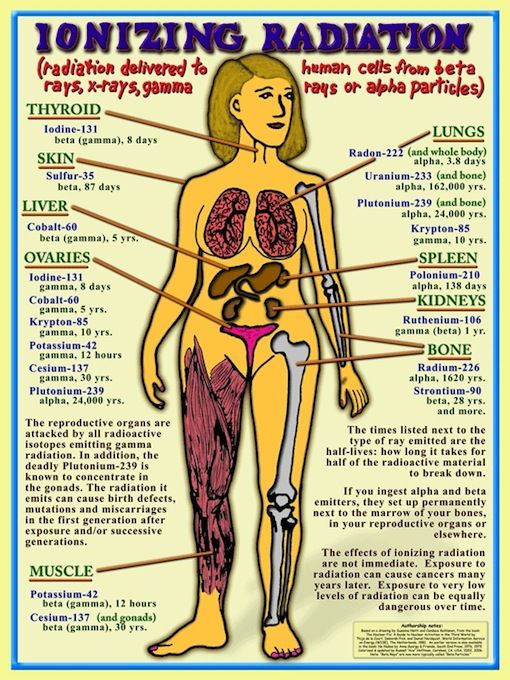
The Mums for Nuclear groups seem curiously uninterested in the fact that women, and children, are significantly more vulnerable to illness from nuclear radiation than men are.
Opposition Leader Peter Dutton has been interrupted by an anti-nuclear protester representing Rising Tide during his first official campaign event in Brisbane.
Peter Dutton has been heckled by a protester just over an hour after Prime Minister Anthony Albanese endured a similar incident in a chaotic start to the first full day of the election campaign for both parties.
The Opposition Leader visited the XXXX brewery in Brisbane on Saturday in his first official campaign event, where he was interrupted by a protester purportedly representing environmental group Rising Tide.
A woman held up a sign that read: “No new gas or nuclear” with “Rising Tide” scribbled underneath as she shouted towards Mr Dutton. Footage showed the woman emerge right next to Mr Dutton wearing a hi-vis vest appearing to blend in with the media in the brewery.
“Why are you lying to the Australian people about the cost of nuclear and gas,” she asked.
“It’s going to cook the country, it’s going to cook our country,” she continued as security began to eject her from the premises.”….
“Industry experts have already agreed your plan’s not going to work. Why are you lying to the Australian people?” she said.
A Rising Tide statement revealed Natalie Lindner was the woman who carried out the protest, in the fifth incident where the group has interrupted a politician’s event in the past fortnight.
It follows the disruptions of Angus Taylor’s press conference, Mr Dutton’s speech to the Lowy Institute, Jim Chalmers’ pre-budget speech and a Liberal Party fundraiser.
Ms Lindner made comment in the statement, claiming Mr Dutton’s nuclear scheme “will actively worsen the cost of living and climate crisis”.
Sky News Political Reporter Cameron Reddin asked Mr Dutton whether the protests would change how he would campaign over the next five weeks.
“While there’s plenty of cash being splashed on gas, no dollars are set aside for nuclear. Is this a genuine policy, or was it always just a ploy for more coal and gas?
Opposition Leader Peter Dutton’s budget reply details the Liberal-National Party’s polluting policies on energy and climate change:
$0 for nuclear begs the question: is the party now walking away from their highly controversial energy scheme?
A whopping $1.3 billion in handouts for multinational gas corporations during a cost-of-living crisis
Zero mention of climate change, net zero or escalating costs of disasters is a head-in-the-sand approach to Australians suffering from worsening climate disasters
The Federal Opposition’s policies put more Australians in the crosshairs of escalating climate-fuelled disasters, the Climate Council summed up in response to tonight’s budget reply.
Their policies help the polluting gas industry with handouts and promises to wave through more projects. It continues their poor track record on climate change with more of the same: more excuses, more delays, and more harmful climate pollution from coal and gas. The Coalition still has no credible plan to deal with climate change, or replace our ageing coal generators.
Climate Council CEO Amanda McKenzie said; “While Australians are struggling in a cost-of-living crisis, the Liberal-National Coalition is focused on handing out $1.3 billion to the gas industry, and waving through their polluting projects. This tramples all over the progress we’re making to cut climate pollution and protect our environment. It’s reckless and destructive.
“While there’s plenty of cash being splashed on gas, no dollars are set aside for nuclear. Is this a genuine policy, or was it always just a ploy for more coal and gas?
“Combine their expensive nuclear scheme with bucketloads of gas, and you have a climate disaster that locks in at least two billion more tonnes of climate pollution from coal and gas.
“They still have no plan to cut climate pollution. They’re wilfully risking our kids’ future by kicking the climate can decades down the road. With coal-fired power stations on the way out, and the climate crisis accelerating, we need energy solutions for today. More renewable energy and storage is the fastest way to get power bills under control, the quickest way to replace coal as it retires, and the only way to secure a safer future for our kids and our communities.”
The 2025 federal election will be all about cost of living pressures, and that is exactly where the Smart Energy Council is aiming with a $1 million spend to tell Australians how much their power bills will go up if Dutton’s nuclear dreams come to fruition.
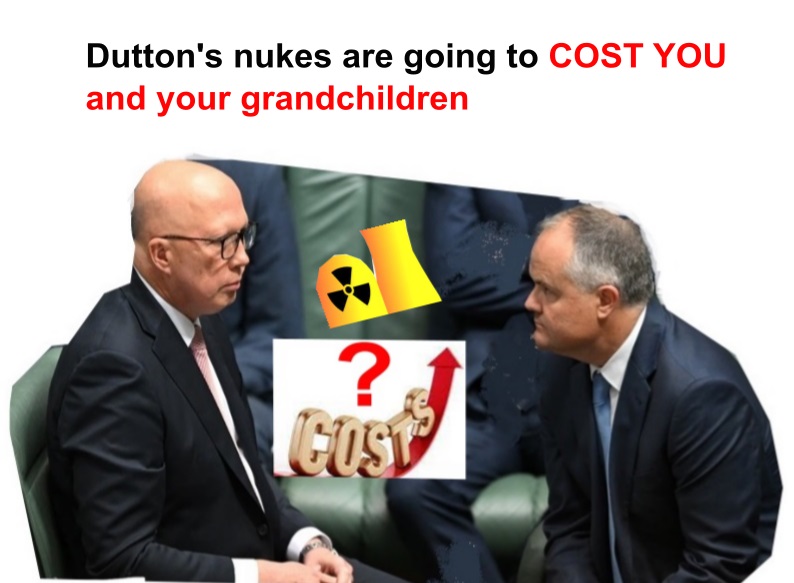
If the Coalition’s price tag of $600 billion for seven reactors is correct – and there are plenty who dispute it – then in today’s money that comes to $30,000 per Australian taxpayer, Smart Energy Council CEO John Grimes said in a statement.
That figure doesn’t take into account the higher power bills Australians will need to pay in order to fund the reactor rollout, he says.
Their accounting suggests that households without rooftop solar will see a potential power bill increase of an average of $665 a year, while households with rooftop solar can expect a bill increase as high as $1400 a year.
Last year, the Smart Energy Council estimated rooftop solar would need to be off for about 67 per cent of the year to make room for the proposed 14 gigawatts (GW) of nuclear power, a fact the nuclear lobby has already accepted.
In June last year Robert Barr, a member of the lobby group Nuclear for Climate, told the ABC that rooftop solar would need to make way for nuclear.
“I think what will happen is that nuclear will just tend to push out solar,” he said.
“I think it wouldn’t be that difficult to build control systems to stop export of power at the domestic level. It’d be difficult for all the existing ones but for new ones, it just might require a little bit of smarts in them to achieve that particular end — it can be managed.”
Given the “white hot rage” of consumers faced with the introduction of emergency stop buttons in South Australia, Victoria, Queensland and now New South Wales (NSW), it’s fair to say the nuclear lobby has underestimated how attached Australians are to their rooftop solar systems.
To give an idea of what they’re up against, the nuclear lobby is today pitting itself against the little over a third of Australia households who already have rooftop solar.
Slightly more than half of houses in Queensland have rooftop solar, the highest penetration in Australia. In South Australia it’s almost half, Western Australia has 45 per cent of homes topped by solar and in NSW it’s 35 per cent, according to a Climate Council report last year.
“Australians will be outraged to know that despite investing thousands of dollars to increase their energy independence and slash power bills, they’ll be forced to pay for their panels to be switched through nuclear power,” Grimes says.
This election is a sliding door moment for millions of Australians that have invested in renewable energy.”
Grimes points out that under the Coalition’s proposal nuclear power plants would be commercially protected, while there is no such law for Australians who’ve invested in rooftop solar systems.
Dutton’s nuclear plan would see large scale renewables capped at 54 per cent of the grid, compared to the minimum-82 per cent target currently in place under the Labor government.
But that would do harm to all Australians, regardless of whether they have been able to install their own solar system, says a report today from the Clean Energy Investor Group.
It found that in 2024, without wind, solar and battery storage, Australian households and businesses would have faced wholesale electricity prices up to between $30/MWh and $80/MWh higher than they actually were in 2024, and paid an estimated $155 – $417 more for household electricity bills.
But it also found that without rooftop solar the 2024 cost of electricity would have increased by a whopping $400-$3,000/MWh.
F-35s, the weapons that have caused such destruction in Gaza, will be in the air at Avalon. For civilian populations on the receiving end, they are objects of terror and loathing, but the Air Show’s website begs to differ: ‘The F-35A Lightning II isn’t just advanced — it’s packed with record-breaking fun facts!’
A Melbourne air show is being promoted as a family event, hiding the dark truth behind its glorification of death and mass destruction, writes Dave Sweeney.
IN THE MISTS of legend, Avalon was a place of mysticism and magic linked with the once and future King Arthur and carrying the scent of sorcery and whispers of the Holy Grail.
This week, the sorcery is back with a showcase of the dark arts of industrial warfare and the Holy Grail of unfettered armaments profits on full display at Melbourne’s “other airport”.
Located around 60 kilometres from Melbourne down the Geelong road, Avalon Airport is home to some Jetstar operations, but it has a long-standing military connection since the strip was first used by federal agencies 70 years ago for the development of the RAAF’s Canberra bomber.
These days, alternate years see the windswept paddocks between the nearby open range zoo and the closed range prison complex host a family feel good celebration of technology that makes many families in other parts of the world feel bad or cease feeling altogether.
The Australian International Air Show and Exhibition is a place for family fun, and with the exciting new food vendors and free carnival rides for children young and old, you are set for ‘a day out with the family that’s not to be missed!’
The Air Show has two parts – one Circus, where weekend crowds can ‘get right up close to feel the rumble and smell the jet fuel’ and one Bread, a closed-door, dollar-driven weapons and technology trade show and networking opportunity.
In a set play from the global textbook of normalising deeply distressing and dangerous practices, the event seeks to braid together war fighting and arms trading with civil aeronautical seminars and emergency response displays.
But the principal public face is a high-octane aerial spectacle and parade of power without glory and context.
Australian manufacturing plays a growing role in the global arms trade, including an essential role in keeping the Israeli Defence Forces F-35 fighters in the air.
According to Amnesty International, Australian-manufactured parts and components, including those produced by sole-source providers, are being used in F-35 fighter jets, raising serious concerns about Australia’s potential involvement in the atrocities in Gaza.
Earlier this year, over 230 global civil society organisations urged governments producing F-35 fighter jets to immediately halt all arms transfers to Israel.
F-35s, the weapons that have caused such destruction in Gaza, will be in the air at Avalon. For civilian populations on the receiving end, they are objects of terror and loathing, but the Air Show’s website begs to differ: ‘The F-35A Lightning II isn’t just advanced — it’s packed with record-breaking fun facts!’
This family fun promotion is worlds away from many other peoples’ experience of the sky as a hostile space that threatens rapid, remote and remorseless destruction and death.
For most of us, the closest we get to this all too common global reality is TV news footage of wailing sirens and survivors amid the rubble.
The reality of what these machines actually do is not likely to be publicly canvassed at the Air Show but will no doubt be a marketing point – as demonstrated in the field – in the exhibition sheds and over networking drinks.
Event sponsors and supporters include federal and state governments, the Australian Strategic Policy Institute and Defence, along with a who’s-who of arms corporations and nuclear weapons heavyweights.
BAE, GE Aerospace and Raytheon will join Lockheed Martin, Northrop Grumman and more in giving away show bags and swapping badged pens, sweets, lanyards and notebooks in an effort to ‘elevate your brand to thousands of attendees’.
The guest list has tentacles around the world, as evidenced by Amentum, an innocuous sounding outfit with fingerprints over Pine Gap, military and civil radioactive waste management in the U.S. and UK and a growing interest in future radioactive waste plans in the Northern Territory.
But none of this is reflected in an event website full of happy family pics, tips on where to park and footage of enraptured kids gazing skywards.
There will be public service announcements reminding folks to slip, slop, slap and stay hydrated and no doubt car conversations on the way home featuring excited chatter about the noise, the power and the cool merch.
But what is likely to be missing – and not by accident – is any serious conversation about Australia’s role and responsibilities and whether our nation prioritises building a human and humane peace or getting a piece of the armaments action and conflict cash in an increasingly uncertain world.





 Antinuclear