Small modular nuclear reactors for Australia?
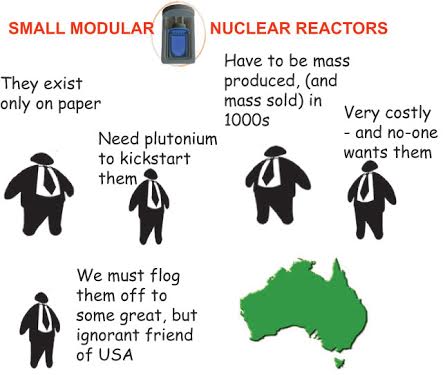 Parliament to look at small nuclear reactors as future energy source. A parliamentary inquiry into an Australian nuclear industry will look at the fast-changing technology of small modular reactors. InDaily, Rebecca Gredley, 5 Aug 19, A parliamentary inquiry into an Australian nuclear industry will look at the fast-changing technology of small modular reactors.Energy Minister Angus Taylor says he’s requested the Standing Committee on the Environment and Energy to investigate nuclear as a power source for Australia.
“We have a moratorium on nuclear. There is absolutely no plan to change that moratorium,” the minister told ABC Radio on Monday…….
Small modular reactors are factory produced and installed on-site.
Director of the Australian National University’s Energy Change Institute Kenneth Baldwin says wind and solar paired with battery storage will continue to be the cheapest form of power.
“These costs will decrease and who knows, in 10-15 years, it may simply be uneconomic to look at nuclear power,” he told ABC News.
Baldwin says such reviews need to be done periodically to understand the current technologies and costs. It would take at least a decade before nuclear is realistically part of the energy mix, he added.
“You need the social licence to operate such a system, and to gain public acceptance may take many years,” he said.
“Add to that the fact that you have to then build a regulatory system – let’s say that it takes five years to do that, five years to build a public acceptance – that’s ten years.”
A federal review into nuclear energy was last conducted under the Howard government, with a report finding 25 reactors would be needed across Australia to supply one-third of the nation’s electricity supply by 2050. https://indaily.com.au/news/2019/08/05/parliament-to-look-at-small-nuclear-reactors-as-future-energy-source/
Australia’s one great river system – Murray-Darling Basin Plan ‘untenable’ – corrupt?
|
Murray-Darling Basin Plan ‘untenable’ says NSW, as Inspector-General says more corruption wouldn’t surprise https://www.abc.net.au/news/2019-08-05/murray-darling-basin-plan-untenable-says-nsw/11382396
Key points:
|
Angus Taylor, Australia’s Minister for Coal and Nuclear, wants to launch Inquiry into nuclear power
Taylor presses nuclear button, as energy wars enter dangerous new phase, Giles Parkinson 5 August 2019 https://reneweconomy.com.au/taylor-presses-nuclear-button-as-energy-wars-enter-dangerous-new-phase-47854/
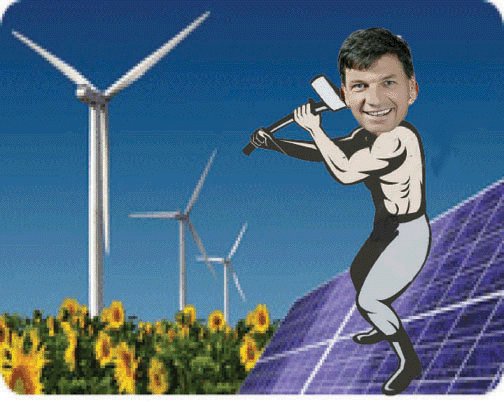 Australia’s energy minister Angus Taylor has campaigned against renewables since before he entered parliament in 2013, appearing at anti-wind events organised by an anonymous and unpleasant website, and vowing on many occasions to scrap the renewable energy target.
He has been powerless to stop the build out of wind and solar, although he has complained about it often enough. But now Taylor and the Coalition government have taken their war against wind and solar to its next inevitable phase: They’ve pressed the nuclear button.
Taylor revealed late Friday that he had asked the Environment and Energy Standing Committee to launch a new inquiry into nuclear energy, including its costs and issues of waste etc. They’ve got four months to produce a report.
Taylor insists that there is no intention to repeal the laws that outlaw nuclear energy in Australia. But that beggars the question. Why have the inquiry in the first place?
The answer is simple. As Taylor revealed in an interview on ABC’s AM program, he simply doesn’t accept that renewables can power the electricity grid. A view that is loudly shared by many of his Coalition colleagues, the Murdoch media, and of course the coal industry.
The timing of the announcement is interesting. It comes just a couple of days after the end of the parliamentary sitting week (they won’t be back again until September) and just as the country’s far-right conservatives got ready to gather at the Australian Conservative Political Action Conference.
Tellingly, this is the first policy or initiative that Taylor has announced since the shock re-election of the coalition government in May, and comes after a major push by the far right ideologues of this conservative government to reconsider the ban on nuclear.

And as we have noted before, the same Coalition MPs that have been pushing for nuclear are the very same Coalition MPs pushing for new coal generation, and the very same Coalition MPs who reject the science of climate change, or make a mockery of the urgings of young people that they should take it seriously.
This is no co-incidence. This is not about carbon emissions, and it is certainly not about cheap energy. The common enemy of these people is wind and solar, and the shift from a centralised system based around “baseload” fossil fuel generators to a renewable system that is largely decentlralised (and democratised), and based around renewables, storage and demand management.
Australia is one of those regions – like Germany and California – that is at the forefront of this transition, and the fossil fuel industry view is that it cannot be allowed to succeed.
So it is no coincidence that the biggest industry supporter of nuclear is the coal lobby itself, in the guise of the Minerals Council of Australia, which is also pushing for new coal generators and urging the government to do as little as possible on climate.
The MCA is cosy with the Coalition – its former CEO and deputy CEOs are now key advisors in Prime Minister Scott Morrison’s office, and its chair is the former Coalition minister Helen Coonan. Its current CEO, Tania Constable, was appointed by the Coalition government to the board of the ABC, over-riding independent recommendations.
A new dimension is also added.
One of the noisiest opponents of renewable energy technologies is Trevor St Baker, pushing for new coal generators and whose Vales Point coal generator in NSW – currently in the queue to get federal government funding to remain open beyond its schedule closure date – is also the founder of a company SMR Nuclear that looking at new “modular” nuclear technologies that Taylor suggests could be a focus of this inquiry.
Like St Baker, the likes of Constable argue that only nuclear is able to deliver 24/7 emissions free power. They insist it is “cheap”, but that is nonsense.
The International Energy Agency desperately wants nuclear to succeed, but it concedes that costs have surged, as this graph (above) from a recent report illustrates. While the cost of solar has fallen 95 per cent over the past decade, and the cost of battery storage by some 70 per cent, the cost of nuclear has more than trebled upwards.
Even re-fitting existing stations was considered more expensive than wind and solar, although as BloombergNEF founder and now commentator Michael Liebreich has pointed out, the costs might be close enough to convince some countries to extend their life.
But there is no economic case for new nuclear. Liebreich says. Cost blowouts are occurring in the UK with Hinckley, and in France and in Finland with their versions of the latest technology, as it is in China (which has begun no new projects in the last three years), and in the US.
This graph[on original] from Le Monde in France illustrates how costs have surged in its next generation technology at its flagship project in Flamanville. It was begun in 20017 with promises it would be finished in 2012 at a cost of €3.5 billion.The latest delay and cost blowout have pushed the assumed finish date to 2022 and the new estimate of costs to €11.5 billion.
As France’s own National Infrastructure Commission said last year, a focus on renewables ‘looks like a safer bet than constructing multiple new nuclear plants’”.
Into this debate recently landed Industry Super Australia, the union fund research body with a report that is quite possibly one of the most inept analyses of the energy industry that has been produced in Australia. And that says something because it has had strong competition. The ISA, and the ISF that oversees it, should be embarrassed that it is published in its name.
To address the issue of costs, the ISA report produces a completely nonsensical “capital cost” assumption that confuses output with capacity factors, multiplies it by the cost of solar plants built more than 5 years ago.
It delivers a figure of $16 billion per gigawatt for the cost of solar. It is not a rough “back of the envelope” calculation as the authors try to claim, it is complete and utter garbage.
Among its other laughable claims are that Australia would need “one hundred” Snowy 2.0 pumped hydro schemes, or 72,000 Tesla big batteries were it to go 100 per cent renewables.
It’s a preposterous number that completely misunderstands the workings of the energy system, and the role of storage technologies, and fails to appreciate that if we do electrify everything, then we will be using less energy, not more.
Apart from now being expensive and polluting, burning fossil fuels is hugely inefficient – most of it disappears as heat, be it in a coal fired power station or in the internal combustion engine of a car – and it is two or three times more wasteful than electric motors and batteries.
But the authors of this report seek to mislead, either deliberately or through their ignorance. They make the patently false claim that fossil fuel plants “do not need back up.” Try running that past anyone who actually operates an electricity grid, and has to deal with large plants that need regular maintenance or which may trip for any number of reasons.
The study is so poorly researched it even claims that the Invanpah solar tower facility in California does not need back-up.
If the authors bothered to spend two minutes researching that project, rather than relying on the blogs of nuclear fantasists, they would have discovered that it has no storage, and needs gas plants to help fire it up in the morning. Yes, it was costly, but it turned out to be such a bad idea that no plant like it has or will be built again. All new solar towers do and will have storage.
But the authors’ minds were set. They even dismiss the reaction to the disasters at Chernobyl, Fukushima and Three Mile Island to “behavioural bias” and compares the lot of the nuclear industry with that of a baseball pitcher in 1930s, Chad Bradford, who had an unusual throwing action.
- “They just judged him on the way he looked. So they demoted him to the minor leagues for a time,” they plead.
- For heavens sake, nuclear is not judged by the way it looks, or its throwing action, but for its costs. And the CSIRO and the Australian Energy Market Operator – like the IEA – have made it clear that nuclear – like new coal – costs a multiple more than the cheapest alternatives, wind and solar backed by dispatchable capacity, be that pumped hydro, batteries, or demand management.
You won’t see baseload mentioned in AEMO’s Integrated System Plan, the 20-year blueprint for the future. Neither will you see it championed by the grid operators in the UK, or China. The world has moved on.
AEMO says Australia has the technology and know-how to move to 100 per cent renewables, although they would differ about the time frame from the most enthusiastic renewables supporters.
The problem is that like the ISA report, the nuclear boosters in the Coalition are prone to accept garbage as gospel.
The energy industry has largely dismissed nuclear as an option in Australia, knowing that it is absurdly expensive, and that if it were built in Australia it would take so long – possibly two decades at the very least – that the country would be powered almost exclusively by much cheap wind and solar and dispatchable storage by that time (if allowed to).
But Ted O’Brien, the chair of the committee reviewing the nuclear issue (it is stacked with four out of seven members from the Coalition) has already made up his mind.
Like his Coalition colleague Craig Kelly, lampooned in the cartoon above, he’s long been a big fan of nuclear – and given his analysis of Labor’s energy policy – he said it would be a tax on Tim Tams – he might have been about as thorough in his assessment of nuclear as Homer Simpson.
Don’t laugh.These people really are that stupid. They are not interested in the advice of experts – be it on climate science, energy technologies, or electric vehicles. But one thing they can’t admit is that the Greens – and now the rest of the energy industry – are right about wind and solar, and the focus on “dispatchable” power rather than “base-load”.
If Australia can demonstrate that a modern economy can be run on a predominantly renewables grid, it’s all over for the fossil fuel industry across the world. So expect this push to have some powerful friends, and not just in the media industry, and not just in Australia.
Giles Parkinson is founder and editor of Renew Economy, and is also the founder of One Step Off The Grid and founder/editor of The Driven. Giles has been a journalist for 35 years and is a former business and deputy editor of the Australian Financial Revie
Liberal National Coalition wants to embrace nuclear power
 Coalition wants to embrace nuclear power, https://www.abc.net.au/radionational/programs/breakfast/coalition-wants-to-embrace-nuclear-power/11382616 4 Aug 19 Australia’s decade-long energy wars have taken a new twist with the Morrison Government ordering a Senate inquiry into the feasibility of nuclear power in this country.
Energy Minister Angus Taylor says the review will look at the economic, environmental and safety implications of lifting the moratorium on atomic energy as a source of baseload power.
The inquiry coincides with the United States flagging the deployment of intermediate missiles in Darwin after Donald Trump pulled the US out of a nuclear arms treaty with Russia
Water shortage hitting Queensland town Stanthorpe
|
Day zero approaches for Stanthorpe as locals face prospect of levy to cover cost of trucked-in water https://www.abc.net.au/news/2019-08-05/stanthorpe-drought-bites-as-town-runs-out-of-water/11381886, ABC Southern Qld , By Elly Bradfield Locals describe it as the “worst drought in living memory” but things are about to go from bad to worse in the southern Queensland town of Stanthorpe, with the town water supply weeks away from drying up.
Key points:
If there is no rain by the end of spring, the council has estimated it will have to truck 45 loads water per day, costing up to $2 million a month, to supply the town. The Queensland Government has refused to be drawn on whether it will contribute, but the council said it would be forced charge ratepayers a levy if governments did not step in. Families strugglingBusiness has doubled at the laundromat, but owner Chris Reedy said that was a bitter pill to swallow with the community struggling.
“They struggle to put food on the table, let alone come and do washing for hygiene,” he said. “I feel depressed to see people in that state … especially families and young kids. “I’ve been helping out a bit with free loads to try to help out where I can.” He described spirits in the town as “at an all-time low” and raised concerns about people’s mental health. Without water you can’t make concreteTraditionally the winter period was concreter Lachlan Carnell’s busiest time, but with most farmers cash strapped, work has dried up and he has been forced to tell staff to “take whatever [work] they can get”. Without water you cannot mix concrete, so everyone’s a bit stressed at the moment,” he said. “The plant will have to start trucking in water, which is going to stress us the contractors and the clients because obviously the concrete is going to go up in price.
Levy threat causes fearAt the motel, owner Michael Jensen raised concerns about the impact of a water levy on the already struggling town. “I think it could have been handled a lot better because there’s a lot of people out there now that are very scared of what’s ahead of us,” he said. “We have an ageing population and a lot of those older people, including my parents for example, just have to try to find that extra money if it does come to that situation.” Mr Jensen broke down when he described the impact of the drought on his community. “If we don’t get water in the next three to six months I fear for the actual community,” he said. “It’s tough; tough for everyone especially the farmers.” ‘Not just farmers who struggle’Secretary of the Stanthorpe and Granite Belt Chamber of Commerce Amanda Harrold said the levy would be “the last straw” for many people. “It goes all the way through the town through families, the retail, the shopping centres, all the way to the school, to the hospital — what services will be kept if we have a dwindling community?” she said. “It’s not just the farmers who struggle in a drought. “This community cannot bear the cost of this, there just won’t be the money.” She said business was already down 20 to 50 per cent. “We are lucky that some tourists are coming to town, but with tourists comes the water usage, so it’s a really hard balancing act.” With the $84 million Emu Swamp Dam now fully funded, there is some hope for locals that the region can be protected from future droughts. But the Bureau of Meteorology has warned the town is unlikely to receive the soaking rain needed in the coming months. |
|
Minerals Council CEO ecstatic about parliamentary inquiry into nuclear power
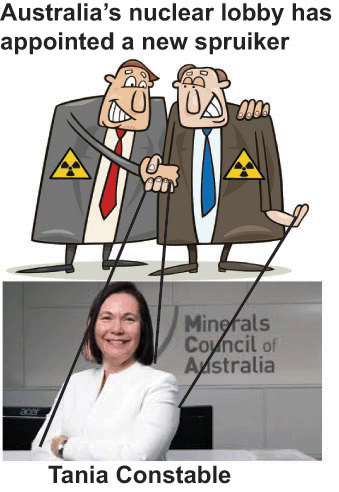 Minerals Council welcomes inquiry into nuclear power, THE AUSTRALIAN, OLIVIA CAISLEY, REPORTER, AUGUST 5, 2019 Minerals Council welcomes inquiry into nuclear power, THE AUSTRALIAN, OLIVIA CAISLEY, REPORTER, AUGUST 5, 2019
“When the rest of the world is deploying the cheapest zero-emission 24/7 energy source, Australia should readily embrace an energy future which is good for both national progress and the environment.” It comes as Energy Minister Angus Taylor wrote to the standing committee on the environment and energy on Friday and asked them to investigate nuclear as a potential power source for Australia……. : “Nuclear energy is safe, reliable and affordable. This is the inconvenient but fundamental truth ignored by those arguing against nuclear power.” Her support of the inquiry comes as Labor leader Anthony Albanese yesterday questioned why the government had requested the inquiry. Mr Albanese said the viability of nuclear energy had been examined “many times” before, with studies showing nuclear power could be up to three times more expensive than wind or solar when connected to other systems. …… https://www.theaustralian.com.au/nation/minerals-council-welcomes-inquiry-into-nuclear-power/news-story/38a0a74c1831558c35bd8a15e9712a9f
|
|

Looks as if Malaysia will let Lynas keep its radioactive wastes there, after all
Malaysian minister capitulates on Lynas waste export condition, The Age, By Colin Kruger, August 4, 2019 One of Lynas Corp’s fiercest critics in Malaysia has confirmed the country’s government will drop a requirement for the rare earths miner to export its radioactive waste from the country.
The confirmation, from Malaysian environment minister Yeo Bee Yin, all but secures Lynas licence to operate in the country beyond September 2 and could reignite a $1.5 billion bid for the business from Perth based conglomerate Wesfarmers.
Ms Yeo said the decision made by Cabinet to allow Lynas to setting up a permanent disposal facility (PDF) in Malaysia was a better outcome than earlier proposals, according to local press reports at the weekend.
A final decision from cabinet is expected later this month.
Ms Yeo had planned to visit Australia last month to discuss exporting the waste back to Australia, but the trip was cancelled after the West Australian and federal government rejected the proposal.
Lynas’ share price plunged in December when her ministry imposed a new condition on the extension of the company’s licence to operate in Malaysia beyond September this year. This included the removal of more than 450,000 of low level radioactive waste.
On Friday Lynas told the ASX it is scouting locations for a permanent disposal facility in Malaysia the day after Malaysian Prime Minister Mahathir Mohamad suggested this is the compromise that will secure its licence.
In May, the company said it would spend $500 million by 2025 on value added processing in the US and Malaysia as well as setting up a processing plant in Western Australia, near its Mt Weld mine, to extract radioactive waste from its rare earths before it is shipped to Malaysia.
On Saturday, Lynas managing director, Datuk Mashal Ahmad, issued a statement to the local media that the company is looking at disused mines as potential sites.
“There are a number of disused mines in the state of Pahang that require rehabilitation and a PDF can be designed such that it assists in the rehabilitation of this land, providing environmental benefits in a sustainable way,” he said in a statement……https://www.theage.com.au/business/companies/malaysian-minister-capitulates-on-lynas-waste-export-condition-20190804-p52dnl.html
Nuclear lobby claims that Australia will hold Parliamentary Inquiry into nuclear power, especially small modular reactors
Australian parliament to launch nuclear energy inquiry. http://world-nuclear-news.org/Articles/Australian-parliament-to-launch-nuclear-energy-inq, 02 August 2019
Australia’s Energy Minister Angus Taylor has asked the House Standing Committee on the Environment and Energy to investigate the nuclear fuel cycle, Committee Chairman Ted O’Brien announced today
“This will be the first inquiry into the use of nuclear energy in Australia in more than a decade and I believe it’s the first time the Australian Parliament has ever undertaken such an inquiry,” O’Brien, who is Member of Parliament for Fairfax in Queensland, said. He will be tasked with leading the inquiry after the ministerial request is considered and adopted by the committee.
In a letter to O’Brien, Taylor said the inquiry will consider the economic, environmental and safety implications of nuclear power. The minister has specifically asked the committee to inquire into and report on “the circumstances and prerequisites necessary for any future government’s consideration of nuclear energy generation including small modular reactor technologies in Australia”.
The terms of reference for the inquiry include: waste management, transport and storage; health and safety; environmental impacts; energy affordability and reliability; economic feasibility; community engagement; workforce capability; security implications; national consensus; and “any other relevant matter”.
“Australia’s energy systems are changing with new technologies, changing consumer demand patterns and changes in demand load from major industries,” the context for the inquiry notes. “At the same time the National Electricity Market is seeing a significant increase in capacity in intermittent low emissions generation technologies.” The country’s bipartisan moratorium on nuclear electricity generation – which has been maintained by successive Labor and Coalition governments – will remain in place, it said.
The inquiry will have regard to previous inquiries into the nuclear fuel cycle, including South Australia’s 2016 Nuclear Fuel Cycle Royal Commission and the 2006 Review of Uranium Mining Processing and Nuclear Energy in Australia, which is also known as the Switkowski report after its lead author Ziggy Switkowski.
The minister has requested that the committee completes the inquiry and delivers its report by the end of this year.
Malaysian Prime Minister Mahathir Mohamad may allow Lynas to dispose of rare earths radioactive wastes in Malaysia
|
Lynas prepares waste disposal plan at behest of Malaysian PM, Brisbane Times, By Colin Kruger, August 1, 2019 Lynas Corp said it is scouting locations for a permanent disposal facility (PDF) in Malaysia for its controversial radioactive waste the day after Malaysian Prime Minister Mahathir Mohamad suggested this is the compromise that will secure its licence to operate in the country beyond September 2.Dr Mahathir signalled on Thursday that his government has dropped its demand for Lynas to ship its radioactive waste out of the country in order for it to secure a licence renewal, but it is not clear whether his ruling coalition has formally agreed to the decision.
In a statement to the media on Thursday, Dr Mahathir said the government was waiting on the rare earths group’s plan to set up a permanent disposal facility in Malaysia for the 450,000 tonnes of low level radioactive waste ahead of a licence renewal deadline. The rare earths producer’s shares jumped 6.32 per cent to $2.69 on Friday. “We are giving this condition to Lynas that they should have a plan for dealing with the waste,” Dr Mahathir told reporters. “We are waiting for them to tell us how they will do that, whether they find a place where they can deposit the waste or not.” In a statement to the ASX on Friday, Lynas welcomed the comments, which indicate that export of its waste is no longer a condition of licence renewal……. https://www.brisbanetimes.com.au/business/companies/lynas-prepares-waste-disposal-plans-at-behest-of-malaysian-pm-20190801-p52d3g.html |
|
Australian govt ignored nomination panel, appointed uranium industry’s Vanessa Guthrie to ABC Board
Documents show Coalition government passed over some of Australia’s most eminent cultural figures to appoint Vanessa Guthrie, Guardian, Margaret Simons, Sat 3 Aug 2019 The government passed over some of Australia’s most eminent cultural figures in order to appoint a mining executive to the ABC board in 2017, despite the fact that she was not recommended by an independent selection process.Documents released under freedom of information legislation show that in February 2017, the government rejected singer, writer and director Robyn Archer, former managing director of SBS Shaun Brown, and Sandra Levy, former chief executive of the Australian Film, Television and Radio School.
They were on a list of eight names recommended by an independent nomination panel after an extensive application and vetting process. The then communications minister, Mitch Fifield, instead appointed the chair of the Minerals Council of Australia, Vanessa Guthrie.
Guthrie had no media experience. At the time, the ABC was facing constant government criticism over its reporting on the coalmining industry and energy security.
Guthrie had also been through the application process but was not recommended for appointment. Fifield’s press release at the time said that while Guthrie had not been recommended, she “was identified by the government as having the requisite skills”.
However, until now, we have not known who was passed over in Guthrie’s favour.
Robyn Archer – singer, writer, director and public advocate for the arts, as well as the former artistic director of the Adelaide and Melbourne international arts festivals.
• Shaun Brown – former managing director of SBS for four years from 2006. Before that, a reporter, presenter, producer and senior executive with Television New Zealand.
• Sandra Levy – former CEO of the Australian Film, Television and Radio School, former head of drama at Zapruder’s Other Films, former director of development at Channel Nine and, before that, director of television at the ABC.
• Emile Sherman – Academy award-winning film producer, known for his work on the films The Kings Speech, Lion and Shame. Co-founder and managing director of See-Saw Films.
• John M Green – publisher, novelist, former executive director of an investment bank, business writer and commentator, member of the governing council of the National Library of Australia.
Georgie Somerset was also on the list recommended by the board, and was appointed with Guthrie. She is a Queensland cattle farmer with board experience across the not-for-profit sector.
An eighth recommended person’s name has not been released at their request. …….
Out of the current nine-member ABC board, five were appointed by the government despite not being recommended through the independent process. As well as Buttrose and Guthrie, the others are company director Dr Kirstin Ferguson (appointed 2015), businesswoman Donny Walford (2015) and businessman Joseph Gersh (2018).
The revelation of the rejected February 2017 applicants is the result of a 22-month battle. The original freedom of information request was lodged in October 2017…….. https://www.theguardian.com/media/2019/aug/03/abc-board-secret-shortlist-of-candidates-ignored-in-favour-of-mining-executive-revealed?CMP=share_btn_tw
South Australian Labor – too pro environment ?
|
Our own base rejected us”: Labor warned on ‘pro-environment’ agenda, InDaily, Tom Richardson @tomrichardson, 2 Aug 19
The ALP’s recent caucus strategy meeting in the Barossa – colloquially known as the ‘Labor Love-In’ – was given detailed analysis of the federal election results in SA, with a breakdown of booths relevant to state seats. Results in the key Liberal-held marginal of Boothby, obtained by InDaily, show strong swings to Labor in more affluent areas, including Hills districts such as Belair and Blackwood, with swings away from the party in more traditional working class booths such as Edwardstown, Ascot Park and South Plympton. Boothby was retained by Nicolle Flint on a 1.4 margin, despite a 1.3 per cent swing against her after a federal boundary redistribution. A Labor insider says the Boothby booth result is indicative of a broader trend seen “in every seat in the country” – which they insist dispels the popular election post-mortem that Labor’s financial reform policies cost them the poll. “The principal conclusion you come to from that data is that there are mild swings in the wealthiest parts of the seat to Labor, and big swings in the working class areas against Labor – that would rather suggest it wasn’t the franking credits that lost us the election,” the source said. “It was something more fundamental – it was our own base that rejected us. “Did they reject us on the franking credits [or a] scare campaign on negative gearing policy? Maybe. “Or did they get the sense that we were more pro-environment than pro-jobs?” That conclusion is one being impressed on Peter Malinauskas’s state caucus, with insiders insisting Boothby “doesn’t augur well for a state result”…….. But ALP insiders aren’t universally convinced that the lesson from the federal result is to eschew a strong climate change agenda, which was a hallmark of Labor’s 16 years in government. …… https://indaily.com.au/news/politics/2019/08/02/our-own-base-rejected-us-labor-warned-on-pro-environment-agenda/ |
|
Andrew Bolt’s media attack on Greta Thunberg – Greta’s answer
|
Teen activist Greta Thunberg hits back at ‘deeply disturbed’ jibe from Andrew Bolt, SBS News, 2 Aug 19 Sixteen-year-old Greta Thunberg has responded to an op-ed written by columnist Andrew Bolt which describes the teenager as ‘deeply disturbed’.
Teen climate activist Greta Thunberg has derided criticism levied at her by conservative commentator Andrew Bolt. Her response follows an opinion piece by the News Corp columnist, labelling the 16-year-old a ‘deeply disturbed’ messiah. In a tweet, Greta returned fire, saying “hate and conspiracy campaigns” around climate change had prompted her strident advocacy action. “I am indeed ‘deeply disturbed’ about the fact that these hate and conspiracy campaigns are allowed to go on,” she tweeted.
“Just because we children communicate and act on the science. Where are the adults?” The Swedish activist’s School Strike for Climate initiative has sparked a worldwide movement calling for greater government action on climate change. She has been nominated for a Nobel peace prize for her campaigning, which has emphasised the need for urgent human action against global warming. But in his opinion piece, Mr Bolt questioned why so many are listening to her “climate panic”. “No teenager is more freakishly influential than Greta Thunberg,” Mr Bolt wrote in his op-ed…… Mr Bolt targeted this unwillingness to “compromise” in his opinion piece. “This allows followers who are tormented with doubt and burden of freedom to relax into her totalitarian certainty,” Mr Bolt wrote. “What is so fascinating about this Thunberg cult is not just that she’s believed so fervently even though she’s wrong.”….. He said it was troubling to him that this “wrong” view was being accepted. …….https://www.sbs.com.au/news/teen-activist-greta-thunberg-hits-back-at-deeply-disturbed-jibe-from-andrew-bolt |
|
|
Drought-stricken NSW braces for an early bushfire season with not enough water to take them on
Drought-stricken NSW braces for an early bushfire season with not enough water to take them on ABC New England By Jennifer Ingall 2 Aug 19, Firefighters in parched New South Wales face the unenviable predicament of preparing for the impending fire season in a state where 98 per cent is in drought or short on water.
Key points:
- Firefighters brace for a hot summer with depleted water resources
- BOM’s August to October climate outlook suggests a drier than average three months for large parts of Australia
- RFS assures farmers it will replace water used to fight fires
“When you’ve got a drought like that, particularly in bush areas, the fuel is so dry it doesn’t take a lot to get it to burn and burn hot,” acting Rural Fire Service (RFS) deputy commissioner Rob Rogers said.
August was traditionally a cool but windy month, but add to that the dry fuel load and it could be a recipe for disaster.
“So you’ve got the dry fuel and the strong winds — if you add a high temperature, and if we don’t get an easing of the drought through rainfall, then that’s quite concerning going into summer proper,” he said.
Resources already depleted
In the state’s north, the community of Tenterfield does not have enough water to supply the townsfolk, let alone an allocation of the precious resource to fight fires.
The drought has left the town supply with less than 200 days of water, requiring the Tenterfield Council to take the drastic measure of bringing in a temporary desalination plant.
In February this year, the region depleted a lot of its water resources fighting fires.
The RFS pulled water from private dams and even household tanks which then had to be replenished……. https://www.abc.net.au/news/2019-08-01/nsw-braces-for-early-bushfires-season-and-lack-of-water/11371540
Yeelirrie uranium project court outcome shows environment laws in need of urgent repair
|

What would it really take, for Australia to get “its own nuclear deterrent”?
 Counting the costs of an ‘independent nuclear deterrent’ The Strategist
Some would argue that the 1962 Cuban missile crisis was such a time. However, Khrushchev backed down not for fear of massive US retaliation but because he realised, only just in time, that the biggest danger came from losing control of his own deployed nuclear-armed forces who might start a war the USSR didn’t want.
It’s also significant that US nuclear weapons were irrelevant in the Vietnam War, in which Australia was deeply involved with its largest military commitment since World War II.
Furthermore, and more recently, the risk of nuclear war through miscalculation, mistake or malfunction has, if anything, increased ……
—the UK has decided to continue with its ‘independent nuclear deterrent’ into the 2060s at an estimated cost of around £150 billion.
However, for all the enormous expenditure, the UK Trident is not independent. In reality, the US—which leases its missiles to the UK from a common US pool, and whose technical design and support for every part of the weapon system to target and launch them is critical—can frustrate the UK from using Trident if it disapproves. So, unlike France, the UK has opted for nuclear dependence on the US.
A force of four nuclear-armed ballistic-missile-equipped nuclear-powered submarines (SSBNs) is required to maintain one continuously on patrol. In addition, to maintain its independence from the US, Australia, like France, would need to design and manufacture its own missiles and associated space-launch system, warheads, specialised satellite navigation, targeting and communications systems. And for that it would need to acquire nuclear submarine design, build, operation and maintenance skills. The UK’s decision to rely upon the US for all of that has predictably resulted in a heavy political as well as still onerous financial cost.
Then there’s the need for a nuclear-powered attack submarine (SSN), plus at least one surface ship and maritime patrol aircraft to protect the deployed SSBN. Experience shows that at least six SSNs are required to have one always available for this task. Keeping one UK SSBN continuously at sea and undetected places huge and growing strains on a now very depleted and imbalanced navy.
In fact, the cost of maintaining a UK ‘deterrent’ has led to the hollowing out of all the UK’s conventional armed forces to the point where it cannot deter, let alone respond effectively to, aggression against the homeland. ……
Australia, with no nuclear propulsion or missile experience to build on, must either be dependent on US technology and support, or embark on an even more costly all-Australian project. I would urge those who advocate either of these approaches to take a long, hard look at the counterproductive effect that sustaining the four UK Trident submarines has had on the defence of the homeland. Simply put, it has denied our armed services, especially the navy, the equipment and personnel they need to meet the wide variety of today’s actual threats……..https://www.aspistrategist.org.au/counting-the-costs-of-an-independent-nuclear-deterrent/
1 This month.
20 September –National Day of Action in Melbourne on the International Day of Peace


Help Aunty Sue Protect Her Land and Sacred Sites From Destructive Rocket Testing.
.

Australians deserve the truth
about
AUKUS – https://aukuspublicinquiry.com/

PETITION – To: Prime Minister Anthony Albanese and the Australian Labor Government

of the week – Australians for War Powers Reform (AWPR)
To see nuclear-related stories in greater depth and intensity
 Antinuclear