Climate change is here, in Australia, as temperatures rise faster than predicted
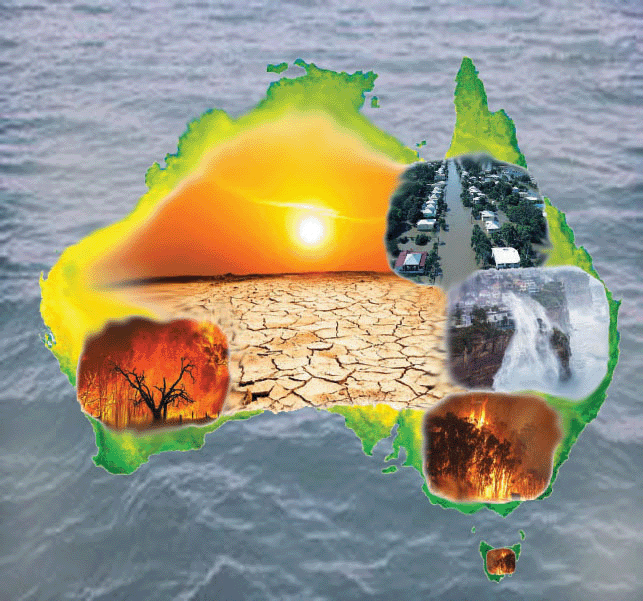
Australia’s extreme heat is sign of things to come, scientists warn https://www.theguardian.com/australia-news/2019/feb/01/australia-extreme-heat-sign-of-things-to-come-scientists-warn-climate
Hottest month ever shows temperatures rising faster than predicted, say climate experts Australia sweltered through the hottest month in its history in January, spurring mass deaths of fish, fire warnings and concerns among climate scientists that extreme heat is hitting faster and harder than anticipated.
For the first time since records began, the country’s mean temperature in January exceeded 30C (86F), according to the Bureau of Meteorology (BoM), which said daily extremes – in some places just short of 50C – were unprecedented.
“There’s been so many records it’s really hard to count,” said Andrew Watkins, a senior climatologist at BoM, after January registered Australia’s warmest month for mean, maximum and minimum temperatures.
This followed the country’s warmest December on record, with heatwaves in every Australian state and territory. With colour-coded heat maps of the country resembling blazing red furnaces for much of the month, the authorities have recently issued a special report on the extraordinary heat.
A persistent high-pressure system in the Tasman Sea that blocked cold fronts and cooler air from reaching the country’s south, and a delayed monsoon in the north, contributed to the heatwave.
Climate change is the long-term driver. “The warming trend which has seen Australian temperatures increase by more than 1C in the last 100 years also contributed to the unusually warm conditions,” Watkins said.
The bureau’s monthly report said the heatwaves were unprecedented in their scale and duration. The highest temperatures of the month were recorded in Augusta on the south-west coast, where thermometers registered 49.5C , but the most relentless heat was in Birdsville, Queensland, which endured 10 consecutive days above 45C.
This was compounded by drought. Large parts of Australia received only 20% of their normal rainfall, particularly throughout the south-east in Victoria and parts of NSW and South Australia.
Menindee in far-west NSW had four days in a row of temperatures above 47C. This was the site of December and January’s mass fish kills on the Darling River. Hundreds of thousands of native fish, including Murray cod, golden perch and bony bream, died around the Menindee weir. The authorities blamed “thermal stratification” as sudden shifts in temperature – first hot, then cold – caused algae blooms and choked the water of oxygen.
After the most recent fish die-off on 27 January, the Labor leader, Bill Shorten, said the Murray-Darling was “facing the makings of an ecological disaster”. He said: “This is not standard, this is not normal. This is a disaster.”
In parts of western Queensland and western NSW, there have been long strings of more than 40 days of temperatures above 40C.
Cloncurry had 43 days in a row that exceeded 40C. Birdsville had 16 days in January of temperatures higher than 45C including 10 days in a row.
NSW, the Australian Capital Territory, Victoria and the Northern Territory all had their warmest January on record.
The meteorological agency has warned that temperatures are set to rise further in the years ahead as a result of climate change. In its report last month, it said warming was contributing to a long-term increase in the frequency of extreme heat, fire weather and drought.
“Australia is already experiencing climate change now and there are impacts being experienced or felt across many communities and across many sectors,” said Helen Cleugh, the director of the Commonwealth Scientific and Industrial Research Organisation, which collaborated on the report.
The study, which is updated every two years, found that Australia’s fire seasons have lengthened – in places by months – and become more severe. From April to October, there has been a broad shift to more arid conditions in south-eastern and south-western Australia. Sea levels have already risen by 20cm and ocean temperatures are up by 1C, which is causing acidification – 10 times faster than at any time in 300m years – which has damaged the corals of the Great Barrier Reef.
Mark Parnell calls on South Australian government to stop its plans to diminish environmental department
 Mark Parnell MLC, 2 Feb 19, The Marshall Liberal Government is planning more cuts to staff and programs in the SA Department of Environment and Water and will transform the Department into an “economic development agency”.
This is outrageous! This Government’s wilful abandonment of the environment will send species extinct and further degrade struggling eco-systems.
The hypocrisy of the Liberals knows no bounds. In opposition, they criticised Labor’s annual budget cuts to the environment, but as soon as they were elected they did the same, with 100 jobs axed last year and more to come. And now they’re going one step further!
The clear message is that if the environment doesn’t make money for someone, it’s not worth protecting. Heaven help our endangered wildlife. If creatures like the Glossy Black Cockatoo or Yellow-footed Rock Wallaby don’t start earning their keep, the Government has made it clear that they are a lower priority. This is not a good time to be a Hooded Plover or an Orange-bellied Parrot in South Australia.
The Marshall Liberal Government’s honeymoon period is now well and truly over. The Government has shown its true anti-environment colours. Any notion that they might care about species, eco-systems, sustainability and the climate, has all but disappeared. Now, they have left us in no doubt that, in their eyes, only those parts of the environment that make money deserve protection.
The Greens are calling on the Liberals to stop the cuts and retain a Department that is focussed on protecting our environment and waterways. They need to stand up for South Australia’s environment and River Murray. The Government should heed the warning of the Royal Commissioner into the management of the River Murray that kow-towing to economic interests upstream only results in further degradation of the environment.
Declaring war on the environment pits this government against everyone who cares about our natural heritage. We must protect the environment for its own sake as well as for future generations.
Our environment and all the species that depend upon it for their survival, deserve better. South Australians deserve better!
Let the Marshall Liberal Government know that you expect the Environment Minister to stand up for South Australia’s environment at all times – not just when there is an economic advantage. Sign our petition and share your concern with family and friends.
Independent media is here to stay – and to keep the politicians honest
 Australian independent media on the rise, Michael West , Feb 1, 2019 The coming of the Internet was the media world’s first real game-changer. Profits enjoyed from the 1970s to 2000s were gone and anyone could start an online news site for little cost. Independent digital media sites not only flourished but did something novel: they engaged with their readers — especially via social media. Today, these sites attract three to four times more visitors via social media than mainstream media. Kim Wingerei reports.
South Australian government changing Environment Dept, and cutting its budget
REVEALED: Staff, budget cuts as Environment Dept becomes “new agency” , In Daily, Tom Richardson@tomrichardson, 1 Feb 19, The state’s Department of Environment and Water will become primarily an “economic development agency” that will be forced to operate with “less staff and smaller budgets” under a major restructure announced to staff yesterday.
The timing of the shift is ironic, with today’s release of a scathing Royal Commission report into the management of the River Murray, itself critical of Environment and Water Minister David Speirs.
Chief executive John Schutz – who replaced former boss Sandy Pitcher, one of four top bureaucrats axed by the incoming Marshall Government last March – yesterday wrote to staff telling them they would be “transitioning to a new agency”……….
“We balance environmental protection with economic development – this means we contribute to our state’s economy by driving sustainable economic development, and unlocking the potential of our natural and heritage resources.” …..
The department will be split into five divisions – Boards and Councils; Strategy, Science and Corporate Services; National Parks and Wildlife; Water and River Murray; and Sustainable Economic Development. https://indaily.com.au/news/2019/01/31/revealed-staff-budget-cuts-as-environment-dept-becomes-new-agency/
Australian government fudging the facts to make its climate policy look good
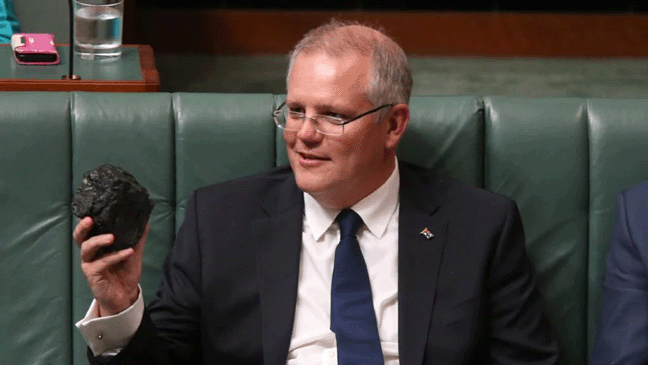 Australia is counting on cooking the books to meet its climate targets , The Convesation, Senior Industry Fellow, RMIT University, January 31, 2019 A new OECD report has warned that Australia risks falling short of its 2030 emissions target unless it implements “a major effort to move to a low-carbon model”.
This view is consistent both with official government projections released late last year, and independent analysis of Australia’s emissions trajectory. Yet the government still insists we are on track, with Prime Minister Scott Morrison claiming as recently as November that the 2030 target will be reached “in a canter”.
The government is indeed poised to deliver on the “letter of the law” of its Paris commitment if two things play out. First, if it claims credit from overdelivering on Australia’s 2010 and 2020 commitments. And second, if the “low demand” scenario is the one that eventuates.
How would this scenario actually eventuate?
Let’s leave aside the technical question of whether it’s legitimate to count past performance towards future emissions targets, and focus for now on how the low-demand economic scenario might become reality.
The government’s report contains no discussion on the basis of the “low demand” scenario. But history suggests the annual baseline estimates of 2030 emissions have overestimated future emissions, with revisions downwards over time. For example, the 2018 projection for 2030 emissions is 28% lower than the 2012 projection for the same date (see figure 2 here).
In the real world, meanwhile, change is evident. Households and businesses are installing solar panels, not least to guard against high power bills. Businesses are signing power purchase agreements with renewable energy suppliers for much the same reason. State and local governments are pursuing increasingly ambitious clean energy and climate policies. Some energy-intensive industries may be driven offshore by our high gas prices.
Other studies also support the idea that Australia may indeed outperform its baseline emission scenario. ANU researchers recently predicted that “emissions in the electricity sector will decline by more than 26% in 2020-21, and will meet Australia’s entire Paris target of 26% reduction across all sectors of the economy (not just “electricity’s fair share”) in 2024-25”.
The government’s baseline electricity scenario uses the Australian Electricity Market Operator’s “neutral” scenario. But AEMO’s “weak” scenario would see 2030 demand in the National Electricity Market 18% lower than the neutral scenario (see figure 13 here).
Of course, many of these changes are happening in spite of the government’s policy settings, rather than because of them. Still, a win’s a win!
Emissions in context
This is partly because of the plan to use prior credit for previous emissions targets to help get us across the line for 2030. This may be allowed under the international rules. But we would be leveraging extremely weak earlier commitments.
For example, Australia’s 2010 Kyoto Protocol target of an 8% increase in emissions was laughably weak in comparison with the developed world average target of a 5% cut. Our 2020 5% reduction target is also well below the aspirations of most other countries. What’s more, several major nations have declared that they will exclude past “overachievements” from their 2020 commitments.
The government has obfuscated the issue further by deliberately conflating our electricity emission reductions target, which will be easily met, with our overall economy-wide target, which presents a much tougher challenge.
There’s more. Australia’s Paris pledge to reduce emissions from 2005 levels by 26-28% between 2021 and 2030 is inconsistent with our global responsibilities and with climate science. The target was agreed to by the then prime minister Tony Abbott in 2015 as the minimum needed to look credible. But as the Climate Change Authority pointed out, a 2030 target of 40-60% below 2000 levels is more scientifically responsible. https://theconversation.com/australia-is-counting-on-cooking-the-books-to-meet-its-climate-targets-110768
Australia’s Energy Minster Angus Taylor ready to subsidise new coal projects
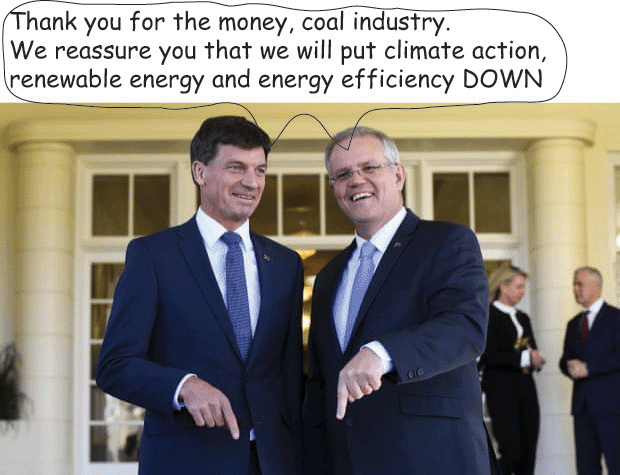
Angus Taylor prepares to underwrite coal-fired power By Phillip Coorey, Fin Rev, 01 Feb 2019 Energy Minster Angus Taylor has all but confirmed the Morrison government is prepared to underwrite new coal-fired power stations, at the same time moderate Liberal MPs are urging the government to adopt a policy on climate change.Mr Taylor released a list 66 potential power generation projects seeking taxpayer support after the government called for expressions of interests to provide “reliable” or “fair dinkum” power.
Of the projects submitted, 10 rely on coal…….
The coal proponents are looking for an indemnity against future climate policy or a guarantee from the government it will act as a buyer of last resort.
Labor opposes coal having any part in Australia’s future energy mix and is focused on renewable energy with back-up capacity. https://www.afr.com/news/politics/angus-taylor-prepares-to-underwrite-coalfired-power-20190201-h1arje?fbclid=IwAR1hVPmlF8TPUOS0exOvr3h5qg-2m0ZfdPN-9InstSG2dud0lNHPRXGR8yU
|
|
Judge refuses to unseal criminal charges against Assange
U.S. District Judge Leonie Brinkema said in a 10-page ruling that free-press advocates seeking to unseal the charges have no proof Assange has actually been charged.
The Reporters Committee for the Freedom of the Press sought to unseal the charges after a federal prosecutor inadvertently typed a reference to “the fact that Assange has been charged” in an unrelated case.
The government has acknowledged it made an error but has not publicly confirmed that charges against Assange have been filed.
After the mistake was made, news outlets including The Associated Press reported that Assange has indeed been charged. But those reports relied on anonymous sources.
The precise charges against Assange are unclear. The Wikileaks founder has been staying in the Ecuadorian Embassy in London since 2012 under a grant of asylum and has long expressed fear of a U.S. prosecution. WikiLeaks has served as a vehicle for release of thousands of classified U.S. military and diplomatic cables. In addition, WikiLeaks’ role in releasing emails hacked from the Democratic National Committee in 2016 has also been under scrutiny as special counsel Robert Mueller has investigated Russian interference in the 2016 election and whether the Trump campaign was involved.
Criminal charges typically remain secret and under seal until a defendant has been arrested to prevent a target from fleeing prosecution or destroying evidence. Lawyers for the free-press foundation said that rationale for secrecy no longer exists given the inadvertent disclosure and the fact that Assange has long assumed he has been charged.
Brinkema, though, wrote in her ruling that the Reporters Committee “has not demonstrated with sufficient certainty that Assange has been charged. Unlike in other high-profile cases, the Government has not affirmatively disclosed that charges have been filed. Although the Government acknowledges that it made a mistake … the nature of that mistake is fundamentally unclear.”
Katie Townsend, a lawyer for the Reporters Committee, said no decision has been made on whether to appeal. “The disclosure of the nature of the charges against Assange are a matter of public interest and should be made public,” she said.
Australian Aboriginal politician Jacinta Price cynical about BHP, Rio Tinto backing Uluru Statement (I would be, too!)
Key points:
- BHP Billiton and Rio Tinto have announced they support the Uluru Statement from the Heart, almost two years after it was made
- Alice Springs town councillor Jacinta Price has questioned whether the companies were looking for a way “to look better in the eyes of Indigenous people”
- Prime Minister Scott Morrison said he remained opposed to a constitutionally enshrined Aboriginal voice in federal Parliament
Indigenous leaders gathered near Uluru in May 2017 to deliver the joint statement, which calls for a constitutionally enshrined Aboriginal voice in Federal Parliament, and for the laying of foundations for a treaty.
The statement was controversially rejected by the Coalition, with Indigenous Affairs Minister Nigel Scullion saying it had “absolutely zero chance of success”.
But now, almost two years on, mining giants BHP Billiton and Rio Tinto have announced they back it.
Uluru Statement signatory and Nyugar man David Collard heard BHP’s boss deliver the news at an event in Perth on Thursday………..
 Miners want to look better in eyes of Indigenous people: Price
Rio Tinto and BHP have mining interests on traditional lands right across the country.
Not everyone is convinced their motives are pure.
Speaking to Sky News today, Central Australian Aboriginal politician Jacinta Price was cynical about the announcement.
“We need to have a bit more of a discussion; I don’t know that simply throwing your support behind something that we’re not sure what that actually looks like is helpful,” Ms Price said.
“Perhaps it is a way of these companies to look better in the eyes of Indigenous people, considering it is Indigenous people’s land they want to be involved in.”
The mining giants’ announcement comes just a few months out from a federal election.
Prime Minister Scott Morrison said the companies’ stance won’t change his opposition to the Statement.
“It doesn’t make a difference one way or the other,” he said.
“You assess these issues on their merits, but I’ve got to tell you, I’m more concerned about young Indigenous girls committing suicide.”
Mr Morrison said the Government would “soon” respond to a November report from a bipartisan committee about developing an Indigenous voice to Parliament.
Federal Labor has vowed to hold a referendum on the matter if it wins Government in May. https://www.abc.net.au/news/2019-01-31/bhp-billiton-rio-tinto-back-uluru-statement-indigenous-lands/10768478
Queensland’s First Indigenous Judge Appointed
Attorney-General and Minister for Justice The Honourable Yvette D’Ath March 22, 2018
Attorney-General and Minister for Justice Yvette D’Ath today announced the appointment of barrister Nathan Jarro as a District Court Judge in Brisbane.
Nathan Jarro will be the state’s first Indigenous judge.
“This is an important appointment for Queensland justice” Mrs D’Ath said.
“Nathan Jarro brings significant litigation experience to the role as a barrister. He initially practised in family and criminal law but has later focused on insurance, administrative, commercial and property law.”
He has held the role of Deputy Public Interest Monitor since 2011.
“He’s also adept at alternative dispute resolution techniques as a long-standing tribunal member for the Queensland Civil and Administrative Tribunal and Mental Health Review Tribunal,” Mrs D’Ath said.
“And he has a strong history of involvement in his community, as a current Board Director for the Queensland Theatre company, chair of the QUT Indigenous Education and Employment Consultative Committee, and former Board Director of the National Indigenous Television LTD (NITV).”
Mr Jarro received his Bachelor of Laws from QUT in 1999 and, after working as a solicitor in private practice, came to the Bar in 2004.
He has been one of Queensland’s most senior practising Indigenous lawyers, identifying as Ghangulu on his father’s side, with connections to Bidjara on his mother’s side.
He takes up his new position on Monday March 26.
Kimba District Council excluded Bangarla Aboriginal people from vote on nuclear waste dump site proposal
 Traditional owners left out of dump vote https://www.eyretribune.com.au/story/5878759/traditional-owners-left-out-of-dump-vote/?cs=9397, Kathryn Bermingham , 30 Jan 19, A South Australian council did not consider native title holders when deciding who should vote on a proposed nuclear waste dump, a court has heard.
Kimba District Council chief executive officer Deborah Larwood gave evidence at a Federal Court hearing between the council and the Barngarla Determination Aboriginal Corporation on Wednesday.
She said there was never any discussion about including traditional owners in the poll until after that decision was made, when the council received a letter from the Barngarla people.
“There was a lot of issues that would arise if the Barngarla Determination Aboriginal Corporation went outside of the guidelines to be allowed to vote,” she said. “It (would have) then opened up: should we be letting all other owners who are non-ratepayers have a vote?”
Two sites near Kimba, on the Eyre Peninsula, have been short-listed as potential locations for a low-level radioactive waste storage facility, while a third is near the Flinders Ranges town of Hawker.
The Kimba vote was stalled last year after the Barngarla people won an injunction in the South Australian Supreme Court, where the case was then referred to the Australian Human Rights Commission.
Lawyer Dan O’Gorman, for the Barngarla people, again argued on Wednesday the ballot was in contravention of the Racial Discrimination Act.
He said the breach occurred because the council chose to use the eligibility guidelines established under the Act – it was not compelled to do so.
Also called to give evidence on Wednesday was Bruce Wilson, principal advisor to the National Radioactive Waste Management Taskforce.
Mr Wilson said the ballot was a “tried method that had community understanding and integrity” after a similar vote was conducted by the Australian Electoral Commission on behalf of the council in 2017.
“That process was run, that worked well… it was agreed by ourselves and the council that they would use that method in the second ballot for that reason,” he said.
Australian promoters of the coal industry also promote nuclear – as a delaying tactic
Steve Dale Nuclear Fuel Cycle Watch South Australia, I’ve put this up a few times as a comment, but the more I think about it, its significance grows for me. It is a statement by Barnaby Joyce in Parliament. I am not picking on Joyce, in fact I thank him for revealing the normally secretive workings of nuclear lobbying in Canberra. Here it is –
Hansard: Mr. Joyce, Parliament, on the 29/3/2017 “Even today we had one of our leading energy producers, ERM, in my office saying that, if the Victorians think they are going to fix it by gas, at $10 a gigajoule the gas power price would be $100 a kilowatt-hour. He said that at that price you should look at small modular nuclear reactors because they would probably be cheaper than the solution that is being suggested.”
Why would ERM suggest using Small Modular Nuclear reactors when they don’t actually exist?
The only answer I can think of is as a delaying tactic. Don’t go to “gas” (or renewables) because around the corner will be a magical nuclear reactor to solve all problems – in the mean time, we will keep supplying profitable coal fired power to you.
How much of this secretive, manipulative nuclear lobbying of poor gullible politicians has gone on in Canberra? At least Joyce gave us a glimpse. https://www.facebook.com/groups/1021186047913052/
Reparation: the colonisers’ fear of admitting the truth of invasion
Ghillar, Michael Anderson 27 January 2019 “One of the slogan chants of the Invasion/Sovereignty Day March in Sydney was “No accident, it was murder!“, referring to the continuing and spiralling number of deaths in custody. International lawyers are now referring to First Nations Peoples’ Deaths in Custody as being attributed to State-sanctioned death squads. People wanting to know need to do research on this. It is in fact an untold story that is operating world-wide, but perfected in Australia.
Another slogan was “What do we want – Land Rights; When do we want it now!” All those years ago the militant young Blacks of the 1960s and 1970s succeeded in smashing PM Billy McMahon’s policy of leasing back land to First Nations Peoples, the owners of the country. But today, with the assistance of wilfully assimilated First Nations Peoples, centralised power and ownership of land is now a reality and as the current cries now state: “Native Title is NOT Land Rights.”
The NSW Land Rights Act is not Land Rights. Other Land Trusts around Australia are not Land Rights. These Land Trusts only lease back land to their own people, as they hold the land in for the Crown. It should also be understood that this is an escheat regime, where the Crown retains ultimate title under a feudal-type system. Thus, Billy McMahon’s policy is now a reality. Land Rights is when First Nations are accepted as the true original owners and guardians of our lands, waters and sacred places. Our ownership can only be secure, if it is not vested in legislation in a minister of the Crown, making the Blacks mere custodians on behalf of the Crown. That is not Land Rights.
The final cry in Sydney this year was “Sovereignty Never Ceded“. So then, what does this truly mean?…
The full bench of the High Court did in fact breach this doctrine of the rule of treason. As Justice Willis explained over 150 years before, it is treasonous to rule the way the High Court judges did in the Mabo Case:
At paragraph 29 The Mabo judgement ruled:
In discharging its duty to declare the common law of Australia, this Court is not free to adopt rules that accord with contemporary notions of justice and human rights if their adoption would fracture the skeleton of principle which gives the body of our law its shape and internal consistency.
… Here rests the ultimate responsibility of declaring the law of the nation. Although this Court is free to depart from English precedent which was earlier followed as stating the common law of this country (21) Cook v. Cook [1986] HCA 73; (1986) 162 CLR 376, at pp 390, 394; Viro v. The Queen [1978] HCA 9; (1978) 141 CLR 88, at pp 93, 120-121, 132, 135, 150-151, 166, 174, it cannot do so where the departure would fracture what I have called the skeleton of principle. The Court is even more reluctant to depart from earlier decisions of its own (22) Jones v. The Commonwealth (1987) 61 ALJR 348, at p 349; 71 ALR 497, at pp 498–499; John v. Federal Commissioner of Taxation [1989] HCA 5; (1989) 166 CLR 417, at pp 438–439, 451–452; McKinney v. The Queen [1991] HCA 6; (1991) 171 CLR 468, at pp 481–482.
As can be seen from this ruling, the Mabo judges committed treason and demonstrated their refusal to make an unbiased decision. This apprehended bias in a judge, or in this case judges, clearly demonstrates that they were unfit for the positions they hold and/or held. This is discrimination and prejudice of the highest order and it is what reflects First Nations Peoples continued cry ‘Sovereignty Never Ceded’ … ” nationalunitygovernment.org/content/reparation-colonisers%E2%80%99-fear-admitting-truth-invasion
Courageous indigenous appeal to Scotland to stop sending nuclear waste – stop indigenous cultural genocide
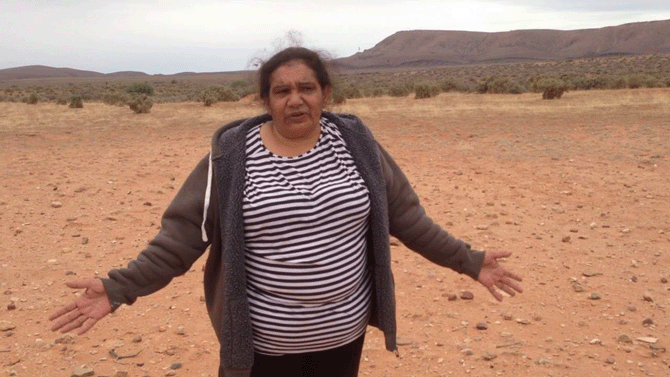 Last ditch aborigine appeal to Scotland to stop nuclear waste transfers to Australia, https://www.heraldscotland.com/news/17391290.last-ditch-aborigine-appeal-to-scotland-to-stop-nuclear-waste-transfers-to-australia/?ref=fbshr&fbclid=IwAR3r2Lqdv0V66rc7I8PrKJme4mkAsIx2Wtd5bv-Vy_XeT1i3GOgi_Mr By Martin Williams @MWilliamsHT 29 Jan 19, SOME of the Aborigines who live in and around a sacred burial place in South Australia can still remember the clouds of poison that were the result of Britain’s nuclear bomb tests in the 1950s.
How our electricity system of the future could be powered by sun, wind and waves
 What would Australia look like powered by 100% renewable energy? https://www.theguardian.com/commentisfree/2019/jan/28/what-would-australia-look-like-powered-by-100-renewable-energy Our electricity system of the future could be powered by sun, wind and waves@nickymison |
|
Olympian Zali Steggall’s main policy will be climate action, as contests Tony Abbott’s Warringah election seat
 Climate key in Olympian’s bid for NSW seat, SBS News 28 Jan 19, Climate change will be one of Olympian Zali Steggall’s main policies as she contests Tony Abbott’s Sydney seat of Warringah in the federal election.The barrister and former world champion skier on Sunday launched her campaign to run as an independent in the upcoming election in a seat she described as socially progressive and caring.
The 1998 Winter Olympics bronze medallist said Sydney’s northern beaches need a voice from “the sensible centre”……..Ms Steggall will make climate change policy a key issue, one which Mr Abbott dismissed saying locals cared about a northern beaches tunnel, lowered living costs, border security and power prices……https://www.sbs.com.au/news/climate-key-in-olympian-s-bid-for-nsw-seat
1 This month
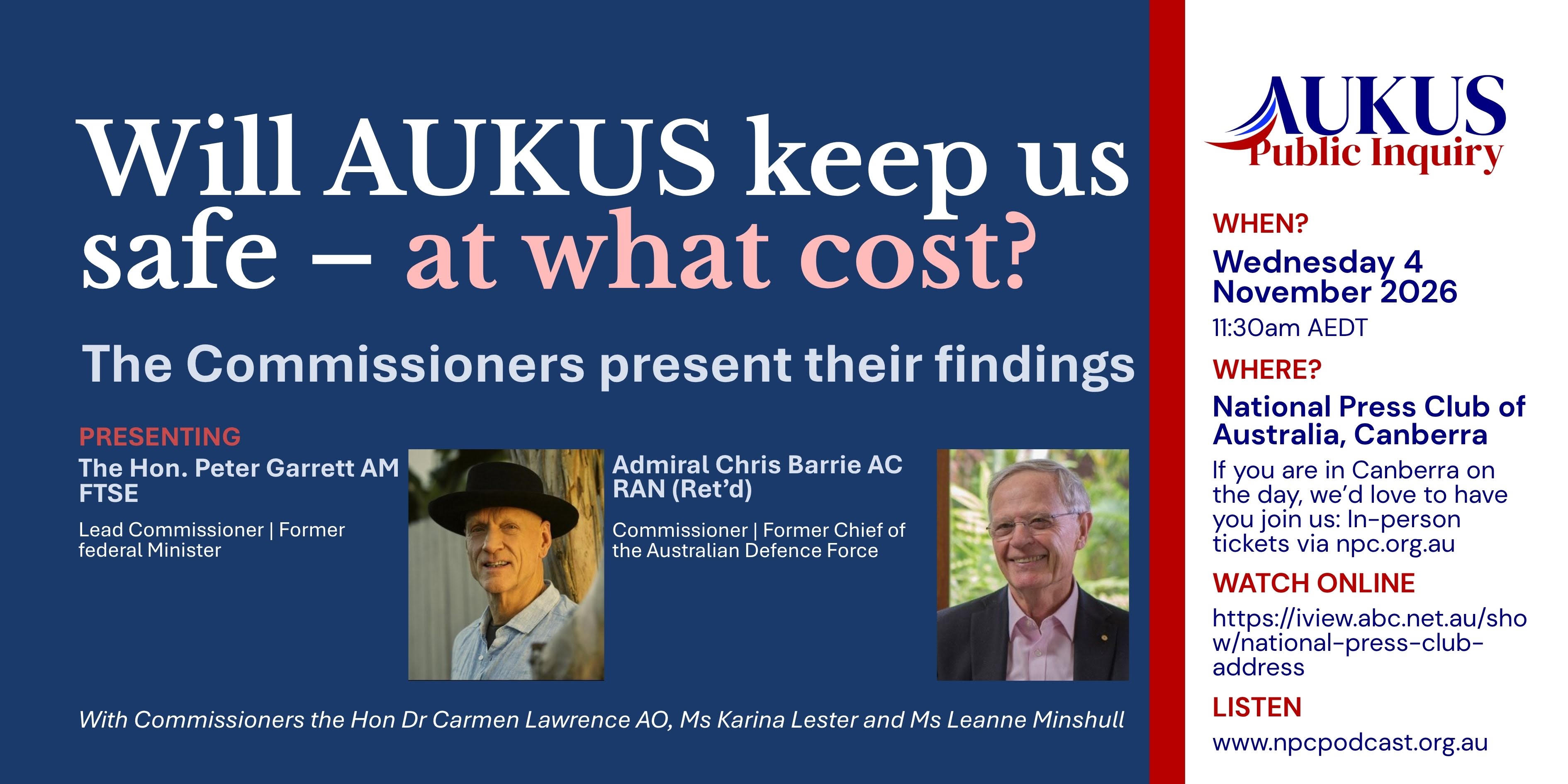
4 November – Will AUKUS keep us safe – at what cost?
the Commissioners of the AUKUS Public Inquiry present their findings at the National Press Club of Australia in Canberra. iview.abc.net.au/show/national-press-club-address
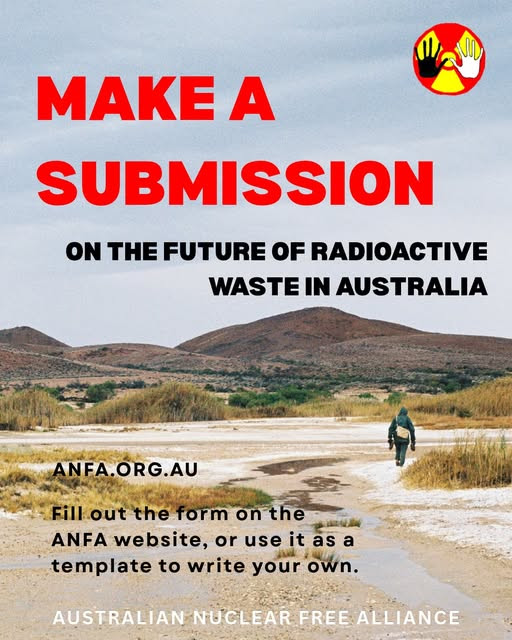
Submissions to the federal government’s new draft framework close on the 13th November 2026.
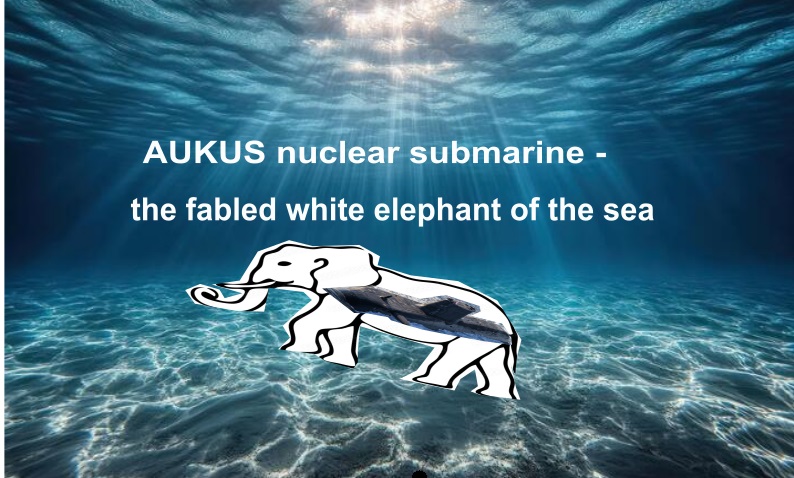
Australians deserve the truth
about
AUKUS – https://aukuspublicinquiry.com/

PETITION – To: Prime Minister Anthony Albanese and the Australian Labor Government

of the week – Australians for War Powers Reform (AWPR)
To see nuclear-related stories in greater depth and intensity

