Labor argues ‘economic madness’ of Coalition’s nuclear plan would cost NSW $1.4tn.
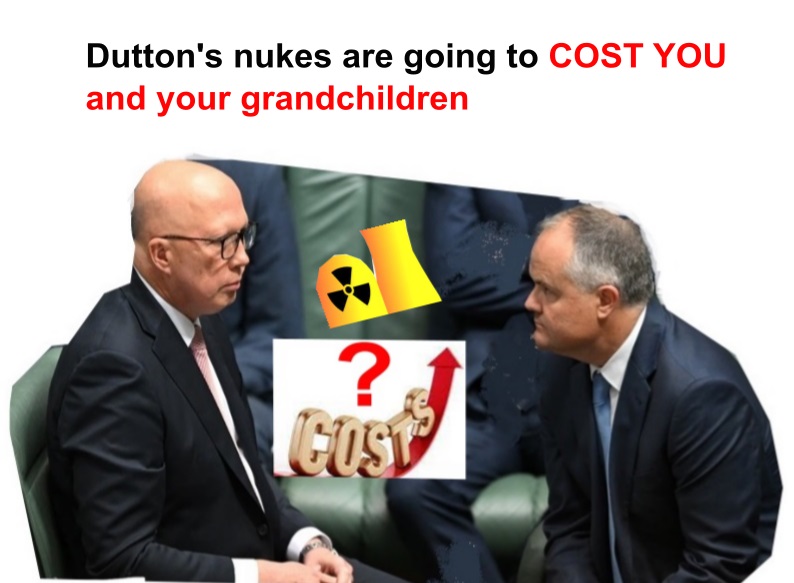
Jim Chalmers says ‘Peter Dutton is the biggest risk to household budgets’ as Coalition defends cheaper costings modelled on a smaller power grid.
Dan Jervis-Bardy, https://www.theguardian.com/australia-news/2024/dec/28/labor-argues-economic-madness-of-coalitions-nuclear-plan-would-cost-nsw-14tn
The Coalition’s nuclear policy will cause a $1.4tn hit to New South Wales over the next 25 years, according to analysis Labor will use to attack the “economic madness” of Peter Dutton’s signature energy scheme.
The federal treasurer, Jim Chalmers, will on Saturday put a dollar figure on the impact on the NSW economy of the Coalition’s plan to build nuclear reactors at seven sites across Australia.
The Albanese government’s analysis is based on the assumption underpinning the Coalition’s costings that less electricity will be needed under its nuclear vision.
Chalmers has argued the Coalition’s plan for a smaller energy grid would result in an economy that is $294bn smaller, with $4tn in lost output, by 2051.
The analysis, to be released on Saturday, suggests that NSW alone would suffer a $1.4tn blow to the state’s economic output over that period, including $114bn in the year 2051.
“Peter Dutton’s nuclear scheme is economic madness,” Chalmers said. “He will push energy prices up and growth down and the people of NSW will be worse off.
“We now know for sure that Peter Dutton is the biggest risk to household budgets and Australia’s economy.”
The new analysis is likely to be quickly dismissed by the Coalition, which brushed off Chalmers’ claims of a $4tn hit to the national economy as “absolute and utter nonsense”.
Asked earlier this month if the Coalition’s plan would shrink the nation’s economy, the opposition’s treasury spokesperson, Angus Taylor, said Labor was already doing that.
The economics of nuclear energy has been thrust to the centre of the political debate after the Coalition released the long-awaited costings for its plan earlier this month.
Frontier Economics modelling suggested the nuclear plan would cost $331bn over 25 years, roughly $263bn cheaper than the estimated bill for Labor’s renewables-focused push to net zero by 2050.
However, the Coalition’s costs are modelled on a scenario – which the Australian Energy Market Operator calls “progressive change” – in which the electricity grid is far smaller than what is envisaged under the “step change” route preferred by Labor.
The rollout of electric vehicles, rooftop solar and the electrification of households and businesses is all expected to be slower under the “progressive change” pathway.
The scenario assumes GDP growth of 1.89% a year through to 2050, compared with 2.21% a year under the “step change” alternative.
The new federal analysis assumes heavy industry, such as aluminium smelters, would have to shut their doors after 2030 because there will not be enough energy to keep operating. That would spell danger for the aluminium smelters in the Hunter Valley in NSW and Portland in Victoria.
The NSW premier, Chris Minns, has repeatedly ruled out lifting the state’s nuclear power ban.
“The bottom line here is that nuclear power costs a lot of money and it takes a lot of time,” Minns said earlier this year.
“And we don’t really have a moment to spare when it comes to renewing our energy grid and thinking about new sources of electricity generation.”
Dutton must face coal, hard facts. Nuclear will not work
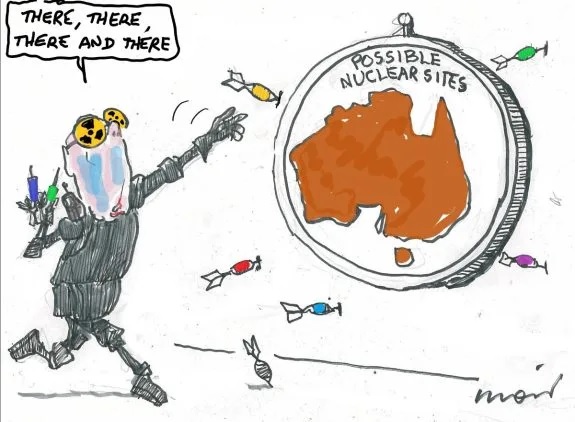
December 27, 2024, https://www.theage.com.au/national/nsw/dutton-must-face-coal-hard-facts-nuclear-will-not-work-20241227-p5l0tj.html
The owners of our coal-fired power plants have pointed to the biggest single flaw in Peter Dutton’s nuclear plan: those plants will all be gone before the first reactor can make an appearance, and long before the last is up and running (“Coal chiefs query Dutton’s nuclear bet”, December 27). Even if the owners wanted to keep them operating, it’s doubtful they could – not without spending inordinate amounts of money. That money, inevitably, would be courtesy of the taxpayer. All so we can enjoy energy at double the cost of renewables. Why can’t the opposition see what all the rest of us can? Or is it just a ploy to delay action on climate change for 20 more years? Ken Enderby, Concord
In March this year, it was reported that AGL, Australia’s largest power supplier, had ruled out taking part in Dutton’s nuclear push. It is instead pressing ahead with long-term plans to transform its legacy coal sites into low-carbon industrial energy hubs, including renewable energy, grid-scale batteries and manufacturing operations for green technologies. The Hunter Energy Hub is to occupy the old coal station Liddell and AGL’s Bayswater coal-fired generator, which is due to retire no later than 2033. Coal stations are ageing and in constant need of repair. Dutton will not include the consequent necessary budget support for coal in his costings, but taxpayers should. Fiona Colin, Malvern East (Vic)
Dutton’s plans depend upon his assumption that the existing coal-fired power plants will keep going until 2050 when nuclear plants replace them. In the Herald article, the Australian Energy Council said Dutton’s assumption was “brave”. “Brave” was a word reserved for impending disaster, that uber-bureaucrat Sir Humphrey Appleby would use to his prime minister Jim Hacker when the latter was contemplating doing something ridiculous. Life imitates art. Joe Weller, Mittagong
We don’t need to replace the soon-to-be redundant 19th century baseload power from ageing coal plants with poisonously expensive and slow-to-build nuclear plants that won’t be ready in time.
We are now well through the transition to a modern, computer-controlled grid that can handle the variable power coming from thousands of sources during the night and millions of sources during the day when rooftop solar is also available. I type this letter on a battery-powered device that was charged yesterday from the grid. An off-the-grid house with solar, wind, batteries and a small generator has no baseload power; one which is on all the time whether needed or not, just clever computer controls managing the balance between the available power and the load. Larger examples are every aeroplane in flight, and every ship away from port. The long-term safety of nuclear and its waste management is another issue. Peter Kamenyitzky, Castle Hill
When is the leader of the opposition going to wake up to the fact that his nuclear option is simply a bad idea? The facts are in. Nuclear will be considerably more expensive and not operational in time. It has no plan for waste disposal and our coal-fired power stations will have closed. This is a classic example of stubborn ideology overwhelming common sense. Bill Young, Killcare Heights
Is Dutton’s persistently promoted nuclear power proposal really a smoke screen over a plan to continue the use of coal, then gas, indefinitely? And to hell with the global heating consequences. Douglas Mackenzie, Deakin (ACT)
We’ve heard from experts, state and local governments, community leaders and now from the fossil fuel operators themselves: not only is it not a technically feasible plan, Dutton’s idea for nuclear power plants is unworkable, from a purely practical perspective. After all the studies and debate demonstrating how Dutton’s plan is economically, technically and practically dead in the water, why do we devote more money and energy giving this oxygen-thieving waste of space the time of day? Frederick Jansohn, Rose Bay
The Coalition has conveniently excluded many of the costs associated with its nuclear plan. The owners of the existing coal-fired plants are well aware of the incredible expense of maintaining them beyond their use-by dates. Eraring is a good example and that extension was only for a couple of years. Additionally, the expenditure involved in the disposal of nuclear waste and the inevitable extraordinary liabilities associated with the future decommissioning of nuclear plants was ignored in Dutton’s costings. If in doubt, check Britain out. Roger Epps, Armidale
Dangerous Tribunal decision paves way for Dutton to keep nuclear blow-outs secret

by Rex Patrick | Dec 27, 2024, https://michaelwest.com.au/art-tribunal-secret-snowy-decision-dangerous-for-dutton-nuclear/
The new Administrative Review Tribunal (ART) just ruled the $2B, no $6B, no $12B Snowy 2.0 project immune from public scrutiny. The decision paves the way for secrecy over Peter Dutton’s nuclear ambitions. Rex Patrick reports.
In April 2023, I made a Freedom of Information (FOI) application for access to Snowy Hydro Limited project reports about Snowy 2.0 pumped storage power scheme to the Minister of Climate Change and Energy, Chris Bowen. I also asked for the briefs on Snowy 2.0 prepared by the Department of Climate Change, Energy, the Environment and Water (DCCEEW) for the Minister.
Suspecting things were off the rails, I wanted to see what Snowy Hydro was saying to the DCCEEW in relation to Snowy 2.0’s progress, or lack thereof, and what DCCEEW was then saying to Minister Chris Bowen.
In August 2023 the Government announced a Snowy 2.0 ‘reset’; a marketing label for a massive cost blowout and schedule delay. That caused me to made a further request for the Snowy Hydro Corporate Plan update sent to Bowen and Finance Minister Katy Gallagher to convince them to back the project cost doubling from $6B to $12B.
Access to the project reports and ministerial briefs was flatly refused and so I appealed the matter to the Administrative Appeals Tribunal, now repackaged by Attorney-General Mark Dreyfus as the Administrative Review Tribunal (ART).
Tribunal rejects transparency
In a decision made by Deputy President Peter Britton-Jones, the Tribunal has affirmed the access refusal decisions, effectively shutting down any FOI scrutiny of Snowy 2.0. This mega-project, which has blown out by $10B, is now shrouded in secrecy, blocking the gaze of members of the public, who are paying for the project.
The ART decision has blown a huge hole in government transparency and accountability because it creates a model that could, and almost certainly will, be used to exempt Opposition Leader Peter Dutton’s $331B nuclear power program from any future public scrutiny. It’s a secrecy barn door that’s big enough to drive a nuclear reactor through.
Protecting business information
How did this happen?
The FOI Act has some reasonable protections in it to ensure sensitive business information is protected from release.
Section 47 of the FOI Act protects trade secrets or commercially valuable information from being disclosed; a company’s ‘11 secret herbs and spices’ stays just that, secret. No other consideration; it’s a full stop exemption from the requirement to disclose.
Section 47G of the FOI Act protects more general business information which, if released, could adversely affect the business in some way. But this particular disclosure exemption clause is conditional on whether the disclosure would be contrary the public interest.
And that’s fair enough – when a company starts taking money from the public for public purposes, if there’s public interest in disclosing the information (like project cost and schedule blowouts), that just sits as a cost of doing business with the Government.
These are important provisions in our FOI law. Last year eighty-three thousand businesses provided their services or products in exchange for $99.6B of public money.
Removing the public interest
There’s another FOI exemption, Section 45, inserted into Act to prevent a “breach of confidence”; that is a promise to keep information confidential – like Aboriginal tribal secrets provided to government in native title matters; artistic assessments by experts of works of art under consideration for purchase – things that need confidentiality but are not business information.
That’s how the Section 45 exemption was presented to the Parliament way back in 1982 when our FOI law was first debated and legislated. In past decisions of the Tribunal Deputy President Britten-Jones has decided not to give that presentation any weight. Instead, Section 45 is interpreted as an unbreakable secrecy clause whenever government and a business agree that it should apply to information that the business has provided to government.
The end result is that now, despite the Parliament determining that business information should be disclosed if that disclosure is not contrary to the public interest, that legislated provision should not be honoured.
Section 45 is, as a result of past Tribunal decisions, the ‘go to’ exemption from departments trying to protect their projects from any scrutiny.
Quacking like a duck
The only reason I actually challenged DCCEEW and the Minister’s FOI decision in this instance is because there’s a carve out in the FOI Act that says Section 45 does not apply if the disclosure of the document would constitute a ‘breach of confidence’ owed to the Commonwealth.
So, one question before the Tribunal was, is Snowy Hydro ‘the Commonwealth’?
To me, the answer was clear.
While Snowy Hydro is a distinct legal entity, it is an 100% government-owned corporation, and is largely funded by the public (the Snowy 2.0 ‘basket case’ project is funded by the taxpayer to the tune of $7B and the rest of the money comes from electricity customers – you).
project is funded by the taxpayer to the tune of $7B and the rest of the money comes from electricity customers – you).
Snowy Hydro has its board appointed by shareholder ministers and remunerated in accordance with a determination of the Commonwealth’s Remuneration Tribunal.
Snowy Hydro is subject to control by the Commonwealth, is obliged to surrender information (unfettered by any confidentiality obligations) requested by a shareholder minister or the Auditor-General or the Senate.
I summarised this legal situation in my submissions to the Tribunal, stating, “If it walks like a duck, looks like a duck and quacks like a duck – it’s a duck!”
The lawyers arguing the government’s case insisted none of that mattered. It might look like a duck, it might even be a government duck but it somehow wasn’t a Commonwealth duck.
Britton-Jones decided it was an elusive night owl, declaring that Snowy Hydro Limited is not the Commonwealth.
Dutton’s Nuclear Power Limited
If the ART decision stands, Snowy Hydro will be effectively excluded from FOI scrutiny. That means an impenetrable wall of secrecy, barring investigation of this government owned and controlled company’s mismanagement of the Snowy 2.0 project and its huge cost to taxpayers.
But that may well be only the beginning of things.
The pieces are all in place for the Coalition’s nuclear power plans to be shrouded in secrecy – thanks in large measure to arguments presented by the Albanese government’s lawyers.
Here’s how Dutton will do it. He just has to follow the Snowy Hydro model and he can ensure than no project reports will ever make it into the hands of the public. The steps are as follows:
- Legislate to set up ‘Nuclear Power Limited’ by way of statute – the ‘Nuclear Power Limited’ Act – with two Ministers to be shareholders in behalf of government.
2. Include the following words in the Act – “‘Nuclear Power Limited’ is not, and does not represent, the Crown”.
3. Subject ‘Nuclear Power limited’ to a policy requirement to report project status to the shareholder ministers (so they at least know what’s going on).
4. Enter into an agreement between Nuclear Power Limited and the government that states “each party agrees to keep the confidential Information confidential and not to disclose it to anyone without the consent of the other party” provided the information is marked as “confidential” (the actual confidentiality of the information does not matter – the key is that the pages are marked “confidential”
Boom! Secrecy heaven
Financial meltdowns can be secret
Nuclear Power Limited will be Snowy Hydro Limited on radioactive steroids. If the similar magnitude $2B to $12 billion blowout to Snowy 2.0 were to occur with Dutton’s (already understated) $331B Nuclear Power Program, the blowout could amount to trillions of public money burned up building reactors that may never be economically viable.
In that regard, ART Deputy President Britten-Jones may have made the most dangerous decision ever made by an administrative review body (even without reference to Dutton’s plans, it casts a secrecy blanket over $100B of annual government procurement).
As such, I’ve put my hand into my pocket and spent $6K initiating a Federal Court Appeal. This secrecy decision can’t be allowed to stand.
And in the meanwhile, we can all just wonder how many more billions Snowy 2.0 will cost us.
Rex Patrick
Rex Patrick is a former Senator for South Australia and earlier a submariner in the armed forces. Best known as an anti-corruption and transparency crusader, Rex is running for the Senate on the Lambie Network ticket next year – www.transparencywarrior.com.au.
The Australian election as a game of cricket: cost of living is the issue, but does Nature bat last?

December 26, 2024 , By Noel Wauchope, https://theaimn.net/the-australian-election-as-a-game-of-cricket-cost-of-living-is-the-issue-but-does-nature-bat-last/
It is not nice to talk about politics at this happy festive time. But you can talk about cricket. Indeed, in Melbourne, it is your patriotic duty. So, I will – sort of.
A prestigious political analyst, Paul Bongiorno, writes in The Saturday Paper about the focus of campaigning for the 2025 Australian federal election. He sees both political parties emphasising the economy, and the “cost of living”. But Bongiorno warns that climate change could suddenly become once more the big factor in the political game, if summer does bring bushfires and floods.
Bongiorno argues that Dutton and the Liberal Coalition are out to stop renewable energy development:
“If the Dutton-led Coalition manages to take the treasury benches, the brakes will be dramatically applied to climate action. The energy transition would be stalled and billions of dollars of new-energy investment put in jeopardy.A key Labor strategist says… it would take only another summer of catastrophic bushfires or floods to significantly jolt public opinion.”
Bongiorno goes on to argue that “The portents here are not favourable for Dutton.” And he cites powerful arguments about “deep flaws” in Dutton’s energy plan’s economic modelling. Bongiorno draws the conclusion that if climate change extremes hit Australia, voters will recognise the value of renewable energy, and vote for the present Labor government’s policies on climate action.
If only that would be the effect of weather disasters – Australian voters embracing action on climate change – the development of renewable energy and energy conservation!
Paul Bongiorno is a much-admired and well-informed analyst. And I am presumptuous to doubt his opinion. But I do doubt it. Look what happened in 2023, with the Australian public first supporting the concept of an Aboriginal Voice to Parliament, but finally voting a resounding “No” to that plan.
How did it happen?
We are in a different era of media and opinion. We are in extraordinary times. When it comes to national elections, people still do vote according to what they see as “their best interest”. It’s just that now, due largely to the power and influence of “social” media, information about “one’s best interest” has become very confusing.
We thought that the Internet would give everyone a voice. And it did. But very soon the new information platforms found money and power could be bought by corporate interests, and indeed, that they themselves could become ultra-lucrative corporations. The media has become a smorgasbord of conflicting information, with so much of it not fact- checked. The “old” media still checks its facts (though I’m not sure about Sky News), but the old media has always been beholden to corporate influence. Even the ABC is circumspect in what it covers, and what it omits – and still makes sure to provide “balance”, even when one side is plainly unreasonable.
Anyway, for the old media to compete – the news has to be preferably exciting, dramatic, even violent. Except for sport and feel-good stuff.
In the new zeitgeist of 24 hour information barrage from so many different outlets, political news can be, and indeed is, swamped by cleverly designed brief messages, from forces like the Atlas Network, from the dominant global fossil fuel corporations. That swamping propelled many Australians to vote against the Aboriginal Voice.
In political news, media emphasis has shifted dramatically away from facts to personalities. In the USA, Donald Trump was seen as a strong, confident, interesting man, as against weak, indecisive, (and female) Kamala Harris. In Australia, there’s an obvious contrast between careful, measured, Anthony Albanese, and strong, outspoken Peter Dutton. In the USA, it didn’t matter that Trump offered few positive policies, so in Australia, the Liberal Coalition does the same.
In the USA, with a population of 334.9 million, approximately 161.42 million people were registered to vote. But only about 64% of these actually did vote in the 2024 general election. So, the majority of Americans don’t vote anyway. Trump was elected by a minority. The rest either didn’t care, or weren’t able to vote.
The Australian election system is so different. With compulsory voting, preferential voting, and the nationwide and highly reliable Australian Electoral Commission (AEC), most Australians do vote. You’d think that with factual news being provided by mainstream media, climate change information would become so important to voters, in the event of summer weather disasters. Paul Bongiorno thinks so.
I think so, too, But the advantage for Peter Dutton in the current national mood might be twofold.
First, Dutton is still that “tough, decisive person” with a tough plan, too – nuclear power instead of renewables. Secondly, the Dutton plan can so easily be marketed as the only real solution to global heating – nuclear power portrayed as “emissions free”, and “cheaper” than solar and wind power.
Never mind that there are substantial greenhouse gas emissions from the total nuclear fuel cycle. Never mind the astronomic cost. Never mind problems of radioactive wastes, safety, and weapons proliferation. The very telling point is that nuclear reactors cannot be up and running in time to have the needed effect on cutting greenhouse emissions. The time for effective action is now, not decades later.
Action on climate change is critical for Australia – and now!
But for the global nuclear lobby, getting Australia as the new poster boy for nuclear power – is critical – now!
Nuclear power should be a dying industry. There is ample evidence of this: reactors shutting down much faster than new ones are built, and of the mind-boggling cost of decommissioning and waste disposal. However, “peaceful” nuclear power is essential to the nuclear weapons industry – with the arms industry burgeoning in tandem with the increasing risk of nuclear war. It seems that the world cannot afford to weaken this war economy.
And the cost and trouble of shutting down the nuclear industry with its tentacles in so many inter-connected industries, and in the media, and in politics, is unimaginable.
The old poster boy, France, has blotted its nuclear copybook recently with its state energy company EDF deep in debt, and things rather crook with its latest nuclear station. But hey! What about Australia, a whole continent, with a national government perhaps ready to institute nuclear power as its prime energy source, and all funded by the tax-payer!
The long-promised nuclear renaissance might really come about – led by Australia, the energetic new nation, with its AUKUS nuclear submarines, with brand-new nuclear waste facilities, and kicking off this exciting new enterprise – nuclear power. This is the opportunity for a global nuclear spin machine to gear up for an onslaught on Australia. They really need the Liberal-National Coalition to win this election.
Dutton will be fed with the right phrases to regurgitate. It’ll be all about a “balanced” economy – nuclear in partnership with renewables and so on, if people have any worries about that. All the same, there are those problems of pesky independent politicians like Monique Ryan and David Pocock, and there’s still the ABC, Channel 9 TV and its print publications.
First, I’m hoping that Australia does avoid bushfires and floods this summer. And second, I’m hoping that in the event of climate disasters, Australians will choose the Labor Party with its real plan for action against climate change, and reject the Coalition with its nuclear power dream. There is a good chance of this result.
I’m hoping that Paul Bongiorno is right, if climate change does bat last in the election game, and that I am wrong about the power of personality politics + slick lies.
Look at the networks, not nuclear, to reduce energy bills
RENEW ECONOMY, Tristan Edis, Dec 19, 2024
The next election is shaping up to become a competition between politicians about which type of big power stations – nuclear or renewables – will help lower or drive-up power bills.
The fact that paying for big power stations makes up only a third of the power bill will probably be completely missed by both sides of politics. If politicians really want to help households lower their energy bills, there’s better places to go looking than the next big power station.
One of the places they seem to always glance past are the energy network monopolies. I suppose politicians can’t quite fathom how they might be able to turn this into a vote winner. But if you genuinely want to help lower energy bills you can’t afford to look past them.
As I explained in a prior article, the monopoly businesses operating our electricity networks have over 2014 to 2022 managed to manipulate the regulations and the regulator to generate profits 70% greater than the regulator had originally thought they’d capture.
This came on the back of a huge blow-out in expenditure and incredible shareholder returns for many of these networks over the 2008 to 2013 period.
Critically, electricity networks have not delivered these increased profits through better efficiency, with total factor productivity of networks today being worse now than it was back in 2006 when the Australian Energy Regulator began measuring productivity.
In terms of gas networks the story is worse, with the Regulator signing off on prices that gave these businesses profits 90% greater than the Regulated had anticipated.
What’s absolutely staggering is the energy network monopolies are mounting a lobbying campaign to extend their monopoly reach beyond poles and wires and into distributed batteries, electric vehicle charging and the management of household electrical devices.
Yet these technologies can be provided to consumers at lower cost via competitive markets and simply don’t need to be delivered or controlled by network monopolies.
The reality is that we can’t rely on the Australian Energy Regulator to keep these monopolies in check. Instead our best hope to address networks’ excessive charges is likely to be competition.
By shifting away from gas appliances to electric alternatives we can minimise our reliance on gas pipelines.
That, of course, still leaves us reliant on electricity networks. In this case though there is also the potential for competition through use of a combination of solar, batteries and energy efficient appliances and homes.
Also, if electric vehicles are charged during the daytime and outside evening demand peaks they can vastly improve utilisation efficiency of network capacity.
Even better, the technology is available for these vehicles to discharge power during peak demand periods to compete against networks augmenting capacity and large peaking power plants.
Energy networks’ lobbying campaign seeks to suggest they just want to help us make effective use of these technologies to address climate change. Yet effective use of these technologies entails less demand for network capacity.
Why would they want to undermine their own revenue base? And why should we turn to a monopoly to roll out technologies which could be procured competitively from businesses that are vastly more experienced in providing these technologies to consumers than the networks?
Where this is most insidious is the concept of so called “community batteries.” Networks are keen to market “community batteries” – which in reality are network monopoly-owned batteries – as a more efficient and fairer option than households adopting their own battery. This is based on the claim that by building bigger batteries, networks will be able to capture economies of scale to deliver batteries more cheaply.
But as I’ve explained previously, and now corroborated in data gathered by the ARENA, it’s just not true. Network-provided batteries are significantly more expensive than household batteries.
Yet this is not their only area of poor performance in supporting the use of distributed energy solutions…………………………………………………………………………… more https://reneweconomy.com.au/look-at-the-networks-not-nuclear-to-reduce-energy-bills/?fbclid=IwY2xjawHYFmJleHRuA2FlbQIxMQABHRWjory7UuJpQrd_U1wReQbbc2h5lgpmbHM
Australian navy advertises nuclear submarine job with $120,000 salary and ‘no experience’ needed
Defence outlines long-term strategy to staff US-built Virginia-class submarines expected in 2030s as part of Aukus deal.
Henry Belot, Guardian, 24 Dec 24
The Australian Navy is offering high school graduates “with no experience at all” up to $120,000 to become nuclear submarine officers who will eventually manage nuclear reactors and weapons systems.
The recruitment drive has been launched despite Defence not being expected to receive a Virginia-class submarine from the US as part of the Aukus deal until at least the early 2030s and amid warnings of cost blowouts and delays.
A navy job ad targets people who may have “recently finished school or are currently studying” with the promise of eventually “driving the vessel and charting its position”.
“Your training will first equip you with technical expertise in nuclear propulsion, the platform, and its equipment,” the ad said. “You will then move into your submarine qualification and oversee day-to-day operations, and you could one day lead the entire crew as commanding officer.”
A Defence spokesperson said the hiring drive was part of a long-term strategy to ensure it had enough specialist staff to deploy the submarine once acquired.
“This is to ensure we have the right mix of candidates and to ensure there is time to generate a sustainable career pathway,” the spokesperson said.
Once accepted, an officer would undergo 12 months of nuclear training in the US along with three months of basic submarine and warfare courses. The officers would then be posted to a seagoing submarine for further training.
Nuclear submarine technicians would receive 18 months of training in the US including six months of nuclear theory and 12 months of practical training on existing vessels. The technicians would also be posted to seagoing submarines…
The job ad also offers recruits “travel opportunities, job security, incremental salary increases as you progress through training and ranks, chef made meals at sea, social and fitness facilities, balance of shore and sea postings [and a] variety of allowances”…………
Defence has previously struggled to recruit enough personnel. In a briefing to Marles in 2022, obtained under freedom of information laws, Defence warned: “The last year has seen lower recruiting achievement and higher separation rates, which have resulted in the ADF and [Department of Defence] workforce size being below approved levels.”
The federal government also funded a new training centre at HMAS Stirling, a Royal Australian Navy base in Western Australia, to train a local workforce to deploy the Virginia-class submarines.
The US plans to sell Australia at least three and potentially five nuclear-powered Virginia-class submarines in the 2030s, before Australian-built submarines enter service in the 2040s.
In the lead-up of the acquisitions, from 2027 at the earliest, there are plans to establish a rotational presence of one Royal Navy Astute-class submarine and up to four US navy Virginia-class submarines at HMAS Stirling. https://www.theguardian.com/world/2024/dec/24/australia-navy-nuclear-submarine-job-salary
The LNP’s nuclear policy is working just fine
by Michael Pascoe | Dec 23, 2024, https://michaelwest.com.au/peter-duttons-nuclear-policy-is-working-just-fine/
Peter Dutton’s nuclear energy announcement has been totally nuked, so to speak,but Michael Pascoe argues it is nonetheless working just fine.
If a major Australian political party has had a core policy more quickly and comprehensively debunked, destroyed and generally defenestrated than the LNP’s nuclear power play, I can’t remember it. But that’s irrelevant to Peter Dutton and Atomic Ted O’Brien.
Despite the near universal rubbishing of the Coalition’s costings, allegedly supplied gratis by economic modeller Danny Price, the stunt is doing exactly what Dutton’s Trumpy playbook said it would do.
cheaper clean energy avoiding much more expensive and unsightly renewable energy spending by Labor.
That all credible media coverage effectively called that promise bullshit doesn’t matter. The promise was still being broadcast, still being talked about, still being reinforced.
For the votes the LNP is chasing, believing or disbelieving the promise is a matter of choice, political choice. Who do you believe, Labor or LNP?
Weak, faltering Albanese or strong, decisive Dutton?
Experts … who needs ’em?
Dutton and the LNP’s media wing have already done the groundwork to undermine those contrary opinions, no matter how numerous or expert.
The CSIRO has a political agenda, the criticism is coming from that “woke” ABC and “left-wing” newspapers, sources not to be trusted, Dutton copying Trump’s very successful “fake news” campaign.
“But, but, but,” you might argue, “these are fake nuclear costings! They have been totally exposed!”
I doesn’t matter. It’s not new that the LNP’s nuclear promise doesn’t add up. All the expert opinions rubbishing last week’s costings had already eviscerated the economics and credibility of the promise since Dutton made it back in May, before the Budget.
The Climate Council’s response back then is as solid an example as any. Dutton’s absolutely false claim that a nuclear reactor’s waste would only fill a Coke can continues to be a joke. Yet, it is unretracted.
Zero difference to Dutton’s polling
That’s seven months of steady, consistent, multifaceted dismissal of the LNP’s core energy and climate policy. Has it made any difference to Dutton’s polling? Well, as his rise in the polls shows, it certainly hasn’t harmed and has probably helped.
Once again, in this age of impressionism politics the detail of a policy being sensible or nonsense doesn’t matter. What counts is the impression it might leave of leadership.
The figures spat out by Danny Price’s modelling aren’t a surprise either. If you search on any issue, you can always find a consultant with a contrary view.
As a leading climate scientist once told me, there is a scientific basis to the three percent of climate scientists who don’t believe in anthropogenic climate change: there will generally be about three per cent of a group that will have a contrary view to overwhelming evidence.
change: there will generally be about three per cent of a group that will have a contrary view to overwhelming evidence.
Coalition media in cahoots
The staged-managed LNP/Murdoch costings reveal last week was a demonstration of Steve Bannon’s “flooding the zone”, starting with the Murdoch media simplifying, swallowing and promoting the nonsense in preview and rolling on with the flood of detailed critical analysis elsewhere, analysis that meant little-to-nothing to the voters Dutton is after.
The LNP’s nuclear policy was adopted without concern for costings. It was the vibe, opposition. The perpetrators knew some figures could be found to suit. Mere details.
There was a hint of that in the Saturday Paper’s story on Danny Price. Mike Seccombe quotes Price:
“What happened was I did an interview on the ABC about nuclear, because I was already doing some stuff in this area. And then the Opposition, Ted O’Brien’s office, contacted me and said they’d be interested in talking about my work. That would have been a few months ago.”
“The truth does not matter”
A “few” months ago? When it comes to months and years and measuring time and such, formulating a major policy in whatever period that would take before the Budget back in May sounds like more than a “few” months to me.
Total opposition. Grab the headlines, look strong and decisive, promise something the eventual failure of which would occur long after you’ve departed the scene, keep promising it, keep opposing whatever the government is doing. Some concurring figures can always be found along the way.
It works. It’s working. The truth does not matter. That’s what the polls are telling Dutton.
That’s what worked and works for Trump. Before the US Presidential election, Trump promised voters he would return prices to pre-COVID levels. It was obviously nonsense, obviously a lie. Doesn’t matter. It was part of Trump’s impression and now that he has been elected, it matters even less as he walks away from the promise.Shadow treasurer Angus Taylor is promising the LNP nuclear show will lower power bills by 44 per cent.
Yeah, right.
The worry for Australia is that the LNP shows every indication of continuing to follow the Trump path, the next step of which is ever greater lawfare.
Trump is suing a pollster and local newspaper over an incorrect poll in Iowa that had him losing that solidly Republican state, claiming the poll was election interference.
That is a fearsome warning to other media and pollsters.
The American ABC network settled a Trump defamation action over a little careless wording around rape/sexual assault, paying Trump $US15 million. The common view is the case would have been defensible, but ABC doesn’t want to be seen opposing Trump.
Given how small and impoverished independent media is in Australia, Dutton taking that next Trumpy step is frightening. A defamation action doesn’t have to be credible to be very effective. It just has to be started by a party with plenty of resources against a party with few.
Teals will baulk
Peter Dutton has backers with effectively endless resources. With such a frightening prospect, the only good news from the LNP’s nuclear fairytale is that it should make it impossible for the community independents, the Teals, to support a Dutton minority government.
The Teals are not stupid. They are committed to climate policy, a raison d’etre for them.
But if Dutton’s impressionist politics momentum continues, the Teals won’t matter either.
Communities vent frustration at Coalition’s nuclear plan for their towns
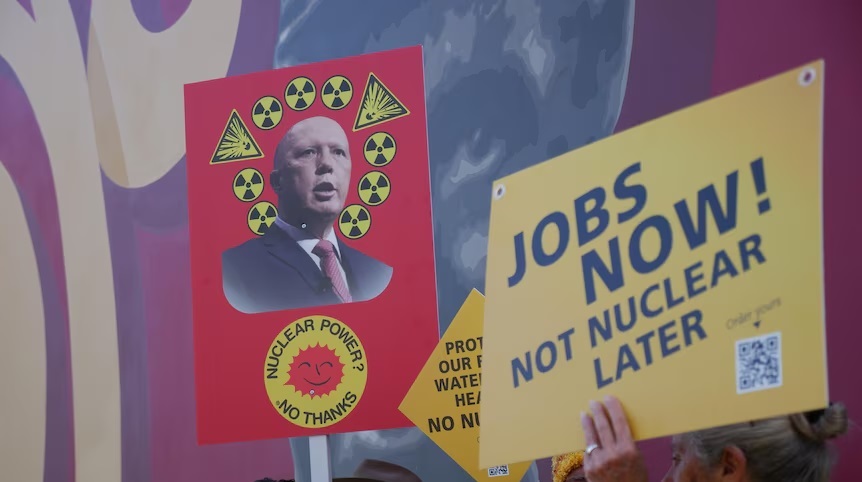
By Joanna Woodburn, ABC Central West, 22 Dec 24,
In short:
Regional communities have shared their views on the federal Coalition’s plan for seven nuclear reactors around Australia.
A parliamentary inquiry has heard pleas for more detail about the proposal, but people have been told to wait for “all the facts”.
What’s next?
The federal committee is due to deliver its report by April 2025.
Opposition leader Peter Dutton has promised his vision to build seven nuclear reactors around Australia will “keep the lights on”.
But people in the communities earmarked to host the plants feel they are being left in the dark as to what the Coalition’s plan means for them.
“What are we actually signing up for?” New South Wales Hunter Valley resident Tony Lonergan said.
Mr Dutton has so far released the locations of the proposed reactors and the costings.
The Coalition wants to build nuclear plants on the sites of seven coal-fired power stations which have shut, or are earmarked to close, at Tarong and Callide in Queensland, Mount Piper near Lithgow and Liddell in NSW, Port Augusta in South Australia, Loy Yang in Victoria’s Latrobe Valley and Muja near Collie in Western Australia.
“I can’t help but feel that politicians see our region as apathetic, desperate and an easy target,” Lithgow resident Tom Evangelidis said.
In the absence of few other details, Labor established a federal inquiry into nuclear power which generated more than 800 submissions from individuals, business owners, industry groups and MPs.
The House Select Committee on Nuclear Energy, which will cease to exist after the inquiry, has toured Australia to hear from the residents whose towns have been selected to host the nuclear reactors.
Wait for ‘the facts’
A repeated request throughout the inquiry has been for the Coalition to explain what technology would be used, how much water would be needed, where the waste would be stored, how it would be transported and whether the infrastructure and technology were safe.
“Even after [the Lithgow hearing] there’s very poor details on will there be one here? When? And those concerns [about] land, safety concerns, environmental concerns; those are all very major concerns and I’ve seen no answers here today,” former NSW mining union executive Wayne McAndrew said.
“The Coalition is proposing the seven sites and I’ve seen nothing from them either.”
The inquiry’s deputy chair, Liberal MP Ted O’Brien, repeatedly told witnesses their communities would have access to a two-and-a-half year “on the ground” consultation process where people’s questions would be answered.
Outside the Port Augusta hearing, SA Liberal MP for Grey, Rowan Ramsey, urged people to wait.
But these assurances have not pacified witnesses.
“That’s not adequate in supporting the general public in forming opinions on things that affect everyone and nor is it adequate for people just to be expected to read or interpret a lengthy report,” Patsy Wolfenden from the Mingaan Wiradjuri Aboriginal Corporation in NSW said at the Lithgow hearing.
“We have agendas that are political and are imposed upon communities without their engagement and without their initial consent in the first place,” Associate Professor Naomi Godden from Edith Cowan University told the Collie hearing in WA.
Jobs promise
One of the Coalition’s key promises is secure employment for coal industry workers who will be out of a job when their power stations close.
In the Latrobe Valley, the Loy Yang power station in Traralgon is due to shut in 2035, which is the same year the Coalition wants its first reactors to be operating.
Local resident Adrian Cosgriff said power station workers were being given false hope, and instead should be encouraged to consider transitioning to the burgeoning renewable energy industry. “Get our coal workers involved, attract other industries as much as we can, so that when they start coming out of those power stations there’s actually work for them,” Mr Cosgriff said.
At Collie in WA, Daniel Graham from the Australian Manufacturing Workers’ Union shared some of the questions and concerns being posed by members.
“What am I going to do? Looking at the nuclear timeline, [I’m] just not sure how that matches up and how that’s going to help Collie,” Mr Graham told the inquiry…………………………………………………. https://www.abc.net.au/news/2024-12-22/coalitions-nuclear-plan-frustrates-communities-at-inquiry/104730522
The glaring gaps and unanswered questions in the Coalition’s nuclear plan and costings.

Peter Dutton’s vision doesn’t address the climate crisis anytime soon and cost savings are based on a comparison with Labor’s proposal that produces 45% more electricity
Graham Readfearn and Josh Butler, 13 Dec 24, https://www.theguardian.com/australia-news/2024/dec/13/australia-nuclear-power-costings-frontier-economics-plan-peter-dutton-coalition-policy?fbclid=IwY2xjawHUXJZleHRuA2FlbQIxMQABHSLJcWqEbGOzAYkAVsppgXxhFjGsXpZLdVYB4J2Fn2n1iyTzXrnP5XMYRg_aem_g_g5MDvHcqIrdVL96ybbNA
The Coalition has revealed further details of its plan to build nuclear reactors in Australia, claiming it could deliver an electricity system costing $263bn less than the Albanese government’s plans to power Australia on renewables backed by storage and gas.
The Coalition is relying on Frontier Economics modelling to argue its nuclear vision for seven reactors across the country would be 44% cheaper than the government’s renewables-led plan.
So what do we need to know about the Coalition’s proposal?
Does the plan address the climate crisis?
Not for about 25 years. Frontier’s modelling shows the amount of CO2 released for every megawatt hour of electricity generated under the Coalition’s nuclear plan.
The report shows the “emissions intensity” of electricity stays much higher with nuclear than without until sometime between 2046 and 2049 – after which electricity would be slightly cleaner.
This is mostly because, under the Coalition, the modelling shows more coal stays in the grid for longer, releasing more CO2.
Any delays in rolling out nuclear reactors, which experts say is very likely, would lead to higher emissions for longer.
The Coalition’s chosen scenario to develop the electricity grid is in line with a 2.6C rise in global temperatures by the end of the century.
Is the Coalition’s plan comparable to the government’s?
No. The Coalition says its plan delivers an electricity system that costs 44% less than the government’s proposal – a saving of $263bn.
But the detail in the Frontier Economics report shows this 44% cost reduction comes as a result of comparing two different scenarios for the future of the electricity grid.
The Australian Energy Market Operator (Aemo) looks at three scenarios for the electricity grid and Frontier based its modelling on two of them – called “progressive change” and “step change”. The Albanese government prefers step change.
Frontier says the “progressive” scenario is preferred by the Coalition and adding nuclear to this “is 44% cheaper than the step change future as envisaged by the federal Labor government”.
The problem here is obvious. We are not comparing apples with apples.
Tristan Edis, director of Green Energy markets, says the “progressive change” scenario “involves total electricity consumption in 2052 of 311TWh, whereas step change is 450TWh or almost 45% greater electricity demand”.
So the Coalition’s plan to deliver nuclear is based on a scenario where Labor’s preferred plan is producing 45% more electricity than the Coalition’s.
Clearly, a system producing more power will cost more. Dr Dylan McConnell, an energy systems expert at UNSW, says without adding nuclear, Aemo’s “progressive change” costs are about $133bn less than for “step change”.
The “progressive change” scenario being promoted by the Coalition assumes much slower roll-outs of electric vehicles, rooftop solar and the electrification of homes and businesses.
That suggests consumers would miss out on any cost savings from running electric vehicles or using less gas in their homes for cooking and heating (as well as the cuts in emissions that come with using less fossil fuels).
How realistic is the Coalition’s timeline for building reactors?
Frontier Economic’s report suggests the first nuclear power would enter the grid in 2036 – but many experts say this is wildly optimistic.
The CSIRO estimates it would take at least 15 years for Australia to establish the necessary legal and regulatory functions and then finance, commission and build a working reactor.
Energy expert Simon Holmes à Court laid out his own timeline this week saying there was “not a hope in hell” a nuclear reactor could be working before 2040. He said his own optimistic scenario put the date at 2044.
What other roadblocks does Peter Dutton face?
Dutton said because the Coalition was in opposition it hadn’t been able to begin the negotiations needed to make nuclear a reality in Australia.
Before a single nuclear energy plant could be built, the Coalition would have to win the next federal election.
Then, a Dutton-led government would have to overturn a Howard-era national ban on nuclear energy – with laws passing both Houses of Parliament. If Dutton winning a majority in the lower house seems a tough ask, getting such a plan through a likely hostile Senate would be even harder.
Then, the Coalition would have to see various state governments overturn their bans on nuclear energy. Finally, state leaders would need to be onboard to support reactors being built in their back yards.
As Guardian Australia has reported, Labor governments and Coalition oppositions in New South Wales, Victoria, Queensland and South Australia are either outright opposed to the plan or have failed to endorse it. The new Queensland Liberal premier, David Crisafulli, ruled out nuclear during that state’s recent election campaign.
Dutton has pointed to constitutional powers to override state objections if necessary. He has also noted the openness of SA’s Labor premier, Peter Malinauskas, to nuclear.
How much will electricity cost under the Coalition’s nuclear plan?
Dutton claimed the nuclear option would mean “a 44% saving for taxpayers and businesses” but does that translate into cheaper power prices?
Frontier’s report says it does not “present any results for the prices [of wholesale electricity] as this will depend on how the cost of new capacity will be treated in the future”.
In other words, they don’t know what the cost of power will be.
How have critics responded?
The climate change and energy minister, Chris Bowen, criticised the Coalition for not detailing how the nuclear plan would affect consumer power bills and pointed to other modelling showing it could push up bills by $1,200 a year.
He claimed the Frontier report contained “fundamental errors” and “heroic assumptions”, pointing out it assumed Australia would consume less power than Aemo’s modelling forecast. Bowen also criticised the report for using cheaper prices to produce nuclear power than the CSIRO and AEMO accounted for.
The federal Greens leader, Adam Bandt, called it a “con job for coal”, noting the nuclear strategy relied on extending the life of fossil fuels.
The Australian Chamber of Commerce And Industry said the plan needed to be scrutinised thoroughly. It wasn’t critical but called for “long-term certainty” for the business community regarding power prices and reliability.
The Clean Energy Council said it would be a “disaster” for power bills and dramatically slow the rollout of renewables like rooftop solar.
Rod Campbell, of the Australia Institute, said the nuclear plan was a “distraction to prolong fossil fuel use and exports”.
Syria Today, Iran Tomorrow, and Inevitably China
A US-backed terrorist organization fresh from overthrowing a US-targeted nation in the Middle East now vows to target China next.
The London Telegraph in a December 13, 2024 article titled, “Uyghur fighters in Syria vow to come for China next,” claims “a Uyghur militant group that helped to topple Bashar-al Assad has vowed to take the fight to China.”
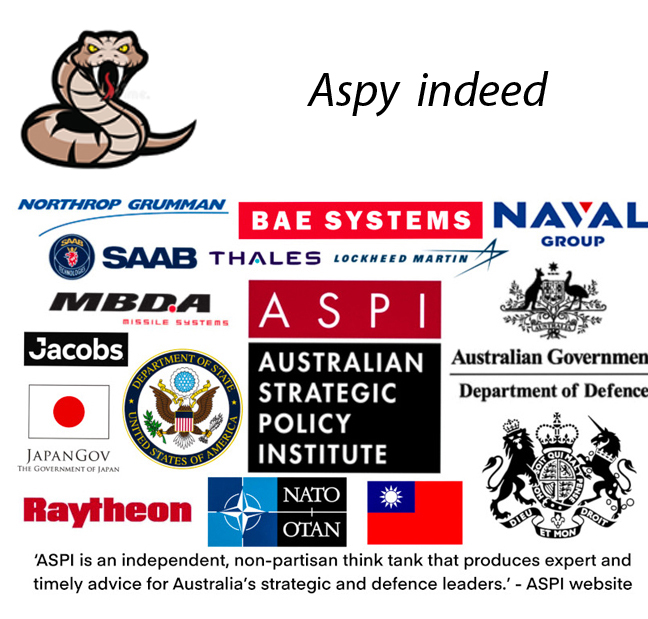
Far from an exception, virtually all reports on the subject stem from either Adrian Zenz himself or reports published by US government-funded organizations including the Australian Strategic Policy Institute
New Eastern Outlook, Brian Berletic, December 19, 2024, https://journal-neo.su/2024/12/19/syria-today-iran-tomorrow-and-inevitably-china/
The collapse of the Syrian government in mid-December 2024 represents a pivotal moment for U.S. geopolitical strategies in the Middle East and beyond.
This event aligns with longstanding objectives, including the subsequently planned disarming, division, and destruction of Iran and the toppling of the Iranian government, the possible eviction of Russian military bases in Syria, and the use of US-sponsored terrorist organizations utilized in overrunning Syria to export terrorism to other targeted nations both in the region and far abroad including both Russia and China.
Syria’s Collapse Was Long Sought After
The US has repeatedly attempted to undermine and overthrow the government of Syria since at least as early as the 1980s. This most recent attempt began preparations as early as 2007 as revealed in a New Yorker article published that year titled, “The Redirection.”
Written by legendary journalist Seymour Hersh, the article admitted:
To undermine Iran, which is predominantly Shiite, the Bush Administration has decided, in effect, to reconfigure its priorities in the Middle East. In Lebanon, the Administration has coöperated with Saudi Arabia’s government, which is Sunni, in clandestine operations that are intended to weaken Hezbollah, the Shiite organization that is backed by Iran. The U.S. has also taken part in clandestine operations aimed at Iran and its ally Syria. A by-product of these activities has been the bolstering of Sunni extremist groups that espouse a militant vision of Islam and are hostile to America and sympathetic to Al-Qaeda*.
Also that year, the US State Department had already been training, equipping, and funding opposition groups to return to their nations across the Arab World and overthrow their respective governments as part of what would later be referred to as the “Arab Spring,” the New York Times would reveal in a 2011 article titled, “U.S. Groups Helped Nurture Arab Uprisings.”
Following the initial protests of the 2011 “Arab Spring,” US-sponsored regime change quickly and deliberately turned violent before transforming into a multitude of armed conflicts – some of which involved overt US military intervention, including in Libya, Syria, and Yemen.
By 2012, a US Defense Intelligence Agency (DIA) report about US-sponsored regime change in Syria specifically, published by Judicial Watch, admitted that the so-called “Syrian” opposition consisted of Salafists, the Muslim Brotherhood, and Al-Qaeda*. The report admitted that, “the West, Gulf countries, and Turkey support the opposition,” and that “if the situation unravels there is the possibility of establishing a declared or undeclared Salafist principality,” and that “this is exactly what the supporting power of the opposition [the West, Gulf countries, and Turkey] want in order to isolate the Syrian regime.”
It is very clear that the “Salafist principality” referred to the so-called “Islamic State.” While the West posed as intervening in Syria to eliminate the “Islamic State,” it was actually supporting and using it precisely to “isolate the Syrian regime,” just as the US DIA report noted.
Through a combination of sanctions, US-Israeli military strikes, US and Turkish military occupation including of Syria’s oil and wheat fields, Syria was slowly hollowed out and, as of December 2024, with Russia and Iran overextended elsewhere, finally toppled.
Next Target: Iran
Most obviously, just as with the US-engineered overthrow of Libya in 2011, Syria will persist as a failed and divided state the US and its regional proxies used to export terrorism across the region toward what remains of Iran’s asymmetrical military power including Hezbollah in Lebanon and Iranian-backed militias across Iraq.
Syria can now also be used as a staging ground for attacks on Iran itself, including via the use of Syria’s now unprotected airspace.
One crucial obstacle eliminated with the collapse of Syria’s government was the destruction of its military hardware, including a formidable integrated air defense network. Even as US-Turkish-backed terrorists advanced on Damascus, US-armed Israeli warplanes carried out 100s of airstrikes across the country, both eliminating the abandoned air defense systems themselves and a long list of targets those air defenses had long prevented Israel from striking.
The Times of Israel itself, in an article titled, “IDF sees chance for strikes on Iran nuke sites after knocking out Syria air defenses,” connected Israel’s targeting and destruction of Syrian air defenses with plans to then carry out direct strikes on Iran.
………………………………….now the Israeli air force “can operate freely across the country’s skies,” and will likely do so both as part of shaping chaos inside Syria itself as well as amid future strikes on Iran.
Far from simply exploiting recent, unexpected developments, the elimination of Syria as an ally of Iran was a long-standing prerequisite required and planned for before moving on to toppling Iran itself.
Such plans were published by US government and arms industry-funded Brookings Institution in its 2009 paper, “Which Path to Persia? Options for a New American Strategy toward Iran,” noting specifically:
Israel may be more willing to bear the risks of Iranian retaliation and international opprobrium than the United States is, but it is not invulnerable and may request certain commitments from the United States before it is ready to strike. For instance, the Israelis may want to hold off until they have a peace deal with Syria in hand (assuming that Jerusalem believes that one is within reach), which would help them mitigate blowback from Hizballah and potentially Hamas. Consequently, they might want Washington to push hard in mediating between Jerusalem and Damascus.
Obviously, Israel’s recent war on Hezbollah and US-sponsored regime change in Syria has fulfilled this prerequisite – regime change achieved in Syria using many of the other methods listed in the 2009 Brookings paper focused on Iran including “supporting a popular uprising,” supporting [armed] minority and opposition groups,“airstrikes,” and “invasion.” In fact, such methods are used over and over again against all nations targeted by the US for coercion and eventually regime change.
US-Sponsored Terrorism Targets China and “Chinese Projects/Embassies”
In addition to targeting Iranian-backed militias, Iranian-friendly governments, and Iran itself, the US has utilized terrorist organizations now in Syria against other adversaries abroad, including China. Many signs now indicate the US could redirect these terrorist organizations back toward China once again.
This includes the so-called, “Turkestan Islamic Party” (TIP) also known as the “East Turkestan Islamic Movement” (ETIM).
What is particularly troubling about TIP/ETIM is the fact that the US disingenuously removed it from its Foreign Terrorist Organizations list in 2020 specifically to provide it with wider and more overt support. DW in its article titled, “US removes China-condemned group from terror list,” would claim TIP/ETIM was removed as a terrorist organization by the US government, “because, for more than a decade, there has been no credible evidence that ETIM continues to exist.”
This is demonstrably untrue considering the US Department of Defense admitted to having carried out airstrikes against the group in Afghanistan only 2 years prior to its delisting, NBC News would report.
Now, the organization the US government claimed no longer exists, is in Syria and reported comprising an entire military unit alongside Hayat Tahrir al-Sham* (HTS), aiding in the recent overthrow of the Syrian government. HTS* is listed by the US as a Foreign Terrorist Organization, while TIP/ETIM is listed as a terrorist organization by the UN and even Washington’s close ally, the UK.
The London Telegraph in a December 13, 2024 article titled, “Uyghur fighters in Syria vow to come for China next,” claims “a Uyghur militant group that helped to topple Bashar-al Assad has vowed to take the fight to China.”
A US-backed terrorist organization fresh from overthrowing a US-targeted nation in the Middle East now vows to target China next. The ability to do so is only possible with continued US government backing including training, weapons, and logistics via regional proxies including Türkiye, who prepared and incorporated the militants in the invasion force that toppled Syria’s government.
Short of fighting in China itself, the Telegraph in an accompanying video would note, “can TIP take the fight to China, home to the world’s largest military with 2 million active troops? It’s easier said than done. Still, TIP could target Chinese projects or embassies abroad.”
The US already backs violent terrorism attacking Chinese projects and embassies abroad, including in Baluchistan, Pakistan and Myanmar. An army of well-trained, well-armed experienced terrorists fresh from the battlefield in Syria are poised to significantly escalate what is already a US war on China by proxy along the length of Beijing’s Belt and Road Initiative (BRI) and ultimately aimed at China itself.
It should be noted that TIP/ETIM and affiliated extremists carried out years of deadly terrorism within China’s western region of Xinjiang. The BBC in a 2014 article titled, “Why is there tension between China and the Uighurs?,” proudly listed the rampant violence Beijing at the time struggled to contain. When Chinese anti-terrorism efforts finally began to work, the BBC along with the rest of the Western media omitted any mention of separatist violence and depicted Chinese efforts to uproot extremism as “human rights abuses,” “coerced labor,” and even “genocide.”
No evidence exists of any systemic abuses, including either “coerced labor” or “genocide.” Even US government-funded organizations tasked with producing reports claiming to document such abuses bury admissions of a lack of evidence in the reports themselves.
One 2020 report titled, “Coercive Labor in Xinjiang: Labor Transfer and the Mobilization of Ethnic Minorities to Pick Cotton,” written by Adrian Zenz, a member of the US government-funded “Victims of Communism Memorial Fund,” admitted in its conclusion that, “in a system where the transition between securitization and poverty alleviation is seamless, and where the threat of extralegal internment looms large, it is impossible to define where coercion ends and where local consent may begin.”
Far from an exception, virtually all reports on the subject stem from either Adrian Zenz himself or reports published by US government-funded organizations including the Australian Strategic Policy Institute (ASPI) or US NED-funded fronts like the World Uyghur Congress, Uyghur Human Rights Project, Campaign for Uyghurs, and the Uyghur Transitional Justice Database Project.
While these organizations pose as “human rights” advocates, their websites overtly refer to China’s Xinjiang region as “East Turkestan*” (sometimes spelled East Turkistan), claiming it is “occupied” by China, and openly seek separatism from China as one of their central objectives – objectives underwritten by generous funding by the US government.
In other words, the US is backing deadly violence, political movements promoting separatism, and fronts attempting to depict the Chinese government’s reaction to all of the above as “human rights abuses,” which in turn is used to justify otherwise indefensible sanctions applied to Chinese companies attempting to do business anywhere the collective West exerts influence.
Defending Against Washington’s Superweapon
While many are tempted to treat conflicts around the globe in isolation, the truth is the United States is pursuing a long-standing global policy of eliminating all rivals through persuasion, coercion, sanctions, US-sponsored sedition, terrorism, and military confrontation – by proxy and directly.
The fall of Syria and other nations like it contribute toward a more dangerous world where larger and more stable nations may be targeted, undermined, and toppled next.
The chaos that has followed US regime change in Serbia, Afghanistan, Iraq, Georgia, Libya, Ukraine, and now Syria this 21st century is just a small fraction of the instability, death, destruction, and destitution the entire globe faces should Washington continue prevailing in its geopolitical pursuits.
Among the most effective and so far unanswered weapons the United States government wields is its dominion over global information space and its global-spanning network of political interference and capture, centered around the National Endowment for Democracy and adjacent government and corporate-funded foundations.
Russian and Chinese military and economic power continues to rise, and both nations have successfully protected their respective information spaces. However, the US continues unopposed undermining nations along both Russia and China’s peripheries, successfully politically capturing nations and transforming them into political and even military battering rams against both targeted nations.
While China may have successfully uprooted US-sponsored extremism in Xinjiang, the US continues arming, backing, and promoting these same extremists out of China’s reach in recently decimated Syria. Through Washington’s control over information space outside of China, these terrorists are being presented as “freedom fighters” in much the same way the US has presented HTS despite being listed by the US State Department as actual terrorists.
Russia and China aid partner nations in the defense of their traditional national security domains – air, land, and sea – but have failed to export their own domestic success in securing a 21st century national security domain – information space. Should Russia and China succeed in doing this, Washington will be denied one of its last and most effective weapons used to sustain its global hegemony, making multipolarism inevitable rather than a mere possibility.
*-banned in Russia
Brian Berletic is a Bangkok-based geopolitical researcher and writer.
Economics of Coalition’s nuclear modelling are worth nothing
There may well still be good reasons to favour nuclear. But on the basis of this modelling, the economics isn’t one of them
Australian Financial Review, .Steven Hamilton, Columnist, 16 Dec 24
On Friday, the Coalition finally released the economic modelling underpinning its plan to produce more than a third of our electricity via nuclear by 2050.
I approached the modelling – produced pro-bono by Frontier Economics – with an open mind. I have no issue with nuclear power so long as the economics stack up. To date, I am yet to read a convincing analysis in its favour in the Australian context.
Alas, after studying the modelling very carefully, I can confirm it is worth about what the Coalition paid for it.
Most critical reporting has focused on the Coalition’s decision, bundled along with nuclear, to abandon the “step change” scenario the government is counting on, which would see significantly greater electricity generation to support widespread electrification of households, transport and business.
But this is a red herring. While the Coalition’s claim that its plan will cost 44 per cent less than the government’s plan relies on the abandonment of step change, the modelling presents both step change and the Coalition’s preferred “progressive” scenario with and without nuclear power.
Within the progressive scenario, nuclear is claimed to reduce costs by a still-substantial 28 per cent. How does the modelling reach such a conclusion? Through sleights of hand, unrealistic assumptions and sheer physical impossibilities.
The first red flag is the odd choice to conduct all cost comparisons across the entire 2025-2051 period. To understand why this matters, consider that the Coalition’s plan involves two big changes.
First, a big slowdown in the renewables rollout paired with delays to coal closures; second, the transition to nuclear of the remaining coal-fired power beginning in 2035, but mostly in the 2040s.
So the claimed cost reductions over 2025-2051 are not driven primarily by nuclear being cheaper than firmed renewables, but by already-sunk coal-fired generation being cheaper than new firmed renewables.
From 2025-2051, nuclear accounts for just 15 per cent of electricity generated; but in 2051, it accounts for 38 per cent. So while the cost difference for 2025-2051 is 28 per cent, the cost difference in 2051, when both systems are fully up and running and producing near-zero-emissions power, is just 12 per cent. And that’s the comparison that matters.
Of course, we should not pretend the decision to swap renewables for coal in the interim is costless. The modelling shows that this will generate two and a half times the emissions from electricity generation from 2025-2051 than Labor’s plan.
That represents 1 billion tonnes of emissions, and that’s ignoring additional emissions outside the electricity sector. Using the Australian Energy Regulator’s “value of emissions reductions” carbon pricing framework, that’s worth $180 billion in today’s dollars. And we can say goodbye to our Paris commitment.
far more capital investment – nuclear or renewables – will be required under the Coalition’s plan than the modelling claims.
So what is driving the claimed 12 per cent cost advantage in 2051? Two key things.
The capital cost of nuclear is assumed to be $10,000 per kilowatt, which then falls by 1 per cent per year from today despite the fact that the first nuclear plant isn’t due until 2035, and most not until the 2040s. So around $8500 per kilowatt in 2040.
But the Centre for Advanced Nuclear Energy Systems at MIT, in an independent assessment of the cost of the next AP1000 units at Vogtle, Georgia, puts the capital cost at a greenfield site at around double this, and that’s likely conservative.
Moreover, historical experience has shown that nuclear costs tend to rise, not fall, as additional units are built. This alone blows through that 12 per cent cost gap.
But there is a bigger problem. Because nuclear is so capital-intensive, the biggest economic challenge it faces is to operate at a high utilisation or “capacity factor”.
s noted by nuclear advocacy group the Nuclear Energy Agency (NEA): “At high levels of renewable generation, for example, as implied by the EU’s 30 per cent renewable penetration target, the nuclear capacity factor is reduced and the volatility of wholesale prices greatly increases whilst the average wholesale price level falls.”
“The increased penetration of intermittent renewables thereby greatly reduces the financial viability of nuclear generation in wholesale markets where intermittent renewable energy capacity is significant,” they say.
But this is completely ignored in the modelling. It assumes an extraordinarily high capacity factor for nuclear of 90 per cent despite 38 per cent of electricity coming from nuclear and 54 per cent from renewables.
This implies nuclear is prioritised to generate near maximum at all times. But then renewables must be forced to serve only residual demand regardless of whether or not the sun is shining or the wind is blowing, pushing down their capacity factor.
Yet the modelling assumes high renewables capacity factors of 26 per cent for solar and 36 per cent for wind. But the real smoking gun is the fact that these capacity factors do not change with the introduction of nuclear producing 38 per cent of generation nearly 24-7. You might imagine storage could soak up surplus energy, but the modelling assumes far less storage with nuclear but with a similar capacity factor.
In practice, one of two things has to happen. Either nuclear’s capacity factor must be reduced below 90 per cent to something closer to coal’s 60 per cent, or renewables’ capacity factor must be reduced to make room for nuclear. Either way, far more capital investment – nuclear or renewables – will be required under the Coalition’s plan than the modelling claims. Which again blows that 12 per cent gap out of the water.
In summary: there may well still be good reasons to favour nuclear. But on the basis of this modelling, the economics isn’t one of them. https://www.afr.com/policy/energy-and-climate/economics-of-coalition-s-nuclear-modelling-are-worth-nothing-20241214-p5kydg?fbclid=IwY2xjawHUWzJleHRuA2FlbQIxMQABHdLavxsUUY_GjBH3PWkhXPoaK5h50Pyy9Zu1WWEt2adqfbAkKQ9zrFsJbg_aem_kbpsngTqQ-zFGfa9cL6s4Q
Nationals senator says Coalition introduced nuclear as a political fix
ABC News, by political reporter Jake Evans, Fri 20 Dec 24
In short:
Video has emerged of a Nationals senator saying his party’s nuclear policy shows it is not serious about cheap energy, arguing if it was it would instead pursue more coal.
Separately, his Nationals colleague Keith Pitt has announced he will quit politics, citing frustrations over the Nationals’ approach to climate.
What’s next?
A new member for Hinkler in Queensland will be elected next year.
Video has emerged of Nationals senator Matt Canavan labelling his party’s nuclear policy a “political fix” and conceding it is not the cheapest form of power, as a colleague quits the party over its approach to climate change.
Senator Canavan told a podcast in August that his party was “not serious” about nuclear power being a solution to high energy costs.
“Nuclear is not going to cut it. I mean, we’re as guilty of this too — we’re not serious. We’re latching onto nuclear,” Senator Canavan told the National Conservative Institute podcast.
“I fully support getting the ban [lifted], we’ve got a bill in the Senate to get rid of it. We should build some nuclear power stations. They’ll help, they’ll help our system.
“But we’re latching on to it as a silver bullet, as a panacea because it fixes a political issue for us, that it’s low-emission and it’s reliable. But it ain’t the cheapest form of power.”
Climate Change Minister Chris Bowen leapt on the comments, saying it revealed a divide within the Coalition.
“I don’t agree with much Matt Canavan says. But I do acknowledge he’s honest on this occasion,” Mr Bowen said.
“Canavan admits the Coalition is willing to impose higher costs on Australians with the most expensive form of energy just to ‘fix a political problem’ for Peter Dutton’s divided party room.”
In a statement, Senator Canavan told the ABC he had consistently over years said that a net zero approach was “not a serious policy” for the country……………………………………………………………………………………………………………………………………………… more https://www.abc.net.au/news/2024-12-20/canavan-coalition-not-serious-nuclear-keith-pitt-quits/104749828
Letter re: Canada selling fission Uranium to OZ.
Ken Collier, Subject: Canada allows sale of fission Uranium to Australian company
To: Justin Trudeau <justin.trudeau@parl.gc.ca 21 Dec 24
Adding to the very evident dangers of nuclear power generally, a topic well-covered in previous correspondence from myself and many others (https://nuclearwastewatch.weebly.com/ ; https://wethenuclearfreenorth.ca/you-can-help/educational-materials/ ; https://www.ccnr.org/index.html , I see further concerns. The conditions set by Industry Canada about limiting Chinese funding are feeble, to be generous. Anyone familiar with accounting techniques know how easy it is to side-step regulations and limits like those stated. All that is needed is a slight change in categories of expenditure, say, from administration to sales, or exploration to promotion, or human resources to fees, to avoid the intent of the provisions about Chinese funding.
Surely approval from Investment Canada is not all that is needed to let this unwise sale go ahead. Scientific, technical and environmental concerns should also be addressed. In the best case, sales of fission Uranium should just not be allowed.
Canada clears Paladin’s $789 million Fission Uranium takeover, By ReutersDecember 18, 2024
- Paladin gets clearance from Investment Canada
- Canada conditions include no China funding
- Buyout opens way to North American markets
MELBOURNE, Dec 19 (Reuters) – Australia’s Paladin Energy (PDN.AX), opens new tab has received the final green light it needed from Canadian authorities to buy Fission Uranium (FCU.TO), opens new tab in a C$1.14 billion ($789.1 million) deal that cements is position as a major global producer, it said on Thursday.
Paladin got the clearance under the Investment Canada Act on Wednesday and said the deal under which it would acquire Fission’s advanced PLS project in Saskatchewan was expected to be completed by early January 2025.
The clearance comes as prices for the nuclear fuel surge on expectations of a demand spike as the energy transition unfolds. Shares fell 1.8% amid weakness in the mining sector.
The Canadian government in October stepped in to review the proposed tieup on national security grounds, raising concerns it may be derailed by the county that has become increasingly sensitive towards strategic resource firms being taken over by overseas buyers.
Paladin has agreed to several conditions Canada has attached to the merger including not to use any China-sourced finance for funding PLS, or to sell PLS’s uranium directly or indirectly to any China customers beyond China General Nuclear Power Group, which has an existing offtake agreement, it said.
Canada in July cracked down on big mining takeovers, saying it would only approve foreign buyouts of large Canadian firms involved in critical minerals production “in the most exceptional of circumstances.”The Canadian government in October stepped in to review the proposed tieup on national security grounds, raising concerns it may be derailed by the county that has become increasingly sensitive towards strategic resource firms being taken over by overseas buyers.
Paladin has agreed to several conditions Canada has attached to the merger including not to use any China-sourced finance for funding PLS, or to sell PLS’s uranium directly or indirectly to any China customers beyond China General Nuclear Power Group, which has an existing offtake agreement, it said.
Canada in July cracked down on big mining takeovers, saying it would only approve foreign buyouts of large Canadian firms involved in critical minerals production “in the most exceptional of circumstances.”
Power, control and symbolic masculinity: How Freud might diagnose the pro nuclear lobby
ReNewEconomy, Giles Parkinson, Dec 19, 2024
When faced with arguments for nuclear power in Australia, many in the energy industry scratch their heads and wonder where they are coming from – the fossil fuel lobby, political ideology and other vested interests are often cited as the reasons, along with a hatred of renewables.
On close inspection, nuclear – at least in Australia – makes no sense on an economic, climate or even grid engineering and management perspective.
But maybe the problem runs deeper than that. John Poljak, a founder at Keynumbers and something of a data nerd (it appears) pondered the question and decided to ask ChatGPT for an answer.
“Australia’s nuclear debate is as polarising as it gets, with two starkly opposed camps,” Poljak writes on LinkedIn. “Let’s be honest – facts alone aren’t likely to sway minds here. So why not take a different approach and explore the deeper psychological forces at play?
So he asked ChatGPT why people might prefer nuclear over renewables.
“For a balanced perspective, I’ve also asked ChatGPT to explore the reverse scenario: Why might the ‘patient’ prefer renewables over nuclear? The answer might surprise you!”
Or, may be – if you have met some nuclear boosters – the answer won’t surprise you at all. We decided we couldn’t do any better than simply reprint the answers, as published on LinkedIn by Poljak.
See what you think. Despite the positive prognosis, we’re not convinced the pro-nuclear lobby is going to sign up for the recommended treatment.
Oh, and if you are interested in pursuing the issue further, here is another musical perspective on the Coalition nuclear proposal, from a group that call themselves the NEMChat Singers, Stake it on the Atom.
The subject group demonstrates a pronounced preference for nuclear energy over cheaper renewable alternatives. From a Freudian psychoanalytic perspective, this preference may be interpreted as stemming from underlying unconscious drives, particularly those related to power, control, and symbolic masculinity.
- The Symbolism of Nuclear Power: Nuclear energy serves as a potent phallic symbol – a technological manifestation of potency, authority, and industrial mastery. The size, complexity, and centralization of nuclear facilities mirror the patriarchal ideals of dominance, precision, and order. For individuals navigating the existential anxieties of middle age – such as waning virility, diminishing career dominance, and an encroaching sense of societal irrelevance – nuclear power provides an unconscious projection of strength and continuity.
Fear of Fragmentation (Dispersed Renewables): Renewable energy, particularly solar and wind, is decentralized, diffuse, and perceived as inherently “feminine” in its relationship to nature, fluidity, and “soft power.” To the Freudian psyche, this challenges the hierarchical, centralized models of energy production that resonate with a paternal superego. Renewables may unconsciously symbolize a loss of control and traditional authority, evoking latent anxieties about societal shifts away from rigid masculinity.
- Latency of Childhood Influences: Many members of this cohort were raised during the Cold War era when nuclear technology was framed as an apex of human achievement. Early life exposure to narratives of nuclear power as an emblem of progress and invincibility may resurface as repressed nostalgic idealization, leading to its advocacy in adulthood.
Treatment Recommendation
- Confrontation of Symbolic Associations: A structured exploration of the symbolic meanings attributed to nuclear versus renewable energy may help subjects recognize their emotional attachments. Psychoeducation regarding the symbolic neutrality of energy sources could loosen the phallic projections onto nuclear power.
Embrace of Decentralized Power Structures: Group therapy focused on reimagining control and security within decentralized systems (e.g., community-owned solar power) could facilitate emotional acclimatization to renewables. Subjects may benefit from recognizing renewable energy as a cooperative expression of resilience rather than a threat to hierarchical order.
- Midlife Reorientation Therapy: Addressing unconscious fears surrounding aging and obsolescence through therapy targeting generativity (Erikson’s stage of psychosocial development) can channel these drives into productive societal advocacy. Renewable energy can be framed as a forward-looking, legacy-building effort rather than a diminishment of traditional ideals.
Prognosis
With appropriate intervention, prognosis is favorable. By fostering awareness of the unconscious biases at play, subjects can transition from rigidly defending nuclear power as a symbolic “bulwark” to embracing renewables as an adaptive, generative solution for the future. Such a shift may alleviate underlying anxieties, promoting psychological reconciliation between their self-image and societal change…………………………………………………………………………………………………………………………….. more https://reneweconomy.com.au/power-control-and-symbolic-masculinity-how-freud-might-diagnose-the-pro-nuclear-lobby/
Dutton’s nuclear plan a “con job” and a recipe for blackouts, says Bowen
Giles Parkinson, Dec 19, 2024, https://reneweconomy.com.au/duttons-nuclear-plan-a-con-job-and-a-recipe-for-blackouts-says-bowen/
Federal energy and climate minister Chris Bowen has lambasted the federal Coalition’s nuclear power plans, describing them as a recipe for blackouts and a “con job”, and has expressed astonishment at Peter Dutton’s assumption of a grid that will use 40 per cent less power than forecast.
Dutton’s nuclear costings – revealed last Friday – and some of its major assumptions have been widely dismissed, even mocked, by the energy industry, although the proposal has garnered support from some with strong connections to the fossil fuel industry.
The reason for that is the Coalition’s focus on extending the life of the country’s ageing coal fired power generators, increasing the dependence on gas, and the implications for renewables, which will largely be stopped in their tracks, and climate targets, which will be ripped up and ignored.
The Coalition says it can get the first nuclear power plant running by the mid 2030s – a target most in the industry find laughable. But its own modelling confirms that most of the planned 14 GW will not be delivered until the mid 2040s, which means it must run ageing coal generators for another two decades.
“This is a recipe for blackouts and unreliability,” Bowen says in the latest episode of Renew Economy’s weekly Energy Insiders podcast. “Sweating the coal assets for longer, I mean, these coal fired power stations are not getting younger. None of us are.
“Just this week, we’ve had 3.4 gigawatts of coal out in the NEM (National Electricity Market, the main grid) and three gigawatts of that was unplanned, ie breakdowns, unexpected breakdowns, three gigawatts out this week.
“Now, the grid’s coped okay, even though it’s been very hot, but you’d still rather not have three gigawatts out, and that’s only going to get worse the longer you rely on coal.”
Indeed, the Australian Energy Market Operator has made it abundantly clear, and even the coal plant owners agree, that the biggest threat to reliability on the grid is the unplanned and sudden losses of big fossil fuel generators, particularly coal.
Over the last two weeks, AEMO has managed the heatwaves and the multiple outages and has turned to more demand and supply flexibility to help manage the situation, including putting several big batteries on standby – a protocol it is now using when the grid faces demand highs, and demand lows.
It is this focus on flexibility that is undermining the case for existing, let alone new even larger “always on” baseload power stations.
Many analysts say there is simply not enough room in the grid. In a submission released this week, Tesla said there was room for barely 1 GW of “baseload” without severe curtailment of household solar.
The Coalition, however, says it is determined to power on, but its costings have also come under heavy criticism – both on the assumed price and timeline of building new nuclear from a standing start, but also its assumption that electricity demand would fall more than 40 per cent below forecasts.
In the energy world, it is generally assumed that less primary energy will be used in an electrified world. But that’s because inefficient fossil fuel engines and generators (in cars, homes and on the grid) are replaced by more efficient inverter based technologies – wind, solar and battery storage.
That means less energy is needed overall (because around two thirds of energy from fossil fuels is lost as waste heat), but more electricity will produced on the world’s grids. The Coalition modelling shuts its eyes to that evolution, and assumes that electrification does not happen and fossil fuels are still burned in huge quantities.
“I spent a fair bit of time thinking about how they (the Coalition) might try and make nuclear look cheaper, and I’ve got a confession to make,” Bowen tells Energy Insiders.
“Not in my wildest dreams did I suspect that they would just assume we need less electricity. So they’ve said we’re going to need 40% less electricity than AEMO’s Step Change scenario.
“And guess what? Who knew if you make 40% less electricity, it’s roughly 40% cheaper. I mean, who would have figured? I mean, what a con job. We all know that nuclear is the most expensive. They had to find a way of pretending it isn’t.”
On Labor’s own policies, Bowen says that the Capacity Investment Scheme, which released the winners of the first major generation tender last week, is working better than expected, with 6.4 GW of capacity awarded rather than the planned 6 GW, and all representing new projects that have not begun construction.
“It’s working better than I thought it would,” Bowen says.
“And that’s a very encouraging thing. The value and the quality of the projects we’re having coming forward means that we can award more than we were intending.
“No, I won’t be giving tenderers an opportunity to know what our reserve price is. That’s not how an auction works, but (the result) meant that I could also announce for the next round that we’re going to target, in effect, 10 gigawatts, four gigawatts of dispatchable and six gigawatts of generation for tenders three and four.
“That’s huge, and that really means that those projects will get into the planning system faster and the emos connection process faster and help us get to our target.
“The only disappointing thing about this round, from my point of view, was the lack of projects that we could award in Tasmania.
“I want to see more Tasmanian projects come forward, and … we have provided feedback to Tasmanian bidders about that …. we’ve got to ensure that we might get more Tasmanian projects into the future.”
However, Bowen says there is more to do, and he is hopeful – should Labor be re-elected and he remains in the portfolio – to make more reforms.
“We’ve made good progress in the first three years, but not yet good enough, in my view, and you really need a good long stretch in a job like this to, you know, bed down the reforms and make them work properly, and keep the momentum growing going and and learn as you go,” he says.
“Obviously, you know, you just get, you just get more proficient on things like the CIS, etc, as you build the experience collectively in the department.
“I would say the next term … should we get one, as I hope and expect we will, is that it’s a combination of consolidation, so a whole bunch of things that are well underway just need to be bedded down and consolidated, including the CIS, including the new vehicle efficiency standards that … have been in the too hard basket for so long, but don’t actually come in until the first of January.
“So they haven’t had any impact yet, to be honest, but they will. Same with the safeguards reforms, again, big and huge and difficult to do, but it has got to be bedded down and continued with and so there’s so much at stake.
“And then there’s the what’s next? And of course, we’ll go through the process of the 2035 target, the climate change authority advice to sector plans. All that process is underway, but I really see it now as a bit of a continuum.
“Having made good progress in the first two and a half to three years, got to build on it, bed it down, continue it. And it’s just unthinkable to me that we would, you know, having made this good progress, then stop, rip some of it up and go backwards, as the alternative would suggest.”
To hear more from Bowen on those plans and more, you can listen to the full episode here once its published later today.
1 This month

of the week – Australians for War Powers Reform (AWPR)
To see nuclear-related stories in greater depth and intensity
 Antinuclear