Police said they charged 10 people with trespassing on business land, and those arrested had been taken to the Bowen watch house.
Anti-Adani protesters arrested outside Abbot Point coal terminal near Bowen
http://www.abc.net.au/news/2017-09-19/anti-adani-protestors-arrested-bowen/8959752 ABC North Qld
Updated Police say they have arrested 10 protesters who were blockading the road to the Abbot Point coal terminal near Bowen in central Queensland.
About 50 people, including members of anti-Adani group Front Line Action on Coal, held banners and voiced their concerns at plans to develop the Carmichael coal mine facility in the north of the Galilee Basin in central Queensland.
Whitsundays Police inspector Steve O’Connell said it was unfortunate arrests had to be made, but he was happy with the overall peaceful nature of the protest.
Bowen resident of 50 years, Elvyn Smith, attended the protest because she had concerns about the environmental impact of the proposed mine.
“At this time with climate change and the knowledge we have on that, that it is not a good time to be opening a large coal mine,” Ms Smith said.
“With the extreme weather events that have been happening, coal is the thing that is fuelling this.
“I am here for future generations to protect this great place that we have.”
Local councillor Mike Brunker said the protesters did not represent the views of local residents who opposed the protest.
“Finally now we see a bit of light at the end of the tunnel, and now we come and see this sort of rubbish. People are sick of it,” Cr Brunker said.
Security ramped up at water reservoir
Whitsundays Mayor Andrew Wilcox said the council was taking extra measures to protect the Bowen water supply after activists hung a banner on the town’s reservoir.
Cr Wilcox said the council was not taking any risks.
“We’re taking extra precautions now. We are just making sure we’re doing more patrols,” Cr Wilcox said.
“At the end of the day it’s already all secured, but we’re just doing that and we’re also putting some cameras around the place.
“And then if we do catch some of these people, we hope that they face the long arm of the law.
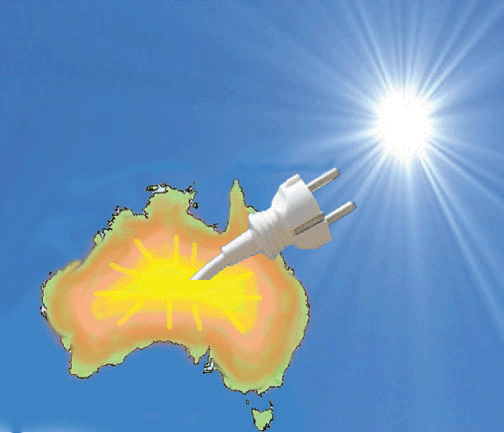
Australia’s top 10 solar postcodes, and the top solar locations by state
 http://reneweconomy.com.au/australias-top-10-solar-postcodes-top-solar-locations-state-60359/
By Sophie Vorrath on 19 September 2017 [excellent map] One Step Off The Grid
We know Australia is leading the world in per capita uptake of rooftop solar, with total installed capacity on homes and businesses this year soaring past the 6GW mark.
But which parts of Australia are leading the country? New data from the Clean Energy Regulator has revealed the latest ranking of Australia’s top 10 postcodes for small-scale solar installation (up to 100kW), with some interesting new additions.
As you can see below, the list this year features a few new entries, and a more diverse spread across the states, instead of being dominated by Queensland and Western Australia locales.
Both the new entries and the old stagers on the list span the suburban, regional and rural areas of Victoria, New South Wales, Queensland and Western Australia, with no entries this year from South Australia, Tasmania, the ACT or the Northern Territory.
In order from the top, the Queensland town of Bundaberg has again secured the number one spot, followed by new entries on the list, the Victorian suburbs of Werribee and Hoppers Crossing. Last year, no Victorian postcodes made the top 10.
According to the CER data, these three postcodes have accumulated the highest number of small-scale renewable energy installations since the small-scale renewable energy scheme began in 2001, each reaching around 17 000 installations as at 1 September 2017.
In fourth place, down from second place last year, is the WA suburb of Mandurah, where the local council is also pushing hard to install PV on government buildings – and just last week agreed to install a 200kW (not a part of the SRES) system at the local pool and sports centre.
The Queensland suburb of Hervey Bay follows, moving to fifth place from third last year. And another Victorian new entry, the semi-rural south-eastern suburb of Cranbourne, is in sixth place.
Bringing up the rear are regular place holders Caloundra and Toowoomba in Queensland, and new entries Wangara (WA) and Lismore (NSW), the latter of which makes the list probably due to the May switching-on of a 99kW rooftop PV system at the Goonellabah Sports & Aquatic Centre, as part of a major community-based and funded renewables campaign.
Despite some bigger commercial installations coming into play, the CER says the average size of the solar postcode installations is 5kW – which is also the average size, now, of a household rooftop solar system. This indicates the dominance, still, of residential uptake in these numbers, considering the SRES encourages commercial systems, too – up to 100kW in size.
“Over the last 10 years, 23 per cent more Australians have embraced rooftop solar,” the CER said in a release on Monday. “That’s one in five homes and businesses now generating their own renewable energy and reducing carbon emissions through rooftop solar.
As we reported here, Australia hit a milestone of 6000 megawatt (6GW) capacity across 2.8 million small-scale installations of renewable energy systems such as solar PV, solar water heaters and air source heat pumps. Nearly 100MW was installed in August, alone.
Interestingly, while no South Australian suburbs on their own make the list, the entire state is setting all sorts of solar records, including a new record low for minimum demand – barely a week after the previous benchmark was set – with a fall to just 587MW on Sunday afternoon.
As Giles Parkinson notes, the record eclipsed the previous mark by nearly 200MW – with AEMO data showing minimum demand at 1.30pm of exactly 587.8MW, compared with the previous low mark of 786.42MW posted last Sunday – thanks to moderate spring temperatures, combined with the state’s more than 700MW of rooftop solar producing 538.54MW at the time of minimum demand.
“That is a phenomenal share of 47.8 per cent of the state’s electricity demand being met by rooftop solar (compares with 36 per cent in the previous record last week) and is clearly a record for South Australia, and for that matter in any large grid anywhere in the world,” Parkinson says.
Below [on original] is the list of last year’s Top 10 solar postcodes:
Norther Territory may be close to getting a lithium mine
NT lithium mine moves closer
THE push to build and develop the Northern Territory’s first lithium mine is gaining momentum
http://www.ntnews.com.au/business/nt-lithium-mine-moves-closer/news-story/fe9071bc2a42cbc28bbdb9fe5a741369
Liberal National Party member would consider taxpayer funding for private coal-fired power station.
Coal-fired pledge for Qld
Queensland LNP leader would consider diverting taxpayer funds from renewable energy into a privately built coal-fired power station.
http://www.theaustralian.com.au/national-affairs/state-politics/wed-invest-in-coalfired-plant-says-queensland-lnp-leader/news-story/20cff6c0ad81b8d6a85ef6ecb8d4c212
20 September REneweconomy news
 RenewEconomy
-
Better data would improve transparency in electricity marketBetter data would reassure consumers that price changes are the result of real problems, such as weather or machinery failure, rather than market manipulation.
-
Liddell: It would cost $900 million to keep it open till 2027Liddell coal generator visit reveals a work-force that wants it to close. Even betting agencies are punting on its closure.
-
Sci-Fi novel envisions corporatocracy in a climate-changed futureIn Tal Klein’s new novel, The Punch Escrow, humans have successfully tackled disease and climate change, but powerful corporations control everything.
-
Graph of the Day: Live renewable energy share and emissions by stateTwo new live graphs show renewable energy share and energy emissions in each state. Rooftop solar is lowering emissions significantly during the day.
-
Queensland big solar boom continues, as another 150MW project approvedQueensland’s Western Downs Region continues large-scale solar boom, with approval of 300MW battery ready Beelbee PV farm.
-
Redflow scores second major battery sale for remote Pacific Island projectsRedflow gets second major order within months for its zinc bromine batteries for application on remote, Pacific Island sites.
-
Brisbane Airport rolls out massive 6MW solar projectHuge 6MW solar upgrade at Brisbane Airport will supply 18% of electricity needs and save around $1m a year on energy bills.
-
SolarEdge enhancing residential PV offering for AustraliaIncreased power production with single-phase inverters and new three-phase inverters for cost-effective larger PV systems
-
Most Labor MPs have pledged to get Australia to sign & ratify the UN nuclear weapon ban treaty

A majority of Labor MPs have pledged to get Australia to sign & ratify the UN nuclear weapon ban treaty: http://icanw.org/projects/pledge/ … #nuclearban
To Malcolm Turnbull’s government, climate change is a joke
 Coalition MPs giggle, cackle, smirk and laugh in Parliament over climate change, Independent Australia , Simon Black Many of our current crop of conservative politicians laugh like naughty children whenever climate change is brought up. This can’t be how the world ends
NERO NEVER FIDDLED while Rome burned.
It is a popular myth, but it’s simply not true — there were no fiddles back in Roman times.
Nero is, however, reported to have sung a song about the sacking of Troy while watching as 70 per cent of Rome was swallowed by flames in a single blistering gulp.
Some of our current crop of politicians have gone one better — they now laugh like small children whenever climate change is brought up.
This week, the conservative side of politics continued what seems to be the running gag of climate change for the during a motion by Senator Peter Whish-Wilson calling for recognition of Australia’s climate scientists.
Whish-Wilson told the floor and later posted on social media, that it was “the angriest I have ever been in the Senate” as he watched members of the house openly mock climate scientists.
Liberal Senator James McGrath stood to read what appeared to be his party’s talking points in a deadpan monotone stopping a number of times to smirk and chuckle.
Leader of the Australian Conservatives Party, Cory Bernardi, rose to make a point of order, informing the house that it was, in fact, he who had been raucously laughing.
Presumably, he was concerned the people who voted him in would be upset if he wasn’t earning his base pay of $199,040 a year by chuckling his way through Senate motions.
Nice work if you can get it.
It’s part of a trend in Australian politics for conservatives to openly mock, laugh and ridicule climate change, even as the Great Barrier Reef bleaches and dies, even as we notch up record hot year after record hot year, even as natural disasters such as Hurricanes Harvey and Irma increase in frequency and intensity worldwide.
When asked about climate change in June this year by a Liberal colleague, Australian Environment Minister Josh Frydenberg had a good laugh.
He spent 30 seconds answering the question and then two-and-a-half minutes openly laughing about an interview where Labor MP Andrew Leigh mentioned climate change could have an impact on the ski season.
“He’s just worried about one thing: losing the ski season,” guffawed Frydenberg.
Someone else who is worried about the ski season is the CSIRO, who warned climate change could shrink Australia’s ski season by 80 days a year by 2050.
But never let reality get in the way of a good joke.
And it seems there’s nothing funnier than the threat posed by climate change — once described by Prime Minister Malcolm Turnbull (before he was Prime Minister) as “catastrophic”. ……..https://independentaustralia.net/politics/politics-display/this-is-how-the-world-ends–not-with-a-bang-but-with-a-chuckle,10722
Anti Adani coal project- action is seriously hotting up in Queensland
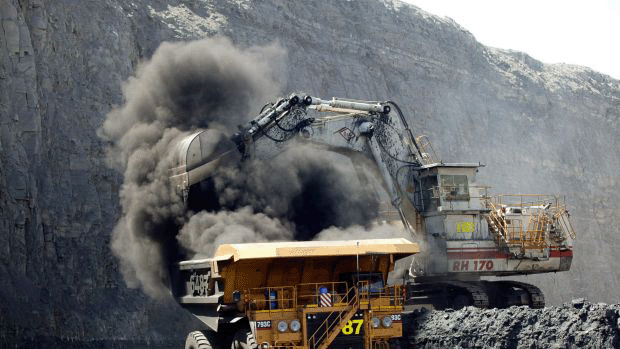 Anti-Adani protesters promise week-long action against Queensland mine https://www.brisbanetimes.com.au/national/queensland/qld-adani-protesters-promise-week-long-action-20170916-p4yvy9.html 16 September 2017
Renowned author Tim Winton on how Malcolm Turnbull betrayed our ocean s
How Malcolm Turnbull has trashed the Liberal Party record and betrayed our oceans, SMH, Tim Winton , 17 Sept 17 “……
Australians have always loved the ocean, but now, more importantly, we understand how vital the sea’s health is to the future of our island home…….
In 2012, after an exhaustive scientific process and wide community consultation, Tony Burke declared a system of marine national parks, one of the biggest and best in the world, the most significant conservation gain in Australian history.
That took courage. Because it put science before politics, prudence ahead of expediency. And it was popular. But as soon as he came to power in 2013 Tony Abbott announced an immediate moratorium on these parks and instigated a review. The purpose was purely political. To delay implementation, corrode consensus and deny the science. A move straight out of the culture warrior’s playbook.
After decades of forward-thinking leaders, the nation had fallen into the hands of a man whose loyalties were only to the past. It was a low moment. But Abbott’s reign was as brief as it was fruitless. It was a relief to see him replaced in 2015 by a man who’d actually done things, who believed in the future. Malcolm Turnbull did not scorn science. He seemed to understand the value and fragility of our natural estate. So there was new hope the marine parks review would now be expedited and redirected towards real conservation outcomes. With coral reefs bleaching and miners pressing for even more coal ports and seabed to drill, the need for protection had only grown more urgent.
Well, that moment of promise is long gone. Turnbull’s period in office has basically been a hostage drama. The bargain he made with powerbrokers rendered him captive to the party’s most illiberal wing, and if his performance on climate, energy and marriage equality aren’t evidence enough, last month’s announcement that marine parks would be slashed beyond all recognition puts it beyond dispute.
……The draft management plans recently released for consultation by Josh Frydenberg don’t just signify the gutting of the national system, they represent the largest removal of protection for Australian wildlife in our history. What the government is proposing is a nihilistic act of vandalism. Forty million hectares of sanctuary will be ripped from the estate. That’s like revoking every second national park on land. Under its new plan, 38 out of 44 marine parks will be open to trawling, gillnetting and longlining, 33 will be open to mining, and 42 exposed to the construction of pipelines. In total defiance of the scientific advice upon which the original system was designed, 16 marine parks will now have no sanctuary zones at all.
…….. The shame of it is, the Liberal Party has a worthy environmental record, especially with oceans. Malcolm Fraser declared the Great Barrier Reef a marine park in 1975 and in 1978 he ended whaling. And remember, the national push for marine parks began under John Howard. So this government is trashing its own party’s proud legacy……..http://www.smh.com.au/comment/how-malcolm-turnbull-has-trashed-the-liberal-party-record-and-betrayed-our-oceans-20170908-gydy2d.html
A mathematician warns – Coalition’s pro-coal policy likely a vote loser
 Coalition’s pro-coal policy likely a vote loser; optional voting in plebiscite helps Yes, The Conversation, Recently the Coalition and its media supporters have condemned the SA and Victorian Labor governments for allowing coal-fired power plants to close. The Coalition is trying to extend the life of the Liddell power plant in NSW, and is considering building a new coal-fired power plant. This is an attempt to portray Labor as the party of intermittent, unreliable and costly power.
The Coalition has been in office for four years. In July 2014, they repealed the carbon price that Labor had introduced. Many people would now ask why energy prices have kept increasing in the three years since this repeal. In a mid-August Essential poll, 59% thought they were paying a lot more for electricity and gas than two or three years ago.
In February, 45% in an Essential poll said that recent blackouts were mainly due to failures of the energy market, 19% blamed privatisation and just 16% blamed renewables.
In mid-August an Essential poll gave the Coalition a net -34 rating on providing affordable and reliable energy, their worst score from a list of 12 issues. In last week’s Essential, 49% blamed private power companies most for rising energy prices, 22% blamed the Turnbull government, 9% environmentalists and 5% renewable energy companies.
People who blame private power companies are more likely to trust Labor than the Coalition to get tough, given the Coalition’s pro-business reputation……. [lots of figures given here]
As a result of the Coalition’s pro-coal policy, some Abbott supporters could return, possibly boosting the Coalition’s primary vote at the expense of One Nation and Others. However, respondent allocated preferences are currently more friendly to the Coalition than the previous election method, and this could change. The Coalition risks losing more centrist voters to Labor.
In some parts of the country, such as NSW’s Hunter Valley, coal is important to the local economy, and the Coalition is likely to benefit. In most of the country, being pro-coal is likely to hinder the Coalition.
SA has been the state most subject to attacks from the pro-coal lobby. It has a Labor government that is over 15 years old, and this would be expected to be a drag on Federal Labor in that state. We would expect the SA swing to Labor to be the lowest of any state.
Instead, the Poll Bludger’s BludgerTrack currently gives Labor their second largest swing in SA. Labor leads in SA by 58.4-41.6, a 6.1 point swing to Labor since the 2016 election. The SA sample sizes used in BludgerTrack are small, so this result is much more error-prone than the national BludgerTrack figure (53.7-46.3 to Labor, a 4.1 point swing), but this is still a large swing to Labor in a state that should have the lowest swing.
SA will have only 10 House seats at the next Federal election, but Victoria will have 38. If the Coalition antagonises Victorians as much as they have South Australians, they could suffer a disastrous loss of seats in both states……..https://theconversation.com/coalitions-pro-coal-policy-likely-a-vote-loser-optional-voting-in-plebiscite-helps-yes-83787
The LNP Welfare Card: the true facts exposed. Corruption disguised as philanthropy!
The AIM Network By Michael Griffin February 27, 2017
https://theaimn.com/lnp-welfare-card-true-facts-exposed-corruption-disguised-philanthropy/
“The Liberal National Party (‘LNP’) Welfare Card programme is really a LNP rort
for the benefit of the Liberal and National Parties and their members, donors and supporters.
“Indue Pty Ltd, the corporation awarded the contract to manage the Welfare Card programme
and to operate its underlying systems, is a corporation owned by Liberal and National Party members
and that donates to various Liberal and National Party branches around Australia.
“The former chairman of Indue is none other than former LNP MP Larry Anthony who is the son of former Liberal Country Party Deputy Prime Minister Doug Anthony.
“Anthony now holds his shares in Indue in his corporate family trust managed by Illalangi Pty Ltd.
“Other companies now owned by Larry Anthony, or by the corporate trustee of his family trust, Illalangi Pty Ltd, work under ‘sub’ contracts for Indue itself and make their profits from dealings with Indue
in the course of Indue performing its contracts with the LNP Government.
“These corporations are SAS Consulting Group Pty Ltd
– a political lobbying group that counts Indue as a client
– and Unidap Solutions Pty Ltd – a digital IT services corporation that provides Indue,
as well as the current LNP Government directly, with various IT services.
“Larry Anthony is also current president of the National Party of Australia, that is, the ‘N’ in ‘LNP’. … “
NUCLEAR LIES: AUSTRALIA – theme for October 2017
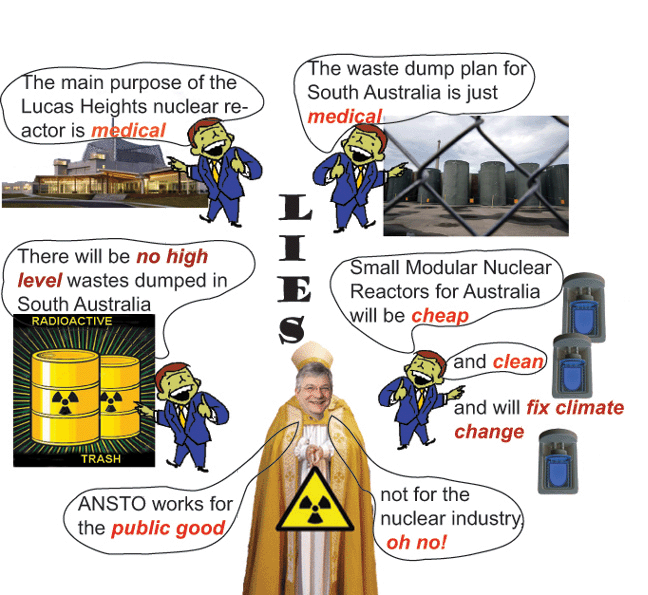
Australia is a particular target of nuclear industry lies.
Unfortunately, both major political parties, and the dominant Murdoch media buy into these lies. Some politicians and journalists actually believe them.
The global industry continues its 70 year campaign of lies. But Australia gets its own very specialised lies, spread by the government, via the Australian Nuclear Science and Technology Organisation (ANSTO) . ANSTO is a law unto itself, working primarily to promote the nuclear industry. The Murdoch media obliges by promoting also the lies of nuclear shills, like Michael Shellenberger, imported from America.
At Australian Nuclear Free Alliance (ANFA) Black and White celebrate their campaign – keeping Australia nuclear free
Celebrating 20 years of helping Australia stay nuclear free Aboriginal land continues to be in the firing line. SBS NITV, By Paddy Gibson, Senior Researcher, Jumbunna Institute UTS 15 SEP 2017

This weekend in Adelaide, Kaurna country, anti-nuclear campaigners from the Australian Nuclear Free Alliance will hold their annual conference to debrief and strategise for the struggles ahead.
At the core of Australian Nuclear Free Alliance (ANFA) are Aboriginal people living with nuclear projects on their lands, including uranium mines and the toxic legacy of nuclear weapons testing in the 1950s and 60s, and others trying to stop new uranium mines or nuclear waste dumps being imposed on their country.
This year’s conference will celebrate 20 years since the network was founded in 1997 in Alice Springs, originally as the Alliance Against Uranium.
The initial meeting was an initiative of Mirarr people and their organisation Gundjeihmi, who were cranking up a major campaign against the Jabiluka uranium mine, along with environment groups such as the Australian Conservation Foundation (ACF), Friends of the Earth and other Traditional Owners. At the time, the Howard government was looking to massively expand Australia’s uranium exports. There was a wealth of experience in Aboriginal communities across the country, who suffer the brunt of this industry and people wanted to come together to fight back. There were growing opportunities to connect with wider civil society groups who shared a deep concern about uranium and recognised the central importance of supporting Aboriginal struggles for country.
Over the past 20 years, the ANFA network has provided vital support to many campaigns, from the victory at Jabiluka, to the battles for compensation for victims of nuclear weapons testing, to numerous struggles against new uranium mines and exploration projects. Lessons from the successful fight to stop a nuclear waste dump in South Australia, a victory achieved in 2004 after a national campaign led by the Kupa Piti Kungka Tjuta, inspired a decade of resistance that eventually stopped a nuclear dump been established in the Northern Territory, despite attempts at multiple sites. International solidarity with other Indigenous peoples, and all peoples, dealing with similar threats, has also been central to ANFA’s practice.
Aboriginal land continues to be in the firing line. This year’s conference will deal with new moves to establish a waste dump in South Australia, being fiercely resisted by Adnyamathanha people whose country in the Flinders Ranges is under threat. Also up for discussion is the ongoing attempt to expand existing uranium mines and establish new ones, including the recent indication by the WA Labor government that it would push ahead with uranium mines in that state, in contravention of clear election commitments and the wishes of Traditional Owners. The growing threat of nuclear war, and the urgent need to rehabilitate country already badly damaged, are also on the agenda.
Below [on original] is a collection of statements from participants in ANFA over the last twenty years, taken from a report produced to celebrate “twenty years of radioactive resistance”.
These statements all demonstrate the importance of Aboriginal connection to country as a driving force behind the network, along with the power that comes from building networks of solidarity across society.

When Adelaide got hit by Maralinga nuclear radiation fallout
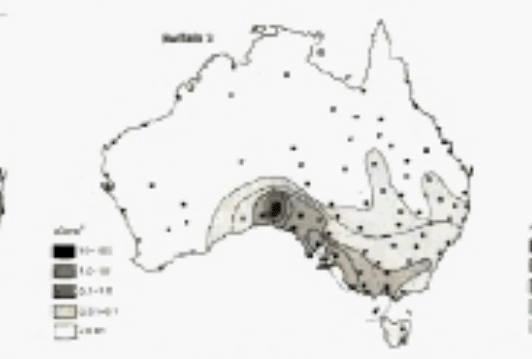
Fallout map from the day Adelaide got hit hard, 11 Oct 1956 …
I was luckily living elsewhere at the time, in NSW … I do remember having bad nose bleeds … we moved to Adelaide a few years later so many of my school and uni and work and sport mates and their mothers were in the thick of the fallout from the British bomb test called Buffalo 3 .. and there are many sad stories of retarded siblings and congenital cardiac issues and early cancers.
QUOTE:
In 1956 a series of atomic tests were carried out in the far north of the state at Maralinga, including the dropping of a bomb from a plane on October 11th, with devastating impacts on nearby Aboriginal communities.
Australian Atomic Confessions [Full Documentary]
Retired academic Roger Cross’s book “Fallout” focuses on the drift of radiation many hundred kilometres south of the site to Adelaide.
“Fortunately for South Australia it was rather a small bomb, but it was dropped from a Valiant Bomber and was designed to explode in the air which it did do,” Mr Cross told Ian Henschke on 891 ABC Adelaide mornings.
“Part of the cloud blew south towards Adelaide and the minor cloud then blew east as it was supposed to across largely uninhabitated areas towards the towns of Sydney and Brisbane and exit Australia between those two cities.
“But the main part of the cloud actually blew down south towards Adelaide and there was great controversy about that,” he said.
Mr Cross says this wasn’t admitted to at the time, causing great controversy.
He says authorities didn’t realise a man called Hedley Marston who was involved with the tests, checking thyroids of sheep and cattle around the area, also set up a secret experiment at the CSIRO building in Adelaide.
Mr Marston recorded a level of 98 thousand counts per hundred seconds the day after the bomb had been dropped.
“The average count in Adelaide at that time was between 40 and 60 counts per hundred seconds,” said Mr Cross.
Mr Marston also carried out some tests on sheep just south and north of Adelaide, finding elevated levels of radiation material in the sheep that were on pasture but not in others that had eaten hay cut the year before.
“This was a very elegant experiment because by luck he had a control, he had this group of sheep that were penned under cover that were just eating hay from previous harvests.”
Mr Cross says Hedley Marston was concerned about strontium 90 in particular and it getting into milk and then being consumed by young children and pregnant women.
Silent Storm atomic testing in Australia
Anti-nuclear campaigner Dr Helen Caldicott entered medical school in Adelaide in 1956 and told Ian Henschke there was no mention of a possible health impact of the tests, and she is not aware of a study of the human population following that test.
“We the population of Adelaide were kept in ignorance and for that I feel very bad about that as a doctor.”
She says you would have to test all the population exposed to radiation throughout their entire life and compare it to people who were not exposed to know if the incidence of cancer was high.
“My prediction is definitely I’m sure it was but we don’t have any evidence.
“Adelaide got a hell of a fallout, and I must say as a young medical student not being taught about that I have deep resentment that the public was not informed about it,” said Dr Caldicott.
(Quote from http://www.abc.net.au/local/stories/2011/03/21/3169570.htm )
(Map is a detail from https://nuclearhistory.wordpress.com/…/allowable-lifetime-…/ )
Saying goodbye to coral reefs
If we continue to have warm summers like we had in ’16 and this year, the next one could wipe out the remaining coral. Now, I don’t want to sound doomsday, but that’s where we’re at right now. It’s still a wonderful place to visit. But if we continue on this trajectory it won’t be, very soon – within our lifetime. I think that this is the wake-up call that we need. If losing the Great Barrier Reef isn’t serious stuff, what is?
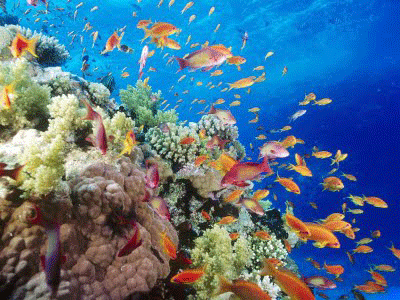 Farewelling coral reefs The Saturday Paper, Karen Middleton, 16 Sept 17 We hear much about trying to contain temperature rises to 2 degrees above pre-industrial levels. Why is that the magic number?
Ove Hoegh-Guldberg The 2-degree guardrail came out of the 2009 Copenhagen meeting. When you looked at how ecosystems were responding, you got into an unmanageable area at 2 degrees above the pre-industrial period, which was where the CO2 concentration had been stable for a long time. The trajectory we’re on today could raise temperatures by as much as 5 or 6 degrees on history.
One of the problems with 2 degrees is that generally people have the idea that it’s a guardrail. You go up to the edge of 2 degrees and look over it and see where you don’t want to go and it’s all very safe here. But it’s more like a slippery slope. Things get progressively worse until they become unmanageable. At the latest Conference of the Parties, the UNFCC [United Nations Framework Convention on Climate Change ] governing framework started to say, “well actually we want to keep things well below 2 degrees, and hopefully aim for 1.5 in the long term”.
KM And where are we now? Continue reading
1 This month


Help Aunty Sue Protect Her Land and Sacred Sites From Destructive Rocket Testing.
.

Australians deserve the truth
about
AUKUS – https://aukuspublicinquiry.com/

PETITION – To: Prime Minister Anthony Albanese and the Australian Labor Government

of the week – Australians for War Powers Reform (AWPR)
To see nuclear-related stories in greater depth and intensity

