Australian Parliamentary Treaties Committee nuclear fast-track cuts corners and lacks evidence
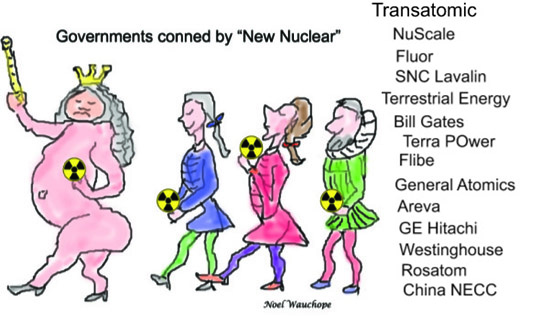
The federal parliament’s Joint Standing committee on Treaties (JSCOT) has today signed off on the use of public funds to support research into so-called Generation IV nuclear reactors.
“This reckless decision follows a rushed process with no public hearings. It lacks evidence and justification and flies in the face of a clear and sustained global trend away from nuclear energy options,” said Australian Conservation Foundation campaigner Dave Sweeney.
ACF joined Friends of the Earth Australia in making a detailed critique of the nuclear plan to JSCOT (attached).
The submission highlighted that the various Generation IV nuclear systems share many of the same risks and constraints as the wider nuclear industry, including prohibitive costs and safety, waste and proliferation concerns.
“Australia’s involvement with Generation IV promotion is a distraction from the real energy challenges and solutions,” said Dave Sweeney.
“Propping up nuclear research is not consistent with clear action to address nuclear non-proliferation, energy transition or climate change. It’s also inconsistent with both Australian prohibitions and community expectations on nuclear power.”
These concerns have been noted in both the Greens’ dissenting report and federal Labor’s additional comments, however they are not reflected in the final report.
“Committing public funds to a risky, divisive and under-performing industry deserves the highest scrutiny and justification, not an under the radar rubber-stamp,” Mr Sweeney said.
Further context or comment:
Dave Sweeney – ACF nuclear free campaigner – 0408 317 812
Dr Jim Green – Friends of the Earth Australia national nuclear campaigner – 0417 318 368
Committee Report: http://www.aph.gov.au/Parliamentary_Business/Committees/Joint/Treaties/CITES/Report_171
Labor’s broken uranium promise a kick in the guts for communities and the environment. Uranium mine plans will be challenged
Leading environment groups have said the fight to keep Western Australia nuclear free was not over despite a serious broken promise by the McGowan Government on the key environmental issue.
 CCWA Director Piers Verstegen said the decision to allow WA uranium mines to proceed on Aboriginal lands was a clear broken promise and a kick in the guts for communities and the environment.
“Should these mines go ahead they would cause permanent damage to our environment and communities and also export WA uranium to countries where it will inevitably result in radioactive waste and risk.
“This terrible decision is a betrayal of the many people, communities, Traditional Owners, trade unions, churches and environment groups who placed their faith in Labor to keep WA uranium free.
“Environmental standards went out the window under the Barnett Government and the approvals that were granted for these uranium mines are some of the most compromised decisions that government made.
“The decision by the McGowan Government to allow those approvals to stand without so much as an inquiry to investigate them, and without even consulting the local communities, workers and Traditional Owners who voted for them in good faith, sends a very bad message about the Government’s commitment to protecting our environment.
“The McGowan Government may think it is OK to let some of the worst decisions in the state’s history stand, but communities, environment groups, workers and Traditional Owners certainly won’t be backing down in our fight to prevent this bad decision turning into a series of toxic and polluting uranium mines.
“We believe there are serious legal flaws in the way these approvals were granted by the Barnett Government and we will continue to contest them at every stage of the process, including through pursuing legal options to protect our communities and environment from this toxic and unwanted industry.
“There will be a lot of members of the Labor Party, a lot of Traditional Owners, and a lot of voters who will be extremely disappointed by this decision which is a direct breach of long-standing state Labor policy and the trust that Western Australians placed in the McGowan Labor Party when they were elected.
“We have worked closely with local communities and Traditional Owners who would be affected by each of these proposals and we certainly won’t be abandoning them in the same way that the McGowan Government appears to be doing.”
National environment group the Australian Conservation Foundation has called the move a retreat from responsibility and will increase its efforts to end plans for uranium mining in WA.
ACF’s Nuclear Free Campaigner Dave Sweeney said “Premier McGowan went to the election saying that uranium mines would not be allowed to proceed unless they had final approval or were in construction.
“None of the four uranium proposal has final approval, none has begun construction and none of the companies have even made a final investment decision.”
“This decision is far from a done deal for uranium mining in WA. No uranium was mined or exported under the pro-nuclear Barnett Government and we will continue to do what is necessary to keep WA’s uranium in the ground.”
Disappointment over Labor’s broken promise on uranium mining in Western Australia
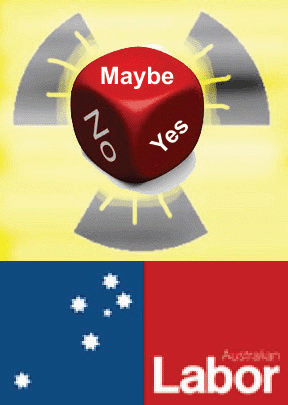 The West Australia Nuclear Free Alliance, an Indigenous alliance opposed to uranium mining, have expressed their deep disappointment by the announcement from Labor that will allow four uranium mines to proceed, that have been contested by Traditional Owners
Janice Scott, Spinifex Pilgi Woman “The Labor Government, we thought they would stand up for us be strong, and all that we’re fighting for – be different from the other Government. They told us lies. We believed that Labor they would help us to stop uranium mining, they got our trust and that’s why we voted for them.”
Mr Glen Cooke Ngaanyatjarra elder “we will be stepping up the fight talking to our countrymen. This impacts our lands and stories all over not just the mine sites. Tribal people are saying we don’t want uranium. Enough is enough. We will take this further, this country is beautiful and we have to look after it for our children and grandchildren and all future generations.”
“What is so disappointing is that the Labor Government did not sit down and talk with us about this decision which affects our country. Today’s decision Labor has not made one friend but has lost them many.” Concluded Mr Cooke.
Strong calls to have Kimba nuclear dump plan dumped
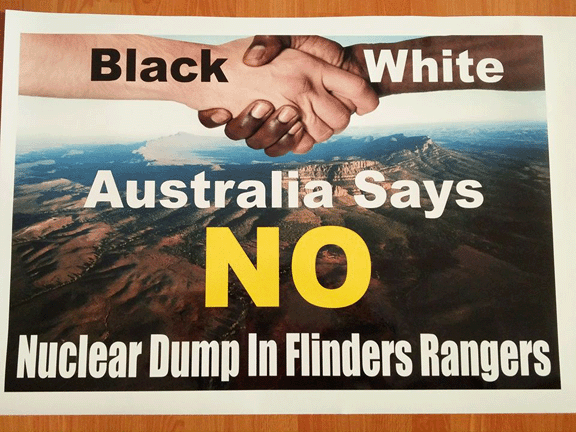 Groups call for nuclear dump to be dropped, http://www.9news.com.au/national/2017/06/20/22/22/groups-call-for-nuclear-dump-to-be-dropped Conservation and anti-nuclear groups have petitioned the federal government to scrap plans for a low-level nuclear waste dump on South Australia’s Eyre Peninsula.
The groups, including Conservation SA, Friends of the Earth and the Australian Conservation Foundation have lodged a submission with the federal Department of Industry, Innovation and Science calling on the government to abandon any plans for a dump at Kimba.
Farming land near Kimba is one of two sites being targeted for the dump, the other near Hawker in SA’s Flinders Ranges.
He says most of the waste is located at the Lucas Heights reactor site south of Sydney and that is where it should stay.
Australian Conservation Foundation campaigner Dave Sweeney said radioactive waste was a national issue that demanded the highest level of inclusion and scrutiny.
“All Australians have a right to be involved to help make sure that this difficult issue is given the best possible consideration,” he said.
“What is planned is a national radioactive waste facility so while local community consultation is useful, an evidence based, national conversation is essential.”
Report shows how Australia is underestimating security threats from climate chnage
 Australia warned it has radically underestimated climate change security threat
Senate inquiry starts as report into political, military and humanitarian risks of climate change across Asia Pacific released, Guardian, Ben Doherty 21 June 17, As the Senate launches an inquiry into the national security ramifications of climate change, a new report has warned global warming will cause increasingly regular and severe humanitarian crises across the Asia-Pacific.
Disaster Alley, written by the Breakthrough Centre for Climate Restoration, forecasts climate change could potentially displace tens of millions from swamped cities, drive fragile states to failure, cause intractable political instability, and spark military conflict.
Report co-author Ian Dunlop argues Australia’s political and corporate leaders, by refusing to accept the need for urgent climate action now, are “putting the Australian community in extreme danger”. Continue reading
9 Renewable Energy Stories From REneweconomy.com.au
-
20 June 17Batteries vs pumped storage hydropower – a place for both?Two very different storage technologies – one old, one new; one that takes years to build, one that can be built ‘within 100 days (or it’s free)’. How else do they differ, and is there a place for both?
-
Finkel: Investors prefer wind, solar because they cheaper than coalFinkel says it clear investors prefer wind and solar because they are cheaper to build than traditional generation such as hydro and coal.
-
Turnbull and Trump both demonising renewables for no reasonTurnbull’s pursuit of “baseload dispatchable” power has all the hallmarks of the Trump administration’s campaign against renewables. But data shows that countries with lots of wind and solar have better energy security.
-
Australian company Vivid Technology enters MoU with Honeywell to become its preferred partner for IoT industrial-scale smart LED lighting in AustraliaMajor strategic partnership opens the possibility of integrating Vivid Technology and Honeywell products to create complete smart buildings solutions.
-
Investing trillions in electricity’s sunny futureNNEF has just published its fourth annual New Energy Outlook with electricity’s future looking sunny — and windy, too — to the tune of trillions of dollars of new investment.
-
AGL says only renewables will provide new “baseload”, not coalAGL ridicules Coalition push for new “baseload” coal plants, saying that the only new “baseload” would be renewables, with gas or storage. “There’s a lot of misinformation out there,” says CEO Andy Vesey.
-
WA national park taken off-grid by local networkHorizon Power’s stand-alone power project taking Fitzgerald River National Park off-grid with solar, battery storage and back-up diesel.
-
Queensland rejects battery swap, but restricts use of storage with premium tariffsQueensland decides against proposed voluntary “buy out” of premium solar feed in tariffs in exchange for battery storage, but announces new rules to stop premium tariffs being rorted by batteries.
-
Rooftop solar’s new boom – when installing PV becomes a no-brainerFalling technology costs and yet another hike in electricity prices are combining to make rooftop solar an economic no-brainer for most Australian households and businesses. Just ask Cory Bernardi.
Liberal Senator challenges Tony Abbott on his climate ;policy u-turn
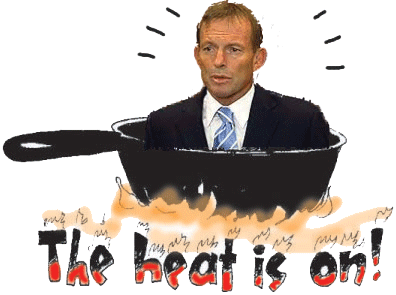 Tony Abbott: Concetta Fierravanti-Wells challenges former PM on climate policy ‘about-face’ ABC News, PM 20 June 17 By political reporter Tom Iggulden, Former prime minister Tony Abbott is being accused of damaging Australia’s international reputation and his own political credibility in another outbreak of internal coalition infighting.
Key points:
- Prime ministers are judged on what they’ve done when in government, Concetta Fierravanti-Wells says
- Criticism follows Tony Abbott’s comment his Paris Agreement targets were “aspirational”
- She calls on Mr Abbott to reflect on his actions for the good of the party
International Development Minister Concetta Fierravanti-Wells, once seen as an ally of Mr Abbott’s, says he has performed a “total about-face” on climate policy that is threatening to turn off investors.
“Credibility is a very important commodity in politics,” she told PM.
“Any former prime minister will be judged on what they’ve actually done when they were in government, not on what they say they should have done or could have done subsequently.”
The criticism follows Mr Abbott’s assertion last week that the Paris Climate Agreement targets he devised as prime minister in 2015 were “aspirational”.
Senator Fierravanti-Wells pointed to “categoric” comments Mr Abbott made in 2015 when he announced the “pledge” to reduce emissions by 26 to 28 per cent by 2030…….http://www.abc.net.au/news/2017-06-19/abbott-shows-about-face-in-climate-policy:-fierravanti-wells/8631956
Battery storage project Victoria. 2 more solar farms Queensland
$660m battery project to give business new power options
A new large-scale solar and battery storage project in Victoria, involving 2.3 million solar panels, is touted as a possible solution for businesses struggling with Australia’s volatile energy market.
http://www.abc.net.au/news/2017-06-20/new-solar-battery-storage-project-for-nowingi/8632628
Germany solar and storage developer Belectric says it plans to complete two more solar farms in Australia by the end of the year, after finishing a 4.77MW solar plant at Goondiwindi , Queensland, using a new, low cost installation system.
http://reneweconomy.com.au/belectric-completes-second-solar-farm-plans-two-more-65632/
Australia kicked off the Global Womens’ March To Ban The Bomb
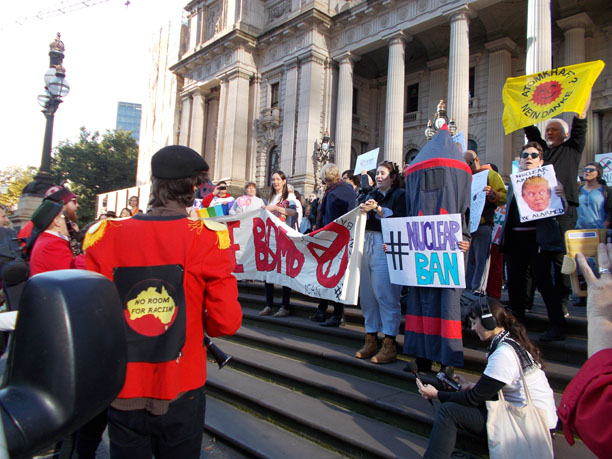
In Melbourne today the march was not huge, but for Melbourne, quite substantial, enthusiastic and made up of people (men and children included) from all area, and from a variety of different organisations. There was a great band – “The Riff Raff” I think is their name, and speakers representing indigenous women, Pacific Island people, ICAN, and one brave Australian Senator, Janet Rice, of The Greens.
Crikey names and shames the Liberal Neanderthals opposing Clean Energy Target
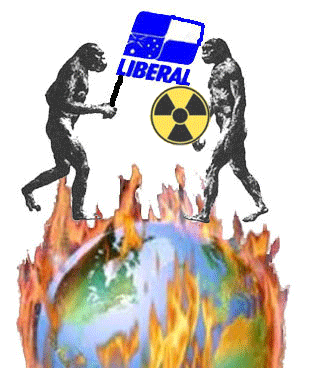 Who are the Liberal MPs worried about Turnbull’s Clean Energy Target?, Crikey.com, 16 June 17 Crikey intern Will Ziebell looks back over past public comments to work out which MPs could end up dissenting. Various media outlets reported this week that at least 22 Coalition MPs spent Tuesday’s joint party room meeting voicing their concern about the proposed Clean Energy Target.
With the numbers supposedly evenly divided between the Liberals and the Nationals, it’s worth taking note of exactly who among the Liberals is on the record as being BFFs with coal. So here are the defenders of coal, in their own words:
Tony Abbott The former PM is still ardently attached to the rock he’s described as good for humanity…….Kevin Andrews……Ian Macdonald…….Craig Kelly……Andrew Hastie……Chris Back…..Rowan Ramsey…….Russell Broadbent……Angus Taylor……Tony Pasin……https://www.crikey.com.au/2017/06/16/who-are-the-liberal-mps-worried-about-malcolm-turnbulls-clean-energy-target/
Future jobs in Far North Queensland threatened by Adani coal mine
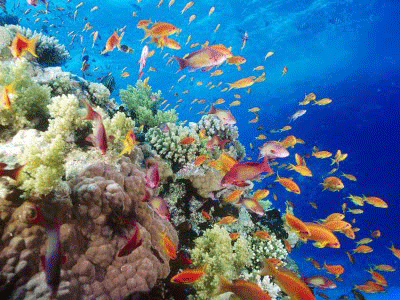 Claims that Adani Coal Mine will threaten future tourism jobs in Far North, Tom Volling, The Cairns Post, June 19, 2017 A GROUP of scientists, doctors and reef conservationists claim a controversial coal mine destined for Central Queensland will negatively impact the Cairns economy.
The facts on wind farms and bird deaths
 Wind farms are hardly the bird slayers they’re made out to be. Here’s why, The Conversation, Emeritus Professor in Public Health, University of Sydney, June 16, 2017, People who oppose wind farms often claim wind turbine blades kill large numbers of birds, often referring to them as “bird choppers”. And claims of dangers to iconic or rare birds, especially raptors, have attracted a lot of attention.
Wind turbine blades do indeed kill birds and bats, but their contribution to total bird deaths is extremely low, as these three studies show.
A 2009 study using US and European data on bird deaths estimated the number of birds killed per unit of power generated by wind, fossil fuel and nuclear power systems.
It concluded:
wind farms and nuclear power stations are responsible each for between 0.3 and 0.4 fatalities per gigawatt-hour (GWh) of electricity while fossil-fuelled power stations are responsible for about 5.2 fatalities per GWh.
That’s nearly 15 times more. From this, the author estimated:
wind farms killed approximately seven thousand birds in the United States in 2006 but nuclear plants killed about 327,000 and fossil-fuelled power plants 14.5 million.
In other words, for every one bird killed by a wind turbine, nuclear and fossil fuel powered plants killed 2,118 birds……
And in Australia?
In Australia in 2006 a proposal for a 52-turbine wind farm plan on Victoria’s south-east coast at Bald Hills (now completed) was overruled by the then federal environment minister Ian Campbell.
He cited concerns about the future of the endangered orange-bellied parrot (Neophema chrysogaster), a migratory bird said to be at risk of extinction within 50 years. The Tarwin Valley Coastal Guardians, an anti wind farm group that had been opposing the proposed development…….
Perhaps the final word on this topic should go to the British Royal Society for the Protection of Birds. It built a wind turbine at its Bedfordshire headquarters to reduce its carbon emissions (and in doing so, aims to minimise species loss due to climate change). It recognised that wind power is far more beneficial to birds than it is harmful.
Simon Chapman and Fiona Crichton’s book, Wind Turbine Syndrome: a communicated disease, will be published by Sydney University Press later this year.
Dennis Matthews reviews Energy Market Operator (AEMO)’s report on ENERGY SUPPLY OUTLOOK
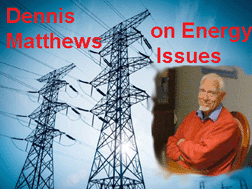 Dennis Matthews June 2017, Comments on “ENERGY SUPPLY OUTLOOK Australian Energy Market Operator (AEMO), June 2017” This 30 page report has more acronyms than you can shake a stick at. The average full page of text contains some 20 acronyms. For example, on the first page of CHAPTER 1 we have
“New information since the November 2016 updates to the ESOO and EAAP, and the March 2017 GSOO, which has been included in the ESO modelling, includes:”
In the majority of cases, the acronym is defined only when first used. There is no list of acronyms.
Needless to say, this makes for very difficult reading except for those working in the energy industry and bureaucracy. The typical energy consumer would be continually frustrated trying to find out what many of the acronyms mean.
Referring to thermal electricity power stations as coal-powered, or as gas-powered, generators (CPG or GPG) suggests a degree of technical confusion. The coal or gas is in fact an energy source (fuel) rather than a power source.
To avoid ambiguity and confusion, the acronym NEM (National Electricity Market) should be reserved for the actual market and not used for the region covered by the market.
A relatively new term (and acronym), ‘unserved energy’ (USE) seems bound to confuse. USE is defined as:
“the amount of energy that cannot be supplied to consumers, resulting in involuntary load shedding (loss of customer supply), because there is insufficient generation capacity, demand side participation, or network capability, to meet demand.”
In other words, it is a demand that is not filled (met, served). A more correct term would seem to be ‘unfilled energy demand’ (UFED).
In considering climate conditions that could lead to peak demand, the report concentrates on temperature, especially high temperature in summer. What is driving peak demand is an ever increasing desire for comfort, throughout the whole year. Ever increasing affluence has led to ever increasing ability to pay for more and more comfort and convenience.
The major determinants of comfort would appear to be temperature and moisture. In summer, high moisture makes hot days less comfortable, whilst in winter, high moisture makes cold days less comfortable. For a given ambient summer temperature, the higher the humidity, the greater the demand for cooling. Whilst for a given ambient winter temperature, the higher the rainfall, the greater the demand for heating.
Exacerbating the trend for more and more comfort and convenience is a trend to houses with larger open spaces, fewer occupants and worse insulation. Nowhere in the report is there any consideration of managing energy demand through better building design and construction. Demand management has come to mean paying consumers to turn off energy guzzling equipment during periods of peak demand (demand side participation, DSP).
The statement that “Extreme weather conditions typically occur on summer weekdays, between 4.00 pm and 8.00 pm” is obviously nonsensical. Presumably, it is meant to refer to energy demand.
In considering risks to ‘electricity supply adequacy’ due to extreme weather conditions, the report does not seem to have included bushfires and floods.
Alan Finkel on nuclear issues – he is (cautiously) pro nuclear
 Finkel, in his Submission to the South Australian Nuclear Fuel Chain Royal Commission, gives qualified support to that (now dead) nuclear waste import plan, and vague support to nuclear power.
Importantly, Finkel is opposed to Australia being the test place for the first Generation IV reactors.
Dennis Matthews Scrutinises the Finkel Energy Report
“The report recommends a Clean Energy Target as the mechanism for the electricity sector.”
The trouble with recommending ‘clean’ as distinct from ‘renewable’ is that ’clean’ means ‘low greenhouse gas emissions’, and hence opens up the electricity sector to nuclear power, which is definitely not environmentally clean in the more general sense and nuclear advocates will attempt to argue that, from an Australian viewpoint, nuclear power is ‘low emission’.
 Dennis Matthews June 2017 Comments on“Independent Review into the Future Energy Security of the National Electricity Market Blueprint for the Future Alan Finkel June 2017”
INTRODUCTION
The Finkel report recommendations involve greater regulation of an already highly regulated electricity market. These regulations are due to serious market failure, especially in those states that have privatised the electricity industry, yet nowhere is the possibility of de-privatisation (re-nationalisation) considered. The report’s answer to market failure is more, and more complicated, regulation and government funding. For example:
- the Australian Energy Market Operator (AEMO) “should develop a list of potential priority projects, in each region, that governments could support if the market is unable to deliver the investment required”.
- For the priority projects, the Australian Energy Market Commission (AEMC) should give guidance for governments on the circumstances “that would warrant government intervention to facilitate specific transmission investments.”
- “The Australian Competition and Consumer Commission should make recommendations on improving the transparency and clarity of electricity retail prices”.
The Finkel report, and its recommendations, contain many references to frequency control and fast frequency response but there are only two brief mentions in the report of direct current (DC) electricity, for which frequency control and fast frequency response are irrelevant.
The way in which the report refers to the financial year is ambiguous, for example: Continue reading
1 This month


Help Aunty Sue Protect Her Land and Sacred Sites From Destructive Rocket Testing.
.

Australians deserve the truth
about
AUKUS – https://aukuspublicinquiry.com/

PETITION – To: Prime Minister Anthony Albanese and the Australian Labor Government

of the week – Australians for War Powers Reform (AWPR)
To see nuclear-related stories in greater depth and intensity


