Why the Coalition should stop trying to silence nuclear power critics

SMH, Nick O’Malley February 27, 2025 ,
News emerged on Monday that the Climate Change Authority had concluded the Coalition’s nuclear power plan would create an extra two billion tonnes of greenhouse gas emissions by extending the life of the nation’s geriatric coal power plants.
The Coalition’s response was swift and emphatic. It attacked the Climate Change Authority as partisan – the CCA that is headed by former NSW Liberal treasurer and energy minister Matt Kean.
“The Climate Change Authority has become a puppet of Anthony Albanese and [Climate Change and Energy Minister] Chris Bowen, as its latest report parrots Labor’s untruthful anti-nuclear scare campaign,” said Coalition energy spokesman Ted O’Brien, as reported by the Australian Financial Review.
The opposition’s finance spokeswoman Jane Hume suggested that should the Coalition win government in coming months, Kean, or the agency he heads, might have to go. “I cannot imagine that we possibly maintain a Climate Change Authority that has been so badly politicised,” she told ABC TV.
“It simply isn’t serving its purpose to provide independent advice to the government on its climate change policy.”
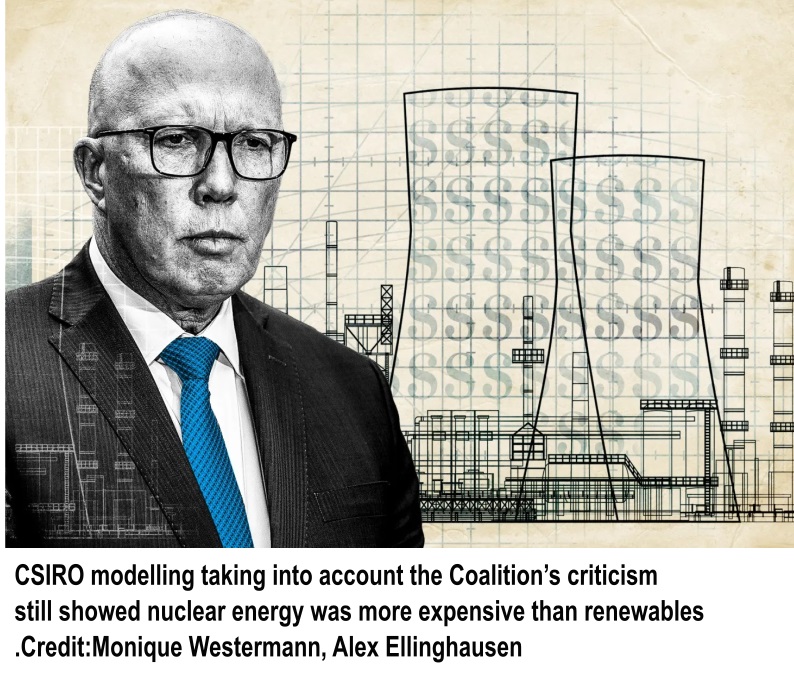
The problem the opposition faces is that if it was to abolish all the bodies casting doubt on its nuclear power plan, it would have to do a lot of abolishing.
Both the CSIRO and the Australian Energy Market Operator have published findings that the opposition’s nuclear plan would be a slower and more expensive way to replace the coal stations than the government’s policy of speeding up deployment of wind and solar, backed by gas and energy storage infrastructure including batteries and pumped hydro.
Both those bodies have copped criticism from the Coalition for stating their case, too.
On Wednesday, a (Labor-dominated) parliamentary inquiry into nuclear power published its interim report, which also found that nuclear would be more costly – in cash and emissions – than the renewables path charted by Labor
O’Brien dismissed the inquiry as a “sham”.
Messenger-shooting is an old sport in politics and has a particularly rich history in climate and energy policy.
Just over a decade ago, the incoming Abbott government wasted no time in knocking off the Climate Commission, an advisory body established by Kevin Rudd. Its chief commissioner, Tim Flannery, was sacked over the phone within hours of the government being sworn in. A few months later, the CSIRO’s “Climate Adaptation Flagship” was also knocked on the head.
Now, in the US, the Trump administration is at work not just unpicking the considerable achievements of Joe Biden in climate, as we have reported, but even scrubbing references to climate change from official websites, including that of the White House.
This week the president ramped up his attack on the very fabric of the science the world is relying on in its response to climate change by preventing a group of scientists from attending a planning meeting of the Intergovernmental Panel on Climate Change, the UN’s key climate science body……………………………………..
as heating accelerates, the world can little afford to have its elected representatives solving political problems by shooting the messengers that serve us all. https://www.smh.com.au/environment/climate-change/why-the-coalition-should-stop-trying-to-silence-nuclear-power-critics-20250227-p5lfnw.html
Nuclear reactors could become targets of war, defence experts warn
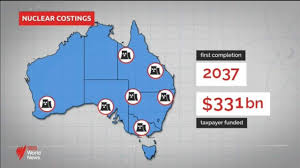
The Australian Security Leaders Climate Group has warned the Coalition’s nuclear plans could leave Australia vulnerable to devastating attacks.
Key Points
- The Australian Security Leaders Climate Group has warned nuclear reactors could become targets of war in Australia.
- Nuclear reactors could be targeted by missile attack and sabotage, the group said.
- The Coalition is planning to build seven small nuclear reactors across five states.
Australian nuclear reactors could become a target of war if the Coalition was to go ahead with plans to build them, a group of former defence leaders warn.
The plan to build seven small nuclear reactors across five states on the sites of coal-fired stations could leave Australia vulnerable to missile warfare and sabotage, the Australian Security Leaders Climate Group says.
The group, including former Australian Defence Force chief Chris Barrie and former director of preparedness and mobilisation at the Department of Defence Cheryl Durrant, is urging the nation not to go down the path of building nuclear power stations.
Modern warfare is increasingly being fought using missiles and unmanned aerial systems, Barrie said.
“Every nuclear power facility is a potential dirty bomb because rupture of containment facilities can cause devastating damage,” he said.
“With the proposed power stations all located within a 100 kilometres of the coast, they are a clear and accessible target.”
Durrant cited the Russia-Ukraine war where both sides have prioritised targeting their opponents’ energy systems
Australia would be no different,” Durrant said.
Nuclear power plants could become a dual target due to their role in energy supply, but also the catastrophic devastation which would occur if facilities were breached.
This means Australia would need to consider introducing expensive and complex missile defence systems and cyber and intelligence resources to defend the plants if war were to break out — which the nation currently lacks.
“Do we prioritise the protection of cities and population centres and military bases, or do we divert vital resources to defending seven nuclear power stations scattered across Australia?” Barrie said.
The group said building nuclear capabilities would derail Australia’s climate targets and exacerbate risks in the region.
‘Not everyone knows acronyms’: Australian politicians shrug off Trump blunder on AUKUS

By Richard Wood • Senior Journalist Feb 28, 2025, https://www.9news.com.au/world/donald-trump-stumbles-when-asked-about-aukus-defence-deal/6a602864-b990-4d37-95a4-530e31bd96e8
Politicians from both sides in Australia have weighed in today on US President Donald Trump’s apparent stumble when he said he did not know what AUKUS was.
Trump was hosting visiting British Prime Minister Keir Starmer at the White House when the pair were asked by a reporter whether they’d be discussing AUKUS, under which Australia will acquire nuclear-powered submarines.
“What does that mean?” Trump replied.
Too slow, too risky, too impractical: Interim senate report pans nuclear
February 26, 2025 AIMN Editorial, https://theaimn.net/too-slow-too-risky-too-impractical-interim-senate-report-pans-nuclear/
Greenpeace Australia Pacific has welcomed findings by an interim senate report that “there is limited utility in pursuing nuclear power at this point,” and called for parties to focus on delivering achievable and affordable, renewable energy solutions instead.
“The Senate Inquiry heard evidence from thousands of people and reached the logical conclusion that nuclear is unlikely to be developed in Australia until the mid-2040s at the earliest, is deeply unpopular among Australians, and will be more expensive to build than renewable energy,” Susie Byers, Head of Advocacy, Greenpeace Australia Pacific, said.
“Taking into account the additional significant risks associated with nuclear waste management and accidents, there are dozens of reasons why nuclear just doesn’t make sense for Australia; and not a single proven reason to support it.
“This evidence-based report underscores that the Coalition’s nuclear fantasy is nothing more than a dangerous, nonsensical distraction, and a blatant ploy to keep coal and gas in our system until the 2040s, worsening climate change to deadly extremes.
“Remarks by Coalition MP Andrew Constance revealing the party’s plans to take the Paris Agreement’s 2035 target “off the table” earlier this week further underscore the Coalition’s absolute disinterest in doing anything to stop the worsening bushfires, floods, and storms that have devastated millions of Australians in recent years.
“Nuclear is a waste of Australians’ time, money, and a bet against a safe climate future for all of us. It will also impose potentially catastrophic risks on communities where the reactors and nuclear waste sites will be located.
“Choosing nuclear for Australia’s energy future will threaten our economy, air, land and water, and our kids’ futures, while backing in 100% affordable, safe, proven renewable energy, will strengthen our place in a global clean economy and help avoid unsurvivable consequences of climate change. The choice is clear.
If China can’t scale nuclear, Australia’s got Buckley’s

Dutton’s proposal has seven nuclear power plants, including five large-scale reactors and two SMRs. This isn’t critical mass for a nuclear program. As of February 2025, the United States operates 94 nuclear reactors, France has 57, and South Korea maintains 26 reactors. Those are sufficient numbers of GW-scale reactors to achieve program economies of scale. Australia’s peak electricity demand of 38.6 GW isn’t sufficient to provide an opportunity for sufficient numbers of reactors of a single design to be built.
Michael Barnard, Feb 25, 2025, https://reneweconomy.com.au/if-china-cant-scale-nuclear-australias-got-buckleys/
The platypus of energy in Australia has reared its duckbill and stamped its webbed feet again in recent years.
A fractious group of bedfellows is advocating for nuclear generation, primarily driven by the Liberal-National Coalition under Peter Dutton, who has proposed repurposing decommissioned coal-fired stations for nuclear power, with the remarkable claim that reactors could be operational between 2035 and 2037.
Other political supporters include the Libertarian Party and One Nation. Unsurprising advocacy organisations such as the Australian Nuclear Association, Nuclear for Australia, the Minerals Council of Australia, and the South Australian Chamber of Mines and Energy are calling for legislative changes to allow nuclear development, citing its reliability and low emissions.
Notable figures like opposition energy spokesperson Ted O’Brien, who has chaired parliamentary inquiries into nuclear energy, and Indigenous leader Warren Mundine, who sees nuclear as an economic and climate solution, have also voiced strong support.
But nuclear energy, like the platypus, is an oddly shaped beast, and needs a very specific hole to fit into the energy jigsaw puzzle.
Successful nuclear programs share several key conditions, drawn from historical examples in the United States, France, South Korea, and the UK. These countries achieved large-scale nuclear deployment first by making it a top-priority national goal, tied to military strategy or energy security.
Bipartisan support ensured long-term stability, while military involvement helped enforce cost discipline and continuity over decades. Australia clearly doesn’t have bipartisan support for nuclear energy.
Previous countries found political consensus in the face of serious geopolitical threats from nuclear armed enemies such as the Soviet Union and North Korea. Australia isn’t threatened by invasion or nuclear war by any country, and the major political parties are clearly on opposite sides of the fence on the subject.
Teal MPs, supported by Climate 200 and a major new force, are in general not supportive of nuclear energy either.
Australia’s federal laws prohibit nuclear power development through the Environmental Protection and Biodiversity Conservation Act 1999 (EPBC Act), which explicitly bans the approval of nuclear power plants.
The Australian Radiation Protection and Nuclear Safety Act 1998 (ARPANS Act) restricts certain nuclear activities, reinforcing the ban. Both laws would have to be repealed or substantially altered, requiring draft legislation to start with. No draft legislation has been in evidence from the Liberal-National Coalition, which appears par for the course for a campaign plank which is very light on details.
If the Liberal-National Coalition were to regain power, they would first have to draft a bill, and then shepherd it through the extensive legislative process, something that with contentious bills can take up to two years. That’s just the beginning.
Australia’s status as a signatory to international nuclear non-proliferation treaties adds a layer of complexity to any move toward nuclear power. Compliance with agreements such as the Treaty on the Non-Proliferation of Nuclear Weapons (NPT) and safeguards enforced by the International Atomic Energy Agency (IAEA) would require strict oversight of uranium handling, enrichment, and waste disposal.
Any shift to nuclear energy could trigger lengthy negotiations with global regulatory bodies to ensure Australia remains within its non-proliferation commitments, delaying and complicating the development of a civilian nuclear program.
The duration for individual countries to negotiate and implement these protocols has ranged from a few months to several years, influenced by national legislative processes and political considerations.
Strong central control is another common factor in successful nuclear programs. National governments directly managed nuclear projects, maintaining tight oversight of construction schedules and decision-making. This approach prevented fragmentation and ensured that experienced leadership remained in place throughout the deployment.
In Australia, power systems are largely under state control, meaning any attempt to build nuclear power plants would require approval from individual state governments. While the federal government sets national energy policies and regulates nuclear safety, states have the authority over planning and construction approvals.
Several states, including Victoria, New South Wales, Queensland, and South Australia, have explicit bans on nuclear power, adding another layer of legislative hurdles. Even if the federal ban were lifted, nuclear development would still depend on state cooperation, making a nationwide rollout politically and legally complex.
Building a skilled workforce was essential to scaling nuclear generation. Successful programs invested in national education and certification systems, training engineers, construction workers, and technicians specifically for nuclear projects. Strict security measures were also necessary to vet personnel and prevent risks.
That’s challenging for Australia. The Australian National Training Authority (ANTA) was abolished on July 1, 2005, with all its functions transferred to the Department of Education, Science and Training. This move aimed to centralize vocational education and training (VET) oversight at the federal level, streamlining operations and reducing administrative complexities associated with the previous federal-state arrangements.
Despite this degree of centralisation, the administration and delivery of VET programs remain primarily under state and territory control, with public technical and further education institutes and private providers delivering courses under regional oversight.
While the coordination and policy aspects of ANTA’s functions persist at the national level, the execution and management of training programs continue to be managed by individual states and territories.
That’s not a good basis for a nationally run and managed nuclear workforce education, certification and security clearance program that would need to persist for thirty to forty years. A nuclear ANTA would have to be established, taking time in and of itself, and then it would take time to attract and create a critical mass of skilled nuclear engineering, construction, operation and security human resources.
Speaking of security, Australia’s nuclear ambitions come with an often overlooked cost: an immense, multilayered security burden that taxpayers will likely shoulder.
In the US, nuclear power requires an extensive web of international, national, state, and local security measures, yet much of this expense is not covered by reactor operators.
The US government funds $1.1 billion annually in international nuclear security, including protecting supply chains and waste management through agencies like the IAEA, the Department of Defense, and the CIA. These costs translate to $8 million per reactor per year, with a full lifecycle cost of $1.2 billion per reactor—expenses that remain largely hidden from public scrutiny.
Domestically, the security footprint is even larger. The U.S. Nuclear Regulatory Commission, the Department of Energy, Homeland Security, and law enforcement agencies provide a $26 million per reactor per year security umbrella, ensuring compliance, protecting fuel transport, and defending against threats.
On-site security measures – including armed patrols, cyber protection, and emergency response teams – add another $18 million annually per reactor. In total, US taxpayers effectively subsidise $34 million per reactor per year, or $4 billion over a nuclear site’s lifespan, a cost that is rarely included in nuclear energy debates.
For Australia, these figures should serve as a stark warning. If nuclear reactors are built, the country will need to establish entirely new layers of security infrastructure, from federal oversight and emergency response teams to military-style site defenses.
The financial burden won’t fall on private operators alone – it will land squarely on the Australian taxpayer. As policymakers debate nuclear’s role in the country’s energy future, they must ask: are Australians ready to take on a security commitment of this scale?
A single, GW-scale, standardised reactor design was crucial to keeping costs under control. Countries that succeeded in nuclear deployment avoided excessive customization and focused on repeating a proven design, allowing for efficiency gains and predictable outcomes.
At present, there are various proposed reactor designs under consideration. Dutton’s proposal includes evaluating various reactor technologies, with a focus on South Korea’s APR1000 and APR1400 pressurized water reactors.
O’Brien has led a delegation to South Korea to study its nuclear power industry and assess the suitability of these reactor models for Australia.
It’s worth noting that while South Korea was successful in scaling nuclear generation, it did so with corruption that included substandard parts in reactors that led to a political scandal that resulted in the jailing of politicians and energy company executives.
Small modular nuclear reactors (SMR) have been proposed as part of the mix. They aren’t GW-scale and they don’t actually exist. As the Australian Academy of Technological Sciences and Engineering (ATSE) accurately pointed out in mid-2024, SMR technology remains in developmental stages globally, with no operational units in OECD countries.
The ATSE suggests that a mature market for SMRs may not emerge until the late 2040s, while I think it’s unlikely to emerge at all. Small reactors were tried in the 1960s and 1970s and were too expensive, leading to reactors being scaled up to around the GW scale in successful programs. There is nothing to indicate that anything has changed since then that will make SMRs successful and inexpensive the second time around.
Scale and speed mattered. Effective programs built between 24 and 100 reactors of very similar designs within a 20-to-40-year timeframe, ensuring that expertise remained within the workforce. Spreading projects over longer periods led to skill erosion and inefficiencies.
Dutton’s proposal has seven nuclear power plants, including five large-scale reactors and two SMRs. This isn’t critical mass for a nuclear program. As of February 2025, the United States operates 94 nuclear reactors, France has 57, and South Korea maintains 26 reactors. Those are sufficient numbers of GW-scale reactors to achieve program economies of scale. Australia’s peak electricity demand of 38.6 GW isn’t sufficient to provide an opportunity for sufficient numbers of reactors of a single design to be built.
Finally, strict adherence to design was non-negotiable. Countries that allowed constant innovation or design changes saw costs balloon and timelines slip. The lesson from history is clear: nuclear success depends on disciplined execution, a committed national strategy, and a workforce dedicated to repeating a single proven approach.
Australia’s strong engineering culture, known for innovation and adaptation, could pose challenges to a strictly controlled nuclear deployment program. Unlike industries where iterative improvements drive progress, nuclear power requires rigid standardization to control costs, ensure safety, and meet regulatory demands.
Australia’s history of engineering-led modifications – seen in mining, renewables, and infrastructure – could lead to pressures for design changes mid-project, a factor that has contributed to cost overruns and delays in nuclear projects overseas.
While flexibility has been a strength in other sectors, in nuclear energy, deviation from a single, proven reactor design undermines efficiency and drives up costs, making strict oversight and discipline crucial to success.
Parliamentary inquiry finds nuclear is high risk, zero reward

The Climate Council 26 FEBRUARY 25 https://theaimn.net/parliamentary-inquiry-finds-nuclear-is-high-risk-zero-reward/#google_vignette
THE COALITION’S NUCLEAR SCHEME is high risk, zero reward—that’s the clear takeaway from the interim findings of the federal inquiry into nuclear power generation in Australia. The committee’s interim report confirms that nuclear energy is not a viable option to meet Australia’s energy needs or climate commitments.
The Climate Council, which appeared at the inquiry, said the inquiry’s interim findings confirm what experts have long warned: nuclear reactors are too risky for Australia. Australians need action now to cut climate pollution and secure our energy future, not a nuclear fantasy that locks us into higher costs, worsening unnatural disasters, and decades of delay.
Amanda McKenzie, Climate Council CEO, said: “The climate crisis is here, now. Australians are already facing more unnatural disasters – record-breaking floods, deadly heatwaves and bushfires, and declining rainfall. In the 15 years that we would be waiting for a single watt of nuclear energy to enter the grid, our climate pollution would soar.
Every coal-fired power station in Australia will be closed before a single nuclear reactor could be built. Already, 40% of our national grid is powered by renewables, and experts have shown that we can power our economy 24/7 with renewables backed by storage and peaking generation, and we can do it well before a single nuclear reactor is online.
“Delaying action to slash climate pollution has real consequences. The catastrophic conditions that led to the Black Summer bushfires will become the average without sustained, urgent action.
“Nuclear reactors in the 2040s is a delay tactic. The consequence is 2 billion tonnes more climate pollution endangering our kids’ future.”
Greg Bourne, Climate Councillor and energy expert, said: “The numbers don’t lie. Nuclear reactors are wildly expensive and painfully slow. The UK’s flagship nuclear project is 14 years late and facing a $60 billion cost blowout. Australians can’t afford to waste tens of billions of dollars on a major energy project that delivers too little, too late.
“There’s an explosion of misinformation and political spin, but here’s the simple truth: not a single investor is lining up to build nuclear reactors in Australia. Meanwhile, investment in renewable power is surging ahead. In 2024, investment in batteries soared, with new energy storage commitments nearly matching new generation. A total of 4 gigawatts of storage was committed, equivalent to the output of around 2,000 wind turbines. Globally, ten times as much money is flowing into renewable power as into nuclear reactors.”
“Renewable power is already delivering—cutting climate pollution, creating jobs, and keeping the lights on. Australia is at 40% renewables and on track for 82% renewable power in only five years. That will slash pollution and provide the energy security we need.”
he Climate Council is Australia’s leading community-funded climate change communications organisation. We provide authoritative, expert and evidence-based advice on climate change to journalists, policymakers, and the wider Australian community.
New report skewers Coalition’s contentious nuclear plan – and reignites Australia’s energy debate
John Quiggin, Professor, School of Economics, The University of Queensland: February 26, 2025, The Conversation
Debate over the future of Australia’s energy system has erupted again after a federal parliamentary inquiry delivered a report into the deployment of nuclear power in Australia.
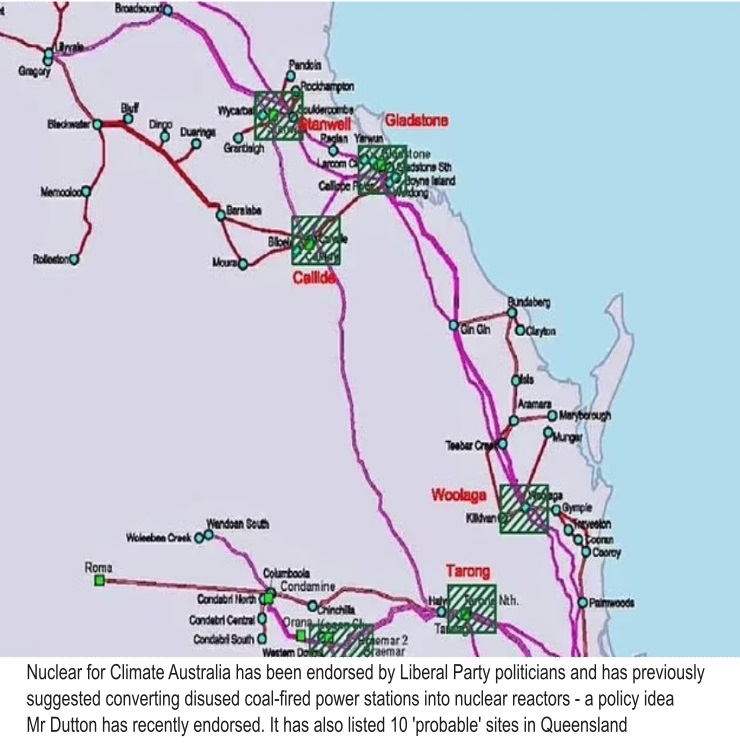
The report casts doubt on the Coalition’s plan to build seven nuclear reactors on former coal sites across Australia should it win government. The reactors would be Commonwealth-owned and built.
The report’s central conclusions – rejected by the Coalition – are relatively unsurprising. It found nuclear power would be far more expensive than the projected path of shifting to mostly renewable energy. And delivering nuclear generation before the mid-2040s will be extremely challenging.
The report also reveals important weaknesses in the Coalition’s defence of its plan to deploy nuclear energy across Australia, if elected. In particular, the idea of cheap, factory-built nuclear reactors is very likely a mirage.
A divisive inquiry
In October last year, a House of Representatives select committee was formed to investigate the deployment of nuclear energy in Australia.
Chaired by Labor MP Dan Repacholi, it has so far involved 19 public hearings and 858 written submissions from nuclear energy companies and experts, government agencies, scientists, Indigenous groups and others. Evidence I gave to a hearing was quoted in the interim report.
The committee’s final report is due by April 30 this year. It tabled an interim report late on Tuesday, focused on the timeframes and costs involved. These issues dominated evidence presented to the inquiry.
The findings of the interim report were endorsed by the committee’s Labor and independent members, but rejected by Coalition members.
What did the report find on cost?
The report said evidence presented so far showed the deployment of nuclear power generation in Australia “is currently not a viable investment of taxpayer money”.
Nuclear energy was shown to be more expensive than the alternatives. These include a power grid consistent with current projections: one dominated by renewable energy and backed up by a combination of battery storage and a limited number of gas peaking plants…………………………..
What about the timing of nuclear?
On the matter of when nuclear energy in Australia would be up and running, the committee found “significant challenges” in achieving this before the mid-2040s.
This is consistent with findings from the CSIRO that nuclear power would take at least 15 years to deploy in Australia. But is it at odds with Coalition claims that the first two plants would be operating by 2035 and 2037 respectively.
The mid-2040s is well beyond the lifetime of Australia’s existing coal-fired power stations. This raises questions about how the Coalition would ensure reliable electricity supplies after coal plants close. It also raises questions over how Australia would meet its global emissions-reduction obligations.
Recent experience in other developed countries suggests the committee’s timeframe estimates are highly conservative.
Take, for example, a 1.6GW reactor at Flamanville, France. The project, originally scheduled to be completed in 2012, was not connected to the grid until 2024. Costs blew out from an original estimate of A$5.5 billion to $22 billion.
The builder, Électricité de France (EDF), was pushed to the edge of bankruptcy. The French government was forced to nationalise the company, reversing an earlier decision to privatise it…………………………………………………………………..
Looking ahead
Undoubtedly, existing nuclear power plants will play a continued role in the global energy transition.
But starting a nuclear power industry from scratch in Australia is a nonsensical idea for many reasons – not least because it is too expensive and will take too long.
In the context of the coming federal election, the nuclear policy is arguably a red herring – one designed to distract voters from a Coalition policy program that slows the transition to renewables and drags out the life of dirty and unreliable coal-fired power.
Parliamentary inquiry finds nuclear is high risk, zero reward.
RenewEconomy, Jim Green, Feb 26, 2025
An Interim Report was released on Tuesday by the House Select Committee on Nuclear Energy, and splits on party lines, with the independent MP Monique Ryan listing a myriad reasons why nuclear is unsuitable for Australia.
Labor MPs have the numbers on the committee and their majority report states that nuclear power “cannot be deployed in time to support Australia’s critical energy transition targets and climate commitments, or to assist the coal workforce and communities in their transition away from the coal industry.”
The interim report says the committee “received compelling evidence nuclear power would cost consumers more to use”. The report continues:
“Evidence received about the private sector’s lack of interest in investing in nuclear power in Australia and the history of issues with private investment in nuclear power internationally highlights the financial challenges for this source of power, making taxpayer funding of an uncertain nuclear venture during a cost-of-living crisis a significant risk.”
The report notes that the evidence the committee received “strongly indicated SMR [small modular reactor] technology is not yet commercially available and so is not a viable option for Australia’s energy needs.”
Climate Change and Energy Minister Chris Bowen commented on the report’s findings:
“Peter Dutton is determined to ignore the experts, reverse policies that bring the cost of energy down, and stick his head in the sand until the 2040s wishing his $600bn nuclear scheme will fix everything. It’s a disaster for our energy system now, and a guaranteed recipe for big bills, blackouts, and bad investments. “
“We already have a solution that works for today, and for this critical decade, that delivers jobs for people transitioning away from coal now, that reduces emissions, and that gets more of the cheapest form of energy into the grid. That solution is reliable renewable energy and the Albanese Government is delivering it.”
Independent MP Monique Ryan
If the Coalition hoped to sway independent MP and committee member Dr. Monique Ryan, they were sorely disappointed. Dr. Ryan said in her ‘Additional Comments’ to the main report that an “ongoing pursuit of nuclear energy options will only perpetuate and increase Australia’s reliance on coal and gas”.
Dr. Ryan reached the following conclusions:
* There are considerable roadblocks to nuclear energy in this country
* Necessary regulatory framework for health, safety, security, environmental impacts, and transport of fuels and waste would likely take some years to develop
* Australia currently lacks the workforce and technical capability required for building multiple large-scale nuclear reactors
* Independent experts (including from the CSIRO and Australian Energy Regulator) repeatedly told the Inquiry that it would take at least 15 years to build a single nuclear reactor — possibly as long as 25 years
* The Coalition’s proposal would provide only 15% of the country’s electricity requirements by 2050
* Under current projections, by 2030 more than 84% of the main national electricity grid will be powered by renewables; 96% by 2035
* Nuclear power is the most expensive form of energy
* Nuclear power does not compete economically
* Australians would pay more for electricity generated from nuclear plants
* Nuclear energy lacks social licence in many parts of Australia
* The impact of nuclear power generation on Australia’s water supplies has been inadequately considered by the Coalition in its proposal.
Coalition dissenting report
The Coalition committee member’s dissenting report goes to some lengths to defend that Coalition’s indefensible claim that nuclear power would reduce energy costs and power bills. Those claims have been thoroughly debunked…………………………………………..
Nuclear Thuggery and Threats: Response to Interim Report of the House Select Committee on Nuclear Energy

February 26, 2025 AIMN Editorial, https://theaimn.net/nuclear-thuggery-and-threats-response-to-interim-report-of-the-house-select-committee-on-nuclear-energy/
Friends of the Earth (FoE) welcomes the Interim Report released by the House Select Committee on Nuclear Energy.
The Interim Report states that nuclear power “cannot be deployed in time to support Australia’s critical energy transition targets and climate commitments, or to assist the coal workforce and communities in their transition away from the coal industry.” It warns that “taxpayer funding of an uncertain nuclear venture during a cost-of-living crisis is a significant risk.”
In ‘Additional Comments’ to the Committee’s report, Kooyong MP Dr. Monique Ryan concludes that an “ongoing pursuit of nuclear energy options will only perpetuate and increase Australia’s reliance on coal and gas”.
FoE Australia’s national nuclear campaigner Dr. Jim Green said:
“The House Select Committee has found that nuclear power is too expensive and too slow. The Coalition hid its bogus economic costings until the Committee’s work was nearly complete, but the absurdity of those costings has now been thoroughly exposed.
“The simple fact is that recent reactor projects in the US, the UK and France have cost A$27-45 billion per reactor ‒ several times higher than the Coalition’s absurd assumption. No amount of sophistry and creative accounting changes the plain facts.
“This week the Climate Change Authority released a detailed analysis concluding that the Coalition’s energy plan would result in an additional two billion tonnes of greenhouse emissions. The Coalition’s response was to threaten to sack the Authority’s chair Matt Kean (a former NSW Liberal energy minister and treasurer) and to scrap the Authority just as a previous Coalition government defunded the independent Climate Commission and tried to kill off the Climate Change Authority and the Australian Renewable Energy Agency.
“The threat to the independent, expert Climate Change Authority is pure thuggery, as is Peter Dutton’s threat to use compulsory acquisition laws to acquire sites to build nuclear reactors from energy companies that are openly critical of the Coalition’s nuclear plan. Those companies are planning their exit from coal and its replacement with renewables and storage projects.
“The Dutton Coalition’s threat to override state governments and state laws is nuclear thuggery. And the threat to override community opposition is nuclear thuggery. Peter Dutton says it is in “the national interest to proceed” with nuclear reactors even in the face of adamant public opposition.
“The Dutton Coalition’s all-embracing nuclear thuggery stands in stark contrast to shadow energy minister Ted O’Brien’s comments in 2019 that a future government should only proceed with nuclear power on the condition that it make ‘a commitment to community consent as a condition of approval for any nuclear power or nuclear waste disposal facility’.”
Peter Dutton abandons global ‘Paris Agreement’ to phase out climate pollution by 2050
February 24, 2025, https://theaimn.net/peter-dutton-abandons-global-paris-agreement-to-phase-out-climate-pollution-by-2050/#comment-1882 Solutions for Climate Australia
New analysis from the national Climate Change Authority shows the Liberal and National Parties’ nuclear scheme would breach Australia’s commitment to international climate pollution targets and break their promise to phase out climate pollution by 2050.
“This independent analysis confirms earlier assessments that under opposition leader Peter Dutton’s nuclear scheme Australia will not reduce climate pollution by 43% by 2030, which would breach our international commitments,” said Senior Campaigner at Solutions for Climate, Elly Baxter.
“The Frontier Economics modelling the Liberal and National Parties are relying on shows the electricity grid would not reach net zero climate pollution until 2049 and would be 44% smaller than the government’s proposed grid. This would make it impossible to decarbonise the rest of our economy – all our transport, all our manufacturing and all our homes.
“Australians voted overwhelmingly for action on climate change and renewable energy at the last election. Mr Dutton insists that he will maintain our international commitment to the Paris Agreement and reach no net climate pollution by 2050, but the proof is in numbers. As we head to the polls in the coming months, voters need to be aware that Mr Dutton’s words do match his scheme.
“This matters enormously for all Australians. Yet again we are facing increasing climate disasters this summer – fires in the south and floods in the north. More Australians would be killed and homes and livelihoods lost if we push billions more tonnes of climate pollution into the air,” Baxter concluded.
The Coalition’s nuclear scheme includes nuclear reactors at seven sites across Australia. Modelling by Frontier Economics, released by the Coalition, shows an electricity grid that is 44% smaller than the government’s plan to use renewable energy like wind and solar with storage. The scheme would cap renewable energy at 54% when our grid was already powered by 46% renewable energy in the December quarter.
On the first sitting day of the year, over 80 community groups representing tens of thousands of Australians endorsed a statement objecting to Dutton’s nuclear push:
“We object to the Liberal and National parties’ nuclear proposal as it is incapable of cutting climate pollution this decade and upgrading our electricity grid in a timely manner,” the statement reads.
“We call for Peter Dutton and the Opposition to abandon the pursuit of nuclear reactors. It’s never too late to do the right thing.”
Nuclear power would push Australia’s net zero back 12 years
Energy Source Distribution, 25 Feb 25,
New analysis from the Climate Change Authority shows pursuing the deployment of nuclear in Australia’s grid could add at least 2 billion tonnes to national emissions.
This approach would involve a pace of climate action consistent with a global pathway to around 2.6°C of warming, a level at which scientists, economists and governments anticipate major social, economic and environmental harm.
The Climate Change Authority has compared published modelling by the Australian Energy Market Operator (AEMO) and Frontier Economics to understand how the adoption of a nuclear pathway could impact national efforts to reduce emissions.
The analysis finds that a nuclear pathway could see Australia miss the legislated 43% emissions reduction target for 2030 by over five percentage points, and still not achieve this level of reduction by 2035.
Australia would not reach 82% zero emissions electricity until 2042—more than a decade later than current national plans.
“Australia faces a fork in the road and we need to be clear about the choices in front of us,” Climate Change Authority chair Matt Kean says.
“Continuing on Australia’s current pathway and accelerating our progress can deliver rapid cuts to emissions by overhauling our grid with renewables, firming and storage in the next 15 years.
“On the other hand, the nuclear pathway would delay Australia’s necessary transition— keeping coal in the grid for longer and leading to billions of tonnes more emissions in the process………………………… https://esdnews.com.au/nuclear-power-would-push-australias-net-zero-back-12-years/
Fake fight over nuclear a distraction from real climate issues
A new report which reveals the coalition’s nuclear plan would send an additional two billion tonnes of emissions into the atmosphere and send power bills even higher is yet another distraction from the real issues in Australia’s energy debate.
The Climate Change Authority report concludes that additional emissions under the coalition plan would see Australia miss its 2030 emissions target and delay the overall transition to clean energy.
“The Climate Change Authority’s slap-down of the Coalition’s nuclear proposal is welcome, but it is yet another distraction from the big climate issues,” said Rod Campbell, Research Director at The Australia Institute.
We’re talking about nuclear yet again, not about Australia’s uninsurable regions, massive fossil fuel subsidies and dodgy offset schemes.
“It suits both major parties to have a fake fight about nuclear and avoid these real problems in Australia’s climate policy, on which Labor and Liberals largely agree.
“It would be more useful if the CCA focused on Australia’s subsidised fossil fuel expansion and rising domestic emissions.
“Nuclear is a distraction that avoids scrutiny of Australia’s real climate problems.
Peter Dutton’s nuclear accounting trick #4: Assume climate change has no cost

Tristan Edis, Feb 23, 2025 https://reneweconomy.com.au/peter-duttons-nuclear-accounting-trick-4-assume-climate-change-has-no-cost/
This is the final part of a five part series of articles examining the four accounting tricks that the Liberal-National Party employed in the costing of their energy plan to slow the roll-out of renewables and rely instead on nuclear power. The first article, which provides the overarching context is published here. Part 2 is here. Part 3 is here, and part 4 is here.
These four accounting tricks act to mislead voters that the Liberal-National Party could lower energy bills through a shift to nuclear when in reality it is likely to increase power bills.
This article focuses on number four and the last of the accounting tricks covered: Assume climate change is not an important and urgent problem that is worthy of costing.
Most types of greenhouse gases last decades to centuries once released in the atmosphere and so the overall level of global warming the planet experiences will be a function of our cumulative emissions over time.
While it would be great if we can reach net-zero emissions in 2050, the level of warming we’re in for will be a result of not just emissions in 2050, but also the years prior to 2050.
The Liberal-National Party’s preferred plan for the electricity system involves slowing the replacement of coal with renewable energy over the next decade and instead waiting until the 2040’s to undertake a concerted replacement of coal with nuclear power. This leads to almost 1 billion extra tonnes of CO2 emissions compared to the so called Labor Scenario (AEMO’s Step Change) from the electricity sector.
There’s also substantial additional emissions from outside the electricity sector due to the Coalition’s preference to maintain consumption of petroleum for transport and natural gas for heating in homes and industry.
The Coalition’s consultant didn’t elect to provide any information to calculate these extra non-electricity emissions. However as detailed in part 3 of this series, it’s possible using AEMO data and the average fuel efficiency of EVs and petroleum-fueled vehicles to estimate extra petrol consumption in the Liberal Party scenario of 203 billion litres. This would add an extra 466 million tonnes of CO2 to atmosphere.
The extra CO2 carries a cost in terms of the damage global warming is expected to inflict on people.
It is interesting to note that the consultant who prepared the Liberal-National Party costing has acknowledged the existence of data prepared by the Australian Energy Regulator that would allow them to attribute an economic cost on this extra CO2.
Yet the consultant explicitly chose to place no economic value at all on carbon emissions. If they had applied the value recommended by the regulator then it would have added $392 billion in extra cost to the Liberal Party Scenario compared to an extra $75 billion to the Labor Scenario.
The end result for the aggregate cost (also taking into account the extra petrol expense to consumers) of the Liberal-National Party’s system versus that of Labor is shown in the chart below.
Overall, the Liberal-National Party system ends up close to $400 billion more expensive than that claimed to be the Labor system (AEMO’s Step Change scenario). Note this doesn’t correct for the fact that the Liberal-National costing has vastly understated the cost of nuclear power plants, which means it’s cost disadvantage is far higher than $400 billion.
No doubt for many people all of this modelling of possible alternative power systems and their cost 25 years into the future is a bit abstract and theoretical. They are right to be sceptical given the uncertainty which surrounds these estimates.
But one thing that isn’t at all uncertain is that the Liberal-National Party decided it was sensible to place a value of zero on avoiding carbon emissions in an economic evaluation of different policy options.
This is potentially far more informative about their energy and climate change policies than the 45 pages of economic modelling that supports their claimed energy policy costs.
Tristan Edis is director of analysis and advisory at Green Energy Markets. Green Energy Markets provides analysis and advice to assist clients make better informed investment, trading and policy decisions in energy and carbon abatem
Dirty deed: Dutton’s nuclear scheme locks in 20 years of higher climate pollution

February 24, 2025 AIMN Editorial, Climate Council https://theaimn.net/dirty-deed-duttons-nuclear-scheme-locks-in-20-years-of-higher-climate-pollution/
Federal Opposition leader Peter Dutton is keeping Australians in the dark about his risky nuclear scheme. An explosive new report from Australia’s independent Climate Change Authority reveals the Federal Coalition’s nuclear scheme would see climate pollution blow out for more than 20 years, leading to up to 2 billion tonnes of additional climate pollution by 2050.
The Climate Council says Mr Dutton’s nuclear scheme risks locking Australia into worsening climate catastrophes, with no credible plan to cut pollution from coal, oil or gas.
Climate Council CEO Amanda McKenzie said: “Mr Dutton knows most Australians want their government to be making progress on climate action. But modelling from the Climate Change Authority shows his nuclear scheme would massively drive up climate pollution and put Australia in breach of its own national law, and international law. Mr Dutton himself has warned that failing to meet our global climate commitments would hurt our own economy and cost Australians jobs.
“The Coalition is out of step and out of touch with the majority of everyday Australians, who overwhelmingly voted for climate action at the last election and want to ditch climate pollution for clean power.”
Climate Councillor Greg Bourne said: “The Federal Coalition has spent the past three years actively blocking policies that cut climate pollution in our electricity, industrial and transport sectors, and now they’re trying to sell an energy scheme to Aussies that could add more than two billion tonnes of pollution and blow up our targets as a credible climate policy.
“Records show the Federal Coalition voted against capping pollution from big industrial polluters. They opposed cleaner and more efficient vehicles being made available to Australians by voting against the National Vehicle Efficiency Standard. And they opposed key policies for making clean energy more accessible, affordable and reliable like the Capacity Investment Scheme. The Coalition’s policies obstruct climate progress.”
Climate Council CEO Amanda McKenzie said: “Dutton’s risky nuclear scheme would burden our kids with more unnatural disasters, rising pollution and higher power bills. All Australians deserve a bright future. We need proven solutions like renewable power, backed by big batteries, that cut pollution now, not a reckless delay that locks us into climate catastrophe.”
Peter Dutton’s nuclear accounting trick #3: Hide the costs of keeping coal
Tristan Edis, Feb 21, 2025, https://reneweconomy.com.au/peter-duttons-nuclear-accounting-trick-3-hide-the-costs-of-keeping-coal/
This is part 3 of a five part series of articles examining the four accounting tricks that the Liberal-National Party employed in the costing of their energy plan to slow the roll-out of renewables and rely instead on nuclear power. The first article, which provides the overarching context is published here. Part 2 is here. Part 3 is here.
These four accounting tricks act to mislead voters that the Liberal-National Party could lower energy bills through a shift to nuclear when in reality it is likely to increase power bills.
This article focuses on accounting trick three of four: Hide most of the cost of replacing coal with nuclear to outside the time period considered in the costing.
It’s very important to note that the Coalition’s costing of its electricity system cuts out in the year 2051. It only accounts for costs incurred between 2025 to 2051 and anything after that date is ignored.
The LNP’s claim of a 44% saving does not represent the cost of two alternative systems for achieving near zero emissions once they are both completed to see how nuclear might reduce the cost of the system.
Instead, a heavy influence on the cost estimates in the model is the degree to which the scenarios can delay incurring costs in replacing the old, highly polluting and likely to be increasingly unreliable coal power plants.
How is this a problem?
Coal power stations are much like a car – they are exposed to extreme heat, pressure and general mechanical stress that means they wear out and become unreliable as they get old. That’s physics.
Many of us will have experience with an old car that has got to the point where it increasingly encounters mechanical problems and the mechanic is warning us that it really needs some major repairs but these would cost more than the car is worth.
At this point many of us can be tempted to take a gamble by putting off such repairs, and go for temporary, less costly patch-ups and hope the car keeps going. That will be a lot cheaper than buying a new car, at least for as long as we can keep the old car going. But it comes with the risk that it could leave us stranded with a broken-down car at an extremely inconvenient point in time and even pose a danger to our safety and that of others.
The Coalition’s modeled plan chooses to take that gamble with our electricity system. But it doesn’t account for the risks and potentially extreme costs this involves if the gamble goes wrong.
Clare Savage, the head of the Australian Energy Regulator has repeatedly warned that failing to replace aging coal plants risks both power system reliability and also affordability observing, “Coal can’t last until you have nuclear power available.”
The bulk of Australia’s operating coal power stations commenced operation more than 30 years ago. By the 2030’s these power stations, particularly in NSW and Victoria, will be close to, or exceeding, the point when coal power stations are typically retired from service. At this point they are likely to be increasingly unreliable and suffering from mechanical wear and tear that can even lead to dangerous explosions and fires that pose a serious risk to worker safety.
This is not theoretical – several Australian coal power stations have suffered from explosions and fires over the years. It’s also important to note that coal power stations over the next decade will face a level of output ramping to work around rooftop solar that is far more stressful than Australian coal plants have typically faced in the past.
Unless Peter Dutton has a secret plan to prioritise curtailment of rooftop solar in favour of coal generators, this is likely to get worse over time.
Now, the way that the consultant, Frontier, constructed Dutton’s costing is that they space out the cost of constructing new power stations as an annualised payment – a bit like how you’d purchase a new car not by paying for it upfront but rather by taking out a loan and then paying it back incrementally over time.
Except in this case the annualised payment for a new power station is spaced out over several decades and for nuclear it is 50 years. Meanwhile for the existing, very old power plants the original cost of constructing those plants is omitted from the annualised costs.
By pushing out the point at which they replace the old power stations with new ones until the 2040’s, the Coalition gets to hide much of the cost of the nuclear plants until towards the very back end of the projection period. We’ll still have to pay for these nuclear power stations well after 2051, but that’s conveniently left out of the costing period.
Meanwhile, in the scenario said to represent Labor Policy, the coal-fired power stations are replaced quite quickly, so the cost of the new, replacement power stations is taken into account across almost the entire time period considered in the model.
You can get a glimpse of how this works in a chart the modelling consultant provides of the annualised cost, which is provided below [on original] (they’ve refused to provide the actual underlying numbers in the chart).
The red solid line is the scenario the Liberal Party claims represents its policy. What the red line shows is that annualised costs grow only slightly up until 2039 with the one exception of a blip upward in 2036. But after 2039 costs grow very quickly.
This growth in costs – both the blip in 2036 and the rapid growth from 2040 onwards corresponds exactly to the timing of replacement of the old coal power plants with new nuclear power plants.
The nuclear plants aren’t really delivering any meaningful saving in the unit cost of energy relative to relying on renewables and storage. Instead, the savings are coming from the Liberal Party delaying the point at which the coal power plants are replaced.
No matter which party is in government, physics still takes its toll on power stations and very old ones will need to be replaced. This will incur costs no matter which technologies we chose to go with.
If we choose to take a gamble that we can string out the life of the old coal power stations, we might save some money in the short-run, but if it doesn’t work out the costs to electricity bills will be very severe.
While building power stations is costly, not having enough power stations is far more costly. We can see that cost through the fact that when coal power stations break down unexpectedly when supply is short then electricity prices typically spike to many multiples of the price needed to pay for a new power plant. That is tolerable if it happens only occasionally, but if frequent we would be far better off building the new replacement plant.
This becomes a particularly significant risk if we choose to go down the path of nuclear power stations. This is not just because we’ll have to wait longer for them to be built, but also because the nuclear industry has been hopeless at accurately estimating their construction timeframes and they come in such large chunks of capacity.
If a utility-scale battery plant comes in late it is unlikely to exceed a year delay, and they come in blocks of a few hundred megawatts. But nuclear power stations come in units of at least a thousand megawatts and can be more than 10 years late (as France has just experienced with its most recently built reactor).
This could create a no-man’s land where multiple coal units are repeatedly out of service and unable to provide reliable supply, but no one is prepared to step into the breach to invest in technologies that are reasonably quick to build. That’s because once the nuclear plant is eventually completed, financial returns in these fast-build power plants will be undermined.
Tristan Edis is director of analysis and advisory at Green Energy Markets. Green Energy Markets provides analysis and advice to assist clients make better informed investment, trading and policy decisions in energy and carbon abatement markets.
1 This month.
20 September –National Day of Action in Melbourne on the International Day of Peace


Help Aunty Sue Protect Her Land and Sacred Sites From Destructive Rocket Testing.
.

Australians deserve the truth
about
AUKUS – https://aukuspublicinquiry.com/


PETITION – To: Prime Minister Anthony Albanese and the Australian Labor Government

of the week – Australians for War Powers Reform (AWPR)
To see nuclear-related stories in greater depth and intensity
 Antinuclear