Australia’s “CATASTROPHIC collapse of life”, in some areas, if we don’t change policies on climate change
 Professor Emeritus of science at Griffith University says govt energy policy risks ‘catastrophe’
A “CATASTROPHIC collapse of life” is drawing closer and parts of Australia could become unlivable by the end of the century if we don’t change course
That’s the warning from the highly decorated Professor Emeritus of the School of Science at Griffith University, and former president of the Australian Conservation Foundation, Professor Ian Lowe.
As public debate rages over the potential opening of the Adani coal mine in Carmichael, Queensland, Prof Lowe believes the government’s dedication to fossil fuels is taking the country in a troubling direction.
Speaking to news.com.au he worried that the government’s intention to not only open up the controversial Carmichael coal mine but also open up the Galilee basin will “effectively guarantee the frying of the planet”.
“If we continue to expand fossil fuels — which is what things like opening up the Galilee Basin means — by 2050 the average global temperature will be at least two degrees more,” he said.
Under such a scenario, he expects parts of inland Australia to see average temperature rises that would make them virtually unlivable by the second half of the century.
“It’s difficult to imagine how life will continue in places like Alice Springs and Bourke under that sort of regime.”
In the coming decades, he believes countries including Australia who are not doing enough to combat global warming will receive backlash from the international community.
“I think there’ll be increasing international pressure for Australia to get into line,” he said……. .http://www.news.com.au/technology/environment/conservation/griffith-universitys-head-of-science-says-govt-energy-policy-risks-catastrophe/news-story/f7cf7b285a7e9e5fdba0457d28591997
Huge surge in household solar panel installations
Solar panel installations ‘skyrocket’ in Australia, ABC News, By consumer affairs reporter Amy Bainbridge , 14 Apr 17 There has been a big surge in the number of households installing solar panels, with March installations reaching their highest level in almost five years.

Key points:
- Solar panels were installed on about 15,000 homes and businesses in March 2017
- Installations have hit their highest level in almost five years
- Experts say rising electricity bills and recent blackouts in SA are turning people to solar
Warwick Johnston from energy consultancy firm Sunwiz crunched the numbers and said 91 megawatts of solar photovoltaic (PV) systems were installed during the month.
“March has been a very impressive month for 2017,” he said.
“We already saw a surge starting to build up in 2016, and we were wondering if that was going to continue into 2017 and it really has just continued to skyrocket.”
Queensland led the way, installing 25 megawatts of capacity, which is enough to power about 5,500 homes and businesses.
Installations were also up in South Australia, New South Wales and Victoria.
Mr Johnston said the recent blackouts in South Australia were a factor in the rising demand.
“People are certainly aware of the benefits of solar power and storage to offset or protect against grid blackouts, and that has been a driving factor in the uptake of solar,” he said.
“We’re seeing the uptake occur in states which weren’t affected by those blackouts as well, so it really is people being aware that solar panels are a great way to beat rising electricity bills.”
Installation figures in Tasmania, the Northern Territory and the ACT were flat……http://www.abc.net.au/news/2017-04-14/solar-panel-installations-skyrocket-in-australia/8443550
EnergyLab: Program to accelerate creation of renewable energy start-ups launches in Sydney
ABC Radio Sydney By Amanda Hoh 14 Apr 17 A start-up accelerator program, dedicated to supporting entrepreneurs designing renewable energy products and technologies, has kickstarted in Sydney.
EnergyLab, based in Chippendale, has granted four companies $50,000 each to spend 12 to 24 months bringing their clean-tech products to market.
Most start-up incubators give entrepreneurs 90 days to develop their products, according to co-founder Piers Grove.
The companies include:
- Eveeh: An electric vehicle car-sharing network.
- Iron Matrix: A Perth company designing a construction system that replaces bricks and mortar with easy-to-manoeuvre steel posts and solar panels.
- BlueVolt: Solar products that can be installed anywhere by anybody.
- Energy Assist: Loans company for those wanting to buy energy-efficient appliances.
The first cohort of start-ups moved into the EnergyLab hub this week at the University of Technology Sydney, where they will receive dedicated mentors, office space and partnership opportunities as they bring their ideas to fruition……..http://www.abc.net.au/news/2017-04-13/renewable-energy-startup-accelerator-launches-in-sydney/8442594
Australian government about to secretly sign up to participate in developing new nuclear reactors
 Under the radar: Parliamentary Committee preparing for Australia to sign up to more participation in developing new nuclear reactors
Inquiry Homepage: Submissions close 28 th April 2017 Inquiry Homepage: http://www.aph.gov.au/Parliamentary_Business/Committees/Joint/Treaties/NuclearEnergy
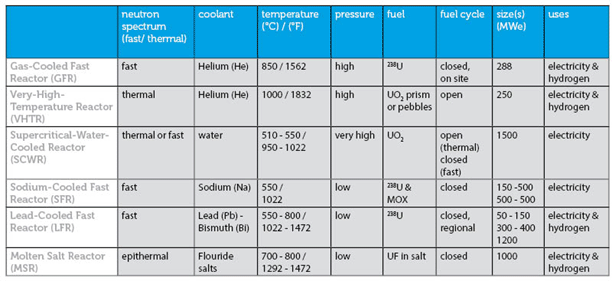
Governments policy position on nuclear power and is inconsistent with Australian laws which prohibit the use of this technology is astounding.
 What the Gov’t said in 2016 in relation to joining GIF: Christopher Pyne, said:
 “Australia’s invitation to join this important global project marks an exciting opportunity to be at the forefront of global innovation in the nuclear industry.” He added, “Inclusion in the GIF further strengthens Australia’s position as a nation that has the research muscle to deliver innovations on the global stage. It reinforces the governments 1 $billion National Innovation and Science Agenda, encouraging our best and brightest researchers to collaborate with international experts.”
 Julie Bishop said in relation to joining GIF
Pine Gap critically involved in USA – North Korea antagonism
 Pine Gap ‘on standby’ as tensions rise between the US and North Korea, debra.killalea@news.com.auIF Kim Jong-un is planning a missile attack, one strategic military and intelligence facility should know all about it. And it’s in the centre of our country.
IF Kim Jong-un is planning to launch a missile at Australia or US interests there’s one strategic intelligence facility that should know all about it.
And it’s right in the centre of our own country.
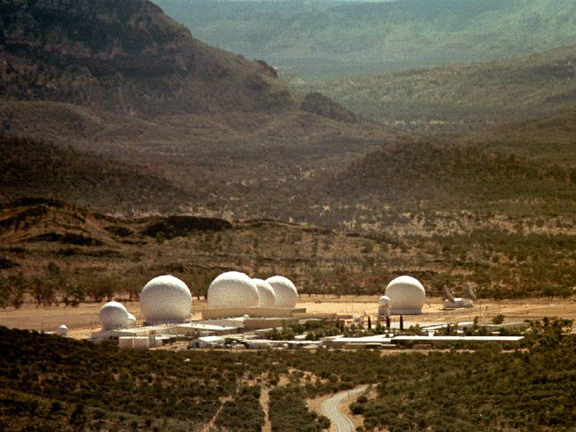
The secretive Pine Gap spy base has a vast array of signals intelligence capabilities and you can bet it will be monitoring Kim Jong-un’s every word.
Run by both Australia and the United States, the Joint Defence Facility Pine Gap is located about 20km from Alice Springs.
The remote site is considered strategically vital by both the US and Australian governments and it is used to collect a wide range of signals intelligence as well as providing information on early warning of ballistic missile launches. The flat landscape away from any city ensures the secretive site has a lack of interference.
It also contributes to and collects data used for US drones in the Middle East and Pakistan and it has access to satellites that could spy on most continents, bar the Americas and Antarctica
And while personnel based there are always searching for intelligence, they are now understood to be on standby following escalating tensions between North Korea and the US, according to the NT News.
According to the report, the US has notified Australia that it’s prepared to shoot down any missiles launched as North Korea escalates its threats. Continue reading
Kimba South Australia: Neighbours still opposed to nominated nuclear waste facility sites
 Mrs Woolford said she and other members of the No Radioactive Waste on Agricultural Land in Kimba or SA group had tried to organise a community forum with all sides represented but said the government did not want to participate.
“A debate with everyone represented would be a fair way for the government to allow people in the community to make up their minds, not just a continuous sell of the alleged benefits.
“People should have the right for their government to provide all sides not just one to suit its purpose,” Mrs Woolford said. .
Neighbours in Kimba are still opposed to nominated nuclear waste facility sites, Eyre Tribune, 10 Apr 2017, DISTRUST in the federal government and the process of nominations in the search for a national low to intermediate radioactive waste site are just some of the reasons Austin Eatts is against the facility being placed at Kimba.
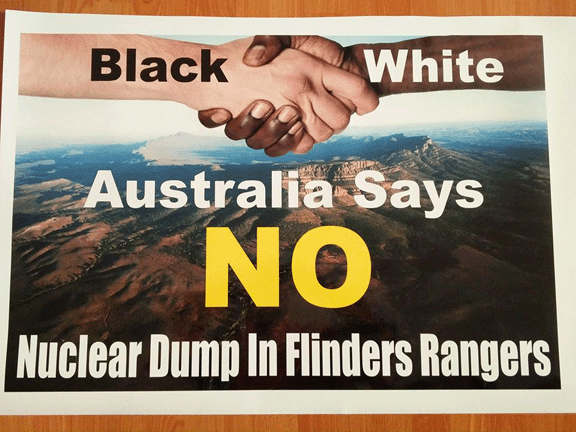
Mr Eatts is a direct neighbour to one of the newly nominated sites in the Kimba district and said the national nuclear waste facility was not something rural or regional people should be responsible for.
He said Eyre Peninsula had a long memory for the impact of politicians’ “dishonesty” during and after nuclear bombs were tested at Maralinga, to the north west of Eyre Peninsula “There is a long history of dishonesty about politicians, they told us then and after that Maralinga was safe. “This is the same message they are giving us now, things will be safe, why should we believe them?“My feelings about Eyre Peninsula and the state having anything nuclear has not changed since then,” Mr Eatts said.
He said he did not want the responsibility of making a decision that would impact generations for hundreds of years not only for Kimba or Eyre Peninsula residents but statewide.
“Once we accept this site here, we have opened the door to further nuclear activity.”
Mr Eatts said the vote to be undertaken by the South Australian Electoral Commission would settle the issue for him however he was concerned if the vote was against further progression it would not be the end of the matter.
“Will it be the end of it for those who want it? “They have already brought it back once after we settled it as a community we didn’t want it,” he said. “Two million dollars (offered to the community by the government) is a lot of money to you and I but for a community it is not much and no amount of money will fix the division in the community.” Continue reading
Adani coal mine could become a massive stranded asset, lawyers warn
 Loaning $900m for Adani’s central Queensland coal railway too risky, environmental lawyers say The World Today By Katherine Gregory Environmental lawyers have warned directors of the Northern Australia Infrastructure Facility (NAIF) to not fund Adani’s proposed coal railway in central Queensland because it is in breach of their duties.
Key points:
- Environmental Justice Australia writes to the Northern Australia Infrastructure Facility, calling for its directors to not fund Adani’s coal railway
- Lawyer says taxpayers exposed to financial risk if $900 million is loaned
- Minister for Northern Australia Matt Canavan calls letter a bullying tactic
Indian coal miner Adani has been seeking a $900-million loan to build the railway line from its proposed mine site in the Galilee Basin to the Abbot Point coal port.
Not-for-profit legal group Environmental Justice Australia (EJA) said the Federal Government’s NAIF directors need to consider the financial risks associated with climate change and he warned the investment was not commercially viable.
Environmental lawyer David Barnden said EJA sent a letter to NAIF’s directors on Tuesday outlining the duty. “The risks to the Adani rail project in the Galilee basin are too great,” Mr Barnden said.
“And there is a massive risk of it being a stranded asset and we think that if NAIF officials are to comply with their duties, then they cannot fund it.”
Mr Barnden said the directors were bound by statutory duties, according to the public governance and performance accountability act, which all Commonwealth public officials need to comply with.He said if they do decide to use taxpayer funds for Adani’s project, then “it would be a breach of law and a breach of a legal standard”.
Mr Barnden also said the Australian taxpayer would also be exposed to financial risk if NAIF decided to fund the project. “If there is no market for this coal, there’ll be no payment to the rail project and project couldn’t replay any loan to it,” Mr Barnden said.
The Australian Conservation Foundation (ACF) commissioned the environmental lawyers’ advice on the issue.
The ACF has been using all avenues, including legal options, to stop Adani’s coal mine, fearing it will contribute to climate change and also further damage the Great Barrier Reef……say http://www.abc.net.au/news/2017-04-12/adani-queensland-coal-mine-railway-$900m-loan-too-risky/8439582
ERA boss pushes nuclear power as energy source for Australia
 Top End uranium miner pushes nuclear power into Australia’s future energy mix as supply debate continues, ABC Rural By Carl Curtain “….Energy Resources Australia (ERA), which operates a uranium mine near Jabiru, held its annual general meeting in Darwin on Wednesday.
With Australia in the grip of a so-called energy crisis as a major gas shortage looms in 2018, chairman Peter Mansell did not miss the opportunity to press his company’s view on the national debate underway.
While he made it clear any future expansion of Ranger uranium mine depended on economic viability, he said a national discussion on nuclear power would provide a boost to the sector.
Although mining ceased at the site in 2012, stockpiled ore continues to be processed, with the operating lease due to expire in 2021.
ERA also holds an option to expand underground via its mothballed Ranger 3 Deeps project, but would face resistance from traditional owners……..http://www.abc.net.au/news/2017-04-12/energy-resources-australia-uranium-mining-nuclear-power-agm/8438800
Broken Hill’s giant leap – from mining hub to solar centre
 Renewables roadshow: how Broken Hill went from mining to drag queens and solar farms The home of BHP and Mad Max can now take credit for kickstarting the large-scale solar industry in Australia, Guardian, Michael Slezak, 13 Apr 17, “…….Broken Hill gave birth to one of the least renewable industries on Earth, but it can now claim to be the Australian birthplace of one of the most renewable.
Officially opened in January 2016, the plants were built with subsidies from the federal government through the Australian Renewable Energy Agency (Arena), as well as support from the NSW government.
With that funding, AGL was able to jump into the large-scale solar industry, and in doing so, create a supply chain that is bringing down the cost of solar farms around the country.
For example, Mackett says a manufacturing plant in the struggling car industry retooled to provide the frames for the solar panels, and is now able to do that for the whole industry. Continue reading
New rules flag big switch in energy markets to cheaper, smarter grid
 By Giles Parkinson on 12 April 2017 New rules flag big switch in energy markets to cheaper, smarter grid
AEMC indicates its support for switch to 5-minute settlement period, albeit with a 3-year transition period, and to a new rule that could allow alternatives to investment in more poles and wires. Both offer incentives to storage, demand response, and local renewables, and herald a more …
http://reneweconomy.com.au/new-rules-flag-big-switch-in-energy-markets-to-cheaper-smarter-grid-19663/
The 10 most-absurd things about the Adani mine.
Australia’s climate bomb: the senselessness of Adani’s Carmichael coal mine https://theconversation.com/australias-climate-bomb-the-senselessness-of-adanis-carmichael-coal-mine-76155 Senior Lecturer, Communications and Media Studies, Monash University April 12, 2017 Veteran environmental campaigner and former Greens senator Bob Brown has previously pointed to Adani’s proposed Carmichael coal mine as the new Franklin River of environmental protest in Australia. Yet the future of this “climate bomb” hangs in the balance.
The ongoing contest over the mine’s approval is about to get very heated. Some of the final decisions are to be made very soon.
On Wednesday, Prime Minister Malcolm Turnbull declared that native title claims would not impede the approval process, and that Adani would press ahead with its plans to seek A$1 billion in funding for the rail line needed to transport coal to Abbot Point for export.
The consequences of going ahead with the mine are almost incalculable. This is not simply because of the emissions it will produce, but from the fact it promotes and normalises the insanity that coal can still be “good for humanity”.
Here’s my list of the ten most-absurd things about the Adani mine. Continue reading
The Parkinson Report: Rooftop solar now Queensland’s biggest power station
 Rooftop solar now Queensland’s biggest power station http://reneweconomy.com.au/rooftop-solar-now-queenslands-biggest-power-station-14848/By Giles Parkinson on 12 April 2017 One Step Off The Grid
The 1,805MW of solar PV capacity on the rooftops of Queensland homes and business now amount to be the biggest power station by capacity in the state, overtaking the 1,780MW of the Gladstone coal fired power station.
The milestone was reached after homeowners and business owners in Queensland added 25MW of rooftop solar capacity in the month of March, the highest since the premium feed-in tariffs of 2012, when households were offered 46c/kWh for their solar power.
Now, they get around 6c/kWh (some smaller retailers offer 10c/kWh) for their exports back to the grid, but the falling costs of rooftop solar, the prospect of competitive battery storage, and the soaring costs of grid power appear to be driving another solar boom.
The likely passing of the milestone was flagged last month by energy minister Mark Bailey, who told a battery storage conference in Brisbane that:
“The combined solar rooftops are now the second largest power generator, just behind the 1680 MW Gladstone Power Station – which emits approximately 11.8 million tonnes of greenhouse gas each year, versus zero from the sun and our second biggest generator.
“So Queensland, as a significant renewables market, is on the transition path. We see our role as a state government as being a facilitator in that transition.”
Queensland is not actually the only state or territory where rooftop solar is the biggest power station. In the ACT, there is 59MW of rooftop solar, but the only competition within the boundaries of the ACT is the 20MW Royalla large-scale solar farm.
There are no gas or coal-fired generators within the boundaries of the national capital, and the ACT is now well on its way to sourcing the equivalent of 100 per cent of its electricity needs from renewable energy by 2020, after contracting a series of new solar and wind farms across South Australia, Victoria and NSW.
In Western Australia, there is 696MW of rooftop solar, but it falls short of the 854MW of the ageing Muja power station, while in South Australia there is 722MW of rooftop solar, still well short of the Torrens Island gas fired generator of 1280MW, although half of that capacity comes from the Torrens Island A, which is 50 years old and tipped for retirement some time soon.
This article was originally published on RenewEconomy’s sister site, One Step Off The Grid, which focuses on customer experience and ambitions with distributed generation. To sign up to One Step’s free weekly newsletter, please click here.
Strong support for renewable energy, by Victorian government
 Victorian Government To Invest $1 Million Into Regional Renewable Energy Development https://cleantechnica.com/2017/04/12/victorian-government-investment-1-million-regional-renewable-energy-development/
by Joshua S Hill The Victorian Labor Government has announced it will commit $1 million in funding to establish a series of community hubs to drive renewable energy projects in regional Victoria, while also exploring the renewable energy potential of empty mine shafts in the state’s center.
An announcement made on Wednesday by the state’s Minister for Energy, Environment and Climate Change, Lily D’Ambrosio, by the Andrews Labor Government, will see a total of $900,000 committed for three, two-year pilot Community Power Hubs in the towns of Bendigo, Ballarat, and the Latrobe Valley region. The community-owned and operated hubs would aim to drive investment into regional Victoria renewable energy projects, create jobs, and help reduce electricity bills. The hubs would also provide legal and technical expertize, as well as start-up funding.
An additional $100,000 has been committed to a feasibility study into the renewable energy potential of empty mine shafts in Bendigo. A further $50,000 will be provided to the City of Greater Bendigo to support the study, which will specifically investigate the potential of using solar powered pumped hydro to generate and store electricity in mine shafts which have long been empty. Early calculations already suggest that such a project could generate up to 784 kilowatt-hours, while simultaneously boosting the reliability of the local electricity grid, creating much-needed local jobs, and supporting the growth of local businesses.
“Interest in community energy projects has increased significantly over the years, with communities wanting greater control over their energy and associated costs,” said Lily D’Ambrosio. “Solar pumped hydro has the potential to store and generate significant amounts of energy. This feasibility study is the first key step towards realising the benefits of solar pumped hydro for the Bendigo region.”
Northern Australia fund board risks legal action over Adani loan
http://www.afr.com/business/mining/coal/northern-australia-fund-board-risks-legal-action-over-adani-loan-20170411-gvipjp
~ Laura Tingle, Political Editor, Australian Financial Review@latingle http://www.afr.com/business/mining/coal/laura-tingle-j7ges.html11 April 2017:
“Directors of the Northern Australia Infrastructure Facility are likely to be in breach of their duties
if they approve a controversial $900 million government loan for a railway to serve the Adani coal mine,
and face possible legal action, according to legal advice received by the Australian Conservation Foundation.
“Lawyers at Environmental Justice Australia wrote to the directors of the NAIF on Tuesday
sharing legal advice that the loan would put the directors personally in breach of duties to consider the financial risks associated with climate change if they make an investment decision in support of the Galilee Basin rail project. … “
Adani faces strong Indigenous fight despite court outcome
http://wanganjagalingou.com.au/adani-faces-strong-indigenous-fight-despite-court-outcome/ ~ Members of the Wangan and Jagalingou Traditional Owners Council 12 April 2017:
“Members of the Wangan and Jagalingou Traditional Owners Council say there is nothing in today’s court decision on the Native Title Act Section 66B application that will stop them in their fight against Adani in the courts.
“Senior spokesperson for the Wangan and Jagalingou (W&J)Traditional Owners Council, and member of the existing Applicant, Mr Adrian Burragubba said, “The decision today shows how vulnerable the rights of Traditional Owners are when they don’t agree to the destruction of their country by big miners like Adani.
““Adani has actively worked to divide our community, undermine our representatives,
and register a sham agreement with our people to pave the way for the destruction of our lands and waters. …
“Youth spokesperson for the W&J Traditional Owners Council, MsMurrawah Johnson, said,
“Adani are pretending this mine is inevitable but it still faces a series of other court cases we are running.
We are currently in the Federal Court, working to prove Adani does not in any event have our consent
and its land use ‘deal’ is a sham and a cover for the destruction of our country.
““Adani is also before the Queensland Court of Appeal in May, when we challenge the Queensland government’s issuing of mining leases to Adani”.
““This proposed mine project will wreck our land and waters, and destroy our culture.
It will ride roughshod over our rights. It will unleash enormous environmental damage and
drive dangerous climate change in the process. … “
1 This month



Help Aunty Sue Protect Her Land and Sacred Sites From Destructive Rocket Testing.
.

Australians deserve the truth
about
AUKUS – https://aukuspublicinquiry.com/

PETITION – To: Prime Minister Anthony Albanese and the Australian Labor Government

of the week – Australians for War Powers Reform (AWPR)
To see nuclear-related stories in greater depth and intensity

