 Australia’s hospitality, largesse and loyalty to Britain were not without their costs. Moreover, the sacrifices made by Australians on behalf of the ‘motherland’ were not equally borne. Whilst low population density and remoteness from major population centres were among the criteria for the selection of the testing sites, the Emu and Maralinga sites in particular were not uninhabited. Indeed, they had been familiar to generations of Aboriginal Australians for thousands of years and had a great spiritual significance for the Pitjantjatjara and Yankunytjatjara people.
A variety of factors underlay the harm to public health, Aboriginal culture and the natural environment which the British tests entailed. Perhaps most significant was the secrecy surrounding the testing program.
During the entire course of the testing program, public debate on the costs and risks borne by the Australian public was discouraged through official secrecy, censorship, misinformation, and attempts to denigrate critics
Wayward governance : illegality and its control in the public sector / P N Grabosky
Canberra : Australian Institute of Criminology, 1989 “……. In 1950, Labor Prime Minister Clement Atlee sent a top secret personal message to Australian Prime Minister Menzies asking if the Australian government might agree to the testing of a British nuclear weapon at the Monte Bello Islands off Western Australia. Menzies agreed in principle, immediately; there is no record of his having consulted any of his Cabinet colleagues on the matter.
The Monte Bello site was deemed suitable by British authorities, and in a message to Menzies dated 26 March 1951 Atlee sought formal agreement to conduct the test. Atlee’s letter did not discuss the nature of the proposed test in minute detail. He did, however, see fit to mention the risk of radiation hazards:
6. There is one further aspect which I should mention. The effect of exploding an atomic weapon in the Monte Bello Islands will be to contaminate with radio activity the north-east group and this contamination may spread to others of the islands. The area is not likely to be entirely free from contamination for about three years and we would hope for continuing Australian help in investigating the decay of contamination. During this time the area will be unsafe for human occupation or even for visits by e.g. pearl fishermen who, we understand, at present go there from time to time and suitable measures will need to be taken to keep them away. We should not like the Australian Government to take a decision on the matter without having this aspect of it in their minds (quoted in Australia 1985, p. 13).
Menzies was only too pleased to assist the ‘motherland’, but deferred a response until after the 195 1 federal elections. With the return of his government, preparations for the test, code-named ‘Hurricane’, proceeded. Yet it was not until 19 February 1952 that the Australian public was informed that atomic weapons were to be tested on Australian soil. On 3 October 1952 the British successfully detonated a nuclear device of about 25 kilotons in the Monte Bello Islands. Continue reading →
April 10, 2017
Posted by Christina Macpherson |
aboriginal issues, AUSTRALIA - NATIONAL, history, reference, South Australia, weapons and war |
Leave a comment
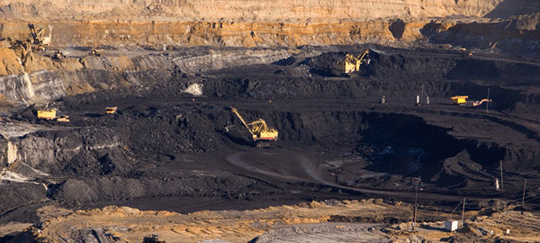
Adani to press Turnbull on $900m boost during visit , THE AUSTRALIAN, DAVID CROWE, Political correspondent, Canberra, @CroweDM, 10 Apr 17, Malcolm Turnbull will be asked to seal a $900 million deal to clear the way for the mammoth Adani coal mine in central Queensland during his visit to India that also seeks to inject momentum into a trade deal between two countries.
The Prime Minister arrived in New Delhi last night for a three-day state visit that will include talks with his Indian counterpart Narendra Modi, meetings with business leaders and a focus on the country’s demand for energy.
The $21 billion coal project towers over other items on the agenda, with Adani pushing for action within months on financing agreements and regulatory hurdles. Its Carmichael mine is being opposed by green groups in the courts and on the ground.
“We’ll certainly be talking about the importance of energy exports to India,” Mr Turnbull said before flying to New Delhi from Port Moresby, where he concluded a two-day visit yesterday morning. “India has a massive program of expanding electrification across the country and Australian coal has a very big role to play in that.”
Adani founder Gautam Adani told Indian media last month the company was eligible for $900m from the Turnbull government’s Northern Australia Infrastructure Fund to build the rail line from the mine to the company’s port at Abbot Point.
The backing from the fund, which uses federal guarantees to finance commercial projects, will help Adani limit its equity contribution to the rail project to about $800m of a total investment of about $2.5bn in the next two years, with the rest coming from debt and the NAIF.
Queensland Premier Annastacia Palaszczuk met Mr Adani in Mumbai last month and announced most approvals had been concluded for the project. At the same function, Mr Adani said he expected final approval from the federal government by May.
Mr Turnbull is expected to see Mr Adani during the visit after meeting him at least twice, in November 2015 and December 2016, when the billionaire pushed for more help to get the mine open.
After the 2015 meeting, Mr Adani said he had pressed Mr Turnbull to legislate to stop environmental groups delaying the project in the courts. The Abbott government’s attempt to amend the Environmental Protection and Biodiversity Conservation Act to stop “vigilante” activists was stymied in the Senate a month before Mr Turnbull became Prime Minister.
Writing in The Australian today, Mr Turnbull emphasises the opportunities for Australia as the Indian economy grows, increasing demand for Australia….. http://www.theaustralian.com.au/national-affairs/foreign-affairs/adani-to-press-turnbull-on-900m-boost-during-visit/news-story/6beae575a49aacfad4d51eca3dfe0846
April 10, 2017
Posted by Christina Macpherson |
AUSTRALIA - NATIONAL, climate change - global warming, politics, politics international |
Leave a comment
 Farmers are leading way on climate change action, http://www.examiner.com.au/story/4582398/farmers-are-leading-way-on-climate-change-action/?cs=97 John Iser, 9 Apr 2017, It’s often assumed that farmers and regional communities aren’t concerned about climate change. Our state and federal politicians debate the issue with little thought of what’s happening in the country, despite agriculture being Australia’s most climate-exposed sector.
However, farmers are taking it upon themselves to bridge the divide. A new advocacy group called Farmers for Climate Action has formed to give a voice to those who are on the frontline of climate change. At the same time, the country’s peak farming body, the National Farmers’ Federation, has updated its thinking on the issue. It now recognises that climate change poses a significant challenge for Australian farmers. In fact, taking action offers many benefits for the millions who live in the country.
The practical solutions for farmers to reduce carbon emissions will advance innovation, and renewable energy developments create jobs.
Climate action is also crucial for land health and biodiversity, both of which affect the productivity of agriculture.
Farmers and rural communities also have a major influence on government decisions.
The Victorian government have just banned fracking after farmers vigorously voiced their concerns. The politicians recognised that mining of unconventional gas puts the quality of farmland and its water at risk, as well as the health of people and animals living nearby.
In South Australia, a parliamentary inquiry made a similar finding.
Rural communities are now turning their attention to the effects of climate change. They know that action will protect farmland and their livelihoods which will then benefit the country as a whole. John Iser is the Victorian chairman of Doctors for the Environment Australia
April 10, 2017
Posted by Christina Macpherson |
AUSTRALIA - NATIONAL, climate change - global warming |
Leave a comment
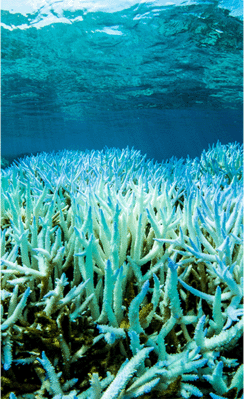 Great Barrier Reef at ‘terminal stage’: scientists despair at latest bleaching data ‘Last year was bad enough, this is a disaster,’ says one expert as Australia Research Council finds fresh damage across 8,000km
‘Australia’s politicians have betrayed the reef and only the people can save it, Guardian, Christopher Knaus and Nick Evershed, 10 Apr 17, Back-to-back severe bleaching events have affected two-thirds of Australia’s Great Barrier Reef, new aerial surveys have found.
The findings have caused alarm among scientists, who say the proximity of the 2016 and 2017 bleaching events is unprecedented for the reef, and will give damaged coral little chance to recover.
Scientists with the Australian Research Council’s Centre of Excellence for Coral Reef Studies last week completed aerial surveys of the world’s largest living structure, scoring bleaching at 800 individual coral reefs across 8,000km.
The results show the two consecutive mass bleaching events have affected a 1,500km stretch, leaving only the reef’s southern third unscathed.
Where last year’s bleaching was concentrated in the reef’s northern third, the 2017 event spread further south, and was most intense in the middle section of the Great Barrier Reef. This year’s mass bleaching, second in severity only to 2016, has occurred even in the absence of an El Niño event.
Mass bleaching – a phenomenon caused by global warming-induced rises to sea surface temperatures – has occurred on the reef four times in recorded history.
Prof Terry Hughes, who led the surveys, said the length of time coral needed to recover – about 10 years for fast-growing types – raised serious concerns about the increasing frequency of mass bleaching events.
“The significance of bleaching this year is that it’s back to back, so there’s been zero time for recovery,” Hughes told the Guardian. “It’s too early yet to tell what the full death toll will be from this year’s bleaching, but clearly it will extend 500km south of last year’s bleaching.”
Last year, in the worst-affected areas to the reef’s north, roughly two-thirds of shallow-water corals were lost.
Hughes has warned Australia now faces a closing window to save the reef by taking decisive action on climate change.
The 2017 bleaching is likely to be compounded by other stresses on the reef, including the destructive crown-of-thorns starfish and poor water quality. The category-four tropical cyclone Debbie came too late and too far south for its cooling effect to alleviate bleaching……….https://www.theguardian.com/environment/2017/apr/10/great-barrier-reef-terminal-stage-australia-scientists-despair-latest-coral-bleaching-data
April 10, 2017
Posted by Christina Macpherson |
climate change - global warming, environment, Queensland |
Leave a comment
 Coalition supporters back quicker shift to renewable energy, The Age, Adam Morton 10 Apr 17, (excellent graphs) The wisdom of a campaign by the Turnbull government emphasising the risks of moving too rapidly to renewable energy has been thrown into question by polling that suggests a majority of its supporters don’t agree. Left-leaning think-tank the Australia Institute surveyed 1420 voters on whether the country was moving too slowly or too quickly in embracing renewable sources wind and solar.
It found two-thirds of voters – and 55 per cent of those who identified as Coalition voters – believed the shift was too slow. Only 9 per cent – and 17 per cent of Coalition supporters – said it was happening too fast.
Forty-five per cent believed electricity prices would go up if the national renewable energy target of about 23.5 per cent by 2020 was abolished. Only 19 per cent thought bills would go down.
Again, Coalition supporters were broadly in step with the majority: 41 per cent said ending the target – a step floated by former prime minister Tony Abbott, among others – would actually push up prices; 23 per cent believed they would come down.
On cost, voters appeared to reject claims that renewable energy was the cause of the significant power bill increases. The support for clean energy is consistent with a Fairfax/Ipsos Poll a fortnight ago that found a third of voters believed the country should continue to use coal-fired power, and 61 per cent said it was time to turn to other sources.
Australia Institute executive director Ben Oquist said clean options were becoming increasingly economically and politically attractive as the price of renewable energy and battery storage came down.
“The war on renewables looks like the political version of the Somme. Furious attacks have not made any ground on the popularity of renewable energy,” he said.
The Australia Institute poll did not test whether views on clean energy would change how people voted.
It found a narrow majority of voters (52 per cent) backed an increase of the renewable energy target, while only 9 per cent wanted it cut.
A clearer majority (73 per cent) supported the introduction of a higher target for 2030.
More than three-quarters of voters (77 per cent) supported state renewable energy targets to drive further investment. Neither question considered what more ambitious policies would cost. (See data tables at the end of this story.- [on original] )……http://www.theage.com.au/federal-politics/political-news/coalition-supporters-back-quicker-shift-to-renewable-energy-20170409-gvgzh6.html
April 10, 2017
Posted by Christina Macpherson |
AUSTRALIA - NATIONAL, energy, politics |
Leave a comment
Insurers call for disaster mitigation increase THE AUSTRALIAN, 8 Apr 17 MICHAEL RODDAN Reporter, Melbourne @michaelroddan The federal government rejected a Productivity Commission proposal to increase natural disaster mitigation spending at the same time it attempted to pressure state governments to accept a drastic cut to recovery spending.
Australia’s biggest insurers want the government to revisit the plans to dramatically increase natural disaster prevention spending, which the commission believes will save billions in post-catastrophe clean-ups.
As the damage wrought by Cyclone Debbie continues to mount, Insurance Australia Group and Suncorp have hit back at politicians’ accusations companies are “stingy” with claims, and have called on the government to adopt the recommendation it commit to an annual $200 million spend on mitigation. The proposal, part of the Productivity Commission Inquiry into Natural Disaster Funding Arrangements, was rejected by the government two days before Christmas last year, after it sat on the report for two years.
“There is overwhelming evidence that shows the economic and social impact savings which upfront mitigation funding could achieve and this is being ignored,” IAG chief executive Peter Harmer told The Weekend Australian.
“The government response in late December …. was disappointing and did not go far enough, particularly in the area of funding for disaster resilience and mitigation.
“We have been advocating for some time that there needs to be a different approach to natural disaster funding, with more focus on mitigation, to avoid some of the impacts we are seeing.”
As of yesterday, insurers had received nearly 47,000 claims from Queensland and NSW policyholders for insured losses stretching to $413m. It is estimated losses will break $1 billion.
The federal government invests about $50m a year on adaptation funding but spends more than $500m on average on post-disaster relief and recovery.
The Australian Business Roundtable for Disaster Resilience said spending $250m a year on preventive infrastructure, such as flood levees, would slash recovery costs in half and generate savings of more than $12bn by 2050.
“The recommendations of the review included significantly reducing recovery funding provided to states, while increasing mitigation funding over time,” a government spokeswoman said……. http://www.theaustralian.com.au/business/news/insurers-call-for-disaster-mitigation-increase/news-story/acf1ecfd783c1422864a4c7ad21908a3
April 10, 2017
Posted by Christina Macpherson |
AUSTRALIA - NATIONAL, business, climate change - global warming |
Leave a comment
Green is the new black: ESG investors turn to green bonds to meet mandates, SMH, Myriam Robin, 9 Apr 17
As the billions of dollars in ethical and environmental funds swell, Australian corporates and governments are issuing increasing amounts of “green bonds” to access the cash.
Green bonds function just like normal corporate or government bonds, but the issuer has to promise to use the funds to fund some type of environmentally beneficial development. This investment doesn’t have to sustain a commercial rate of return itself – if the bond is instead underwritten by the total balance sheet of the issuer, it shares the issuers’ credit rating. Because of this, green bonds typically have identical yields to equivalent regular bonds.
Between 2014 and 2016, the total amount of money put in funds with some social or green investment principles grew from $US148 billion to $US516 billion across Australia and New Zealand, according to the Global Sustainable Investment Review, released in March.
Most of this growth, the report stated, came from professionally managed funds choosing to incorporate such principles into their main funds. Funds specifically targeting green or social impact investors amount to 3.8 per cent of Australia’s total professional managed assets market, up from 2.5 per cent in 2014.
The style of investments by such funds is changing in a way that shows increasing demand for green bonds. In Canada and Europe, the only two regions for which asset allocations were available to the Global Sustainable Investment Review report, a majority (64.4 per cent) of such funds were invested into green bonds – a rapid reversal of the dominant trend in 2014 when equities dominated.
The surging investment in green bonds, the review suggested, could reflect rising environmental concerns. According to Bank of America Merrill Lynch, $US90 billion of green bonds were issued in 2016, taking the total market past $US200 billion in early 2017. $US19 billion in green bonds were issued globally in the first two months of this year. At the end of February, $US2.3 billion in green bonds had been issued so far in Australia.
Australian governments and banks have led the way in green bond investments – their issuances have been oversubscribed, showing heavy local demand for the products. In a $300 million NAB green bond raising in December 2014, 54 per cent of the bond distribution went to fund managers, with another 30 per cent being purchased by institutions and pension funds.
HSBC’s Violeta Jovanoska, director of debt capital markets in its Sydney office, was involved in the first corporate green bond issue in Australia, a Euro-donominated bond issued by Stockland Trust Management in November 2014, as well as the NAB bond, which HSBC was a joint bookrunner on.
She said corporates were turning to green bonds as a way to access this swelling pool of money placed in funds with an environmental, social or governance mandate. As many investment managers have signed up to responsible investment or climate change agreements, green bonds are a way to meet that commitment………..
The lack of regulation around green bonds has meant some critics dismiss the area as “greenwash” marketing – an environmental sheen on what is essentially a regular corporate bond. It’s hard to say whether green bonds allow new green projects to be completed or if organisations are using them just to easily fund the more environmentally friendly parts of their investment agenda, with the green bond money going towards projects they would have funded anyway. Companies don’t have to turn green in any significant way to issue a green bond……http://www.smh.com.au/business/markets/green-is-the-new-black-esg-investors-turn-to-green-bonds-to-meet-mandates-20170404-gvd2v6.html
April 10, 2017
Posted by Christina Macpherson |
AUSTRALIA - NATIONAL, business, energy |
Leave a comment
Malcolm Turnbull ‘knew in advance’ of US strike on Syria, called for a ‘strong response’, The Age, David Wroe 8 Apr 17, The Trump administration informed the Australian government in advance of its plans to launch the Tomahawk missile attack on Syria, Fairfax Media understands.
Prime Minister Malcolm Turnbull had pointedly said before news of the strikes broke that the chemical attack on civilians “cries out for a strong response”.
On Friday morning, Mr Turnbull linked the attacks to Syrian dictator Bashar al-Assad and blamed Russia for failing to rein in its ally.
But Mr Turnbull carefully sidestepped questions about what action Australia might take against the regime after Washington appeared to ramp up its rhetoric about the need for Mr Assad’s removal.
“This is a war crime of the worst sort. It is inhumane and it has been universally condemned,” Mr Turnbull told radio 3AW………
Asked on Friday morning whether Australia would step up its military effort in Syria beyond air strikes against the so-called Islamic State group, Mr Turnbull said he had spoken “a little while ago” to Defence Minister Marise Payne and Chief of the Defence Force Mark Binskin but refused to say if any action was being discussed.
“I don’t want to speculate any further about that. You know where we stand. We have condemned this attack, utterly. It cries out for a strong response and we are in very close touch, as we always are, constant communications with our allies, in particular the United States.
In a slap at the administration of Russian President Vladimir Putin, Mr Turnbull said that “Russia obviously is the principal foreign sponsor of the Assad regime”.
Asked whether Russia had behaved appropriately, Mr Turnbull said, “No.”…….
Greens senator Scott Ludlum issued a statement on Friday condemning the US strikes on Syria and calling on Mr Turnbull to rule out Australian involvement in any new military campaign.
“The horror of the chemical weapons attack in Syria this week requires a credible, independent investigation, not a random barrage of missiles ordered by a clueless President,” he said. http://www.theage.com.au/federal-politics/political-news/malcolm-turnbull-says-syria-chemical-attack-demands-strong-response-as-military-threats-grow-20170406-gvfnqh.html
April 8, 2017
Posted by Christina Macpherson |
AUSTRALIA - NATIONAL, politics international |
Leave a comment
 Tim Bickmore Fight To Stop Nuclear Waste Dump In Flinders Ranges SA
Don’t get sucked in by the “medical gloves & gowns” Canberra con-job:
FACT 1 – South Australia’s current hospital waste storage regimen WILL REMAIN in-situ;
FACT 2 – Radioactive metal from the 1940’s British Montebello Atom Bomb Tests IS DESTINED for the suppository;
FACT 3 – Radioactive concrete & steel from the de-commissioned Lucas Heights HIFAR reactor WILL ALSO be supposited;
FACT 4 – If/when the 10,000 Woomera barrels arrive, Radon gas WILL LEAK. This heavy invisible radioactive odourless & poisonous gas flows like water & accumulates in low-lying areas;
FACT 5 – The so-called Intermediate Level Waste ALSO RELEASES invisible radioactive odourless gasses;
FACT 6 – The lowest area in the Wallerberdina precinct is the Hookina Creek line;
FACT 7 – GLOVES & GOWNS WILL BE A MINOR FRACTION OF THE LOW LEVEL WASTE INVENTORY.https://www.facebook.com/groups/344452605899556/
April 8, 2017
Posted by Christina Macpherson |
Federal nuclear waste dump, South Australia |
Leave a comment
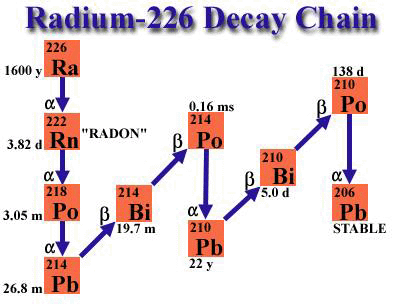 Fight To Stop Nuclear Waste Dump In Flinders Ranges SA In April 2016 ARPANSA discovered that Radium had leaked from the 10,000 barrels stored at Woomera. http://www.arpansa.gov.au/…/inspections/2016/R16-05292.pdf This means that Radon gas is being released into the environment. Radon is heavy & tends to flow to the lowest point & accumulate. After about 4 days it transforms into a solid & infects the ground surface. As time passes more & more Radon converts to a solid that builds up & continuously increases the radioactivity wherever it may happen to land – which is at the place it arrives at after about 4 days. This will continue to happen for at least 16,000 years. https://www.facebook.com/groups/344452605899556/
April 8, 2017
Posted by Christina Macpherson |
environment, South Australia, wastes |
Leave a comment
With actuaries warning that some properties could become uninsurable in future, land values in some areas would likely plummet.
“The possibility of legal liability heightens risks for companies that aren’t responding”
While the financial sector is now seriously factoring the practical impact of climate change into their plans, many within it fear government is not.
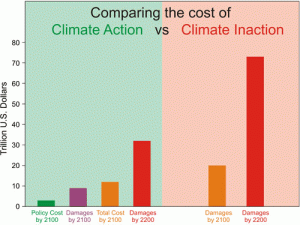 Business takes lead on climate disasters, In the wake of cyclone Debbie, the insurance and banking industries are pushing for better mitigation measures, while the federal government lags behind. By Karen Middleton, Saturday Paper 8 Apr 17, “……..The Cannons and their neighbours join the residents of Murwillumbah, Lismore and other affected areas of NSW and Queensland in surveying the damage from cyclone Debbie, and the storms and flash flooding of its aftermath, and asking what can be done to help communities protect themselves in future.
The same questions are being asked in the boardrooms of corporate Australia – especially but not only in the finance sector – with an increasing emphasis on planning for and guarding against such events, rather than just cleaning up afterwards.
…….The Insurance Council of Australia wants the federal government to focus on mitigation as a priority in the upcoming federal budget.
“Cyclone Debbie and the floods that followed it should be a starting point for state and federal governments to address mitigation,” council spokesman Campbell Fuller said.
In the insurance and superannuation industries, work is being done on the likely longer-term impact of climate change on the frequency and ferocity of these major disasters and how they and other investors – and ultimately governments – should respond.
The big banks have also begun studying the implications of climate change on their risk exposure through mortgages reaching back 30 years. Continue reading →
April 8, 2017
Posted by Christina Macpherson |
AUSTRALIA - NATIONAL, business, climate change - global warming, politics |
Leave a comment

 ‘On Tues a large group of Galilee Blockade grandparent activists occupied office of Qld Dep Premier Jackie Trad. Cayman Islands was the theme, Gautam Adani holidaying with a billion dollars of public funds.’
Eleven Hour Occupation.
Three Arrests.
One Message.
Galilee Blockade campaign http://galileeblockade.net/occupying-trad/ http://galileeblockade.net/wordpress/wp-content/uploads/2017/04/S1010163.jpg
“Prepared with food, bedding and a camp toilet, the grandparents vowed to occupy the office until Jackie Trad (as Minister for Infrastructure) signed a legal letter stopping our money going to Adani.
NAIF’s own process is clear that the Queensland Labor Government can reject the applications of both Adani and Aurizon. …
“Bill Shorten says he is against taxpayer funds going to Adani.
Wayne Swan says it’s a slush fund for the Liberals and has asked the Auditor-General to investigate.
Jackie Trad has the power to actually stop our money going to Adani but refuses, despite 75% of Australians being against it. …
Direct action can be very fun. The grandparents engaged staff and the general public, often in song.
https://www.facebook.com/GalileeBlockade/videos/1883638468560217/
The grandparents stopped the office closing for the day, taking turns blocking the doorway for almost 5 hours. Again with music! https://www.facebook.com/GalileeBlockade/videos/1883714215219309/
Anne, Richard and John were arrested but released without charge. We broadcast this live on Facebook.
https://www.facebook.com/GalileeBlockade/videos/1883853088538755/
“P.S. Activist tip. What does a grandparent activist do when he’s about to be arrested.
Take a selfie and put it on Facebook!” http://galileeblockade.net/wordpress/wp-content/uploads/2017/04/3.jpg
April 8, 2017
Posted by Christina Macpherson |
ACTION, climate change - global warming, Queensland |
Leave a comment
 Transgrid gets 6,000MW solar proposals in 2017, sees 95%
  renewables by 2050 http://reneweconomy.com.au/transgrid-gets-6000mw-solar-proposals-2017-sees-95-renewables-2050/ By Giles Parkinson on 7 April 2017 Transgrid, the owner and operator of the main transmission line in New South Wales, reports that is has received “enquiries” about more than 6,000MW of large scale solar so far in 2017.The figure, revealed by business development manager Gustavo Bodini at the Large Scale Solar conference hosted by RenewEconomy and Informa earlier this week, is more than a six fold increase over 2016, and highlights the huge interest in solar as it matches wind on costs and beats new gas (and new coal) by a significant margin.
Of course, not all that 6,000MW will be built, or even get to development approval stage, but large scale solar is clearly the energy source of choice at the moment, accounting for at least half of new projects for the renewable energy target – a share that is likely to increase in coming years.
Amy Kean, the renewable energy advocate for the NSW government, showed this slide (on original) at the conference, indicating the amount of large scale solar already installed, under construction, and those in the pipeline and the “stealth” projects, which may well refer to the Transgrid enquiries.
This graph above from Transgrid’s Bodini is the most striking – because it predicts that by 2050, 95 per cent of the demand will be delivered by renewable energy – some 65 per cent from large scale renewables like wind and solar and hydro, and another 30 per cent from “distributed energy”.
That’s why, says Bodini, we need to get out and test new technologies, such as battery storage, to see how they operate and integrate with the grid.
There is some grace. There will be enough synchronous generation, Bodini says, within the whole National Electricity Market by 2030 to provide the inertia required to keep the grid stable. From that point, as more of the legacy coal and gas plants retire, it will be up to new technologies to take over.
The grid of the future, he says, will focus on better ways of managing peak demand, energy efficiency, widespread deployment of distributed generation (mostly solar), network based storage and new market rules to allow this to happen and one that promotes “genuine competition” and protects consumers when there is ineffective competition.
April 8, 2017
Posted by Christina Macpherson |
New South Wales, solar |
Leave a comment
February recorded more capacity than November. And now March capacity has shot 16 per cent higher than December.
This has got us thinking at Green Energy Markets that more fundamental and longer term drivers are potentially supporting this increased capacity.
it doesn’t quite work out the way the fossil fuel industry that dreamed up the PR campaign intended. Households and businesses start worrying and think I need to take things into my own hands – and that happens to mean a solar system.
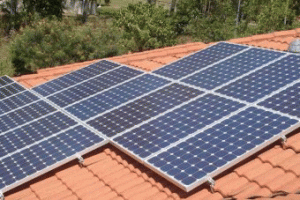 Rooftop solar enjoys second boom as fossil fuel scare campaign backfires, REneweconomy By Tristan Edis on 7 April 2017 It appears the fossil fuel industry’s scare campaign over renewable energy driving up the price of electricity is having the same desired effect that it had back in 2011, when they campaigned against placing a penalty on polluting the atmosphere with global warming gases.
Yep you guessed it – households and businesses are flocking to install solar on their rooftops.
Green Energy Markets’ Solar Report assessment of STC creation data shows that March hit levels of capacity not seen since the days of 45c to 60c premium feed-in tariffs in 201, when there was also an STC rebate that was twice to five times its current level.
All up, we estimate almost 92MW (92,000 kilowatts) of rooftop solar PV capacity created certificates in March………. Continue reading →
April 8, 2017
Posted by Christina Macpherson |
AUSTRALIA - NATIONAL, solar, storage |
Leave a comment