Virtual power plant achievable within 5 years – AGL Energy’s Andy Vesey
‘Virtual power plant’ is here, says AGL Energy’s Andy Vesey, AFR, 17 Mar 17 Home storage batteries will be cheap enough within five years to make the “virtual power plant” achievable, revolutionising energy and making investment in traditional plant harder to justify, AGL Energy chief executive Andy Vesey says.

Mr Vesey said that batteries would be about the same $3500 price that AGL is charging 1000 Adelaide householders for its virtual power plant trial, a fraction of the $16,000 full price of the Sunverge batteries used in the trial. They could pay themselves off in about five years.
“It’s coming,” he told an American Chamber of Commerce lunch. He said grid scale batteries proposed by Tesla and others already offer value in the right circumstances.
Virtual power plants – “behind the meter” energy resources such as batteries, solar panels, software and smart thermometers managing power-hungry appliances – are one way to ease pressure on the grid and help prevent blackouts such as those plaguing South Australia. ….
Mr Vesey said on Friday that adding storage to solar homes was like adding refrigeration to agriculture, changing the way consumers interact with the power grid and the investment equation for energy companies….
He said when you put 1000 rooftop solar households with batteries together and control them in the cloud “you fundamentally have a 5 megawatt peaking plant on the edge of the grid. It changes everything”. …… http://www.afr.com/news/economy/virtual-power-plant-is-here-says-agl-energys-andy-vesey-20170316-gv0564
Seawater pumped hydro could help South Australia
 Snowy Hydro gets a boost, but seawater hydro could help South Australia, ABC News, 17 Mar 17 The Conversation By Roger Dargaville, University of Melbourne “………could this technology help to ease South Australia’s energy crisis?
The Melbourne Energy Institute (MEI) report on Pumped Hydro Opportunities identifies several potential seawater PHES locations in South Australia.
This includes a very promising site at the northern end of the Spencer Gulf, with significant elevation close to the coast and close to high-capacity transmission lines.
The Department of Defence manages this land, and discussions are ongoing as to how the project might be designed to not interfere with the department’s operations on the site. A win–win development is the primary design aim.
The MEI study suggests that PHES could be delivered at around $250 per kWh of storage.
This compares well with utility-scale lithium ion battery storage, which currently costs of the order of $800 per kWh, although recent announcements on Twitter from Elon Musk suggest this might be coming down towards $500 per kWh.
The Spencer Gulf site has the potential to provide at least 100 megawatts of dispatchable generation, effectively making the wind and solar generation in South Australia significantly more reliable.
The Australian Renewable Energy Agency (ARENA) will help fund a feasibility study into the technology, working with partners Energy Australia, Arup and MEI.
If the facility is ultimately built, it could become a key element in SA’s bid to avoid future power blackouts.
Dr Roger Dargaville is the Deputy Director of the Melbourne Energy Institute. He is an expert in energy systems and climate change.
Originally published in The Conversation http://www.abc.net.au/news/2017-03-17/how-seawater-hydro-could-help-south-australia/8363054

South Australia’s energy policy
Instead of the gas plant, Saddler wants to see the government back solar thermal with storage, even if existing proposals sit at a significantly higher price bracket, such as the $1.2 billion 170MW solar thermal tower proposal for Port Augusta
Renewables and South Australia’s power policy, The Saturday Paper, Max Opray , 18 Mar 17 “……Weatherill said the Frydenberg announcement of a reinvigorated Snowy Mountains hydro scheme showed the federal government was in a “white-knuckled panic” about energy policy. “It is a $2 billion admission that the national energy market has broken and there needs to be public investments to actually fix it up.”
And later, in the same answer: “It is a disgrace the way in which your government has treated our state.”
The showdown came after a week in which the Weatherill government had broken ranks with the National Electricity Market in declaring a “South Australia first” energy policy.
The state has endured a cursed run when it comes to keeping the lights on……
Most of these issues were not the fault of the South Australian energy grid’s high level of renewable energy penetration, but that hasn’t stopped the Turnbull government and other clean coal cheerleaders using the state as a cautionary tale about green energy. Continue reading
New South Wales electricity prices make household solar and storage look good
 Solar and storage boost? NSW households face 5c/kWh price rise http://reneweconomy.com.au/solar-storage-boost-nsw-households-face-5ckwh-price-rise-99553/ By Giles Parkinson on 17 March 2017 The continuing surge in New South Wales wholesale electricity costs – and in other states for that matter – is likely to add even more incentive for households and business to turn to rooftop solar and battery storage. NSW baseload futures prices for 2018 have jumped another $10/MWh to $115/MWh in the last two weeks, meaning that a rooftop solar system is cheaper than the wholesale price of the coal-fired grid, let alone retail prices which are more than twice as high.
Analysts at Morgan Stanley say that if the wholesale price increase was to be fully captured by energy retailers, then the retail price would need to rise by around 5c/kWh, or about 20-25 per cent.
This scale of rise, shocking as it would be, is unlikely to happen because most retailers will have a rolling hedge book that will mitigate part of the cost increase.
Still, Morgan Stanley expects that retail prices will still have to increase around 10 per cent from July 1, which would add at least 2c/kWh on to energy costs, which are currently 21c/kWh to 24c/kWh, not including hefty network charges of up to $1.50/day.
This should be yet another incentive for NSW households to invest in rooftop solar. The state trails most other states on solar penetration, with around 15 per cent of homes, compared to nearly 30 per cent in Queensland and South Australia.
And the fact that NSW retailers offer such a small amount on solar exports (most at around 6c/8c/kWh, with a couple of outliers on 12c/kWh) this should increase the attraction of battery storage.
NSW is already seen as the best state for battery storage because of the recent expiry of premium feed-in tariffs.
As Queensland Premier about to decide on Adani coal mine, Indian fishermen warn Australia against it
 Adani: Indian fishermen warn Australia against environmental impact ahead of coal mine talks ABC AM By South Asia correspondent James Bennett , 17 Mar 17 Fishermen in India say a local Adani project is harming them and killing off sea life, warning Australia to be wary as Queensland’s Premier Annastacia Palaszczuk prepares to decide whether to proceed with the Carmichael coal mine.
Key points:
- Noor Mohammad said the Adani project’s coal dust, stream discharge harmed the community
- Adani has been heavily criticised for a series of environmental breaches during construction of Gujarat project
- Comment was sought from Adani on measures it had taken to address the ash problem, but the ABC received no response
Ms Palaszczuk and eight regional mayors are preparing to sit down with the chairman of Adani Enterprises, Gautam Adani, ahead of the company deciding whether to proceed with the proposed mine.
The Queenslanders will be shown the Adani’s Gujarat port and power station, which itself has a chequered environmental record, of which the local fishermen said Australia should be wary……http://www.abc.net.au/news/2017-03-17/fishermen-warn-australia-against-adani-mine-environmental-impact/8362230
Never mind the danger: economically nuclear power for Australia is a stupid idea
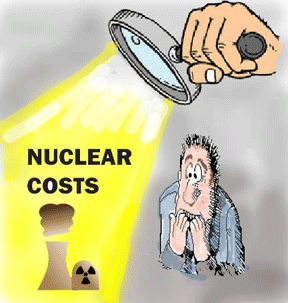 Nuclear energy is still a stupid idea for Australia, SMH,
You don’t even need to monger any scares about radiation: nuclear energy isn’t remotely the solution to Australia’s self-created energy problem Andrew P Street, 16 Mar 17 As you are doubtlessly aware, our nation is currently gripped in an energy crisis that demands rapid – indeed, hasty and reckless – action to address.
Plenty of new solutions are being suggested – except for renewables, obviously, which could meet all of Australia’s energy needs right now if wind and solar energy wasn’t all a socialist leftist plot fermented by that notorious Safe Schools-loving Marxist feminist greenie, the Weather.
The Prime Minister has announced plans to expand the Snowy River Hydroelectric scheme, which will be a boon to employment via massive construction projects and generate enough energy to power half a million homes – an excellent plan that will benefit places that aren’t actually having any problem with their power supply.
And, predictably, a bunch of Coalition backbenchers have come out in favour of that old conservative favourite, nuclear energy. Which isn’t going to happen in Australia, obviously, because words like “Fukushima” and “Chernobyl” trigger the bit of people’s brains that don’t want to endure a slow, lingering death from radiation-induced cancer. …
The biggest problem is one that you might not be aware of, which is that electricity demand in Australia has been dropping for years – partially because of better efficiency, partially because of higher prices, partially because of government regulation, and partially because of the decline of heavy manufacturing in Australia.
This is one of the reasons our liquid natural gas manufacturers have been focusing on export rather than local generation: the demand in Australia just doesn’t exist to a suitably profitable extent….
as the SA storms showed us, the biggest liabilities relating to Australia’s energy security is the profiteering of the national electricity market, and the weakness of the grid itself.
If we’re seriously thinking about large scale investment devoted to shaking up the way we meet Australia’s energy needs, maybe having a handful of large, centralised generators with long spindly arms of distribution towers which get blown over isn’t the best model to maintain.
So you might conclude that right now might not be a great time to sink billions into making more large-scale electricity plants of any shade – but there are some extra costs that are unique to nuclear reactors.
- First up, nuclear reactors are very, very, VERY expensive to build……
- Depending on the level of regulation a plant takes between five and seven years to build and another year or more to get online – so, again, not a great short-term solution for power generation by a government eager to improve energy security.
And that’s assuming that a large-scale project of this type and complexity never runs into any snags.
- then you have the decommissioning costs, which are in the billions of dollars. ….
- the state is forced to pick up the tab for de-poisoning the site, which is what’s currently happening at Sellafield in the UK.
There’s also the cost of storing radioactive waste, which is a whole extra issue – but if the British experience is anything to go by, the public can expect to be paying for that too. …..
- any green credentials are more than offset by the carbon emission heavy process of mining the uranium to fuel it, which is an environmental nightmare. Right, Ranger Mine?…….
- So, to recap: nuclear energy costs a lot to set up, a lot to break down, creates extra new storage problems that are expensive to fix, and isn’t a long term solution in any case. Advocating for power plants to be built in Australia is just another excuse to subsidise the construction and mining industries – so at least it’s in line with the rest of the government’s existing policy priorities.
If only the sun hadn’t been built by Karl Marx and was therefore ideologically untenable. Then we’d all be fine. http://www.smh.com.au/comment/view-from-the-street/nuclear-energy-is-still-a-stupid-idea-for-australia-20170316-guzb68.html
PM Turnbull comes out in his true pro nuclear colours
 Let’s have debate on nuclear power: PM https://au.news.yahoo.com/a/34674870/lets-have-debate-on-nuclear-power-pm/#page1 AAP on March 17, 2017 Nuclear power would demand political consensus and take many years to develop but it is a debate worth having, the prime minister says.
Malcolm Turnbull made the remark after spruiking his $2 billion expansion of the Snowy Hydro scheme and following weeks of unceasing discussion about gas, coal and renewable energy.
The Minerals Council of Australia has called for the blanket ban on nuclear power to be lifted after 11 coalition government MPs publicly declared it should be included in the energy mix.
Mr Turnbull says establishing a nuclear power station would need a high degree of bipartisanship because its development would span the lives of various governments from different parties. “But even assuming you had all of that, it would take many, many, many years to build. It’s not something that could be done in four or five years, let alone two or three years,” he told Sydney’s 2GB Radio.
“I think it’s an important debate to have but in the near term and in the medium term, storage is a very critical necessity.”
The minerals council argued nuclear power was reliable, affordable, safe and a proven technology that produced close to zero carbon emissions.
Media toes then government’s right-wing line, rubbishing South Australia’s innovative energy plan
 South Australia shows up the federal government … and rightwing commentary, Guardian, Jason Wilson, 16 Mar 17 The reaction to the South Australian energy plan from the federal government and rightwing media shows just how out of touch with public opinion they are. The South Australian government announced on Tuesday that it would address market failure with the time-honoured measure of government intervention. In addition, the Weatherill government has chosen to continue to rely extensively on renewable energy. Together, these themes in the government’s announcement have provoked the kind of howling rightwing atavism that shows exactly why they are increasingly at odds with the Australian public on this issue.
Cast your mind back to 2016, when South Australia suffered from major power outages. The right took this as a propaganda opportunity for the promotion of dirty power. The problem, op-ed after op-ed from Einsteins like Chris Kennyproclaimed, was the reliance on wind. Magic words like “baseload” were relentlessly defecated into the pail of our energy debate. The verdicts of experts were roundly ignored, if not castigated. It was all of a piece with the madness that has produced Senate inquiries into imaginary ailments and the veneration of inanimate carbon in the parliament.
Sensibly, the South Australians have brushed aside pretty much all of this. Weatherill’s statement laid the blame where it belonged: a dysfunctional national energy market, an absence of national policy, lazy coal-fired generators which don’t maintain their plant, and a perfect storm. Through a mix of public and private initiatives, the government will build in redundancies using battery storage and a 250MW gas-fired plant. And the energy minister will direct the market.
Environmental groups and the Greens are concerned about the continued presence of gas in the energy mix, but even some of these groups managed to give qualified approval. Industry leaders seem relieved that someone is approaching these problems rationally. But the lizard brain faction of the right – encompassing the Australian’s opinion section, certain thinktanks, and the dominant faction of the Coalition – is furious.
In the Australian on Wednesday, their somewhat ironically titled environment editor bravely spun the announcement as a slap in the face for “armchair electrical engineers” who advocate battery power – even though battery power is part of the mix. Coming heartbreakingly close to grasping the idea of market failure, he called it a “slippery slope to further nationalisation”………
Fellow travellers in the media like Chris Uhlmann – himself a big fan of the cultural Marxism conspiracy theory – were trying to save face over previous prognostications on the power grid by pretending they were right all along.
From farther out the fringes, the usual clown troupe has clumsily piled on. The IPA took us through the looking glass by accusing the South Australian government of an “ideological opposition to coal”, in between ritual incantations of the word “baseload”. And Malcolm Roberts seemed to think that carbon-reduced power generation posed some unspecified risk to carbon-based life.
The difficulty that the right will face on this issue going forward is a microcosm of their more general problem. Their increasingly fanatical dedication to fossil fuel, and their relationship with miners and generators, is increasingly at odds not only with public opinion, but with the lived experience of many Australians.
Voters support renewable energy, and in turn they want governments to do more to support it. More importantly, they are choosing in droves to supply their own homes with renewable sources, especially with photovoltaic solar rigs. South Australia is second only to Queensland in domestic solar installations, and a greater proportion of Australian homes have solar power than any other country.
Malcolm Turnbull and Josh Frydenberg are not following public opinion as they investigate obstacles for the SA proposal. They are, in effect, pandering to the rightwing tail that wags the Coalition dog…….
The West Australian correctly pointed out that the Australian’s coverage of the state election showed how far adrift it, too, is of community sentiment on a range of issues.
As the reef is bleached, as mangroves die, and as Australia relentlessly heats up, it may be small comfort to know that the Coalition’s perversity on energy might add to its deep political difficulties. But at the very least, South Australia may be showing us how ideologically driven federal intransigence can be sidestepped. https://www.theguardian.com/australia-news/commentisfree/2017/mar/16/south-australia-shows-up-the-federal-government-and-rightwing-commentary
Australian Broadcasting Commission – parrotting the propaganda from the fossil fuel industries?
When will ABC stop parroting fossil fuel lobbyist lines?, REneweconomy, By Giles Parkinson on 16 March 2017 Where’s the ABC Fact Check department when you need it? Ah, that’s right, it’s closed. And that’s a pity, because it would be kept mighty busy by some of the recent editorialising by Andrew Probyn, the 7.30 Report’s new political editor.
Probyn, like his predecessor, Chris Uhlmann, has got into the nasty habit of parroting fossil fuel myths as if they are fact. They’ve become obsessed with concepts such as “synchronous” generation and “baseload”, using them to slap down wind and solar without really understanding why or how.
This is a problem for ABC viewers because they are not getting a clear and unbiased picture of energy issues. A complex subject is being poorly served. Labor is accused by Probyn of being a “slave” to wind and solar ideology, while Uhlmann thinks more wind and solar will lead to a national blackout.
Last night, Probyn tried to wrap up the gas talks, led by prime minister Malcolm Turnbull, and the push into battery storage into one big omnibus piece. But then he got diverted by his own prejudice, or misconceptions.
The report started promisingly. Michael Ottaviano, the CEO of Perth-based Carnegie Clean Energy, was explaining how a local company could do exactly what Tesla’s Elon Musk could do – provide battery storage, make wind and solar dispatchable, and provide grid security.
And, he said, they could do it at the same competitive prices, and in the same time frame. They could match Tesla and Musk on every front, with the exception of tweeting.
But in an instant after Ottaviano had explained how wind and solar and storage were a current reality, Probyn had decided it was something only for the future. (Full transcript here).
“Wave, solar and wind power may be key to the future energy mix, but the intermittent nature of renewables means they can’t yet guarantee baseload generation.”
Er, yes they can. Ottaviano just told you they can – not baseload, that is a redundant term invented by the fossil fuel lobby to justify coal generation, but dispatchable generation, which is what really counts.
When South Australia announced its new energy plan on Tuesday, it didn’t announce a baseload plant, it sought instead battery storage and a peaking gas plant. This is about dispatchability, not baseload.
It’s a crucial point. The energy market is in a massive technological transition. Running such lines about baseload is like arguing a car can’t do what a horse and cart can do because it doesn’t eat straw.
Mind you, it’s not just mainstream media that is slow to pick up on this, or being downright antagonistic, as is the case with much of the Murdoch media. The regulators have been slow too……..http://reneweconomy.com.au/will-abc-stop-parroting-fossil-fuel-lobbyist-lines-37563/
A pack of Liberals want nuclear power for Australia
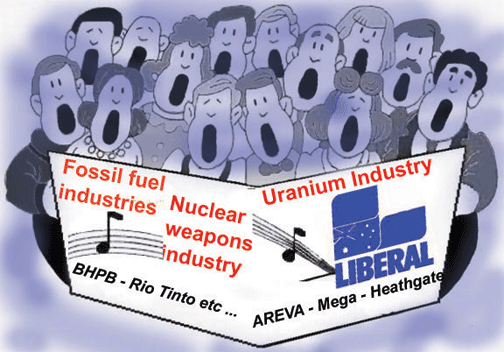 Put nuclear in the energy mix, Coalition MPs tell Malcolm Turnbull, SMH, James Massola, Adam Gartrell, 16 Mar 17 One in 10 Turnbull government MPs say nuclear power should be on the table as federal and state governments grapple with Australia’s future energy needs.
The 11 Coalition MPs – Andrew Broad, James Paterson, Tony Pasin, Tim Wilson, Chris Back, Craig Kelly, Eric Abetz, Andrew Hastie, Warren Entsch, Bridget McKenzie and Rowan Ramsey – are from both the Liberal and National parties and come from the moderate and conservative wings of the government…..
The call to consider nuclear power came as Prime Minister Malcolm Turnbull and senior ministers met the chief executives of major gas companies including Santos, Origin, ExxonMobil and Shell to discuss shortfalls in gas supplies projected to hit the eastern and southern states in the coming years……
The talks came amid escalating debate over energy security and a day after South Australia announced a “go it alone” energy policy that includes plans for a new $360 million gas-fired power plant……
Victorian Premier Daniel Andrews took a swipe at Mr Turnbull, calling on him to “admit that the national energy market is failing households and businesses across the country, especially in Victoria. If he can bring himself to acknowledge that, we can then have a mature discussion about our energy future”.
A nuclear power plant would take an estimated 15 to 20 years to build and would cost several billions of dollars. It would also be expensive, relative to coal and gas-fired power, though a carbon price or emissions intensity scheme for electricity sector could make it more competitive.
Nuclear would not, therefore, offer a solution to short-term gas shortages but – the MPs said – in the medium term it should be considered. However, partisan politics in the form of opposition from Labor and the Greens could get in the way……
Both Mr Turnbull and deputy Liberal leader Julie Bishop have both previously backed nuclear power. http://www.smh.com.au/federal-politics/political-news/put-nuclear-in-the-energy-mix-coalition-mps-tell-malcolm-turnbull-20170315-guylds.html
At least in the State of South Australia there is a plan for energy self sufficiency
At least there is a plan in South Australia, albeit one that will place its drive for self-sufficiency in conflict with the operation of the National Electricity Market.
Provided there is decent backup power generation there shouldn’t be an issue with developing VPPs and new forms of energy storage so that they can be refined and more affordable in time.
Role of batteries provides aspirational charge to energy debate , The Australian, 16 Mar 17 CHRIS GRIFFITH Technology reporter Sydney @chris_griffith Call it battery fetishism if you must, but batteries are going to play an even bigger role in power sources being tested in Australia. Take for example the virtual power plant concept which has gone live in South Australia.
A VPP comprises hundreds, maybe thousands, of homes each with solar panels where excess energy is stored in batteries. Instead of operating as separate entities, energy stored in those batteries is made available in unison to the grid at times of peak load or an outage.
An outside body such as an energy retailer co-ordinates the flow of battery power back to the grid. For the rest of the time, consumers self-manage their stored solar power. Continue reading
South Australian govt calls for battery storage offers within two weeks
S.A. wants first round battery storage offers within two weeks http://reneweconomy.com.au/s-a-wants-first-round-battery-storage-offers-within-two-weeks-92337/ By Giles Parkinson on 15 March 2017
Snowy Hydro a “thought bubble” – not a solution to present energy problems
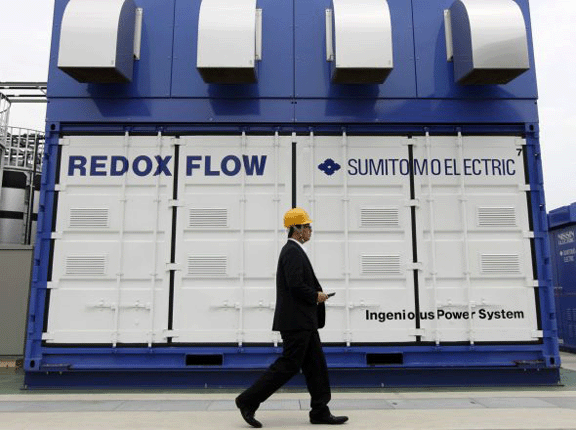
Snowy Hydro expansion won’t be ‘magical’ solution to power problems, experts say, ABC Radio The World Today By Nick Grimm 16 Mar 17 Engineering experts are less critical than the South Australian Premier but some are warning that the expansion of the hydro-electric scheme won’t be a “magical” solution to Australia’s power problems.
And they point out that it is an old idea that has previously been ruled out as too expensive…….
Max Talbot, the former executive officer of Strategic Engineering at the Snowy Hydro Scheme, told ABC Local Radio previous expansion plans had proved too expensive.”We did look at that prospect briefly, expanding the scheme goes back nearly 20 years ago,” he said. “If he’s [Malcolm Turnbull] talking about what I think he’s talking about, then that was considered a feasible but far too expensive at the time…….
Energy experts wary over hydro expansion But with the details of the plan yet to be resolved, energy experts are inclined to reserve judgement on whether the plan is the answer to Australia’s looming power shortage.
The Grattan Institute’s Tony Wood said the project faced so many stumbling blocks and was unlikely to be a “magical panacea”. “The real question here is the economics,” Mr Wood said. “And whether it’s privately owned or publicly owned, is this a good use of public funds? That’s going to be the trick for the feasibility of the study to determine.
“And that would also be therefore the reason why no-one has leapt into this before. “To be fair some of the really sharp issues only started to crystallise in the last six months or so, particularly for example with the announced shut down of the Hazelwood power station.”
That is echoed by another energy economist — Danny Price from Frontier Economics.As he told RN Breakfast, he is sceptical about the plan’s viability, especially given the shared ownership of the scheme, split between the Commonwealth, Victorian and New South Wales governments.
“I’ve worked on the Snowy Hydro corporation over many years, and let me say getting anything done in the Snowy is extremely difficult as it involves the three governments that own it,” he said.
“So at this stage I would regard the Snowy proposal as a thought bubble, and it’s a bit like saying ‘I’m about to begin building a boat and rescue someone’ — it will be years off before anything happens.“…..http://www.abc.net.au/news/2017-03-16/snowy-hydro-expansion-wont-be-magical-solution-to-power-problems/8360320
Malcolm Turnbull talks up his grand Snowy Hydro energy scheme, “better than solar and batteries”
Malcolm Turnbull says Snowy Hydro plan will outdo South Australian battery storage
PM says plan would turn Snowy Hydro into energy storage system but Labor says proposal leaves unanswered questions, Guardian, Gabrielle Chan, 16 Mar 17, Malcolm Turnbull has used his expansion plans for the Snowy Hydro to try to outdo South Australia on battery storage, saying it would provide 20 times the capacity of the battery system proposed by the premier, Jay Weatherill. Continue reading
Daylesford’s community renewable energy success
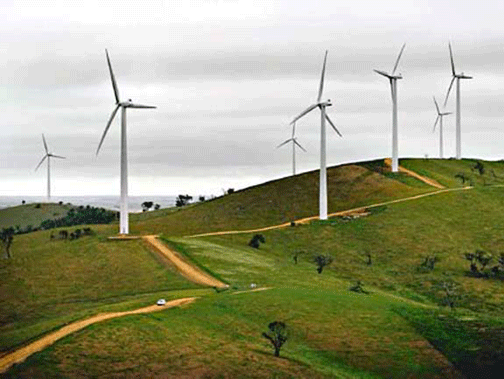 Renewables roadshow: how Daylesford’s windfarm took back the power
In the first of a series about Australian communities building renewable energy projects, we look at how Victoria’s Hepburn Shire overcame local opposition to deliver a new homegrown, community-owned generator, Guardian, Michael Slezak, 15 Mar 17 From the fertile spud-growing country of Hepburn Shire, 90km northwest of Melbourne, has sprung what many hope will become a revolution in renewable energy in Australia.
On Leonards Hill, just outside the town of Daylesford – famed for its natural springs – stand two wind turbines that not only power the local area, but have also added substantial power to the community-owned renewable energy movement in Australia.
The turbines, cheesily called Gusto and Gale, constitute the very first community-owned windfarm in Australia. It borrows the idea from a long tradition of community-owned power that was forgotten in Australia, but lives on strongly in Denmark.
“In Denmark there’s over 2,100 versions of this,” says Taryn Lane, the community manager for Hepburn Wind, the cooperative that owns and operates the windfarm. “Their model – this way of owning your own energy generator locally – emerged in the late 70s, so they have been doing it for decades.” .
It was at a community meeting for a large corporate-owned windfarm, like the one near Hepburn, that the idea for Hepburn Wind emerged…….
the group had overwhelming local support. “We are a cooperative of 2,007 members,” says Lane. “They’ve contributed just under $10m.”
The majority of the investors are from the local region, something the cooperative has written into its rules.Paul Howden is one of them. As with most investors in community-owned renewable energy, his motivations were a mix of hard-nosed financial ones, and the desire to do a bit of good. “Partly, obviously because it’s a renewable energy project,” he says, explaining his investment. “But also because we thought it was a good and wise investment for our super fund.
“This is a win-win for both the environment [and] the community.”
One of the things that made him confident that the project was a good investment, he says, was the level of community support it received, and the passion of the people running it.
But beyond the construction of the 4.1MW windfarm – enough to power about 2,300 households – Hepburn Wind pioneered the modern large-scale community-ownership model of renewable energy in Australia, which is now being replicated around the country.
Simon Holmes à Court was the founding chairman of Hepburn Wind. And after spending years developing a model that worked, and navigating the various logistical potholes in getting it up and running, he set up Embark, a non-profit company dedicated to helping other community energy projects adopt the Hepburn model.
Several projects around the country have received advice and support from Embark, including Pingala, which gathered locals in Sydney’s Newtown to build a solar array on the top of a brewery, and the Sydney Renewable Power Company, which recently built Australia’s largest CBD solar farm.
But back in Hepburn shire, not satisfied with the windfarm, the residents are expanding the renewables in their area.
By a picturesque lake in Daylesford, where locals go to swim and cool off, is an antique hydro generator, which used to power a few homes around the lake, and the lake’s lights. “It kept the lake area electrified,” says Lane.
In February, that was made possible when the energy retailer that buys Hepburn Wind’s electricity – Powershop – announced it had crowdfunded more than $100,000 for community-owned renewable energy projects, and one project that would receive a slice of it was Hepburn Wind’s hydro project.
“The original size was 13kWs or just under,” says Lane. “And we will look to somewhere between there and maybe up to 40kWs if we can put a side-by-side motor next to it.”
She says that will be enough to power about eight to 12 houses – not a huge amount, but it’s an easy win.
And with Hepburn shire adding its name to a growing list of councils shooting to reduce their emissions to zero, every bit counts. Says Lane: “At Hepburn Wind we really want to play our role in helping our community reach zero net emissions.” https://www.theguardian.com/environment/2017/mar/15/renewables-roadshow-community-owned-windfarm-daylesford-hepburn-australia
1 This month



Help Aunty Sue Protect Her Land and Sacred Sites From Destructive Rocket Testing.
.

Australians deserve the truth
about
AUKUS – https://aukuspublicinquiry.com/

PETITION – To: Prime Minister Anthony Albanese and the Australian Labor Government

of the week – Australians for War Powers Reform (AWPR)
To see nuclear-related stories in greater depth and intensity

