Allume’s box costs $490 upfront for every apartment whose connection is housed within, so $4900 if 10 units in a block sign up to get solar power. The startup then charges $4.99 per apartment per month for access to its billing application programming interface, which includes a direct debit service.
More Bleaching on Great Barrier Reef #auspol
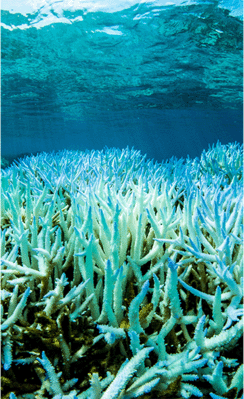 https://wordpress.com/read/feeds/17124327/posts/1359555949 John Pratt 2 Mar 17 Just when you thought the situation couldn’t get much worse for the Great Barrier Reef comes news that devastating coral bleaching will almost certainly increase significantly — again — in the coming months.
Record bleaching hit the 1,400-mile-long reef system in 2016, for the third year in a row, killing more than 65 percent of the coral of the northern reef. Climate change has impacted the ecosystem, as the colorful zooxanthellae are expelled from the coral during times of stress, according to numerous studies and the Australian Government’s Great Barrier Reef Marine Park Authority.
Coral can rebound in good times — though it takes as long as a decade — but scientists say that’s not likely to happen soon, if ever. The reef is already warmer than it was at this time last year and there’s a strong strong possibility that March and April will set new temperature highs ― and a new record for coral bleaching. Marine park authority workers are already seeing significant bleaching this season.
Press link for more: Huffington Post
Aerospace Australia Ltd a registered charity? why Australia’s defence splurging?
With the state governments of South Australia, Victoria and Queensland all touting for contracts, what is the role of the defence sector? Should Australian academic institutions enter into commercial-in-confidence research arrangements with corporations that trade in weapons, including nuclear weapons? Why is Australian defence spending growing and who are we protecting – and from what threat – with our $20 billion plus annual spend? And how can the event’s organiser, Aerospace Australia Ltd, be a registered charity?
Melbourne’s air warfare convention: ‘The ultimate family adventure’? Independent Australia Dave Sweeney 2 March 2017, This week, Geelong hosts a defence industry focused jaw jaw about war war, writes Dave Sweeney. “…….The Australian International Aerospace and Defence Exposition is an industry focused jaw jaw about war war that runs for three solo days before merging with the co-located and more public Australian International Airshow for a further three days of ‘the ultimate family adventure’.
If websites could get breathless this event’s would need a respirator:
AIRSHOW 2017 will feature the raw potency and power of modern military aviation. The thrust and grunt of the latest military heavy metal will take centre stage. The stars of the show will be state-of-the-art jet fighters, bombers and giant heavy lift leviathans from home and abroad. See them so close you could almost touch them. Shudder to the roar of their mighty jet turbines as they perform high octane routines and simulated combat manoeuvres. Marvel as swarms of attack helicopters join in the fray.
Oh, and it’s free for the under fives and there’s plenty of parking!
Avalon airport has a long-standing military connection. Currently owned by the Linfox group the strip was first used by federal agencies 65 years ago as the site for the development of the RAAF’s Canberra bomber.
Over the course of the week long event, around 200,000 people are expected to join air force representatives from Australia, France, Japan, Singapore, the UK, Canada, New Zealand and, of course, the US to ‘feel the power’.
Behind the disturbing images exhorting civilian families to bring their loved ones to the new Colosseum is a far more deeply disturbing trend towards uncontested war planning, spending and legitimising.
The sponsors of the event include the Federal and state governments, along with a who’s who of arms corporations.
BAE and Raytheon are giving away show bags, while nuclear weapons heavyweight Lockheed Martin will no doubt be spruiking its controversial new relationship with Melbourne University.
General Atomics, a shadowy group that has a finger in poisoned pies from drones to uranium mining in South Australia, is hosting the reception at the U.S. pavilion. Northrop Grumman, which has a cyber division that boasts of being able to “project force” globally is another of the cash-splashers.
And these corporations have cash to splash.
In 2015, the leading U.S. arms corporations generated more than $US200 billion.
A recent analysis by the International Institute for Strategic Studies shows with an annual spend of around $600 billion the U.S. is home to 40 per cent of the entire globe’s annual military outlay.
And with the new U.S. President planning a “massive” military budget increase and trumpeting “peace through strength“, these are good times for the MBA heavy masters of war.
But there are big questions that should be ventilated, along with the jet fuel and av-gas.
With the state governments of South Australia, Victoria and Queensland all touting for contracts, what is the role of the defence sector? Should Australian academic institutions enter into commercial-in-confidence research arrangements with corporations that trade in weapons, including nuclear weapons? Why is Australian defence spending growing and who are we protecting – and from what threat – with our $20 billion plus annual spend? And how can the event’s organiser, Aerospace Australia Ltd, be a registered charity?
Alongside the warplanes, it’s time for some plain truths and some “full throttle” answers.
Dave Sweeney is the nuclear free campaigner with the Australian Conservation Foundation. You can follow him on Twitter @nukedavesweeney. https://independentaustralia.net/article-display/melbournes-air-warfare-convention-the-ultimate-family-adventure,10073
Turnbull government failing badly on climate. pandering to fossil fuel companies
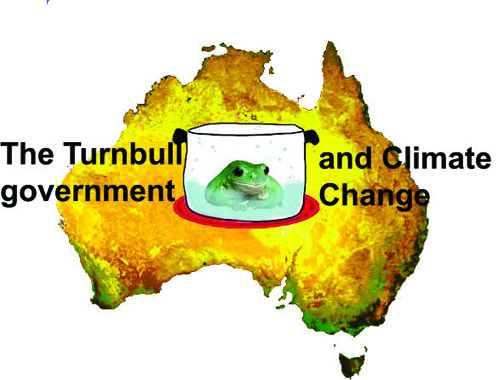 Climate pollution rising: Turnbull, Frydenberg failing, REneweconomy, By Matthew Rose and Suzanne Harter on 1 March 2017 If the Turnbull government had to pay a dollar for every time a minister claimed Australia was ‘meeting and beating’ its climate targets, the money would be stacking up. Their claims, however, would not.
New data, just released under the National Greenhouse & Energy Reporting Scheme, shows the climate policies of Prime Minister Malcolm Turnbull and Environment & Energy Minister Josh Frydenberg are simply not working.
The data reflects the emissions of approximately 400 of Australia’s biggest companies and sits alongside the National Greenhouse Gas Inventory as an indicator of our emissions trajectory.
The 10 biggest polluters remain the same as last year. although the order has slightly changed.
They include Australia’s biggest electricity generators, AGL, Energy Australia, Origin, Engie and CS Energy, along with mining giants Rio Tinto and Glencore.
Overall, climate pollution is up by 3.4 per cent since last year and by 7.5 per cent since the Abbott-Turnbull government axed the carbon price. Unlike the government’s current policy, the carbon price was reducing Australia’s pollution. This is evident in the data. [graph on original]
The new data also shows pollution from Australia’s electricity sector, which is responsible for about 35 per cent of our climate pollution, went up 2.6 per cent on the previous year and 5 per cent since the carbon price was removed.
The pollution increases — from specific generators and overall — show there is little incentive for big polluters to clean up their acts when they have a free ride to pollute.
Meanwhile, global warming continues to damage Australian treasures, like the Great Barrier Reef, and increase the likelihood and severity of heatwaves and bushfires.
And there’s no sign Australia’s international commitments under the Paris agreement, including our 2030 target for 26-28 per cent pollution reduction in 2005 levels, will be able to be reached without major policy changes that see Australia phase out fossil fuels and enable a rapid transition to clean renewable energy.
However, instead of acknowledging global warming as a national crisis that demands immediate serious action, the federal government is considering loaning Adani $1 billion for a coal-carting railway line from the Galilee Basin to the Great Barrier Reef coast and wants the Clean Energy Finance Corporation to fund new coal-fired power stations.
None of this stacks up for investors that see coal in terminal decline and are unwilling to sink their money into facilities that will undoubtedly end up as stranded assets.
Nor is support for coal consistent with our Paris commitments, which include driving down pollution to net zero well before mid-century keeping global warming under 1.5—2 degrees………
Turnbull and Frydenberg continue to blame renewable energy. The data released this week is hard evidence Australia’s pollution is going up and that means Turnbull and Frydenberg’s policies are failing. http://reneweconomy.com.au/climate-pollution-rising-turnbull-frydenberg-failing-15377/
National Australia Bank now investing in renewable energy in Europe, US and UK
 NAB taps offshore green bond market for 1.1GW of solar, wind, REneweconomy, By Sophie Vorrath on 2 March 2017 National Australia Bank has broadened its renewable energy investment reach to the European, US and UK markets, with the issuance this week of a €500 million ($A690 million) green bond, targeting what the bank describes as “strong investor demand” for solar and wind energy projects.
The bond, issued on Thursday, will refinance renewable energy and low carbon transport projects and assets in the UK, Europe, Australia and the Americas, including wind and solar energy assets with an expected installed capacity of more than 1GW.
It is the third bond of its kind to be issued by NAB, but marks the first issuance of an offshore green bond by an Australian bank, and the biggest ever green bond from an Australian issuer.
And it takes the bank’s total funds committed to the financing of renewable energy generators, globally, to more than $1 billion since October 2016, the bank says.
In 2014, NAB became the first Australian lender to jump into the booming green bond market, with the issue of a certified $150 million climate bond targeting a portfolio of 17 wind and solar projects.
As we reported here at the time, the largely renewable-focused exercise was a huge success, with strong investor demand doubling the size of the bond to $300 million within hours.
NAB it says its second green bond was also met with strong investor demand, and the order book well oversubscribed……http://reneweconomy.com.au/nab-taps-offshore-green-bond-market-for-1-1gw-of-solar-wind-48807/
Comments on the FINAL REPORT – SOUTH AUSTRALIAN SEPARATION EVENT- Australian Energy Market operator (AEMO)

After all the negative comments from State and Federal politicians and the media about renewable energy not providing synchronous generation I find it ironic that this “event” was 99% related to synchronous thermal (coal and gas) electricity generators. Ill-informed comment from politicians and journalists exposes the subjective ideological underpinning of these commentators.
Dennis Matthews 1 Mar 17, INTRODUCTION The AEMO report (, 1 DECEMBER 2016) is shockingly (!) written.
It’s full of jargon and acronyms with no easy way of finding what the acronyms mean. We could be forgiven for thinking that AEMO publications are intended to be read only by industry experts rather than concerned consumers.
Its charts are frequently unreadable, with minute characters used to label the axes, the axes overcrowded with labels, and five figure labels such as 200.00 where 200 would have sufficed.
The continual use of the words “incident” and “event” are reminiscent of the nuclear industry’s description of its many serious accidents and failures.
AEMO has uncovered gross inadequate performance by the electricity industry from electricity transmission to fossil fuel electricity generation to systems needed to maintain the integrity of the overall generation-distribution-transmission system. At no stage is there even a hint that severe penalties should be incurred by those responsible. I suspect, even if there were penalties that these would be recovered through increased prices. Competition is almost totally lacking in the industry.
At no stage was the cause of the “separation event” (failure of the Heywood interconnector from Victoria to SA) the fault of wind or solar electricity generators, quite the opposite. Wind powered electricity generators contributed 6% to power supply and the interconnector failure led to the shutdown of 2 wind farms in Victoria.
The following discussion uses the same section notation as the AEMO report.
1. OVERVIEW Continue reading
Newspaper “THE AUSTRALIAN” wages war on renewable energy
 The Australian’s war on renewables, The Australian newspaper has not
  allowed facts to get in the way of a good story in its sustained war on renewable energy. Norm Sanders reports. Independent Australia, 27 Feb 17
BY SEPTEMBER 2016, the coal lobby’s PR campaign was stalled — “clean coal” wasn’t selling. It was an obvious oxymoron, like “military intelligence”.
Then the South Australian Blackout gave the coal miners an unexpected break. Never mind that the blackout was caused by two tornadoes which blew transmission towers over. This was a golden opportunity to attack the renewables which are threatening the coal industry.
The Australian jumped in with gusto and began an extraordinary deluge of articles, editorials and cartoons denigrating renewables and the Labor State governments which supported them. Continue reading
Victorian government more than doubles solar-feed-in tariff
 Victoria solar feed-in tariff more than doubles to 11.3c/kWh, REneweconomy,By Giles Parkinson on 28 February 2017 More than 130,000 solar households in Victoria will benefit from a steep increase in their solar feed-in tariff in 2017/18, and will receive a minimum 11.3c/kWh for their exports back to the grid, up from 5c/kWh currently.
The hefty increase announced by the Essential Services Commission on Tuesday is the result of a big rise in wholesale prices, and the Victoria Labor government’s instruction to include an implicit carbon price, network benefits and environmental benefits into the tariff. Continue reading
Study finds that 100 per cent ‘off the shelf’ renewable energy network is affordable
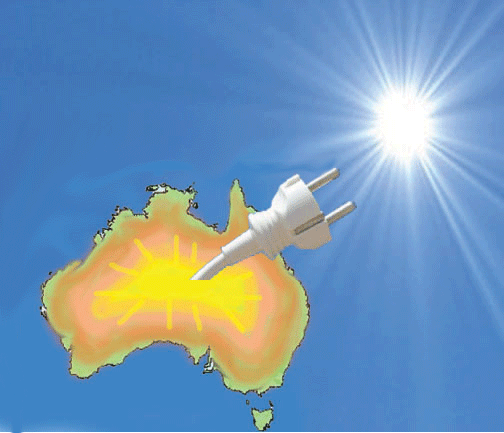 100 per cent renewable energy network affordable, secure and ‘off the shelf’: study, ABC News, AM By Caroline Winter, 27 Feb 17, Australia can build an affordable and secure electricity network with 100 per cent renewable energy, using existing technologies, according to research by the Australian National University (ANU).
So how would it work?
The study details plans for a zero-emissions grid which would rely on wind and solar technology, supported by pumped hydro storage.
It could be set up with inexpensive, currently available, “off the shelf” products and eliminate the need for coal and gas-fired power……
Professor Andrew Blakers from the ANU said wind and solar can be that replacement, with the support of off-river pumped hydro, where reservoirs at different altitudes can be used to store and generate power……..http://www.abc.net.au/news/2017-02-27/100-per-cent-renewable-network-possible/8306482
Traditional Owners v Adani in Federal Court today then to Canberra to discuss Native Title Amendments

 http://wanganjagalingou.com.au/traditional-owners-v-adani-in-federal-court-today-then-to-canberra-to-discuss-native-title-amendments/ Wangan and Jagalingou (W&J) Traditional Owners Council 27 February 2017:
“Traditional owners fighting the Carmichael megamine are on the front foot this week, challenging in court the native title process which allowed the Qld Government to issue a mining lease without their consent, and meeting with Federal MPs to present arguments why the Government’s amendments to the Native Title Act threaten the rights of Traditional Owners and fail to deal with the real issues arising from the recent McGlade decision.
“Senior spokesperson for the Wangan and Jagalingou (W&J)
Traditional Owners Council, Mr Adrian Burragubba, says,
“The W&J Family Council have voted three times since 2012 to reject Adani’s sham deal, while the National Native Title Tribunal gave the green light to the Qld Government to issue Adani with a mining lease, after the mining company applied to have our decision overridden.
This is the crux of our appeal before the full bench of the Federal Court on Monday”.
“Spokespeople for W&J, Mr Burragubba and Ms Murrawah Johnson, will also visit Canberra this week to meet with key Federal MPs about the Government’s Native Title Act Amendment Bill and explain the failures of the native title process.
Labor and The Greens voted against rushing the Bill through the House of Representatives last week. The Bill is now being scrutinised by a Senate committee which is due to report on 17 March 2017. … “
Industry request for Clean Energy Finance Corporation funds for new coalmining!

 Government green bank receives funding request for $1.2 billion coal-fired power plant, The Age, Adam Morton Amy Remeikis 28 Feb 17 The Turnbull government’s push for taxpayers to finance new coal-fired power stations is facing its first test after an application for support was lodged with the national green bank.
Clean Energy Finance Corporation chief Oliver Yates told a Senate estimates hearing that the agency received an email on Friday from an unidentified company requesting a loan for a proposed $1.2 billion, 900 megawatt coal plant with carbon capture and storage.
It was not immediately clear who was behind the plan, but energy industry experts noted the size and estimated cost were similar to a previous proposal by former mining magnate and MP Clive Palmer for a generator in Queensland’s Galilee Basin.
Speaking to Fairfax Media on Monday night, Mr Palmer said he had “retired” and directed questions to Waratah Coal managing director Nui Harris. But he said the company had spent $20 million on a similar plant under the Gillard government and the project was in a “high state of readiness”.
The Clean Energy Finance Corporation is banned from financing capture and storage technology, which involves burying the greenhouse gas emitted in burning coal underground. Dropping the ban would require a challenging change in legislation – a step likely to be opposed by Labor and the Greens.
Mr Yates said he believed new coal plants were not commercially viable unless the government was willing to indemnify the owner for the life of the plant.
He said the indemnity would need to cover any future climate change policy – an unquantifiable sum covering decades – and potential delays in construction due to protests.
Mr Yates, a former Macquarie Bank executive director who is stepping down as head of the finance corporation, said he was not aware of any bank that would be willing to lend to a project that may not be viable.
“I don’t see that as a sensible risk position for the taxpayer to take,” he said.
“If a private sector participant wants to go and build anything – they want to build a theme park, want to build the Eiffel Tower – it may not be economically sensible, but they are entitled to go and do it if they want to.”…….
Mr Yates said among the risks facing coal proposals was the falling cost of renewable energy. Coal generators would need to compete to sell the electricity they produced.
An analysis by consultants Bloomberg New Energy Finance recently found new coal plants, with emissions up to 25 per cent lower than Australia’s existing plants, would be more expensive than gas, wind or solar power. Adding carbon capture and storage would dramatically further increase the cost. ……. http://www.theage.com.au/federal-politics/political-news/government-green-bank-receives-funding-request-for-12-billion-coalfired-power-plant-20170227-gume05.html
No to Constitutional recognition. YES to Aboriginal Sovereignty and Treaties
Grassroots Aboriginal movement in NSW
squashes ‘Recognise’ Sovereign Union http://www.sovereignunion.mobi/ 24 February 2017:
“Grassroots Aboriginal people from New South Wales have rejected recognition in the Australian Constitution in favour of Aboriginal Sovereignty, the need for Treaties and for government to enter discussions with First Nations.
“‘It is heartening to know that the Recognise Regional Meeting, organised by the Referendum Council and the New South Wales State Land Council, held in Dubbo on 17 and 18 February 2017 voted to reject First Nation Peoples’ recognition in the colonial constitution from Britain and instead asserted Sovereignty and the need for Treaties and for the government to talk with First Nations,’
Ghillar, Michael Anderson, Convenor of the Sovereign Union, said. …
“Lynda Coe, a Wiradjuri representative at the Dubbo meeting, said:
“‘Proud to say the agenda in Dubbo this weekend was Sovereignty/Treaty … the dialogue around constitutional reform and recognise squashed by the grassroots movement!
The consensus from those who attended agreed that the process of invite only meetings did not provide clear representation of nations in New South Wales nor did the process give authority of those attending to speak on behalf of their nations as per our procedures.
The majority of those attending raised … the issue of Sovereignty/Treaty be addressed by Governments rather than the ‘yes vote’ for constitutional reform and/or recognise.'”
Ghillar said:“‘Whilst we may wonder why the Commonwealth government is now spending
millions and millions of dollars on a brain-washing campaign, the answers for this can be found in Commonwealth and State legislation everywhere, for example in the Native Title Act, Amendments to the Western Australian Heritage Act, the New South Wales Crown Lands Act, the New South Wales Biodiversity Conservation Act 2016, and the list goes on. …
“‘The recent meeting in Dubbo made it very clear that we are independent sovereign Nations and continue to be such in the present and to this extent call for negotiated Treaties as opposed to constitutional recognition. Continue reading
Conflict of interest: Queensland govt appoints Adani director to oversee coal port!
Adani director appointed to body overseeing mining giant’s coal port despite conflict of interest warning http://www.abc.net.au/news/2017-02-27/adani-director-appointed-government-body-overseeing-coal-port/8301104 Exclusive by the National Reporting Team’s Mark Willacy and Alexandra Blucher 27 February 2017:
“The Queensland Government appointed an Adani company director to chair the authority overseeing the Abbot Point coal port, despite being warned of “potential conflicts of interest”.
Key points:
“It’s undoubtedly a conflict of interest,” said law professor on Mr Fish’s appointment
Treasurer’s office confirms it knew of Mr Fish’s directorship and that he “disclosed potential conflicts of interest prior to his appointment”
But Mr Fish’s link to Adani was not disclosed publicly by the Treasurer when he was appointed … “
Plan for solar panels accessible to flat dwellers
Startup Allume lets solar panels be ‘shared’ by strata dwellers, AFR by Michael Bailey, 1 Mar 17 Providing solar power to apartments is an expensive and onerous problem which a Melbourne startup claims to have cracked.
Allume, a 2016 graduate of the Melbourne Accelerator Program, is patenting a 50 centimetre by 25 centimetre box its founders say. will allow solar power to be distributed and billed to individual apartments, without the expense of changing the building’s existing metering infrastructure.
Apartment residents wanting solar power have to date had two options, according to Allume co-founder Cameron Knox.
They could band together to install an ’embedded network’, where one meter channels electricity to the whole apartment block. However this requires everybody in the block to agree to sign up, and involves a “regulatory overhead” that renders most installations unviable………
Individual apartment owners could also connect to their own panels but even if their neighbours agreed to grant them the roof space, Mr Knox said the upfront cost of wiring a single flat would exceed $3000 and likely lead to inefficient use of the panel, with a much longer ‘payback period’ than that enjoyed by owners of standalone houses.
Under Allume’s system, not every apartment owner has to sign up and an installation is usually viable with as little as six customers, Mr Knox said.
In return residents get access to solar power for an average 16 cents per kilowatt hour, compared with the average retail power cost of 24 cents/kWh. The purchaser – whether it be the body corporate, or an external financier – is charged only the wholesale cost of the power and makes enough margin for the ‘payback period’ on Allume’s deal to range between six to eight years.
“Solar power purchase agreements typically last for 25 years, so that’s a lot of years of free revenue stream,” said Mr Knox.
Allume worked with the Australian Energy Regulator to get a ‘retail exemption licence’ allowing it to sell energy to landlords, who can then on-sell to tenants…… http://www.afr.com/leadership/entrepreneur/startup-allume-lets-solar-panels-be-shared-by-strata-dwellers-20170228-gun689#ixzz4a2ajEQB2
Media and nuclear – Australia – theme for March 2017
The new media landscape – what does it mean for Australia and nuclear issues? For one thing, the decline in mainstream media means that it’s cheaper and easier for mainstream media, particularly the Murdochracy, to abandon paying for true journalism and just regurgitate propaganda from government and the nuclear industry.
Australia’s news media, print, radio and TV continue to be under pressure, as people turn ever more to a variety of digital sources. Traditional news media lose advertising revenue, and good journalists lose their jobs. I have written about this before. But now, it’s happening ever faster. Quality newspapers struggle, especially in the print versions. The Sydney Morning Herald and The Age are likely to move from a daily to a weekend only printing. Still, print survives, and newer print news, like The Saturday Paper and The Monthly might just surprise us all.

The ABC soldiers on, with TV,radio and online news, in a climate of political pressure,and of repeated cutting of its funds, and threats of more cutting. In some areas, such as ABC Radio National, one detects dumbing down of content. Late Night Live survives – Phillip Adams now calling it “Fake Night Live”
Online news – Independent Australia, Crikey, Online Opinion, New Matilda etc battle on for financial survival, as the media landscape becomes an ecosystem of competing digital sources. Here some very fine journalism appears, from the usually unpaid critics of the nuclear industry, including internationally known experts on the subject, notably Dr Jim Green and Dr Helen Caldicott. At the same time, the well-heeled nuclear lobby also contributes articles.
Social media is increasingly, where it’s at, especially for nuclear issues. Websites, Blogs, Facebook, Youtube, Twitter, Linked-In, Tumblr etc.
Environmental organisations have busy websites. But increasingly – it’s Youtube and Facebook that now lead the pack. Sadly, for Youtube, the pro nuclear lobby has many sophisticated propaganda videos. Australia’s under-funded Aboriginal and environmental groups lack the resources to make great use of Youtube.

For hot nuclear issues, Facebook sites, especially for South Australia. Some examples: nuclear fuel cycle watch south australia, Fight To Stop Nuclear Waste Dump In Flinders Ranges SA No High Level International Nuclear Waste Dump in South Australia enuff south australia . Some other sites: Central Australian Nuclear Free Alliance. west australia nuclear free alliance. Nuclear Spinbuster.
Twitter is, at present, under-used by Australia’s nuclear-free activists, though Friends of The Earth tweets at @NuclearFreeAus
Meanwhile Australia’s pro nuclear lobbyistsare very active, and use sophisticated algorithms to churn out multiple tweets from just one source. Fortunately a lot of these seem quite stupid, spending much time on infantile trolling of Dr Caldicott. Examples: @totterdell91 @thjr19 and a lot of their fake clones, often adopting female names e.g Marcelina, EcoWife
How do we manage in the new media ecosystem?
First, Australians who care about their country and their planet need to make better use of social media in particular. And, we need to be aware of the traps in it. Our public social media sites are viewed by the nuclear lobby and Australia’s government, (often lackey to the nuclear lobby). Personal information can be used against you. Mistaken, inaccurate, unwise statements can be used against the environmental cause.
Above all, the new media landscape means that we have to exercise judgement in what we read and write. Look for accuracy. Look for credible sources, and quote these. As Donald Trump has taught us – there’s so much “fake news” out there. I don’t think that Trump actually meant his own lies, here, But Trump has certainly been a force in hastening the already happening process of muddying the media waters.
Australia’s dwindling nuclear lobby pushes on, blind to the economic realities
Nuclear Power Is In Crisis As Cost Overruns Cripple Industry Giants, New Matilda., By Jim Green on February 26, 2017 “……….Shellenberger recently noted that: “Radical breaks from past designs sometimes work in industries that require little up-front capital, like Internet companies. It’s now clear that they are deadly when it comes to nuclear.”
 Those comments refer to APR1000 and EPR reactors, which are just modified versions of long-established, conventional reactor technology. The likelihood of genuinely radical Generation IV concepts coming to the rescue is minuscule in circumstances where the inability to build a handful of conventional reactors on-time and on-budget has brought industry giants ‒ with decades of experience and tens of thousands of employees ‒ to their knees.
Yet Australia’s dwindling but determined group of nuclear lobbyists continue to press the case for Australia to take the lead developing Generation IV reactor types. So Australia ‒ a country with virtually no relevant expertise and even less experience ‒ should take the lead developing Generation IV reactors despite the fact that four global giants face crippling debts due to cost overruns building a handful of conventional reactors?
That proposition is beyond stupid and it was completely rejected by the SA Nuclear Fuel Cycle Royal Commission last year.
The Royal Commission said: “[A]dvanced fast reactors and other innovative reactor designs are unlikely to be feasible or viable in the foreseeable future. The development of such a first-of-a-kind project in South Australia would have high commercial and technical risk. Although prototype and demonstration reactors are operating, there is no licensed, commercially proven design. Development to that point would require substantial capital investment. Moreover, electricity generated from such reactors has not been demonstrated to be cost competitive with current light water reactor designs.”
On conventional nuclear power, the Royal Commission concluded that “on the present estimate of costs and under current market arrangements, nuclear power would not be commercially viable to supply baseload electricity to the South Australian subregion of the NEM from 2030 (being the earliest date for its possible introduction)”.
The dwindling nuclear lobby will continue with their beyond-stupid promotion of Generation IV reactors, and they’ll continue peddling misinformation about renewables, but there’s no longer any reason why the rest of us should pay any attention. https://newmatilda.com/2017/02/26/nuclear-power-is-in-crisis-as-cost-overruns-cripple-industry-giants/
1 This month


Help Aunty Sue Protect Her Land and Sacred Sites From Destructive Rocket Testing.
.

Australians deserve the truth
about
AUKUS – https://aukuspublicinquiry.com/

PETITION – To: Prime Minister Anthony Albanese and the Australian Labor Government

of the week – Australians for War Powers Reform (AWPR)
To see nuclear-related stories in greater depth and intensity

