Nuclear Gamble is an Economic Wrecking Ball
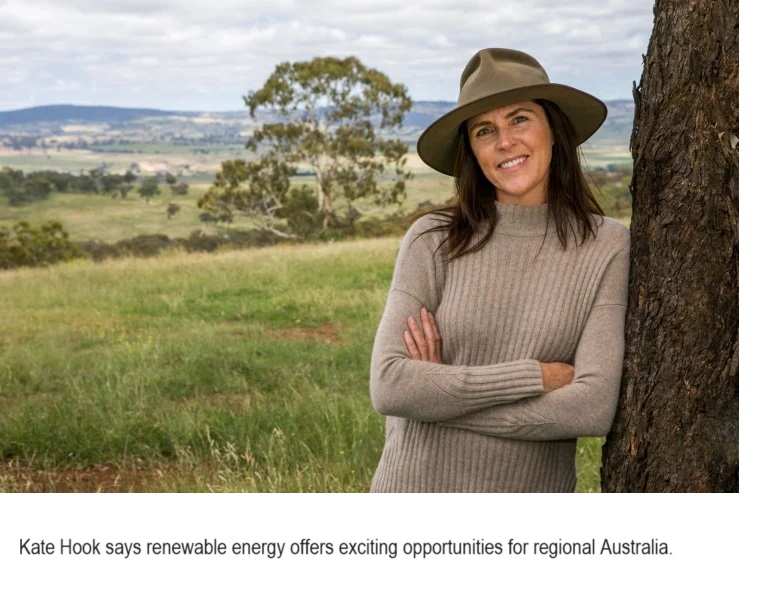
February 17, 2025 AIMN , Kate Hook
Nuclear gamble is an economic wrecking ball – Lithgow and the Central West deserve better
Independent candidate for Calare, Kate Hook, has slammed the Coalition’s nuclear proposal, calling it an economic wrecking ball that will waste billions, push up power prices, and stall job creation in regional Australia.
“Energy experts, market operators and Australia’s leading economists have been clear – Australia can achieve a secure, reliable, and affordable power system without nuclear power,” Ms. Hook said. “The Coalition’s plan is a costly distraction, and I will not support it.”
“The communities that will suffer most from this reckless policy are the very ones that need investment in real, job-creating industries right now – not in 15 or 20 years.”
Ms. Hook called out the nuclear plan for what it is – a stalling tactic to prop up fossil fuel operators, keep government subsidies flowing to outdated industries, and leave Australian taxpayers to foot the bill.
Nuclear reactors take decades to build and cost tens of billions of dollars – public money that could instead be spent on renewables, storage, and grid upgrades today. By the time nuclear power could even begin operating, Australia’s energy system will already be overwhelmingly powered by cheaper, cleaner alternatives.
“We are at 40% renewable energy now and in the last 6 years alone, we’ve already added over 46 TWh (Terra Watt hours) of annual renewable energy generation to the grid. This number might not mean much to most people but it’s huge! It’s the equivalent of six nuclear power stations. And we did it in six years – not 15 or 20 years,” Ms Hook said.
Renewables and Storage: Reliable, Affordable, and Ready Now
The Australian Energy Market Operator (AEMO) has mapped out the most efficient path forward—and nuclear isn’t part of it. The smart, cost-effective way to secure Australia’s energy future is through renewables, backed by battery storage, pumped hydro, and modern grid technology.
Big battery projects like South Australia’s Hornsdale Power Reserve are already proving their worth. Originally built with a capacity of 129 MWh – enough to power 30,000 homes for a day – it has since expanded to 194 MWh, providing power to 50,000 homes and stabilising the grid within milliseconds during sudden demand spikes.
“This fast response prevents blackouts and keeps energy prices stable—something nuclear power just can’t do,” Ms. Hook said.
Pumped hydro projects like Snowy 2.0 will ensure around-the-clock reliability. When completed, its 2.2 GW capacity will generate enough electricity to power three million homes during peak demand – like when air conditioning use surges on a hot summer evening.
With 350,000 MWh of storage, Snowy 2.0 could power 500,000 homes for an entire week or every home in Sydney for three days.
“We don’t need to waste time and money on nuclear power when we have already invested in proven, ready-to-go solutions that lower energy bills and create jobs right now,” Ms. Hook said.
Lithgow Needs Smart Investments, Not Costly Distractions
Kate Hook recognises that Lithgow has been at the heart of Australia’s energy production for generations. With coal mines closing and Mt Piper Power Station scheduled to shut in 2042, Lithgow needs a real plan for its future – not a decades-long delay.
“Lithgow deserves practical, affordable, and proven energy solutions – not a risky, drawn-out experiment that will leave taxpayers footing the bill for decades,” Ms. Hook said.
Beyond spiralling costs and construction delays, nuclear power comes with long-term risks that regional communities like Lithgow will be forced to bear. The Coalition has no plan for nuclear waste storage, no consultation with impacted communities, and no clear strategy for financing these massive projects.
……………………………………….“Nuclear is a dead-end policy – an economic wrecking ball that will drive up power prices and leave communities paying the price,” Ms. Hook said. “Instead of pouring billions into an outdated, high-risk technology, we should be investing in industries that will deliver affordable energy and secure jobs for Lithgow and all of Calare.”
A Clear Choice on Election Day
With voters in Calare facing a critical decision at the next election, Kate Hook urged the community to reject the Coalition’s nuclear “plan” and back a renewables-led future.
“This election is about who we trust to deliver cheaper energy, good jobs, and a secure future for our region,” Ms. Hook said. “Nuclear power in Australia is an expensive fantasy which is not backed by economic or energy experts – renewables are the real opportunity for Calare.”…………………………. https://theaimn.net/nuclear-gamble-is-an-economic-wrecking-ball/
The four accounting tricks behind Peter Dutton’s nuclear cost claims

So according to the data within the Liberal-National Party’s costing document, Dutton’s power system underpinned by nuclear will generate electricity at 6% lower cost than one that doesn’t rely on nuclear. It leads you to wonder – how on earth did Dutton come up with it being 44% cheaper?
There are four accounting tricks behind the 44% cheaper claim which mean that, in reality, Peter Dutton’s plan is not cheaper and is far more risky.
Tristan Edis, Feb 18, 2025, https://reneweconomy.com.au/the-four-accounting-tricks-behind-peter-duttons-nuclear-cost-claims/
The Liberal-National Coalition claims it has found the solution to bring down energy bills – slow the growth of renewable energy and roll-out nuclear power.
According to Liberal Leader Peter Dutton, their plan for a power system including a significant role for nuclear will be 44% cheaper than a system relying predominantly on renewables. This claim is based on energy market economic modelling it released just before Christmas, prepared by an economic consultant – Frontier Economics.
A range of energy analysts and economists have criticised the Coalition’s claims, finding an array of problems with how this number was derived (see the list at the bottom of this article for examples). Nonetheless this hasn’t made any difference to Peter Dutton’s claims, and earlier this month he was on ABC television telling viewers that he had a plan to deliver voters 44% cheaper power bills.
However, you don’t need to be any kind of expert analyst or economist to work out that the claim nuclear will deliver you 44% lower bills is a bit like a wrinkle cream claiming it will make you look 44% younger.
And in the end, though it might not be obvious, this is really about whether Liberal-National Party have discovered a miraculous cure for aging, and quite potentially the laws of physics. It isn’t really about nuclear.
To explain this you need to do a very simple calculation:
1) Get out a basic calculator.
2) Into this calculator type in the $20.5 billion dollars that the Liberal-National Party costing says will be the annual price of their power system once all the nuclear power plants are complete in 2051 (see Figure 12 on page 38 of the consultant’s report).
3) Then divide this cost by the total amount of electricity that system will deliver in 2051 after deducting generation from energy storage, which is roughly 255 million megawatt-hours (see table 8 on page 34).
That gives you the cost of energy under their system of around $80.30 per megawatt-hour.
Now do the same thing for the power system which Dutton claims to represent Labor’s policy (by the way it’s not really Labor’s policy, it’s the Australian Energy Market Operator’s Step Change modelling scenario). So divide $28.5 billion (Figure 12 on page 38 of consultant’s report) by 333 million megawatt-hours (table 5 on page 28).
That gives a cost of energy of close to $85.50 per megawatt-hour for the so called Labor system.
So according to the data within the Liberal-National Party’s costing document, Dutton’s power system underpinned by nuclear will generate electricity at 6% lower cost than one that doesn’t rely on nuclear. It leads you to wonder – how on earth did Dutton come up with it being 44% cheaper?
There are four accounting tricks behind the 44% cheaper claim which mean that, in reality, Peter Dutton’s plan is not cheaper and is far more risky. The four tricks involve the following:
1) It doesn’t reflect the real cost of building nuclear – the Liberal Party costing assumes a cost for nuclear power plants which is around half what nuclear reactors have actually cost to build. Once you use the average construction cost and construction time of real world nuclear plants, the cost per unit of energy for the Liberal-National Party’s power system is two thirds more expensive than what is estimated for Labor’s scenario, once the system is fully built.
2) Only considers electricity costs while ignoring the cost of petrol and gas – The costing omits much of the costs of energy to heat buildings, fuel vehicles and power industry in the Liberal-National party scenario because they seem to prefer that we continue to heavily rely on petrol to fuel our cars and gas instead of electricity to heat homes and run factories.
Meanwhile, a lot of these costs are included in the scenario for Labor, where electricity has largely replaced the use of petrol and gas for fuelling our vehicles and heating buildings and industrial processes. By just accounting for the 203 billion litres of extra petrol consumption in the Liberal-National scenario the claimed 44% saving evaporates and instead you find their energy system is $80 billion more expensive that what they claim is the cost for the Labor scenario.
3) Tries to hide the cost of replacing old coal power stations with nuclear to outside the time period covered by the costing. The costing only includes costs incurred between 2025 and 2051, anything beyond that point is ignored. Under the costing of the Liberal-National Party’s scenario they’ve pushed most of the costs of replacing old coal power stations to outside the 2025-2051 time period. Meanwhile, the costing ignores the risks and potential large costs associated with extended reliance on increasingly unreliable old power stations.
4) Assumes climate change isn’t an important and urgent problem – The modelling consultant has openly acknowledged the availability of economic data that would allow them to cost the damage from carbon emissions. But instead of using this data from the Australian Energy Regulator, they instead completely ignore the damage costs from the higher emissions under the Coalition’s preferred scenario of extended reliance on coal, petrol and gas.
If the consultant had adhered to the basics of first year economics based on work published back in 1920, and placed a cost on carbon in line with AER guidance, it would add $392 billion to the Liberal-National scenario compared to just $75 billion to the Labor scenario. If you add that to the extra cost of petrol then the Liberal-National scenario is almost $400 billion more expensive than the scenario claimed to be Labor’s across 2025 to 2051. That’s even if we ignore the extra costs associated with accounting tricks 1 and 3.
Over the next few days I’ll go into each one of these four accounting tricks in more detail with an article explaining how that trick acts to mislead voters and means that energy consumers would most likely face higher, not lower energy bills.
This isn’t intended to suggest that the Australian Energy Market Operator’s Step Change scenario (said to represent Labor policy) should go unquestioned. The future is full of uncertainties and we need to examine a range of options for how we can sensibly lower emissions while maintaining reliable and affordable energy suppliers.
Unfortunately, the suggestion that Nuclear Power is the easy fix simply ignores the incredible difficulties and costs Europe, North America and Japan have experienced with Nuclear Power.
Tristan Edis is director of analysis and advisory at Green Energy Markets. Green Energy Markets provides analysis and advice to assist clients make better informed investment, trading and policy decisions in energy and carbon abatement markets.
Dutton’s nuclear disaster: Cheap lies and a $20 billion deficit
By Steve Bishop | 17 February 2025, https://independentaustralia.net/politics/politics-display/duttons-nuclear-disaster-cheap-lies-and-a-20-billion-deficit,19447
The Coalition’s nuclear policy announcement comes with a massive price tag but is also built on disinformation, writes Steve Bishop.
A $20 BILLION deficit and cheap lies mean that Opposition Leader Peter Dutton‘s attempt to “extend the life” of coal-fired power plants with a nuclear “fix” has come spectacularly unstuck.
Dutton and the Coalition stand condemned for presenting the public with a shoddy, ill-prepared policy on a multi-billion dollar project that the Climate Council warns could risk power shortages in the 2030s.
On 13 December last year, Mr Dutton promised:
SEARCH
Daily Telegraph tries and fails to stage antisemitic incident
Share the love — Gift an IA Subscription!
Dutton isn’t just exploiting antisemitism — he’s driving it
Dutton’s vow to slash public servant numbers another Coalition disaster
The Apprentice tells Trump’s supervillain origin story
Daily Telegraph tries and fails to stage antisemitic incident
Share the love — Gift an IA Subscription!
Dutton isn’t just exploiting antisemitism — he’s driving it
Dutton’s vow to slash public servant numbers another Coalition disaster
The Apprentice tells Trump’s supervillain origin story
Politics Opinion
Dutton’s nuclear disaster: Cheap lies and a $20 billion deficit
By Steve Bishop | 17 February 2025, 3:00pm | 0 comments |

The Coalition’s nuclear policy announcement comes with a massive price tag but is also built on disinformation, writes Steve Bishop.
A $20 BILLION deficit and cheap lies mean that Opposition Leader Peter Dutton‘s attempt to “extend the life” of coal-fired power plants with a nuclear “fix” has come spectacularly unstuck.
Dutton and the Coalition stand condemned for presenting the public with a shoddy, ill-prepared policy on a multi-billion dollar project that the Climate Council warns could risk power shortages in the 2030s.
On 13 December last year, Mr Dutton promised:
‘By 2050, our plan will deliver up to 14 GW of nuclear energy, guaranteeing consistent and stable electricity for all Australians.’
Yet the Coalition’s costings report, released on the same day, repeatedly deals with only 13 GW.
That’s 1,000 MW short of the target.
Three small modular reactors (SMRs) producing 345 MW each would be needed to make up the shortfall at a cost of almost $20 billion based on the US$4 billion (AU$6.2 billion) price of Opposition energy spokesman Ted O’Brien‘s favoured Natrium reactor.
Just to put this critical mess in focus — that’s twenty thousand million dollars. It makes a mockery of Dutton’s claim that “the Liberal Party has always been a better economic manager…”
And then come the cheap lies.
Mr Dutton claims:
“…electricity is cheaper where there is a presence of nuclear energy. That is a fact.”
No, it’s not a fact. It is a lie.
Ted O’Brien has repeatedly talked about Ontario as having cheap power because it has nuclear reactors.
But Quebec’s electricity prices are far cheaper than Ontario’s. Quebec closed its only nuclear power plant in 2012.
Not only that, but Quebec’s power company paid the provincial government a dividend of $2.5 billion in 2023/24.
On the other hand, the Ontario Government pays subsidies of up to $720 a year to families of four earning less than $65,000 a year.
Coalition frontbencher Dan Tehan says nuclear power contributes to low power prices in Tennessee but Electric Choice shows that this month Idaho, Kentucky, Oklahoma and Utah all have lower power prices — and none of them has nuclear power,
Dutton claims “Australian families at the moment are paying some of the highest energy costs in the world” and they would enjoy ‘massive savings’ if we had nuclear power.
The Opposition Leader also says it’s a fact that countries such as the UK and France, with their nuclear power, have cheaper power prices than Australia.
Here’s the lie exposed again. It’s a complete meltdown. According to Statista, power prices in the UK and France are more expensive than in Australia.
Here’s another lie.
Mr Dutton asserts:
‘…nuclear energy… has proven to get electricity prices and emissions down all over the world…’
Slovenia has a nuclear power plant but is one of the most expensive providers in Europe with Switzerland‘s nuclear power prices not far behind.
Slovakia generates half its power from nuclear plants but power prices are more than twice what Norwegians, with no nuclear power, pay.
Then Dutton has the chutzpah to accuse the Government of lying when it points out that nuclear power is the most expensive type of energy.
In the 2021 edition of its annual cost report, Wall Street firm Lazard estimated that the levelised cost of electricity from new nuclear plants will be $131–204 per megawatt-hour (MWh), whereas newly constructed utility-scale solar and wind plants produce electricity at somewhere between $26–50MWh.
An independent report commissioned by the Clean Energy Council and conducted by Egis, a leading global consulting, construction and engineering firm, has confirmed that nuclear energy is up to six times more expensive than renewable energy.
The Institute for Energy Economics and Financial Analysis (IEEFA) found nuclear power in Australia could result in electricity bills rising by $665 a year on average
And the Commonwealth Scientific and Industrial Research Organisation (CSIRO) has found:
‘…building nuclear reactors in Australia would cost at least twice as much as renewable power…’
No wonder that Coalition whistleblower Senator Matt Canavan revealed the nuclear policy is no more than a fix. It doesn’t even deserve a half-life.
Taxpayers should not foot the bill for nuclear risk
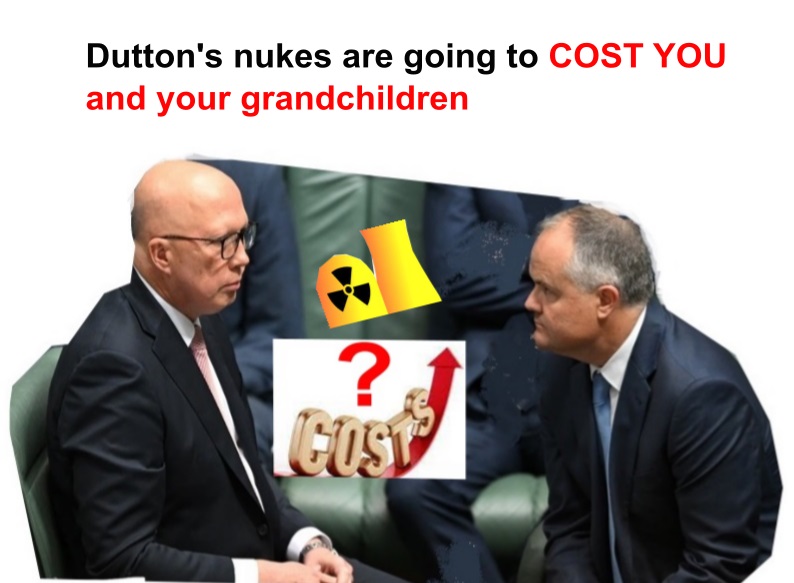
Australians for Affordable Energy, 17 Feb 25, https://theaimn.net/taxpayers-should-not-foot-the-bill-for-nuclear-risk/
If private insurers refuse to cover nuclear reactors the financial risks will be shifted onto Australian taxpayers, meaning we are still unclear how much taxpayers will have to cover of the nuclear bill.
Australians for Affordable Energy has expressed deep concern over the revelation the private sector may not be able to insure nuclear reactors, following comments on Monday from the CEO of the Insurance Council of Australia.
Many of Australia’s leading insurance companies won’t cover damage from a nuclear disaster, leaving the government as the insurer. By shifting the financial burden of insuring nuclear facilities onto taxpayers, Australians could be exposed to potentially tens of billions of dollars in liabilities if a nuclear accident were to occur.
“We know that private investors won’t put money into building the industry, that we will need to create a massive new government agency to oversee it, and now we are hearing that we will need to pay for the insurance too? What’s next?”
“Advocates for nuclear energy need to say whether it can stand on its own, including paying their insurance. And they need to tell us what other costs we might be asked to carry. The fact is by the time the reactors are done it won’t be us paying the bills for the insurance, it’ll be our grandkids. I’d like to know what we’re signing them up for. ”
Australians for Affordable Energy spokesperson Jo Dodds, a bushfire survivor and advocate for evidence-based policy, said: “Australians are already struggling with rising energy costs, the last thing we need is a power source that could further inflate our electricity bills and our taxes.
“The high costs associated with uninsured nuclear power could be passed onto consumers, who are already looking at paying higher bills if we were to shift to nuclear power. This is money hardworking Australians simply can’t afford to pay.”
AFAE is warning against locking into costly or uncertain energy options and is calling for greater transparency on the long-term costs of competing energy plans.
Why are young people like this 18-year-old fronting the pro-nuclear push in Australia?
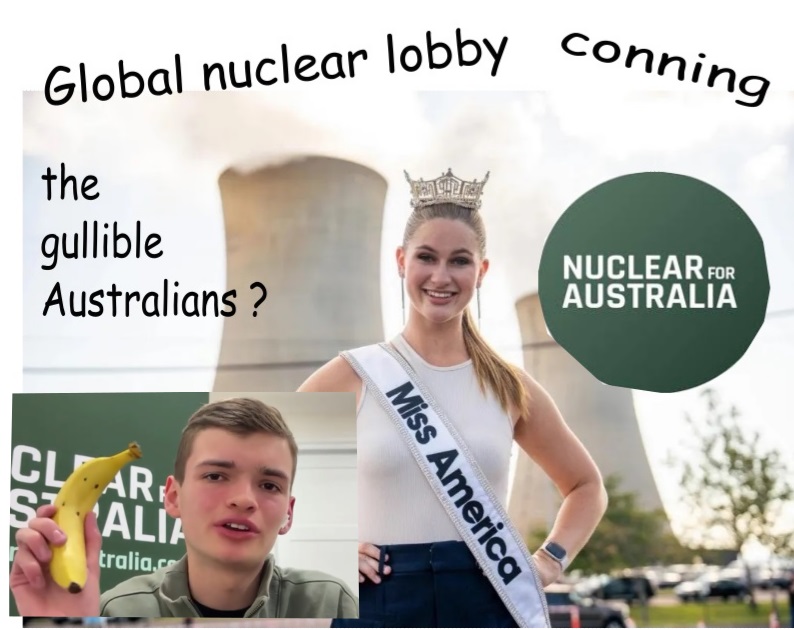
SBS News, 13 February 2025
The regional sessions were not publicised beforehand on Nuclear for Australia’s social media accounts or the tour page on its website — you could only register for tickets if you knew the URL for the event’s webpage.
Campaigns director for the Conservation Council of Western Australia, Mia Pepper, said when she tried to get tickets for the Perth event online, she was denied. She said a colleague also failed to get tickets using their real name, but able to get in using an alias.
Shackel said Nuclear for Australia Googles people’s names beforehand to determine whether they are “likely going to cause a disruption or a threat”
Some polling suggests older Australians are more supportive of nuclear power than their younger counterparts. So why are young people fronting a pro-nuclear push?
SBS News, By Jennifer Luu, 13 February 2025
In a function room at Brisbane’s The Gabba sports ground, around 600 people have gathered to hear Miss America 2023 try to convince Australians nuclear power is a good idea.
Sporting a blue cocktail dress, blonde hair and a wide smile, 22-year-old Grace Stanke looks the part of a beauty pageant contestant.
She’s also a nuclear engineer touring the country with Nuclear for Australia: a pro-nuclear lobby group founded by teenager Will Shackel and funded by donors that include entrepreneur Dick Smith.
The event — billed as an information evening featuring a panel of experts — is off to a rocky start. A protester steps in front of the audience and speaks into a microphone.
“All of the organisers, presenters and sponsorship of this event tonight has a very deep vested interest — ” he says, before he’s drowned out in a chorus of boos and the mic is seized from his hand.
Audience members continue to disrupt last month’s event, raising their voices and speaking to the crowd before being herded out by security.
Among them is Di Tucker, a retired psychologist concerned about climate change. She said she became upset after submitting half a dozen questions online to be answered by the panel — and felt like they were being deliberately ignored.
“I felt so frustrated by the lack of factual information in that so-called information session forum on the safety, the timescale and the reality of nuclear energy,” Tucker told The Feed.
“I did stand up and I addressed the crowd, and I said something like: ‘You people need to go away and do your own research … it’s glossing over facts’.”
Nuclear for Australia founder Will Shackel, who was emceeing, estimated there were 20 to 30 protesters heckling the room.
He labelled their behaviour “simply unacceptable and … not in the interest of a fair discussion”.
“They were yelling abuse at us on stage. We had people come up to Grace at the end, call her a clown,” he claimed.
Shackel told The Feed: “We had people [who] had to be physically dragged out because they were resisting security … it was pretty ugly and pretty disturbing.”
Tucker disputes this: “Nobody I saw leave the room was hostile or aggressive, physically aggressive towards the security guards.”
“In fact, it was the opposite. The security guards were shoving the people outside.”
Outside, a separate group of protesters wields banners warning against the dangers of radioactive waste.
The words “Nuclear energy distracts from the climate emergency” are projected onto The Gabba over the image of a red herring.
The teen and the beauty queen
Tucker said the audience was mostly male and over 60. So why are two young people fronting the pro-nuclear movement in Australia?………………………….
As well as launching Nuclear for Australia — which describes itself as “the largest nuclear advocacy organisation in Australia” with over 80,000 supporters — he’s addressed a Senate committee and interviewed French President Emmanuel Macron for his organisation’s social media at the COP28 climate conference in Dubai in 2023.
Shackel first became fascinated with the nuclear debate while in high school in Brisbane.
“I’d just done a school assignment on nuclear energy when I realised it was banned. And that, as a 16-year-old kid, was pretty shocking to me,” he said.
Australia is one of the few countries where using nuclear energy to produce electricity is illegal. The ban was introduced in 1998, when the Howard government made a deal with the Greens in order to build a nuclear reactor in Sydney for research purposes.
At 16, Shackel launched a petition calling on Australia to lift its nuclear energy ban, garnering a flurry of media attention……….
As well as launching Nuclear for Australia — which describes itself as “the largest nuclear advocacy organisation in Australia” with over 80,000 supporters — he’s addressed a Senate committee and interviewed French President Emmanuel Macron for his organisation’s social media at the COP28 climate conference in Dubai in 2023……………………………
Nuclear power is still a contentious topic, but more Australians have become supportive of the idea over time.
A 2024 Lowy Institute poll of 2,028 Australians
indicates 61 per cent support Australia using nuclear power to generate electricity, while 37 per cent were opposed.
Among the 18- to 29-year-olds surveyed, 66 per cent supported nuclear power while 33 per cent were opposed.
In contrast,
a December 2024 poll of 6,709 people conducted for the Australian Conservation Foundation suggests young people were less likely to agree that nuclear is good for Australia, compared to older respondents. For example, 42 per cent of males aged 18-24 agreed, while 56 per cent of males over 54 agreed.
There’s also a gender gap — in the same poll, just over a quarter of women thought nuclear would be good for Australia, compared to half of men.
Nuclear for Australia hopes Grace Stanke can convince the sceptics. Dubbed “the real-life Barbenheimer”, she works for the operator of the largest fleet of nuclear power plants in the US, Constellation. (The company operates 21 of the US’s 94 nuclear reactors).
Now 18, Shackel suggests young Australians are more open-minded towards nuclear power than older generations and are more likely to support parties that are concerned about climate change……..
Physicist Ken Baldwin speculates the rise in support for nuclear power is due to shifting demographics.
He said older generations are more likely to have historical hangups around the dangers of nuclear power, having lived through the British and French weapons tests in the Pacific and nuclear catastrophes like the 1986 accident in Chernobyl and the 2011 accident in Fukushima. ……
“The younger generation … doesn’t have that particular historical baggage, and perhaps they’re more attuned to thinking about the need to do something about climate change,” he said.
Nuclear for Australia hopes Grace Stanke can convince the sceptics. Dubbed “the real-life Barbenheimer”, she works for the operator of the largest fleet of nuclear power plants in the US, Constellation. (The company operates 21 of the US’s 94 nuclear reactors)…………….
Nuclear for Australia has been drumming up public support for nuclear power over the past fortnight, touring every capital city (except Darwin) and holding a parliamentary briefing in Canberra.
It also targeted regional areas near the Coalition’s proposed sites for future nuclear power stations — including Morwell in Victoria, Collie WA, Port Augusta SA, Callide and Tarong in Queensland and Lithgow in NSW. The Coalition says its taxpayer-funded plan is for five large and two smaller reactors, with the smaller ones to come online in 2035 and the rest by 2037.
Nuclear for Australia was slow to reveal all the names for a total number of regional locations for the tour. During the first week of the tour, Nuclear for Australia told The Feed there would only be two regional stops.
The regional sessions were not publicised beforehand on Nuclear for Australia’s social media accounts or the tour page on its website — you could only register for tickets if you knew the URL for the event’s webpage.
Campaigns director for the Conservation Council of Western Australia, Mia Pepper, said when she tried to get tickets for the Perth event online, she was denied. She said a colleague also failed to get tickets using their real name, but able to get in using an alias.
She accused Nuclear for Australia of blacklisting known anti-nuclear activists and trying to avoid criticism by attempting to “creep around the country”.
“If they were really genuine about having a mature debate, they would do their best to invite some people like myself that have engaged really respectfully in the debate over many years to answer the tough questions,” she said.
Shackel said Nuclear for Australia Googles people’s names beforehand to determine whether they are “likely going to cause a disruption or a threat”, and that regional events aren’t publicised on social media because they are not relevant to city-based audiences.
“We care about the safety of our attendees, we care about the safety of our experts,” Shackel said.
“If we believe that someone is a known protester … someone who could cause a physical threat to people in there, we will not allow them in.”
Pepper said: “I have never been physically aggressive to anybody in my entire life.”
“The idea that because you are opposed to nuclear power, you somehow would be aggressive or violent is absolutely outrageous.”
Locals left with more questions than answers
South of Perth, around 100 of the 9,000 residents of the tiny coal mining town of Collie showed up to the Nuclear for Australia event, hoping to learn more about how living next to a nuclear reactor could affect them.
The Coalition has proposed converting Collie’s coal-powered station into a nuclear power plant. But the state government is vowing to phase out coal by 2030 and there’s little chance nuclear power could come online by then, leaving coal workers in limbo.
Resident Jayla Anne Parkin said the information session was “an utter waste of time”, and she came away with more questions than answers. “Their whole speech was very generic. They were probably using the same speech for every single area,” she said.
Parkin asked one of the experts where the water for a nuclear power plant would come from — with large amounts needed to cool the radioactive core.
“He gave a long-winded speech about how we can take any body of water, whether it be the ocean, the river, pool, sewage, and treat it and turn it into the water. But at the end of him answering it, he still didn’t tell me what source of water in Collie they were going to use,” she said.
“We’re very limited with water here as it is.”……………………………………………
there have been reports about Shackel’s alleged political ties.
A 2024 research report from progressive activist group GetUp on nuclear disinformation in Australia
analysed Shackel’s LinkedIn connections and reported that their political party affiliation leant heavily towards Liberal Party MPs, Senators and advisors.
GetUp reported at least 36 of Shackel’s connections, including 11 current or former politicians, were directly linked to the Liberal Party — with the party having the highest concentration of current employees from a single organisation in his network…………………………………..
Lobby groups are allowed to have political party affiliations. While registered charities can participate in campaigning and advocacy, they “cannot have a purpose of promoting or opposing a particular political party or candidate”, according to the Australian Charities and Not-for-profits Commission.
……………………………………………………… Professor Ken Baldwin said nuclear is “not really viable” as an option for decarbonising Australia by 2050, as it would take 15 years at the very minimum to develop the necessary regulations and build a nuclear power station.
“We will have, according to the current plans, converted our current energy system to almost an entirely renewable energy system by that time,” Baldwin said.
“Australia is at the leading edge of the renewable energy transition. We’re installing solar and wind at one of the fastest rates per capita of any country in the world.”…………… https://www.sbs.com.au/news/the-feed/article/will-shackel-australia-pro-nuclear-movement-young-people/gucu0iefz
Doctors fear health fallout from nuclear energy plans
Canberra Times, By Marion Rae, February 12 2025
Doctors have warned of no “safe” level of radiation from a proposed network of nuclear reactors as battlelines are drawn for the federal election.
Similar to other nuclear-powered nations, Australians living within a certain radius of a reactor would need to be issued potassium iodide tablets for use in a radiation emergency, a nuclear briefing has learned.
“The only reason that everyone in that radius is given that is because they might need it,” Assistant Minister for Climate Change and Energy Josh Wilson told a nuclear briefing on Tuesday.
If anyone comes to buy your house, the proximity of a reactor will be noted on the land titles register, and insurers will not cover nuclear accidents, he said.
The warning came as doctors fronted parliament to warn of long-term health risks for workers and surrounding communities, particularly children.
Evidence included a meta-data analysis of occupational and environmental exposure that accumulated data on more than seven million people.
It found living within 30km of a reactor increased overall cancer risk by five per cent, with thyroid cancer increasing by 14 per cent and leukaemia by nine per cent.
A separate study of workers in the nuclear industry in France, the United Kingdom and the United States analysed results from more than 300,000 people who were monitored for over 30 years.
Finding not only increased cancer rates but surprisingly increased rates of heart attacks and strokes, it found impacts at low doses were larger than previously thought.
“There is no ‘safe’ lower dose of radiation. The science is clear. All exposure adds to long-term health risks,” vice-president of the Medical Association for Prevention of War Dr Margaret Beavis said……………………………
Under the coalition’s nuclear energy blueprint, seven reactors would be built across five states to replace ageing coal-fired power plants with more gas-fired plants to provide baseload power in the interim.
“Zero-emissions nuclear plants” are a key part of the Nationals’ election pitch to regions where coal plants are already closing, while Labor is pressing ahead with the transition to renewable energy backed up by big batteries.
Public Health Association of Australia spokesman Dr Peter Tait said the idea that the nuclear industry was free of greenhouse gas emissions was a “furphy”, given the construction and uranium supply chain involved.
Emissions would rise threefold under the nuclear plan due to increased coal and gas use, he warned, with the first plant not due to come online until the late 2030s.
From a public health perspective, Australians can’t afford that delay, Dr Tait said.
Executive director of Doctors for the Environment Dr Kate Wylie said prolonging the dependency on fossil fuels would mean more Australians would be affected by their known health risks, including increased rates of asthma.
Nuclear energy would also put communities at risk during the next drought, when reactors would be first in line for scarce water, Dr Wylie said.
“The ethical thing to do is to choose the least water-intensive energy sources, which are wind and solar,” she said. https://www.canberratimes.com.au/story/8890265/doctors-fear-health-fallout-from-nuclear-energy-plans/?fbclid=IwY2xjawIan3hleHRuA2FlbQIxMQABHaAJ7wF9BUi9CgA1_tQDXS5gC2WCrX8HSFZUrOQPGgXABnNkhEvlgHKolQ_aem_OShH2FPpE3tO3RIv_gAgBg
Why the USA’s Endless Wars Harm Global Stability & Australia

February 12, 2025 AIMN Editorial, By Denis Hay
Discover how USA’s endless wars destabilise nations and why Australia’s alignment with the US military threatens its sovereignty and security.
Introduction
For over a century, the United States has engaged in military interventions worldwide, often framed as efforts to spread democracy and protect human rights. However, history shows these interventions have frequently served corporate interests, ideological dominance, and geopolitical strategies rather than humanitarian concerns.
From orchestrating coups to funding proxy wars and setting up military bases across the globe, US actions have led to mass displacement, economic turmoil, and loss of sovereignty in many nations. Australia’s increasing alignment with the US military brings significant risks, potentially compromising national security and financial independence.
This article examines the history of US interventions, their consequences, and why Australia must develop an independent foreign policy free from US influence.
The Foundation of US Imperialism
Colonial Expansion and the Displacement of Indigenous Peoples……………….
Military Interventions for Economic and Geopolitical Gain…………………………
US Corporate Interests and Nazi Germany……………….
The Korean War: US Expansion Beyond the 38th Parallel…………………..
Regime Change and Proxy Wars in the Cold War Era………………….
US-Backed Coups in Latin America……………………….
The Vietnam War: A 30-Year US Military Disaster……………
The Post-Cold War Era and US Hegemony……………….
The US Military Empire – 800 Bases Worldwide………………
The Dangers of Australia Aligning with the US Military
Loss of Australian Sovereignty
• The increasing military integration between Australia and the US, including bases and joint operations.
• The AUKUS agreement and its implications for Australian independence.
Increased Risk of Conflict
• Australia’s involvement in US-led wars in Iraq and Afghanistan, despite no direct national security threat.
• Potential entanglements in US-China tensions and future conflicts in the Indo-Pacific.
Economic and Social Costs
• Military spending redirected toward US-led initiatives rather than domestic priorities.
• The risk of Australia becoming a target in global conflicts due to its close military ties with the US.
Conclusion
…………………………………………….. For Australia, continued alignment with US military strategies poses significant risks. By participating in US-led wars, maintaining military bases, and deepening its commitment to the AUKUS agreement, Australia risks being drawn into unnecessary conflicts that do not serve its national interests. Moreover, prioritising militarism over diplomacy diminishes Australia’s ability to foster independent international relationships, negotiate trade agreements on its own terms, and establish a sovereign defence strategy that prioritises regional stability over foreign interventions.
To protect its sovereignty and long-term security, Australia must adopt a foreign policy that prioritises diplomacy, peace-building, and multilateral cooperation rather than blindly following US military agendas. A truly independent approach would involve reassessing military alliances, reducing foreign troop presence, and focusing on strengthening regional partnerships, particularly within the Indo-Pacific, to ensure a more balanced and peaceful international order. Australia has the resources, economic power, and global standing to lead by example – choosing peace over war, cooperation over subservience, and true independence over external influence………………. more https://theaimn.net/why-the-usas-endless-wars-harm-global-stability-australia/
Nuclear advocates: Splitting atoms and spinning agendas
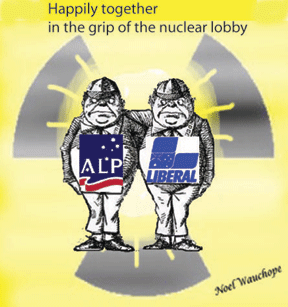
Ed COMMENT. I can’t help noticing how the Liberal ad Labor agendas overlap here – in this carefully controlled pro-nuclear event -described by Sybilla George.
Labor is pushing on with the AUKUS nuclear submarine folly. Liberal is pretending that jt really intends to start nuclear power in Australia.
Both in the grip of USA militarism and the nuclear lobby
Despite having three women on stage – including Stanke – for the panel event, the Celebrity Room at Moonee Valley Racing Club was dominated by men on Saturday night. Opening the evening, Shackel said his charity aimed to “enable civil debate”, yet panels on the tour featured only pro-nuclear views.
By Sybilla George | 6 February 2025, https://independentaustralia.net/environment/environment-display/nuclear-advocates-splitting-atoms-and-spinning-agendas,19407
Former Miss America and nuclear energy activist Grace Stanke‘s Melbourne visit saw a pro-nuclear panel push persuasion over debate, with filtered questions and few dissenting voices, writes Sybilla George.
FOLLOWING EVENTS in Perth and Brisbane, Nuclear for Australia’s ‘An Evening with Miss America 2023 Grace Stanke’ took place last Saturday at the Moonee Valley Racing Club.
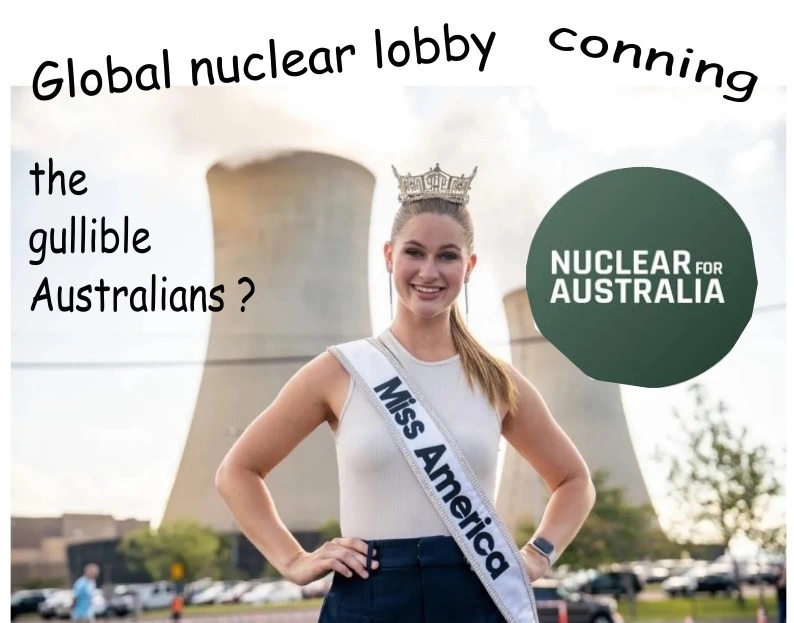
Nuclear for Australia is a nuclear power advocacy charity started in 2023 by teenager Will Shackel and patronised by electronics entrepreneur Dick Smith. The Miss America 2023 Australia Tour is also supported by Smith, according to the Nuclear for Australia website which has served as a platform for Smith’s response to The Guardian’s fact-checking of his anti-renewables arguments.
Nuclear for Australia is a nuclear power advocacy charity started in 2023 by teenager Will Shackel and patronised by electronics entrepreneur Dick Smith. The Miss America 2023 Australia Tour is also supported by Smith, according to the Nuclear for Australia website which has served as a platform for Smith’s response to The Guardian’s fact-checking of his anti-renewables arguments.
The tour aims to ‘help bridge the current divide between men and women for nuclear energy’ and cites the Australian Conservation Foundation statistic that 51% of men versus 21% of women support nuclear energy.
Despite having three women on stage – including Stanke – for the panel event, the Celebrity Room at Moonee Valley Racing Club was dominated by men on Saturday night. Opening the evening, Shackel said his charity aimed to “enable civil debate”, yet panels on the tour featured only pro-nuclear views. Questions put to the panel were selected from those sent in before and during the event, omitting the opportunity for live questions.
Stanke, who has an undergraduate degree in nuclear engineering, advocates for clean energy, including wind, solar and nuclear power. She began working for the United States’ largest nuclear energy provider, Constellation Energy, in 2024. Of Constellation’s energy capacity, 60% derives from nuclear power, while 25% comes from oil and natural gas fossil fuels.
The panel portion of the event featured Stanke alongside fellow American Mark Schneider, former operator of U.S. civil and defence nuclear reactors and current chief nuclear officer for UBH Group — an Australian defence consultancy firm angling for a ‘piece of the AU$368 billion nuclear sub [AUKUS] pie’.
They were joined by energy and resources lawyer Kirsty Braybon and Global Nuclear Security Partners’ (GNSP) Australia branch managing partner Jasmin “Jaz” Diab.
Army officer and nuclear engineer Jaz Diab is a star of the pro-nuclear media circuit. She’s made several appearances on Sky News and spoke at The University of New South Wales (UNSW) Navigating Nuclear conference in May 2024 alongside Coalition Shadow Energy Minister Ted O’Brien, before the Coalition’s nuclear energy plan announcement in July 2024.
Diab joined the business group AUKUS Forum, suggesting GNSP will be making a play for the AUKUS pie and nuclear energy contracts should the Coalition get into government at the next federal election.
As reported by the Australian Financial Review in December 2024, the Australian Department of Defence spent AU$811 million on just the big five consultancy firms in 2022-23.
Braybon, who teaches a subject on nuclear law at the University of Adelaide, responded to a question about the current illegality of nuclear power in Australia under the 1998 Radiation Protection and Nuclear Safety Act.
Some legal barriers to nuclear energy have already been watered down to accommodate AUKUS nuclear-powered submarines, Braybon said, and “no one noticed”, pointing to the entwined framework of defence and civil nuclear programs.
The defence backgrounds of panel members Diab and Schneider also attest to this. Braybon did not specify which law changes she was referring to, however, the Australian Naval Nuclear Power Safety Act 2024, which was pushed through the Senate in October 2024 – designating waste “zones” in Adelaide and Perth for AUKUS-related nuclear waste – was reported on by Independent Australia, Michael West Media, The Advertiser and The Guardian.
While anti-nuclear protesters attended the Perth and Brisbane events – including a community action projecting ‘Nuclear energy distracts from the climate emergency’ outside the Gabba – there were no visible objectors in Melbourne.
However, Latrobe Valley Sustainability Group (LVSG) members attended the Moonee Valley Racing Club ahead of the Morwell event the next evening. The Coalition selected Loy Yang – a coal-fired power station in the Latrobe Valley – as one of seven sites around Australia for proposed nuclear power plants.
LVSG is concerned about the questions that Nuclear for Australia will not answer regarding the impact of nuclear power in fighting climate change and the economic cost of constructing and maintaining nuclear power plants. It points out that renewables have surpassed nuclear energy production in the U.S. in just 15 years and that there is a lack of private investment in nuclear power because of its unprofitability.
Indeed, a popular argument in favour of nuclear power appealing to the increasing energy demands of artificial intelligence data centres took a blow in recent days with the announcement that the Chinese AI program DeepSeek performs a similar function to the U.S. program ChatGPT, at a fraction of the cost and energy.
According to LVSG member Dan Caffrey, the Nuclear for Australia Morwell event attracted 240 attendees, but panel members “expressed a complete ignorance” of issues in the local area that reduce the viability of nuclear power, such as water availability and rehabilitation of the existing coal-fired station. The avoidance of challenging questions about nuclear power was “very disheartening”.
Sybilla George is a freelance writer with an interest in nuclear policy and the Pacific region.
Dutton’s nuclear policy is a Coalition scam
By Steve Bishop | 10 February 2025, https://independentaustralia.net/life/life-display/duttons-nuclear-policy-is-a-coalition-scam,19427
Overwhelming evidence is proving the Coalition’s nuclear plan to be a scam, writes Steve Bishop.
OPPOSITION LEADER Peter Dutton is scamming Australians with a nuclear power promise he knows he cannot deliver.
LNP research would have revealed the impossibility of providing nuclear power by the Coalition’s target of the mid-2030s.
This means a Dutton government would continue the years of Coalition ineptitude in tackling climate change and failing to provide a workable energy policy.
Coalition Senator Matt Canavan has revealed it’s nothing more than a “fix”.
Canavan said:
“Nuclear is not going to cut it. But we’re latching on to it… because it fixes a political issue for us… But it ain’t the cheapest form of power.”
In other words, it’s a con. Or to use a good Aussie word: a rort.
It’s why an internet search has found no trace of an authoritative nuclear body or expert endorsing the Coalition’s nuclear timeframe.
It’s simply a version of the old-time medicine show that peddled worthless cures to the gullible. The evidence demonstrates that the flimflammery of Mr Dutton’s Miracle Nuclear Elixir cannot work.
Mr Dutton promised:
‘A Federal Coalition Government will initially develop two establishment projects using either small modular reactors or modern larger plants such as the AP1000 or APR1400. They will start producing electricity by 2035 (with small modular reactors) or 2037 (if modern larger plants are found to be the best option).’
The CSIRO found in its GenCost 2023‐24 report that the earliest deployment for large-scale nuclear rectors would not occur until after 2040.
In the U.S., which has a nuclear power industry, AP1000 units at Vogtle, Georgia took 15 years to build, more than twice the projected timeline.
In Finland, the 1600mw Olkiluoto 3 was completed in 2023 — 18 years after construction started.
Even in China, with fewer hurdles to jump and a massive nuclear industry, it took 14 years for the Sanmen1 nuclear power station to be completed with plans for two units approved in 2004 and the first 1200mw reactor starting commercial operation on September 2018.
So it would be impossible to switch on a large plant in Australia before 2040. Is it feasible for the Coalition to build small modular reactors (SMRs) by 2035 as projected?
The ANU Institute for Climate, Energy and Disaster Solutions suggests it would be more like 15 years before the first reactor could start producing.
It says:
In Western countries… recent construction times have far exceeded a decade.
Before any nuclear power plant can be built here, we would first need to establish a regulatory system. That could take up to five years.
The Institute for Energy Economics and Financial Analysis (IEEFA) has found:
‘SMRs would not be operating before the 2040s in Australia, too late to replace coal.’
It also revealed construction delays of 12 to 13 years had occurred in four of the few completed SMRs in Argentina, China and Russia.
Similarly, the Australian Academy of Technological Sciences and Engineering (ATSE) has found
‘…a mature market for the technology may emerge in the late 2040s.’
Professor Hugh Durrant-Whyte, a nuclear engineer, told a NSW inquiry in 2020 that it would be naïve to think a power plant could be built in less than two decades.
The UK, which already has nuclear power stations, claims it is running the world’s fastest process to deliver an operational SMR by the mid-2030s. But it started this process in 2021 with a target date of the early 2030s and that has already blown out to the mid-2030s — some 16 years on from 2021.
This process aims to invest in demonstration SMRs in 2029. But a research paper filed on Social Science Research Network (SSRN) has found that if it then takes only two years to deploy resources ready for construction, only three years to build the plant and a further two years to demonstrate successful operation, any follow-on capacity would only come online well after 2040.
Even if a Coalition government was able to emulate this “fastest” process it would be after 2040 before an SMR is built. But a graph on page 7 of the plan released by Mr Dutton shows about 1,750mw of nuclear power being produced by 2036.
That would require six reactors having gone through the planning process, built, tested and commissioned — an impossibility based on the expert evidence.
In June, Mr Dutton said:
“I’m very happy for the Election to be a referendum on energy, on nuclear, on power prices…”
The overwhelming evidence means the Coalition scam should be rejected at the ballot box.
Australia’s technocratic drive to nuclear ignorance
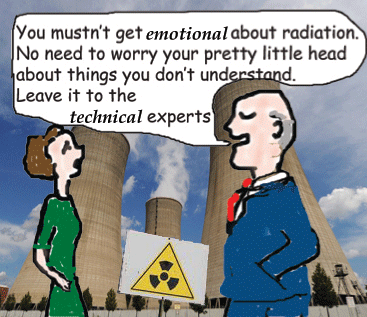
The worshipped role of the expert has excised public debate from nuclear policy. The expert’s validation exonerates the government from the onus of explanation, excluding constituents from relevant information and thus precluding commentary. Nuclear science, a field shrouded in esotericism, marks the summit of techno-scientific rationality, in which utter destruction is intellectually atomised out of politics to the realm of the expert/executive.
ARENA, Sybilla George, 11 Dec 2024
Australia is ‘going nuclear’. The addition of nuclear-powered submarines to Australia’s defence arsenal through the $368 billion AUKUS deal passes a threshold of nuclear legitimisation that Oceania’s anti-nuclear activists have been battling for decades. Nuclearisation used to be an eco-ethical debate, as with the anti- vs pro-uranium mining battles since the 70s that have seen wins and losses on both sides. The rapid increase of Australia’s nuclear involvement, however, signals the reframing of national nuclear rhetoric as techno-scientific rationality that precludes dialogue and authorises executive ruling.
While the AUKUS deal plays out in the limelight, at RAAF Tindal in the Northern Territory the building of facilities to host six United States B-52H Stratofortress bombers on rotational deployment, alongside ‘up to 75’ US Armed Force permanent staff, is underway. The facility renovations are funded through the Force Postures Initiative, the most recent phase of the Force Postures Agreement which since 2014 has defined the United States’s military agenda in Australia, with the consent of successive Australian governments. The Enhanced Air Cooperation branch of the US Alliance was recently ratified when Australian Defence provided ‘air-to-air refuelling’ to B-2 Spirit bombers involved in the US’s October strike on Houthi targets in Yemen.
More than half of the United States’s stock of 76 active B-52 bombers is capable of carrying and deploying nuclear weapons; the remainder is conventionally armed. These jets have been flying over Australian airspace for half a century; however, stationing them at RAAF Tindal signals a significant escalation in nuclear involvement, as it will produce for the first time the conditions ‘to support potential nuclear combat missions from Australian soil’, according to a Nautilus Institute Special Report published in August.
This would be illegal under the United Nations Treaty on the Prohibition of Nuclear Weapons (TPNW), an agreement on which Australia under Labor has abstained since 2022 when it rescinded the Coalition government’s ‘No’ vote. Signing and ratifying the treaty features as a goal in Labor’s 2023 National Platform. Yet progress seems unlikely, given Australia’s third abstention on the TPNW on 1 November 2024 and the persistent silence from the government on the United States’s policy to ‘neither confirm nor deny’ the presence of nuclear arms aboard aircraft or ships. Under this policy, Australia will not be informed whether B-52 bombers on deployment at RAAF Tindal are carrying nuclear weapons.
The public interest in the disclosure of the presence of nuclear weapons includes matters of security, ethics and democratic transparency. Of great concern is the Albanese government’s passive concession to a foreign state’s policy that conflicts with its own commitment to ‘full knowledge and concurrence’ of foreign activities conducted in Australia. Restricted speech has been increasingly utilised as a tactic to expedite pro-nuclear policy in the rush towards technological rationality.
Another example is Albanese’s Nuclear Power Safety Bill, which was rammed through the Senate without debate in October 2024. It stipulates two dumping ‘zones’ for highly irradiated ‘spent nuclear fuel’, to be located within dozens of kilometres of Perth and Adelaide—Western and South Australia being selected once again to play host to nuclear, as during the United Kingdom’s nuclear testing campaign. Indeed, Defence recently withdrew its environmental approval application for developments to prepare HMAS Stirling to host nuclear-powered submarines, and The Australian has reported that the government will resubmit the application with an additional request for the rights to store irradiated waste materials at the facility, which would thus be ‘subject to a single round of community feedback’.
Deferral to the United States’s ‘neither confirm nor deny’ nuclear weapons policy is an appeal to ignorance, and thus innocence, which in turn forecloses systems of accountability, since governments’ denial of information renders their constituents ignorant. The current government’s silence on the presence of nuclear weapons on US aircraft stationed at RAAF Tindal eerily resembles Robert Menzies’ ‘extreme’ commitment to the United Kingdom’s ‘need to know’ policy during the nuclear testing campaign from 1952 to 1963. As prime minister, Menzies exclusively assented without consulting Cabinet or scientific advisers to the use of the Montebello Islands as the site of Operation Hurricane, the nuclear bomb detonation that cemented the United Kingdom as the world’s third nuclear power. The program was not announced until 1952, prior to which Menzies deliberately misled the media about plans for nuclear testing on Australian soil, claiming he had ‘heard nothing’ about it.
The worshipped role of the expert has excised public debate from nuclear policy. The expert’s validation exonerates the government from the onus of explanation, excluding constituents from relevant information and thus precluding commentary. Nuclear science, a field shrouded in esotericism, marks the summit of techno-scientific rationality, in which utter destruction is intellectually atomised out of politics to the realm of the expert/executive.
. The UK nuclear testing campaign caused massive human and ecological suffering to Aboriginal communities in Western and South Australia. It was not until the publication of the 1985 Royal Commission into British Nuclear Tests in Australia, more than two decades after the final tests, that the extent of Australian government collusion was revealed, typified by Menzies’ ‘complete’ acceptance that Australia be entirely excluded from technical information about the tests. This submission to an allied foreign state enacts the technocratic power of nuclear, which pitches influence disproportionally towards those with technical knowledge and renders those without it mute and nakedly vulnerable to, in the case of nuclear arms, annihilation………………………………
The Albanese government’s silence on the presence of nuclear weapons aboard B-52s at RAAF Tindal regurgitates the United States’s policy so as to allow it to skirt its democratic responsibility to inform the public of potential nuclear escalation. Extensive control of messaging and media across the decade-long nuclear testing campaign by Menzies on behalf of the United Kingdom, particularly regarding its true health risks, denied Australians the opportunity to establish informed opinions on the tests. The drive to ignorance common to both Menzies’s and Albanese’s nuclear policy strategies has been achieved via the interiorisation of allied foreign states’ intelligence protocols. This techno-scientific rationale dangerously licences executives to accelerate nuclear proliferation beyond the forum of public debate to which it belongs, and into reality. https://arena.org.au/australias-technocratic-drive-to-nuclear-ignorance/
American or Trump’s values, or are they the same?
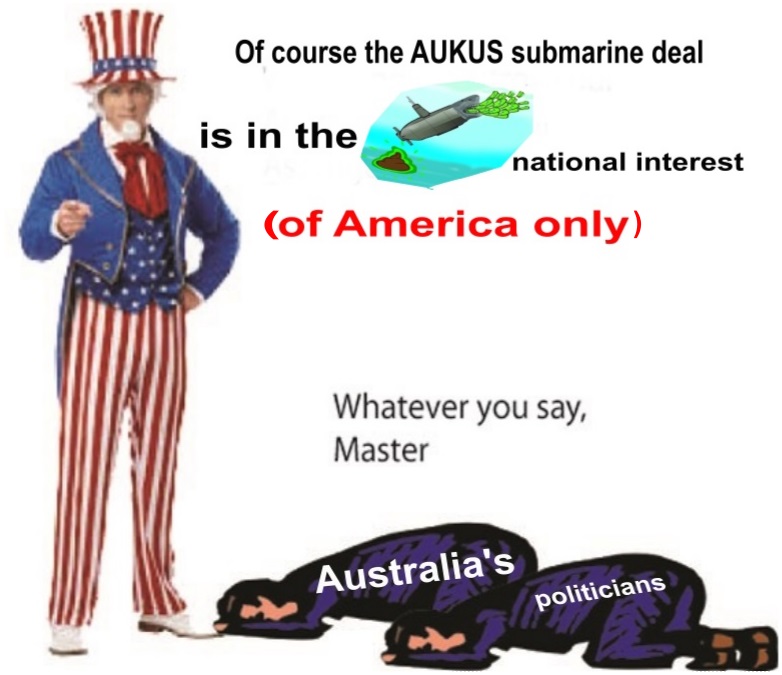
Crispin Hull, 11 Feb 25 https://www.crispinhull.com.au/2025/02/10/american-or-tumps-values-or-are-they-the-same/?utm_source=mailpoet&utm_medium=email&utm_campaign=crispin-hull-column
Australia can now either grimace and bear it for four years pretending nothing has happened; or face reality and question whether AUKUS and the US alliance more generally are worth it.
ANZUS and AUKUS were, from the start, purportedly based on “shared values”. Less than a month into the Donald Trump presidency can we put our hands on our hearts and say, “We share values with the US, and we will spill blood and treasure for those values”?
The acid question now is: to what extent are Trump’s values American values?
Can they be separated as if there is a separate pocket of American values – the rule of law; the separation of powers; freedom of the press; international order; liberal democracy and its spread throughout the world; and the helping hand to people and countries less fortunate?
It is difficult to see how.
The assertion by Trump of his “values” has attracted dozens of lawsuits in less than a month. He acts unlawfully; he bullies; he acts with cruel indifference to human suffering; he acts capriciously and vindictively and without diplomacy.
Trump is reversing 400 years of progress in governance: the rule of law; and the principle that those who are governed owe their loyalty to the law and not to the ruler and that those who govern do so with the consent of the governed and owe their loyalty to the law and the people not to themselves.
The time has come for the allies of the US to ask: what are the passing Trump values that we do not share that will disappear and what values, under Trump, have transmogrified into American values. After all, that is what Trump asserts: that his values are American values.
And, let’s face, a majority of voters voted for Trump.
If Trump values are now American values and American values Trump values, does Australia want to be a part of it? Is Australia safe relying on a new transactional America that sees everything through the selfish prism of only what is good for America, or more narrowly what is good for Trump.
Surely it is dangerous to presume that there are some underlying intrinsically good Amercian values that transcend Trump and will re-emerge when he is gone – when the chances are that this Trump administration will have trashed America’s constitutional framework and electoral processes so badly that the next election, if there is one, will be Trump’s for the taking, with the constitutional prohibition against third terms ignored. Or it will be a shoe-in for his anointed successor – probably JD Vance.
Surely, a better, safer, and more morally sustainable position would be for Australia to suspend the alliance until we can truly say that we have “shared values”.
How do we know that contributing militarily to any US international action is nothing more than Australian blood and treasure being expended to enhance Trump’s personal real-estate empire? He wants to buy Greenland; make Canada the 51st state; and overrun Gaza.
The treatment of Canada is alarming. Canadian Prime Minister Justin Trudeau said that Trump’s desire to make Canada a 51st state “is a real thing”. Remember Trump referred to Trudeau as “Governor Trudeau”.
He threatened Canada with crippling tariffs They have been suspended, but you cannot undo the threat. The relationship dynamic is forever changed because threats (economic, violent, or psychological) destroy trust.
If he can treat Canada, the US’s closest neighbour geographically, linguistically, and historically in that way, surely Australia is no more than a bit piece in the American game of global dominance and economic exploitation.
Australia should now also look at its alliance with the US against the background of history. Against that it is alarming: Trump is not a passing aberration but part of a continuum of some deep-seated ugly American traits.
It starts with the Declaration of Independence when “all men are created equal” excluded women and slaves. Then the Constitution was framed with a deep suspicion of the mass of people and set up an Electoral College to elect the President, rather than by the people directly.
Violence, racism and guns have dominated US history, beginning with the dispossession and genocidal cruelty against the indigenous population. Shortly after fighting a civil war over slavery, the south reverted to segregationist racism that lasted into the 1960s.
In the 19th century, the US was a vicious colonial occupier of the Philippines, In the 20th century, rampant capitalism tipped the US into the Great Recession. Selfish America refused to join the fight against racist Nazism and Japanese fascism until it was itself directly attacked.
Yes, Australia benefited from the US joining the fight against Japan, but the US did not do it to help Australia; that was a side-effect. It just used Australia as a base for its efforts to counter Japan’s threat to the US.
What if our naïve belief in US goodness and exceptionalism is misguidedly founded upon those four or five years of US munificence immediately after World War II despite a 250-year violent history of a male, white, Christian assertion of supremacy?
In those brief years after World War II, the US led the foundation of the United Nations; set up the international rules-based order leading to the World Bank and International Monetary Fund.
The US led the way promoting peace, law, harmony, and immense generosity in adopting the Marshall Plan to reconstruct Europe and a benign, forgiving occupation of Japan.
The US has benefitted and traded off that immediate sunlit post-war image for way longer than its used-by date. And US allies have fallen for it.
Later decades gave us the Korean war; the Vietnam War; Iraq; and Afghanistan. It gave us the Bay of Pigs and numerous other ill-founded, unwarranted interferences in small nations to promote US economic interests under the guise of promoting democracy over communism. The incessant US blood-spilling belligerence went on and on, and Australia was sucked into it at great cost to our blood and treasure.
Do we really now want to contribute to a genocidal expulsion of two million Palestinians so Trump’s America can erect a hotel-strewn shoreline in Gaza for Israel and exploit the rights to newly found oil and gas offshore?
Under Trump, the AUKUS deal takes on a different complexion. Australia, under then Prime Minister Scott Morrison, was stupid enough to sign up to an asymmetrical deal where we pay (and have in fact mostly paid) $A4 billion to US shipyards to help them hasten the construction of Virginia-class nuclear submarines of which we are supposed to get three. But this would be contingent on the President of the day certifying that US would not need the submarine.
Does anyone imagine that transactional Trump would allow any submarines to go to Australia without some further payment or supplication?
The US does not protect Australia, it uses us – and puts us in harm’s way in doing so.
Perhaps we should just be honest and say we do not care about shared values or morality we just want protection and we are willing to pay for it – like some nervous shop owner being stood over by a gangster.
But I think Australia is better than that and that, in the face of the Trumpian wrecking ball, we should suspend AUKUS and the US alliance, or at least have an inquiry into them. Disruptive surprises need not be the sole purview of the attention-seeking and attention-demanding man in the Oval Office.
A former Miss America takes her nuclear sales pitch to audiences in Australia
By Hilary Whiteman, CNN, February 6, 2025, Brisbane, Australia,
Nuclear engineer and former Miss America Grace Stanke has entered the fierce debate in Australia over its future energy policy with a 10-day national tour extolling the benefits of nuclear power in a country where it’s been banned for almost 30 years.
The speaking tour is familiar territory for the 22-year-old former beauty queen, who said she studied nuclear engineering as a “flex,” but now works for US energy giant Constellation as a spokesperson and as an engineer on its nuclear team.
Her recent arrival comes at a delicate time in Australia, months before a national election that could put the opposition Liberal Party in power, along with its promises to build seven nuclear power stations – upending the current Labor government’s plan to rely on renewable energy and gas.
For several days, Stanke has been speaking to hundreds of Australians, in events organized by Nuclear for Australia (NFA), a charity founded by 18-year-old Will Shackel, who has received backing from a wealthy Australian pro-nuclear entrepreneur.
Most talks were well-attended by attentive crowds, but not all audience members were impressed by Stanke’s message.
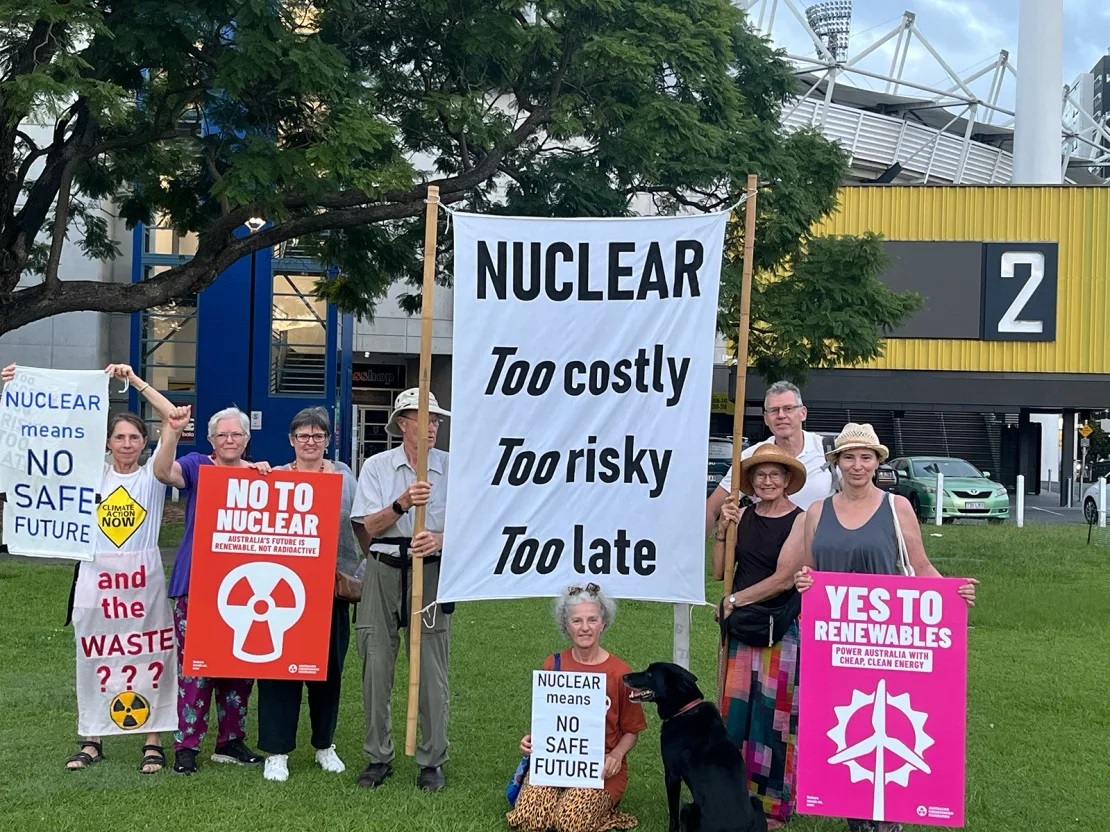
As she started to speak in Brisbane last Friday, a woman in the audience began shouting, becoming the first of several people to be ejected from the room as other attendees booed and jeered. One woman who was physically pushed from the premises by a security guard has since filed a formal complaint.
……………Those against nuclear power say it’s too expensive, too unsafe and too slow to replace Australia’s coal-fired power stations that would need to keep burning for several more years until nuclear plants came online.
………………….A numbers game
Australia banned nuclear energy in 1998 as part of a political deal to win approval for the country’s first and only nuclear research facility that’s still operating in southern Sydney.
A change in government in an election, to be held before mid-May, would see seven nuclear reactors built in five states to provide power alongside renewable energy – a bold shift in direction that would not only require changes to federal law, but amendments to laws in states where premiers oppose nuclear power.
According to the plan proposed by Liberal Party leader Peter Dutton, the nuclear reactors would be funded by 331 billion Australian dollars ($206 billion) in public money and the first could be working by 2035.
Both forecasts are disputed as underestimates by the government acting on the advice of the country’s independent science agency – the Commonwealth Scientific and Industrial Research Organisation (CSIRO) – which says renewables are still the cheapest and the most efficient way for Australia to reach net zero by 2050.
…………………..“I do believe that a strong grid requires both renewables and nuclear energy combined,” Ms Stanke said, referring to the argument for a “baseload” energy source that doesn’t rely on unpredictable weather.
That argument is challenged by experts worldwide, who say the need for “baseload” energy is an outdated concept, and that stability can be achieved by other means, including batteries.
……………………………………………..Advance, a conservative campaign group that says it works to counter “woke politicians and elitist activist groups” is promoting a 48-minute documentary it claims tells the “untold stories” of farmers whose “lives have been upended by the rapid rollout of wind and solar projects.”
………………………………….Rural areas where opposition is building to renewable projects are fertile ground for Shackel and his nuclear campaign. He’s already visited some areas earmarked for power stations under the Liberal proposal. And while he says NFA isn’t politically aligned with either of the major parties, he accepts he’s doing some of the groundwork to bring the community on side………………………….
Nuclear ‘foolishness’
Bringing a former Miss America to Australia was part of a plan to raise support for nuclear power among Australian women, who according to one survey are far less enthusiastic than men about the proposal.
According to several people who attended sessions in various states, the audience was dominated by older men, many of whom didn’t seem to need convincing.
Jane McNicol, the first protester escorted from the room in Brisbane, told CNN she’s been an anti-nuclear campaigner since the 1980s. She said she stood up to “ensure that this foolishness does not take off.”
“It’s just a way of spinning the fossil fuel industry out for a bit longer, and we cannot afford to do that,” she said. “You can see how the climate is collapsing around us. Look at Los Angeles. Those poor people over there lost everything.”
Others said the panel – which included local nuclear experts – made generalizations and didn’t get to the nub of issues specific to their area, like the potential strain they say a nuclear power station could have on resources in Victoria’s Latrobe Valley.
“There is literally no water for a nuclear power station. The existing allocation is already committed to mine repair,” said Adrian Cosgriff, a member of community advocacy group Voices of the Valley, who attended the Melbourne talk.
“Australians know nuclear power exists. That’s fine. It’s just not suitable for here. That’s kind of the argument,” he said.
David Hood, a civil and environmental engineer who attended the Brisbane talk, said: “Renewables are working right now. We can’t wait 10 to 20 years for higher cost and risky nuclear energy.”
Stanke and Shackel delivered a parliamentary briefing in Parliament House, Canberra on Wednesday, to politicians and aides across the political spectrum.
Prime Minister Anthony Albanese was unsurprisingly not in attendance, having already labelled his political rival’s nuclear proposal as “madness” and a “fantasy, dreamed-up to delay real action on climate change.”……………. https://edition.cnn.com/2025/02/06/australia/australia-nuclear-debate-grace-stanke-intl-hnk-dst/index.html
Confused about nuclear energy? The fossil fuel industry is trying to mislead women.
by Madeline Hislop, https://womensagenda.com.au/latest/confused-about-nuclear-energy-the-fossil-fuel-industry-is-trying-to-mislead-women/ 10 Feb 25
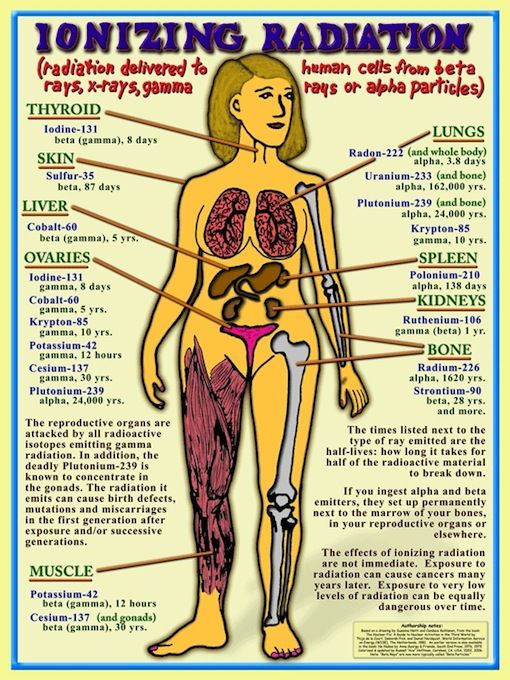
An advertising campaign targeting women ahead of the federal election is promoting misleading information about nuclear energy.
New analysis undertaken by the Climate Council shows that 63 per cent of all nuclear energy advertising active across Facebook and Instagram as of January 2025, was viewed by women.
The ads are largely being driven by the Get Clear on Nuclear group, which is backed by the Minerals Council of Australia, a peak mining lobby group.
The ads are part of a misinformation campaign targeting women voters to undermine their confidence in renewables and promote nuclear energy and gas as false solutions to the climate crisis.
Speaking to Women’s Agenda, CEO of the Climate Council Amanda McKenzie said the advertising campaign is using misinformation to compel women to vote for the Coalition’s nuclear energy policy.
“What [our analysis] indicates is that it’s being pushed specifically towards women, and it’s largely driven by the Minerals Council,” she said.
“That’s where the funding for those ads is coming from, and I think it reveals what is known in the polling, which is that women tend to be more undecided in their vote, and that women need to be persuaded if Australia was to go nuclear.”
Polling shows women are unconvinced about nuclear energy and are more likely to consider nuclear to be high risk and high cost.
“Women are quite inherently skeptical of nuclear power as a proposal,” McKenzie said.
“I think women have a lot of valid concerns about the risks of nuclear reactors, whether that’s concerns around disaster risk, toxic waste, cost blowouts or the length of time it takes to build nuclear. And I think women feel a bit left in the dark when it comes to the Coalition’s nuclear scheme.”
Despite some claims the ads are making, McKenzie says that all the evidence, including from the CSIRO, shows us that nuclear power is the most expensive form of new power. On top of that, the Coalition’s policy would see Australia remain reliant on fossil fuels until at least 2036.
Opposition leader Peter Dutton has pledged to build seven publicly-owned nuclear power plants in locations across the country if he is elected Prime Minister this year. The first of these plants would be operational by 2036, Dutton claims, although experts have questioned this date and suggested it is more likely to be the 2040s.
McKenzie said it’s important to know that over the last few years, Australia has moved to 40 per cent renewable power for our whole economy. And we can get to nearly 100 per cent renewable power within the 2030s.
“Nuclear wouldn’t come online until the 2040s, so it’s inherently a big delay in changing our energy system,” McKenzie says. “Our coal fired generators—all of the ones that are the most polluting energy source—are all slated to retire because they’re very old, by the end of the 2030s.”
“We have this urgent climate crisis because of the pollution that all of those fossil fuels are creating, and we’re actually underway in solving the problem now.
“The main message for women is that there is actually progress that has been made. The energy system is changing and becoming cleaner, but we need to double down on that this decade if we’re going to safeguard our kids’ future.”
Women are not being exposed to the facts
Ahead of the election, McKenzie said she is concerned that women are not being exposed to the information they need to make informed decisions on energy policy.
She says the Get Clear on Nuclear advertising is attempting to persuade women on nuclear power, but it’s misleading.
“The advertising is really being designed to try and persuade women, but our concern is that women are not being exposed to the facts,” she says.
“There is this sort of David and Goliath battle between groups like ours, who are representing the community, trying to educate the community with facts and with scientists versus industry bodies that are trying to push ideas that are going to benefit their vested interests.”
There are also many unanswered questions about nuclear, McKenzie says.
“Where will the toxic radioactive waste be buried? Which communities will the trucks drive through when they carry that toxic rate waste? Will the proposal for seven nuclear power plants be the full story?” she says. “Because actually, you would need far more nuclear plants if you were genuinely going to be powering Australia with nuclear.”
“There’s a sense that there’s a downplaying of risks, and women want those sorts of questions answered.”
Going nuclear: Meet Grace Stanke, the American pageant queen on a mission in Australia
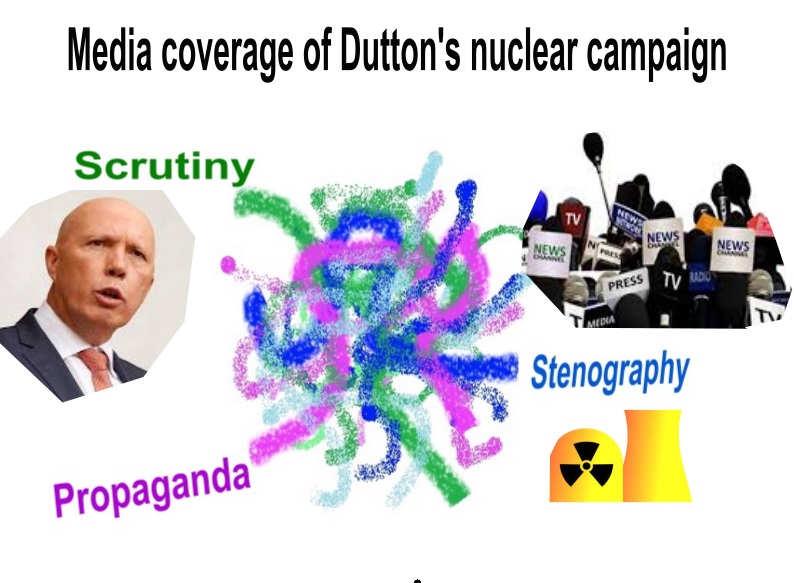
COMMENT. This article is pretty good for SCRUTINY, giving both the nuclear propaganda in spades, but also the environmental, safety, economic and political objections to it.
It does show Grace Stanke as a clever operator, with her giving simplistic, but impressive sounding pro-nuclear spin
By Maddison Leach, Feb 8, 2025, https://www.9news.com.au/national/nuclear-power-australia-miss-america-grace-stanke/74f1791d-be18-420f-8a76-5026bb3de4c1
Nuclear power has been banned in Australia since the turn of the century. Former Miss America Grace Stanke is the unlikely figure who wants to change that.The 22-year-old American has been in Australia for over a week, advocating for nuclear power at events hosted by Australia’s largest nuclear power advocacy organisation, Nuclear for Australia.
Her arrival seems perfectly timed for Opposition Leader Peter Dutton and the Coalition as they promote their nuclear plans ahead of the 2025 federal election.
If elected, the Coalition says it plans to build taxpayer-funded nuclear reactors at seven sites around Australia. The first is slated to start operating in 2035.
Mr Dutton has said the plan will help lower carbon emissions and make electricity cheaper for Australians, however climate experts have challenged those claims.
Hailing from the US, which home to 94 operable nuclear reactors and remains the world’s largest producer of nuclear power, Stanke wants to see Australia follow in her home nation’s footsteps and embrace nuclear power.
“This is a necessary part of the future,” she told 9news.com.au, adding that the federal and state bans on nuclear power “baffle” her.
“Nuclear is safe, it’s effective, it’s reliable, it requires a small amount of land, it provides high paying jobs and helps build up strong communities around it.”
With a degree in nuclear engineering and a Miss America title (she was crowned in 2023), Stanke is already the poster girl for nuclear advocacy in the US.
“People look at a woman and they make assumptions,” Stanke said, then laughed.
“Usually they are not expecting me to speak about nuclear energy or nuclear engineering, so it is a ton of fun.”
The Wall Street Journal called her the “new face of nuclear energy” in 2023 and she appeared on the Forbes 30 under 30 for Energy list the following year.
Inspired by her impact in the US, Nuclear for Australia’s 18-year-old founder Will Shackel flew her to Australia in a bid to further the conversation around nuclear power here too.
That has meant addressing environmental and financial concerns around the Coalition’s nuclear plans.
Mr Dutton claims the plan will slash energy bills but research from the Institute for Energy Economics and Financial Analysis (IEEFA) suggests it would actually increase Aussie households’ energy bills by about $665 annually.
The Coalition also claims the plan would reduce Australia’s carbon emissions but energy experts estimate that extending the life of coal plants as part of the plant could produce 1.7 billion tonnes of extra emissions by 2050.
Stanke questioned these figures, citing studies from the Nuclear Energy Institute in the US as proof nuclear power is a cost-effective and “emissions free” energy source.
“To produce your entire lifetime’s amount of electricity, we’ll only create enough waste that it fits inside of a soda can,” she said in response to environmental concerns.
Though she acknowledges that building the reactors would come with financial and environmental costs, Stanke is focused on the end result: “clean energy” for millions of Australians.
However, there are also questions about how long it would take Australia to build seven nuclear reactors.
The Coalition plans to have the first up and running by 2035 but CSIRO experts argue that it’s unlikely any of the plants would be ready until at least the early 2040s.
It takes an average of nine years to build a nuclear power station according to the Australian Conservation Foundation, plus another 10 years for planning and licensing, but Stanke firmly believes Australia can get these reactors built within a decade.
“I would completely disagree on the idea that Australia is not a nuclear nation,” she said.
She noted that Australia’s only nuclear reactor OPAL in Lucas Heights, which opened in 2007, was built in just nine years and said that “if Australians can do that in nine years”, this country can surely “do even better in the future”.
However, OPAL was build on the site of an existing nuclear reactor while the Coalition’s proposed reactors would be built on coal-fired power stations.
And the Coalition doesn’t just have to build these nuclear reactors; it also has to regulate and staff them, and overturn federal and state bans on nuclear power.
It will be easier said than done given that Labor, the Greens and some independents oppose nuclear energy, as do many state premiers and opposition leaders.
As well as the financial, environmental and legal concerns, some Australians fear the potential community and health risks associated with building nuclear reactors across the country.
Though she’s received some pushback from everyday Aussies and anti-nuclear groups while touring Australia, the 22-year-old hopes her visit will inspire more open dialogue about the possibilities nuclear power presents for Australia.
“This deserves a fair discussion [and] I’m here to help start that conversation.”
Explained: Why nuclear power has been banned in Australia for more than 25 years
COMMENT. This news item from 9 news is a rare example of SCRUTINY, in that, although it basically delivers the facts (Stenography), it shows some insight into the arguments and reasons behind Australian attitudes.
For a commercial media article, this is remarkably unbiased.
By Maddison Leach Feb 9, 2025, https://www.9news.com.au/national/why-is-nuclear-power-banned-in-australia-explained/9f758cf3-0677-4787-bfce-a5
Opposition accuses Labor of scare campaign over Nuclear, PM says he holds economic concerns
Nuclear power is shaping up to be a hot button issue in the 2025 federal election, with Opposition Leader Peter Dutton and the Coalition pushing a plan to build seven nuclear reactors across Australia if elected.
Such reactors are currently banned at a federal level, meaning the Coalition would have overturn federal and even some state laws to build their proposed reactors.
Here’s everything you need to know about the nuclear power bans in Australia.
Why is nuclear power banned in Australia?
Nuclear power as an energy source has been banned in Australia since the late 1990s, when Prime Minister John Howard’s Coalition government passed two laws prohibiting it.
First came an amendment to the National Radiation and Nuclear Safety Act (1998) which banned the development of any new nuclear power sites in Australia.
The following year, the Commonwealth Environment Protection and Biodiversity Conservation Act (1999) introduced new rules prohibiting the construction or operation of any facilities that generated nuclear power, fabricated nuclear fuel, enriched uranium or processed nuclear waste.
At the time these laws were passed, there was only one site in Luca Heights, south of Sydney. It remains the site of Australia’s only nuclear reactor, which is used for medical and industrial research.
Some state governments have also introduced additional nuclear prohibitions.
Which countries have banned nuclear power?
Countries that have banned the construction of new nuclear power plants like Australia include Austria, Denmark, Greece, Italy, Ireland, Norway and Serbia.
Several other nations have also announced plans to phase-out nuclear power, including Belguim, Germany, the Phillipines and Switzerland.
Why is Australia anti-nuclear?
There was a dramatic shift in public opinion on nuclear power after the catastrophic Chernobyl disaster in 1986.
That shift likely contributed to the introduction of anti-nuclear laws in Australia in 1998 and 1999, which have remained in place ever since.
Modern Australian attitudes towards nuclear power are mixed but the majority of anti-nuclear sentiment centres around the financial and environmental costs.
It would cost billions to establish a nuclear power network in Australia and though nuclear power is considered “clean” (it doesn’t produce carbon emissions), it is not renewable.
Is it illegal to build a nuclear reactor in Australia?
Yes. The National Radiation and Nuclear Safety Act (1998) and Commonwealth Environment Protection and Biodiversity Conservation Act (1999), as well as some additional state legislations, prohibit the construction or operation of nuclear reactors.
Is there support for nuclear power in Australia?
Some. The Coalition is leading support for a nuclear future for Australia with its nuclear power proposal, which would see seven nuclear reactors built across the country.
Nuclear for Australia, the country’s largest nuclear power advocacy organisation, has voiced support for the plan.
What is Peter Dutton proposing?
Opposition Leader Peter Dutton and the Coalition are proposing overturning existing laws banning nuclear power in Australia in order to build seven new nuclear plants.
“This will make electricity reliable, it will make it more consistent, cheaper, for Australians and it will help us decarbonise as a trading economy as we must,” Dutton said.
“The fact is we can deliver a plan which is going to keep the lights on and we have a plan and a vision for our country which will help grow businesses, not close them down.”
The Coalition has claimed the plan is 44 per cent cheaper than the government’s renewable energy plan and would lower Australians’ electricity bills.
However, the Coalition’s figures are based on a scenario that produces about 45 per cent less energy by 2050 than renewables.
What does nuclear power cost?
Modelling from the Coalition suggests its nuclear policy would cost Australia more than $300 billion, significantly less than the government’s renewables plan.
But the CSIRO’s draft GenCost 2024-25 report projected that building nuclear reactors would actually cost at least twice as much as renewable power in Australia.
By 2040, it predicted nuclear-generated electricity would cost about $145-$238 per MWh by 20204, compared to $22-$53 per MWh for solar, and $45-$78 per MWh for wind.
What does nuclear power mean for the climate/environment?
Nuclear power doesn’t produce greenhouse gasses, however it’s not renewable as the process of fission (which generates nuclear energy) requires fuel, typically uranium.
Though Australia has one of the world’s largest uranium reserves, it is a finite resource and therefore isn’t renewable.
Nuclear waste also poses an environmental threat, especially in the case of a disaster like the Chernobyl or Fukushima.
1 This month
.

Australians deserve the truth
about
AUKUS – https://aukuspublicinquiry.com/

PETITION – To: Prime Minister Anthony Albanese and the Australian Labor Government

of the week – Australians for War Powers Reform (AWPR)
To see nuclear-related stories in greater depth and intensity

