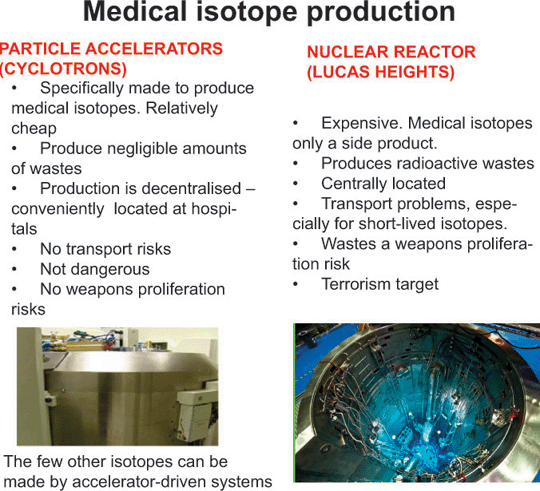
Cyclotron – a little ray of light in Premier Weatherill’s otherwise dreary nuclear spiel
From Jay Weatherill’s Response to Nuclear Fuel Cycle Royal Commission Report
“I’m also excited about the many positive commercial opportunities that are on the table for South Australia in nuclear medicine around the SAHMRI cyclotron.”
This IS one positive outcome from this long drawn out process. ra ra http://nuclear.yoursay.sa.gov.au/news/get-to-know-nuclear-discover-discuss-decide-government-delivers-response-to-nuclear-fuel-cycle-royal-commission-report
Introduction to the newest South Australian nuclear front – Ben Heard’s ‘Bright New World’

Ben Heard has achieved Australian and global fame, in his pro nuclear lobbying, and especially in running the website Decarbonise SA. Purporting to be a climate action site, Decarbonise SA has in reality been dedicated to the nuclear industry.
Anyway, Heard is moving on now – to a new front – a supposedly environmental Bright New World, as Heard describes it:
a new environmental NGO born and based here in South Australia with a global outlook and ambition
We are a registered not-for-profit organisation, governed by an independent board, and pursuing tax-deductible gift-recipient status.
It’s all about environment, biodiversity, natural resources – and just one tiny mention of nuclear :
tired of the junk-science approach to nuclear that typifies the environmentalist mainstream.
But he does thank well known nuclear lobbyists Atomic Insights, and The Actinide Age for their help.
And he does mention thee goal of his new organisation:
Our immediate job is to bring forward a strong “Yes” message for proceeding to next steps in investigating a used fuel service in South Australia.
No further investigation into high level nuclear waste dump – Jay Weatherill
16 Nov 16 On Monday, Premier Jay Weatherill announced that the absence of bipartisanship and broad social consent meant that the Government is unable to further progress investigations into a high level international waste disposal facility for South Australia.
Yesterday, the Premier delivered the State Government’s full response to the Nuclear Fuel Cycle Royal Commission, supporting 9 of 12 recommendations, a copy of the Government’s response is available here: nuclear.yoursay.sa.gov.au
Toxic nuclear debate in South Australian Parliament – Liberal MPs ejected
 Liberal MPs ejected from SA parliament during debate over nuclear waste dump
 http://www.adelaidenow.com.au/news/south-australia/liberal-mps-ejected-from-sa-parliament-during-debate-over-nuclear-waste-dump/news-story/552eb707f54fef48488b6cc0d4189d14
Premier Weatherill wants expansion of uranium mining, and nuclear waste dumping
 Premier Jay Weatherill backs expansion of uranium mining in South Australia, Daniel Wills State Political Editor, The Advertiser November 15, 2016 PREMIER Jay Weatherill has backed an expansion of uranium mining in the state, as recommended by a Royal Commission, while also continuing to explore the prospect of a nuclear dump.
A day after floating long-term plans for a referendum on a high-level nuclear waste dump, Mr Weatherill today addressed the Royal Commission findings in Parliament.
Mr Weatherill rejected recommendations urging he talk to the Federal Government about removing legal bans on uranium enrichment and nuclear power in Australia.
He also rejected a recommendation that the State Government remove state legislation stopping an “orderly, detailed and thorough analysis” of establishing nuclear waste storage in SA.
Recommendations accepted include simplifying mining approvals for uranium and backing more scientific studies of where ores can be uncovered…..
He said the Government will “not pursue policy or legislative change” to develop a nuclear dump, after the Opposition pulled support for the project…..” http://www.adelaidenow.com.au/news/south-australia/premier-jay-weatherill-backs-expansion-of-uranium-mining-in-south-australia/news-story/28cc5b147ce446430ad812a5105f7662
Protestors in the streets of Adelaide call for “Dumping the Nuclear Waste Dump”
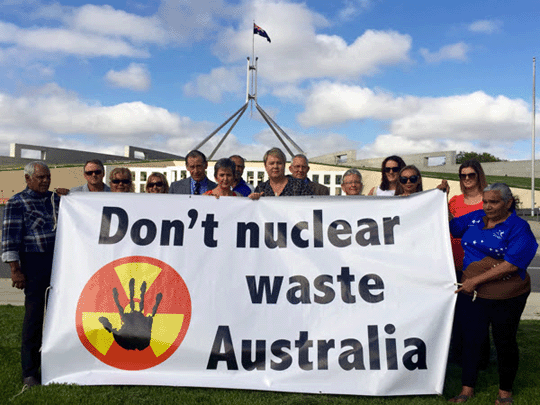 Protesters take to the streets to ‘Say No’ to an SA nuclear dump
 http://www.adelaidenow.com.au/news/south-australia/protesters-take-to-the-streets-to-say-no-to-an-sa-nuclear-dump/news-story/c43353c797fe02ca6d79730b953f5f01 Mitch Mott, The Advertiser November 14, 2016 CHANTING “dump the dump”, Anti-Nuclear Coalition supporters took to the streets on Monday outside the University College London campus on Victoria Square.
Protesting both the proposed nuclear waste storage facility and the Nuclear Fuel Cycle Symposium, activists on Monday described Premier Jay Weatherill’s proposal as “ludicrous” and potentially a threat to the future of the state.
“If we had a repeat of this year’s storms, there is no guarantee there wouldn’t be an accident,” protester Janett Jackson said. “You can’t ever guarantee there won’t be a storm like that again.
“We had an earthquake south of Alice Springs this year which measured six on the Richter scale. We’re talking about building a dump and saying that there is never ever going to be another earthquake. It’s a ludicrous comment to make.” Activist Susan Brame wrote a song for the protest and asked the Government to consider the lasting harm to the indigenous communities, especially less than 60 years after nuclear tests were conducted in the north of the state.
“It is so insulting to the Aboriginal people, after everything they have been through with Maralinga,” Ms Brame said. “It is such a slap in the face to them to seriously consider bringing the world’s most toxic waste to this state. They have been in total despair about this.”
For the protesters, international examples of what can go wrong when nuclear storage facilities fail are hitting too close to home. Ms Jackson said the February 2014 fire at the Waste Isolation Pilot Plant in New Mexico was evidence that human error can never be discounted,“That accident occurred in 2014 and cost more than $500m to repair and the dump is still closed down,” Ms Jackson said.
“If that happened to us our taxes would have to pay for it, which would eat into any profit Jay Weatherill thinks we’ll get. Economically it’s not viable”
South Australian Liberal Parry guru pushed for the nuclear industry and waste dump
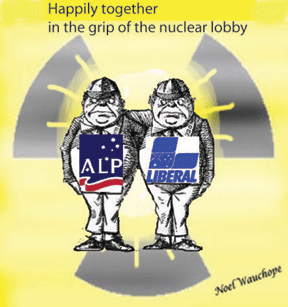 Liberal policy guru urged SA to go nuclear Tom Richardson http://indaily.com.au/news/local/2016/11/15/liberal-policy-guru-urged-sa-to-go-nuclear/ The state Liberal Party’s new policy director is a long-time nuclear advocate who personally called for the establishment of a nuclear waste dump in a submission to the Scarce Royal Commission. Steven Marshall’s Opposition has staunchly rejected any further investigation of a potential high-level repository.
But Richard Yeeles, a former corporate affairs manager with BHP Billiton and Western Mining Corporation who has recently run his own advisory firm, struck a very different tone when the State Government sought submissions on its royal commission proposal early last year.
“I commend the South Australian Government for initiating this inquiry,” wrote Yeeles, who has also previously worked as a chief of staff for Liberal leaders Dale Baker, Dean Brown and John Olsen.
In his lengthy 270-plus page submission to the subsequent inquiry, he urged the Government to “offer to host a national facility for storage and disposal of Australia’s own low and intermediate-level radioactive waste with the ultimate aim of securing Federal Government support for hosting an international radioactive waste management facility in South Australia”. Continue reading
Jay Weatherill’s nuclear political suicide
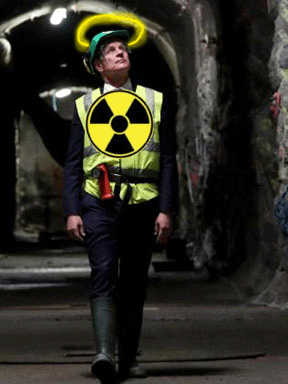 Jim Green: Jay Weatherill willing to commit political suicide with push to turn South Australia into world’s nuclear waste dump, Jim Green, The Advertiser November 15, 2016 PREMIER Jay Weatherill previously said that “there’s no doubt that there’s a massive issue of trust in government … that’s why we started the whole citizen’s jury process” into the nuclear waste import proposal.
Yet the Premier has now overturned the SA Citizens’ Jury on Nuclear Waste’s verdict with his decision to continue to promote his plan to import high-level nuclear waste. His overturning of the jury’s verdict will worsen public distrust of government.
The citizen’s jury was emphatic in its rejection of the proposed nuclear dump – 70 per cent argued that it should not proceed “under any circumstances”.They clearly explained their reasons, including respect for Aboriginal traditional owners, scepticism about fanciful economic claims, concerns that the royal commission and the government downplayed environmental and public health risks, and distrust that the government could deliver the project on time and on budget.
The Premier justified his decision to overturn the jury’s verdict by referring to a ‘Community Views Report’ released on Sunday, reflecting the results of a statewide consultation process.
But his take on the report was extremely selective.
The Premier noted that 43 per cent of people questioned in surveys and focus groups supported further consideration of the nuclear waste dump proposal whereas 37 per cent were opposed.
He failed to note that many other people made their voice heard during the community consultation process.
Over three-quarters of Aboriginal respondents opposed the plan.
The community consultation process found that only 20 per cent of respondents were confident that nuclear waste could be transported and stored safely, while 70 percent were not confident.
The consultation process found that the number of people confident in the government’s ability to regulate any new nuclear industry activities in SA (2125 people) was barely half the number who were not confident (4190 people).
The consultation process found that 66 per cent of respondents were not confident that a nuclear waste import project would bring significant economic benefits to SA.
Nuclear Royal Commission Response – No policy, No legislation, Just more taxpayers’ money wasted.
 The formal Government response to the Nuclear Royal Commission final report released today shows how little value was received from nearly $10 million of taxpayers’ money, according to Mark Parnell MLC, Parliamentary Leader, Greens SA.
“From Day One, it was clear that nuclear power was too expensive, nuclear fuel processing was unviable and uranium mining was already in the doldrums, with mines moth-balled because they were losing money.
“It was also clear from Day One that the real agenda was about establishing a nuclear waste dump. This is the same dump that was overwhelmingly dumped by the Premier’s own Citizens’ Jury. It’s also the same dump that was promoted in the 1990s by the Royal Commission’s own business consultants.
“Despite clear community opposition, clear Parliamentary opposition and even opposition in his own ranks, the Premier seems hell-bent on flogging the dead horse.
The Government response says it “won’t pursue policy change or legislative change at this time, but will continue to facilitate discussion”. The Premier is also wedded to an expensive and doomed-to-fail referendum.
“The Greens urge the Premier not to waste any more scarce public funds on this folly and to withdraw gracefully. The idea of keeping an entire administrative unit of Government busy talking about something that will never happen is just ludicrous”, concluded Mark Parnell.
BHP Billiton living in la la land on uranium: mining giant faces difficult questions at its Annual General Meeting
 16th November 2016 Company Directors of BHP Billiton will face some difficult questions tomorrow at the mining giants Annual General Meeting in Brisbane. The operator of the Olympic Dam uranium mine in South Australia’s north has been receiving much attention over the past year after the tailings dam collapse at its jointly owned Samarco iron ore mine in Brazil in November 2015, causing what’s been described as the worst environmental disaster in Brazil’s history.
Anti-nuclear and social justice campaigner Adam Sharah is one of several delegates attending the meeting to challenge company directors on matters including the Samarco disaster and issues surrounding the Olympic Dam mine. Mr Sharah will question company directors about BHP Billiton’s position regarding nuclear regulation in Australia, new expansion plans for Olympic Dam, and plans to increase the height of the tailings dams at the mine.
In its submission to the recent South Australian Royal Commission into the Nuclear Fuel Cycle, BHP Billiton recommended that nuclear actions should not be regulated under the federal Environment Protection and Biodiversity Conservation Act, the key piece of legislation for environmental protection in Australia, on the basis that uranium is just like any other mineral. The company claims that “there is no scientific basis for uranium mining to be defined as a Matter of Environmental Significance…”[1]
“BHP Billiton is in la la land if they still believe that uranium is just like any other metal – no other metal has such an enormous range of international treaties – uranium is fundamentally risky, and BHP Billiton should act accordingly,” said leading Environmental Engineering academic, Dr Gavin Mudd.
“What would have been the impact of the tailings dam collapse in Brazil if the tailings were radioactive?” asks Adam Sharah. “Uranium and the tailings produced by uranium mining are unique both in their health and long term environmental impacts.”
“In the wake of the tailings dam collapse in Brazil, there are concerns here in Australia about reports that BHP Billiton are seeking approval to increase the height of their tailings dams at the Olympic Dam mine,” continued Mr Sharah. “It is important that the company clarify this for the Australian public, Aboriginal custodians of the area, and its shareholders.”
Mr Sharah will also seek clarification on the progress of the company’s plans for an on-site heap leach trial at Olympic Dam as part of a cheaper expansion plan, after it shelved it’s grand expansion plans in 2012.
“It is always a concern when corporations start seeking cheaper, cost-cutting alternatives,” said Nectaria Calan, of BHP Billiton Watch. “These concerns are magnified by the fact that federal approval of the heap leach trial did not require any environmental assessment even though heap leach mining is not a method currently used on-site at the Olympic Dam mine.”
“Yet despite by-passing environmental assessment for the trial, and despite the legal privileges and exemptions BHP Billiton enjoy under the Indenture Act, which only applies to the Olympic Dam mine, the company is still lobbying through forums such as the Nuclear Fuel Cycle Royal Commission to reduce regulation further. This type of regulatory race to the bottom, characteristic of third world nations competing for foreign capital, will only make disasters like Brazils more common.”
BHP Billiton’s AGM will be held on Thursday 17th November, 11 am, Brisbane Convention and Exhibition Centre
Pro nuclear Royal Commissioner Scarce still pushing the barrow for the industry
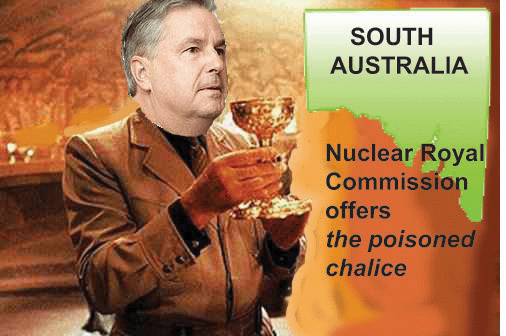 Nuclear discussion not finished yet, says ex Royal Commissioner, Chief Reporter Paul Starick, The Advertiser, November 14, 2016 SOUTH Australia has already invested money in investigating the significant opportunity posed by a high-level nuclear waste repository and should properly finish the discussion, former royal commissioner Kevin Scarce says.
Speaking just after Premier Jay Weatherill said the only way forward was through a referendum at an unnamed time, Rear Admiral Scarce issued veiled criticism of the citizens’ jury process.
Rear Admiral Scarce declared that the discussion had been rushed and the community needed more time to work through issues…..
“I think the next step would be for the government to satisfy itself that it’s got sufficient support to continue forward,” Rear Admiral Scarce said….
Rear Admiral Scarce said more analysis was needed of costs and revenue, but emphasised any agreement to accept waste would be made as a treaty between two nations, even if a private operator was contracted to run the facility. He rejected claims of blanket opposition from Aboriginal communities, saying some had privately said they were prepared to consider a proposal but stressed any final site had to have community approval. http://www.adelaidenow.com.au/news/south-australia/nuclear-discussion-not-finished-yet-says-ex-royal-commissioner/news-story/163094d541fe87bdbf67eea2d6358f70
South Australian Treasurer Koutsantonis sulking about “elites” influencing Nuclear Citizens Jury
 Nuclear fuel cycle: ‘Silent majority’ over ‘elites’ telling people what to think about waste dump http://www.abc.net.au/news/2016-11-16/’silent-majority’-want-sa-nuclear-dump-koutsantonis-says/8030816 A “silent majority” of South Australians want the investigation into a nuclear waste dump to continue, the State Treasurer says, citing a comparison with US voters who elected Donald Trump as their next president.
This week the SA Government announced the proposal for a high-level nuclear waste dump would only go ahead after a state-wide referendum, with bipartisanship and approval from the Indigenous community where the dump was planned.
Treasurer Tom Koutsantonis said there were South Australians who wanted further discussion on the proposal. Two thirds of a citizens’ jury concerning the project did not want the state to store waste “under any circumstances”. The Government’s own community consultation report found of those surveyed randomly, 37 per cent were against the idea, while 43 per cent wanted more discussion on the issue.
There’s a silent majority that want to talk about this a bit further,” Mr Koutsantonis said.
“We saw that now in the United States with Donald Trump, we’ve seen what happens when the elites tell the people how to think.
“I think a referendum is a great way of having South Australians actually talk about this, but in the end we can’t have a referendum without the consent of the Parliament.”
Premier Jay Weatherill released a statement this afternoon stating the Liberal Party was holding back the nuclear debate by “engaging in a series of pathetic stunts” and questioning the binding nature of of a referendum.
“Without bipartisanship, there is no way can meaningfully progress this discussion,” Mr Weatherill said.
“The Liberal Party wants to shut down this debate entirely, they think they know better than the South Australian people.
“We trust the South Australian people to make the right choices in the state’s best interests.”
Economic modelling described as optimistic
Meanwhile, the Opposition has seized on a report which questioned the royal commission’s economic modelling showing there would be a $257-billion windfall for the state from a nuclear storage facility.
In the independent report provided to Parliament, the modelling was described as optimistic.
Opposition spokesman Rob Lucas said the modelling was based on “vague” assumptions.
“There are very significant questions and concerns being raised by these international experts, independent international experts, about the financial assumptions which underpin the project,” Mr Lucas said.
“They mirror the concerns, some of the concerns that we have expressed in the past.”
Australian Aboriginal Presence at COP22 Climate Summit Marrakesh
‘First Nations Peoples must demand our participation in the planning of Australia’s climate change strategies, which they have agreed to, at the Paris conference.’http://www.sovereignunion.mobi/content/feedback-cop22-climate-summit-marrakesh
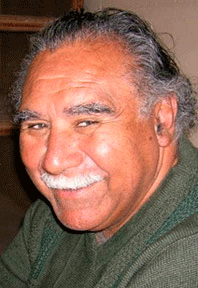 Ghillar Michael Anderson | Sovereign Union 8 November 2016: “First it’s important to know that the delay in countries signing the Paris Agreement was caused by both Australia and the USA threatening to walk away if other parties refused to permit various out clauses.
“Notable and critical examiners of the Paris Agreement all agree that the symbolism was great for the world facing catastrophies because of climate change, especially those of the small Pacific Islands and low coast lands.
“In reality the Paris Agreement leaks like a sieve and permits too many escape clauses for the major polluters and countries promoting extractive industries, despite the overall great objectives of the Paris Agreement.
“As Aboriginal Peoples of the world the Paris Agreement acknowledges us in the preamble where it states:
“The Paris Agreement affirms the importance of traditional knowledge of Indigenous Peoples as well as local knowledge systems in adaptation to climate change.
Indigenous Peoples’ traditional knowledge related to their food sources and subsistence practices, flora and fauna and relationships with their traditional lands, waters and other natural resources are the basis of their traditional economics as well as their cultures, identity and spirituality. Indigenous Peoples’ inherent rights to their lands, cultural heritage, traditional knowledge, land, resources and subsistence practices are affirmed and recognised in the UN Declaration on the Rights of Indigenous Peoples.
“The Paris Agreement specifically recognises the importance of Indigenous Peoples’ traditional knowledge in adaption actions and in recognition of the need to strengthen such knowledge, technologies, and practices it establishes a platform for the exchange of experience and sharing of best practices on mitigation and adaptation in a holistic integrated manner.” … “
Discussions on the future of uranium mining town Jabiru, as ERA pulls out
Miner contemplates NT town’s future http://www.news.com.au/national/breaking-news/miner-contemplates-nt-towns-future/news-story/ebc248cbfd26edd555465ae79964e8ad NOVEMBER 15, 2016
Discussions over the future of a community near the Northern Territory’s Kakadu National Park have begun as a mining company prepares to pull out.
Jabiru town was built for a uranium mine which has been operating for more than three decades.
It was always intended to be temporary and its head lease will expire in about four years.
ERA operates the Ranger mine and has started a social impact assessment (SIA) to determine a transition and rehabilitation strategy for the township.
ERA says it’s not developing a plan for the future of Jabiru beyond the lease expiration in 2021 when production stops, which is expected to cost 350 jobs.
“It is important to note that a separate process involving the commonwealth government, Northern Territory government and traditional owner representatives has commenced to develop and agree a future plan for Jabiru,” ERA said.
“The outcome of those discussions will also have a significant influence on ERA’s plans.”
Traditional owners warn that if the NT government doesn’t commit to the town’s future it will effectively be demolished.
Justin O’Brien, chief executive of the Gundjeihmi Aboriginal Corporation which represents traditional owners, says Jabiru is the gateway to Kakadu and should continue to function without the mine.
Jabiru residents and local business owners have been invited to attend 30 information sessions in November and Deccember, while more will take place early next year.
Australia on the wrong side of nuclear disarmament history
 As the world pushes for a ban on nuclear weapons, Australia votes to stay on the wrong side of history, The Conversation, Associate Professor, International Education and Learning Unit, Nossal Institute for Global Health, School of Population and Global Health, University of Melbourne November 16, 2016 “………Australia’s role in fighting a nuclear weapon ban
In voting “no”, Australia stuck out like a sore thumb among Asia-Pacific nations in at October’s UN committee meeting. All of the Association of Southeast Asian Nations (ASEAN) members – including Indonesia, Malaysia, Singapore and Thailand – as well as New Zealand and ten out of 12 Pacific island countries voted yes.
Australia is signatory to all the key international treaties banning or controlling weapons. On some, like the Chemical Weapons Convention, Australia was a leader. Australia’s active opposition and efforts to undermine moves towards a treaty banning nuclear weapons stand in stark contrast.
Australia’s stated arguments for opposing a ban treaty have varied, including that there are no “shortcuts” to disarmament; that only measures with the support of the nuclear-armed states are worthwhile; that a ban would damage the nuclear non-proliferation treaty, causing instability and deepening divisions between states with and without nuclear weapons; that it wouldn’t address North Korea’s threatening behaviour; and that it does not take account of today’s security challenges.
Perhaps the most extraordinary justification of Australia’s position came from Department of Foreign Affairs and Trade’s first assistant secretary, Richard Sadleir, who said at a Senate estimates hearing on October 20, 2016:
it is not an auspicious time to be pushing for a treaty of this sort. Indeed, in order to be able to effectively carry forward disarmament, you need to have a world in which there is not a threat of nuclear weapons and people feel safe and secure.
Can anyone seriously imagine Australian officials arguing that we need to keep stockpiles of sarin nerve gas, plague bacteria, smallpox virus, or botulism toxin for deterrence, just in case, because we live in an uncertain world?
Yet that is what Australia continues to argue about nuclear weapons. Sadleir is saying that disarmament is only possible after it has happened, when we live in an impossibly perfect world. It’s a nonsensical argument that puts off nuclear disarmament indefinitely.
As revealed in Department of Foreign Affairs and Trade internal documents, released through a Freedom of Information request, the real reason that Australia opposes a ban treaty is that it would jeopardise our reliance on US nuclear weapons.
How Australia can help with disarmament
It’s 71 years since the Hiroshima bombing, and 46 years since the nuclear non-proliferation treaty came into force, committing all governments to bring about nuclear disarmament. But that treaty is too weak: no disarmament negotiations are underway or planned.
Instead, every nuclear armed state is investing massively in keeping and modernising their nuclear arsenals for the indefinite future. The US alone has said it plans to spend about US$348 billion over the next decade on its nuclear arsenal.
Nations like Australia cannot eliminate weapons they don’t own. But they can prohibit them, by international treaty and in domestic law. And they can push other nations to do more to reduce threats to humanity – just as Australia has done with every other weapon of mass destruction.
An overwhelming majority of Australians have said in the past that they support a treaty banning nuclear weapons: 84% according to a 2014 Nielsen poll commissioned by the International Campaign to Abolish Nuclear Weapons, with only 3% opposed.
This is an issue that should be above party politics. In 2015, the Labor Party adopted a new national policy platform committing to support the negotiation of a global treaty banning nuclear weapons. At a public meeting in Perth last month, Bill Shorten said that a Labor government would support the UN resolution for a ban treaty.
In October 2016, our government let us down by voting to be counted on the wrong side of history. Thankfully, we can still expect to see the United Nations ratify the move towards a new treaty banning nuclear weapons in December, with negotiations set to begin in March 2017 in New York. It’s still not too late for Australia to change its vote, and participate constructively in the negotiations next year. https://theconversation.com/as-the-world-pushes-for-a-ban-on-nuclear-weapons-australia-votes-to-stay-on-the-wrong-side-of-history-68337
1 This month


Help Aunty Sue Protect Her Land and Sacred Sites From Destructive Rocket Testing.
.

Australians deserve the truth
about
AUKUS – https://aukuspublicinquiry.com/

PETITION – To: Prime Minister Anthony Albanese and the Australian Labor Government

of the week – Australians for War Powers Reform (AWPR)
To see nuclear-related stories in greater depth and intensity

