What’s in store at the Marrakech climate talks – and will Australia still back coal?, Guardian, Graham Readfearn,6 Nov 16
The US presidential race is guaranteed to prove a distraction at the Morocco COP22 gathering, where action is on the agenda. he Australian government takes a delegation to the United Nations climate change talks in Morocco starting Monday – two weeks that are sure to be dominated by, well, who knows?
Because, during the first week, the United States will go to the polls to pick a new president – an event that will act like a giant weapon of mass distraction in Marrakech.
The Republican candidate, Donald Trump, has pledged to pull the US out of the UN process on climate change and cancel the global deal agreed at the last talks in Paris…….
aside from the distraction of US politics, what else for Marrakech – a meeting known as COP22 (so called, if you must ask, because this is the 22nd meeting of the conference of the parties to the UN framework convention on climate change)? And what about Australia’s position?
Since the Paris agreement was gavelled last December, the process to ratify the deal has been ongoing.
This process, known as “entry into force”, required at least 55 “parties” representing about 55% of global greenhouse gas emissions to ratify the agreement.
This threshold was met on 5 October and the deal will enter into force right about … now!…….
Australia has still not ratified the Paris agreement but there are reports this could happen before the talks close on 18 November……
Australia pledged that by 2030, it would cut emissions between 26% and 28% below where they were in 2005.
While the Department of Foreign Affairs and Trade stands by the target as being ambitious and fair, there are many critics who say it’s anything but……
Australia remains an influential country in the talks, owing in part to its position as chair of the umbrella group of countries – one of many negotiating groups.
As yet there has been no formal announcement from the Australian government on who will attend, but there is an expectation among some that the foreign minister, Julie Bishop, will be there for the “high-level segment” that starts in week two.
The Australian delegation will also have a new diplomat in charge. Replacing Peter Woolcott as climate change ambassador is Patrick Suckling, who took over the role in February after serving as Australia’s high commissioner in India.
During his time in New Delhi Suckling made several statements supporting the controversial Carmichael mega-coalmine project in Queensland, being proposed by Indian company Adani.
“This project will drive economic growth and create more than 6,000 jobs in Australia,” he said in 2014. “It will also boost India’s development by providing electricity to 100 million Indians.”
In one report in the Economic Times, Suckling was quoted as saying the Australian government was trying to tighten legal rules around who could and could not challenge coalmines through the courts (a theme that has re-emerged in recent weeks).
“We are actively thinking of possible ways to limit the scope of litigation to only those with a real standing in a project,” he was quoted as saying.
Language like this tends not to go down well with the army of NGOs, campaigners and civil society groups who attend the climate talks and have given Australia more then a fair share of “fossil” awards over the years.
The perception among many has been that Australia has sought to defend the coal industry too many times at UN meetings.
Will Australia stake its reputation on coal again? https://www.theguardian.com/environment/planet-oz/2016/nov/05/whats-in-store-at-the-marrakech-climate-talks-and-will-australia-still-back-coal
November 6, 2016
Posted by Christina Macpherson |
AUSTRALIA - NATIONAL, climate change - global warming, politics, politics international |
Leave a comment
 Solar energy: Sunny western Queensland to become a hub for power farms, ABC News, 6 Nov 16 By Lucy Murray Western Queensland is becoming a major hub for solar energy, with the state’s largest solar power farm soon to go online near Barcaldine and construction of another major project about to get underway in Longreach.
Six solar projects partially funded by the Australian Renewable Energy Agency (ARENA) were either recently completed or being built across Queensland.
Construction is expected to begin on another six projects next year.
With construction of the 25 megawatt (MW) Barcaldine solar farm now finished, work is underway to connect the 79,000 panels to the state’s electricity grid with about 580 kilometres of cable.
It will feed the grid with the capacity to power more than 8,000 homes once finished by mid-December, enough to light up Barcaldine 11 times over.
A short distance away, work will soon begin on the 15MW Longreach Solar Farm.
Canadian Solar was successful in the last round of ARENA funding and will begin construction on the project early next year……http://www.abc.net.au/news/2016-11-06/queensland-biggest-solar-farm-set-to-go-online/7975060
November 6, 2016
Posted by Christina Macpherson |
Queensland, solar |
Leave a comment
 The aggressive neo-liberal land grab is dividing Aboriginal communities and even brothers. As one Traditional Owner in the
Northern Territory told me recently, “these mining deals can give one or two families a big pay but generally they don’t improve the
community. Money goes on a few new cars and more grog comes in. We never see things get better but someone is getting very rich on our land.”
In the Kimberley and Pilbara in Western Australia, across the Northern Territory, on Cape York and in parts of NSW and South Australia, it is disturbing to see the divide and conquer tactics of mining companies and governments………..
Privatisation of land is the neo-liberal spearhead hurled deep into the heart of the traditional Aboriginal way of life……..
The Intervention’s extraordinary damage to the Aboriginal sense of control and wellbeing makes it the gravest policy disaster in
Australia since the removal of Aboriginal children in the Stolen Generations.

 THE WAY AHEAD: The new land grab Tracker, BY JEFF MCMULLEN, JUNE 21, 2013 NATIONAL: Neo-liberalism is a
hungry beast and this 21st Century strain of capitalism is shaping the agenda for control of Aboriginal lands, writes JEFF MCMULLEN.
You only have to listen to Professor Marcia Langton’s Boyer Lectures on ABC Radio or read Noel Pearson’s sermons on acquisition to see how this virulent form of free-market fundamentalism has gathered influential adherents, including policy makers in both political
parties.
Australian Government policy is heavily influenced by neo-liberalism through its extraordinary emphasis on managing access for mining
companies to resources on Aboriginal lands. This involves controlling what is still perceived as ‘the Aboriginal problem’ and forcing a
social transition from traditional values and Cultural practice to ‘mainstream’ modernism of a particular brand. It also involves
displacing many Aboriginal people from their traditional lands and concentrating them in ‘growth towns’. Continue reading →
November 5, 2016
Posted by Christina Macpherson |
aboriginal issues, AUSTRALIA - NATIONAL, reference, uranium |
Leave a comment
 The Paris climate deal has come into force – what next for Australia?, The Conversation, Peter Christoff, 4 Nov 16 “……… From Paris to Australia Australia is expected to ratify the Agreement later this year. When it does so, it will be committing itself to regularly increasing its efforts to reduce greenhouse gases, improve climate adaptation, and provide climate finance.
Like other nations, Australia will have to review and toughen its climate targets every five years, starting no later than 2020, and report back regularly on its efforts.
While Australia’s 2020 and 2030 emissions targets are seen as weak by international standards, doubts have still been expressed about the federal government’s ability to reach them.
Modelling suggests Australia’s emissions are projected to rise to 21% above 2005 levels by 2030 – rather than fall by the 26-28% proclaimed in its official target.
Australia’s Emissions Reduction Fund has been criticised as being underfunded and focused on the wrong projects. Recent analysis of the contracts awarded through the scheme’s “reverse auctions” confirms that little real additional abatement has been achieved.
Moreover, likely future changes in land use and forestry (mainly reductions in land clearing) will be insufficient to achieve these goals in isolation or to contribute significantly to future ones. The current policy mix means that tougher – and perhaps even existing – national targets could only be met by buying international carbon credits.
In addition, Australia’s reports to the UN will have to reflect “environmental integrity, transparency, accuracy, completeness, comparability and consistency in accordance to rules to be adopted by parties to the Agreement”. The transparency and accountability of Australia’s emissions reporting was recently questioned by the United Nations and by other parties to the Climate Convention. This too will have to improve.
Like other parties, by 2020 Australia will also be invited to provide the UN Climate Secretariat with a long-term low-carbon strategy to run until 2050. Designing an effective transition strategy will require extensive consultation with state and territory governments, industries, and other stakeholders. Such attention to detail, although essential for building wide and deep support for a future low-carbon economy, has so far been well beyond the ability of politicians stuck in Canberra’s toxic climate policy culture.
In all, the Paris Agreement, although voluntary, can be thought of as a global climate safety net held by all nations. This inclusiveness means that Australia will no longer be able to point to the absence of other states as an excuse for its recalcitrance. It will increasingly be held to account by other nations, and the need for meaningful action will become ever more irresistible, as the net gradually tightens. https://theconversation.com/the-paris-climate-deal-has-come-into-force-what-next-for-australia-68140
November 5, 2016
Posted by Christina Macpherson |
AUSTRALIA - NATIONAL, climate change - global warming |
Leave a comment
Clearly, Australia, Japan and South Korea voted in solidarity with their U.S. nuclear protector and against the overwhelming sentiment of their Asian and Pacific neighbors as well as against global opinion. Being on the wrong side of geography as well as history is not a good look. Their vote might also attract charges of hypocrisy the next time they criticize North Korea’s nuclear program
Rattling the nuclear cage, and look who is terrified, Japan Times, BY RAMESH THAKUR , 4 Nov 16, “…….on Oct. 27 the First Committee of the U.N. General Assembly adopted, by the overwhelming vote of 123-38 (with 16 abstentions), Resolution A/C.1/71/L.41, which calls for negotiations on a “legally binding instrument to prohibit nuclear weapons, leading toward their total elimination.” Two conferences will be convened next year in New York (March 27 to 31 and June 15 to July 7). The resolution fulfills the 127-nation humanitarian pledge “to stigmatize, prohibit and eliminate nuclear weapons.”
The strengthening international sentiment was evident at the U.N. working group’s disarmament meeting in Geneva in August when Australia angered many countries by insisting on a recorded vote instead of approving a consensus report calling for negotiations on a ban to begin in 2017.
Continue reading →
November 5, 2016
Posted by Christina Macpherson |
AUSTRALIA - NATIONAL, politics international, weapons and war |
Leave a comment
 SA blackout: Wind farm industry ‘hung out to dry’ by energy market operator AEMO RN By David Lewis for Background Briefing , 4 Nov 16, The organisation that manages the national electricity market has been accused of leaving wind farms “hung out to dry” after the recent statewide blackout in South Australia.
The Australian Energy Market Operator (AEMO) is still investigating the cause of the blackout, which plunged 1.7 million people into darkness on Wednesday, September 28.
The catastrophic power outage sparked furious disagreement about whether the state’s heavy reliance on wind farms contributed to the event.
Giles Parkinson, a veteran journalist and founder of the website RenewEconomy, believes AEMO has added fuel to the fire in a deliberate attempt to deflect attention away from its own role.
“I think people are quite confused about what the market operator seems to be doing and I think some people think it’s more interested in protecting its own reputation at this stage than getting to the bottom of it,” he said.
“It’s basically left the wind industry hung out to dry, leaving enough inference in there for people who do not favour wind to find it guilty and write and declare all sorts of things about the wind industry and the weakness of wind energy.”……..
AEMO made ‘foolhardy’ decisions
Mr Parkinson said he believed the emotionally charged wind-versus-coal debate is distracting from the mistakes AEMO made when preparing for the storm.
He pointed out that when assessing the severity of the approaching weather system, AEMO decided against declaring a “credible contingency”.
“In other words, (AEMO) saw no risk to the transmission or the generation assets despite the fact this storm was approaching and it was packing wind speeds well beyond the stated limits of many of the wind farms that were operating at the time.”
Had AEMO declared a “credible contingency”, it could have intervened in the market by reducing the amount of electricity being produced by generators, including the interconnector to Victoria.
“It was basically running the interconnector not at full throttle but pretty close to full throttle,” Mr Parkinson said……..
David Leitch, the principal at electricity consultancy firm ITK, said he agreed.
“The Heywood interconnector could have been derated an hour earlier so that when the wind generation went off, the Heywood interconnector could have picked up more electricity from Victoria and put it in and that probably would have helped a lot,” he told Background Briefing…….
AEMO unaware of safety settings
AEMO has also been criticised for not having enough information about the safety settings on wind turbines across the state.
In its second report into the blackout, the market operator admits it had no idea how many system faults individual wind farms could ride through before shutting down.
Kobad Bhavnagri, the head of Bloomberg New Energy Finance in Australia, described this gap in knowledge as one of the “big issues” with AEMO’s handling of the disaster.
“Now the question is did AEMO have a duty to know about those settings? If not, why not?” he said……..http://www.abc.net.au/news/2016-11-04/wind-farms-hung-out-to-dry-by-energy-market-operator-aemo/7992768
November 5, 2016
Posted by Christina Macpherson |
AUSTRALIA - NATIONAL, South Australia, wind |
1 Comment
Australia risks being excluded from the first meeting of countries signed up to a landmark deal on climate change because parliament is yet to ratify the agreement, an international agency warns.
The annual United Nations climate change conference starts in Marrakech on Monday and will also serve as the first official meeting of parties to the Paris agreement struck in 2015.
That deal comes into effect on Friday after 55 per cent of the world’s emitters ratified it but Australia isn’t among them, with the government blaming the timing of the federal election for the delay.
It hopes to have parliament ratify the deal by year’s end.
Oxfam Australia’s climate change adviser says the failure to ratify is a disappointment that risks Australia being excluded from the international meeting.
Simon Bradshaw said there was also a bigger issue around the “yawning gap” between Australia’s commitments and the demands on climate action under the Paris agreement.
The deal signed by global leaders agrees to limit global warming to two degrees and commit countries to updating emissions reduction targets every five years. “Australia’s continued recalcitrance risks not only greater harm to vulnerable communities, but also threatens our own economic prosperity in a world shifting ever more rapidly away from fossil fuels,” Dr Bradshaw said on Thursday.
November 4, 2016
Posted by Christina Macpherson |
AUSTRALIA - NATIONAL, climate change - global warming |
Leave a comment
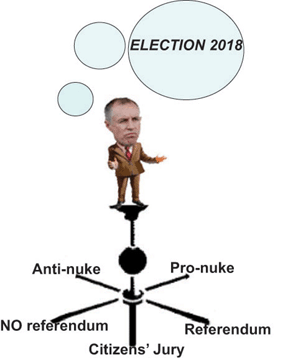 Bias of SA Nuclear Royal Commission finally exposed, REneweconomy, By Jim Green on 4 November 2016 “……..SA Premier Jay Weatherill should initiate a Royal Commission to investigate the discredited, $9 million Nuclear Fuel Cycle Royal Commission. He should also have the decency to fall on his sword for his role in the fiasco.
Weatherill’s exit is looming as a real possibility. He hoped that the state Labor conference on October 29 would give him licence to push ahead with his nuclear waste plans. But he had to defuse a plethora of no-dump resolutions by promising to hold a ‘Special ALP Convention’ to discuss the issue. The resolution read: “This Special ALP Convention should be held at the conclusion of community consultation and before a decision is made on the development of a high level nuclear waste repository in SA.”
Yet days later, on November 1, Weatherill denied that he had made a commitment to hold a special convention. He told Parliament: “There is no upcoming special convention. There will be a special convention at a time when it is necessary. It is not going to happen anytime soon. It may be a question of years away”.
There is plenty of angst within the state Labor Party (an election is just over a year away) and there will be plenty more as a result of Weatherill’s welshing on his promise to hold a special convention.
And there is plenty of public opposition: a protest rally in Adelaide on October 15 attracted 3,000 people; Aboriginal Traditional Owners are overwhelmingly opposed to the nuclear waste plan and are fighting hard to stop it; trade unions and churches are speaking out in opposition; and the SA Liberal Party is hedging its bets by pointing to the huge upfront costs (estimated at between $600 million and $2.4 billion) that the state would need to gamble before any income was generated.
November 4, 2016
Posted by Christina Macpherson |
NUCLEAR ROYAL COMMISSION 2016, politics, South Australia |
Leave a comment
 Climate warning at bushfire inquiry, Examiner,
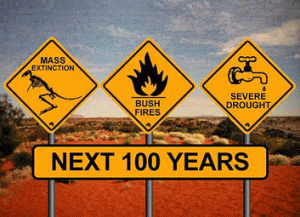
2 Nov 2016, Tasmania could see major transformations in its landscape as climate change-caused fires impact vulnerable species, an expert has warned a Senate inquiry.Evidence showed pencil pine trees burnt thousands of years ago never recovered, University of Tasmania environmental change biologist Professor David Bowman told the inquiry into responses to recent bushfires in remote Tasmanian wilderness.
Professor Bowman said he didn’t make the decision lightly to identify last summer’s Tasmanian Wilderness World Heritage Area fires as a symptom of climate change.
However he wanted to warn the community that such unprecedented events occurred with a rapidly warming climate, he said.
The summer’s bushfires took fire managers to “the limit of their imaginations let alone their capacities” after lightning struck in vast and unusual quantities throughout remote wilderness areas, Professor Bowman said.
While rapid attack firefighting and fire detection would save some vulnerable systems in the TWWHA, he warned against expectations that all fires could be extinguished.
These expectations were unfair to fire managers, Professor Bowman said.
“This is a very challenging environment, particularly given the soil can burn.” …..
The Wilderness Society urged the committee to recommend that the management plan for the TWWHA prioritised protection of irreplaceable values over built infrastructure.
State environment minister Matthew Groom is expected to finalise the plan by the end of the year.
Fires impacted about 20,100 hectares, or 1.3 per cent, of the TWWHA last summer. About 2,700 hectares of fire-sensitive areas with vegetation not adapted to recover from bushfire were damaged. http://www.examiner.com.au/story/4268911/bushfire-climate-warning/?cs=5312
November 3, 2016
Posted by Christina Macpherson |
climate change - global warming, Tasmania |
Leave a comment
Mike Baird is going rogue on climate change, The Age, Christine Milne , 3 Nov 16.In NSW the Baird government is set to give the green light to land clearing that will increase our greenhouse gas emissions just as the Paris Agreement to limit global warming to 2 degrees and pursue a more ambitious 1.5 degrees limit comes into effect on Thursday. Premier Baird is going rogue on climate.
As the world meets in Morocco for COP22, Australia will be under scrutiny as never before. Not only have we not ratified the Paris Agreement, we are increasingly being seen as cheating the process with rubbery figures. To meet the Paris Agreement objectives, negative emissions will be required. That is pulling CO2 from the atmosphere at the same time as reducing emissions from all sources. The Baird government is doing the opposite, increasing emissions from coal and coal seam gas at the same time as pushing up emissions from land clearing.
The rest of the world is sick of Australia’s creative accounting using land use, land use change and forestry, or LULUCF, as a “get out of jail free card” to “offset” its rising greenhouse gas emissions from industry. Australia has argued that while its emissions from coal-fired power stations, industries, cars and transport fleet vehicles and fugitive emissions from gas are rising, they are offset by our forests.
That is the basis of the Turnbull government’s Emission Reduction Fund. It has spent over $1 billion paying farmers not to clear or to regrow forests so polluters can keep on polluting. People think the fund must be invested in upgrading industry. Wrong, it has been overwhelmingly paid to farmers.
That is why the Baird government’s proposed changes are so bad. Not only will they destroy biodiversity and send species to extinction by destroying habitat, they will undermine efforts to meet our greenhouse gas reduction targets by cancelling out any reductions that may have been made through the ERF……….
In its reports to the United Nations Framework Convention on Climate Change, Australia said that from 2005- 2013 land use emissions dropped by 10 per cent but admitted that they will increase by 8 per cent from 2013 to 2020. As part of a peer review process, other countries can ask questions and they have leapt at the chance.
The US asked: “Can you explain what caused this reversal from downward trend to upward trend?” Australia has not yet answered but it is obvious that the Liberal governments of Newman, Baird and Malcolm Turnbull are to blame.
The European Union has noted:”Australia updates some details on ‘avoided clearing of native regrowth’, stating that projected increases in land clearing will be offset by low rates of native forest harvesting. Noting that tree-clearing controls were instrumental in Australia meeting its Kyoto commitment, have the emissions projections been adjusted to account for the updates?”…..
This cannot go on. The offsetting, lies and rubbery figures must stop. Carbon in the landscape must be increased, not decreased. The Baird government’s new land clearing laws must be stopped and if NSW won’t act the federal government should step in to make it happen.
Christine Milne is the former leader of the Australian Greens. http://www.theage.com.au/comment/mike-baird-is-going-rogue-on-climate-change-20161102-gsg4zr.html
November 3, 2016
Posted by Christina Macpherson |
climate change - global warming, New South Wales |
Leave a comment
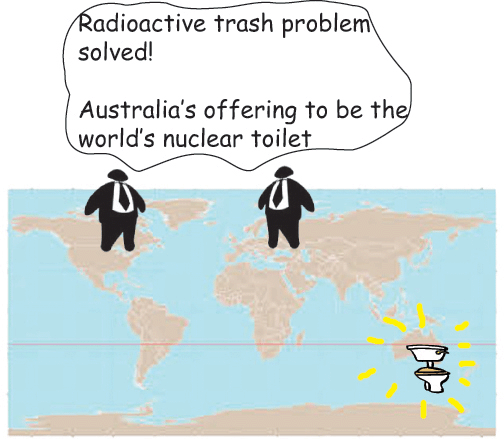
So – the Australian public dreams on – preoccupied with the Melbourne Cup and other sporting events. And the global nuclear lobby continues its machinations. It would be such a strong selling point, to be able to tell South Asian countries that they can go ahead with nuclear power, as Australia will take out the radioactive trash
The machinations of the global nuclear lobby, http://readersupportednews.org/pm-section/27-27/40006-the-machinations-of-the-global-nuclear-lobby-qdown-underq31 October 2016
Australia has been pretty much of a forgotten player in the global nuclear “renaissance”. Not any more. The big nuclear players – USA, Russia, Canada, France, China , Japan South Korea are busily marketing nuclear technology to every other country that they can. Strangely enough little ole non-nuclear Australia, (population 23 million) has a starring role to play in all this.
You see, the global nuclear lobby’s problem is – what to do with the radioactive wastes? I know that the new geewhiz guys and gals are pushing hard for Generation IV reactors that will “eat the wastes”. The trouble is – there is an awful lot of the stuff. World total of high level radioactive wastes was estimated at 250,000 tonnes in 2010 . There must be quite a bit more by now. The other trouble is that even the most geewhiz of the as yet non- existent Gen IV nuclear reactors still would leave a smaller but highly toxic volume of radioactive trash, which would still require disposal.
This leads to a serious marketing issue. If countries such as USA, Japan, Canada, South Korea, are still having trouble dealing with their own domestic accumulation of nuclear waste, how can they persuasively sell nuclear reactors to Asian, Middle Eastern and African countries? The waste problem must be solved!
The wizards of the global nuclear lobby have come up with what they see as the perfect answer. A far away land, with lots of space that’s owned by “unimportant” indigenous people, could import the wastes, and thus remove the problem. It’s a sort of variant on the old “toilet way down the back”. Continue reading →
November 3, 2016
Posted by Christina Macpherson |
AUSTRALIA - NATIONAL, NUCLEAR ROYAL COMMISSION 2016, South Australia, wastes |
Leave a comment
Jim Green, 3 Nov 16 No High Level International Nuclear Waste Dump in South Australia
The Nuclear Royal Commission was a disgraceful con-job from start to finish.
The SA government chose a nuclear advocate as Royal Commissioner.
The Royal Commissioner stacked his Advisory Committee with three strident nuclear advocates, ‘balanced’ by one token critic.
There wasn’t even one token nuclear critic on the Royal Commission’s staff.
And there isn’t even one token nuclear critic on the SA government’s Consultation & Response Agency which has been exerting influence on the Citizens’ Jury, and which also has strong influence over the statewide ‘consultation’ process (thinly-disguised promotion).
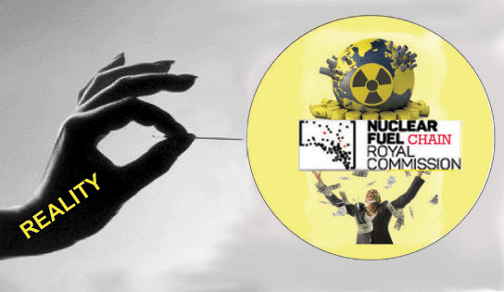
This morning the ABC reveals that the economic modelling commissioned by the Royal Commission was co-authored by the president and vice president of a group which aims to promote nuclear waste “solutions” and which also promotes nuclear power. A clear conflict of interest and an absolute disgrace. (www.abc.net.au/am/content/2016/s4568141.htm)
Royal Commissioner Kevin Scarce told the ABC this morning:
“The conflict of interest would arise if they were the only source of information that we were using to assess the evaluation. They were not.”
Really? In fact, only one, conflicted consultant was used by the Royal Commission for economic modelling. The fanciful speculation of the conflicted consultant was heavily promoted in the Royal Commission’s report and is now being promoted as solid, factual information by the government’s Consultation & Response Agency.
THERE NEEDS TO BE A ROYAL COMMISSION TO INVESTIGATE THE ROYAL COMMISSION.
For a serious discussion on the economics of the plan to turn SA into the world’s high-level nuclear waste dump, see this submission from Prof. Richard Blandy: http://nuclearrc.sa.gov.au/…/upl…/2016/04/Blandy-Richard.pdf
And see also the report by the Australia Institute: http://www.tai.org.au/…/P222A%20Digging%20for%20answers%20-…
November 2, 2016
Posted by Christina Macpherson |
NUCLEAR ROYAL COMMISSION 2016, secrets and lies |
Leave a comment
Kim Mavromatis No High Level International Nuclear Waste Dump in South Australia, 1 Nov 16 SA Government Nuclear Focus Group in Port Pirie last night.

I got into a SA Govnt Nuclear Focus Group session in Port Pirie last night. 9

males – no females. There was an all female focus session before the all male session. Males and females were separated, why? Apparently females are predominately against the nuclear waste dumps and males are more open to it.
It was an interesting discussion though, one pro nuclear, the rest either fence sitters or like me opposed to the waste dumps. We were given parameters of what to talk about but mostly discussed the nuclear industry and the SA govnt proposed waste dump. The 90 min session was recorded. We did 2 written surveys as well, at the beginning and at the end, to see if our views had changed.
The group was asked why we thought most women were opposed to Nuclear waste dumps and I said because they are smarter than males. I expect there have been a lot of these sessions held around the state (closed to the media and public scrutiny). And at the end we were given $70 cash each in unmarked sealed brown envelopes, for our top-secret work.
From what I can gather, it’s the Know Nuclear mob running the show – they commissioned a 3rd party to do the business – and they report back to govnt with their findings
https://www.facebook.com/groups/1314655315214929/
November 2, 2016
Posted by Christina Macpherson |
politics, South Australia |
Leave a comment
Special assembly to weigh SA nuclear dump, SBS, 30 Oct 16, SA’s Labor Party state  convention has delayed making a decision on the proposal for a nuclear waste dump in the state’s north.
 South Australian Premier Jay Weatherill has run the gauntlet of anti-nuclear protesters as Labor voted to put the question of establishing a high-level nuclear waste dump to a special party convention.
Mr Weatherill was heckled by several hundred anti-nuclear activists while entering the ALP state conference in Adelaide on Saturday, as they called on him to scrap the dump idea, which goes against current party policy.
Dave Sweeney, from the Australian Conservation Foundation, told the protesters South Australia was so much more than a dumping site.
“This is a bad idea, it’s a thought bubble that should have burst on day one,” Mr Sweeney said.
“We will not be burying waste, we will be burying this idea.”
The convention considered a number of motions related to the dump, including one calling for the government to hold a referendum on the issue.
Others called for the government to delay any decision until after the issue was discussed at the next national ALP conference while the Maritime Union of Australia urged the state government to “cease and desist” with any action to consider a dump of any kind.
However, the party endorsed a motion to have the issue put before a special convention at the conclusion of the community consultation process.
The state government remains committed to making a decision on the dump proposal by the end of the year ….http://www.sbs.com.au/news/article/2016/10/29/special-assembly-weigh-sa-nuclear-dump
October 31, 2016
Posted by Christina Macpherson |
politics, South Australia, wastes |
Leave a comment