Nuclear showdown for South Australia’s Labor Party Conference – perhaps
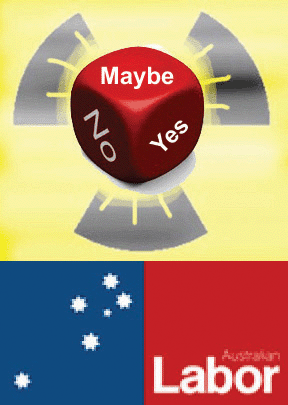
Steve Dale , Nuclear Fuel Watch South Australia Watch out, there is also a group trying to delay decision making about the dump for a few months. They say they are anti-dump but the agenda is probably to defuse maritime/transport/fire/.. unions anger over this crazy plan. These unions who will have to handle this poisonous muck are rightfully angry. They should kill this plan off on Saturday unless they want their workers killed by this cancer causing poison years later.https://www.facebook.com/groups/1021186047913052/permalink/1342858522412468/?comment_id=1342893619075625

 http://www.adelaidenow.com.au/news/south-australia/labor-readies-for-tense-nuclear-showdown-amid-opposition-at-state-meeting/news-story/94b465193620d74f489a1f0cd3fc6e40 Political Reporter Sheradyn Holderhead, The Advertiser October 27 2016
PREMIER Jay Weatherill faces a tense showdown over his Government’s nuclear strategy at a state Labor meeting this weekend.
Three motions have been listed for a vote that essentially call on the Government to abandon the proposed nuclear waste dump while others call for further consultation or a referendum. A joint motion from the Maritime and Rail, Tram and Bus unions demands the State Government “immediately cease and desist any further action or consideration” of any type of nuclear dump.
Among its concerns are a weak economic case, high upfront cost, political damage to Labor, safety risks to workers and the public, and ignoring the rights of Aboriginal people.
The moves make good on threats of a heated fight from powerful union figures who have publicly backed anti-dump campaigners. The Advertiser revealed last month that some within Labor were talking about a repeat of the union campaign against Mike Rann, which boiled over in 2010 when he needed a police escort through protesters at Labor’s state convention.
Anti-dump protesters are expected at the West Adelaide Football Club, which is the venue for Saturday’s meeting. Mr Weatherill declined to comment on the meeting.
The Government is pinning its hopes on an alternative motion that would buy time on a vote to overturn the longstanding party policy to oppose nuclear reactors and imported waste storage.
It instead calls for a Special State ALP Convention on the matter to be held at the conclusion of community consultation but before a decision was made on whether to develop a dump.
 Labor MP Tom Kenyon said he hoped the convention would show there was support within the party to continue investigating the $445 billion project, which he called a “tremendous opportunity” for SA.
Mr Kenyon, also a member of a parliamentary committee considering the project, said making it easier for other countries to have nuclear power could potentially do more to address climate change than efforts toward renewables.
He said while the party always “finds something to be excited about” at conventions this issue was unique.
“This is unusual because since the ‘70s, the Labor Party has had a very strong anti-nuclear position. It’s almost an article of faith,” Mr Kenyon said.
“At some point the party will have to grapple with this deeply and consider its position at the state and federal level.”
Health Services Union state secretary Jorge Navas, who also put forward a motion to reaffirm the existing policy of opposition to a dump said safety risks remained a significant concern.
He likened pursuit of the nuclear industry to asbestos.
“It was profitable but the consequences are devastating,” he said.
Extreme heat events increase: State of the Climate report 2016
 State of the Climate report 2016: Extreme heat events increasing in duration, frequency and intensity By national science reporter Jake Sturmer, ABC News 28 Oct 16 The duration, frequency and intensity of extreme heat events have increased across large parts of Australia, a climate report has found.The Bureau of Meteorology and CSIRO’s biennial State of the Climate report also found May-July rainfall had reduced by around 19 per cent since 1970 in the south-west of Australia.
The report offers a snapshot of how Australia’s weather has changed over the last two years. According the latest report, there has been an increase in extreme fire weather days, and a longer fire season, across large parts of Australia since the 1970s.
Temperatures in Australia — both in the air and on the sea surface — have warmed by a degree since 1910, the report said.
It may not sound like much, but according to the Bureau of Meteorology’s Karl Braganza, it is a big deal.
“It’s not significant when you think about the shift from night to day, but we’re talking about a shift in the actual climatology of Australia,” Dr Braganza said.
“If you move from one climate zone to another in Australia — where there’s only a degree or two of difference — you’ll notice quite a different environment.”
So is anything changing globally? Last year was the warmest on record for the globe since reliable surface air temperature records began in 1880 — 15 of the last 16 years have been the hottest recorded.
Sea levels globally have risen more than 20 centimetres since the late 19th century — one third of this rise is because of ocean warming and the rest from water stored on the land and melting land ice.
It is that melting land ice that could cause a huge shift in sea levels.
Take the ice on Greenland, for example. CSIRO’s Steve Rintoul said if that melted, there would be enough ice to raise global sea level by seven metres.
What makes this even more challenging is that scientists are not sure at what level of temperature rise this melt would happen.
“It could be as low as 1.5 degrees Celsius [or] it could be as high as 3C, but once we cross that threshold we have committed ourselves to losing most of the ice on Greenland,” Dr Rintoul said.
What do we do about it?
Scientists say there is not a moment to lose and we must reduce the consumption of fossil fuels and consequently lower CO2 emissions……..http://www.abc.net.au/news/2016-10-27/extreme-heat-events-increasing-in-duration-frequency-bom-report/7965650
How USA got rid of Australian Prime Minister Whitlam – it was all about Pine Gap
Whitlam demanded to know if and why the CIA was running a spy base at Pine Gap near Alice Springs, a giant vacuum cleaner which, as Edward Snowden revealed recently, allows the US to spy on everyone. “Try to screw us or bounce us,”the prime minister warned the US ambassador, “[and Pine Gap] will become a matter of contention”.
Victor Marchetti, the CIA officer who had helped set up Pine Gap, later told me, “This threat to close Pine Gap caused apoplexy in the White House. … a kind of Chile [coup] was set in motion.”
Pine Gap’s top-secret messages were de-coded by a CIA contractor, TRW. One of the de-coders was Christopher Boyce, a young man troubled by the “deception and betrayal of an ally”. Boyce revealed that the CIA had infiltrated the Australian political and trade union elite and referred to the Governor-General of Australia, Sir John Kerr, as “our man Kerr”.
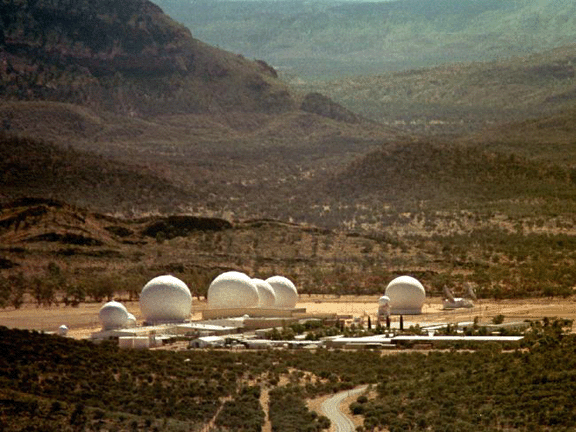
By John Pilger 23 Oct, 2014 Across the political and media elite in Australia, a silence has descended on the memory of the great, reforming prime minister Gough Whitlam, who has died. His achievements are recognized, if grudgingly, his mistakes noted in false sorrow.
But a critical reason for his extraordinary political demise will, they hope, be buried with him. Australia briefly became an independent state during the Whitlam years, 1972-75. An American commentator wrote that no country had “reversed its posture in international affairs so totally without going through a domestic revolution”.Whitlam ended his nation’s colonial servility. He abolished Royal patronage, moved Australia towards the Non-Aligned Movement, supported “zones of peace” and opposed nuclear weapons testing.
Although not regarded as on the left of the Labor Party, Whitlam was a maverick social democrat of principle, pride and propriety. He believed that a foreign power should not control his country’s resources and dictate its economic and foreign policies. He proposed to “buy back the farm”. In drafting the first Aboriginal lands rights legislation, his government raised the ghost of the greatest land grab in human history, Britain’s colonization of Australia, and the question of who owned the island-continent’s vast natural wealth. Continue reading
Jobs in a clean energy future
http://apo.org.au/resource/jobs-clean-energy-future
25 October 2016 Download file
By committing to the Paris Agreement, the world recognised the need to work together to keep global warming well below 2 degrees. Around the world, other governments are embracing the opportunities of transitioning to a clean energy future. But at home, Australia’s pollution continues to rise and Australia remains as one of the biggest per capita polluters in the world. There is still no coherent national plan to transition Australia to a net zero emissions economy.
Jobs in a clean energy future updates our 2010 collaboration Creating Jobs – Cutting Pollution and demonstrates, yet again, that creating a brighter future for the Australian community and our environment go hand in hand.
This report presents a clear choice. If Australia continues with business as usual, pollution will continue to rise and the health of the people and our natural world will continue to deteriorate. If the government acts now and implements policies under a strong action scenario we can create one million more jobs by 2040. People and nature will be better off and the places we love will thrive. If we increase public transport and clean energy Australia’s cities, towns and regions will be more liveable, smarter and healthier places to live. By embracing these opportunities Australia can be a world leader and create jobs and industries that are at the forefront of the transition.
Canavan doing foreign miner Adani’s bidding
http://wanganjagalingou.com.au/canavan-doing-foreign-miner-adanis-bidding/
~ Wangan & Jagalingou http://wanganjagalingou.com.au/
23 October 2016:
“Rockhampton-based Minister for Resources and Northern Australia, Senator Matt Canavan
“is feigning concern for Aboriginal people while relying on misleading media stories this weekend
which attempt to discredit the Wangan and Jagalingou (W&J) Traditional Owners counciland
our rejection of the proposed Adani Carmichael mine”,
said Adrian Burragubba, senior Traditional Owner and spokesperson for the W&J council.
“Mr Adrian Burragubba said,
“We are self-determined and stand independently
– and we have said ‘no’ to Adani and their Government backers more times than we should have to
and Canavan is using us to serve his own self-interest.
““Hiding behind one W&J applicant, who is named as one of seven who received funds from Adani in a deal to attempt to overturn our decisions,
shows nothing but contempt for our concerns.
We have taken our concerns to the courts in a series of current cases, to the public, and to the United Nations. … “
Port Augusta is attracting solar energy developers
Solar energy developers attracted to Port Augusta after power station’s closure, ABC, The World Today 25 Oct 16 By Khama Reid Solar energy developers are honing their attention on the South Australian city of Port Augusta after the community’s economy took a hit when its largest employer, Alinta Energy, closed its coal-fired power station.
For the past five years, the community has been pushing for a transition from coal to renewable energy, which is now steps closer to becoming reality.
Residents and those in the neighbouring city of Whyalla brag the region gets “300 days of sunshine” a year.
Port Augusta Mayor Sam Johnson said the tagline had become more than just a tourism slogan with solar companies getting serious about development in the region.
“Reach Solar have made an application to the State Government as recent as only a few weeks ago for a very real project here at Port Augusta using solar PV [photovoltaic],” Mr Johnson said.
“We know there’s Solastor and Solar Reserve both looking at large scale solar thermal technology, both in the vicinity of $1 billion projects.”
Mr Johnson said one of the further progressed proposals was for the DP Energy Renewable Energy Park to the south of the city.
“DP Energy actually has planning approval and will be the largest wind and solar PV farm in Australia and actually the first to have not just wind but solar PV technology as well.”
Queensland and SA ‘real hot markets’ for solar
Renew Economy editor Giles Parkinson said the spike in interest was not surprising. “There’s two real hot markets for solar at the moment, that’s Queensland and South Australia and in South Australia around the Port Augusta/Whyalla area and that comes from two things,” Mr Parkinson said.
“One is the excellent sunshine, but also the high wholesale electricity prices.
“They rely so much on gas to set the price of generation, and the price of gas has gone up, so the wholesale price has gone up as well.”
Mr Parkinson said solar was becoming a more affordable investment option.
“I guess the overwhelming driver is the reduction in costs of solar PV, it’s actually falling to a point where it can actually compete with wind energy.”
He said the Australian Renewable Energy Agency (ARENA) previously funded wind farm developments, but in its latest round awarded more than $91 million to solar photovoltaic projects across the country……http://www.abc.net.au/news/2016-10-25/solar-energy-developers-flock-to-port-augusta/7962306
Australian government considering law to stop environment groups taking legal action
 Coalition can bring back green ‘lawfare’ bill if Senate supports it, says Turnbull
Prime minister floats plan to reintroduce controversial laws to limit right of conservation groups to mount court cases, Guardian, Paul Karp, 24 Oct 16, The government plans to reintroduce controversial laws to limit the legal standing of conservation groups mounting court cases if it thinks the new Senate will support them, Malcolm Turnbull has revealed.
At a press conference in Sydney on Monday Turnbull expressed concern that “systematic, well-funded” environmental campaigns were targeting major projects and flagged a renewed attempt to pass the law.
In August 2015 the Abbott government announced it would remove the right of most environmental organisations to challenge developments under federal laws unless they could show they were “directly affected”.
The Environment Protection and Biodiversity Act allows any Australian citizen or resident who has engaged in conservation activities in the previous two years to bring a legal challenge to government environmental decisions.
The proposed changes followed a federal court decision that the then environment minister, Greg Hunt, had not properly considered all advice in his approval of Adani’s $16.6bn Carmichael coalmine.
After becoming prime minister Turnbull unexpectedly retained plans to introduce the laws limiting legal standing…….
The Greens environment spokeswoman, Senator Larissa Waters, said: “Stopping ordinary Australians from enforcing our environment laws would be a capitulation to the hard right inside the Coalition and yet another win for Tony Abbott.”
She added: “Gutting public enforcement of environmental laws is an attack on democracy and the rule of law.
“When governments fail to enforce or comply with their own laws, it falls to community groups to hold them to account.”
Waters said there were already strict rules that limit which cases go to court and frivolous or vexatious claims could be struck out.
On Tuesday a United Nations special rapporteur, Michel Forst, criticised the proposed law after a two-week visit to Australia investigating protections for human rights defenders, including environmentalists.
Forst said there were already significant obstacles to environmental litigation including complexity and the risk of a costs order if a case was unsuccessful.
An Australian Conservation Foundation campaigner, Basha Stasak, welcomed the UN rapporteur’s findings that environmental campaigners had been “vilified” for legitimate legal action.
She called on the government to “take on board the recommendations that environmental groups have a legitimate interest in decision making and in the courts” and withdraw amendments to deny them standing and deprive them of tax-deductible status. https://www.theguardian.com/australia-news/2016/oct/24/coalition-can-bring-back-green-lawfare-bill-if-senate-supports-it-says-turnbull
Could there EVER be an ethical argument for Australia to import nuclear wastes?

If indeed, the waste importing idea were conditional on a Japanese plan to close down the industry, and help Japan overcome its very serious dilemma, this could be one big move towards halting the global nuclear industry juggernaut, with its undoubted connection to nuclear weapons. Japan could pay a reasonable amount to the waste host country, without being ripped off, without that country expecting to become mega wealthy. That would be one circumstance in which it would be an ethical choice for South Australia to import and dispose of nuclear waste.
“Pie in the sky!” I hear your cry.
Yes, sadly so. Is there any chance that such an ethical decision would ever be made? I doubt it. The Nuclear Citizens’ Jury is left with the question of whether or not to support the NFCRC’s plan for a nuclear waste bonanza, or to risk possible State bankruptcy in the event of it all going wrong. http://www.onlineopinion.com.au/view.asp?article=18603
Nuclear Citizens’ Jury: an ethical case for importing nuclear wastes, Online Opinion, Noel Wauchope, 25 Oct 16 The South Australian government will call another Nuclear Citizens’ Jury, on October 29 – 30. This time the jury must answer this question:
Under what circumstances, if any, could South Australia pursue the opportunity to store and dispose of nuclear waste from other countries?
That set me thinking. The main “circumstance” for recommending this “opportunity” is the State Government’s plan to eventually bring in a pot of gold for the State. There really is no other argument for this project in the Report. In the 320 page report any arguments about Aboriginal issues, safety, environment, health, are aimed at rebutting criticism of the plan. They provide no argument on the plan actually improving health or environment, and are in fact quite defensive about Aboriginal impacts. Continue reading
Lack of balance in the Witness List for Nuclear Citizens’ Jury South Australia October 29-30 ?
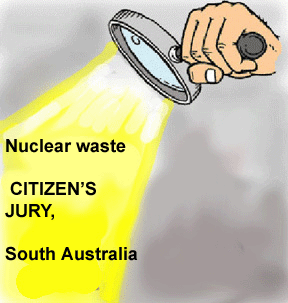 The Witness list for the 29 -30 Nuclear Citizens’ Jury in Adelaide is posted here on Antinuclear . This list is shown with indications of which witnesses are pro nuclear waste import and which are not.
It is interesting to observe that the pronuke and nuclear free witnesses are not always balanced evenly.
On “ECONOMICS” there is, oddly, a clear majority of nuclear-free opinions. It looks as if no-one in the nuclear lobby was game to face questioning on this topic! DemocracyCo was forced to step in and find a pro nuclear speaker!
On “SAFETY” (includes general safety, siting and transport) there are just two witnesses who appear to be neutral. The remaining four including the facilitator are pro nuclear.
“CONSENT” is a dodgy one, with only one nuclear-free opinion – three pro nuclear (including the facilitator, and two neutral.
Meanwhile – this Citizens Jury will probably go on under the media radar, as the South Australian Labor Party National Conference is happening at the same time – where the ALP will be debating changing their nuclear policy, and overturning or weakening the Nuclear Waste Storage Facility Prohibition Act 2000
Menzies, Australia’s Maralinga shame, Aboriginal impacts – and can it happen again?
One wonders if the interests of a ‘handful of natives’ might on some future occasion again be deemed subordinate to those of the dominant culture.
Each of these explosions generated considerable radioactivity, by means of the initial nuclear reaction and the through dispersion of radioactive particulate colloquially known as ‘fallout’. In addition to British scientific and military personnel, thousands of Australians were exposed to radiation produced by the tests. These included not only those involved in supporting the British testing program, but also Aboriginal people living downwind of the test sites, and other Australians more distant who came into contact with airborne radioactivity.
While less spectacular than the major detonations, the minor trials were more numerous. They also contributed to the lasting contamination of the Maralinga area. As a result of the nearly 600 minor trials, some 830 tons of debris contaminated by about 20 kg of plutonium were deposited in pits which graced the South Australian landscape. An additional 2 kg of plutonium was dispersed over the area. Such an outcome was unfortunate indeed, as plutonium is one of the most toxic substances known; it dissipates more slowly than most radioactive elements. The half-life of plutonium is 24,000 years. At this rate of decay, the Maralinga lands would be contaminated for the next half-million years.
Perhaps most significant was the secrecy surrounding the testing program. The decision to make the Monte Bello Islands available to the British for their first nuclear test appears to have been made by the Prime Minister alone, without reference to Cabinet, much less Parliament or the Australian public.
 Chapter 16: A toxic legacy : British nuclear weapons testing in Australia Published in: Wayward governance : illegality and its control in the public sector / P N Grabosky Canberra : Australian Institute of Criminology, 1989 ISBN 0 642 14605 5(Australian studies in law, crime and justice series); pp. 235-253 “……..In 1950, Labor Prime Minister Clement Atlee sent a top secret personal message to Australian Prime Minister Menzies asking if the Australian government might agree to the testing of a British nuclear weapon at the Monte Bello Islands off Western Australia. Menzies agreed in principle, immediately; there is no record of his having consulted any of his Cabinet colleagues on the matter. A preliminary assessment of the suitability of the proposed test site was conducted in October-November 1950.
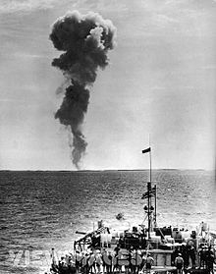 The Monte Bello site was deemed suitable by British authorities, and in a message to Menzies dated 26 March 1951 Atlee sought formal agreement to conduct the test. Atlee’s letter did not discuss the nature of the proposed test in minute detail. He did, however, see fit to mention the risk of radiation hazards:
6. There is one further aspect which I should mention. The effect of exploding an atomic weapon in the Monte Bello Islands will be to contaminate with radio activity the north-east group and this contamination may spread to others of the islands. The area is not likely to be entirely free from contamination for about three years and we would hope for continuing Australian help in investigating the decay of contamination. During this time the area will be unsafe for human occupation or even for visits by e.g. pearl fishermen who, we understand, at present go there from time to time and suitable measures will need to be taken to keep them away. We should not like the Australian Government to take a decision on the matter without having this aspect of it in their minds (quoted in Australia 1985, p. 13).
Menzies was only too pleased to assist the ‘motherland’, but deferred a response until after the 195 1 federal elections. With the return of his government, preparations for the test, code-named ‘Hurricane’, proceeded. Yet it was not until 19 February 1952 that the Australian public was informed that atomic weapons were to be tested on Australian soil.
One Aboriginal family – devastated by Maralinga nuclear bomb testing
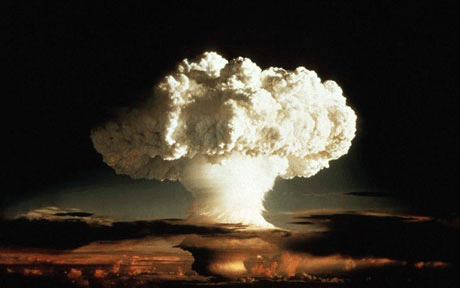 Chapter 16: A toxic legacy : British nuclear weapons testing in Australia Published in: Wayward governance : illegality and its control in the public sector / P N Grabosky Canberra : Australian Institute of Criminology, 1989 ISBN 0 642 14605 5(Australian studies in law, crime and justice series); pp. 235-253 “…….The security measures taken to restrict access to the testing site were not without flaws. One morning in May 1957, four Aboriginal people, the Milpuddie family, were found by range authorities near the crater formed by the ‘Buffalo 2’ explosion the previous October. ‘Me man, woman, two children and two dogs had set out on foot from the Everard Ranges in the northwest of South Australia, and were unaware that the Aboriginal inhabitants of the Maralinga area had been removed. When authorities discovered them, the family was immediately taken to a decontamination centre at the site, and were required to shower. After this experience, which must have been frightening enough, the family was driven to Yalata.
As one of the site personnel described the experience:
It was a shocking trip down as they had never ridden in a vehicle before and vomited everywhere (Australia 1985, p. 320).
On instructions from the Secretary of the Commonwealth Department of Supply, the dogs were shot. ‘ne woman was pregnant at the time the family was taken into custody; subsequently, her baby was born dead. Australian authorities went to great lengths to keep the incident secret, but they appear to have been less concerned with the family’s subsequent health. Commenting upon the fact that no-one appears to have taken the time to explain the experience to which the hapless Aborigines were subjected, a team of anthropologists was to comment:
[T]he three remaining members of the family have been subjected to a high degree of stress and unhappiness about the events of twenty-eight years ago (Australia 1985, p. 323)…….http://aic.gov.au/publications/previous%20series/lcj/1-20/wayward/ch16.html
Electric car charging stations for Adelaide in 2017 – says Mayor
 Adelaide City Council ‘leads the way’ with rollout of 40 electric car charging stations in 2017, ABC News, 23 Oct 16 By Candice Prosser Electric cars are the way of the future and Adelaide will lead the nation in developing infrastructure to encourage more of them, Adelaide’s Lord Mayor says.
The Adelaide City Council has announced it will roll out 40 electric charging stations throughout the city in 2017 in addition to the four charging points it currently has in two CBD car parks.
Speaking at the Electric Vehicle Expo at Elder Park, Lord Mayor Martin Haese said the infrastructure would be free to all users. “At this point in time the council needs to show leadership — we are very much in a changing environment whereby we’re forecasting the growth and sales of electric vehicles over the next few years is just going to grow exponentially,” he said. “Adelaide has a goal to become the world’s first carbon neutral city by 2025 and electric vehicles are an important part of that story.
“We want to be a smart city, we want to send a very clear signal to everyone that technology and the knowledge economy is important to our future. “We believe electric vehicles do both.”
The Lord Mayor said he expected electric vehicles to become increasingly more popular.
“Electric vehicles are very important, they are going to become incredibly commonplace much sooner than what we think,” he said.
“We’ve currently got about 700 electric vehicles registered in South Australia, we’ve got some 22,000 hybrid vehicles registered in South Australia and those numbers are going to grow exponentially.”
The council is also offering residents and businesses $5,000 to install their own charging points and will consider installing faster super chargers around the city in the future……..http://www.abc.net.au/news/2016-10-23/adelaide-city-council-rollout-40-electric-car-charging-stations/7958074
The role of Professor Ernest Titterton in deceiving Australians about nuclear weapons testing
Chapter 16: A toxic legacy : British nuclear weapons testing in Australia Published in: Wayward governance : illegality and its control in the public sector / P N Grabosky Canberra : Australian Institute of Criminology, 1989 ISBN 0 642 14605 5(Australian studies in law, crime and justice series); pp. 235-253
“……….Another factor which underlay Australian deference during the course of the testing program was the role of Sir Ernest Titterton. A British physicist, Titterton had worked in the United States on the Manhattan Project, which developed the first nuclear weapon.
After the war, he held a position at the British Atomic Energy Research Establishment, and in 1950 he was appointed to the Chair of Nuclear Physics at the Australian National University. Among Titterton’s earliest tasks in Australia was that of an adviser to the British scientific team at the first Monte Bello tests. In 1956, the Australian government established an Atomic Weapons Tests Safety Committee (AWTSC) responsible for monitoring the British testing program to ensure that the safety of the Australian environment and population were not jeopardised. To this end, it was to review British test proposals, provide expert advice to the Australian government, and to monitor the outcome of tests. Titterton was a foundation member of the Committee and later, its Chairman.
While Menzies had envisaged that the Committee would act as an independent, objective body, evidence suggests that it was more sensitive to the needs of the British testing program than to its Australian constituents.
Members tended to be drawn from the nuclear weapons fraternity, as was Titterton; from the Defence establishment, from the Commonwealth Department of Supply, from the Commonwealth X-Ray and Radium Laboratory, and from the Australian Atomic Energy Commission. Although the expertise of these individuals is beyond dispute, one wonders if they may have been too closely identified with the ‘atomic establishment’ to provide independent critical advice. The nuclear weapons fraternity have often been criticised as a rather cavalier lot; no less a person than General Leslie Groves, who headed the Manhattan Project which developed the first atomic bomb, has been quoted as having said ‘Radiation death is a very pleasant way to die’ (Ball 1986, p. 8). In retrospect, the Australian safety committee suffered from the absence of biologists and environmental scientists in its ranks……..
In 1960, the British advised the AWTSC that ‘long lived fissile elements’ and ‘a toxic material’ would be used in the ‘Vixen B’ tests. Titterton requested that the materials be named, and later announced ‘They have answered everything we asked.’ The substances in question were not disclosed (Australia 1985, p. 414). In recommending that the Australian government agree to the tests, he appears to have been either insufficiently informed of the hazards at hand, or to have failed to communicate those hazards to the Safety Committee, and through it, to the Australian government. Earlier, before the Totem tests, he had reassured the Australian Prime Minister that
the time of firing will be chosen so that any risk to health due to radioactive contamination in our cities, or in fact to any human beings, is impossible. . . . [N]o habitations or living beings will suffer injury to health from the effects of the atomic explosions proposed for the trials (quoted in Australia 1985, p. 467).
There were other examples of Titterton’s role in filtering information to the Australian authorities, a role which has been described as ‘pivotal’ (Australia 1985, p. 513). He proposed that he be advised informally of certain details of proposed experiments. In one instance, he advised the British that ‘It would perhaps be wise to make it quite clear that the fission yield in all cases is zero’, knowing that this would be a misrepresentation of fact (Australia 1985, p. 519). Years later, the Royal Commission suggested that Titterton may have been more a de facto member of the British Atomic Weapons Research Establishment than a custodian of the Australian public interest.
The Royal Commission’s indictment of Titterton would be damning:
Titterton played a political as well as a safety role in the testing program, especially in the minor trials. He was prepared to conceal information from the Australian Government and his fellow Committee members if he believed to do so would suit the interests of the United Kingdom Government and the testing program (Australia 1985, p. 526)……… http://aic.gov.au/publications/previous%20series/lcj/1-20/wayward/ch16.html
Premier Jay Weatherill’s Nuclear Waste Decisions in November South Australia
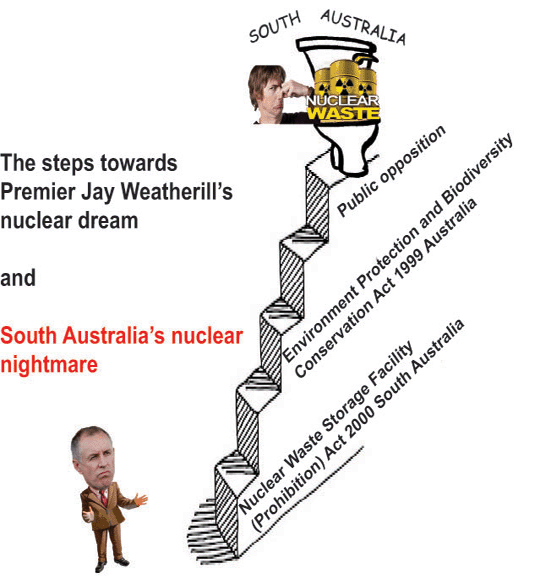 David Noonan, 22 Oct 16 In mid-late November Premier Weatherill intends to announce his SA gov decision and go to the SA Parliament to amend the Nuclear Waste Storage Facility Prohibition Act 2000 – at a minimum: to repeal the prohibition on spending public monies on nuclear waste plans (as per the likely ‘amber light’ Citizen Jury outcome over the first weekend in Nov).
This has to follow on from release of the SA Parliamentary Inquiry Report, likely in the week of Parliamentary sittings 15th to 17th Nov. The SA Liberals have privately said they will not give their position while the Citizen’s Jury is on, and will not do so until after this Inquiry reports.
The Premier will likely go to Parliament in the final scheduled sitting week of 29th Nov to 1st Dec (with an ‘optional sitting week’ in early Dec – which is very rarely ever used). The Premier requires the SA Liberals to agree to his proposed changes.
Appears unlikely the SA Liberals will agree to repeal the key prohibitions on import, transport, storage and disposal of International nuclear waste (at this time) BUT likely agree to repeal the prohibition on spending public funds – in a ‘further information’ style approach.
The Premier will then formally ask the Federal government to jointly work up the Inter dump plan along-side the SA gov through-out 2017 and in the lead up to the March 2018 State election. The Premier would then have to return to Parliament to repeal the key prohibitions on import, transport, storage and disposal of nuclear waste – potentially late in 2017 OR after the State Election.
Note: Shadow Treasurer Rob Lucas MLC (the lead Liberal on the Parliamentary Inquiry) has made media statements (as an individual) that the extent of public funds required to be spent before SA knows if this plan could go ahead – “is a potential deal breaker”;
And has also cast doubt on the potential economic benefits: warning it was not possible to verify “some of the financial estimates in terms of what the state might earn from this facility”.
see:“SA nuclear dump dreams just fool’s gold: senior Lib” The Australian 29 Sept 2016:http://www.theaustralian.com.au/national-affairs/state-politics/sa-nuclear-dump-dreams-just-fools-gold-senior-lib/news-story/a595649777c14703159a462c5d9cb34f
see: “SA would have to spend up to $600 million to plan a nuclear waste repository” The Advertiser 11 September 2016:http://www.adelaidenow.com.au/subscribe/news/1/index.html?sourceCode=AAWEB_WRE170_a&mode=premium&dest=http://www.adelaidenow.com.au/news/south-australia/sa-would-have-to-spend-up-to-600-million-to-plan-a-nuclear-waste-repository/news-story/9287ad32b2717574afdeb29e0cf90f5c&memtype=registered
|
|
Australia desperately needs to discuss our poisoned military role – Pine Gap and other targets
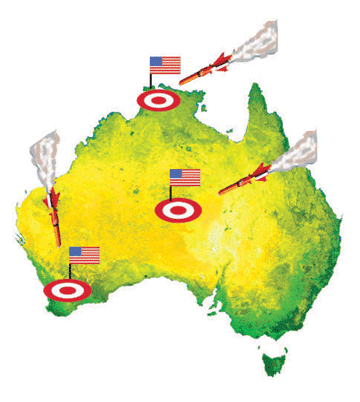 when China looks at Australia, it will see Australia as an American base
“I think fundamentally we have to ask is that really the way we want to go. The signal we’re sending to Americans is that if they go to war with China, sure, we’ll be part of that.”
“It is embedding us in global military operations for which there is little strategic benefit for Australia.”
We are told mass surveillance makes us safer and in our fear we accept growing militarisation….. these facilities most likely don’t protect us, but put us at greater risk….These are the questions we don’t discuss.
Under a burning hot sun in the red centre, experts and citizens shared their fears over what is happening in the most remote parts of the country. These mysterious bases may be invisible to the majority of us living in the most populated regions along the coast, but could threaten the fabric of all our lives. Here’s what you need to know:
NORTH WEST CAPE — SPACE WARFARE Perhaps the most frightening of all the bases, North West Cape is at the cutting edge of warfare — in space.
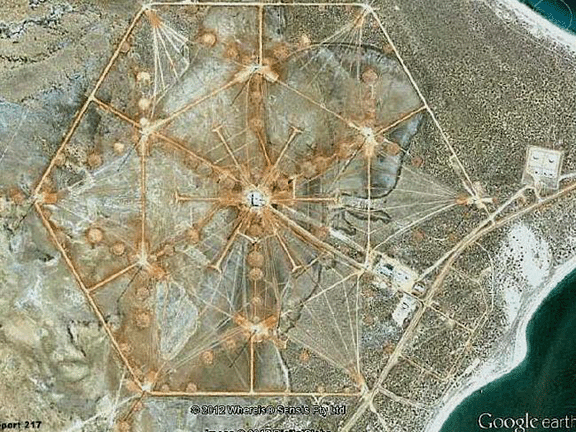
The monstrous structure sits on the northwest coast of Australia, where kilometres of wire surround a soaring central tower and others fanning off it, sucking up huge amounts of electricity.
North West Cape (also known as Harold E Holt Communications Station) was established as an American nuclear submarine communication station, with a very low frequency that could penetrate water, before being given back to Australia in the 1990s.
In 2008-10, the US and Australia agreed it would be upgraded with an advanced space radar and space telescope.
The radar was built in New Mexico by the US, with Australia paying for installation, and the space telescope comes from Antigua in the Caribbean and was once part of Cape Canaveral rocket range in Florida.
The telescope points at the sky, providing what the US calls “space situational awareness”. The rationale is that it will find space junk, as in the movie Gravity. In fact, its primary purpose will be looking for where adversaries’ satellites are in space and what they do, says Professor Richard Tanter from the School of Political and Social Studies at the University of Melbourne.
If a country like Russia, for example, was hiding a satellite’s purpose, the US might photograph or neutralise it.
Professor Tanter warns Australia could become enmeshed in anti-satellite warfare. If there was a war between US and China over the South China Sea and US could not bring a fleet near the coast any more, “the first thing they want to do is blind other side’s satellites”.
We are providing the US with extra capacity to make that happen, says Prof Tanter.
PINE GAP — ‘THE POISONED HEART OF AUSTRALIA’
Pine Gap was established in Alice Springs in 1966 when the CIA came up with the idea of putting satellites 36,000 kilometres above the earth’s surface. These had giant antennae that could listen to very weak signals from Soviet missiles testing, allowing the agency to work out the capability of enemy weapons.
The spy base was placed in isolated Alice in the NT because at the time, the massive amount of data had to be collected over 130km of land.
Prof Tanter says Pine Gap rivals Uluru as the symbolic centre of Australia, with its strange, mysterious power.
“It’s the poisoned heart of Australia and it is increasingly having an effect on our defence policies and the way in which we conduct our foreign policy,” he says.
The establishment of Pine Gap heralded the start of the American early warning system, which involved powerful infra-red telescopes staring at the earth looking for the heat bloom of nuclear weapons. And it continues to grow in strength long after the Cold War, with the number of antennae growing from two or three in 1970 to 33 today.
It has also grown in capability — picking up satellite and mobile phone transmissions that are important for conducting war in Iraq and Afghanistan and monitoring people allegedly carrying out terrorist activities. It spots jet aircraft in the sky and explosions on the ground.
If a North Korean missile takes off, its trajectory can be rapidly beamed to the US, triggering a possible drone assassination. Prof Tanter says such behaviour makes Australia a target.
“Do we really want to be implicated in that?”
DARWIN — TROOPS ON THE GROUND Continue reading
1 This month


Help Aunty Sue Protect Her Land and Sacred Sites From Destructive Rocket Testing.
.

Australians deserve the truth
about
AUKUS – https://aukuspublicinquiry.com/

PETITION – To: Prime Minister Anthony Albanese and the Australian Labor Government

of the week – Australians for War Powers Reform (AWPR)
To see nuclear-related stories in greater depth and intensity

