http://www.robinchapple.com/crisis-confidence-over-epa-uranium-mine-push 27 September
WA Greens Senator Scott Ludlam and Robin Chapple MLC have today questioned the EPA’s approval for preparatory works at the proposed Mulga Rock uranium mine, which is yet to be approved and currently subject to an appeal.
“Today’s approval for preparatory works at Mulga Rocks exposes the sham of the assessment and appeals process; the EPAs decision today is at odds with the intention of the Environmental Protection Act 1986,” Mr Chapple said.
“There has been serious public backlash against the project reflected in numerous appeals being lodged against the project, including from Traditional Owners and people in the local community.
“There is a race on in WA to get uranium mines approved before the State election. This ambition is ridiculous given the widespread opposition to the industry and the market conditions which are prohibitive to new mines.”
“World-wide we’re seeing uranium mines close and others put in to care and maintenance. Vimy Resources may have some political influence and big benefactors like Andrew Forrest, but none of these things will make this mine profitable or socially acceptable,” Senator Ludlam said.
“The EPA’s response to Vimy’s aggressive approach to starting this mine is not just a demonstration of a poor and non-transparent process, it is a slap in the face for the public and local community that have engaged in good faith in a process which is in essence a fait accompli.
“While the process is broken, the resolve of communities to fight this project is very much alive and well.”
September 28, 2016
Posted by Christina Macpherson |
politics, uranium, Western Australia |
Leave a comment
“Perhaps the barrage of pro-nuclear forces/strategies explains why there’s no explosion of outrage either in South Australian society or in church and faith groups against this extraordinarily destructive scheme.”
 The normalisation of destruction in SA nuclear plan, Eureka Street. Michele Madigan | 22 September 2016 On Friday 26 August in Adelaide, Yankunyjatjara Elder Edie Nyimpula King was awarded the 2016 Perpetual Trophy of the prestigious Gladys Elphick Awards for her decades of work ‘in standing up for culture, country and community’.
On Saturday 3 September, in Port Augusta, Edie was keeping up the struggle, singing again the Seven Sisters inma, strong in its demands for a clean country and protection for the future generations.
Unable then to stop the flow of tears, she paid tribute to her former companions’ heroic struggles. ‘Ivy Makinti Stewart, Kampakuta — Eileen Brown, Eileen Unkari Crombie’ amid all the other heroes — the brave fighters for country and the future generations against the nuclear industry and its proponents in South Australia; women who had immortalised that inma in the same obedient re-enactment of the Seven Sisters and their demands to care for country.
Its cry: Irati Wanti — leave the poison! Have nothing to do with it! No radioactive waste dump in our country!
But why is such responsibility for country and the health of its people — forever — so hard? And ongoing! Why is the destruction of country — its lands and waters and huge risks to the future generations — forever allowed to be normalised?
Indeed how to explain the current normalisation of the new threat — of importing high-level radioactive waste across the Southern Hemisphere oceans and its dumping onto the lands of South Australia. And this with the seemingly full permission of a government and perhaps a peoples, both of whom will be long gone in the ‘hundreds of thousands of years’ which the nuclear royal commission itself admits such material must be isolated.
Poll results during the third week of September revealed that 50 per cent of those polled agree to welcome such waste with 35 per cent against and 15 per cent undecided.
Of course the full throttled media campaign must take credit for much of this.
Recently the Adelaide Advertiser had a front page story entitled ‘Nuke fear for kids’. The heading would surely lead one to believe that (surprisingly) SA’s only daily paper had a front page article about the substantial risk that the proposed importation of international high-level radioactive waste will be for the present and future generations of South Australian children.
But no — further reading made clear that the ‘fear’ was the effect ‘noisy protestors’ would have on the 150 high school children who had been chosen to meet with the former nuclear Royal Commissioner Scarce. Hence the venue was to be secret.
There seems little expense spared either at the importation of experts like Geraldine Thomas, who spoke  at the Hawke Institute at the University of South Australia on 16 September on the risks of radiation. Were many of her audience relieved to hear that, well, no, there is actually little risk? In that jolly English way reminiscent of one of the English experts in the government ‘consultations’ also being conducted across the state, she explained that the problems of the people of Fukushima were mainly psychological.
Proposed is a forever risk-laden project of ships travelling to a yet unnamed Australian port every 24 to 30 days with the world’s highest level nuclear waste. Then dumping/storing the casks perhaps five or ten kilometres away for some decades until funds are available to build a ‘safe’ depository — something that has not yet been possible anywhere in the world including countries with decades of nuclear expertise.
Perhaps the barrage of pro-nuclear forces/strategies explains why there’s no explosion of outrage either in South Australian society or in church and faith groups against this extraordinarily destructive scheme. Much less in Australian society in general.
Or perhaps theologian Brendan Lovettt names it.
‘If there is a typically bourgeois virtue it must be the cult of moderation. The extreme is to be abhorred; it is a matter of unseemly exaggeration. We cannot bear too much reality. the world is to be thought of as a place where comfortable mediocrity rules, where everything is under control and there is nothing to be horrified about, either in ourselves or in the world. This is our necessary lie. What we deny under our veneer of a smoothly reasonable world are the real dimensions of life and history. Understandably we project a God who will be compatible with this comforting view of life and history.’
What we are resisting, he concludes, is our own responsibility for the world.
On 3 September, the 25 year old Kumana Karen Crombie, now herself mother of two, danced with veterans, Betty Ngangala Muffler and Dianne Pinku Edwards, to Edie Nyimpula’s singing, to herald the new generation taking up responsibility for country and its peoples.
What will it take for the rest of us to take up our own responsibility.
Michele Madigan is a Sister of St Joseph who has spent the past 38 years working with Aboriginal people in remote areas of South Australia and in Adelaide. Her work has included advocacy and support for senior Aboriginal women of Coober Pedy in their campaign against the proposed national radioactive dump. https://www.eurekastreet.com.au/article.aspx?aeid=49962#.V-9UG4h97Gg
September 26, 2016
Posted by Christina Macpherson |
South Australia, spinbuster |
Leave a comment
 I knew that The Advertiser was the mouthpiece of the nuclear lobby, anyway, but their latest effort was really sick-making.
 A rave which portrays Premier Weatherill as some kind of democratic champion, and which is pushing the soft sell that the decision on nuclear waste importing will not happen soon, but be dragged on for years. (They don’t say this, but in the interim, the nuke lobby has time to get secret arrangements made – and money lent to South Australia, so that ultimately, it might all be just too committed to turn back.)
A Premier with any spine might make a decision, a soon decision, and a wise one, to say no to the whole noxious scheme, – send home the business lobbyists and the propaganda spruikers like Geraldine Thomas, put the lid on the shonky Nuclear Royal Commission’s biased report, stop the silly nuke spinning Forums, and get on with running South Australia properly. Such an opportunity that State has, as a world leader in renewable energy!
Lack of trust more toxic than nuclear dump notion: Daniel Wills, The Advertiser September 23, 2016 “South Australia is still at the stage where it needs reassurance about the science, as well as the competency and motivations of a government that would oversee its administration.
No site has been selected to house the world’s high-level international waste for profit, should the state choose to build one, nor any explanation of how one would be picked. The State Government is yet to overturn laws that ban public money being spent on investigating the establishment of a nuclear dump or even to pick up the phone to ask places like Japan what they would pay…….
 The Finnish operators say they would jump at the chance to form an alliance with SA to build a dump here…..
Mr Weatherill is likely to confirm before Christmas that the Government will begin the serious work of developing a robust business case…….
Expect the Government to seek money from overseas to undertake a major geological survey that rules out places too unsafe for disposal to occur. At a cost of up to $1 billion, this is too expensive for SA to fund itself, but could have the benefit of doubling as a discovery tool for new mining deposits.
From there, it is likely the offer will be thrown open to communities to show an interest, and estimates made of what they could receive. Even on the most extremely rapid timeline, that point is unlikely to have been reached by the time voters head to the polls in March 2018.
This project is multi-generational, with a point of no return years away. But it is a doubtful and open question as to whether our politics are up to the job…….Mr Weatherill has framed this as a great test of our democracy’s ability to consider difficult questions and come to wise solutions. … http://www.adelaidenow.com.au/news/opinion/lack-of-trust-more-toxic-than-nuclear-dump-notion-daniel-wills/news-story/e927e455e6f244f35a8b6743bc791adb
September 24, 2016
Posted by Christina Macpherson |
Christina reviews, media, politics, South Australia, wastes |
Leave a comment
We shouldn’t be the world’s nuclear dump, Adelaide Hills Herald News. By Councillor Lynton Vomow, Lobethal 23 Sep 16, You may have recently had a say at one of the Nuclear Waste Dump forums being held around the state. My biggest concern, however, being the prevention of an  accident at sea and the loss of highly radioactive nuclear waste into the ocean, was not satisfactorily explained .
Indeed the attendant basically said that we could not guarantee against such a disastrous event, it could be impossible to retrieve every container of waste and modelling is showing it wouldn’t actually be that bad! Fish and all creatures of the ocean for hundreds of miles around the lost radioactive waste material would be devastatingly affected.
Did you know that medium or high level (depending on whether it’s France or Australia describing it) nuclear rubbish was brought to Australia, in December just last year, in a rust bucket that had failed three safety inspections in five years?
Can you imagine what could happen if we were to receive dozens of shipments? Can we be guaranteed the waste will make it here safely, every single time?
Some are saying that low level waste is non hazardous, so then why not store it near its source i.e Sydney, and save the fuel costs of transporting it?
Basically a low level waste dump would be coming here to soften us up for a high level dump.
There is a need to have safe repositories for the waste, somewhere, but it will have to be near its usage location.
Countries ought to be looking at phasing out nuclear power so that there is as little waste as possible.
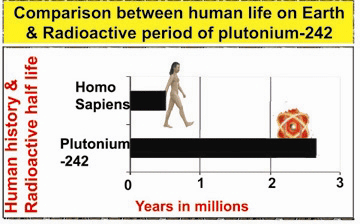
How long does nuclear waste last anyway? Can you imagine two hundred years? Ten times that then takes us back to the birth of Christ. Ten times all of that now takes us back to just before the last ice age, 20,000 years ago. Then ten times 20,000 years? 200,000 years. That’s when only about half of the atoms in high level nuclear waste will have decayed to less harmful atoms. It is going to be a long wait for this deadly waste to become harmless, to care for our generation’s nuclear waste.
Are we going to be beggars or choosers? We are not so desperate that we have to take the world’s most toxic waste and prevent it from damaging anything for hundreds of thousands of years.
South Australia continues to have huge potential for growing the renewable energy industry instead.
The risk to the world’s environment of transporting high level nuclear waste across the oceans to to the furthest point on the planet, ie, South Australia, just doesn’t make sense.
And people, (including of course the Adnyamathanha Indigenous people of the Flinders Ranges) do not want it.
September 24, 2016
Posted by Christina Macpherson |
Opposition to nuclear, South Australia, wastes |
Leave a comment
 Pine Gap: Secretive spy base’s role in drone strikes putting Australia in danger, expert warns http://www.abc.net.au/news/2016-09-23/pine-gaps-actions-could-endanger-australian-security/7872190?section=environment The World Today By Brendan Trembath An expert on Pine Gap has raised concerns about the spy base’s role in supporting drone attacks on suspected terrorists overseas.
Officially called The Joint Defence Facility Pine Gap, the site is jointly run by the Australian and United States governments and is one of Australia’s most secret sites. The facility has been in operation since 1970 and is located half-an-hour’s drive south-west of Alice Springs.
Professor Richard Tanter, from the University of Melbourne, says Pine Gap contributes targeting data to American drone operations, including assassinations. “One of Pine Gap’s two key functions is as a control station and a downlink station for signal intelligence satellites 36,000 kilometres up in space,” he said. “They are picking up a very wide array of radio transmissions, including cell phones, satellite phones and so forth. “And that provides the data, both the contents and the geolocation data for targets of interest through the United States military.”
He said Pine Gap was also used for counter-terrorism and wider intelligence programs, as the site was able to contribute data “pretty directly — for example into drone targeting operations.”
Professor Tanter acknowledged that those type of programs were part of the alliance between the US and Australia, and Australia’s interest in the global fight against terrorism
But he said the question was whether it could be considered a good idea on a political level, seeing the potential for creating “further terrorism” if a strike were to go wrong.
“At a legal and moral level do we really want to be involved in operations which are frankly illegal under international law. In countries where we’re not at war, such as Pakistan or Somalia or Yemen, these are simply assassinations.”
“We won’t like it very much when it’s done back to us I suspect.”
Base also a likely target for nuclear missiles Professor Tanter said the site continued to be a “pretty high priority nuclear missile target” in the event of a major conflict between the United States and Russia or China.
“It would be, as they say in the military, a lucrative target of many benefits,” Professor Tanter said . “Secondly it is itself involved in nuclear war planning. I think that’s a totally awful thing for us to contemplate — you can’t use nuclear weapons except in a fairly genocidal way.”The Defence Department said that “the facility makes an important contribution to national security.”
A spokesperson said: “It provides intelligence on priorities such as terrorism, the proliferation of weapons of mass destruction, and foreign military capability and weapons developments. “It also supports monitoring of compliance with arms control and disarmament agreements, and provides ballistic missile early warning information.”
September 24, 2016
Posted by Christina Macpherson |
AUSTRALIA - NATIONAL, Northern Territory, safety, weapons and war |
1 Comment
 Some comments on Weatherill’s article .( Jay Weatherill: South Australia can learn valuable lessons from nuclear waste facility at Eurajoki, Finland)
James, 23 Sept 16 We will certainly need to be right on top of our game to beat out all those other places fighting to become the world’s nuclear lavatory, right Jay?
Perhaps, if this is the best idea we have to ‘save’ our economy then we may as well turn the lights off now and hopefully save a few native species in the process. It doesn’t matter how it’s dressed up, whether it’s made of plastic, porcelain or gold, it’s still a toilet.
Chad, 23 Sept 16 No mention of the massive cost blow-outs the Finns have experienced, then? The Finns do not need to transport it through rough seas and huge distances over remote roads, our transport risks are huge. The vast majority of the waste in fact comes from 800 metres up the road, at the Olkiluoto Nuke plant. Sweden is firmly against the dump, just 90km from it’s own coastline. The Swedish Royal Institute of Technology just released a report suggesting the privately sourced copper capsules are not actually corrosion-proof. Oh, and the Finnish dump will only be able to accept waste for 100 years! Then they’ll need billions of euros for a new hole.
Some comments on Weatherill’s article .( Jay Weatherill: South Australia can learn valuable lessons from nuclear waste facility at Eurajoki, Finland)
James, 23 Sept 16 We will certainly need to be right on top of our game to beat out all those other places fighting to become the world’s nuclear lavatory, right Jay?
Perhaps, if this is the best idea we have to ‘save’ our economy then we may as well turn the lights off now and hopefully save a few native species in the process. It doesn’t matter how it’s dressed up, whether it’s made of plastic, porcelain or gold, it’s still a toilet.
Chad, 23 Sept 16 No mention of the massive cost blow-outs the Finns have experienced, then? The Finns do not need to transport it through rough seas and huge distances over remote roads, our transport risks are huge. The vast majority of the waste in fact comes from 800 metres up the road, at the Olkiluoto Nuke plant. Sweden is firmly against the dump, just 90km from it’s own coastline. The Swedish Royal Institute of Technology just released a report suggesting the privately sourced copper capsules are not actually corrosion-proof. Oh, and the Finnish dump will only be able to accept waste for 100 years! Then they’ll need billions of euros for a new hole.
It is not a good legacy to leave behind, Jay. 100,000 years is a long time for something to go wrong and you’ll be remembered for it, if it does.
Sanity, 23 Sept 16
@Michael well, actually the Fins haven’t. Not any radioactive waste at all. But they hope too! Probably some time next decade, unless things go wrong. But they are c̶e̶r̶t̶a̶i̶n̶ c̶o̶n̶f̶i̶d̶e̶n̶t̶ hopeful that it will be fine, that is why they want to sell it to us. Not for money, because it has cost them so much more than they expected and taken so much longer. No for altruistic reasons, sortof.
Of course they don’t trust it for foreign high level waste – I mean you never know what might be in there! No, only Finland’s waste! And they have tight laws about not importing anyone else’s waste.
Finland currently have two different types of operating reactors and the different fuel rods mean canisters are different for the two types of reactors they have. It also means that they drill different depth holes.
But Australia won’t be so lucky if SA imports high level waste from different countries because there will be all sorts of different reactors with many, many different fuel rod length and array dimensions. Lucky eh?
Well, that is if we stick to Finland’s quality KBS-3V system, and not try to sacrifice safety for price by using cheap steel and concrete vessels. When has safety ever been sacrificed for cost in SA? n̶R̶A̶H̶, R̶a̶i̶l̶ ̶u̶p̶g̶r̶a̶d̶e̶, s̶o̶u̶t̶h̶ ̶r̶o̶a̶d̶ ̶s̶u̶p̶e̶r̶w̶a̶y̶, a̶m̶b̶u̶l̶a̶n̶c̶e̶ ̶r̶a̶m̶p̶i̶n̶g̶…..
Pfffft! mere details, it only has to work without failure for 100,000 years!, http://www.adelaidenow.com.au/news/opinion/jay-weatherill-south-australia-can-learn-valuable-lessons-from-nuclear-waste-facility-at-eurajoki-finland/news-story/b8e2250210f4f2a3b0c6a60d9a8037d5
September 23, 2016
Posted by Christina Macpherson |
media, politics, South Australia, wastes |
Leave a comment
 23 Sept 16 In today’s Advertiser, Jay Weatherill writes about the Finland nuclear waste project.( Jay Weatherill: South Australia can learn valuable lessons from nuclear waste facility at Eurajoki, Finland)
Weatherill’s article completely ignores the negative side of the project – over time, over budget, possibly too small even for Finland’s requirements. Meanwhile he spouts deceptive nonsense about it being so similar to the South Australian plan. He implies that it is already functioning, which is not true. He praises the supposed “transparency” and “community consultation”, which is also incorrect. (See When haste makes risky waste: Public involvement in radioactive and nuclear waste management in Sweden and Finland http://bellona.org/news/nuclear-issues/radioactive-waste-and-spent-nuclear-fuel/2016-08-21710)
September 23, 2016
Posted by Christina Macpherson |
politics, secrets and lies, South Australia, wastes |
Leave a comment
 Art exhibition to mark 60th anniversary of nuclear testing in Maralinga asks what has changed ABC Central Victoria By Larissa Romensky , 22 Sept 16, A national touring exhibition of artwork marks 60 years after the British government exploded an atomic bomb in South Australia’s outback.
On September 27, 1956 the British government conducted its first atomic test at Maralinga.
In total, seven nuclear bomb blasts were detonated between 1956 and 1967 in the southern part of the Great Victoria Desert in South Australia followed by more than 600 “minor tests”.
These were not the first nuclear tests to be conducted in Australia, but the term Maralinga, an Aboriginal word for thunder, became the name associated with this chapter in Australian history.
Black Mist Burnt Country, is a national touring exhibition that revisits the events and its location through the work of more than 30 Indigenous and non-Indigenous artists.
Curator JD Mittman said the title refers to the “mysterious” black mist that hovered over the country after the first test at Emu Field in South Australia in 1953 that “badly” affected Aboriginal families at Wallatinna.
“[Yankunytjatjara man] Yami Lester testified that people got very sick, some died, and he lost his eyesight,” Mr Mittman said.
Burnt country was in reference to the enormous heat generated by an atomic bomb blast, 1,000 times hotter than the sun.
“The blast melts the ground to glass, also called Trinitide, after the Trinity test ," he said.
Inspired by Jonathan Kumintjarra Brown
Jonathan Kumintjara Brown was a member of the stolen generation and later in life connected with his family in South Australia and found out about the atomic testing of his traditional land.
Mr Mittman said the exhibition was originally inspired by the artist's work entitled Marilinga before the atomic test.
"The question that came to mind immediately was: if there's a work that depicts the country before the atomic tests then surely there must be work that is also about the period after or during the tests," he said.
The work in the exhibition spans seven decades from across the globe from the first atomic test in Hiroshima to the present day, from both private and public collections........http://www.abc.net.au/news/2016-09-21/exhibition-to-mark-60th-anniversary-of-nuclear-testing/7865192
September 23, 2016
Posted by Christina Macpherson |
aboriginal issues, AUSTRALIA - NATIONAL, culture |
Leave a comment
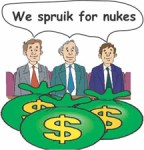 Dan Monceaux to Nuclear Fuel Cycle Watch South Australia, 22 Sept 16 On his current delegation to Finland, Premier Weatherill has been accompanied by Bill Muirhead (Agent-General for South Australia), Madeleine Richardson (CE of CARA) and John Mansfield (chair of the Nuclear Fuel Cycle Consultation and Response Agency (CARA) advisory board).
Muirhead is an advertising man with a political bend who has been busy promoting SA as a destination for defence and mining investment since his appointment as Agent-General in 2007.
September 23, 2016
Posted by Christina Macpherson |
politics, South Australia, wastes |
Leave a comment
 Leon Ashton 21 Sep 2016
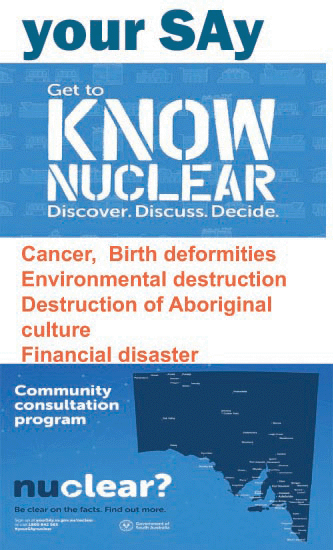
The government has the last say on the decision so as most people before me have said, no matter how many people are against it, the whole nuclear consultation process is a farce. The Know Nuclear displays tell half truths and make nuclear storage sound incredibly safe without adding any of the negatives. For a state which is struggling economically there seems to have been a helluva lot of money already spent in the name of nuclear. I don’t trust the government. We only need to look at the bungled RAH project and our useless desalination project to realize how inept the state government is. If SA becomes the world nuclear dumping ground, it will be the WORST decision an Australian government has ever made.
Steve Charles 20 Sep 2016
The article in today’s Australian demonstrates that the consultation process is a farce. Weatherill decided long ago that he wanted to turn SA into the world’s nuclear waste dump, and the “consultation” that has been going on is all for show. We are all being led by the nose to a conclusion that he wants, and the taxpayer pays for it all. Weatherill should be treated with the contempt he deserves.
It would be a disaster for SA to have a nuclear waste dump here.
Jay Weatherill will never get consent to go ahead from the South Austrlain public, to consent to a nuclear waste dump in South Australia. We know better despite what the media is reporting about the statistics. He must lose his position as Premier if the rest of the Labour Party has any sense.
Peter Lazic > Kay Dl 18 Sep 2016
I agree, but hot to get him kicked out before he takes the next step down the path of a nuclear waste dump.
Steve Charles > Kay Dl 20 Sep 2016
The decision was made long ago. We are all being led like lambs to the slaughter. Weatherill must be stopped.
Looks as though ourgov has lost interest in this discussion board. Ourgov’s rep last commented on 15 Aug. Maybe we are being very dull and boring. Any suggestions on how to spice this board up a bit.
Mary-Ann Lovejoy > Steve Ingham 16 Sep 2016
September 23, 2016
Posted by Christina Macpherson |
politics, South Australia, wastes |
Leave a comment
 Peter Lazic 16 Sept 16 What consent does Jay Weatherill have to spend $600 million dollars of taxpayer money to plan a nuclear waste dump, when the proposed dump may never get approved. This and the money spent to date on the Royal Commission, the road show, now TV advertisements, etc, is obscene and immoral
Noel Wauchope > Peter Lazic 16 Sep 2016
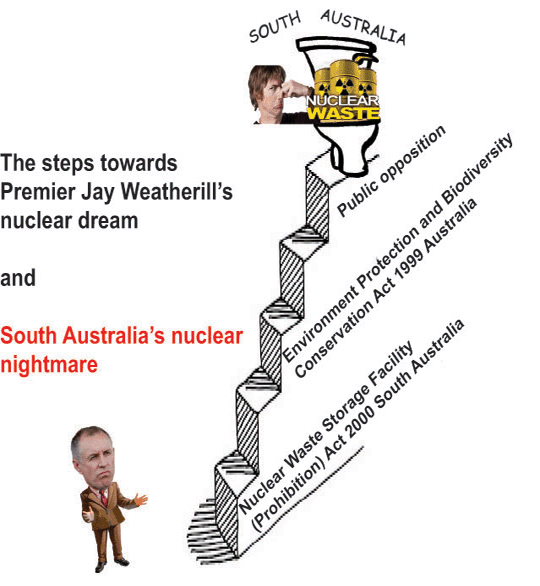
Especially as the SA Law says:
September 23, 2016
Posted by Christina Macpherson |
legal, South Australia, wastes |
Leave a comment
Art exhibition to mark 60th anniversary of nuclear testing in Maralinga asks what has changed ABC Central Victoria By Larissa Romensky , 22 Sept 16 “….Portrait of a whistleblower
One of the exhibiting artists is Castlemaine’s Jessie Boylan who contributed her portrait of whistleblower Avon Hudson in his “room of archives”, surrounded by objects, newspaper articles, documents, and photos related to Maralinga.
“It’s a portrait of a man who has always stood by his convictions,” Boylan said.
In 1960 Mr Hudson was a 23-year-old RAAF leading aircraftman who arrived at Maralinga after the British had stopped testing the A-bombs and started the “minor trials”, which resulted in the scattering of plutonium, uranium and beryllium across the desert.
“He wasn’t aware of the dangers of working on that site and then it wasn’t until later on that he realised all of his mates where dying in their 20s,” Boylan said.
This prompted his disclosure to the media of what he had witnessed, and ultimately providing testimony to the royal commission into British nuclear testing in Australia.
“His life has been dedicated to advocating for nuclear veterans as well as the Anangu people of Maralinga, and becoming an advocate and activist about nuclear issues in Australia,” Boylan said.
Nuclear issue still relevant today
Mr Mittman hoped the exhibition would bring this chapter of Australian history to the attention of the Australian public and remind them that the nuclear issue was still relevant today.
“The country to a large degree is still contaminated; the traditional owners, even though they have been handed back the land, cannot live there,” he said.
“I mean you can pass through there but for generations to come this country has been damaged.”
He said the Australian story was not an isolated story and referenced nuclear testing around the world including Nevada, French testing in the South Pacific, and Russian testing in Kazakhstan to name a few.
With the current discussion around whether South Australia should build a high-level nuclear waste dump he said “the past is very much on people’s minds”.
“The nuclear threat still hasn’t gone away with the end of the Cold War; in fact experts say the situation is more precarious now than it ever has been before,” Mr Mittman said.
Black Mist, Burnt Country opens on September 24 at the National Trust SH Ervin Gallery, NSW and will tour nationally. http://www.abc.net.au/news/2016-09-21/exhibition-to-mark-60th-anniversary-of-nuclear-testing/7865192
September 23, 2016
Posted by Christina Macpherson |
AUSTRALIA - NATIONAL, culture |
Leave a comment
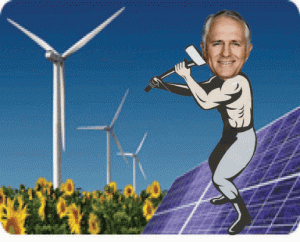 ARENA Cuts Impact Renewable Energy Businesses
  Business investment in Australia’s renewable energy sector will take a direct hit, with up to $5 billion of private funding at risk, as a result of the federal government’s decision to cut half a billion dollars from the Australian Renewable Energy Agency. Pro Bono, Wednesday, 21st September 2016 Ellie Cooper, Journalist Future Business Council executive director Tom Quinn said the government’s decision to cut funding to ARENA in the budget savings bill could have run-on effects on matched private-sector funding for renewable energy.
ARENA was saved from a worse fate, with the Coalition originally planning to strip $1.3 billion from the agency. Negotiations with the opposition secured $800 million in funding over the next five years.
But Quinn said the damage to the renewable energy sector would still be significant.
“The cuts to ARENA are shaking business confidence even further in the renewable energy space. This is a boom sector of this century, Australia’s got natural advantages in this space,” Quinn told Pro Bono Australia News.
“But the one thing holding back the industry is policy uncertainty created by hostile government actions.”
He said demand for renewable energy technology was “enormous”, with $329 billion invested globally in the sector last year.
But he said the role of ARENA was critical in launching renewable startups, growing viable businesses, and attracting local and international investment.
“If we’re talking about innovation in any new technology then early stage investment is critical, and that’s really where government comes in. Government has the ability to invest where the private sector can’t, and all too often that’s where Australia has let down its innovators and entrepreneurs,” he said.
“We haven’t got a good track record of backing early-stage innovation, and this is where ARENA was critical…….https://probonoaustralia.com.au/news/2016/09/arena-cuts-impact-renewable-energy-businesses/
September 23, 2016
Posted by Christina Macpherson |
AUSTRALIA - NATIONAL, business, energy, politics |
Leave a comment
In an era where short-term populist thinking prevails, South Australian Premier Jay Weatherill is pushing forward a project that is not only ridiculously long-term but has proven to be political dynamite.
So, Mr Weatherill would have to pull off something that has never been done anywhere else, a project even Finland thinks is too hard, one that could prove a major political headache, all to dump hazardous spent radioactive fuel Australia does not even use?
Why Jay Weatherill is in Finland to investigate Australia’s nuclear future, ABC News ANALYSIS By Europe correspondent James Glenday In case you missed it, South Australian Premier Jay Weatherill is in western Finland.
Why?
To investigate whether his state should build a high-level international nuclear waste dump to store radioactive uranium deep underground for at least 100,000 years.
The industry aficionados call it a “final repository”, but basically it is a big tomb-like system of tunnels built into solid bedrock where spent fuel rods are encased in steel, copper and clay.
Why should you care?
In an era where outrage is the cheapest commodity and short-term populist thinking prevails, the Premier is pushing forward a project that is not only ridiculously long-term but one that has proven elsewhere to be political dynamite.
A number of scientists believe a dump could be safely built and many economists think it could make South Australia $100 billion.
But it is also important to point out there is no pressing national need for this facility.
Australia does not produce high-level nuclear waste.
So, why is he in Finland?
Somewhat by chance, Finland is leading the world in the construction of a high-level waste facility 420 metres below Olkiluoto Island on the country’s west coast.
The company building it, Posiva, has been working on the idea since the 1970s, but quite reasonably assumed bigger nations like the United States, Britain, France, Sweden or Germany would come up with a solution they could copy.
But community opposition and controversy has killed, crippled or delayed plans for several radioactive dumps.
So, despite a couple of cost blow-outs, Finland has found itself at the front of the line.
And why do the Finns love the idea?
On a national level, opinion is actually mixed.
But around the “final repository”, the tax cuts, welfare increases, community facilities and jobs the nuclear industry has funded got the dump over the line.
Locals near Olkiluoto Island said, because they have benefited from nuclear energy, they also have a responsibility to safely manage the waste.
Currently, it is in a series of pools.
So, why not build an international dump then?
Ah, here is where we hit Finland’s “red line”.
According to Posiva executives, it would be “politically impossible”.
“Finland doesn’t want to become the waste dump of the world,” one said.
It is also against federal law.
Is it not also against Australian law?
Yes, it is.
But putting the politics aside, Posiva thinks it could help South Australia design and construct a high-level facility within 15 to 20 years.
Unsurprisingly, they are keen to try to sell their success to the world…………
OK. Is Jay Weatherill really likely to push on with this project?
He is likely to keep making positive noises, consulting and talking about how the waste facility discussion “must be led by the community”.
But the Labor Premier knows the biggest political threat to its development comes from his own side of politics…….
To realistically get a dump built in Australia, it will require the enthusiastic backing of a local community, industry, the South Australian Government and the Commonwealth for a period of at least 20 years, probably longer.
It is worth remembering proposals for many previous nuclear projects have proved controversial in Australia.
Also, you would have to convince a majority of people it is completely safe.
So, Mr Weatherill would have to pull off something that has never been done anywhere else, a project even Finland thinks is too hard, one that could prove a major political headache, all to dump hazardous spent radioactive fuel Australia does not even use? http://www.abc.net.au/news/2016-09-20/why-jay-weatherill-is-in-finland-to-investigate-nuclear-future/7859812
September 21, 2016
Posted by Christina Macpherson |
politics, South Australia, wastes |
Leave a comment
Finland’s Onkalo nuclear waste disposal facility want to export the technology to South Australia, The Advertiser Daniel Wills, Helsinki, Finland, The Advertiser September 21, 2016 OPERATORS of the world’s most advanced nuclear disposal facility want to export the technology to South Australia and form an alliance to help the state develop its own commercial facility to take waste from around the world.
At a briefing with Premier Jay Weatherill at Finland’s Onkalo nuclear waste disposal facility, Posiva Solutions Oy managing director Mika Pohjonen said his company would be willing to licence intellectual property and engineering solutions to SA if it were to proceed with expanding the local nuclear industry.
Posiva is a joint venture owned by two of Finland’s biggest energy companies — Teollisuuden Voima Oyj and Fortum Power and Heat. It is set to become the first organisation in the world to bury a canister of spent nuclear fuel when they begin inserting them into the bedrock from 2020. Mr Pohjonen said SA could hope to move from site selection to burying canisters within about 15 years, less than half the time taken by Finland, because the Scandinavians had already undertaken the slow work of proving the technology………
The Onkalo disposal site is about 10 times smaller than that conceived by SA’s Nuclear Fuel Cycle Royal Commission.……
Mr Weatherill will by the end of the year declare a formal State Government position to Parliament on expansion of the industry………
“The next major step is a threshold question about whether we maintain our prohibition against a facility for spent fuel or whether we take a step to explore it further.”- Mr Weatherill said ….
….http://www.adelaidenow.com.au/news/south-australia/finlands-onkalo-nuclear-waste-disposal-facility-want-to-export-the-technology-to-south-australia/news-story/5b26cc6e0bf9f342bac97fa5ba81c444
September 21, 2016
Posted by Christina Macpherson |
marketing for nuclear, politics, South Australia |
Leave a comment