Victorian government backing 2 new wind farms
Two new wind farms gain Victorian government support http://www.theage.com.au/victoria/two-new-wind-farms-gain-victorian-government-support-20160705-gpz37f.html Benjamin Preiss STATE POLITICAL REPORTER FOR THE AGE TWO NEW VICTORIAN WIND FARMS WILL BE BUILT WITHIN TWO YEARS AND WILL RECEIVE AN EXTRA SOURCE OF INCOME FROM THE STATE GOVERNMENT.
The new wind farms will produce enough energy to power 80,000 homes. They will be located at Kiata near Horsham and Mount Gellibrand near Colac. The Kiata wind farm will have up to 13 turbines, while Mount Gellibrand will host up to 44. Both projects are expected to be operating by 2018.
The government says it is using its purchasing power to support these wind farms through so-called renewable energy certificates. The state government has committed to purchasing some renewable energy certificates from these two wind farms, giving them an additional revenue stream. Certificates are allocated to wind farms as part of the national renewable energy target. Producers of renewable energy can also sell the certificates to energy retailers.
Energy Minister Lily D’Ambrosio said the government was rebuilding much-needed confidence in the renewable energy industry. “We can build a strong, sustainable, renewable energy industry that powers our broader economy, creates well-paid jobs and reduces our environmental impact,” she said.
Last month the government committed to a renewable energy generation target of 25 per cent by 2020 and 40 per cent by 2025. Planning Minister Richard Wynne is also considering six applications to amend existing wind farm permits so they can increase their turbine size.
Teach climate denial in schools – the Hanson plan !
 Federal election 2016: Potential One Nation senator wants climate scepticism taught in schools, SMH July 5, 2016 Nicole Hasham The One Nation candidate with a strong chance of joining Pauline Hanson in the Senate, Malcolm Roberts, wants climate scepticism taught in schools and says the CSIRO and United Nations’ peak climate body endorse corruption.
As Australians adjust to One Nation’s return as a political force, attention has turned to the party’s far-right agenda, which extends well beyond controversial views on immigration and Islam.
Ms Hanson is confident of securing a second Senate spot out of Queensland, which would see Mr Roberts take a seat in the red chamber. She claims her party is in the running for six Senate position
The One Nation website touts Mr Roberts as a family man and former coal mine manager who is “passionate about climate change data and facts”.
He “has earned the respect of informed people around the world for his investigation of claimed global warming and climate change where he … exposed the corruption,” the website states.
……..Mr Roberts’ views appear to be driving One Nation’s extreme climate policy agenda, which includes pushing for a royal commission into climate science and abolition of the Renewable Energy Target.It also wants the teaching of climate science in schools to be based on “the scientific method of scepticism”.
One Nation wants the Bureau of Meteorology reviewed, including “public justification of persistent upward adjustments to historical climate records” and a review of the CSIRO to determine whether funding has influenced its climate claims.
Mr Roberts is listed as a project leader for the Galileo Movement, a prominent climate-sceptic group that boasts broadcaster Alan Jones as its patron.
In a paper published in 2013, Mr Roberts claimed CSIRO scientists were “deeply enmeshed in producing corrupt UN IPCC reports”, in reference to the United Nation’s Intergovernmental Panel on Climate Change, which he also described as “corrupt”.
He claimed IPCC papers “contradict empirical scientific evidence and provide no logical scientific reasoning for their core claim that human CO2 caused, causes or will cause global warming”.
The federal election cleaned out a number of parliamentarians seen as roadblocks to the environment cause, such as WA climate-sceptic MP Dennis Jensen and Bass MP Andrew Nikolic, who wanted environment groups stripped of their charity tax status.
It also put in serious doubt the political futures of others including anti-wind farm crossbench senators Bob Day, David Leyonhjelm and John Madigan.
However One Nation’s new power in the Senate would pose a fresh challenge to those seeking stronger climate action in the next Parliament.
On Monday Ms Hanson said she was “definitely not sold on” climate change…….. Comment has been sought from Mr Roberts. http://www.smh.com.au/federal-politics/federal-election-2016/federal-election-2016-potential-one-nation-senator-wants-climate-scepticism-taught-in-schools-20160705-gpytok.html#ixzz4DapAkA8C
Some uncomfortable questions ignored by the South Australian Nuclear Waste Dump Commission
 SA Nuclear waste dump questions http://chriswhiteonline.org/2016/06/sa-nuclear-waste-dump-questions/
Nuclear un-clear: Some questions that need answers before
South Australia becomes the world’s nuclear waste dump
by Dr Tony Webb June 2016
Where is it coming from and where is it going?
• Where is this waste coming from? The Royal commission speculates about various countries wanting us to take their waste but there’s nothing definite.
• Where will it come into Australia? We’ve heard that it might come in via Darwin (unlikely) or (more likely) through a new specially built port in theSpencer Gulf. If so where is this to be built – and at what cost, paid for by whom?
• Where are the detailed engineering plans for this supposedly ‘secure’ but ‘unguarded’ underground site? No other country in the world has yet found a way to safely dispose of nuclear wastes. Several countries are trying – on a much smaller scale than proposed for South Australia – and for their own waste only.
Once again, Australian government wages nuclear war on Aboriginal people
The plan to turn South Australia into the world’s nuclear waste dump has been met with near-unanimous opposition from Aboriginal people.
The Royal Commission acknowledged strong Aboriginal opposition to its nuclear waste proposal in its final report – but it treats that opposition not as a red light but as an obstacle to be circumvented.
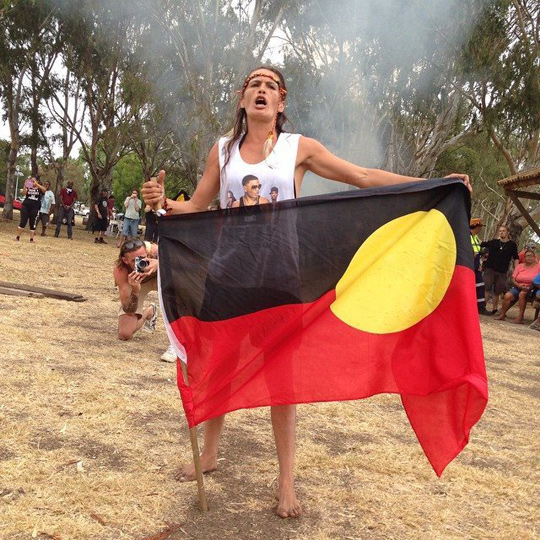

 Radioactive waste and the nuclear war on Australia’s Aboriginal people, Ecologist Jim Green 1st July 2016
Australia’s nuclear industry has a shameful history of ‘radioactive racism’ that dates from the British bomb tests in the 1950s, writes Jim Green. The same attitudes persist today with plans to dump over half a million tonnes of high and intermediate level nuclear waste on Aboriginal land, and open new uranium mines. But now Aboriginal peoples and traditional land owners are fighting back!
Then the government tried to impose a dump on Aboriginal land in the Northern Territory, but that also failed.
Now the government has embarked on its third attempt and once again it is trying to impose a dump on Aboriginal land despite clear opposition from Traditional Owners. The latest proposal is for a dump in the spectacular Flinders Ranges, 400 km north of Adelaide in South Australia, on the land of the Adnyamathanha Traditional Owners.
The government says that no group will have a right of veto, which is coded racism: it means that the dump may go ahead despite the government’s acknowledgement that “almost all Indigenous community members surveyed are strongly opposed to the site continuing.”
The proposed dump site was nominated by former Liberal Party politician Grant Chapman but he has precious little connection to the land. Conversely, the land has been precious to Adnyamathanha Traditional Owners for millennia.
It was like somebody ripped my heart out’
The site is adjacent to the Yappala Indigenous Protected Area (IPA). “The IPA is right on the fence – there’s a waterhole that is shared by both properties”, said Yappala Station resident and Adnyamathanha Traditional Owner Regina McKenzie.
The waterhole – a traditional women’s site and healing place – is one of many archeological and culturally significant sites in the area that Traditional Owners have registered with the South Australian government over the past six years. Two Adnyamathanha associations – Viliwarinha Aboriginal Corporation and the Anggumathanha Camp Law Mob – wrote in November 2015 statement:
“Adnyamathanha land in the Flinders Ranges has been short-listed for a national nuclear waste dump. The land was nominated by former Liberal Party Senator Grant Chapman. Adnyamathanha Traditional Owners weren’t consulted. Even Traditional Owners who live next to the proposed dump site at Yappala Station weren’t consulted. This is an insult.
“The whole area is Adnyamathanha land. It is Arngurla Yarta (spiritual land). The proposed dump site has springs. It also has ancient mound springs. It has countless thousands of Aboriginal artefects. Our ancestors are buried there.
“Hookina creek that runs along the nominated site is a significant women’s site. It is a registered heritage site and must be preserved and protected. We are responsible for this area, the land and animals.
“We don’t want a nuclear waste dump here on our country and worry that if the waste comes here it will harm our environment and muda (our lore, our creation, our everything). We call on the federal government to withdraw the nomination of the site and to show more respect in future.”
Regina McKenzie describes getting the news that the Flinders Ranges site had been chosen from a short-list of six sites across Australia: “We were devastated, it was like somebody had rang us up and told us somebody had passed away. My niece rang me crying … it was like somebody ripped my heart out.”
McKenzie said on ABC television: “Almost every waste dump is near an Aboriginal community. It’s like, yeah, they’re only a bunch of blacks, they’re only a bunch of Abos, so we’ll put it there. Don’t you think that’s a little bit confronting for us when it happens to us all the time? Can’t they just leave my people alone?”
Adnyamathanha Traditional Owner Dr Jillian Marsh said in an April 2016 statement:
“The First Nations people of Australia have been bullied and pushed around, forcibly removed from their families and their country, denied access and the right to care for their own land for over 200 years. Our health and wellbeing compares with third world countries, our people crowd the jails. Nobody wants toxic waste in their back yard, this is true the world over. We stand in solidarity with people across this country and across the globe who want sustainable futures for communities, we will not be moved.”
The battle over the proposed dump site in the Flinders Ranges will probably be resolved over the next 12 months. If the government fails in its third attempt to impose a dump against the wishes of Aboriginal Traditional Owners, we can only assume on past form that a fourth attempt will ensue……
Now Aboriginal people in South Australia face the imposition of a national nuclear waste dump as well as a plan to import 138,000 tonnes of high-level nuclear waste and 390,000 cubic metres of intermediate level waste for storage and disposal as a commercial venture.
The plan is being driven by the South Australian government, which last year established a Royal Commission to provide a fig-leaf of independent supporting advice. The Royal Commissioner is a nuclear advocate and the majority of the members of the Expert Advisory Committee are strident nuclear advocates.
Indeed it seems as if the Royal Commissioner sought out the dopiest nuclear advocates he could find to put on the Expert Advisory Committee: one thinks nuclear power is safer than solar, another thinks that nuclear power doesn’t pose a weapons proliferation risk, and a third was insisting that there was no credible risk of a serious accident at Fukushima even as nuclear meltdown was in full swing.
Announcing the establishment of the Royal Commission in March 2015, South Australian Premier Jay Weatherill said: “We have a specific mandate to consult with Aboriginal communities and there are great sensitivities here. I mean we’ve had the use and abuse of the lands of the Maralinga Tjarutja people by the British when they tested their atomic weapons.”
Yet the South Australian government’s handling of the Royal Commission process systematically disenfranchised Aboriginal people. The truncated timeline for providing feedback on draft Terms of Reference disadvantaged people in remote regions, people with little or no access to email and internet, and people for whom English is a second language. There was no translation of the draft Terms of Reference, and a regional communications and engagement strategy was not developed or implemented.
Aboriginal people repeatedly expressed frustration with the Royal Commission process. One example (of many) is the submission of the Anggumathanha Camp Law Mob (who are also fighting against the plan for a national nuclear waste dump on their land):
“Why we are not satisfied with the way this Royal Commission has been conducted:
Yaiinidlha Udnyu ngawarla wanggaanggu, wanhanga Yura Ngawarla wanggaanggu? – always in English, where’s the Yura Ngawarla (our first language)?
“The issues of engagement are many. To date we have found the process of engagement used by the Royal Commission to be very off putting as it’s been run in a real Udnyu (whitefella) way. Timelines are short, information is hard to access, there is no interpreter service available, and the meetings have been very poorly advertised. …
“A closed and secretive approach makes engagement difficult for the average person on the street, and near impossible for Aboriginal people to participate.”
The plan to turn South Australia into the world’s nuclear waste dump has been met with near-unanimous opposition from Aboriginal people. The Aboriginal Congress of South Australia, comprising people from many Aboriginal groups across the state, endorsed the following resolution at an August 2015 meeting:
“We, as native title representatives of lands and waters of South Australia, stand firmly in opposition to nuclear developments on our country, including all plans to expand uranium mining, and implement nuclear reactors and nuclear waste dumps on our land. … Many of us suffer to this day the devastating effects of the nuclear industry and continue to be subject to it through extensive uranium mining on our lands and country that has been contaminated.
“We view any further expansion of industry as an imposition on our country, our people, our environment, our culture and our history. We also view it as a blatant disregard for our rights under various legislative instruments, including the founding principles of this state.”
The Royal Commission acknowledged strong Aboriginal opposition to its nuclear waste proposal in its final report – but it treats that opposition not as a red light but as an obstacle to be circumvented.http://www.theecologist.org/News/news_analysis/2987853/radioactive_waste_and_the_nuclear_war_on_australias_aboriginal_people.html
Australian uranium mining is polluting the Antarctic
Climate scientists: Australian uranium mining pollutes Antarctic http://phys.org/news/2016-06-climate-scientists-australian-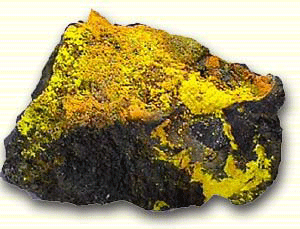 uranium-pollutes.html June 30, 2016 by Beth Staples Uranium mining in Australia is polluting the Antarctic, about 6,000 nautical miles away. University of Maine climate scientists made the discovery during the first high-resolution continuous examination of a northern Antarctic Peninsula ice core.
Ice core data reveal a significant increase in uranium concentration that coincides with open pit mining in the Southern Hemisphere, most notably Australia, says lead researcher Mariusz Potocki, a doctoral candidate and research assistant with the Climate Change Institute.
“The Southern Hemisphere is impacted by human activities more than we thought,” says Potocki.
Understanding airborne distribution of uranium is important because exposure to the radioactive element can result in kidney toxicity, genetic mutations, mental development challenges and cancer.
Uranium concentrations in the ice core increased by as much as 102 between the 1980s and 2000s, accompanied by increased variability in recent years, says Potocki, a glaciochemist.
Until World War II, most of the uranium input to the atmosphere was from natural sources, says the research team.
But since 1945, increases in Southern Hemisphere uranium levels have been attributed to industrial sources, including uranium mining in Australia, South Africa and Namibia. Since other land-source dust elements don’t show similar large increases in the ice core, and since the increased uranium concentrations are enriched above levels in the Earth’s crust, the source of uranium is attributed to human activities rather atmospheric circulation changes.
In 2007, a Brazilian-Chilean-U.S. team retrieved the ice core from the Detroit Plateau on the northern Antarctic Peninsula, which is one of the most rapidly changing regions on Earth.
More information: Mariusz Potocki et al. Recent increase in Antarctic Peninsula ice core uranium concentrations, Atmospheric Environment (2016). DOI: 10.1016/j.atmosenv.2016.06.010 Journal reference:Atmospheric Environment  Provided by: University of Maine
Attempts to dump nuclear waste on South Australia 1998-2004
The Kungkas wrote in an open letter: “People said that you can’t win against the Government. Just a few women. We just kept talking and telling them to get their ears out of their pockets and listen. We never said we were going to give up. Government has big money to buy their way out but we never gave up.”
Radioactive waste and the nuclear war on Australia’s Aboriginal people, Ecologist Jim Green 1st July 2016 “………Dumping on South Australia, 1998-2004
This isn’t the first time that Aboriginal people in South Australia have faced the imposition of a national nuclear waste dump. In 1998, the federal government announced its intention to build a dump near the rocket and missile testing range at Woomera.
The proposed dump generated such controversy in South Australia that the federal government hired a public relations company. Correspondence between the company and the government was released under Freedom of Information laws. Continue reading
Australia’s big banks lending to fossil fuels 6 times more than to renewables
 Climate change: big four banks’ lending to Australian renewables projects falls, Guardian, Michael Slezak, 4 July 16 Market Forces finds only two financing deals closed in first half of 2016 despite banks’ purported support for sector Australia’s big four banks’ lending for Australian renewable energy projects has tumbled in the first half of 2016, despite all of them spruiking their continuing support for the sector.
Based on public announcements from the banks and their customers, the activist group Market Forces has found only two financing deals were closed this year in the Australian renewables sector.
The National Australia Bank lent money to a windfarm in South Australia and both NAB and Westpac helped finance one in New South Wales.
Although more financing could be revealed in the second half of the year, the figures seem to show the banks have slowed their flow of money to the renewables sector in Australia.
“This is what you see when you have years of stagnation and cutting into renewable energy policy,” said Julien Vincent from Market Forces.
The group has been collecting the data on financing for Australian renewable energy projects for the past eight years.
The first six months of 2016 have seen the big four banks lend only $162m to renewable projects. That is less than half the average amount loaned in all previous six-month periods since 2008 and the fifth-worst half-yearly figure in the dataset.
So far this year, according to public announcements, both the Commonwealth Bank and ANZ have not closed any deals for renewable energy projects in Australia.
Market Forces data previously showed the big four banks lent $5.5bn to the Australian fossil-fuel sector in 2015 and that the amount lent to the fossil-fuel sector was six times more than lent to the renewables sector since 2008. One bank had a ratio of 13 to one, favouring lending to fossil fuels over renewables……….https://www.theguardian.com/environment/2016/jul/04/climate-change-big-four-banks-lending-to-australian-renewables-projects-falls
Botched clean-up of the Maralinga nuclear test site
 Radioactive waste and the nuclear war on Australia’s Aboriginal people, Ecologist Jim Green 1st July 2016 “……..The 1998-2004 debate over nuclear waste dumping in South Australia overlapped with a controversy over a botched clean-up of the Maralinga nuclear weapons test site in the same state.
The British government conducted 12 nuclear bomb tests in Australia in the 1950s, most of them at Maralinga. The 1985 Royal Commission found that regard for Aboriginal safety during the weapons tests was characterised by “ignorance, incompetence and cynicism”.
The Australian government’s clean-up of Maralinga in the late 1990s was just as bad. It was done on the cheap and many tonnes of plutonium-contaminated waste remain buried in shallow, unlined pits in totally unsuitable geology.
Nuclear engineer and whistleblower Alan Parkinson said of the clean-up: “What was done at Maralinga was a cheap and nasty solution that wouldn’t be adopted on white-fellas land.”
Dr Geoff Williams, an officer with the Commonwealth nuclear regulator, the Australian Radiation Protection and Nuclear Safety Agency, said in a leaked email that the clean-up was beset by a “host of indiscretions, short-cuts and cover-ups”.
Nuclear physicist Prof. Peter Johnston noted that there were “very large expenditures and significant hazards resulting from the deficient management of the project”.
Prof. Johnston (and others) noted in a conference paper that Traditional Owners were excluded from any meaningful input into decision-making concerning the clean-up. Traditional Owners were represented on a consultative committee but key decisions – such as abandoning vitrification of plutonium-contaminated waste in favour of shallow burial in unlined trenches – were taken without consultation with the consultative committee or any separate discussions with Traditional Owners.
Federal government minister Senator Nick Minchin said in a May 2000 media release that the Maralinga Tjarutja Traditional Owners “have agreed that deep burial of plutonium is a safe way of handling this waste.” But the burial of plutonium-contaminated waste was not deep and the Maralinga Tjarutja Traditional Owners did not agree to waste burial in unlined trenches – in fact they wrote to the Minister explicitly dissociating themselves from the decision.
Barely a decade after the Maralinga clean-up, a survey revealed that 19 of the 85 contaminated waste pits have been subject to erosion or subsidence.
Despite the residual radioactive contamination, the Australian government off-loaded responsibility for the contaminated land onto the Maralinga Tjarutja Traditional Owners. The government portrayed this land transfer as an act of reconciliation. But it wasn’t an act of reconciliation – it was deeply cynical. The real agenda was spelt out in a 1996 government document which said that the clean-up was “aimed at reducing Commonwealth liability arising from residual contamination.”……http://www.theecologist.org/News/news_analysis/2987853/radioactive_waste_and_the_nuclear_war_on_australias_aboriginal_people.html
Indigenous elder Dr Jillian Marsh – Greens candidate for Grey, South Australia
 Nuclear personal and political for Dr Jillian Marsh http://www.portpirierecorder.com.au/story/3987452/nuclear-issue-personal-and-political-for-marsh/ Politicians more often than not stick religiously to the party line when it
  comes to key policy issues.
But for The Greens’ candidate for Grey, Dr Jillian Marsh, the issue of a proposed nuclear industry in South Australia is not just political – it is personal, too. Dr Marsh is a traditional owner and elder of the Adnyamathanha people.
She endorses The Greens’ nuclear and uranium policy which outlines a future without uranium or nuclear energy production. But she said that her Aboriginal heritage motivated her to take the role as candidate for Grey and fight against the proposed nuclear dump.
“I know this is something I have as an obligation as an Adnyamathanha traditional owner,” Dr Marsh said. “I am required to step up to the mark … to take this on board for the sake of future generations.”
One of the proposed sites for a low to intermediate-level nuclear waste dump at The Wallerberdina station, near Barndioota in the Flinders Ranges, sits on Adnyamathanha land.
Dr Marsh was involved in anti-nuclear protest marches through Port Pirie and Port Augusta recently.She felt the the responsibility as a traditional owner and elder of the Adnyamathanha people to speak out about the federal and state government plans.
“Traditional owners, the Aboriginal people, have really had a gutful of this type of approach to community consultation,” she said. “They are always facing the prospect of their culture and country being damaged, destroyed, abused once again.”
Dr Marsh said that the consultation processes and uncertainty put a lot of pressure on aboriginal communities. “It creates a lot of ill-feeling in the community,” she said. “This type of uncertainty and angst is one of the things contributing to the shorter lifespans faced by our people.”
The translation of Adnyamathanha is “people of the rock” or “people of the rocky country” and Dr Marsh said this sacred cultural connection is under threat. “Our connection to the land is constantly being ransacked by ill-informed policies,” she said.
Australian Marine Conservation Society’s scoreboard on Liberal and Labor policies
Reef election policies don’t go far enough: Fight for the Reef AMCS (Australian Marine Conservation Society) http://www.marineconservation.org.au/news.php/826/reef-election-policies-dont-go-far-enough-fight-for-the-reef29 June 16:
“The Fight for the Reef campaign’s final Election Policy Scorecard, released today (Wednesday),
shows that the next Australian Government will need to increase its financial commitment to the Reef,
regardless of which party wins office.
“Key findings of the scorecard:
“The Coalition’s $1 billion loan announcement is an existing climate fund rebadged as a Reef water quality initiative.
Assessing this policy announcement has been challenging as no further information has been forthcoming.
… Accordingly, the policy has been assessed as not meeting what is required to deliver the water quality reforms that are needed.
“The ALP’s promise to increase funds by $377 million is a good down payment, but it’s not enough.
“The ALP has scored green for two major Reef policies:
commitment to introduce a legal cap on pollution flowing from the catchment into the Reef and
a promise to reform the Great Barrier Reef Marine Park Authority to make it more independent.
“Both the Coalition and the ALP scored green for committing to satellite tracking of commercial fishing vessels to improve protection of green zones. … ”
From WGAR News ( WGAR: Working Group for Aboriginal Rights (Australia) Editorial Note: The Australian #Greens scored green for all items on the scorecard.
Guardian’s video explains Liberal and Labor plans on climate change
 So what will the Coalition, Labor and the Greens do about climate change? A video explainer https://www.theguardian.com/australia-news/video/2016/jun/29/so-what-will-the-coalition-labor-and-the-greens-do-about-climate-change-a-video-explainer Lenore Taylor explains what each of the major parties plan to tackle the problem of greenhouse emissions. While the Coalition is planning to review its plans after Saturday’s general election, Labor is promising two new emissions trading schemes and the Greens have are advocating that Australia source 90% of its power from renewable sources by 2030 Lenore Taylor,Josh Wall and Clare Downey, Source: theguardian.com 29 June 2016
Fiona Stanley’s survey on political parties’ response to climate change
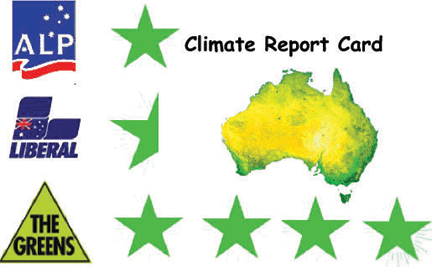 The climate change letter most candidates won’t answer Canberra Times, June 29 2016 Fiona Stanley I recently wrote to more than 1000 candidates in the federal election. I described how climate change is a real and growing threat requiring urgent attention, and that health professionals are seeing its impacts in medical practice right now and will be increasingly in the future.
The results distressed me. More than 100 independent candidates and those from virtually all minor parties and Greens responded to me with comments that were often constructive and extensive. There was only one individual response from a Labor Party candidate, and a courteous response from Labor campaign headquarters detailing official Labor policy. No Liberal Party candidate acknowledged my letter and there was no official response. Continue reading
China as market for agriculture, could be finished if nuclear waste dump goes ahead
Kristen Jelk, Your Say Last month I was in China promoting an Australian product that comes from SA which is pitched as a clean, green, environment. The full potential of the market in China for South Australian produce is immeasurable. From a Chinese consumers point of view, the environmental conditions where the product is sourced or grown, is pivotal to the choices made when purchasing.
Chinese consumers will pay top prices for products that are considered SAFE – produced where the source is known to be an unpolluted clean environment. Perception is everything, and if a consumer becomes aware that SA had developed a nuclear waste dump, then that perception of a safe environment will be shattered. It will not matter that the dump is in a desert, nor will it matter if the dump is considerable distance from prime agricultural land, nor will it matter if experts assure of safety standards.

The perception that would prevail is that SA will be a dumping ground for nuclear waste. If this is a discussion over commercial viability verses environmental risks long term, then I would argue that the real cost of the dump being located in SA is the loss in the perception that SA is a “clean, green” state. Questions would be raised over validity of the safety of the states produce.
Science does not dispel the pervading distrust of nuclear waste storage. Impassioned long standing anti-nuclear supporters cannot be placated and therefore ongoing discourse over the proposed dump will just shine a brighter light on the discussion world wide. The long term impact on the revenue of export sales will, without doubt be affected.
To risk the potential of long term growth in export sales due to a short term vision on job creation,( which is questionable ) is not good economics. SA has the potential to be a renewable energy ambassador with exciting projects already in development. We have to think globally, not locally if we are to sustain economic growth based on the real tangible asset that we have, which is our environment. http://yoursay.sa.gov.au/discussions/nuclear-community-conversation-comment-on-the-specific-recommendations-in-the-final-report
Australians Saving $1 Billion Per Year through Solar Energy
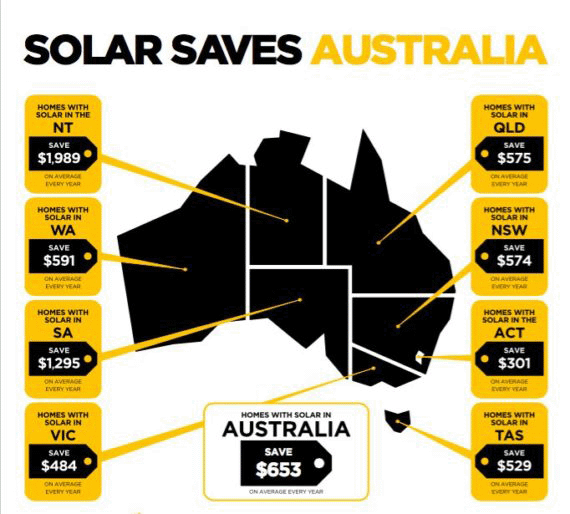
Solar In Australia Saving $1 Billion Per Year http://cleantechnica.com/2016/06/28/solar-australia-saving-1-billion-per-year/ June 28th, 2016 by Joshua S Hill Australia can now boast of over 23.2 million solar PV panels saving citizens $1 billion on their power bills each year.
According to a new report from Solar Citizens, “an  independent community based organisation,” Australia reached 23.2 million solar PV panels installed earlier this year — the equivalent of one per person in the country.
Solar Citizens also calculated the savings currently being made by solar owners on their regular electricity bills, analysing average electricity retail rates across all State and Territories over the past 8 financial years, revealing that solar households have saved $4.4 billion on their power bills since FY 2007–2008, and have been saving around $1 billion every year over the past three years.
“The pace of rooftop solar installation in Australia has been nothing short of phenomenal in recent years,” said Claire O’Rourke, National Director of Solar Citizens. “Solar panels are now a regular and normalised part of Australian life. In fact, Australians spend as much on their solar as they do on tea and coffee.”
In terms of investment, the report shows that 1.5 million Australian households and small businesses have invested more than $8 billion into rooftop solar PV. In fact, the investment figures reported in The State of Solar: Australia’s Solar Rooftop Boom are the highlight of the Solar Citizen’s research. During the 2014–2015 financial year, Australians invested $1.23 billion in rooftop solar — compared to only $118 millioninvested in large-scale solar projects in the calendar year 2014. So far, it is the hard-earned cash of Australian homeowners and small business owners that is driving the renewable energy transformation in Australia.
“Australians are leading the renewables charge and this new set of data plainly reveals that investment in solar PV has been the backbone of the renewables revolution in Australia,” said O’Rourke.
So far in 2016, Australia’s rooftop solar PV installation base has generated over 6.5 TWh, preventing 6.3 million tonnes of greenhouse gas emissions.
And with Australia about to go to the polls this weekend in the country’s federal election, this goes a long way to showing what Australians want from their politicians.
“Australian political leaders need to understand just how much the average Australian themselves have committed of their own money to play a part in the transition of our power system,” added O’Rourke. “With 5 million Australians (or 1 in 5 voters) living under a solar roof, this is potent political constituency.”
A solar energy revolution in mining
The next solar revolution could replace fossil fuels in mining, The Conversation, Geoffrey Brooks Pro-Vice Chancellor (Future Manufacturing), Swinburne University of Technology, June 29, 2016 Recently Sandfire Resources, a gold and copper producer based in Western Australia, announced its new solar power plant will soon start powering its DeGrussa mine. By replacing diesel power, the 10-megawatt power station, with 34,000 panels and lithium storage batteries, is expected to reduce the mine’s carbon emissions by 15%.
This is an exciting development because it realises an important potential that has long been recognised but not exploited. Two of Australia’s greatest resources – solar energy and minerals – are, as luck would have it, both highly concentrated in the same parts of Australia.
In this case, solar energy is being used to power the mine, but there is also great potential for solar energy to be used to convert the minerals to chemicals and metals……..
The next revolution
Currently, Australia’s use of solar energy is largely limited to homes, for hot water and solar-powered electricity. But solar energy has great potential for regional Australia too.
Mines are often isolated. There is typically limited natural gas and electricity supply, and in remote areas energy supply is limited to liquid fossil fuels. This is exactly the potential being exploited by Sandfire Resources at its mine facility 900km north of Perth.
Recent studies by CSIRO have identified the potential to use solar in high-temperature processing of ores such as bauxite, copper and iron ore. This process would use concentrated solar thermal (CST) energy as a heat supply. This heat can also be converted to electricity, known as concentrated solar power (CSP).
This is different to the solar photovoltaic technology used in Sandfire’s solar power plant (and rooftop solar panels), which converts sunlight directly to electricity……..
Concentrated solar energy is still relatively expensive. The Australian Solar Institute estimated in 2012 that the cost of electricity from concentrated solar was approximately double the current cost for conventional energy, reflecting largely the high capital cost of solar systems.
This gap can reasonably be expected to close with increases in the scale of operations (lowering manufacturing costs) and in regulatory pressure on conventional power sources.
It may be a way off, but the small step by Sandfire Resources could be the start of a revolution in the Australian minerals industry. https://theconversation.com/the-next-solar-revolution-could-replace-fossil-fuels-in-mining-61153
1 This month


Help Aunty Sue Protect Her Land and Sacred Sites From Destructive Rocket Testing.
.

Australians deserve the truth
about
AUKUS – https://aukuspublicinquiry.com/

PETITION – To: Prime Minister Anthony Albanese and the Australian Labor Government

of the week – Australians for War Powers Reform (AWPR)
To see nuclear-related stories in greater depth and intensity

