Cash splash for nuclear towns under Coalition plan

Don’t believe the hype!
The Age, By Paul Sakkal and Mike Foley, September 5, 2024 —
Regional communities will be showered with gifts for hosting nuclear reactors under Opposition Leader Peter Dutton’s energy policy, as the Coalition pledges a government-backed managed investment fund propped up by profits from its proposed power plants.
Opposition energy spokesman Ted O’Brien detailed the plans in a speech planned for this week’s Gippsland New Energy Conference, announcing the Coalition’s Community Partnership funds that invest dividends earned by the nuclear plants into the local economy.
Climate and Energy Minister Chris Bowen was invited to speak at the conference while O’Brien’s office claimed he was blocked from speaking despite the Coalition proposing a nuclear facility in the region, displaying what O’Brien called Australia’s “immature” energy debate that excludes nuclear energy advocates. Conference organisers were contacted for comment.
The Coalition’s signature energy policy would build seven taxpayer-funded, government-owned nuclear plants on the sites of existing coal generators. The proposed sites are in Lithgow and the Hunter Valley in NSW, Loy Yang in Victoria’s Latrobe Valley, Tarong and Callide in Queensland, Collie in Western Australia and Port Augusta in South Australia.
In his draft speech given to this masthead, O’Brien claimed the plants would supply the “cheapest electricity in the nation” for firms in industrial zones, which would attract a wave of investment to build facilities, grow the workforce and drive regional population growth.
“We want to ensure that communities like Latrobe can power Australian manufacturing for the remainder of this century and beyond,” O’Brien said in the speech.
“The key here is workers can move over in their same occupations, continuing to apply their skills, doing what they’ve always done. It means their social networks remain, their kids can still go to the same school.”
The Coalition has pledged to build the first two nuclear plants by 2037, with all seven completed by 2050. The sites have been selected to tap into existing transmission line infrastructure once the existing coal plants reach the end of their life.
However, experts have rejected claims that nuclear energy would be cheap, arguing renewables already produce less expensive electricity than fossil fuels and that CSIRO findings show it would cost more than $16 billion to build a single nuclear reactor.
The CSIRO said electricity will come from a grid drawing 90 per cent of its power from renewables, it would cost between $89 and $128 per megawatt hour by 2030. A large scale nuclear reactor would supply power for $136 to $226 per megawatt hour by 2040, according to the CSIRO.
The Coalition disputes the findings, saying the CSIRO did not consider the long life of nuclear plants, but has not released its own costings. This document will be key to understanding how the Coalition intends to return a profit on taxpayers’ investment in nuclear plants.
Bowen told the Gippsland conference on Wednesday the Coalition’s nuclear plan would cripple investment in renewable energy currently flowing to regional communities.
“They want to stop investment, stop jobs, and stop benefits in favour of waiting for a nuclear fantasy that may never come true,” he said.
The Coalition’s claims of a regional industrial boom under the nuclear plan resembles the goals of its previous regional investment policies…………………….more https://www.theage.com.au/politics/federal/cash-splash-for-nuclear-towns-under-coalition-plan-20240902-p5k72h.html
A quick update on Submissions to Parliament about the new AUKUS agreement

The remaining 16 Submissions are clear and straight-out in their condemnation of the agreement.
So far, – at 6 pm Tuesday 3rd September – 18 Submissions have been published
For several days, there were only 2 Submissions up. One, (by Robert Heron) – gives some weak criticism of the agreement. The other gives fulsome support to the agreement – it’s by Crispin Rovere – poker player, AI enthusiast, science fiction writer – who claims to be an “internationally recognised nuclear expert” – recognised by whom, I wonder?)
The remaining 16 Submissions are clear and straight-out in their condemnation of the agreement. On the whole, they give sound arguments for their opposition. I will be publishing them over the next days.
One wonders whether Australia’s always conformist and now cowardly Labor politicians will take any notice of these strong opinions. Liberal/National politicians can be relied on to kow-tow to their corporate backers and to the USA. Thank goodness Australia’s system gives intelligent iIndependents and Greens a chance to have a say.
Here are some of the core statements among those 16 Submissions:
I wish to express my complete opposition to the Aukus agreement. Australia should pursue an independent non aligned foreign policy.
It is sheer lunacy that we have put ourselves in a position which only profits the US and UK.
It is not in the best interests of the Australian people on a number of grounds
This Agreement should be rejected – the underlying premises are false or misleading.
The National Interest Analysis is negligent
Proceeding down the path of AUKUS will not make us safer. This Agreement should
not go forward.
Firstly, AUKUS is a horrifying idea in the sense that it is taking money away from the
Australia institutions that well and truly need it.
The acquisition of a fleet of nuclear-powered submarines (some of them second-hand) costing up to
A$368 billion is the largest defence project since World War Two and the worst foreign policy
mistake.
Not only does the AUKUS spending not produce social good it is harmful and causes risks to
Australian society.
Much to lose and nothing to gain.
Dutton’s nuclear vision is distorted by ignorance (or worse)
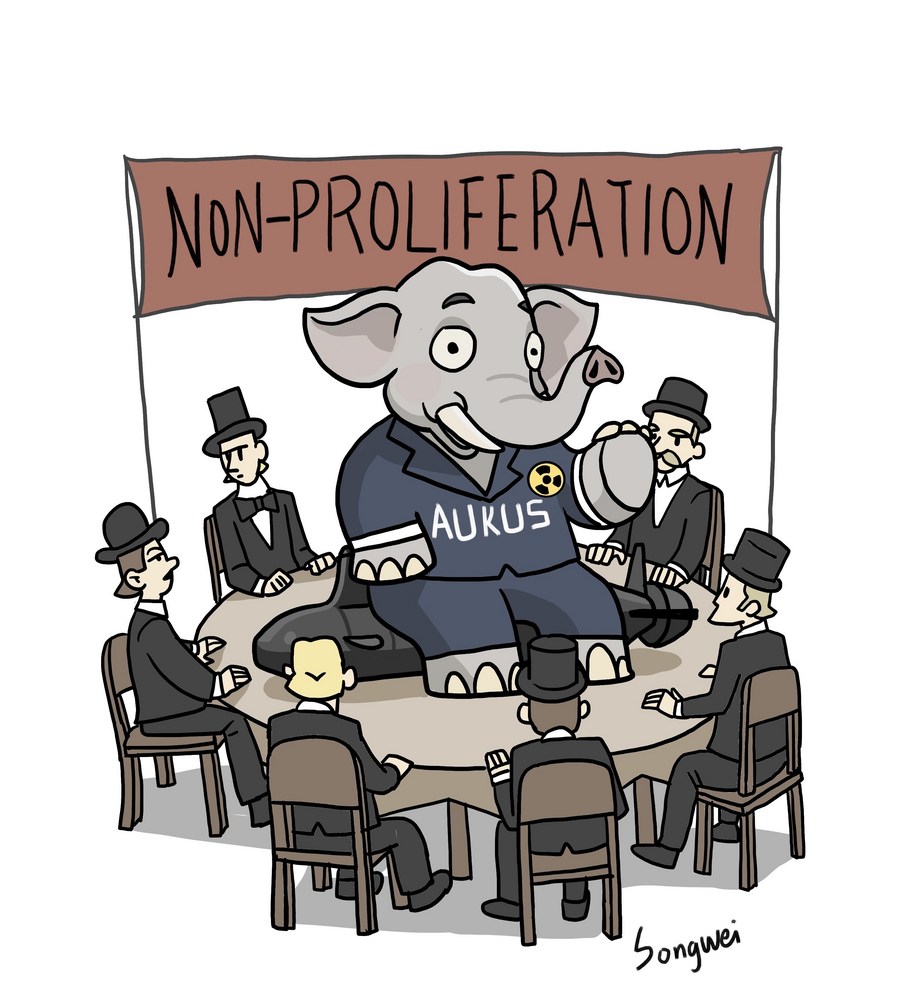
The elephant in the room is the fantasy that we will somehow graduate to having a self-sustaining nuclear industry. Firstly, this would be in breach of the Nuclear Non-Proliferation Treaty, which, AUKUS notwithstanding, would bring down on our heads the disapproval of the civilised world. The difficulties I have described above, with the fuel rods presumably purchased from a weapons state, most likely the US, would be compounded by the need for the International Atomic Energy Agency to ensure that any processing of the fuel in Australia meets non-proliferation standards.
By Jim Coombs, Sep 2, 2024, https://johnmenadue.com/duttons-nuclear-vision-is-distorted-by-ignorance-or-worse/
Peter Dutton’s nuclear plan may well have minimal carbon emissions, but the distant time of arrival, and ignoring the well known drawbacks makes it a dud.
On the face of it, it is all whizzbang white heat of technology (albeit of 60 years ago) and no carbon emissions (never mind the other ones). The problem lies with the nature of the beast.
The energy produced is heat, resulting from nuclear fission (the splitting of atoms, from a critical mass of highly radioactive material, e.g., uranium 235). The process needs to be controlled or it goes off like Hiroshima, so it is a technical fear of some delicacy, given the cost of failure, as can be seen from Chernobyl and Fukushima.
The fuel is usually in the form of rods containing the fissile material, and, over time, it is transmuted into “waste” which contains residual fuel and what are quaintly called the “daughter products of fission”. The spent fuel is reprocessed to extract further and remaining fissionable material and the “daughters’, which are extremely radioactive and dangerous with radioactive half-lives of some thousands of years and which, up to now, have not been found a final resting place that can guarantee their safety for future generations for those thousands of years.
The most celebrated aggregation of these products is at Sellafield in the UK where they have sat awaiting adequate disposal for decades. Dutton blithely says the spent fuel rods will be stored on the power station site, which is mostly not the case elsewhere. For how long, how many and where they might be sent, once processed, for future generations to be safe, is ignored.
The nations he says happily depend on nuclear power, such as France or Japan, either fuel their stations with fissile material from their nuclear weapons programs, as in the case of France, (the cost is, thus, a defence secret), or they are trying to reduce their dependence, to reduce the cost of ensuring safe operation (Japan and Germany).
The cost overruns of nuclear power stations under construction in the UK and elsewhere are notorious. The light-bulb idea of small modular stations has yet to be demonstrated in practice, though the concept has been around for decades. They too have the problems of what to do with the waste as described above which remain unsolved .
The elephant in the room is the fantasy that we will somehow graduate to having a self-sustaining nuclear industry. Firstly, this would be in breach of the Nuclear Non-Proliferation Treaty, which, AUKUS notwithstanding, would bring down on our heads the disapproval of the civilised world. The difficulties I have described above, with the fuel rods presumably purchased from a weapons state, most likely the US, would be compounded by the need for the International Atomic Energy Agency to ensure that any processing of the fuel in Australia meets non-proliferation standards.
The idea that we could produce the fuel rods from our own supply of uranium would entail our establishing a uranium enrichment facility. All that we now know about the cost of doing this, in the face of international obloquy, is that it is a defence secret, which has never been undertaken commercially. Indeed President Richard Nixon famously offered GE and Westinghouse free access to the technology and they both declined to take it on as a business.
Consider then, what is involved in uranium enrichment. Uranium comes in two isotopes. U235 (the fissile one) and U238. To achieve fission, the concentration of U235 needs to be higher than is found in nature, so increasing the proportion of U235 is what needs to be done. That is, increasing the amount of the lighter isotope, and this can only be done by physical means, separating on the basis of three parts by weight out of 238. The only medium for achieving this separation is, in the case of uranium, uranium hexafluoride, an extremely corrosive gas, making the process entirely contained and corrosion resistant the only way to go ahead.
What is the mechanism working in this severely constrained process? A long series of gas centrifuges of the highest quality stainless steel requiring a constant supply of energy to keep the spinning process going. A task at the very edges of technical feasibility. Desperate stuff, or as Dr Johnson said of women preaching, surprising that it is done at all. Cost estimate? A deep dark secret.
Lastly, Dutton’s pro-AUKUS stance goes along with his wilful blindness to the nuclear safety issue. Way back, Billy McMahon denied entry of nuclear-powered submarines to all Australian harbours, because of the mere possibility of an escape of waste or other nuclear materials into populated environments. In the UK and US, berthing of nuclear powered vessels takes place largely at purpose-designed port facilities away from population centres. AUKUS plans to berth near Adelaide, and port cities in NSW. Imagine the effect of a minor “excursion” on real estate prices near Adelaide or even Port Kembla. “It’s clean, it’s green,” Peter cries, with no evidence whatsoever of the cost of keeping it all safe.
Barmy, or dishonest ?
Barnaby’s Bush Summit bombshell: Why ScoMo wouldn’t back nuclear
Barnaby Joyce revealed Scott Morrison rejected a push from within the Coalition to introduce nuclear power in Australia because polling showed it was unpopular.
Daily Telegraph, John Rolfe and James O’Doherty, 30 Aug 24
Former Prime Minister Scott Morrison rejected a push from within his Coalition government to introduce nuclear power in Australia because polling showed it was unpopular, the Bush Summit has heard.
Speaking in a panel on energy policy at the Summit in Orange, Barnaby Joyce revealed that when he was Deputy Prime Minister he went to Mr Morrison, the then PM, and made the case for overturning the prohibition on nuclear and building reactors.
He claimed Mr Morrison said there wasn’t enough community backing.
“He (Mr Morrison) said that the polling didn’t support that,” Mr Joyce recalled. “And so it didn’t go ahead.”
He added: “We’ve continued fighting, and … now the Opposition is taking it on. That’s what happens in politics. You just fight, fight, fight, and then you finally get there, and we’re there.”
Later, in an interview for DTTV, Mr Joyce went further: “I’ve always been a supporter of nuclear power. So Scott Morrison didn’t pursue nuclear power because he thought it was politically untenable.
“In politics, it’s not a case of following. It’s a case of leading. And that’s what we intend to do.”
Mr Morrison told The Telegraph it was “seriously considered and discussed.
“It was determined and agreed that there was insufficient runway before the election to prosecute the case for a civil nuclear energy capability … especially given there would not be bipartisan support for the change, which had been our standing policy position on nuclear power for many years, that is, to proceed it would need to be bipartisan.
“That said, nuclear power was included in our government’s Technology Road Map.”
Mr Joyce also told the Summit that the push for renewable energy is the “most divisive thing” he has seen in his time in politics in a fiery debate with Matt Kean.
‘WHAT IS THIS, THE WIZARD OF OZ?’
“It has split communities down the middle. It has made good friends (go) for each other’s throats,” Mr Joyce said during his face-off with the former NSW treasurer and energy Minister Mr Kean – now Climate Change Authority chairman.
“We are going to be mugged by reality on this one … if we keep going down this path, the lights are going to go out,” Mr Joyce said, adding red tape would slow down building new energy such as nuclear power.
“You were the deputy Prime Minister of the country Barnaby … you could do something about it,” Mr Kean said.
Mr Kean added he wasn’t “opposed” to nuclear.
“I’m supportive of the facts, I’m not opposed to nuclear per se, but … nuclear is three to five times more expensive than firmed renewables,” Mr Kean said, prompting a barrage of rejections from the New England MP.
“What is this? The Wizard of Oz,” Mr Joyce said.
Mr Kean said the government Mr Joyce was part of didn’t build any baseload power.
Earlier, Mr Joyce met with pro-nuclear protesters outside the summit and promised he would “fight this till the end.”
The anti-wind farm campaigners were brandishing signs saying “we do not consent” and “minimum 6km setback from our homes”.
“They’re ruining the environment and wrecking regional Australia,” one protester said of wind farms………………………………………………………………………….. https://www.dailytelegraph.com.au/bush-summit/barnabys-bush-summit-bombshell-why-scomo-wouldnt-back-nuclear/news-story/f16eae0098c75cb049d0d1a03eddf4be
That time when Canada cancelled its nuclear submarine order
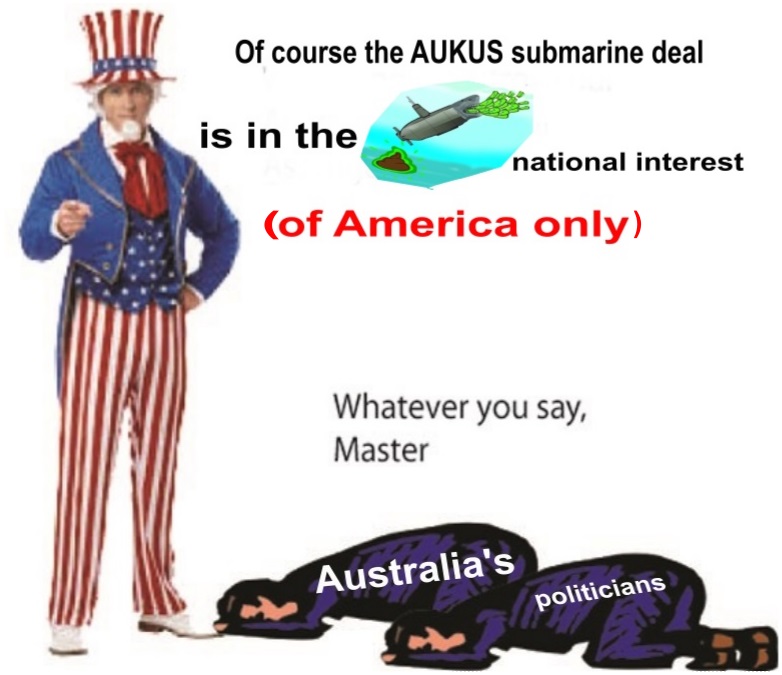
The decision to cut the Australian community out altogether — except where we will be called upon to service the US military as it builds its base in WA — puts us in the relationship of a vassal state, existing only to do the bidding of our powerful friend.
By Julie Macken and Michael Walker, Aug 30, 2024, https://johnmenadue.com/that-time-when-canada-cancelled-its-nuclear-submarine-order/
Back in 1987, when no one knew that the Cold War was just about to end, the Canadian Government signed up to build 10 nuclear-powered submarines. That submarine program lasted for all of two years before being cancelled in 1989. No nuclear Canadian sub ever even began construction, let alone getting put in the water.
There is a very real sense of déjà vu when we look at the Canadian experience and the current Australian experience of AUKUS. The good news is that it is not too late to learn the lessons the Canadians learnt for us.
One of the reasons for the Canadian cancellation was the $8 billion price tag, or about $19 billion in today’s money. Two billion dollars per submarine now sounds like a bargain compared to the astronomical $45 billion per submarine under AUKUS. Canada decided it had other priorities where that money could be put to better use.
But before the contract was cancelled in Canada, the ministries involved in its construction became embroiled in conflict, the Government itself was in a cost-of-living-crisis with immediate, real-world needs pressing and the hasty and secretive choice of vessel design came under withering criticism from the Treasury department for poor procurement with the cost expected to blow out to $30 billion ($70 billion today). And finally, media support eroded, with 71% of the population opposed to the project.
Déjà vu much?
On 12 June, the US Congressional Research Document service produced a research and advice document called the Navy Virginia-Class Submarine Program and AUKUS Submarine (Pillar 1) Project: Background and Issues for Congress.
The document points out the AUKUS deal was a three-step process. The first was to establish a US-UK rotational submarine force in Western Australia. The second was that the US would sell us three or five Virginia nuclear powered submarines and the third would be that the UK assists us in building our own AUKUS class nuclear submarines.
But the Congressional report outlines when comparing the “potential benefits, costs, and risks” of the three stage plan, it might just be better for the US to operate more of its own boats out of WA. That is, “procuring up to eight additional Virginia-class SSNs that would be retained in US Navy service and operated out of Australia along with the US and UK SSNs”.
That’s right, why bother with the whole step two and three when the US is best served by simply operating its nuclear-powered attack submarines out of WA?
This is an extraordinary development and one that demands more attention than has been given previously because a number of issues flow from this kind of thinking.
First, this potentially frees up $400 billion that could be put to far better use on a national housing construction program or high-speed rail network running the entire east coast of Australia or other large and much-needed nation-building projects. But not so fast.
The US Congressional Research Document suggests that “those funds (the $400 billion) could be invested in other military capabilities”, such as long-range missiles and bombers, “so as to create an Australian capacity for performing non-SSN military missions for both Australia and the United States”.
The decision to cut the Australian community out altogether — except where we will be called upon to service the US military as it builds its base in WA — puts us in the relationship of a vassal state, existing only to do the bidding of our powerful friend.
The fact that the document only referenced the “potential benefits, costs, and risks” from the US perspective, without any attempt to imagine how Australia may view becoming a life support for a US submarine base, makes the nature of our relationship pretty clear.
Australia’s Government may not consider it necessary to have done its due diligence on AUKUS but the Americans are happy to do that for us and, you guessed it, even though they quietly have doubts about the SSN project, they’ve already thought of plenty of other ways to spend our money on their own defence objectives. Spending it on the well-being and prosperity of our own people didn’t even rate a mention.
Opposing a USA-led international nuclear agreement that is bizarrely unfair to Australia
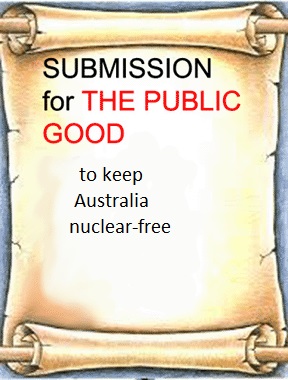
Australians can object to the agreement, by putting in a submission to a Parliamentary Joint Standing Committee.
Submissions are due by September 1st. So far, only 2 submissions have been published. They’re sort of “zipped” – so I can’t read them. You can bet your boots they are from the nuclear lobby
I’s a bit of an IT hurdle to actually get your submission in. That’s after you’ve even written it. Which is tough, too, as the general public in Australia knows nothing about it.
But anyway, here’s one little effort
TITLE: Submission to the Joint Standing Committee on Treaties concerning the:
Agreement among the Government of Australia, the Government of the
United Kingdom of Great Britain and Northern Ireland, and the Government
of the United States of America for Cooperation Related to Naval Nuclear Propulsion.
This submission urges that the Joint Standing Committee on Treaties recommends against
the Australian Government signing this Agreement as I believe that it is not in the best interests of the Australian people on a number of grounds, as outlined in this submission
Australia would be landed with high level nuclear waste – This Agreement
requires Australia to “be responsible for the management, disposition, storage, and
disposal of any spent nuclear fuel and radioactive waste resulting from the
operation of Naval Nuclear Propulsion Plants transferred pursuant to this Article,
including radioactive waste generated through submarine operations, maintenance,
decommissioning, and disposal.” (ARTICLE IV Naval Nuclear Propulsion Plants,
Related Equipment and Material, Section D).
The health risk to Australians brought in by the construction of nuclear facilities
and the management and storage of radioactive wastes. Buying second-hand
nuclear submarines make this waste danger another hazard, as we’d be buying
already existing toxic wastes.
Under this agreement it is possible for a nuclear weapon to be present on
Australian shores– this would it would be a clear breach of the highest order of the
Treaty on the Non-Proliferation of Nuclear Weapons (NPT) because as a signatory to
NPT Australia is not allowed to manufacture or otherwise acquire nuclear weapons.
The agreement does not guarantee that the USA will continue with the nuclear
submarine arrangements, but still ensures that Australia will cop the costs. This is
blatantly unfair.
It is extraordinarily unfair and bizarre that under Article IV E. “Australia shall
indemnify, the United States and the United Kingdom against any liability, loss,
costs, damage or injury (including third-party claims) arising out of, related to, or
resulting from Nuclear Risks connected with the design, manufacture, assembly,
transfer, or utilization of any Material or Equipment, including Naval Nuclear
Propulsion Plants and component parts and spare parts thereof transferred or to be
transferred pursuant to this Article.”
The ‘National Interest Analysis [2024] ATNIA 14 with attachment on consultation’,
acknowledges that “There has been no public consultation”, with paragraph 55
stating that “No public consultation has been undertaken, given the classified scope of consultations between the Parties on the Agreement, including matters relating to
national security and operational capability.”
The Treaty clearly outlines that Special Nuclear Material to be transferred under the
agreement, “shall contain highly enriched uranium and, only with respect to
irradiated fuel, may contain plutonium”, (ARTICLE VI Conditions and Guarantees,
SECTION I –SPECIAL NUCLEAR MATERIAL)
In conclusion – the whole agreement is unfair, poorly organised, and should not be
accepted by Australia, particularly in this situation where there has been no public
consultation – set up completely in the dark as far as the Australian people are
concerned.
Noel Wauchope
Coalition Proposal Undercuts Australians to Fund Expensive Nuclear Fantasy

August 28, 2024, https://theaimn.com/coalition-proposal-undercuts-australians-to-fund-expensive-nuclear-fantasy/
In response to the federal Coalition’s proposal for $100 billion in cuts to housing, transport, education, and climate solutions, the 30 undersigned organisations released the following statement:
Peter Dutton and the Coalition made their priorities clear today with a proposal to gut social services and roll back Australian renewables – all to fund their expensive nuclear fantasy
The radical proposal would slash everything from housing and public transport to renewable energy and manufacturing jobs in an attempt to find the $100 billion they’d need to bankroll their unpopular nuclear scheme – a scheme that would drive up energy bills in the short, medium, and long-term.
By attacking both bedrock social programs and the renewable energy already providing 40% of Australia’s electricity, the Coalition would undercut Australia’s economic prosperity, undermine investor certainty, and make life harder for Australians already doing it tough.
By scrapping Future Made in Australia, Powering the Regions Fund and Rewiring the Nation, Peter Dutton would also abandon the key initiatives designed to reduce carbon pollution and reform the economy to ensure we remain prosperous and internationally competitive in a decarbonising world.
Peter Dutton’s attacks on a Future Made in Australia are especially telling, a rehash of the tired arguments Donald Trump and the Republicans used in their attempt to kill the U.S. Inflation Reduction Act.
Contrary to their ‘sky-is-falling’ rhetoric, however, U.S. inflation has decreased substantially since the U.S. passed its signature clean industry policy. Meanwhile, the policy has crowded in private investment equivalent to six times the support it provides, driven the creation of 210 new clean projects, created 400,000 new jobs and added $155B to the U.S. GDP annually.
The Coalition wants Australians to forego that same opportunity and sacrifice their own social services so they can prop up a nuclear industry expected to raise household energy bills an average of $1000 annually. If elected, Peter Dutton risks taking Australia back to the decade of chaos that characterised the Abbott, Turnbull, Morrison years on climate and energy policy.
-Advertisement-
This proposal is a transparent stunt, not a serious plan. Where the Coalition should be proposing real solutions on cost of living, the economy, and climate, they continue to offer only denial, delay, and disinformation. The Australian people deserve far more.
Surging seas are coming for us all, warns UN chief

Katy Watson, 26 Aug 24
The United Nations Secretary-General António Guterres has said that big
polluters have a clear responsibility to cut emissions – or risk a
worldwide catastrophe.
“The Pacific is today the most vulnerable area of
the world,” he told the BBC at the Pacific Island Forum Leaders Meeting
in Tonga. “There is an enormous injustice in relation to the Pacific and
it’s the reason I am here.” “The small islands don’t contribute to
climate change but everything that happens because of climate change is
multiplied here.”
But eventually the “surging seas are coming for us
all,” he warned in a speech at the forum, as the UN releases two separate
reports on rising sea levels and how they threaten Pacific island nations.
The World Meteorological Organization’s State of the Climate in the South
West Pacific, external report says this region faces a triple whammy of an
accelerating rise in the sea level, a warming of the ocean and
acidification – a rise in the sea’s acidity because it’s absorbing
more and more carbon dioxide.
“The reason is clear: greenhouse gases –
overwhelmingly generated by burning fossil fuels – are cooking our
planet,” Mr Guterres said in a speech at the forum. “The sea is taking
the heat – literally.”
BBC 27th Aug 2024
Coalition pledges to ditch nuclear sites if earthquake zones are declared unsafe

The Age, By Mike Foley, August 26, 2024
Proposed nuclear sites would be abandoned if studies reveal unacceptable risks, the Coalition has declared following an earthquake near its planned Hunter Valley site, raising questions about other selected locations close to geological fault lines.
A magnitude 4.7 earthquake struck near Muswellbrook in NSW’s Upper Hunter region on Friday, several kilometres from the Liddell coal plant where the opposition has pledged to build a nuclear reactor if elected. The quake damaged buildings in the town while tremors were felt as far away as Sydney.
Opposition energy spokesman Ted O’Brien pledged that if the Coalition formed government, it would establish an independent nuclear authority that would conduct detailed studies of the proposed sites.
“If [the studies] come back with advice that says any power plant should not proceed, then a power plant would not proceed, full stop,” he told ABC radio on Friday. “That is absolutely key.”………………………………………………………………………………………………………………
Four of the opposition’s seven proposed nuclear sites are located near active fault lines: Port Augusta in South Australia, Lithgow in NSW, Collie in Western Australia and the Latrobe Valley in Victoria – an area that has had seven seismic events this year ranging from magnitudes of 2 to 4.3.
Latrobe Valley resident Wendy Farmer, president of the Voices of the Valley group, is helping to establish an alliance of anti-nuclear groups from the communities selected for plants.
Farmer said the opposition should have studied its selected sites before nominating them for reactors.
“Had they taken time to either speak to companies or communities, they would have already known this,” she said.
Hunter Community Environment Centre co-ordinator Jo Lynch said she was concerned about nuclear waste, considering the millions of tonnes of fly ash stored in dams across her region.
“I am concerned about waste management from a nuclear facility. Just looking at the track record with coal, that was a result of outdated environmental laws,” Lynch said………………………….. https://www.theage.com.au/politics/federal/coalition-pledges-to-ditch-nuclear-sites-if-earthquake-zones-are-declared-unsafe-20240826-p5k5d5.html
Is the USA now considering withdrawal from AUKUS?

A little bird sent me this:
“I have just had it from a strong source in America that if Australia fails to reach an article 14 arrangement with IAEA within the next three months then irrespective of the presidential result America will give notice of withdrawal from AUKUS
However it may negotiate with Australia to use Garden Island as a base for its Indian Ocean fleet
Apparently major contractors involved with the first phase of AUKUS are lobbying the USA government to continue irrespective of what occurs with AUKUS but so far with little success”
Answers to the Questions on Notice are published in due course on the Australian Parliament House website.
Civil Society faces imposition of an AUKUS military High Level nuclear waste dump
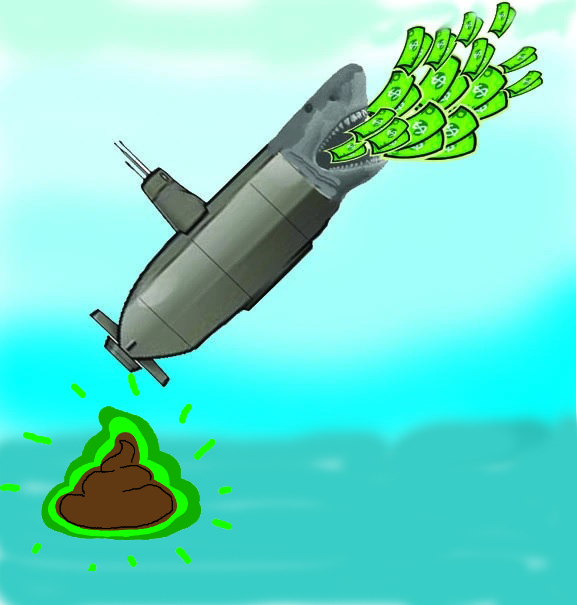
by David Noonan, Independent Environment Campaigner 22 August 2024
The Federal ALP belatedly disclosed a secret pre-condition in AUKUS plans to buy second hand US
nuclear subs: for Australia to keep US N-Subs US origin military High Level nuclear waste forever.
In a breach of trust the ALP is seeking to ‘normalise’ High Level nuclear waste in Australia. Claims of
‘nuclear stewardship’ in taking on US N-Subs and in retaining untenable US N-Sub wastes are a farce.
Disposal of High-Level nuclear waste is globally unprecedented, with our AUKUS ‘partners’ the US &
UK having proven unable to do so in over 65 years since first putting nuclear powered subs to sea.
Minister for Defence Richard Marles MP has still not made a promised ‘announcement’, said to be by
early 2024, on a process to manage High Level nuclear waste and to site a waste disposal facility, he
saying “obviously that facility will be remote from populations” (ABC News 15 March 2023).
Defence is already working to identify potential nuclear waste storage and disposal sites, assessing
existing Defence lands, and appraising potential regions with areas to compulsorily acquire a site.
The public has a right to know who is already being targeted for imposed AUKUS N- waste storage.
Political leaders in WA, Qld and Vic have already rejected a High-Level nuclear waste disposal site.
Our SA Premier has so far only said it should go to a safe ‘remote’ location in the national interest.
AUKUS compromises public confidence in Gov and sets up a serious clash with civil society:
In setting the offer for a next Federal Election, Labor must become transparent and be made
accountable over AUKUS and associated rights and interests that are at stake in Labor’s intended
High Level nuclear waste dump siting process. For instance:
- Federal and SA Labor must commit to comply with the United Nations Declaration on the Rights
of Indigenous Peoples Article 29 provision of Indigenous People’s Rights to “Free, Prior and
Informed Consent” over storage or disposal of hazardous materials on their lands. - Defence must declare their intension to over-ride the SA Nuclear Waste Storage (Prohibition) Act
2000 to impose an AUKUS nuclear dump on outback lands and unwilling community in SA. - Federal Labor must fully set out the array of AUKUS nuclear wastes to be stored in Australia.
The ALP National Platform (2021, Uranium p.96-98) makes a commitment to oppose overseas waste:
Labor will: 8.d. Remain strongly opposed to the importation and storage of nuclear waste
that is sourced from overseas in Australia.
In contrast, AUKUS aims Australia buy existing US military nuclear reactors in second-hand N-Subs
that are to be up to 10-12 years old, loaded with intractable US origin High-Level nuclear wastes that
are also weapons usage fissile materials – and remain as Bomb Fuel long after decommissioning.
Further, in an affront to public trust Labor’s AUKUS Bill has been written to provide a federal legal
power to take existing US and UK N-Sub nuclear reactor wastes for storage and disposal in Australia.
Labor claims that it is not their ‘policy’ to do so – but it is their proposed Federal Law…
Q: Is Federal Labor already targeting the Woomera Area in SA as a potential site to impose an AUKUS military High-Level nuclear waste dump?
A Labor AUKUS Bill assumes a power and a right to over-ride State laws by naming State laws in
Regulations that are to be made in 2025. Section 135 “Operation of State and Territory laws”, states:
If a law of a State or Territory, or one or more provisions of such a law, is prescribed by the
regulations, that law or provision does not apply in relation to a regulated activity.
The Bill provides for regulated activities in ‘nuclear waste management, storage and disposal’ at
AUKUS facilities in future nuclear zones, which are to be authorised in part under Sec.135.
The national press has reported the Woomera rocket range is understood to be the ‘favoured
location’ for storage and disposal of submarine nuclear waste (“Woomera looms as national nuclear
waste dump site including for AUKUS submarine high-level waste afr.com 11 August 2023).
A ‘Review’ of the Woomera Prohibited Area has just been announced by the Minister for Defence
Richard Marles MP: “to ensure it remains fit for purpose and meets Australia’s national security
requirements.” The Review is due to report in mid-2025 – after the federal election…
AUKUS will aim to compulsorily acquire and declare a High-Level nuclear waste dump site, with over-
ride of State laws through this Bill, long before the 2032 first purchase of a second-hand US N-Sub.
It was left up to a US Vice Adm. Bill Houston to reveal the proposed sales of in-service Virginia-class
subs will be in 2032 and in 2035, with a first new N-Sub in 2038 (US Breaking Defence 8/11/23).
If Federal Labor wants to locate an AUKUS nuclear waste dump in SA, it will have to over-ride our
existing State Law to impose the dump. This AUKUS Bill is a threat to the safety of the people of SA.
Storage and disposal of nuclear wastes compromises the safety and welfare of the people of South
Australia, that is why it is prohibited by the SA Nuclear Waste Storage (Prohibition) Act 2000.
Labor Premier Mike Rann strengthened these laws in 2002 and now Federal Labor may over-ride them.
The Objects of this Act cover public interest issues at stake, to protect our health, safety and welfare:
“The Objects of this Act are to protect the health, safety and welfare of the people of South
Australia and to protect the environment in which they live by prohibiting the establishment
of certain nuclear waste storage facilities in this State.”
The import, transport storage and disposal of High-Level nuclear reactor waste is prohibited in SA.
However, Federal Labor are taking up legal powers to impose a dangerous AUKUS nuclear dump on
SA or on the NT, through an undemocratic override of State laws and compulsory land acquisition.
Question: Will Federal Labor also disregard Indigenous Peoples UN recognised Right to Say No?
In the lead up to a federal election Labor must now declare if they will respect or ignore an
Indigenous Right to Say No to an AUKUS nuclear waste dump on their country.
South Australians have a democratic right to decide their own future & to Say No an AUKUS dump.
AUKUS 2.0: Albanese Drives It Like He Stole It, and Then Gives It Away to the US

by Paul Gregoire, 15 Aug 2024, Fact Checked, https://www.sydneycriminallawyers.com.au/blog/aukus-2-0-albanese-drives-it-like-he-stole-it-and-then-gives-it-away-to-the-us/

On his jaunt to the US last week, not only did defence minister Richard Marles glorify the US presence across the entire Australian military domain at the AUSMIN, but he also signed an updated version of the AUKUS Exchange of Naval Nuclear Propulsion Information Agreement (ENNPIA).
Then in announcing the updated AUKUS agreement had been tabled on Monday, Marles explained that it “will be central to Australia’s acquisition of a sovereign nuclear-powered submarine (SSN) capability from the 2030s”, including US-made SSN and UK-assisted Australian-made SSN.
“It will also enable Australia to prepare for Submarine Rotational Force-West (SRF-West) at HMAS Stirling from 2027, supporting the rotational presence of up to four Virginia class submarines from the US and one Astute class submarine from the UK,” the deputy PM added in his press release.
Yet, while Marle’s first proposition, that Australia will ever acquire any of the eight proposed SSN of its own, has been shown to be full of holes, a recent paper by the US congress’ thinktank reveals that the mainly US submarine force stationed in WA is a given and it recommends no Australian SSN.
And despite these questions, the Albanese government did table the updated EENPIA, which, if all parties provide a note assuring that domestic requirements are completed, will replace the 2022 original agreement, and this rather lopsided treaty will continue to be in force until the end of 2075.
A lack of sovereignty
The AUKUS ENNPIA establishes a legally-binding framework to facilitate the communication and exchange of naval nuclear propulsion information and nuclear material and equipment from the UK and the US to Australia – the AUKUS powers – in regard to our own coming “sovereign” SSN.
The reason it’s questionable that any boats we may acquire will be sovereign is that the deal adheres to the Treaty on the Non-Proliferation of Nuclear Weapons (NPT), which guards against new states acquiring the ability to produce such weapons, so therefore, the reactors in the subs are off-limits.
The plan is to purchase three to five second-hand Virginia class SSN from the states, starting in the early 1930s, with sealed nuclear reactors in them, and in terms of the five Australian-made AUKUS subs, the UK will provide welded naval nuclear propulsion plants to be inserted into the AUKUS SSN.
And author of Nuked, investigative journalist Andrew Fowler told the ABC last month in reference to the Virginia class SSN that if Australia buys these boats, it’s questionable that they can every really be referred to as owned solely by the nation, as treaty obligations guard against that final step.
Non-proliferation requirements
The updated ENNPIA further requires Australia to establish an Article 14 Arrangement under the Agreement between Australia and the International Atomic Energy Agency (IAEA) for the Application of Safeguards in Connection with the Treaty on the Non-Proliferation of Nuclear Weapons.
This 1974 agreement permits Australia to use nuclear material in relation to “peaceful” activities, which is safeguarded under its provisions, and this further entails ensuring that the “material is not diverted to nuclear weapons or other nuclear explosive devices”.
Article 14 of the agreement requires that if Australia plans to use nuclear material in a “non-proscribed military activity”, that our nation and the IAEA must come to an arrangement, so that Australia is permitted to use it in this non-safeguarded manner.
And if Australia is found to be in breach of the NPT, it’s agreement with the IAEA or the Article 14 agreement, the US and the UK have the right to cease the AUKUS agreement and will require the return of all nuclear material and equipment transferred to it, which again raises sovereignty.
Pulling the plug
Australians have been told that the nation is committing at least $368 billion to this AUKUS sub deal, which certainly signals a nation sliding towards a war economy with less social services. And the ENNPIA notes that no public consultation has been undertaken because the process is classified.
But as Greens Senator David Shoebridge told Sydney Criminal Lawyers in April, our nation has already committed AU$4.6 billion to the US for its nuclear submarine industrial base, and another AU$4.6 billion for the UK’s nuclear submarine industrial base.
The updated ENNPIA further provides that “any party may, by giving at least one year’s written notice to the other parties, terminate this agreement”. Yet, there is nothing within it stipulating that Australia will be receiving any refunds on these already progressing investments.
And on such termination or if one party has breached the deal “each other party has the right to require the return or destruction of any naval nuclear propulsion information, nuclear material and equipment that it communicated, exchanged, or transferred pursuant to the agreement”.
So, while this last clause does technically apply to all AUKUS powers, it doesn’t really have any bearing on our nation, as we are to pay for the transference of information, nuclear material and related equipment, and we’re not supposed to provide any in the other direction.
So, Australia is left in a precarious situation where everything can be taken away.
A dumping ground for nuclear waste
In terms of nuclear waste, the AUKUS ENNPIA only “obligates Australia” to store and dispose of “any spent nuclear fuel and radioactive waste resulting from naval nuclear propulsion plants that are transferred”.
However, this document only relates to the exchange of naval nuclear propulsion information coming from the US and the UK. And it does not, for instance, dictate what will happen to the nuclear waste generated by SRF-West: the US and UK SSN force that will operating out of WA from 2027 onwards.
Indeed, the Australian Radiation Protection and Nuclear Safety Agency last month, signed off on storing the nuclear waste produced by SRF-West on Garden Island, off the coast of Perth, and this will be both low-grade and intermediate-grade waste. And such arrangements could be expanded.
And the Australian Naval Nuclear Power Safety Bill 2023 continues to sit in the lower house, after it went through the parliamentary committee process, which, amongst other measures, facilitates the establishment of a high level nuclear waste dump/s on First Nations land.
There’s a new sheriff in town
So, while the new AUKUS ENNPIA doesn’t facilitate our nation taking on high grade radioactive waste that the US and the UK hasn’t been able to store themselves, the updated document neither rules out that this will be facilitated via other means in the future.
And nor does it spell out what was clear at last week’s AUSMIN meet, which was that increasing interoperability between the US and Australian defence forces is coming, with Washington being the senior partner, and it will have a much greater military presence and in turn, control on the ground.
“If you look at the force posture of the United States on the Australian continent, we’ve seen a growth in marine rotation in Darwin,” our deputy PM said during the AUSMIN, and added that “in fact, that force posture lay down of the United States in Australia is across all domains”.
The anti-renewables groups pushing the nuclear option to rural Australia.

SMH, By Bianca Hall, August 26, 2024
Conservative economists, lobbyists, commentators and energy boffins have descended on regional communities nominated by the Coalition for nuclear sites, in a raft of events aimed at changing hearts and minds in the bush.
Organisers hope the events will create grassroots support for nuclear energy and stoke scepticism about renewables, particularly wind farms. The events, which organisers say aren’t linked, have featured climate science denier Ian Plimer, who recently wrote a treatise mocking the “blackbirding” slave trade, anti-wind farm activist Grant Piper, and others.
A matter of detail
Opposition Leader Peter Dutton announced a future Coalition government would build seven government-owned nuclear facilities on the sites of existing coal-fired power stations, using existing transmission poles and wires.
To get there, it would need to overturn the federal ban on nuclear energy, and overcome state bans in NSW, Victoria and Queensland. It would also need to overcome community opposition to nuclear energy.
Dutton is yet to offer detailed costings for his nuclear policy, but CSIRO’s latest energy cost report card, compiled with Australia’s energy market regulator AEMO, estimates a large-scale nuclear reactor could cost $16 billion and take nearly two decades to build.
While the Coalition’s policy details remain scant, Nuclear for Australia, a lobby group founded two years ago by 16-year-old Will Shackel and backed by entrepreneur Dick Smith, has been growing as a political force to sell nuclear to Australia.
The group has more than 10,000 followers on Facebook; it has paid ads on Meta’s social media platforms that can reach up to 500,000 people; and it held a standing-room only pro-nuclear event recently in Lithgow.
Shackel said he wasn’t a political party member, and his organisation received no funding from any party.
But there are clear links between anti-wind farm activists, the pro-nuclear movement and conservative think tanks like the Centre for Independent Studies.
The pro-market CIS in January launched its new Energy Program, focusing on nuclear energy. Its energy research director Aidan Morrison was a keynote speaker at Nuclear for Australia’s Lithgow event.
Morrison, a data analyst, in June told CIS senior fellow Robert Forsyth he was no expert, and that he was still learning about climate science.
“I haven’t, like many people, dived deep into the science on climate change and tried to map out my assessment of all the different mechanisms and how it’s worked, so I rely – like most people – on trusting those in public spaces.”
Nuclear for Australia was established as a charity in October, but it isn’t required to report its financial statements and reports until December.
Three people are listed as directors of Nuclear for Australia: former ANSTO chief executive Adrian (Adi) Paterson, also the chairman, Will’s mother Kylie, and Matthew Faint.
Paterson, who told The Guardian he was not a climate change denier, in May nonetheless described concerns about human-induced climate change as “an irrational fear of a trace gas which is plant food”.
Tony Irwin, a member of Nuclear for Australia’s “expert working group”, told this masthead the group was trying to convert hearts and minds in communities earmarked for nuclear sites by the Coalition.
“You’ve got to have a bottom up approach to lifting the ban, and also be able to influence the politicians and the people at the top,” he said.
Irwin said his group had been contacted by communities in NSW and Queensland opposed to the rollout of renewables.
“I’ve just been in Queensland and the Great Dividing Range, who’ve been absolutely devastated with wind turbines and just bulldozing through all the forests up there,” he said. “We seem to be destroying the environment to save the environment.”
Concerns about land use have been promoted by the Institute of Public Affairs, which in December said “one third of Australia’s prime agricultural farmland” could be covered in solar panels and wind turbines by 2050.
(It’s an assessment rejected by Australian National University professor of engineering Andrew Blakers, who estimates we could fulfil Australia’s solar and wind energy needs in just 1200 square kilometres, a tiny fraction of the 4.2 million square kilometres devoted to agriculture.)
Professed concerns about wind turbines, and their effects on landscapes, are common among pro-nuclear campaigners.
Also speaking was Dr Alan Moran, an economist and former director at the conservative think tank the Institute of Public Affairs, who on his website derides “green radicals”.
……………………. Nuclear for Australia has secured frequent and positive coverage in News Corp outlets, including front page coverage in the Daily Telegraph and on Sky News, Chris Smith’s show TNT Radio, and with 2GB’s Ben Fordham.
Exclusive polling conducted by Resolve Political Monitor for this masthead in June showed voters are open to the prospect of nuclear: 41 per cent support it, and 35 per cent are opposed.
But renewable projects have far stronger support: 73 per cent are in favour, amid warnings that investment in wind and solar may weaken after Dutton promised to set up seven nuclear plants if he wins the next election………………………………………
What we hear matters
It’s a truth of politics that a simple message repeated often enough becomes accepted wisdom. But this month a group of Australian National University academics released research that shows this is also true of climate change and renewables.
The team, led by PhD candidate Mary Jiang, showed even the most committed climate science believers could be swayed by hearing repeated scepticism; while sceptics could be affected by repeated statements of science.
“It shows that the power of repetition is quite strong,” Jiang said. “It can influence truth assessment.”
Nuclear for Australia’s Shackel said his group was now planning events across the country.
“If a community want to know about nuclear, we will provide our experts and support our experts to get out there,” he said.
For those living in regions under a nuclear shadow the questions are more complex, says Kate Hook, who is considering a run against Nationals MP-turned-independent Andrew Gee in Calare next election.
“[What] I’m hearing from people is the nuclear proposal, as a best-case scenario, could be up and running in 15 years [and] that’s not a ‘now’ thing. Whereas you can see renewable energy projects coming up in the region, and that is a ‘now’ thing,” she said. https://www.smh.com.au/national/the-anti-renewables-groups-pushing-the-nuclear-option-to-rural-australia-20240812-p5k1mp.html
NSW earthquake shows Peter Dutton’s nuclear plans are on shaky ground: ACF
Australian Conservation Foundation , Dave Sweeney:
“A magnitude 4.8 earthquake not far from one of Peter Dutton’s proposed nuclear reactor sites is further evidence of the risky nature of the Coalition’s radioactive plan.
“The Coalition failed to do any detailed site analysis or community consultation and has instead based its plan on politics rather than evidence.
“The Fukushima nuclear disaster was caused by a tsunami following an earthquake off the coast of Japan.
“Nuclear facilities are particularly vulnerable to external – and often unpredictable – seismic and climate events.
“Many Australians will have clear memories of the scenes of devastation that followed the December 1989 Newcastle earthquake that killed 13, injured more than 150 and caused a damage bill of around $5 billion.
“If this event had of involved a nuclear reactor, the scale of destruction and impact would have been far greater.
“As well as being the slowest and most expensive energy option for Australia nuclear power is also the most risky and vulnerable.”
Nuclear industry front group? The Australian Strategic Policy Institute (ASPI) enthuses over nuclear-armed submarines’
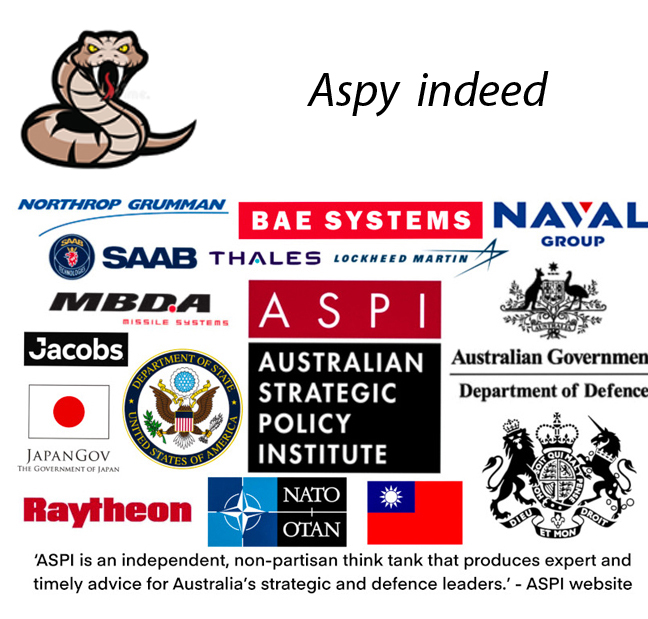
COMMENT. It really is about time that the Australian government stopped heeding this hawkish pretend-independent “think tank”.
Its thinking is limited to whatever the military-industrial-corporate-media complex tells it to think.
Australia could soon be hosting nuclear-armed US submarines The Strategist 23 Aug 2024.Alex Bristow
“……………………………………………………..One way to demonstrate that Canberra has real skin in the deterrence game is to host more US nuclear forces.
Australia is yet to follow South Korea’s example of welcoming a visit by a US ballistic missile submarine, which would always carry dozens of nuclear warheads. But changes afoot in Washington mean Australia could soon be regularly hosting other types of nuclear-capable submarines—those that can deliver nuclear weapons even if the US neither confirms nor denies that any are aboard.
Largely overlooked in Australia, the US Congress has funded development of a nuclear-tipped cruise missile for use at sea, formally called SLCM-N, to become provisionally operational by 2034. Such nuclear cruise missiles have not been deployed on US Navy vessels since the early 1990s.
The new ones seem to be primarily earmarked for Virginia-class attack submarines—a type of boat that visits Australia regularly and will form part of the rotational force being established at the base HMAS Stirling in Western Australia later this decade as part of AUKUS.
Politics could still get in the way, but there is bipartisan support for SLCM-N in the US Congress and the Biden administration’s opposition has lessened. If Trump wins, its future should be secure. Elbridge Colby, who is widely tipped for a top national security role in a second Trump administration, is a fan.
………………………Australia will have a greater say over changes to US nuclear posture if it does more to support extended deterrence than host such joint facilities as Pine Gap. But doing more will require public understanding and support, which the government must build.
Canberra’s first task is ensuring that disinformation about US nuclear weapons does not undermine AUKUS.
…………………………Ministers must make the case to the Australian public and the international community that the US nuclear umbrella, which relies on support from allies, helps make the world more stable and less prone to the proliferation of nuclear weapons.
………………………..Australian interests are best served by contributing more actively to extended nuclear deterrence, including being open to hosting more US nuclear forces, without seeking nuclear weapons……
1 This month

of the week – Australians for War Powers Reform (AWPR)
To see nuclear-related stories in greater depth and intensity
 Antinuclear