Flinders Aboriginal elders strong in their fight against nuclear waste dumping on their sacred lands
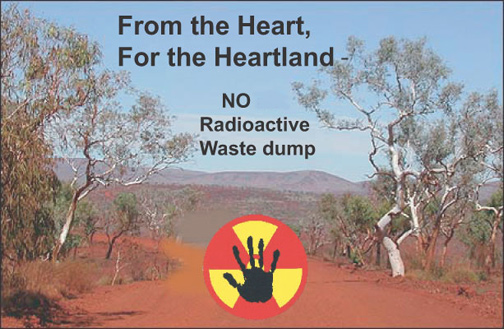 Dumped-on Elders down but not despairing, Eureka Street Michele Madigan | 02 May 2016 “……..Outlining the numerous times that the Traditional Owners had asked the State Minister for the Environment and the Federal Resources Minister Josh Frydenberg to visit the site, she [Enice Marsh, Adnymathanha Elder/Traditional Owner for the Flinders Ranges area of SA.] could only conclude, ‘But all this has come to no avail — it’s all been totally ignored.’
On Friday Frydenberg managed to have it both ways, in what seems to be a now fashionable way to go about such announcements. ‘There is no final decision.’ And yet, there is only one site remaining from what was a ‘self selection’ offer by the original 28 property owners and the shortlisted six.
Frydenberg described the selection process to date as ‘rigorous’. However, as the follow up process will now include ‘technological, safety and environmental assessment’, an obvious question remains about just how ‘rigorous’ it could really have been.
In a repeat of the one of the Kimba owners’ comments some months back, Chapman seems to be quite ill-informed regarding what will actually be deposited on the property, quoting the usual presenting argument used in the former SA campaign of 1998-2004: that the dump will be for medical low-level waste from various hospitals and universities around the country.
No mention as usual that there is no need for this to be stored long term in the first place. No mention of the intermediate level radioactive spent fuel rods which arrived back from France in December, and are presently housed at Lucas Heights. One wonders when such news will be broken to the property owners and the Hawker community.
In contrast, the Adnyamathanha neighbours and other Traditional Owners are completely aware of this and decry the flawed, seemingly unscientific process where one person can offer their land with absolutely no consultation to the neighbours.
Their own Indigenous Protected Area expert research and eyewitness knowledge cites that as well as being a site replete with ‘countless thousands of Aboriginal artifacts and registered cultural heritage sites’, ‘There are frequent yarta ngurra-ngurrandha (earthquakes and tremors). We see the ground move and the hills move; we feel the land move. At least half a dozen times each year.
‘It is flood land. The water comes from the hills and floods the plains, including the proposed dump site. Sometimes there are massive floods, the last one on 20 January 2006.’
In stark contrast to the previous national dump campaign of 1998-2004 which was opposed by the state government, it seems that this time no member of the SA government has come to the defence of the extraordinary Flinders Ranges, a focal point for the tourism industry of South Australia. Wilpena is a famous tourist site of great beauty and heritage, popular with both national and international tourists.
Indeed the SA community next Friday will hear the royal commission’s final recommendation to import high-level radioactive waste into our seemingly politically disposable state — disposable, now, even to our own politicians…….
despair is a temptation but there is also ‘the distressing matter of indifference. Indifference can be lethal.’ And what pain it gives to those like Enice Marsh who care.
But still there is resilience, and still there is hope. Not only are the Adnyamathanha determined to fight on, the five other communities that are now off the shortlist have pledged their solidarity in a continuing fight against ‘this flawed process’.
Who knows the power of such leadership to break the bonds of our own indifference and despair. http://www.eurekastreet.com.au/article.aspx?aeid=47266#.VylNVdJ97Gh
No thought of nuclear upgrade for submarines, says Prime Minister Turnbull
 Possibility of nuclear upgrade held no sway in subs decision: PM, THE AUSTRALIAN MAY 3, 2016 Brendan Nicholson Malcolm Turnbull has strongly rejected claims his government picked the French submarine so the navy could more easily swap to nuclear powered boats in the future……….
Mr Turnbull said the submarines would be the best.
“This is a great national enterprise and it will drive our economic plan for jobs and growth.” http://www.theaustralian.com.au/national-affairs/defence/possibility-of-nuclear-upgrade-held-no-sway-in-subs-decision-pm/news-story/ce2c7e245db93571fbd7007a86ce0f04
Why must we always force nuclear waste onto Aboriginal people?
What we believe is needed now is an independent and deliberative inquiry into long-term isolation and stewardship options for this material, and learning from countries overseas who are dealing with much larger inventories of this material than we are. What have they learned, long term? Isolation and stewardship of this material, rather than simply which outstation we should build the shed on.
The second thing that we believe should happen while that inquiry is underway is to properly containerise, in these 60-year licence caskets, the existing spent fuel and reprocessed material that at the moment is lying at the Lucas Heights facility. We believe that should be properly hardened and containerised, and there should be an audit of the existing collections of dispersed waste, non-reactor isotope investigations so that we are not producing this waste, and a commitment to not take international waste.
We need to respect the voices of the communities who are standing up and saying no.
 03 May 2016 | Scott Ludlam I rise this evening to speak on the long history of failed plans to locate national radioactive waste dumps here in Australia at multiple sites across South Australia, the Northern Territory and Western Australia and to point out the disturbing consistency with which it is disproportionately Aboriginal land that is targeted, Aboriginal communities who are expected to host the most dangerous categories of industrial waste that this society is capable of producing.
It seems that so little has been learnt since when long ago, in 1991 or 1992, the federal government embarked on a national site selection process to try and work out where the waste from the HIFAR reactor at Sydney’s Lucas Heights should go—more than 30 years after the reactor first went online. It probably came as something of a surprise to the community then that, 30 years after this industrial facility had started operating, there was still no coherent plan for the disposal of its waste products.
And here we are now, in 2016, and you have to ask: what on earth have we learnt in the intervening time? One thing I think we have learnt is that coercive attempts to dump radioactive waste on unwilling communities are doomed to fail. That is not just the experience here in Australia; international experience bears this out as well. And so little has been learnt from a process which, in my view and in the view of some of my colleagues, actually held some promise…..
Whether it be spent fuel, whether it be radioactive waste from the isotope plant at the Lucas Heights complex, whether it be other categories of medical waste—trash, gloves and other items—or whether it be radioactive waste of various categories from mining operations, the question ‘Which outstation should this stuff be dumped on, which Aboriginal community should host this material, at which outback site can we dump this stuff out of sight out of mind?’ is simply wrong. If we start with the wrong question, we inevitably come to the wrong answer……… Continue reading
Montebello nuclear test veterans return to site – no compensation over 60 years later
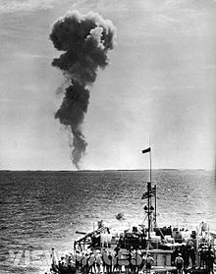 Atomic test veterans back at Montebello Islands as compo bid drags on Malcolm Quekett – The West Australian on May 4, 2016 “……After returning to HMAS Fremantle, the sailors were tested with the Geiger counter and told they had to decontaminate themselves using a hard brush and soap under the shower.
They stayed under the water for hours and scrubbed. But they were then told they were wasting their time. They were showering under sea water which was itself contaminated.
Mr Whitby said he collapsed soon afterwards and was taken to a naval hospital in Darwin where he stayed for a week, lost one-third of his body weight and developed extreme anxiety and a chronic cough.He was transferred to hospital in Perth for another two weeks. “No one had any knowledge of radiation illness,” he said.
Mr Whitby was eventually discharged from the Navy in 1961, but the problems have followed him to this day. He said he developed skin cancers that had to be removed, and he still had the anxiety and the cough.
His best man, who had gone ashore with him, died at the age of 38 from cancer, and another mate died before turning 40. Wives of men on the ship suffered miscarriages.
After years of struggling to have his case acknowledged by officialdom, the Administrative Appeals Tribunal found in 2012 that he should be paid compensation and have his legal bills met.
Mr Whitby, 76, of East Fremantle, said he was still waiting. A Department of Veterans’ Affairs spokesman said the DVA was “investigating the claims and will be in a position to respond when that investigation is complete”.
Mr Whitby has allies among the other members of the Australian Ex-Services Atomic Survivors Association. Between 1952 and 1957, Britain conducted 12 atomic tests at the Montebellos as well as Emu Field and Maralinga in South Australia.
“Minor trials” were also conducted at Emu Field and Maralinga between 1953 and 1963. Next month, members of the association and family members will journey to the Montebellos to place a plaque to mark the 60th anniversary of the last test.Among them are Jim Marlow, 80, of Canning Vale, Rex Kaye, 76, of Melville, and Denis Flowers, 80, of Ferndale, who will all pay their own costs to be part of the expedition.
Mr Marlow was aboard HMAS Karangi near the Montebellos when one of the tests took place. He said the crew assembled on deck and were told to turn their backs just before the explosion, and then turned back again to see the massive cloud build up.
Mr Kaye was a general hand in the Royal Australian Air Force and worked with planes used in the SA tests. He said he was still fighting leukaemia and side effects……..https://au.news.yahoo.com/thewest/wa/a/31511899/atomic-test-veterans-back-at-montebello-as-compo-bid-drags-on/
End of Kakadu uranium era brings old threats, new challenges and new hope
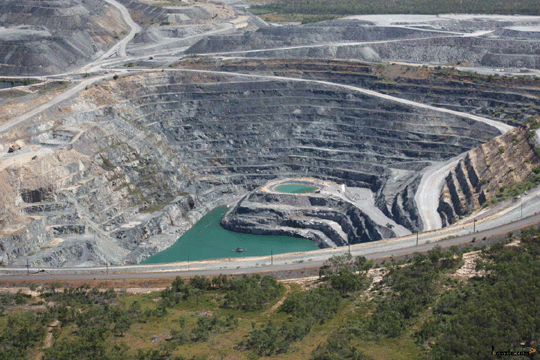 4 May 16 The Australian Conservation Foundation and the Mineral Policy Institute have today welcomed further moves towards the end of the uranium industry in Kakadu and called for confirmation that no underground mining plans will be pursued ahead of Energy Resources of Australia’s (ERA) annual meeting in Darwin today.
Last week ERA confirmed it had finally formalised a A$100 million credit deal with parent company Rio Tinto to provide extra certainty and capacity around rehabilitation of the Ranger mine site. The credit deal, described by ERA as ‘prudent, appropriate and in the best interests of all shareholders,’ is predicated on no further uranium mining at Ranger.
“ERA no longer mines uranium and soon will no longer process uranium at the troubled Ranger site,” said ACF campaigner Dave Sweeney. “This annual meeting is a good time for the company to accept that the uranium production era is over and it is now time for clean-up and repair. ERA should now formally withdraw its Ranger 3 Deep (R3D) application for underground mining at Ranger and instead focus its full efforts on closure, exit and transition”.
All mining and mineral processing at Ranger is required to end by early January 2021 and ERA is obliged to ensure the comprehensive rehabilitation of the mine site and surrounds.
This rehabilitation is required to be of a very high standard – suitable for the former Ranger mine site to be formally included into the surrounding Kakadu World Heritage region. Environment groups will be inside the Darwin meeting and will ask questions of ERA about the future rehabilitation of the site.
“There are massive challenges facing ERA and Rio Tinto at Ranger and they will be long judged by their efforts in the coming years,” said Mineral Policy Institute legacy mines project coordinator Lauren Mellor.
“Ranger has had a troubled and contested history and there is a clear need to now do business differently and better. Many eyes across Australia and around the world are watching ERA and Rio Tinto and this rehabilitation work is a key test of the company’s credibility and responsibility”.
Environment groups will be continuing their efforts to ensure the highest standard rehabilitation and closure work at Ranger and to support the aspirations of the region’s Mirarr Traditional Owners in the transition to a vibrant post mining regional economy.
New legal case against Adani coal mine now underway
Activists launch fresh court challenge over Carmichael coalmine ‘Australian Conservation Foundation argues emissions from coal mined from Adani’s project
will put the Great Barrier Reef at risk by exacerbating climate change’ Michael Slezak | The Guardian Australia http://www.theguardian.com/environment/2016/may/03/activists-launch-fresh-court-challenge-over-carmichael-coalmine 3 May 16:
” … If successful, the case will have ramifications beyond the Carmichael mine or even the Great Barrier Reef. It could have implications for any fossil fuel development, and require the minister to consider the effect of the burned fuel on any world heritage area – like the forests in Tasmania, for example.
“This is the first case of its kind to be heard in Australia,” said O’Shanassy. “The court will be asked to examine a section of Australia’s national environment law that has never before been tested in court. If this case is successful it will strengthen climate change considerations and world heritage protection in Australian law.” The hearing at the federal court in Brisbane is expected to go for two days. Hunt and Adani will be represented.”
Adani Big Coal Case Could Make It Harder To Get Mines Approved ‘A landmark case that could “put a brake on Australia’s fossil fuel exports” kicked off this morning in the Federal Court, in a precedent-setting bid to invalidate Environment Minister Greg Hunt’s approval of the largest coal mine the nation would ever see’ Thom Mitchell | New Matilda https://newmatilda.com/2016/05/03/adani-case-coal-mines-approved/ 3 May 16:
” … Under the United Nations process, the country that burns fossil fuels is responsible for them. Who exported the fossil fuels is considered irrelevant. And that was why Hunt, and all governments to date, largely ignored the damage Australia’s fossil fuels exports do to our environment when making approval
decisions.
The Australian Conservation Foundation is trying to change that. They’re arguing that irrespective of where the coal is burnt, it will have a serious impact on the Reef, and that this impact will be felt irrespective of how the United Nations framework on climate change works. … “
More research needed into climate change – bushfire links
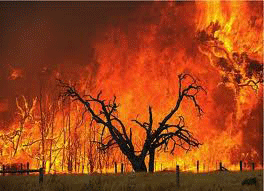 Senate inquiry told of need for more research into bushfire-climate change links May 3, 2016 BLAIR RICHARDS State Political Reporter Mercury CALLS for more research into the links between climate change and bushfires and for greater national firefighting capacity have emerged from a Senate inquiry into the Tasmanian Wilderness fires.
The Senate’s environment and communications reference committee is examining the response to the fires that blazed through more than 20,000ha of the state’s Wilderness World Heritage Area in January and February.
The inquiry has received 24 submissions from stakeholders including scientific and conservation organisations, government agencies and individuals.
Some submissions called for more research into the impact of climate change on fire risk:…….
THE Australian Conservation Foundation said the fires should be a “wake-up call” for Australian governments to act on climate change.
However, the Tasmanian Government’s submission said the forecast outlook for the Tasmanian Wilderness World Heritage Area was classified as “normal”.
The Senate committee is due to report by May 30. http://www.themercury.com.au/news/politics/senate-inquiry-told-of-need-for-more-research-into-bushfireclimate-change-links/news-story/4ab57529e85c2a55a9ec82fbd64a2f0e
Senate Committe calls for delay in CSIRO job cuts, until after the federal election
 CSIRO job cuts should be delayed until after federal election, Senate Committee says Job cuts at the CSIRO should be delayed until after the federal election, a Senate Select Committee has recommended. ABC News 3 May 16
In a revision of the original plan to shed 350 positions, the CSIRO wants to cut 275 jobs and set up a new climate research centre in Hobart, creating 40 positions.
A Senate Committee has recommended the Government direct the organisation to stop its proposed restructure in light of an anticipated election in July. It also recommended a suitable independent agency investigate the economic value of CSIRO climate measurement and research.
The Oceans and Atmosphere division was the hardest hit under the plan, facing a loss of 75 positions.Losses elsewhere included 35 from Minerals, about 70 from land and Water, about 30 from Agriculture, 45 from manufacturing and about 20 from Food and Nutrition.
Greens senator Peter Whish-Wilson said in a statement it was clear the value of CSIRO’s climate scientists had been underrated. “What is clear from this entire debacle is that both the Australian Government and the CSIRO management has at no stage placed any value on the work being done by the CSIRO climate scientists,” he said.
“The report makes clear recommendations to halt the restructure process until the election is over. Both the board and the Government have the ability to do this right now.”……..http://www.abc.net.au/news/2016-05-03/csiro-job-cuts-should-be-delayed-senate-committee/7380754
Australian Greens unveil 7 point plan for the nation getting off coal and gas
 Greens climate policy calls for immediate ban on new gas, coal projects http://reneweconomy.com.au/2016/greens-60604 By Sophie Vorrath on 28 April 2016 The Australian Greens have unveiled a seven-point policy plan to wean the Australian economy and electricity network off coal, including an immediate ban on all new coal and gas projects, a tax on coal exports and a carbon price.
Following on the heels of federal Labor’s Climate Change Action Plan, the Greens’ 7-point plan – released on Thursday – aims to put an “urgent brake” on Australia’s fossil fuel emissions, while also investing in large-scale clean energy.
And it follows the ALP in calling for the reinstatement of a carbon price – although Greens Leader Richard di Natale has already ridiculed Labor’s proposed version, which he told the National Press Club on Wednesday equated to a carbon price of 3c a tonne.
The Coalition, meanwhile, is busy disparaging both, with environment minister Greg Hunt dusting off the party’s tried and tested mantra on ABC Radio National on Thursday, that “the overarching point here is that this is an electricity tax.”
The Greens plan, which would raise revenue by placing a levy on coal exports and “ending tax-free fuel” for mining companies, includes a $1 billion Clean Energy Transition Fund to help workers exit the coal industry.
It would also invest in the health of the Great Barrier Reef, which is already feeling the effects of global warming, with as much as 90 per cent of its coral affected by bleaching. Continue reading
Liberal and Labor will downplay nuclear waste issues, until the election is safely over
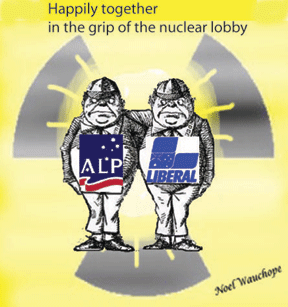 Decision on low-level nuclear waste dump unlikely before year-end and without public support, April 30, 2016, The Advertiser, DANIEL WILLSPARIS, FRANCE, Sunday Mail (SA) A GO-AHEAD for a low-level nuclear waste dump for South Australia will not be granted before the end of the year – and will only proceed if there is public support, Premier Jay Weatherill says.
Speaking to the Sunday Mail during a visit to France to meet the designers of the future submarines, Mr Weatherill said the proposal could only be approved after the final Royal Commission report and the delivery of a State Government response to Parliament.
An array of state laws currently ban both low- and high- level waste facilities, as well as the use of nuclear energy and enrichment of mined uranium……..
“I think it’s a community debate that will begin in earnest after the next federal election,” he said.……http://www.adelaidenow.com.au/news/south-australia/decision-on-lowlevel-nuclear-waste-dump-unlikely-before-yearend-and-without-public-support/news-story/4fb4790f8c5d433ddb509b60bec39cdc
The submarine boondoggle- over $2000 per each Australian
4. BUT WAIT THERE’S MORE So we spend $2,000 each. That just gets us the big lumps of steel. If you actually want to use them, you’re paying more. It could be another $2,000 to $4,000 per Australian….
OPTIONS The great thing about the way the acquisition will work is there should be the opportunity to cut back from 12 when the inevitable delays and cost blowouts happen. From here we can’t save the whole $2000 but maybe we can save some, for better uses.
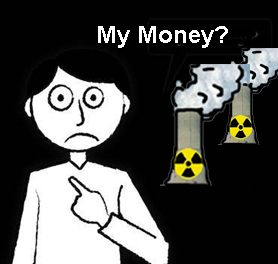 Sub standard: why the $2,000 we are each spending on submarines will probably be a terrible waste http://www.news.com.au/technology/innovation/design/sub-standard-why-the-2000-we-are-each-spending-on-submarines-will-probably-be-a-terrible-waste/news-story/6922de6f6a72657c669fdc1a1248916f APRIL 30, 2016, Jason Murphy news.com.au@jasemurphy AUSTRALIA is spending $50 billion to buy submarines. The biggest whack of money we’ve ever spent on a Defence project. It comes out at $2000 per person. And it’s probably a shocking idea. Continue reading
South Australia Aboriginal land again targeted, for probably unnecessary radioactive trash dump
The Flinders Ranges site was nominated by Grant Chapman but he has precious little connection to the land. Conversely, the land has been precious to Adnyamathanha Traditional Owners for millennia. The fact that the government is once again targeting a ‘remote’ Aboriginal site is beyond comprehension and creates a lot of frustration and hurt.
“Adnyamathanha Traditional Owners weren’t consulted about the nomination. Even Traditional Owners who live next to the proposed dump site at Yappala Station weren’t consulted. The proposed dump site is adjacent to the Yappala Indigenous Protected Area.
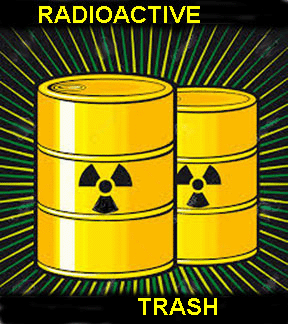 SA once again targeted for nuclear waste dump, http://www.onlineopinion.com.au/view.asp?article=18200, Anica Niepraschk, 2 May 16
Last Friday the government announced its preferred site for a national radioactive waste dump, near Hawker in South Australia’s Flinders Ranges. The site was nominated by former Liberal Senator Grant Chapman, who holds a long-term lease over the Barndioota station, and his nomination has been endorsed by the Liberal government in Canberra.
The latest process to find a dump site follows 20 years of failed attempts trying to force a dump on Aboriginal communities in SA and later the Northern Territory. Continue reading
Liberal coalition plans nuclear submarine fleet so that we can fight China
Coalition plans nuclear-powered submarine fleet over long term. Fin Rev, by Aaron Patrick and Phillip Coorey, 1 MAY 16
Some of Australia’s new submarines could be nuclear-powered by the time they enter service, making them much more potent against the huge Chinese navy.
One of the reasons French ship builder Direction des Constructions Navales Services, also known as DCNS, won the $50 billion contract was its ability to switch easily to a nuclear version of the submarines being designed for the Royal Australian Navy.
That is because the Australian diesel-powered Shortfin Barracuda will be a shorter, lighter version of a nuclear submarine already being manufactured by DCNS in Cherbourg on the English Channel.
Cabinet ministers and defence officials have already discussed the possibility of switching from diesel engines to nuclear power part-way through the construction contract, political, government and industry sources say.
The Coalition wants to keep the option open in case public opposition to nuclear power changes in the future. National polls taken from 2006 to 2009 found between 35 and 50 per cent of Australians supported introducing nuclear power, a study by the National Academies Forum showed.
DCNS, which is majority owned by the French government, is expected to start building the Australian submarines in Adelaide next decade. The last one might not be completed until 2050.
The other bidders for the contract, Germany’s Thyssenkrupp Marine Systems and Japan’s Kawasaki Heavy Industries and Mitsubishi Heavy Industries, don’t make nuclear submarines………..
The government, which has been criticised for opting to build the submarines in Australia, said it was not considering switching to a nuclear-powered version………
Another drawback of nuclear reactors is that, unlike diesel motors, they can’t be turned off to make the submarine silent.
Australia’s submarines are unusual. They would be the only conventionally powered ones that used pump jets for propulsion rather than propellers, Stephan Fruehling, a defence expert at the Australian National University’s College of Asia and the Pacific, said.
The Coalition government quietly supports developing a nuclear industry in Australia and on Friday proposed storing radioactive waste on a remote South Australian cattle station.
It has encouraged the South Australian Labor government to push ahead with a debate over storing spent nuclear rods from overseas. Given the submarines will be built in Adelaide and South Australia has some of the largest uranium deposits in the world, the state could one day become the centre of an Australian nuclear industry. http://www.afr.com/business/manufacturing/coalition-plans-nuclearpowered-submarine-fleet-over-long-term-20160429-goieal
Australia’s uncertain politics mean that Renewable Energy Target is in doubt
Renewable energy target in doubt as $10b investment needed The Age, Angela Macdonald-Smith, Energy Reporter , 2 May 16,Fresh doubts have been raised about the country’s ability to meet the 2020 renewable energy target after a new analysis found that $10 billion of extra investment is needed in a market where lenders are wary because of changing regulations.
In research to be released on Monday, BIS Shrapnel has determined it is “highly doubtful” the 2020 target of 33,000 gigawatt-hours of renewable energy output can be achieved given the stalling of investment over the past few years that means a huge catch-up effort is required. It expects the goal may only be reached one or two years late.
Some 4850 megawatts of wind farms and solar power plants need to be installed to meet the deadline, with most expected to be built in NSW, Queensland and Victoria, the research firm found. It calculates that though $340 million of investment has been committed to new projects, another $10 billion is needed.
The findings come as the Clean Energy Council is calling for an increase and extension to the 2020 target as part of a package of measures proposed to end greenhouse emissions from the electricity sector by 2050, as required if climate change is to be limited to less than 2 degrees C.
In a document called Power Shift, also released on Monday, the council proposes measures to ensure the “orderly” closure of heavy-emitting coal plants, which chief executive Kane Thornton said were “more at home in the Eastern Bloc” than in Australia.
“As these plants phase out, Australia can take advantage of our world-class sun, wind, waves and bio-energy that will deliver the lowest-cost form of new electricity generation,” Mr Thornton said. The document says regulated emissions limits or emissions trading could be used to drive plant closures.
On the renewable energy target, which peaks at 2020 and then continues flat until 2030, the council is pushing for an extension of the system to 2035 to provide the certainty required for investment…….http://www.theage.com.au/business/energy/renewable-energy-target-in-doubt-as-10b-investment-needed-20160428-gohsyo.html
New submarines chosen as prelude to nuclear submarines

 Business SA says Future Submarine fleet could include nuclear-powered versions once local atomic industry is established, Adelaide Now April 30, 2016 State political reporter Daniel Wills, Paris, France, Sunday Mail (SA) AUSTRALIA’S future submarine fleet could be transitioned to include a potent mix of both intelligence gathering diesel boats and rapid, fast-moving nuclear-powered vessels once the state develops a sophisticated atomic industry based around storage, Business SA says.
The Federal Government is facing calls from across the strategic policy and business communities, as well as from an outspoken SA Senator, to strongly consider the nuclear option.
Premier Jay Weatherill visited DCNS’ Cherbourg shipyard last on Friday Adelaide time, just hours after SA was chosen as the likely site of a low-level nuclear waste dump and as former governor Kevin Scare puts the finishing touches on a Royal Commission due for release within days.
Business SA chief executive Nigel McBride, who joined the Cherbourg tour to observe the construction of a nuclear Barracuda sub that will become the template for Australia’s diesel fleet, said there was strong national defence reasons for having a mix of the two…..
Mr McBride told the Sunday Mail that building community confidence behind nuclear storage was crucial before the question of expanding the industry into defence capabilities.
“As we’ve gone around Europe and looked at their nuclear cycle, and take into account the likely final recommendations from the Royal Commission in regards to the storage of waste, we will as a nation and state soon come to a decision about if we participate or not,” he said…….
Mr McBride said storage was a “starting point” in a discussion about other applications.
The first future sub is set to hit the water in the early 2030s, about the time when Mr Scarce says the state could have a storage industry up and running if it moved to do so immediately……
“We walked around a facility today which had a significant nuclear threat, nobody even blinked. We walked around and took it for granted that it would be professionally contained,” Mr McBride said……
Senator Day said there was “no escaping” the strategic need for nuclear subs…….
“The winning DCNS bid links SA with a French nation with nuclear subs and nuclear power. This opens up great opportunities for SA to learn how to embrace all facets of the nuclear fuel cycle.”…….
Mr Thomson said diesel subs were valuable in “certain, specific circumstances”.
“But if you had to choose between 12 nuclear or 12 conventional subs, it’s a no-brainer. You’d have the nuclear subs every time…
Australian law currently bars the use of nuclear subs………http://www.adelaidenow.com.au/news/south-australia/business-sa-says-future-submarine-fleet-could-include-nuclearpowered-versions-once-local-atomic-industry-is-established/news-story/9ae30cb1933a6119182944f6dbdcf09c
1 This month


Help Aunty Sue Protect Her Land and Sacred Sites From Destructive Rocket Testing.
.

Australians deserve the truth
about
AUKUS – https://aukuspublicinquiry.com/

PETITION – To: Prime Minister Anthony Albanese and the Australian Labor Government

of the week – Australians for War Powers Reform (AWPR)
To see nuclear-related stories in greater depth and intensity

