ARPANSA: a not so independent radiation regulator
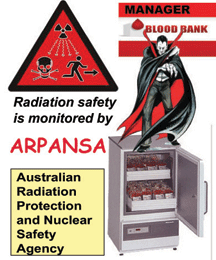 Jim Green 21 Feb 16 Bruce Wilson (from the federal government’s Department of Industry, Innovation and Science) and other governments reps were keen to talk up the role of the ‘independent’ regulator, the Australian Radiation Protection and Nuclear Safety Agency (ARPANSA). But ARPANSA has a troubled history. Its troubles began immediately: the government allowed ANSTO a direct role in selecting the founding CEO of ARPANSA, so ARPANSA’s independence was undermined from the start.
Here’s a more recent example of problems with ARPANSA, summarised in a 2011 ABC article:
“A review of Australia’s nuclear industry regulator, ARPANSA, has found an improper relationship with the main agency it monitors [ANSTO]. The Health Department’s audit and fraud control branch has been investigating how ARPANSA handled allegations of safety breaches and bullying at the nation’s only nuclear reactor in Sydney. Whistleblowers had alleged ARPANSA was too close to the Australian Nuclear Science and Technology Organisation (ANSTO), which runs the Lucas Heights research facility.”
ABC, 8 July 2011, Nuclear regulator ‘too close’ to ANSTO, www.abc.net.au/news/stories/2011/07/07/3264086.htm
An independent regulator could provide some confidence. But a not-so-independent regulator with a poor track record …
More information about ARPANSA:
- www.foe.org.au/anti-nuclear/issues/oz/arpansa
- ANSTO / ARPANSA whistleblower saga: www.foe.org.au/ansto-whistleblower-saga-2007-ongoing
Nuclear waste dump plan for Kimba – govt ignores relevant standards and codes
 Jim Green 21 Feb 16 Some comments on the 18 Feb 2016 government ‘information session’ in Kimba regarding plans for a radioactive waste repository and above-ground ‘interim’ store for long-lived intermediate-level waste.
 1. The government ignores and breaches relevant standards and codes when it suits.
As a Kimba resident noted at the meeting, the National Health and Medical Research Council’s (NH&MRC) ‘Code of Practice for Near-Surface Disposal of Radioactive Waste in Australia (1992)’ states that “the site for the facility should be located in a region which has no known significant natural resources, including potentially valuable mineral deposits, and which has little or no potential for agriculture or outdoor recreational use”.
So the government has breached the NH&MRC Code of Practice by short-listing the Kimba sites.
Following the so-called clean-up of the Maralinga nuclear test site in the late 1990s, nuclear engineer Alan Parkinson wrote: “The Department has claimed that burial is a safe disposal method consistent with “the [NH&MRC] Code.” This was the first time that the Code had been mentioned in relation to the Maralinga project. When three of the five authors said that it was not applicable (the other two were Commonwealth public servants and would not comment), the Department claimed that it did not have to follow the Code but had chosen to do so. It made this statement despite the fact that not a single requirement of that Code was satisfied.”
(Alan Parkinson, “The Maralinga Rehabilitation Project: Final Report”,
http://www.ippnw.org/pdf/mgs/7-2-parkinson.pdf)
So the government ignores relevant standards and codes when it suits, and the government breaches relevant standards and codes when it suits. Why would anyone trust the government to safely operate a radioactive waste facility in the Kimba region in those circumstances?
Alan Parkinson summarises the problem (keep in mind that he is pro-nuclear and a nuclear engineer): “The disposal of radioactive waste in Australia is ill-considered and irresponsible. Whether it is short-lived waste from Commonwealth facilities, long-lived plutonium waste from an atomic bomb test site on Aboriginal land, or reactor waste from Lucas Heights. The government applies double standards to suit its own agenda; there is no consistency, and little evidence of logic.”
(Alan Parkinson, 2002, ‘Double standards with radioactive waste’, Australasian Science, www.foe.org.au/anti-nuclear/issues/oz/britbombs/clean-up)
Nuclear Semioticians (sign experts): how to warn future generations of the wastes danger
they established the field of nuclear semiotics……. an “atomic priesthood”
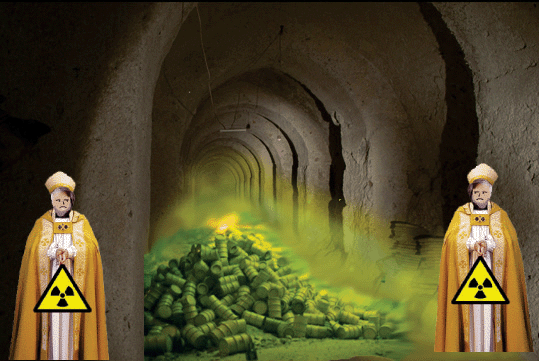
The message walls would have the faces as well as simple messages

Temple of Doom: How do we warn the future about nuclear waste?, Triple J Hack, by James Purtill, 19 Feb 16 This week the South Australian Royal Commission released “tentative findings” recommending the state take more than 100 tonnes of high-level radioactive waste and store it in the desert for hundreds of thousands of years.
……..If the facility goes ahead, the designers may consider a problem that has baffled linguists and semioticians (sign experts): how to tell the distant future don’t dig up the dump?
Atomic priesthoods and ‘ray cats’
In 1991, the Department of Environment hired linguists, scientists and anthropologists at a cost of about $1 million to answer what is basically a conundrum of labelling. How do you warn far-off civilisations or scattered bands of post-apocalyptic survivors that invisible beams of energy emanating from the earth could kill them, and this was not a trick, there’s no buried treasure?
The report runs to 351 pages and has the (rather dry) title: Expert Judgement on Markers to Deter Inadvertent Human Intrusion into the Wasteland Isolation Pilot Plant.
Here’s some of the problems they identified:
- Languages evolve too fast to communicate with the future: Few English speakers understand Old English, which was spoken about 1000 years ago.
- The meanings of symbols is too ambiguous: For example, the physicist Carl Sagan was invited to join the researchers, couldn’t make it, and wrote to suggest they simply use the skull-and-crossbones symbol to signify danger. But this symbol has only been current for a few hundred years, has meant ‘poison’ for the last 100, and is no longer very threatening. It’s on ‘pirate theme’ drink bottles.
- Even if they understand the warnings, future trespassers might not believe them. Curses associated with the burial sites of the Egyptian Pharaohs did not deter grave robbers.
Australian govt’s wrong decision to dump CSIRO climate modelling – Dr John Church
 Renowned CSIRO scientist Dr John Church speaks out against decision to dump climate modelling, ABC News 19 Feb 16 By Angela Ross One of the CSIRO’s most respected scientists, Dr John Church, has spoken out against the body’s decision to scrap its climate modelling program.
A petition signed by 2,800 international scientists from more than 60 countries expressed outrage about the decision to cut two research programs under the oceans and atmosphere business unit.
“The decision to decimate a vibrant and world-leading research program shows a lack of insight and a misunderstanding of the importance of the depth and significance of Australia’s contributions to global and regional climate research,” it read……..
Dr Church argued there was no point collecting data if scientists were not there to analyse the results.
“If Australia pulls out of key activities in the southern hemisphere then that will leave significant gaps, we will be losing partnerships with key agencies all around the world,” he said……..
The union representing Dr Church and his colleagues, the CSIRO Staff Association, has lodged a dispute with the Fair Work Commission but no date has been set. http://www.abc.net.au/news/2016-02-19/award-winning-scientist-condemns-csiro-job-cuts/7184410
Melbourne Girls’ College’s original approach to becoming carbon neutral
 Melbourne Girls’ College pedals toward carbon neutral status with outdoor cinema, solar installations, ABC News, 19 Feb 16 774 ABC Melbourne By Clare Rawlinson An all-girls Melbourne high school is on its way to becoming the first Victorian school to go carbon neutral.
Melbourne Girls’ College is working towards carbon neutral status through the installation of solar arrays and energy reduction projects, spearheaded by the school’s Sustainability Collective.
The passionate young environmentalists are hosting an outdoor cinema powered by bicycles and ergo machines on Friday, to share their quest with the public and draw attention to the true cost of energy.
The students will pedal all day to charge the cinema batteries for the screening of movie Oddball, as well as the power for coffee carts and popcorn machines.
“The idea behind it is to show people what a watt hour is and how much electricity goes into these events,” former student Ruby Wynn Williams said.
Sustainability coordinator Andrew Vance said the first step towards the school’s goal of carbon neutrality was awareness. “It’s really easy to burn some coal to watch a movie but it’s completely out of sight and out of mind,” he said. “When you get on the bike and pedal two watts, it’s like an epiphany.”
Reputation for environmental sustainability
The school’s reputation for environmental sustainability has already earned it acclaim through a major international competition, the Zayed Future Energy Prize. In 2015 it was selected as one of five schools globally to receive the competition’s $US100,000 funding grant for sustainability projects.
The majority of the prize money has been spent on converting the school’s permanent power source to solar, with the installation of a 33kW solar array on one side of the gymnasium roof.
It plans to cover the other side of the roof with community-funded solar arrays.
“[Each person] who buys a panel will get their name on it … so they can go and look at how much carbon they’ve offset and the equivalent in trees,” Mr Vance said.
“That will get us close to our carbon neutral goal.”…….http://www.abc.net.au/news/2016-02-19/melbourne-girls-college-pedals-toward-carbon-neutrality/7180684
Western Australian govt to press on with its changes to Aboriginal heritage legislation
WA government to proceed with controversial changes to Aboriginal heritage legislation, ABC News 19 Feb 16 By Jacob Kagi The West Australian Government intends to proceed with controversial changes to Aboriginal heritage legislation, despite progress on the bill stalling for so long that it dropped off the list Parliament was due to consider.
The Government first introduced legislation to Parliament to amend the Aboriginal Heritage Act in 2014, but there has been no substantial progress on the bill since then.
Because it had been so long since the bill had been debated, it dropped off the Legislative Assembly’s “notice paper”, which is the list of legislation and motions which Parliament is due to consider.
However, that was rectified on Thursday, with the Government passing a motion to restore the bill to the notice paper.
The proposed changes have proven controversial, with concerns that much of the decision-making power would rest of the head of the Department of Aboriginal Affairs, and fears the legislation did not give enough of a role to Indigenous people…….http://www.abc.net.au/news/2016-02-19/wa-government-to-proceed-with-controversial-changes-to-aborigin/7182280
World’s most expensive and toxic “stranded asset” – Nuclear Waste Dump For South Australia
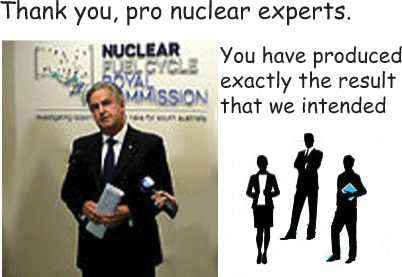 Nuclear Royal Commission: What’s Scarce in Kevin’s Report, Independent Australia
17 February 2016,The Scarce Report recommends South Australia being storing the world’s nuclear waste, opening the door for nuclear power generation in Australia in the future, writes Noel Wauchope.
Kevin Scarce’s Report on the “tentative findings” of the South Australian Nuclear Fuel Chain (I mean Cycle) Royal Commission runs to 42 pages. Still, he manages to leave a few questions unanswered and, indeed, a few questions not even asked, as well as leaving a few grey areas to be brushed over in a suitably vague manner.
MONEY
The major recommendation of the Report is for South Australia to make billions by importing, managing, storing and disposing of nuclear waste.
Who pays up first?
An interesting question – and grey area – is exactly who would be responsible for paying for the building of the nuclear waste facilities; for the construction of the dedicated port facility, airport and rail freight line; and the maintenance of all the infrastructure?
Well, that question is not answered clearly at all by the Report. However, as it states that ‘the facilities would need to be controlled and owned by government’, we can assume that the tax-payer will be responsible for the costs, now unto eternity, as eternity is about how long that high level radioactive wastes have to be contained and kept secure .
The Commission’s financial advice from Jacobs MCM makes this clear:
‘Capital and operating costs are assumed to be met from revenue. In the first few years of the model costs are assumed to be incurred before revenue is received.’
The payments for taking in spent fuel (high level wastes) from other countries would start only ‘at the moment of transfer from ship to shore in South Australia’, which would happen 15 years after the waste storage facility was built
Now how could they sell that idea to the public? Well, there’s the possibility of other countries paying for some of it, sort of:
‘…the potential to negotiate advance reservation fees with some prospective client countries to offset at least a portion of this cost.’
How much will it all cost?
Scarce reports the underground disposal facility as costing $33 billion. The Jacob report does not make all of the costs clear. It does not reveal the costs of the surface storage facilities and of maintaining high level wastes for many decades in dry storage casks.
The Jacobs MCM financial advisory report to the Commission has a tone of optimism and yet its 214 pages contain many “ifs” and “buts”.
Some of these include:
- Disposal of spent fuel (SF) will account for 93% of the costs. No country except UK has actually priced this cost, and estimates for these costs vary wildly from country to country.
- Countries with established nuclear experience – USA, UK, France, Sweden, Finland, Russia, China and India – will not be exporting nuclear waste to Australia, which leaves potential markets to a number of nuclear-inexperienced countries in Asia and Middle East — some with unstable regimes. Japan is committed to reprocessing its nuclear wastes, with no plan to export them……….
How come Australia is the only country to jump at this opportunity? Continue reading
Barry Brook, Pinchy Lobster and Clive Palmer: Three ‘Outstanding Scientists/Intellectuals’
 Jim Green, 19 Feb 16 Tas Uni academic Barry Brook’s university webpage says that in 2005 he was listed as one of the “2000 Outstanding Scientists of the 21st Century” by the International Biographical Centre (IBC). But the IBC is a zero-credibility money making operation.
The WA Government’s Dept of Commerce ‘ScamNet’ website states: “The material promoting the International Biographical Centre creates a false impression about the credentials of the organisation. It also wrongly implies that the receiver of the letter has been picked through a special research process considering their work and qualifications.”
If there was any doubt about the IBC’s illegitimacy, one of Brook’s academic colleagues nominated a squeaky toy lobster and Prof. Lobster was accepted for inclusion as one of the ‘2000 Outstanding Scientists of the 21st Century’. And the IBC has accepted a nomination for Clive Palmer to be listed as one of the ‘2000 Outstanding Intellectuals of the 21st Century’. A ‘Medal of Intellect’ will be sent to Palmer on payment of a $240 fee.
Feel free to test the IBC’s credibility yourself … you’ll have no trouble getting the Wiggles or the Bananas in Pyjamas or Thomas the Tank Engine accepted as Outstanding Scientists or Outstanding Intellectuals.
Given that the illegitimacy of the IBC is beyond doubt, why does the IBC accolade remain on Brook’s university webpage?
Sources:
- Brook’s Tas Uni website (see the Career tab, under “Awards and Prizes”): https://secure.utas.edu.au/profiles/staff/plant-science/barry-brook
- IBC: www.internationalbiographicalcentre.com/2000_outstanding_scientists_of_the_21st_c.php
- WA Government ‘scamnet’ website: http://www.scamnet.wa.gov.au/scamnet/Scam_Types-Directory_Listings_and_registry_schemes-International_Biographical_Centre.htm
- Wikipedia IBC entry: https://en.wikipedia.org/wiki/International_Biographical_Centre
- Critique of Brook’s nuclear propaganda: www.foe.org.au/anti-nuclear/issues/oz/barry-brook-bravenewclimate
Barry Brook, Pinchy Lobster and Clive Palmer: Three ‘Outstanding Scientists/Intellectuals
Jim Green, 19 Feb 16 Tas Uni academic Barry Brook’s university webpage says that in 2005 he was listed as one of the “2000 Outstanding Scientists of the 21st Century” by the International Biographical Centre (IBC). But the IBC is a zero-credibility money making operation.
The WA Government’s Dept of Commerce ‘ScamNet’ website states: “The material promoting the International Biographical Centre creates a false impression about the credentials of the organisation. It also wrongly implies that the receiver of the letter has been picked through a special research process considering their work and qualifications.”
If there was any doubt about the IBC’s illegitimacy, one of Brook’s academic colleagues nominated a squeaky toy lobster and Prof. Lobster was accepted for inclusion as one of the ‘2000 Outstanding Scientists of the 21st Century’. And the IBC has accepted a nomination for Clive Palmer to be listed as one of the ‘2000 Outstanding Intellectuals of the 21st Century’. A ‘Medal of Intellect’ will be sent to Palmer on payment of a $240 fee.
Feel free to test the IBC’s credibility yourself … you’ll have no trouble getting the Wiggles or the Bananas in Pyjamas or Thomas the Tank Engine accepted as Outstanding Scientists or Outstanding Intellectuals.
Given that the illegitimacy of the IBC is beyond doubt, why does the IBC accolade remain on Brook’s university webpage?
Sources:
- Brook’s Tas Uni website (see the Career tab, under “Awards and Prizes”): https://secure.utas.edu.au/profiles/staff/plant-science/barry-brook
- IBC: www.internationalbiographicalcentre.com/2000_outstanding_scientists_of_the_21st_c.php
- WA Government ‘scamnet’ website: http://www.scamnet.wa.gov.au/scamnet/Scam_Types-Directory_Listings_and_registry_schemes-International_Biographical_Centre.htm
- Wikipedia IBC entry: https://en.wikipedia.org/wiki/International_Biographical_Centre
- Critique of Brook’s nuclear propaganda: www.foe.org.au/anti-nuclear/issues/oz/barry-brook-bravenewclimate
Nuclear waste dump for South Australia: an unacceptably bad option
The endeavours of our scientists and engineers are needed in dealing with the many facets of climate challenge, including the transition to renewable energy, and they should be focused on this.
 Nuclear waste dump just another bad option — what about renewable energy? http://www.adelaidenow.com.au/news/opinion/nuclear-waste-dump-just-another-bad-option–what-about-renewable-energy/news-story/92f494cdde1dcae41481a45e5ac4f4ac February 18, 2016 John Willoughby The Advertiser SOUTH Australia’s Nuclear Fuel Cycle Royal Commission, in its tentative findings, has recommended avoiding some bad options: no nuclear power generation and no reprocessing or fuel leasing in the foreseeable future.
However, a bad option it found acceptable is allowing a proportion of the world’s most dangerous high-level nuclear waste to be transported to SA for long-term disposal. Continue reading
Proposal for nuclear waste dump splits South Australian Kimba community
 Support for proposed nuclear storage facility at Kimba difficult to determine
ABC Rural 18 Feb 16 The South Australian town of Kimba is divided over the benefits or otherwise of a low level nuclear storage facility in the area.
The Federal Government has released a shortlist of six sites nominated to store low-to-intermediate nuclear waste, with three of them located in South Australia.
The three South Australian sites are Cortlinye and Pinkawillinie near Kimba on the Eyre Peninsula, and Barndioota near Hawker, north of Port Augusta.
The prospect of Kimba region being selected has caused deep divisions in the community of Kimba.
The ABC has been told some people are boycotting local businesses in town due to their opposing views  on the issue but the Federal Member for Grey,Rowan Ramsey believes as the debate continues more people are coming around to the idea.
“That’s very concerning, I had not anticipated that people would go to those lengths. All I have ever wanted was a calm rational debate,” Mr Ramsey said…….
Mr Ramsey has been a key player in the debate even offering up his own property as a possible site to host the facility before it was deemed a conflict of interest……
Andrew Baldock and his father Graeme nominated 100 hectares of cropping country at Cortlynie outside Kimba to host the nuclear site……
Melanie Woolford who runs Merinos and prime lambs with her husband, kilometres from the proposed site at Pinkawilinie does not share that view. Ms Woolford is concerned the risk of jeopardising the regions clean, green image does not justify the proposed benefits of having a nuclear waste facility in the region.
“It scares me to think what could happen to our kids or our grandchildren, I think we have a right to say no. “It’s good farming land and I don’t understand why you’d want to put it (a nuclear storage facility) in the middle of farming land,” Ms Woolford said.
“I’ve been here for 13 years and I don’t enjoy coming to Kimba anymore, it’s horrible.” http://www.abc.net.au/news/2016-02-18/nuclear-dump-support-at-kimba-diifficult-to-determine/7181410
Donations to Political parties reap #millions in subsidies to fossil fuel industry
Fossil-fuel industry gets $2,000 in ‘subsidies’ for each $1 in party donations
 Activist group 350.org claims fossil-fuel companies’ $3.7m donations to Liberal, National and Labor parties taints the electoral process, Guardian, Michael Slezak 17 Feb 16 Major political parties have receive $3.7m in donations from fossil-fuel companies since the last election, and will deliver $2,000 in subsidies to the industry for every dollar donated, according to a 350.org report.
“The ongoing failure of our politicians to tackle climate change is directly attributable to the political influence of the fossil-fuel industry,” said Blair Palese, the chief executive of 350.org Australia.
“If we are serious about climate solutions, we must end the cosy relationship between our politicians and the big polluters.” (Below donations by mining industries)

The activist organisation has launched the report alongside a campaign asking individual federal politicians to sign a “pollution-free politics pledge”, where they commit to refuse donations from the fossil-fuel industry.
It has already been signed by all federal Greens politicians, independents Cathy McGowan and Andrew Wilkie, and outgoing Labor MPs Melissa Parke and Kelvin Thomson.
A list of those who have signed is being curated by 350.org. Continue reading
Clean Energy Finance Corporation funding exciting solar initiative by Melbourne University
 Melbourne Uni taps CEFC loan to cut power costs, grid dependence, http://reneweconomy.com.au/2016/melbourne-uni-taps-cefc-loan-to-cut-power-costs-grid-dependence-70503 REneweconomy, By Sophie Vorrath on 16 February 2016 The Clean Energy Finance Corporation has announced it will loan up to $9.1 million to the University of Melbourne, to accelerate the installation of solar PV and other renewable and energy efficiency technologies in an effort to cut energy costs and improve sustainability.
The University says the measures – including voltage optimisation, freezer upgrades, and the installation of solar PV, solar thermal and wind micro-turbines – will reduce its grid electricity use by around 8 per cent; not bad considering the university has the energy requirements of a town the size of Warrnambool.
The voltage optimisation equipment – which controls and corrects incoming power voltage to increase building energy efficiency – is expected to produce the biggest energy saving, reducing consumption by more than 4GWh per annum. It also has the added benefit of reducing operating and maintenance costs.
The funding will also see a total of 1.5MW of solar PV installed across 18 roof spaces, which will offset grid energy by generating more than 2.2GWh of electricity a year. The university also plans to install three micro wind turbines on three separate buildings, to demonstrate their potential.
A concentrated solar thermal power system will also be installed, to be used for space and swimming pool heating, with expected energy savings of 0.75GWh. The measures are also expected to cut the university’s emissions by more than 9,000 tonnes a year, thus contributing to its commitment to achieve carbon neutrality by 2030.
For the CEFC, the project falls under the green bank’s investment mandate of financing emerging and innovative renewable energy technologies and energy efficiency for cities and the built environment.
“Australia’s 39 universities make a major contribution to the national economy and to the Australian community,” said the CEFC’s executive director of corporate and project finance, Paul McCartney.
“Yet they face the ongoing challenges of public budget restraint, intensifying global competition and the need to use cutting edge technologies to meet increasing student expectations.
“Clean energy installations like those being undertaken by the University of Melbourne can help universities meet these challenges through an investment that results in reduced environmental impact, higher productivity and stronger financial performance.”
McCartney said the CEFC was looking to work on similar projects with other Australian universities, to help them achieve increased sustainability and cost cuts through energy efficient and renewable technologies.
“The CEFC’s finance can be structured over a longer term than traditionally offered by banks, tailored to match the cost savings delivered through the reduction in grid energy usage,” he said.
Solar energy trading between households a – new concept becoming a reality
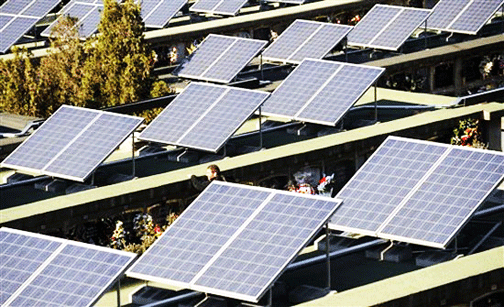 Trading solar-generated power between households to change the way consumers buy electricity, ABC News By consumer affairs reporter Amy Bainbridge, 18 Feb 16 The concept of bypassing major energy retailers to trade rooftop solar-generated electricity between households, small businesses and community groups is inching closer to reality.
Key points:
- Home-based energy generation grows in popularity
- CitiPower and Powercor, owners of poles and wires in Victoria’s power network, installing 18 solar battery power test sites
- Companies say their grid could help facilitate home-generated power in the future
- Community groups and homeowners eager to be part of Tesla solar battery trials
This month’s arrival of the Tesla battery in Australia is slated as a major shift in favour of consumers taking charge of their energy storage.
One Sydney entrepreneur has devised a system that would allow consumers to set up a virtual shop to trade their surplus energy with other households, small businesses and community groups in their grid.Jitendra Tomar, from the Sydney-based start-up Local Volts, said it was about changing the way consumers buy electricity. “Anybody, whether you’re big or small, whether you’re a farmer or residential person, whether you’re a high school or tennis club, can become an energy farmer,” he said……..
The Institute for Sustainable Futures at the University of Technology Sydney is conducting virtual trials of local energy trading at five sites along the eastern seaboard.
The Footscray Community Arts Centre in Melbourne’s Western suburbs is looking to become the first organisation of its kind to be powered by solar.
CEO and director Jade Lillie said the centre was running a crowdfunding campaign to combine with philanthropic donations to buy the panels and a battery. “We’re putting 30 kilowatts of solar panels on this roof, which is the warehouse, and 10 kilowatts of solar panels on Henderson House, which is the heritage-listed building,” she said. “What we’ll be able to do is actually through the Tesla battery is store that energy during the day as well and then use it in the evening so we’re less reliant on mainstream grid-based power sources.”
Ms Lillie says the centre aimed to save $15,000 in power bills each year. The project will also fund LED house lights for its performance space.
The Australian Energy Council, which represents retailers and generators, said it was early days, but there was work underway to study the implications of solar trading within the electricity grid.
With a large component of energy bills made up of network fees and charges, it remains to be seen how much cheaper energy bills will be if consumers are able to trade between each other. http://www.abc.net.au/news/2016-02-17/tesla-trading-solar-generated-power-change-electricity-market/7156934
Australia’s greening cities: Adelaide leads
Australia’s greenest city: Adelaide pulls ahead of Sydney and Melbourne, Guardian, Annie Kane, 12 Feb 16 Across the nation, city councils are tackling climate change at a grassroots level, with green buildings, electric transport and ambitious emissions targets. “……Last year, Adelaide city council and the government of South Australia announced that they were working in partnership to make the state capital the “world’s first carbon neutral city” (or at least by 2025). According to a spokesman, Adelaide City Council allocates 1% of total rates to its Climate Change Action Initiatives Fund annually. In 2015/16 this is $932,000.
An action plan is in the works for later this year, but it is hoped the program will bring $10bn of low-carbon investment to the state and eradicate nearly a million tonnes of greenhouse gas emissions every year.
The state has also committed to match-fund the city’s incentives scheme so that all building owners and tenants installing energy-efficient devices could claim back some of the costs, ranging from $120 for energy-monitoring systems to $5000 for solar panels and energy storage systems.
“One of the things I noticed while in Paris at COP21 in December 2015, was the uniqueness of the partnership we have here in Adelaide between the city council and the state government,” says Adelaide’s lord mayor, Martin Haese.
“Effective collaboration between the city and the state is essential for real progress.”
Indeed, with the federal government still to announce details of how it will meet its COP21 commitment to reduce its greenhouse gas emissions to 26 to 28% of 2005 levels by 2030, any work that can come from a state or local level is welcome.
Sydney’s lord mayor, Clover Moore, says: “As we know, the time for action on climate change is now. In the face of inaction from the federal government, we’re calling on other Australian cities to pick up our plan and help us get on with the job of tackling climate change.” http://www.theguardian.com/sustainable-business/2016/feb/12/australias-greenest-city-adelaide-pulls-ahead-of-sydney-and-melbourne
1 This month


Help Aunty Sue Protect Her Land and Sacred Sites From Destructive Rocket Testing.
.

Australians deserve the truth
about
AUKUS – https://aukuspublicinquiry.com/

PETITION – To: Prime Minister Anthony Albanese and the Australian Labor Government

of the week – Australians for War Powers Reform (AWPR)
To see nuclear-related stories in greater depth and intensity

