Queensland Premier says “focused on solar and wind’ but also ‘committed to coal’
 Queensland to boost renewable energy target in wake of Paris climate agreement, Palaszczuk says, ABC News 13 Dec 15 By Jessica van Vonderen Queensland will look to lift its renewable energy target in the wake of the Paris agreement to tackle climate change.
Envoys from 195 nations agreed on the weekend to transform the world’s fossil fuel-driven economy within decades and slow the pace of global warming to well below 2 degrees Celsius.
Premier Annastacia Palaszczuk said her government was focused on wind and solar farms, while maintaining a commitment to coal……
University of Queensland’s Matt McDonald, a reader in international relations who attended the negotiations in Paris, told 612 ABC Brisbane there were lots of discussions about mining, in particular the proposed $16 billion Carmichael coal mine in central Queensland.
“It does raise a series of questions about whether Australia and businesses really want to commit to that scale of investment into fossil fuel, given all the signals that are pushing in the other direction,” Mr McDonald said.
“So there’s a lot of concern about a future of that type of mining program.” http://www.abc.net.au/news/2015-12-13/firm-focus-on-renewables-palaszczuk-says/7024762
Australia’s nuclear weapons plan, and the connection with NSW nuclear reactor
On Nov. 2, 1956, Australia’s Defense Committee formally recommended the acquisition of kiloton-range tactical nuclear weapons.
In 1969, the government announced plans to construct a 500-megawatt nuclear reactor at Jervis Bay in New South Wales.
The intention was clear — this reactor was to support a nuclear weapons program. The reactor project pushed ahead and preliminary site work commenced.
 Revealed: Australia’s Failed Bid for Nuclear Weapons, Chris Walsh, The
  National Interest 16 Sept 15, At 9:00 in the morning on Oct. 3, 1952, a 25-kiloton nuclear explosion vaporized the retired British frigate HMS Plym off Australia’s remote western coast. The Operation Hurricane detonation in the Monte Bello Islands was a seminal moment for Britain and marked its return to the club of great powers.
But for Australia, these tests and others served a murkier purpose – as important and deliberate steps toward Australia’s own acquisition of nuclear weapons. It was in the tense Cold War environment of the late 1950s and early 1960s that these aspirations moved beyond talk and into concrete action.
By the time the Hurricane detonation took place, Australia was already experienced in weapons of mass destruction. From 1943 and in the shadow of a possible Japanese invasion, Australia built extensive stocks of chemical weapons and delivery systems…….
Australia — with its vast coastlines and deserts — emerged as a key player in Britain’s nuclear strategy.
When Britain approached Australia to host nuclear tests, a sympathetic government led by Prime Minister Robert Menzies readily agreed. While Menzies — an Anglophile — focused on his relationship with the United Kingdom, others saw this as an opportunity for Australia to buy membership into the nuclear club. Continue reading
Wangan and Jagalingou traditional owners continue to fight $16.5 billion Carmichael coal mine
 Vow to fight mine ‘Wangan and Jagalingou (W&J) traditional owners were blindsided last week..’
http://www.cpa.org.au/guardian/2015/1714/05-vow-to-fight.html 9 Dec 15:
“Wangan and Jagalingou (W&J) traditional owners were blindsided last week by revelations that Queensland Coordinator-General Barry Broe was proposing to extinguish native title on parts of their traditional lands in the Galilee Basin in order to enable Indian company Adani to develop infrastructure for its $16.5 billion Carmichael coal mine. …
“It is beyond comprehension that the government would consider such a shameful and absurd proposal in an era when our rights are sanctioned under international law and when we are already in the Federal Court contesting the state government and Adani’s attempts to override our rights,”
[Adrian] Burragubba said. “I assure the Premier she will be bringing on one of the biggest human rights battles we’ve seen in Queensland in a long time. … ” … “
Julie Bishop signs Paris Declaration for clear rules for carbon trading
What a tortuous track Julie Bishop, Greg Hunt and co. have to navigate, as they weave about within the Turnbull government’s climate policies – which are exactly the same as Tony Abbott’s !
 How long before the Turnbull government trips itself up in its own convoluted
rhetoric?
How long before Australia’s voters wake up to them?
Australia signs up for clear carbon trading rules, hinting at policy change, Guardian, Lenore Taylor in Paris, 10 Dec 15
Signing declaration at the Paris climate talks ‘recognises the role a carbon market might play after 2020’, foreign minister Julie Bishop says. Australia has signed a Paris declaration calling for new clear rules for international carbon trading in a signal the Coalition’s six-year carbon pricing policy veto could be softening as it prepares to review its climate policy in 2017.
Foreign minister Julie Bishop, who signed the declaration in Paris, said it was in Australia’s interests to recognise the role an international carbon market might play in reducing emissions after 2020.
“It’s just a declaration, it’s not legally binding,” she said after a speech to an event organised by Australia’s Carbon Market Institute. Continue reading
Australia not welcomed into “high ambition coalition” climate action group
 Aust missing from climate change group, Herald Sun, 12 Dec 15 Australia has not yet been welcomed into a new “high ambition coalition” of 100 nations at major climate talks in Paris, despite claiming it had joined through the European Union.
Marshall Islands Foreign Minister Tony de Brum revealed the alliance of around 100 countries, including the United States, this week at the United Nations summit.
Australia was not among them and Foreign Minister Julie Bishop seemed unaware of the group when it was revealed on Wednesday.
Mr de Brum, who spearheaded the alliance, issued an open invitation to countries in Paris.
A spokeswoman for Ms Bishop on Friday confirmed Australia had been formally invited by the European Union and had accepted the invitation. However, it appears Australia hasn’t yet been welcomed into the group, the Marshall Islands hinting the country would have to prove its worth.
“We are delighted to learn of Australia’s interest and look forward to hearing what more they may be able to do to join our coalition of high ambition here in Paris,” a spokesman for Mr de Brum said.
Earlier on Friday Mr de Brum read out a list of countries that had accepted his open invitation, with Australia notably absent.
WHAT THEY WANT *Reference to limiting global warming to 1.5C (is in the text)
*Clear path towards a low-carbon future (emissions neutrality by second half of century in text)
*Five yearly updates (is in the text)
*Strong package of financial support for developing nations ($100 billion per year plus scale up after 2020 is an option in the text – could be removed) http://www.heraldsun.com.au/news/breaking-news/aust-not-yet-welcome-in-climate-alliance/news-story/f7812eb6755851c7cc8ecd71ae9ca55f
‘High ambition coalition” on climate change – but Australia won’t be joining
 Australia unlikely to join climate coalition, Sky News, 11 December 2015 Canada has joined a new coalition of 100 countries calling for an ambitious agreement at major climate talks in Sky News alia is unlikely to add its name to the list.
Some predict the new ‘high ambition coalition’ could be a significant force in the negotiations, with a majority of nations – from the richest to the poorest – involved.
Australia, while supporting its intention, hasn’t joined.
The 100 countries, including the United States, are demanding a reference to limiting global warming to 1.5C, five-yearly reviews and a pathway to low carbon.
It also wants adequate financing for poor countries.
Marshall Islands Foreign Minister Tony de Brum urged more countries to join while revealing the coalition on Wednesday night.
Canada’s environment and climate change minister Catherine McKenna took up that offer the following day, despite not initially being on the list.
Australia is understood to agree with the group’s goals but wants to focus its energy elsewhere…….http://www.skynews.com.au/news/top-stories/2015/12/11/-difficulties–in-climate-talks–hollande.html
Western Australia systematically eroding Aboriginal heritage rights
 Separate but unequal: the sad fate of Aboriginal heritage in Western
  Australia The Conversation, Tod Jones Senior Lecturer, Human Geography, Curtin University December 7, 2015 There is systemic discrimination against Aboriginal heritage in Western Australia. This does not come from a racist administrator somewhere who hates Aboriginal heritage, but from the evolution of the institutions, rules and conventions that make up cultural heritage management.
Let me explain why.
Western Australia manages the heritage sites of Aboriginal and non-Aboriginal sites through different institutional channels, under different laws. This system is now providing much higher levels of protection for non-Aboriginal heritage.
There are several obvious imbalances. Should the Aboriginal Heritage Amendment bill that’s currently before parliament be passed, the maximum penalty for an individual illegally disturbing a non-Aboriginal heritage site will be A$1 million and two-years imprisonment, but for an Aboriginal site it will be A$100,000 and 12 months imprisonment, doubled on a second offence (it is currently A$20,000 and imprisonment for nine months, increasing to A$40,000 and two years for a second offense).
Less obviously, since Colin Barnett’s government took office in 2008 it has gradually reduced protection by reinterpreting definitions within theAboriginal Heritage Act 1972 to severely curtail the number of new sites. To date, some 1,262 sites have been blocked from gaining protection.
In 2012 the definition of “sacred” was reinterpreted to only include sites “devoted to a religious use rather than a place subject to mythological story, song or belief” – leading to the deregistration of 35 sites. This was found earlier this year to be a “misconstruction” by Justice John Chaney in the Supreme Court of Western Australia. Dreamtime stories have long been and continue to be considered sacred to Aboriginal people.
Furthermore, a recent report by UWA archaeologists indicates that more than 3,000 Aboriginal heritage sites have lost registration status as part of sweeping changes in classifications in the Aboriginal Heritage Register.
At no stage have Aboriginal custodians been notified about the changing status of their heritage……….
Proposed amendments to the Aboriginal Heritage Act
Sydney’s Lord Mayor Clover Moor in Paris: upbeat about city’s climate change action
Paris UN climate conference 2015: Clover Moore tells government to get out of the way http://www.canberratimes.com.au/environment/un-climate-conference/paris-un-climate-conference–clover-moore-says-government-hindering-her-carbon-neutral-efforts-20151203-glf653.html December 8, 2015 Peter Hannam Environment Editor, The Sydney Morning Herald In Paris, the local city government is presenting a grim view of the possible impacts of global warming. It is offering visitors to the climate conference apocalyptic visions of a Venice or New York largely under water, and Stonehenge surrounded by an English desert.
Sydney lord mayor Clover Moore adopts a more optimistic view. In the French capital for a number of events held on alongside the climate summit, she has a positive story to tell, noting her city’s operations are already carbon neutral and deep emissions cuts are under way as business and green groups get on with it.

The city’s top commercial landlords have cut 45 per cent of their carbon dioxide emissions since 2006, saving $30 million a year, she said on the sidelines of the Paris . A surge in developments – almost $4 billion in 2014 rising to $7 billion this year – means a focus on efficiency in new buildings will also avoid future costs for energy, water and waste.
“The actions cities are taking across the world are making an incredible difference,” Cr Moore told Fairfax Media, noting 75 per cent of Australians and more than half the world’s people live in cities.
The performance and potential of the world’s major cities has been a theme of the Paris climate summit through a series of urban events – Ms Moore attended or spoke at five – highlighting the contribution that cities can make to meeting the conference’s wider goal of keeping global warming to less than 2 degrees of pre-industrial levels.
A report released at the conference found that cities – already home to more than 50 per cent of the world’s population – alone had the potential to cut global greenhouse gases by about 6 per cent by 2030 – or 3.7 gigatonnes of carbon dioxide – and more than double that by 2050.
For Sydney, the goal is to cut emissions 70 per cent on 2006 levels by 2030. Although well on the way to that goal, the city’s progress is being hampered by Canberra on the planning front, Cr Moore said. Continue reading
Upper Hunter Aboriginal Cultural Heritage Trust under scrutiny over funds to mining industry
 Mining funds reserved for Indigenous groups allegedly funnelled back to industry, ABC News 7 Dec 15 By state political reporter Brigid Glanville
A New South Wales Government body is under scrutiny amid claims it failed to distribute trust money to local Indigenous projects in the Upper Hunter and instead gave it to a mining industry body.
Key points:
- Trust set up so that mining companies pay $50k for each new development
- Funds to go to Aboriginal groups with connection to Upper Hunter
- $300k given to ARG, a company endorsed by chief mining lobby group
- Aboriginal Land Council chief says ARG has little affiliation with Indigenous communities Continue reading
Aboriginal landowners in King’s Canyon area want protection against mining

“The CLC and traditional owners of the park will accept nothing less than a [government] decision to protect the park for future generations by prohibiting exploration or mining within its boundaries.”
Kings Canyon landowners want protection from mining: ‘What happens if the water gets messed up?’ Guardian, Helen Davidson , 8 Dec 15 Watarrka national park’s Indigenous owners will petition environment minister over an existing fracking exploration licence and future mining ‘of all kinds’
Traditional owners of the land encompassing Kings Canyon in Australia’s central desert are petitioning the federal environment minister, Greg Hunt, to guarantee their protection against mining operations.
Under Northern Territory legislation, the Watarrka national park has no real protection from oil and gas exploration or mining operations, according to David Morris, the principal lawyer of the NT Environmental Defenders Office (EDO). Continue reading
Increasing popularity of community solar energy projects in Australia
 Small is beautiful: the community solar projects taking on big energy, Guardian, Annie Kane, 8 Dec 15 A brewery, a bowling club and a library join forces with a new type of energy supplier to save money and become more sustainable
What do Sydney’s Young Henrys brewery, Shoalhaven Heads’ Bowling and Recreation Club, and Bendigo library have in common? They’re all hosts to some of Australia’s first solar power projects funded and run by local people in community energy groups.
Projects like these are becoming increasingly popular in Australia. The Coalition for Community Energy (C4CE) 2015 national community energy strategy states that there were 19 community energy groups operating in early 2015, with a further 59 projects in development. Continue reading
South Australia headed for 100% renewable energy, and away from nuclear
It is also supporting its capital city, Adelaide, in its push to become the first large carbon neutral city in the world – a target it hopes to achieve within a decade. Both the state government and the city council have pushed new incentives to encourage battery storage in homes and businesses. Weatherill has also called for tenders to ensure that his government’s own electricity demand is met entirely by renewable energy.
South Australia is also hosting a royal commission into the nuclear fuel cycle, but since the release of a new report late last month predicting that nuclear technology will cost more than twice as much as wind and solar in the next decades, the chance of nuclear power being built in South Australia, or even Australia, appears negligible.
 South Australia to set path towards 100% renewable energy, REneweconomy By Giles Parkinson on 8 December 2015 South Australia is expected to pass its 50 per cent renewable energy target next year – nearly a decade ahead of schedule – and the Labor government will now aim to get the state as close to 100 per cent renewable energy as possible.
Premier Jay Weatherill said in Paris on Monday that the state was leading the world in the incorporation of variable renewable energy sources such as wind and solar, and hoped the knowledge gained would create a massive economic opportunity for a state struggling with the decline of long-term industries such as car manufacturing.
“We are running a big international experiment right now,” Weatherill said at the launch in Paris of the Compact of States and Regions, an initiative that will see 44 states and regions reduce their emissions by 12.4 tonnes by 2030.
“We have got a long, skinny transmission system and we will soon have 50 per cent renewable energy, including a lot of wind and some solar.
“We need technology breakthroughs for large-scale storage, such as pumped hydro or batteries, but these are massive technological challenges that are exciting opportunities for the state.”
South Australia does find itself at the cutting edge of the transition from a fossil-fuel based economy to an energy system dominated by technologies such as wind, solar and storage. Its last coal fired power generator is due to close in March next year.
The 50 per cent renewable energy target was formally announced last year, but was always going to be met well ahead of time – the addition of the Snowton 2 wind farm, the construction of the Hornsdale wind farm, and the growth in rooftop solar PV will take the state over that threshold in 2016.
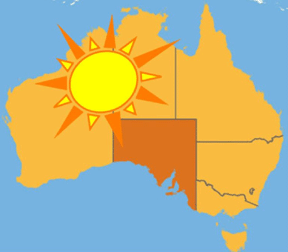
Indeed, the Australian Energy Market Operator has forecast that all of the state’s daytime demand may on occasions be met by rooftop solar alone within the next decade. Continue reading
Don’t undervalue the contribution of Australia’s indigenous people at Paris Climate Summit
West Australian Indigenous association, the Kimberley Land Council has sent a group of representatives to the conference.
The Council’s CEO, Nolan Hunter, warns that Indigenous communities shouldn’t be undervalued.
What do the Indigenous voices say on climate change? SBS, 8 Dec 15 Climate change continues to dominate the agenda, with Prime Minister Malcolm Turnbull holding firm to his target of a 26 to 28 per cent reduction on 2005 levels of carbon emissions at the Paris talks, but some are wondering where the Indigenous voices are in the debate?It’s a truly international topic of discussion: what can and should the world do about climate change?Like many nations, Australia faces hotter summers, more droughts, rising tides and a significant impact on its ecology.
Larissa Baldwin, national coordinator of youth climate group Seed, says the country’s Indigenous communities will bear the brunt.
And she believes their voices aren’t being given enough attention.
“I don’t think we have been given enough of a say, when you look at Indigenous communities around the world we’re already being impacted by climate change right now. We’re also on the forefront of fossil fuel extraction in Australia, and I think for a lot of us – we’ve had to send people over to Paris to actually get in front of our world leaders and say ‘hey you need to listen to us’.” Continue reading
Western Australian Greens appalled at plan for funding out-of-state renewable energy projects
 WA considers funding out-of-state renewable energy projects, The Fifth Estate Annie Kane | 8 December 2015 Electricity generator and retailer Synergy, owned by the Government of Western Australia, is considering paying for renewable energy projects in other states in order to meet renewable energy targets.
According to The West Australian, the company is looking at paying for wind farms and solar plants in eastern states to help meet the Renewable Energy Target, which requires electricity providers to get 20 per cent of their power supplies from large-scale renewable sources by 2020…..
Move is a “bastardisation of the Renewable Energy Target”
The move, however, has been criticised by WA Greens energy spokesperson Robin Chapple, who said: “The idea of our tax dollars going towards renewable projects interstate is a bastardisation of the Renewable Energy Target.
“Why would we pay for clean energy projects that we won’t ever receive electricity from? “The fact that this has even been floated just shows how short-term this government is in its thinking.
“Here is an industry that could create new jobs, lower the price of electricity and greatly improve our environment. “The excuse that our system is over capacity is ridiculous.”
He said that by retiring the state’s fossil-fuel generators could help bring in new renewable capacity and therefore work towards the 2020 target.
Mr Chapple added: “As a state we should, and could, be doing a lot more around renewables. Frankly, the costs of this technology are dropping so fast, and our natural resources are so good, that it is only a matter of time for WA.
“I am dumbfounded by Mr Rowe’s comments, and I sincerely hope that these ideas are not borne out.” http://www.thefifthestate.com.au/innovation/energy/wa-considers-funding-out-of-state-renewable-energy-projects/79284
Govt talks big on renewables ‘innovation’, but will close Australian Renewable Energy Agency
JOHN CONNOR: Well, we’ve got a big belting boom gate that’s our old, clunking coal-fired power stations, and so until we get those out of the system and replaced with cleaner technologies, then we’re going to be stuck.
Innovation is fine, but we’ll have no way to implement it.
MICHAEL EDWARDS: The environmental sector also wants the Government to provide certainty about the future of the Australian Renewable Energy Agency, the body charged with developing new technologies and increasing the supply of renewable energy in Australia.
Hopes innovation money will drive investment in renewable energy http://www.abc.net.au/am/content/2015/s4367751.htm Michael Edwards reported this story on Tuesday, December 8, 2015 MICHAEL BRISSENDEN: There are hopes that renewable energy products will be one of the areas that will see a boost in investment form the Government’s billion-dollar innovation package.
The Prime Minister Malcolm Turnbull says he wants to start an ‘ideas boom’ to transform Australia’s economy away from mining.
The investment sector has welcomed the package, saying it provides a policy framework needed for people to invest in the clean energy sector.
But some say the Government needs to change its positions on renewable energy and climate change for the industry to truly thrive. Continue reading
1 This month


Help Aunty Sue Protect Her Land and Sacred Sites From Destructive Rocket Testing.
.

Australians deserve the truth
about
AUKUS – https://aukuspublicinquiry.com/

PETITION – To: Prime Minister Anthony Albanese and the Australian Labor Government

of the week – Australians for War Powers Reform (AWPR)
To see nuclear-related stories in greater depth and intensity

