Australia making ’empty promises’ on phasing out fossil fuel subsidies – report
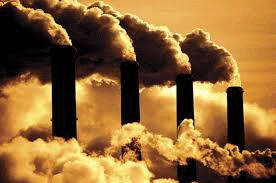 Australia and its fellow G20 nations are “paying fossil fuel producers to undermine their own policies on climate change”, a British think tank says.
In a report released on Thursday, the Overseas Development Institute questioned why the Australian government continued to provide more than $5 billion a year to support fossil fuel production, despite a G20 commitment to phase out subsidies six years ago.
The report, titled Empty Promises: G20 subsidies to oil, gas and coal production, comes ahead of the G20 summit in Turkey on November 15, and says that G20 governments collectively spend more than $640 billion a year to support the production of fossil fuels – almost four times the total of global subsidies for renewable energy. http://www.smh.com.au/environment/australia-making-empty-promises-on-phasing-out-fossil-fuel-subsidies-report-20151111-gkwbrb.html
Radioactive trash dump would damage tourism – Sally’s Flat residents say “NO”
 Sallys Flat should be removed from nuclear waste shortlist, residents say, ABC News 13 Nov 15 By Joanna Woodburn, Residents have slammed a proposal to store nuclear waste at Sallys Flat, near the historic gold mining village of Hill End in New South Wales’ central west.
The association’s Ross Brown said the historical significance and population of the area made it a poor choice for a nuclear facility…….
Bathurst Climate Action Network head Tracy Carpenter said Bathurst, which is an hour away from Sallys Flat, had been a sister city with Okuma in Japan, one of the towns affected by the Fukushima nuclear disaster. “People cannot occupy [Okuma] since the tsunami and earthquake and the result [of] the nuclear disaster, and now we’re being slated as an area to dump nuclear waste,” she said. “It’s just appalling.”…….
NSW Opposition Leader Luke Foley said he would be surprised if the site was chosen……….”I think people in New South Wales will take an enormous amount of convincing for such a repository to be placed in our state, somewhere around Bathurst.
“We’re not talking about the outback, we’re talking about a pretty well populated area.”…….http://www.abc.net.au/news/2015-11-13/take-sallys-flat-off-nuclear-waste-shortlist-residents-say/6937442
Australia two-faced at OECD discussions on coal and climate change
 In addition, taking a blocking position at the OECD has the potential to damage Australia’s credibility in other international negotiations and particularly as its role as co-chair of the Green Climate Fund. Overall, to address climate change, our policies on energy and climate change will need to align. As the US, EU and China step up their leadership on climate change, Australia will come under increasing pressure to reconcile its different positions.
OECD coal discussions highlight tensions in Australia’s position on climate change, The Conversation, Katherine Lake November 13, 2015 While the UN Paris talks approach at the end of November, attention is currently focused on another forum, the Organisation of Economic Cooperation and Development (OECD), where member countries are negotiating a deal to limit public finance to overseas coal projects in emerging and developing countries.
Australia and South Korea are reportedly opposed to an agreement struck by the US and Japan and supported by other member countries, notably Germany and France, to prevent public finance to all but the very cleanest power plants.
How will these discussions at the OECD impact on the UN Paris negotiations? Australia’s approach to these international meetings would seem to be inconsistent……..
Australia is walking a fine line in climate diplomacy
Are Australia’s positions on climate change in the UN and the OECD inconsistent?
On the one hand, Australia supports the objective of keeping the global temperature rise within 2℃ and is willing to make some domestic emission reductions to assist in achieving this.
On the other hand, it is not yet willing to place any real limits on its coal exports to developing countries. It justifies this position on the basis that coal is required by developing countries to alleviate poverty and that it is not for Australia to decide how other countries allocate their public finance. Continue reading
Yami Lester, victim of nuclear testing urges communities to fight nuclear waste dumping
SA Government ‘open’ to nuclear waste dump proposal despite previous opposition: Weatherill, ABC News, 13 Nov 15, “…… Greens MP Mark Parnell said he wanted to see more detail on the proposal, but was suspicious of the agenda from Canberra. He was concerned accepting a site in South Australia could lead to the storage of high level radioactive waste.
“It’s no surprise that the Federal Government has its eyes on South Australia for its nuclear waste dump,” Mr Parnell said. “But what will worry people in this state is whether this is a precursor to a high level radioactive waste dump.”…
 Indigenous man Yami Lester, from Mintabie in the APY Lands, said the state and federal governments should not mine uranium, let alone store it.
Mr Lester was blinded from a radiation fallout in 1953 when the British and Australian governments conducted uranium testing near his community, west of Coober Pedy.
“It was terrible. Some older people died, I went blind and my cousin went blind, skin rash, diarrhoea and all that sickness,” he said.
“We had no treatment at all, the hospital nearest the clinic was 160 kilometres [away] at Ernabella, and we were sitting here, no doctor nothing.
“That’s why I’m scared of the government mining uranium. Better to leave it under the ground. Don’t touch it.”
Mr Lester urged the communities close to the proposed waste sites to fight against the dumps.
He said the state and federal government should learn from past mistakes.
“I don’t agree with [experts] at all. The Australian Government and the South Australian Government, people haven’t learnt from the mistakes that happened overseas, in Germany, Japan they haven’t learned from that,” he said…..http://www.abc.net.au/news/2015-11-13/sa-govt-consider-nuclear-waste-proposal-royal-commission/6937530
NATIONAL NUCLEAR WASTE DUMP IN SA: TROJAN HORSE FOR AN INTERNATIONAL NUCLEAR WASTE DUMP?
 13 Nov 15 The Federal Government has released the shortlist of six sites for the location of a national radioactive waste dump. Three of these sites are in South Australia.
Friends of the Earth Adelaide is cautious about the Federal Governments genuine commitment to a voluntary site nomination and selection process.
“The test will be how the government handles community opposition, how inclusive and transparent the site selection process will be, and how it will handle the issue of existing South Australian legislation banning the establishment of a nuclear waste dump,” said Nectaria Calan of Friends of the Earth Adelaide.
The National Radioactive Waste Management Act 2012, the Act governing the site selection process, over-rides existing state legislation prohibiting the establishment of a nuclear waste dump.
“Will the Federal Government impose a nuclear waste dump on states that have legislated against it, or communities that do not want it?” asked Ms Calan.
“The location of a waste dump cannot simply be decided through individual nominations,” said Ms Calan. “It affects the wider community, particularly those in close proximity to the site. Radioactive contamination knows no property boundaries. The principle of voluntarism extends beyond the individual where an action has wider ramifications,” continued Ms Calan.
“There is yet to be an independent inquiry into all our radioactive waste management options, so the nominations process is premature,” said Ms Calan.
Additionally, here in South Australia the Royal Commission into the Nuclear Fuel Cycle is considering the feasibility of an international nuclear waste dump. “Will a national nuclear waste repository in SA be the trojan horse for an international high level nuclear waste dump down the track?” asked Ms Calan.
“Rather than considering existing nuclear waste in Australia as an intractable problem, the SA government and some proponents of the nuclear industry seem to consider radioactive waste a business opportunity and want to import it, astounding given that so far globally there has been no success in establishing even one facility for the long term storage of high level waste.”
“ The one deep underground repository for intermediate level waste that does exist, the Waste Isolation Pilot Plant (WIPP) in New Mexico, saw an incident in February last year where a waste barrel exploded, leading to an aboveground release of airborne radiation, after only 15 years in operation,” said Ms Calan. “According to the US Department of Energy, twenty-two workers tested positive to low-level radiation exposure.”
Friends of the Earth Adelaide has serious concerns regarding the regulatory framework that may be applied to a nuclear waste dump in South Australia, whether national or international.
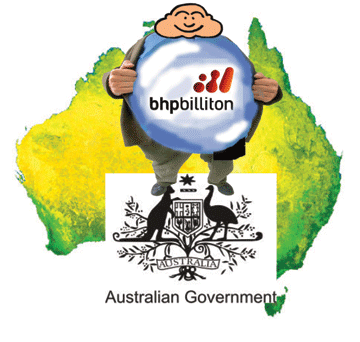 “BHP Billiton, operator of the Olympic dam mine, is exempt from key regulating legislation in SA, including the Freedom of Information Act, and parts of the Radiation Protection and Control Act and the Environmental Protection Act. With such a precedent here in SA for the regulation of the nuclear industry, where is the guarantee that other nuclear projects such as a nuclear waste dump would not also be exempt from laws regulating radiation, environmental protection, and transparency?” asked Ms. Calan.
Scrutiny on the Australian govt’s plan for Lucas Heights nuclear waste
 Community consent must be forthcoming and it must be informed consent. Defining the relevant affected community can be fraught. For example, people living on transport routes clearly have an interest but are rarely given a say. Several states and territories − indeed all four of the short-listed states and territories − have legislation banning the imposition of nuclear waste repositories. The nomination of sites in those jurisdictions suggests the federal government may be willing to ignore or override legislative bans.
An immediate problem is that visits to affected communities by government officials may not be illuminating or helpful. Government officials will insist the waste is safe and communities will wonder why it isn’t buried beneath Parliament House − or at a local landfill − if the waste is as safe as the government insists it is.
the government should go back to the drawing-board and ask whether a remote repository is needed at all. About 95 per cent of the waste is securely stored at two locations: the Australian Nuclear Science and Technology Organisation’s Lucas Heights site in southern Sydney, and Defence Department land near Woomera in SA. There is no obvious reason why that waste should be moved.
Government must learn from past mistakes on nuclear waste Anica Niepraschk & Jim Green, 13 Nov 2015, Climate Spectator www.businessspectator.com.au/article/2015/11/13/policy-politics/government-must-learn-past-mistakes-nuclear-waste
After failed attempts to impose a national nuclear waste repository in South Australia and the Northern Territory, the federal government has embarked on its latest attempt to find a site.
To its credit, the government has learnt from past mistakes. Instead of attempting to impose a repository (to be precise, a repository for low-level waste and an above-ground store for intermediate-level waste), the government called for land-owners to nominate potential sites. The two-month nomination period ended in May. That was followed by a desk-top study to evaluate the sites’ suitability according to a number of social, environmental and economic factors. Twenty-eight sites were put forward and six made the short-list: three in SA and one each in NSW, Queensland and the NT.
The announcement of the short-list will now be followed by a public consultation period, then detailed site characterisation studies to further assess the suitability of the sites. An announcement of a preferred (but not yet selected) site will be made in mid-2016 at the earliest.
A community compensation package of up to $10 million is on offer − a pittance considering the repository would be operational for around 300 years and hazardous for thousands of years beyond that.
Two of the SA sites are near Kimba, 150 km west of Port Augusta. It is agricultural land and there is overwhelming opposition from local farmers. The South Australian debate also feeds into a debate as to whether the state might offer itself up as the world’s nuclear waste dump, accepting high-level nuclear waste from power reactors around the world. Despite extravagant claims about the potential revenue stream from high-level nuclear waste, less than one in six South Australians support the proposal.
A strong coalition of Aboriginal communities and civil society organisations in South Australia has already clearly announced its opposition to hosting a nuclear waste repository and is prepared to follow in the footsteps of the Kupa Piti Kungka Tjuta, senior Aboriginal women who successfully prevented a repository being foisted on their land from 1998−2004. Continue reading
A Non-Reactor Future for Lucas Heights
 The Australian govt continues to hype the Lucas Heights nuclear reactor, as though
 it were some grand asset to this nation. Well, it’s not. It’s major function is ceretainly not medical, as the government would have you believe.
 Indeed, is its major function an excuse to justify the toxic nuclear fuel chain?.
Friends of The Earth, Jim Green, 1. Summary
* most of the work at ANSTO’s Lucas Heights facility does not depend on the operation of a reactor.
* a good case can be made for greater investment in non-reactor technologies/programs at Lucas Heights.
* pursuit of a non-reactor future for ANSTO offers several advantages, including a large reduction in the generation of radioactive waste……
4. Research reactors are yesterday’s technology:
“The future direction of nuclear medicine lies with cyclotron produced products and accelerators. …
Over half of all research reactors ever built have been closed and the number in operation continues to decline…. the number of cyclotrons in operation continues to increase. Some multipurpose research reactors are being replaced by reactors, but most are not being replaced or are being replaced by non-reactor technologies..
6. Alternatives to a domestic reactor for medical isotope supply:
Ongoing reliance on existing cyclotrons in Australia, plus a greater reliance on imports, is a perfectly viable alternative to a domestic reactor.. http://www.foe.org.au/anti-nuclear/issues/oz/lh
Govt releases 6 sites short-listed for Lucas Heights nuclear wastes returning from France etc
Six sites shortlisted for Australia’s first permanent nuclear waste dump revealed, SMH November 13, 2015 James Massola Political correspondent
The Turnbull government has finally released a shortlist of six sites that are in the running to host Australia’s first permanent nuclear waste dump for low-level and intermediate waste.
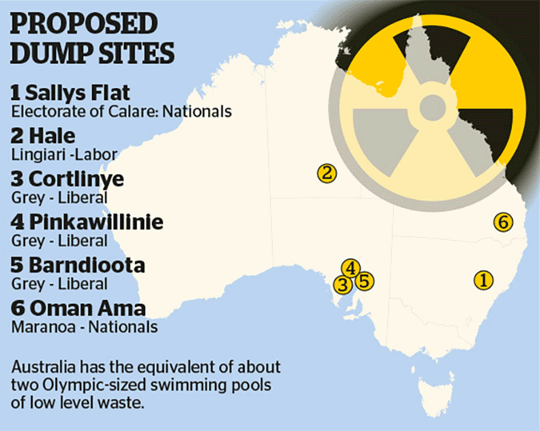
The six sites have been chosen from 28 voluntarily nominated sites around Australia and are at Sallys Flat in NSW, Hale in the Northern Territory, Cortlinye, Pinkawillinie and Barndioota in South Australia and Oman Ama in Queensland.
Following release of the much-anticipated shortlist, locals who live in the six locations will now be consulted over the next four months about what will eventually be a remote, 100-hectare site.
 Resources Minister Josh Frydenberg said Australians should embrace the eventual construction of a permanent facility as it would allow Australian to continue to enjoy the benefits of nuclear medicine, for example………
“This is completely independent from the nuclear fuel cycle royal commission process underway in South Australia.”
Australia has the equivalent of about two Olympic-sized swimming pools of low-level nuclear waste at 100 sites across the country and the facility will store this waste, as well as low and intermediate-level radioactive waste from the Lucas Heights facility in Sydney.
The waste includes laboratory items such as paper, plastic and glassware, material from medical treatment and even radioactive soil………
Mr Frydenberg cautioned that under current legislation, “Australia can’t take another country’s waste” and thus, the possible expansion of the industry was not at this stage possible.
Australian-produced waste that had been sent to France, the US and Britain between 1996 and 2009 is due to be returned to Australia under international agreement, with a load from France currently enroute back to Australia and due to arrive at Port Kembla later this month. http://www.smh.com.au/federal-politics/political-news/six-sites-shortlisted-for-australias-first-permanent-nuclear-waste-dump-revealed-20151112-gkx8mo.html
Australian govt avoiding opposition from Aboriginals, as it selects nuclear waste dump sites
Is the Australian government in a hurry to reassure Sydney residents about the nuclear waste dump, and also scared of the potential powerful opposition by Aboriginal people? Australia is contractually bound to take back these wastes from France.
 Native titles extinguished Significantly, native title has been extinguished on all the shortlisted sites.
Six areas make shortlist for nuclear waste storage, AFR, by Laura Tingle, 13 Nov 15, South Australia appears to be the most likely home for nuclear waste storage after the Turnbull government shortlisted six sites for a facility to store low-level radioactive waste.
Resources Minister Josh Frydenberg unveiled the list of six sites arising from a process in which landowners voluntarily nominated their land. A final decision is expected by the end of next year after long community consultations.
The six shortlisted sites are at locations near Sally’s Flat in NSW; Hale in the Northern Territory; Cortlinye, Pinkawillinie and Barndioota in South Australia; and Oman Ama in Queensland….
The federal low-level waste storage proposal is separate from the [South Australia Nuclear Fuel Chain Royal Commission] scheme originally raised by a nuclear energy inquiry commissioned by the Howard government – and recently canvassed by Prime Minister Malcolm Turnbull – that would see Australian uranium exported and ultimately brought back as high-level waste…….. Continue reading
Australian govt: slap in the face for its own Standing Committee, on uranium sales to India
Australia Ignores Red Light On Uranium Exports To India, http://www.huffingtonpost.com.au/dave-sweeney/government-fails-india-ur_b_8547542.html?utm_hp_ref=australia Huffington Post, Dave Sweeney 13/11/2015, The federal government has delivered a stiff slap in the face to due process and evidence-based policy development by ignoring an unambiguous red light on planned uranium sales to India.

It was only two months ago that the Joint Standing Committee on Treaties delivered a well-considered report into the controversial plan to sell Australian uranium to India. The government-controlled Committee identified a number of practical steps needed to address safety, security and legal uncertainty around the deal.
Importantly the committee’s report clearly recommended against uranium sales at this time or under the current terms of the Australia-India Nuclear Co-operation Agreement, and outlined a series of pre-conditions required before any future sales to India.
These include the full separation of military and civil nuclear facilities, the establishment of an independent nuclear regulatory authority, a review of the adequacy and independence of the regulatory framework, IAEA verification that inspections of nuclear facilities are of best practice standard, improved decommissioning and radioactive waste planning and more.
But, earlier this week, the government chose to ignore these recommendations — emphatically stating that “the Government does not accept the Committee’s recommendation that exports of uranium to India should be deferred.” Continue reading
Australia’s obligations to Pacific climate migrants
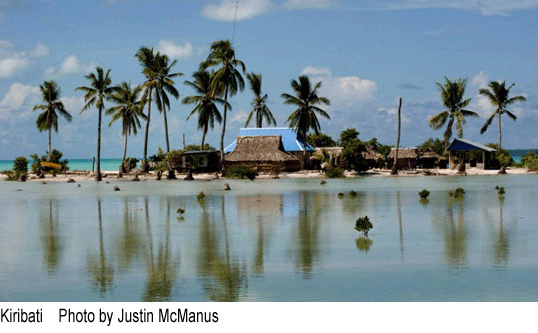 Australia must not be afraid of its obligations to Pacific climate migrants, Guardian,
Richard Marles, 12 Nov 15 Australia’s humanitarian intake is from distant countries; as climate change leads some islanders to migrate, that will change. So must our approach “……While land is a necessary precondition for life, people live on these atolls because of the sea. It is the source of food, culture and legend. These are marine people whose ancient understanding of the wind and the waves still often transcends what modern equipment has to offer.
Yet as the greenhouse effect starts to take hold these winds are beginning to change. Predictable weather patterns in equatorial environments which produced constant temperatures, regular rains and seasonal storms are no longer behaving. Life is being disturbed.
Of all the climate change threats to coral atolls the most pressing is water security. On Tarawa atoll in Kiribati, half the fresh ground water supply is now permanently salty.
On Funafuti in Tuvalu there is no groundwater, which leaves people dependent on water tanks next to their homes – many of which have been provided by Australian aid. But even with extra tanks the water supply of the atoll amounts to about six weeks worth of water.
In November 2011 reduced rainfall brought the atoll to a point where the water supply was down to just a few days. Drastic water restrictions were imposed which essentially allowed for little more than the bare minimum of drinking water. Australian and New Zealand mercy flights had to airlift an emergency supply of water on to the island.
This community had lived on the atoll for centuries relying on highly predicable rainfall in order to have a supply of fresh water. Just a small shift in weather patterns had suddenly overwhelmed even the enhanced infrastructure to a point where there was almost no water. When winds and rain change, the conditions of life are thrown into question.
This question raises another for Australia. Kiribati and Tuvalu are in a region where Australia has enormous influence and great obligations. We are for both countries the natural development partner and by far the largest aid donor. In large measure it is this work which sits atop our calling card as a good global citizen. And we derive much from that reputation.
If climate change is beginning to raise the existential question in the Pacific then this also has implications for our obligations.
To be sure, the desire for the peoples of the Pacific to migrate because of climate change will not happen tomorrow. The focus of all these communities right now is naturally on how they maintain their homes, lives and cultures. And currently they see the critical role for Australia as playing its part in reducing greenhouse emissions and in supporting them with adaptation efforts.
But if climate change is placing the viability of communities in question, then inevitably some people will move as a result. So Australia being a destination for climate change migrants surely has to be up for discussion……..http://www.theguardian.com/commentisfree/2015/nov/11/australia-must-not-be-afraid-of-its-obligations-to-pacific-climate-migrants
Australia’s ’empty promises’ on phasing out fossil fuel subsidies
 Australia making ’empty promises’ on phasing out fossil fuel subsidies: report, SMH, Lucy Cormack November 12, 2015 Environment Reporter Australia and its fellow G20 nations are “paying fossil fuel producers to undermine their own policies on climate change”, a British think tank says.
In a report released on Thursday, the Overseas Development Institute questioned why the Australian government continued to provide more than $5 billion a year to support fossil fuel production, despite a G20 commitment to phase out subsidies six years ago.
The report, titled Empty Promises: G20 subsidies to oil, gas and coal production, comes ahead of the G20 summit in Turkey on November 15, and says that G20 governments collectively spend more than $640 billion a year to support the production of fossil fuels – almost four times the total of global subsidies for renewable energy.
“The G20 committed for the first time in 2009 to phase out fossil fuel subsidies. Six years later, very little has happened,” said Shelagh Whitley of the Overseas Development Institute, which jointly published the report with US-based Oil Change International.
According to the report, “production subsidies” are national subsidies delivered through direct spending and tax breaks, investments by majority state-owned enterprises and public finance from majority government-owned banks and institutions.
The report specifically excludes support to consumption of fossil fuels and consumption of fossil fuel-based electricity.
“We’ve done this work to focus on production subsidies, because [they] are what is driving the exploitation of reserves that we know we have to keep in the ground to avoid dangerous climate change,” Ms Whitley said.
“We’re putting this inventory together – which we shouldn’t really be doing, it should be governments doing it themselves … It’s potentially a precedent for what governments can do and it allows policy makers looking at this for reform.”
The report placed Russia at the top of the list for production subsidies, averaging around $23 billion each year, followed by the US providing more than $20 billion, Britain providing $9 billion, China giving just over $3 billion and Brazil about $5 billion.
“Without government support for production and wider fossil fuel subsidies, large swaths of today’s fossil fuel development would be even less profitable,” the report said, pointing to the Isaac Plains mine in the Bowen Basin of northern Queensland, which, valued at $628 million in 2012, sold for $1 in June this year.
Australian Conservation Foundation economist Matthew Rose said the report’s findings about Australia were shocking but unsurprising.
“It’s in the budget every year. The fuel tax credit scheme is a majority of that money, but it’s usually over $5 billion every year that we use to subsidise fuel of large corporations,” he said.
“Malcolm Turnbull, Greg Hunt and Julie Bishop can go to the Paris climate conference and say what they like, but looking ahead if they haven’t started phasing out subsidies in the budget in May and if they haven’t laid out a plan for what is happening to renewables past 2020, there is a problem.”
The Australian Conservation Foundation estimates that federal budget handouts that encourage pollution will amount to $47 billion in the four years between 2014-15 and 2017-18………. http://www.smh.com.au/environment/australia-making-empty-promises-on-phasing-out-fossil-fuel-subsidies-report-20151111-gkwbrb.html#ixzz3rKHM7RZj
UCL Australia – key player/driver in South Australia nuclear push
“University College London’s International Energy Policy Institute (IEPI), based at its Australia campus in Adelaide, undertakes economic, regulatory and policy research on how Australia could develop a nuclear energy industry and manage its externalities, including decommissioning and waste.”
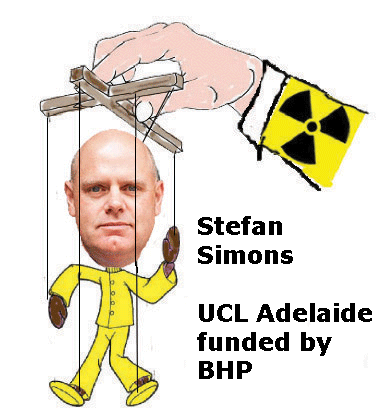
UCL Australia https://en.wikipedia.org/wiki/UCL_Australia 10 Nov 2015
UCL Australia is an international campus of the University College London, located on Victoria Square in Adelaide, South Australia.
Industry partnerships
UCL Australia has key corporate partnerships with two major resource and energy companies operating in South Australia: Santos and BHP Billiton. Santos’ South Australian interests include onshore and offshore oil and gas developments while BHP Billiton’s interest is concentrated on the expansion of the Olympic Dam mine- the world’s largest known deposit of uranium.
International Energy Policy Institute
The International Energy Policy Institute (IEPI) is housed on the Adelaide campus of University College London, Australia. In 2011, UCL signed a five-year $10 million partnership with BHP Billiton to establish the International Energy Policy Institute in Adelaide and an Institute for Sustainable Resources in London. Continue reading
Malcolm Turnbull all tied up over Climate Change and Paris Conference
 Malcolm Turnbull: Verbal acrobatics required for Paris climate
  talks, Independent Australia, 8 November 2015, Malcolm Turnbull will need to utilise his obvious talent for rhetoric to convince a global audience at the Paris climate talks in November, as there is no substance to the Government’s “Direct Action” climate policy, says Noel Wauchope.
Australia’s new Prime Minister Malcolm Turnbull has an appealing and glib turn of phrase. He’s going to need that talent when he speaks at the United Nations Paris Climate Conference in late November.
The thing is, Malcolm has to sell to the conference Australia’s current policy on climate change. The Government’s “Direct Action” climate policy is unchanged, despite the departure of climate sceptic Tony Abbott. Its flagship is the Emissions Reduction Fund (ERF).
The ERF boils down to tax-payer handouts to polluting companies that volunteer to cut their greenhouse emissions. There is no enforcement policy, meaning that the companies get the money, and for a year or more, do not need to show that they have reduced emissions.
After a year, the government proposes a ‘safeguards mechanism’, to be explained fully then, so allowing the companies plenty of leeway to lobby to make it meaningless. ……..
What happened to Turnbull? Mark Kenny & James Massola wrote in The Age in February:
‘Amid feverish speculation over the leadership, unconfirmed reports also claimed Mr Turnbull had moved to assuage fears in the conservative wing of the party that his return to the leadership would see a reprise of the carbon tax or an emissions trading scheme. It was claimed Mr Turnbull had promised, in a secret deal, that there would be no such reprise if elected.’
More recently, Kenny expressed it in this way:
‘Turnbull has his hands tied, having lost the leadership in 2009 to Abbott for supporting emissions trading, and then having regained it in 2015 on the express condition of opposing it. Release from such Houdini-esque chains will take some doing.’…….
Turnbull’s support for nuclear waste dumping in Australia might go down okay at the Paris talks. There will be a strong push there for nuclear power to be portrayed as cure for a climate change. At present, “new nuclear” is hamstrung in the U.S. because there has to be a waste solution before it can go ahead. ……
However, to persuade the world on Australia’s entire climate inaction package is a task that will demand Turnbull’s very best linguistic acrobatics.
Malcolm Turnbull faces an epic task to keep faith with Liberal Coalition climate denialists, while making Australia’s pathetic climate policy look at all reasonable to the global audience. https://independentaustralia.net/politics/politics-display/malcolm-turnbull-verbal-acrobatics-required-at-the-paris-climate-talks,8356
Why interim storage at Lucas Heights is the least worst solution for returning nuclear wastes.

 Dave Sweeney, Australian Conservation Foundation, 9 Nov 15 Last week Natalie Wasley (BNI) and myself spent a few days talking to a range of stakeholders in Sydney and Sutherland Shire and this note seeks to provide some context for the ENGO response to this development.
The BBC Shanghai left the French port of Cherbourg in mid-October carrying twenty five tonnes of Australian origin intermediate level waste returning here after reprocessing in France.
There has been controversy about the shipment, including safety and capacity concerns raised by Greenpeace about the vessel and a statement from the Indonesia’s Maritime Security Board that it can not pass through Indonesian waters. There is sure to be more domestic and international media attention when it arrives in Port Kembla (Wollongong), expected to be in early December.
After arrival in Kembla it is planned that the waste – which is in solid form inside a special transport container – will be moved by road to the Australian Nuclear Science and Technology Organisation’s Lucas Heights reactor facility in southern Sydney.
Some local residents are/will be calling for this material to not be stored in Sydney – this is an understandable response, but it is not one supported by the wider national nuclear free movement and key civil society partners.
We advocate that extended interim storage at Lucas Heights is the current least worst option as:
- ANSTO is already both the continuing producer of and home to the vast majority of Australia’s higher level radioactive waste
- ANSTO has certain tenure, a secure perimeter and is monitored 24/7 by Australian federal police
- Storing the waste at ANSTO means the waste will be actively managed as operations at the site are licensed for a further three decades – it also keeps waste management on the radar of the facility/people with the highest concentration of nuclear expertise and radiation response capacity in Australia
- Since the government realised in 2012 that the planned national waste dump at Muckaty would not be in place prior to the return of this waste, ANSTO has constructed and commissioned a new purpose built on site storage shed dedicated to housing this waste
- Extended interim storage at ANSTO helps reduce the political pressure to rush to find a ‘remote’ out of sight, out of mind dump site and increases the chances of advancing responsible management
- Storage at ANSTO has been publicly identified as a credible and feasible option by ANSTO, the nuclear industry lobby group, the Australian Nuclear Association and the federal nuclear regulator, the Australian Radiation and Nuclear Safety Agency (ARPANSA)
Importantly, this approach also provides the ability to have a circuit breaker in this long running issue in the form of an evidence based and open review of the best longer term management options.
Nothing about the nuclear industry, especially nuclear waste, is clean or uncomplicated and some in the wider community might be critical of this position.
However we believe that extended interim storage is the least worst approach and that coupled with a sustained ENGO call for a wider public review, is the path that is most likely to usefully advance the debate about future management options.
There is also an unusually high level of common acceptance that storage at Lucas Heights is the best option in the current circumstances – as well as ENGO’s this view is shared by the Sutherland Shire Council, local Greens and environmentalists, ANSTO and the Maritime Union.
Given this, pending a safety inspection upon the ship’s arrival, we do not forsee protest action aimed at disrupting the transfer of this waste from the Port to ANSTO – we want to see that happen with as low risk as possible. There are plans for a peaceful presence to witness the arrival and transfer and convey that while we (reluctantly) accept the need for this transport to occur we will not accept these shipments becoming routine and will actively resist moves to impose a national waste dump on remote communities or develop international waste dumps/storage in Australia.
Clearly this is an important message to convey in the context of the South Australian Nuclear Royal Commission and recent comments by PM Turnbull and other senior Coalition figures.
There is also both a real opportunity and need for a clear social and wider media profile at this time on the need for an open review of the best ways to manage this material and to end/reduce its production.
1 This month


Help Aunty Sue Protect Her Land and Sacred Sites From Destructive Rocket Testing.
.

Australians deserve the truth
about
AUKUS – https://aukuspublicinquiry.com/

PETITION – To: Prime Minister Anthony Albanese and the Australian Labor Government

of the week – Australians for War Powers Reform (AWPR)
To see nuclear-related stories in greater depth and intensity

