Western Australian gas company planning to sell solar panels and batteries
 Alinta’s solar plan to cut bills, The West Australian Daniel Mercer June 1, 2015 Gas giant Alinta is hatching a plan to sell solar panels and batteries to households, allowing them to slash power bills by reducing reliance on the electricity grid.
Alinta is also weighing the idea of offering micro gas generators, which could pave the way for households to disconnect from the grid altogether.
The plan looms as a direct challenge to taxpayer-owned electricity provider Synergy, which has been losing millions of dollars as customers switch to solar en masse.
There are about 170,000 households in the South West grid alone which have photovoltaic cells on their roofs, and this figure is expected to soar by the end of the decade.
Under Alinta’s plan, tipped to start this year, it would lease solar panels to residential customers, who would then provide any power they did not use back to Alinta to sell into the market.
The Sydney-based company would also offer batteries to store surplus solar power and small gas-fired generators that could be used as a backup in the event it was cloudy for days.
Efficient and affordable battery storage has long been regarded as the holy grail of renewable energy and US firm Tesla announced last month it was on the verge of being able to produce it………https://au.news.yahoo.com/thewest/a/28289418/alintas-solar-plan-to-cut-bills/
Effects of extreme heat in USA – and what about Australia?
 Anthony M Horton: Extreme heat – ‘Business as usual’ life to end in less than 30 years in the U.S.
A new study projects that the United States will have a four to six-fold increase in extreme heat exposure by 2070 — and even earlier in the South. Unfortunately, no similar study has been conducted in Australia…
As a scientist, I am concerned that research into a range of climate related issues are seemingly not on the agenda in Australia and stellar pillars such as the world renowned Commonwealth Scientific and Industrial Research Organisation (CSIRO) and the Bureau of Meteorology (BoM) are suffering increasingly deep staff cuts at a time when they are needed the most.
It also appears that the long held “without fear or favour” bastion of these pillars has also seemingly ended. If this is really the case, it is a truly sad day for Australia-especially given the many world leading breakthroughs achieved by the former and the proud record of the latter. …
I fear for the future of Australia if this trend becomes entrenched as, by the time the Government realises they have made a tactical error, there won’t be enough trained people left to pick up the slack, as they will have retired, retrained or will be employed elsewhere in the world.
ANSTO’s problem of mounting radioactive wastes at Lucas Heights
 ANSTO staves off nuclear waste squeeze AFR by Christopher Jay 28 May 15, The Australian Nuclear Science and Technology Organisation ANSTO) will use a slab of this year’s $193 million budget allocation to extend and retrofit two existing nuclear waste storage facilities, to stave off a critical shortage of storage space which will otherwise materialise by 2017.Another $26.8 million over four years has been allocated to pack, ship and return Australian high level waste being reprocessed in the UK Sellafield plant no earlier than mid-2019. EPA Continue reading
Solar testing laboratory: CSIRO helps investor confidence in large-scale solar
 CSIRO establishes solar testing laboratory http://www.dailytelegraph.com.au/business/breaking-news/csiro-establishes-solar-testing-laboratory/story-fnn9c0gv-1227375518543 JOHN CONROY MAY 30, 2015
CSIRO is set to increase confidence in large-scale solar by more accurately predicting how different solar photovoltaic (PV) systems will perform on Australian shores.
Over the course of a 32-month project supported by $1.3 million Australian Renewable Energy Agency (ARENA) funding, CSIRO successfully established unique indoor and outdoor testing capabilities that are now accessible to PV researchers and industry.
ARENA CEO Ivor Frischknecht said these new facilities would allow different solar panels and cells to be scrutinised, assessing how they respond to Australian conditions and predicting their output over time.
“Accurately predicting the energy output of a solar PV power plant is critical throughout its lifecycle, from forecasting future revenue and determining commercial viability to day-to-day operation on the electricity grid,” Mr Frischknecht said.
 “Effective forecasting is particularly important for investor confidence and risk mitigation as the cost of new plants is mostly up-front.
Clean Energy Finance Corporation helping irrigators to buy renewable energy
 Funding for irrigators to buy renewable energy made available through Clean Energy Finance Corporation ABC Rural By Sarina Locke , 29 May 15 Irrigators, furious with power price rises, are pushing hard to install renewable energy on their farms.
To date the financial backing from banks has been largely missing.
Now the Government backed Clean Energy Finance Corporation is poised to announce a partnership with a major bank, to help irrigators invest in more efficient energy. It is just the tip of renewable energy projects in agriculture, worth $3 billion that will need financial assistance from the Corporation in future……..
The Clean Energy Finance Corporation is responding. It has a program with the Commonwealth Bank, called the energy efficient loan for mid-sized companies, available nationwide. It offers small loans of $100,000 up to $5 million plus.
But the CEFC is poised to rollout more programs with other banks offering a similar product for irrigators. Continue reading
The ANZ Bank’s first green bond issuance a resounding success
 Australian investors lap up ANZ green bonds THE AUSTRALIAN JOHN CONROY MAY 28, 2015 The ANZ Bank’s first green bond issuance – and Australia’s largest – has been a “resounding success”, the Clean Energy Finance Corporation said, with the CEFC not needing to provide the $75m it had committed to back the issuance.
The $600m ANZ green bond issuance – which has been certified by the Climate Bonds Initiative – was fully subscribed by private sector investors and will back investment in utility-scale wind and solar as well as green buildings.
About 40% of the green bond funds will go into green building projects in Australian and New Zealand, as well as some parts of Asia, with the remaining 60% to be invested in renewable energy, largely wind and solar, The Fifth Estate reports, with Australian institutional investors making up the majority of subscribers.
The five-year fixed rate bond had a coupon of 3.25% and was rated AA-, the website said. The Fifth Estate also quotes CBI as saying the issuance was actually oversubscribed, at $725m. CEFC CEO Oliver Yates said the “high quality” bonds would expand and diversify the investor base for clean energy.
“Green bonds provide investors with a unique opportunity to invest in renewable energy and energy efficiency through a low-risk, high quality fixed-income product. At the same time, green bonds support long term investment in important low carbon infrastructure projects which can benefit the broader economy,” he said.
He said investors were increasingly seeking additional benefits, such as an environmental or social return……..http://www.theaustralian.com.au/business/latest/australian-investors-lap-up-anz-green-bonds/story-e6frg90f-1227372751422
An international Treaty that has saved lives – the Montreal Protocol
 Ozone treaty ‘prevented skin cancer deaths’ http://www.abc.net.au/science/articles/2015/05/27/4242804.htm Anna Salleh
The ozone hole over the Antarctic would have been 40 per cent bigger in 2013 if the Montreal Protocol hadn’t curbed the production of CFCs, according to a new study.
In this scenario, Australia and New Zealand would have experienced greater UV radiation, which in turn would have increased the rate of skin cancer, say the authors of a new paper today in Nature Communications.
The paper also shows that, by 2011, ozone depletion would have become a northern hemisphere problem too.
“There would have been an Antarctic-like ozone hole in the Arctic over populated regions,” says co-author Dr Richard McKenzie, an atmospheric physicist at the National Institute of Water and Atmospheric Research in New Zealand.
In the mid-1980s scientists discovered a hole in the ozone layer above Antarctica, and in 1987 the world agreed to the Montreal Protocol, which limited the production of chlorofluorocarbons (CFCs).
Despite this, the concentration of CFCs continued to rise until 1993, and even today the ozone hole reappears each spring, and this contributes to an increase in cancer-causing UV radiation in Australia and New Zealand.
But without the Montreal Protocol it could have been so much worse, say the researchers. Continue reading
Tour of French art – Aboriginal life before colonisation
Rare French paintings of Tasmanian Aboriginal life before colonisation to tour Australia, ABC News, By Sam Ikin 19 May 2015, A collection of 19th century French illustrations depicting Indigenous life in Tasmania and around mainland Australia before British colonisation will go on show in the state for the first time next year.
The drawings and sketches were done in early 1802 during Nicholas Baudin’s exploration of Australia.
The French explorer’s artists, Charles-Alexandre Lesueur and Nicholas-Martin Petit, meticulously documented their meetings with local Aboriginal people when they landed in Tasmania.
The pictures are owned by France’s Museum of Natural History in La Havre and will tour the Tasmanian Museum and Art Gallery (TMAG), Launceston’s Queen Victoria Museum and Art Gallery, the National Museum of Australia in Canberra and several other Australian galleries next year and in 2017………The French museum’s director Cedric Cremiere said he was proud to be able to show the works in Australia.
“It is wonderful that after that first French encounter with Australia more than 200 years ago, we can share these discoveries and sense of wonder with Australian audiences.” he said.
Tasmanian Arts Minister Vanessa Goodwin said the artworks were of huge importance to Tasmania.
“This partnership will allow audiences across Tasmania to see depictions of early Tasmanian life which are of enormous significance to the Tasmanian Aboriginal people and the Tasmanian community in general,” she said.http://www.abc.net.au/news/2015-05-19/paintings-of-tasmanian-aboriginal-life-before-colonisation/6479650
America’s long term push to make Australia accept nuclear waste
 US pressed Canberra to play ball on nuclear waste by: PAUL CLEARY http://www.theaustralian.com.au/in-depth/wikileaks/us-pressed-canberra-to-play-ball-on-nuclear-waste/story-fn775xjq-1227373417008 May 29, 2015
 US government cables from 1978 reveal Washington had a long-term strategy to make Australia acknowledge its “responsibility” to accept nuclear waste.
This pressure coincided with parliament’s approval on June 8 that year of a six-part regime to facilitate the mining, milling and exporting of uranium oxide.
Senior US officials began raising the waste issue in June when the two countries began high-level talks over a nuclear co-operation agreement, cables posted on the WikiLeaks website reveal.
A US embassy cable reported that Australia shared the US government’s views about uranium enrichment but “was unreceptive to questions about waste disposal in the Australia-Pacific area”.
When in September that year the Mirror editorialised against Australia’s accepting nuclear waste, US embassy officials told the Department of Foreign Affairs Australia should expect the US to “nudge” it about this issue.
The editorial was brought to the attention of the US embassy by Ron Walker, who headed the defence and nuclear division in the department. US officials bluntly told him Australia was essentially ignoring the problem of nuclear waste. “We replied by telling Walker he and other GOA (government of Australia) officials should assume that during the course of the next several decades there will inevitably be speculation about potential sites for nuclear waste storage,” the US officials wrote in the cable.
“We added that while we read GOA views ‘loud and clear’, the GOA should assume there will be continuing discussion about storage sites for nuclear wastes and in fact we would probably from time to time even go as far as to nudge the GOA about its responsibility in helping to find appropriate, safe and secure storage areas.”
The following week, two officials from the Australian embassy in Washington, described as “Starr and Knight”, asked the US State Department for guidance on talking points to respond to media reports. State Department officials said Australia should mention the US government’s policy of encouraging international co-operation in storage and processing of spent fuel.
One week later, an embassy official asked the State Department if the Australian government could use a form of words at the next Pacific Forum that said it was “highly unlikely” the US government would ask Pacific countries to accept spent nuclear fuel.
The US officials said Australia should not use this language.
The nuclear agreement referred to was signed by the Fraser government in 1979, but the Hawke government ended the plan to develop nuclear enrichment technology when it dismantled Australia’s laboratory-scale centrifuge enrichment plant.
Australia’s nuclear lobby keen to “educate” schoolchildren
Forget the nuclear family we are soon going to have nuclear classrooms if ANSTO has its way BRUCE MCDOUGALL THE DAILY TELEGRAPH MAY 28, 2015
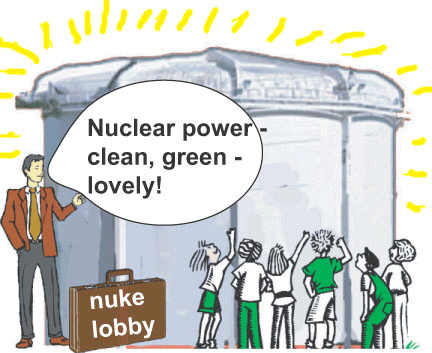
AUSTRALIA’S nuclear facility at Lucas Heights is spearheading a major push to encourage schoolchildren to become scientists.
Thousands of secondary students have been invited to tour the country’s only operational nuclear reactor, meet its scientists and study their research programs.
As Federal Education Minister Christopher Pyne launched a plan to make maths and science compulsory in the final year of school, 250 students arrived at Lucas Heights yesterday to work on special projects.
The Year 9 and Year 10 students from seven schools took part in a series of competitive challenges at the Australian Nuclear Science and Technology Organisation (ANSTO)……http://www.dailytelegraph.com.au/news/nsw/forget-the-nuclear-family-we-are-soon-going-to-have-nuclear-classrooms-if-ansto-has-its-way/story-fni0cx12-1227372012172
Australia’s public sector now losing its climate change experts

Canberra’s climate change brain drain becoming critical, The Mandarin 28 May 15 by David DonaldsonClimate change expertise is being lost from the public sector as the government fails to fill board vacancies and departments stop commissioning climate policy modelling from ABARES. Continue reading
Federal and Western Australian govts systematic attack on environmental critics
Funding withdrawal from Environmental Defender’s Office criticised as ‘systematic attack’ on community groups, ABC News, By Stephanie Dalzell, 28 May 15, The Conservation Council of Western Australia has accused the State and Federal Governments of launching a “systematic attack” on community groups which scrutinise policy decisions.
The criticism comes after WA’s Environmental Defender’s Office (EDO) had its funding completely withdrawn by the State Government, effective from the end of this financial year.
The decision follows similar action by the Federal Government in 2013.
The EDO, which also relies on grants and donations, said the combined cut in state and federal funding would leave it with a gap of $250,000 in annual operating expenses. Conservation Council director Piers Verstegen said the cut appeared to be a direct response to the EDO’s advocacy for groups which challenged policy or development decisions.
“The EDO is an extremely important organisation in our community and it brings scrutiny to environmental issues often where government make bad decisions or go wrong in relation to environmental management,” he said. “I think the Government’s keen to remove that scrutiny.
“I think this is part of a systematic attack on community groups around the country that engage in advocacy on environmental issues and stand up for clean water, healthy land, and healthy ecosystems.
“And when that doesn’t align with government policy or the industries that government [is] supporting, that’s when government [feels] uncomfortable with that advocacy and [starts] to cut funding.”……..http://www.abc.net.au/news/2015-05-27/conservation-council-criticises-funding-withdrawal/6499492
BHP funded Grattan Institute unfairly critical of solar energy

Solar Industry Hits Back At Report Critical Of Roof-Top Solar, New Matilda, By Thom Mitchell, 27 May 15 A report by a respected think-tank is being slammed by key players in the solar energy industry. Thom MItchell reports.
A report published by the Grattan Institute on Monday has been dismissed by the solar industry, which argues its critique of generous state and federal government subsidy schemes misrepresents their true value and ignores important flow-on benefits. Continue reading
Australia’s Aboriginals again threatened by nuclear radiation
 Nuclear-hit Aborigines again in radiation danger https://linksunten.indymedia.org/de/node/144304 Verfasst von: Diet Simon, sourcing from beyond nuclear news roundup (Account: Nuclear Worrier). Verfasst am: 25.05.2015
Darren Farmer, a burly middle-aged Martu tribal man, told VICE online magazine that “the Martu people do not want this uranium mine. Everybody has said no.” But that hasn’t stopped the federal environment minister Greg Hunt from givingKintyre the green light.
The VICE article explains how poverty prompts some Martu to agree to mining on their country and how Darren Farmer and others are physically assaulted for opposing it.
Meanwhile four decades after test explosions of atom bombs in the Maralinga desert area of South Australia, which killed and maimed Aboriginal people, Indigenous people face barriers as they try to contribute to a parliamentary inquiry whether the state should start a nuclear fuel cycle industry.
 A requirement for all submissions to be sworn in front of a justice of the peace makes it particularly difficult for Aboriginal people, people from remote areas and those with language issues to present their views.
The former Governor [Queen Elizabeth’s representative] of South Australia, Kevin Scarce, who heads the inquiry, is to inspect the Fukushima region of Japan,ravaged by nuclear reactor explosions.
One of the things the inquiry will consider is the storage of nuclear waste from other countries. The federal government is currently looking for a site to dump six cubic metres of nuclear waste that must return to Australia from France for processing this year.
The federal government had previously targeted Aboriginal-owned sites in the Northern Territory, including Muckaty Station, where agreements with Aboriginal governance fell through or stalled. Aboriginal women’s resistance also stopped a 2003 plan by the federal government to dump nuclear waste in South Australia.
The French state-owned nuclear giant Areva is offering to sell its ‘world leading’ nuclear technology to South Australia. “The offer is being reported in the South Australian media without a hint of irony,” comments leading anti-nuclear Australian activist, Jim Green. “A reality check is in order.”
Two former Australian prime ministers, one each from the Liberal [in name only, actually right-of-centre conservative] and Labor [only nominally left] parties have said it would be a good idea for Australia to take in all the world’s nuclear waste. Guess on whose lands.
Small scale solar power from Australian company transforms slum life in India
Australian solar company Pollinate Energy brings light to slums of India ABC Foreign Correspondent By South Asia correspondent Stephanie March 26 May 15 With indoor air pollution from kerosene lamps and stoves the second largest cause of death in India, one company, founded by Australians, has come up with a solution to the problem.
Every night in the sprawling shanty towns of the country of 1.2 billion people, the air fills with dense, black smoke.
“We used to get oil from the market and pour it into the lamp and light it; the house used to get full of soot and dirt,” said Abdul, a slum-dweller in Bangalore who lives in a hut made of wooden board and tarpaulin.
That was until Abdul bought a portable solar light from a company called Pollinate Energy, founded by five young Australians.
“After we got this solar lamp a lot of things improved,” Abdul said. “Now we don’t worry that there will be a fire.” Continue reading
1 This month


Help Aunty Sue Protect Her Land and Sacred Sites From Destructive Rocket Testing.
.

Australians deserve the truth
about
AUKUS – https://aukuspublicinquiry.com/

PETITION – To: Prime Minister Anthony Albanese and the Australian Labor Government

of the week – Australians for War Powers Reform (AWPR)
To see nuclear-related stories in greater depth and intensity

