50 year old mystery “UFO” was in fact government testing for radiation
 Westall ‘UFO’ incident was actually government radiation testing, reports reveal MARK DUNN HERALD SUN AUGUST 06, 2014 AN almost 50-year-old mystery when more than 200 people believed they had a close encounter with a UFO landing in Clayton may have finally been solved after newly-unearthed government documents revealed a secret radiation-testing program.
Although federal and state government agencies refused to comment about the 1966 ‘Westall’ incident at the time, it is now believed that, rather than a UFO, what landed was an errant high altitude balloon used to monitor radiation levels after the controversial Maralinga nuclear tests.
The HIBAL program was a joint US-Australian initiative to monitor atmospheric radiation levels using large silver balloons equipped with sensors between 1960 and 1969.
Documents held by the National Archives and former Department of Supply indicate one test balloon launched from Mildura may have been blown off course and came down in Clayton South in a paddock near Westall High School, alarming and baffling hundreds of eyewitnesses, including teachers and students.
After hovering over the area, it landed at an area known as The Grange, behind a grove of pine trees, before taking off again and being pursued by several light aircraft in a sighting which lasted 20 minutes from 11am on April 6, 1966.
The event has ever since been shrouded in mystery.
- But researcher Keith Basterfield, who has spent years investigating unexplained phenomenon in Australia, said a “runaway” balloon from the HIBAL (high altitude balloon) project was the likely answer.
Each test balloon lifted a 180kg payload consisting of an air sampling and telemetry unit in a gondola and was followed by a light aircraft tasked with tracking it and triggering its 12mtr parachute via radio signal.
Immediately after the Westall “UFO” sighting, reports emerged of Government men in suits converging on the area and asking school officials and other witnesses to not talk about the event……..http://www.heraldsun.com.au/news/victoria/westall-ufo-incident-was-actually-government-radiation-testing-reports-reveal/story-fni0fit3-1227015591764?nk=bac73ea2ae593147970baba97764d7da
Proposed changes to Western Australia’s Aboriginal Heritage Act for benefit of mining companies
 Fast track approvals should be dumped: KLC ABC News 6 Aug 14 By Nicolas Perpitch Proposed changes to Western Australia’s Aboriginal Heritage Act have been labelled discriminatory, amid calls for them to be dumped and the act rewritten. In a scathing submission, the Kimberley Land Council (KLC) also warned the amendments would disenfranchise Indigenous people.
KLC chief executive Nolan Hunter said the draft bill focused power in the hands of one bureaucrat – the Department of Aboriginal Affairs’ chief executive officer. “This is a totally bureaucratic government process, so we pretty much will be disenfranchised in terms of having a say once all this is set,” he said.
“This basically discriminates against Aboriginal people. It favours the state’s position.”
Currently the Aboriginal Cultural Material Committee (ACMC), established through the act, provides advice and recommendations to the Aboriginal Affairs Minister on heritage sites. Fast track’ authority for permits handed to CEOMinister Peter Collier revealed the draft bill in mid-June, saying the pace of economic development in recent years, particularly in mining and construction, had highlighted inadequacies in the current legislation.
The draft bill would speed up the approval process for mining and other development by giving the Department of Aboriginal Affairs chief executive officer “expedited” or “fast track” authority to declare whether or not an Aboriginal heritage site existed.
The CEO would be able to issue land use permits when he or she decided a site would not be significantly damaged or altered.
Submissions on the draft amendments have been overwhelmingly critical of the proposed changes, in particular the new fast track approvals process. The KLC and other land councils, Aboriginal corporations, the Law Society of WA, individuals and anthropologists such as La Trobe University’s Nicholas Herriman have argued the new process would largely cut out Aboriginal people.
The Law Society, in its submission, said the proposed amendments stripped the ACMC of its evaluative role and predominantly shifted power to the CEO, who was not obliged to consult with Aboriginal people or to apply anthropological expertise.
Mining and other companies could appeal decisions but no statutory right of review was provided for Aboriginal custodians or traditional owners.
“The lack of such a right again negates the claim that these amendments are increasing the strength of the voice of Aboriginal people or that the amendments increase accountability,” the Law Society said.
The Goldfields Land and Sea Council pointed out the Government had not specified the process to be followed by the CEO in making his or her decisions, raising concerns about “the validity of any decision made”.
“It remains that the most significant issue raised by the proposed amendments to the act is that the regulations that will govern how it will operate are not yet available,” the land council wrote in its submission…………
‘Streamlining development’ aim of act: council
National Native Title Council CEO Brian Wyatt said the changes were not primarily directed at heritage protection.”There’s no real will or desire by government to protect heritage. It’s all about streamlining the processes of development,” Mr Wyatt said.
The KLC also stressed a new section in the act making it a criminal offence not to declare potential heritage sites could force land councils and representative bodies to break the law. There would be fines for people, other than traditional owners, who did not report sites or objects.
Mr Hunter said traditional owners disclosed information to consultants, development proponents and representative bodies on a legal, confidential basis and that arrangement could fall foul of the new provision.
“It sets a default position where we can be subject to a criminal prosecution with very little culpability on our part,” he said.
“How can you create legislation that compels you to break the law?”
He called on the Government to dump the draft bill and start again……….
Submissions on the draft amendments to the 42-year-old act close this week following an eight-week public consultation period. http://www.abc.net.au/news/2014-08-05/indigenous-groups-speak-out-about-aboriginal-heritage-act/5650320/?site=indigenous&topic=latest
Green MP Robin Chapple’s submission on the Aboriginal Heritage Legislative Changes
 These matters are especially important given the lack of both review/appeal processes and
compensation processes in the Act and Bill for Aboriginal peoples facing damage to or
destruction of their heritage.
Dear Chief Heritage Officer
Feedback on the Aboriginal heritage legislative changes
Thank you for the opportunity to provide feedback on the Aboriginal heritage legislative
changes.
I would like first to acknowledge that the Aboriginal Heritage Amendment Bill 2014 makes
improvements, for example the extension of time in which to bring a prosecution, the
provision of express penalties where these are currently lacking, and the increased
penalties for offences.
The Bill also seems likely to deliver on its promise to deliver better quality registers, and the
inclusion of a historic record of all approvals should assist with monitoring compliance.
The Bill also seems likely to deliver on its promise to deliver faster decision making, and the
prescribing of processes for decision-making would make those processes more certain
and transparent.
However, on the draft legislation currently available, and particularly in the absence of draft
regulations, I am not at all satisfied that the legislative changes will effectively improve
either the protection of Aboriginal heritage or adequately involve Aboriginal peoples in that
process. At the end of the day, protection of Aboriginal heritage is what the Act is for. Continue reading
Liberal MP steps out of line, promoting the Renewable Energy Target
 Out on a limb, or a return to common sense on renewable energy? http://reneweconomy.com.au/2014/out-on-a-limb-or-a-return-to-common-sense-on-renewable-energy-83989 By Kane Thornton on 5 August 2014 Being out on a limb can be a dangerous place to be, particularly in politics. When federal Liberal politician Sarah Henderson stated loudly and proudly that she supports Australia’s Renewable Energy Target, she certainly went against the grain of some of her party colleagues who have been calling for a massive reduction in the target.
But did she step out on a limb, or was she simply showing a deeper understanding of the policy, and recognising the strong support of voters for clean energy?
The truth is that producing renewable energy from our wind, sun, waves and more just makes sense to people. This is why, whenever someone asks the question in a survey, renewable energy polls its solar panels off – it is generally supported by more than three quarters of the population.
The Renewable Energy Target (RET) has helped deliver more than 20,000 jobs in renewable energy across Australia. Sarah Henderson’s electorate of Corangamite is blessed with an abundance of wind energy resources and includes dozens of small businesses employing hundreds of qualified solar panel installers. And almost a quarter of homes have either solar power or solar hot water, which is well above the Victorian average.
The RET is also driving innovation, something the greater Geelong region needs as it rises to the challenge of major changes in the manufacturing and automotive sector. IXL Solar is a good example of this transformation, with operations in South Australia and Geelong. It used to produce parts for car manufacturing and is now busily manufacturing parts for several huge solar power farms being built in New South Wales. It is a fantastic reminder of how innovative companies can respond to the many changes we are facing.
Of course, benefits such as these do come at a cost and the cost of the RET is about 3 per cent of the average Australian household power bill. That’s not much compared to the 40 per cent of bills that goes towards the poles and wires necessary to deliver the electricity. And the cost of the RET is balanced out by the savings it creates on another party of your bill – the cost of wholesale power.
If we weren’t using renewable energy, we would also have to rely on more gas for our electricity, and gas prices seem to have a nasty habit of going up lately. This is why economic analysis undertaken by ACIL Allen for the Federal Government has found the Renewable Energy Target will actually save consumers money in the long run, as it will help shield us from rising gas prices.
This and four other economic studies this year have led the Australian Industry Group – the nation’s leading business group representing over 60,000 major energy customers – to conclude that scrapping the RET would not save any money on power bills.
With all of this in mind, it is not surprising that Sarah Henderson can tell which way the wind is blowing in her electorate. It’s an electorate that is home to thousands of solar power systems, and a region in much need of alternative economic opportunities.
In supporting the RET she is also continuing a long Liberal tradition. The RET was first introduced back in 2001 by the Howard Government and the Liberals supported its expansion and refinement in 2009 and 2010. It has been a bipartisan policy.
At a time when people are desperately looking for authenticity in their public figures, it’s great to see a politician take the time to look at this issue sensibly and stand up for the courage of their convictions. In doing so, Ms Henderson is not out on a limb. She is joining the vast majority of Australians, the renewable energy businesses and workers in her electorate, and the 144 countries around the world with renewable energy target policies, that are all pushing even harder for a transition to a cleaner, smarter energy system. Kane Thornton is Acting Chief Executive of the Clean Energy Council
South Australia: Bill to back renewable energy on pastoral lands
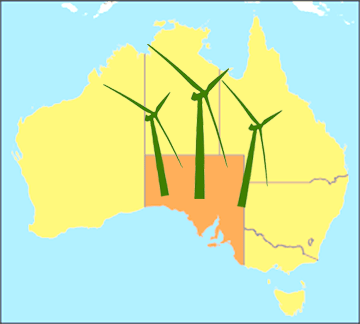 Bill backing pastoral lands renewable energy projects passes Legislative Council http://www.abc.net.au/news/2014-08-06/bill-backing-pastoral-lands-renewable-energy/5652118 6 Aug 2014, A bill supporting renewable energy developments on South Australian pastoral lands will go to State Parliament’s House of Assembly, after passing the Upper House.
The Government says the Pastoral Land Management Bill is the first of its kind in Australia.
It aims to make it easier to establish wind farms or solar energy projects on pastoral properties.
Environment Minister Ian Hunter says it would allow a wind farm developer to apply for a licence to build and operate a wind farm on Crown land subject to a pastoral lease and for the wind farm to co-exist with a pastoral leaseholder’s activities.
He says the views of affected pastoralists will be taken into account. Ninety-five per cent of wind farm licence payments would go to lessees and native title holders.
Films record the sorry history of Australia’s involvement in the nuclear industry

 Superpit: Digging for uranium in the Australian cultural imaginary, [ excellent videos and pictures] National Sound and Film Archive, by Adam Broinowski The mining industry has been a central force in shaping Australian history in the 20th century. In fact, as is evident in the policy switch from the ‘Mining Super Profits Tax’ (Rudd/Gillard government) to ‘Open for Business’ (Abbott government)1, mining influence in Australian politics is direct and far-reaching. Any historical discussion of mining, however, should not overlook the historical relations between the Aboriginal owners and settler populations and their transnational partners…….
As the poisonous modern rituals of atomic testing were carried out (Monte Bello Island, Emu Fields, Maralinga), which included the use of Plutonium 239, both Australian and British officials repeated that the health risks were negligible, despite extensive local radioactive contamination
while some Aboriginal people from Ooldea were moved from their traditional lands to Yalata prior to the 1956–57 series of tests at Maralinga, there were still Aboriginal people using their camping grounds that passed through the Maralinga test site. As found in the Royal Commission (1975), the insufficient caution taken to ensure that all people were removed from the Area prior to tests was based on the false and negligent assumption that there were no longer people living on this land. Members of the Pitjantjantjara, Yakunytjatjara, Tjarutja, and the Kupa Piti Kungka Tjuta nations are said to have been exposed to radioactive contamination, whether in ‘black mist’ or other forms. Along with many Australian atomic test veterans, they developed chronic illnesses, the complications from which led to many premature deaths.
These ‘side effects’ were largely ignored as officials prioritised the plans to make Australia a ‘great power by 2000’ (such as Philip Baxter, Chair of the Australian Atomic Energy Agency)…….
In 1977, when the bid to mine one of the largest uranium deposits in the world at Ranger 1 and Nabarlek in the middle of the park was approved by the Fraser government, the Fox Report warned that mining waste would have to be stored for a quarter of a million years. Aboriginal elders also warned that mining ‘sickness country’ would lead to disaster…….
Given the ongoing damage caused by the Fukushima nuclear disaster since 11 March 2011, with the Fukushima Daiichi reactor said to have been fuelled by Australian uranium (at least in part), one wonders how many more warnings the authorities and their transnational partners need. The image in Phantom Gold of a lone European settler in the desert who hunts for gold while dying from thirst, may indeed come back to haunt us.
http://www.nfsa.gov.au/research/papers/2014/07/01/superpit-digging-uranium-australian-cultural-imaginary/.
Bob Hawke sees importing nuclear waste as solution to Aboriginal disadvantage!
 Bob Hawke: nuclear waste storage could end indigenous disadvantage. Former prime minister says Northern Territory leader Adam Giles supports idea, despite rejection of Muckaty dump plan Oliver Milman in Arnhem Land theguardian.com, Sunday 3 August 2014 “….. Hawke said he was confident that the answer to long-standing indigenous socioeconomic problems was to allow radioactive waste to be stored on Aboriginal land, and use the revenue to improve living standards.
Speaking at the Indigenous Garma festival in the Northern Territory, Hawke said he had met Adam Giles, the territory’s chief minister, to discuss the idea and had got a favourable response……..”.I believe I have the answer. I’ve discussed this proposal with Adam Giles, who tells me he’s been approached by a number of elders who, like himself, are keenly supportive of the proposal.”
Despite having some of the largest deposits of uranium in the world, Australia has maintained a long-standing opposition to nuclear power and storing radioactive waste from overseas.
In June, traditional Indigenous owners in Muckaty Station, north of Tennant Creek, triumphed in a seven-year battle to stop domestic nuclear waste being dumped on their land……..
he stressed that the solution would give Australia “the capacity for substantial new expenditure on indigenous Australians”………Dave Sweeney, a nuclear-free campaigner with the Australian Conservation Foundation, said Hawke’s proposal was a “bloody disgrace”.
“Here you’ve got a privileged white man standing up saying this rubbish should be dumped on systematically disadvantaged people’s land,” he told Guardian Australia. “It’s offensive and it’s dumb.
“For more than 20 years Aboriginal communities at multiple sites in South Australia and the NT have mobilised and defeated federal government plans for a national radioactive waste dump on their country, most recently at Muckaty. To think that they will accept an international dump is fanciful.
“To put forward that the best way to address the shameful state of the economic and structural disadvantage of the world’s oldest continuing culture is through hosting the world’s worst industrial wastes is a profound and perpetual policy failure.” http://www.theguardian.com/world/2014/aug/03/bob-hawke-nuclear-waste-storage-could-end-indigenous-disadvantage
With current Ukraine crisis should Australia be selling uranium to Russia?
 Should we be selling uranium still to Russia?, Independent Australia Dave Sweeney 4 August 2014, Australia’s treaty watchdog refused to endorse the treaty to sell uranium to Russia due to security issues. Dave Sweeney, theAustralian Conservation Foundation’s nuclear-free campaigner, calls for the treaty to be reviewed in the aftermath of the MH17 tragedy. IT IS appropriate that Australia takes strong action to send a clear message to Moscow in the aftermath of the MH17 tragedy. Not welcoming Russian president Vladimir Putin to the G20 summit in November would be one step.
Immediately halting Australian uranium sales would be another.
Uranium is a dual use fuel. It provides the power fuel for nuclear reactors and the bomb fuel for nuclear weapons — and the distinction between the two sectors is more one of political convenience than practical effect……….
In 2007 and again in 2008, Russia threatened Poland with nuclear strikes from missiles it would base at its enclave of Kaliningrad following Polish approval for U.S. missile defence bases in Poland. Today, as clashes continue along the Ukrainian border, we can be sure Moscow’s missiles are on high alert………
JSCOT, to its considerable credit, recommended a mix of caution and action in relation to Australian uranium sales to Russia. It called for any sales to be linked to Russian compliance with a set of essential pre-conditions including a detailed analysis of Russia’s nuclear non-proliferation status; the complete separation of Russia’s civil and military nuclear sectors; reductions in industry secrecy; independent safety and security assessments of Russian nuclear facilities; and action on nuclear theft and smuggling concerns.
None of these have been realised and as the crackdown on EcoProtection! shows, the Russian nuclear sector is becoming even less transparent. Continue reading
Australia’s Future Fund and Banks invest in nuclear weapons
 The Don’t Bank on the Bomb report in 2012 revealed that most Australian banks have provided loans to nuclear weapons companies at some stage since 2008. Disappointingly, none have shown a willingness to divest, but they draw the line at financing projects specifically for nuclear weapons work.
Australia: The Future Fund goes Ballistic, Tim Wright, http://www.dontbankonthebomb.com/2014/07/30/australia-the-future-fund-goes- ballistic/ Opinion polls show that Australians overwhelmingly oppose nuclear weapons. So when we learned in 2011 that our major federal government investment fund – the so-called Future Fund – has substantial investments in nuclear weapons companies, there was widespread public uproar.
Melbourne’s leading daily newspaper, The Age, ran a front-page story with the headline: “Australia investing in nuclear arms.” The following day, readers reacted angrily on the letters pages, and a cartoon depicted businessmen being hurled through the air by an exploding nuclear bomb. “The Future Fund goes ballistic,” read the caption.
We uncovered this controversial information using freedom-of-information laws, which allow any member of the public to gain access to documents held by Australian government agencies. There was no charge for this service.
When the news broke, the Future Fund stated that it had no plans to divest from companies involved in nuclear weapons production, even though it had earlier divested from cluster munitions and landmines. It claimed that countries such as the United States, Britain and France possess nuclear weapons legitimately.
Not satisfied with this response, we encouraged friendly senators to quiz the Future Fund leadership about their position in the parliament. This helped keep the issue on the political agenda. The minister overseeing the fund, Senator Penny Wong, was forced to defend the position.
We then commissioned legal advice from a team of top barristers, who found that the Future Fund had failed to comply with its own stated investment policies. Continue reading
How the Aboriginal people of Maralinga lost traditional knowledge due to atomic bombing
The Radiation That Makes People Invisible: A Global Hibakusha Perspective Robert Jacobs The Asia-Pacific Journal, Vol. 12, Issue 30, No. 1, August 3, 2014.
“…….Loss of traditional knowledge– In some remote places survival is dependent on centuries old understandings of the land. In Maralinga, Australia the areas where the British conducted nuclear tests between 1956 and 1963 are very difficult places to live. Traditional communities in these areas often have songs that hold and transmit essential knowledge about how to survive in such a harsh environment, such as where to find water, when to hunt specific animals, when to move to various locations. But can knowledge gathered over millennia be effectively applied to radiation disasters?
When the British relocated entire communities to areas hundreds of kilometers from their homes, the local knowledge chain was broken. It became impossible for the refugees to sustain a traditional life in areas where they had no knowledge of the rhythms of the land and animals. This removal from their lands led to ever increasing dependence on governmental assistance and severed what had been millennia of self-reliance. While self-reliance had been dramatically impacted by the brutal rule of the Australian government and its policies towards aboriginal peoples, the people living near the test site were still living on the land in the 1950s. Relocation led to the further erosion of community, familial and personal wellbeing………….http://japanfocus.org/-Robert-Jacobs/4157
Australian Renewable Energy Agency (ARENA) funding large solar farm at Moree
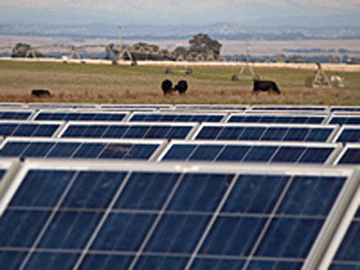 Moree Solar Farm puts big solar in big sky country 4 Aug 14 The Australian Renewable Energy Agency (ARENA) today announced $101.7 million of support for Moree Solar Farm, which upon completion will be one of the largest solar plants in Australia.
ARENA CEO Ivor Frischknecht congratulated renewable energy company Fotowatio Renewable Ventures (FRV) who are set to begin construction on the project shortly. “Moree Solar Farm will be the first large-scale solar plant in Australia to use a single-axis horizontal tracking system, where panels follow the sun across the sky to capturesunlight and maximise power output,” Mr Frischknecht said.
“The 56MWac (70MWp) farm will produce enough electricity to power the equivalent of 15,000 average New South Wales homes.”
Mr Frischknecht said the Moree community would benefit from the project and had been keen supporters, along with the Moree Plains Shire Council, for several years. “The $164 million Moree Solar Farm will benefit the local economy and will also deliver an estimated 130 local jobs during the construction phase over 2014–2016.
“More than 50 locations around Australia were investigated before the developers selected the site 10 kilometres out of Moree in NSW’s northern wheat belt, an area known as ‘big sky country’. “The location benefits from high levels of solar radiation and also allows the solar farm to connect to the national electricity grid.”
Mr Frischknecht said the project, which is also being supported by the Clean Energy Finance Corporation, would aim to demonstrate that large-scale solar power plants can be constructed and operated within Australia’s major electricity grids.
“ARENA will work with FRV to share the valuable knowledge gained in delivering the Moree Solar Farm with the rest of the industry,” Mr Frischknecht said. “We recognise reducing early mover disadvantage and supporting the transfer ofinformation will help advance development of more utility scale solar plants in Australia.”
Moree Solar Farm is a solar flagship project ARENA inherited when it was established in July 2012. Last week, another former flagship project supported by ARENA, reached a major milestone when the first of approximately 1.35 million panels were installed at AGL’s large-scale solar plant in Nyngan, NSW.
Silex dumped solar for nuclear: now nuclear has dumped Silex
 Silex tumbles after solar-nuclear switch hits market roadblock, REneweconomy By Giles Parkinson on 28 July 2014 Silex Systems decided in June to dump its solar business to focus on nuclear. But now the nuclear industry has dumped Silex.
 Less than one month after Australia’s Silex Systems placed its solar technology assets up for sale to focus on uranium enrichments, it has been dealt a massive blow by the suspension of its nuclear ambitions.
In late June, Silex sought to arrest its slumping share price and preserve its cash reserves by deciding to seek buyers and co-investors in its Solar Systems and Transluscent businesses.
CEO Michael Goldsworthy said at the time he wanted to focus on its laser uranium enrichment process, confident that its partnership with GE and Hitachi (GLE) could mean that the world’s first commercial laser enrichment plant could be in operation later this decade.
But those dreams are now on hold – indefinitely – after GLE said it would cease funding laser development projects at Lucas Heights in Sydney and put the main project facility near Oak Ridge in Tennessee in “cold storage”. Most contractor-based work on the project will be suspended, with the project facility near Oak Ridge, Tennessee to be placed in a safe storage mode, and GLE-funded activities at the laser development facility at Lucas Heights, Sydney to cease.
Silex appears to to have been shocked by the announcement, saying it was “unexpected” and GLE had already invested “hundreds of millions of dollars” in the project.
The share slump cames just days after “stock pickers” in Fairfax and News Ltd business pages rated Silex as the “best speculative stock” on the ASX. A day after a Fairfax collumnist called Silex “one of the best intelligent speculations on the ASX, the stock plunged rom 94c to a low of 49c. The stock has fallen from a 2009 high of $7.97 a share, and a year ago it was trading at more than $3.
Those brazen calls – and the optimism of its mostly retail shareholders – were based on the optimistic belief that the nuclear industry is about to rebound. But this is mostly based on hope – and an arrogant distrust of renewables – than any actual evidence.
GE CEO Jeff Immelt, who made the call to bring the research to a halt despite investing hundreds of millions, has said privately that nuclear is “too difficult” . (GE was one of the biggest suppliers of nuclear technology in the world.”
Goldsworthy says it is clear that the global nuclear industry is “still suffering the impacts of the Fukushima event” and the shutdown of the entire Japanese nuclear power plant fleet in 2011.
Demand for uranium has been slower to recover than expected and enrichment services are in significant oversupply, and the market could take “several years” to rebalance………..http://reneweconomy.com.au/2014/silex-tumbles-after-solar-nuclear-switch-hits-market-roadblock-51041
Queensland government willing to consider exporting uranium though Queensland Ports
 Cripps claims preference to export uranium from SA or NT, Australian Mining 1 August, 2014 Ben Hagemann With Queensland drumming up support for getting back into the uranium business, mines minster Andrew Cripps has not ruled out the prospect of exporting the radioactive resource from Queensland ports.
A statement from Queensland government yesterday said the Government had a “preference” for uranium to be exported from existing licensed ports.
Australia has only two licensed ports for the export of uranium, being Port Adelaide in South Australia (receiving ore from Olympic Dam), and Darwin in the Northern Territory (shipping ore from Ranger). Cripps said that the Queensland government would be willing to consider licensing a port within the state for shipping uranium.
Well if an application comes forward to assess a port for the export of uranium oxide, I mean, we’ll take it and we’ll assess it,” he said………
The Queensland government has invited tenders to reopen the Mary Kathleen mine, which has been closed since 1982.
Mary Kathleen is near Mt Isa in Northern Queensland, and bears rare earth elements such as lanthanum, cerium, praesodymium, neodymium, as well as uranium, all of which are present in tailings waiting to be processed.
Presently there are 7 million tonnes of tailings left at the Mary Kathleen mine, with an estimated 3 per cent rare earth purity……..http://www.miningaustralia.com.au/news/cripps-claims-preference-to-export-uranium-from-sa
How coal will kill the Great Barrier Reef
The Great Barrier Reef and the coal mine that could kill it, Guardian, Tim Flannery, 2 Aug 14 These are dark days for Australia’s Great Barrier Reef. On 29 July, the last major regulatory hurdle facing the development of Australia’s largest coal mine was removed by Greg Hunt, minister for the environment. The Carmichael coal mine, owned by India’s Adani Group, will cover 200 sq km and produce 60m tonnes of coal a year – enough to supply electricity for 100 million people. Located in Queensland’s Galilee Basin, 400km inland from the reef, it will require a major rail line, which is yet to receive final approval, to transport the coal, which must then be loaded on to ships at the ports of Hay Point and Abbot Point, near Gladstone on the Queensland coast, adjacent to the southern section of the reef. Both ports require dredging and expansion to manage the increased volume of shipping. Once aboard, the coal must be shipped safely through the coral labyrinth that is the Great Barrier Reef, and on to India, where it will be burned in great coal-fired power plants.
The proposed development will affect the reef at just about every stage. Indeed, so vast is the project’s reach that it is best thought of not as an Australian, or even an Australian-Indian project, but one of global impact and significance………..
Today, the Carmichael mine development is occurring adjacent to what is now a very sick Great Barrier Reef. A 2012 study established that around half of the coral composing the reef is already dead – killed by pesticide runoff, muddy sediment from land clearing, predatory starfish, coral bleaching and various other impacts. The coal mine development will add significant new pressures. First will come the dredging for the new ports. The 5m or more tonnes of mud, along with whatever toxins they contain, will be dug up, transported and dumped into the middle of the reef area. Some studies suggest that the suffocating sediment will not drift far enough to harm the majority of the reef. But who can say what impact tides, currents or cyclones, which are frequent in the area, will have on the muddy mass?
The raw coal itself will be another pollutant. Coal dust and coal fragments already find their way from stockpiles, conveyor belts and loaders into the waters of the reef. Indeed, existing coal loaders have already dumped enough coal for it to have spread along the length and breadth of the reef. In areas near the loaders, enough has accumulated to have a toxic effect on the corals that grow there.
There is also the ever-present possibility of a coal ship running aground on the reef……….
If the Carmichael coal mine is a global story, and the Great Barrier Reef a global asset, then the issue should not be left to Australia alone to decide. The citizens of the world deserve a say on whether their children should have the opportunity to see the wonder that is the reef. Opportunities to do this abound. Petitioning national governments to put climate change on the agenda of the G20 summit, to be held in Australia in November this year, is one. Pushing governments to play a constructive role at the 2015 climate negotiations in Paris is another, as is letting the Australian government know directly that everybody has a stake in the reef, and that it needs to act to secure its future. The Great Barrier Reef does not have to die in a greenhouse disaster like the one that devastated the world’s oceans 55 million years ago. But if we don’t act decisively, and soon, to stem our greenhouse gas emissions, it will. http://www.theguardian.com/environment/2014/aug/01/-sp-great-barrier-reef-and-coal-mine-could-kill-it
Renewable energy should be the ‘norm’ say Queenslanders
 Queenslanders want renewables to become the ‘norm’ http://reneweconomy.com.au/2014/queenslanders-want-renewables-to-become-the-norm-89672 By Giles Parkinson on 1 August 2014
That would mean that “alternative, renewable energy is a Queensland commodity. It is affordable, commercially viable and available to all Queenslanders. Our infrastructure supports these renewable energy solutions.”
The document also states: “Increasingly, Queenslanders are turning to renewable energy alternatives. In the coming decades, as new technologies emerge, cleaner alternative energy sources may help us become better and wiser at using natural resources so they are protected and last longer.”
Premier Campbell Newman hailed the plan as “a massive and exemplary exercise in listening and consulting which involved various discussion forums from summits and community think tanks to boardroom workshops and robust family debates.”
But Queenslanders shouldn’t get too excited about Newman’s LNP government making a sudden lunge towards clean energy.
Queensland may well have more rooftop solar PV than any other state – 1.1GW out of a country total of 3.4GW – but it has very few large scale renewable energy projects, and little prospect of more in the near term. Network operators have also introduced new rules that may prevent new solar installations from exporting their output back into the grid.
The Newman Government has constantly derided “green schemes”, such as the solar feed-in tariff, for contributing towards higher power prices, even though it has benefited from a huge increase in dividends from the state owned network operators derived from big increases in network costs.
The government also wants the renewable energy target brought to a halt, rather than expanded. This appears designed to accommodate the needs of the state-owned fossil fuel generators, Stanwell Corp and CS Energy, which have called for renewable support schemes to end.
Stanwell Corp, in particular, has been critical of the role that rooftop solar has played in lowering wholesale electricity prices and forcing its books into the red.
The Queensland Energy Minister, Mick McArdle, said in his submission to the RET Review panel, that efforts to reduce emissions should be delayed until the state is rich enough.
So, how will the Newman government respond to the desire of its constituents expressed in the Queensland Plan?
The document includes some suggestions about how Queenslanders can “turn their ideas into action” and “make our vision a reality”.
Specifically, the document recommends:
“Subscribe to local and international think tanks and keep up to date about alternative energy solutions and environmental issues.”
Well, that’s a start. We trust, however, that the Newman government is not suggesting the Institute of Public Affairs. We’d recommend The Australian Institute, or the Centre for Policy Development. And RenewEconomy.
1 This month


Help Aunty Sue Protect Her Land and Sacred Sites From Destructive Rocket Testing.
.

Australians deserve the truth
about
AUKUS – https://aukuspublicinquiry.com/

PETITION – To: Prime Minister Anthony Albanese and the Australian Labor Government

of the week – Australians for War Powers Reform (AWPR)
To see nuclear-related stories in greater depth and intensity

