Clive Palmer very flustered over Climate Change, contradicts his Western Australian candidate
 Palmer loses cool in climate debate http://www.businessspectator.com.au/news/2014/4/4/policy-politics/palmer-loses-cool-climate-debate Palmer United Palmer leader Clive Palmer has lashed out an ABC interviewer who was probing the MP about his dismissal of the IPCC climate consensus.
In a debate with economist Ross Garnaut on Lateline last night, interviewer Tony Jones questioned Mr Palmer’s dismissal of the IPCC process and suggestion the world needed a “proper report” on climate change, prompting a reply of “shut up” from the mining magnate.
CLIVE PALMER: I don’t want to be interrupted. Well, I haven’t made my point.
TONY JONES: Well, I’m sorry, every now and then …
CLIVE PALMER: “Well, I’m sorry.” Why don’t you shut up for a while and let me finish?
TONY JONES: Every now and then – every now and then …
CLIVE PALMER: Why don’t you just keep quiet while – why don’t you just keep quiet and let me finish what I’m saying? “Every now and then,” come on, we’ll have a fight if you want to. But why don’t you just shut up while I’ll can say what I want to say? I’m saying that 100 per cent of carbon, we’ve got to reduce it. 97 per cent comes from nature. Let’s reduce it, let’s look at both areas, not just look at industry, not just take away our jobs, up our electricity prices…
Confusion over BHP’s plans about its uranium projects
 Which of these reports is true?
For profit, environment and efficiency, Australia could have renewable-energy powered high speed rail
Australia Urged to Build High-Speed Rail System Powered By Renewable Energy, EV World 4 April 14, Proposed high-speed rail system would connect 12 major regional towns, and the cities of Brisbane, the Gold Coast, Newcastle, Sydney, Canberra and Melbourne.
A renewable energy powered high speed rail service linking the east-coast Australian cities of Melbourne, Sydney and Brisbane would cut the nation’s regional transport emissions by almost 30 per cent, while providing a profitable and popular service, a new report has found.
The report – a collaborative effort from climate change think tank Beyond Zero Emissions (BZE), the German Aerospace Centre (DLR) and the University of Melbourne’s Energy Research Institute – explores the potential for high speed rail in Australia.
Two years in the making – and due for release next week – the report’s recommends the development of a high speed rail network along the lines of the recent government study; connecting 12 major regional towns, and the cities of Brisbane, the Gold Coast, Newcastle, Sydney, Canberra and Melbourne……….. http://evworld.com/news.cfm?newsid=32762
BHP getting out of uranium mining
BHP weighs divestment options Mining Weekly By: Esmarie Swanepoel 1st April 2014 PERTH – Mining giant BHP Billiton on Tuesday said it was “reviewing” and “assessing” its divestment options, after media outlets in Australia reported that the company was considering a $20-billion demerger plan……..As we have said previously, the simplification of our portfolio is a priority and is something we have pursued for several years,” BHP said in response to the market speculation, adding that in the last two years, the company had completed a number of divestments in Australia, the US, Canada, South Africa and the UK.
Divestments included petroleum, copper, coal, mineral sands, uranium and diamond assets……….
BHP told shareholders that the company would actively continue to study the next phase of simplification, including its structural options, but noted that it would only pursue those avenues that maximised value for the company’s shareholders.
BHP CEO Andrew Mackenzie has previously said that Australia would remain a focal point for the company, pointing out that the country accounted for about 70% of its profits……..http://www.miningweekly.com/article/bhp-weighs-divestment-options-2014-04-01
Scott Ludlam’s speech went viral -by 13 March 700,000 viewings
 Scott Ludlam’s speech worth paying attention to, SMH, Elizabeth Farrelly 13 March 14 Australian politics measures itself in landmark speeches. Menzies’ ”forgotten people” speech, 1942. Keating’s ”Redfern” speech, 1992. Gillard’s misogyny speech, Hockey’s entitlement speech. And now, Scott Ludlam’s ”Welcome to WA, Tony Abbott” speech.
I like such speeches, if only for their comforting illusion that there’s more to our political life than the mundane squabble over money and resources. Not exactly ”I have a dream” territory, perhaps, but they do at least imply core principle.
And apparently I’m not the only one hungry for it. Sorry to say I don’t mean our political leaders, whose indifference to the parlay for which we pay them is so profound that Ludlam found himself delivering his adjournment speech to a near-empty Senate, occupied by just one of his 75 elected colleagues.
But it was the populace came thundering through on horseback. Ten days on YouTube garnered Ludlam’s speech 700,000 views; more than Cate Blanchett’s Oscar win. This kind of response makes Australian politicians’ disdain for principle the more surprising. Take, for example, Tony Abbott’s recent address to the ForestWorks dinner. It was a classic crowd-pleaser, a cynical exercise in wrongful and duplicitous nonsense.
Abbott told the logging industry lobby group that ”too much” of our pristine forest is protected, that loggers are the ”true conservationists” and that the Greens – which he characterised as ”the devil” – are to blame for Tasmania’s high unemployment, low life-expectancy and low school retention rates. It was dumb. It was embarrassing. But it worked.
The subtext was appeasement; a placatory sop to an angry state for Abbott’s shameless downgrade of his national broadband network optic fibre promise to slow old copper.
Against such background blather, statements of principle stand in stark contrast. True, even principled speeches can have destructive consequences. Menzies’ ”forgotten people” speech, in validating the middle classes, helped justify a century of bloat and sprawl. Helped feed the entitlement from which we are now forced painfully to resile.
Far more dangerous, however, are those speeches that appear principled and are not. A comparison of Ludlam’s ”Abbott” speech with Joe Hockey’s ”entitlement” speech is edifying here. The first, marked by a kind of reckless candour (driven, no doubt, by Labor’s threat to redirect preferences on April 5) is a lucid, point-by-point explication of principle. The other merely deploys principle to cloak economic expedience.
As opponents, the Liberals and the Greens could hardly be more adamant. Yet the weird thing is, if Hockey were serious about ending entitlement he would adopt just about every principle Ludlam so eloquently voiced……..
by far the bigger and more urgent picture is how entitlement on all our parts, and most especially the parts of wealthy hyper-consumers, drives our wanton planetary destruction.
Ludlam’s speech showed where Hockey’s reasoning should have taken him, if he’d only had the courage and imagination to go there.
Ludlam begged Abbott to see Western Australia as ”a place where the drought never ended, where climate change from land clearing and fossil fuel combustion is a lived reality that is already costing jobs, property and lives”. He sketched a moving vision of ”Australia as it could be – an economy running on infinite flows of renewable energy; a society that never forgets it lives on country occupied by the planet’s oldest continuing civilisation; and a country that values education, innovation and equality”.
He went on to log some of the ways in which Abbott’s government has allowed its agenda to be driven by expectations of entitlement. Entitlement to what? Well, broadly, to exploit natural resources for immediate financial gain, entitlement to predator capitalism, whatever the long-term cost.
Ludlam cited Abbott’s ”blank cheque” for West Australian Premier Colin Barnett’s ”bloody and unnecessary” shark cull (over which an unprecedented 12,000 public submissions were received), and his summary cancellation of half a billion dollars’ worth of funding for Perth light rail.
He also cited Abbott’s support for gas-fracking and uranium mining, despite the known dangers and evident toxicity. And Abbott’s determination to log Tasmania’s old-growth forests, pretending that they’re already ”degraded” when in fact only a fraction of the world’s-tallest flowering forest has ever been logged.
And Abbott’s support for Monsanto and other global biotechs, in proposing the so-called Investor State Dispute Resolution clauses for the Trans-Pacific Partnership agreement. ISDRs will effectively allow these massive biotechs, their clanking war-chests bigger than many state budgets, to sue Australian states that try to legislate against coal-seam gas or GM crops or for consumer labelling.
The writer Tim Winton says WA’s ground-wealth has bred a ”smugness that has paralysed parts of the communal brain”. Ludlam insists otherwise. This is his gamble, that we’re wrong to act ”as though the western third of our ancient continent is just Gina Rinehart’s inheritance, to be chopped, benched and blasted”.
Ludlam finished by thanking the PM because ”every time you open your mouth the Green vote goes up”. In three weeks, we’ll know whether he was right.http://www.smh.com.au/comment/scott-ludlams-speech–worth-paying-attention-to-20140312-34ml1.html
University of Western Australia has resisted intimidation from climate denialists
 ‘Conspiracist’ climate change study withdrawn amid legal threats April 2, 2014 Peter Hannam Lunar landings? Made in Hollywood. Smoking causes cancer? No way. And as for climate change, better not ask.
Or rather, better not study – at least if the case of a Swiss-based journal is any guide. It means that if a paper is published that the climate deniers don’t like the look of, they can bombard the journal with complaints or threats
Climate change academics say the decision by a publisher to retract their paper examining the links between conspiracy theorists and denial of global warming because of legal threats could have a “chilling effect” on research.
A year-long investigation “did not identify any issues with the academic and ethical aspects of the study,” it said. However, the probe found “the legal context (to be) insufficiently clear”.
The paper, though, is being carried by the website of the University of Western Australia where one of its authors, cognitive scientist Stephan Lewandowsky, was based.
“Sadly, it has turned into a routine for outsiders with no scientific standing to approach, bully, or intimidate journals, editors, and academics,” said Professor Lewandowsky, now at the UK’s University of Bristol.
One person commenting on the Frontiers’ website asked for the ‘‘full details of the investigation,’’ saying the paper had been ‘‘derogatory and insulting’’ by naming people as conspiracy theorists who were ‘‘merely pointing out errors in the previous paper’’.
According to Graham Readfearn ofDeSmogblog.com, the legal threats were that the paper was defamatory.
Scientific rejection
The genesis of the rejected paper was a 4000-word paper in Psychological Science in 2012 by Professor Lewandowsky and co-authors that explored the links between an endorsement of free-market economics and a rejection of climate change science.
Support for free markets was also a predictor of rejection of mainstream science in other fields, such the link between smoking and cancer, the authors wrote.
Endorsement of a range of conspiracy theories, such as a belief NASA faked the moon landing in a Hollywood studio or that the FBI had killed US civil rights campaigner Martin Luther King Jr., also predicted a climate change denial stance.
Professor Lewandowsky and co-authors then studied how internet bloggers reacted to their initial work, producing the Recursive Fury paper that Frontiers published in February 2013 and has now retracted.
“The extent and vehemence of contrarian activity provided a particularly informative testbed for an analysis of how conspiracist ideation contributes to the rejection of science among web denizens,” the authors wrote.
Responses took several paths: opponents objected to UWA alleging misconduct by Professor Lewandowsky; requests for freedom of information were submitted seeking emails and documents; findings were re-analysed to show the facts did not exist; and several theories began circulating “with arguably conspiracist content”, the researchers said.
Two typical conspiracist attributes emerged: an immutable belief that “something must be wrong” and that the authors were engaged in intentional malfeasance”, they wrote.
‘Bombard’ the journal
John Cook, a researcher at the University of Queensland and a co-author of the second paper, said the Frontiers’ decision to retract the work might have a “chilling effect” on research.
“It means that if a paper is published that the climate deniers don’t like the look of, they can bombard the journal with complaints or threats,” Mr Cook said.
“Knowing they have had success once might embolden them to try to retreat the strategy again.” (Mr Cook also helms the Skeptical Science website.)
Kim Heitman, a lawyer for the UWA, said the university had done its own risk analysis before publishing the paper online. “There’s no reason to take it down,” Mr Heitman said.
The university had also received complaints from some groups. “It’s quite relentless,” he said.
“There’s always a close interest in everything that Steve (Lewandowsky) does,” Mr Heitman said. “We are conscious that we are going to be targeted by people opposed to his works.”
The university, though, had also received plaudits from around the world for its decision to publish the paper.
“I couldn’t list them,” Mr Heitman said. “And I wouldn’t list them, having regard to the fact that anyone who issues a ‘thanks UWA’ will probably get their own enquiry.”
‘Spineless’
Elaine McKewon, one of the retracted paper’s three independent reviewers, said Frontiers had been “spineless” in its response to complaints. Kim Heitman, a lawyer for the UWA, said the university had done its own risk analysis before publishing the paper online. “There’s no reason to take it down,” Mr Heitman said.
The university had also received complaints from some groups. “It’s quite relentless,” he said.
“There’s always a close interest in everything that Steve (Lewandowsky) does,” Mr Heitman said. “We are conscious that we are going to be targeted by people opposed to his works.”
The university, though, had also received plaudits from around the world for its decision to publish the paper.
“I couldn’t list them,” Mr Heitman said. “And I wouldn’t list them, having regard to the fact that anyone who issues a ‘thanks UWA’ will probably get their own enquiry.”
‘Spineless’
Elaine McKewon, one of the retracted paper’s three independent reviewers, said Frontiers had been “spineless” in its response to complaints……….http://www.smh.com.au/environment/climate-change/conspiracist-climate-change-study-withdrawn-amid-legal-threats-20140402-35xao.html
Indigenous future needs security and independence of The Land Account
 The Land Account must be protected for future Indigenous generations By Dawn Casey -Online opinion, 1 April 2014
Connections to and caring for land have been central to the lives of Indigenous peoples in Australia for thousands of years. The Indigenous Land Corporation (ILC) has released a Draft Bill to focus attention on a key land issue for the future. The Draft Bill seeks to strengthen and protect the Aboriginal and Torres Strait Islander Land Account and mark an important stage in the journey towards greater recognition of Aboriginal and Torres Strait Islander peoples within our nation.
The Land Account and the Indigenous Land Corporation were legislated together, some 20 years ago, as part of the national settlement following the High Court’s recognition of native title in the Mabo judgment. The Land Account provides partial compensation for the vast majority of Indigenous Australians who are unlikely to benefit from the Native Title Act because they have been dispossessed of their land.
Revenue from the Land Account, which currently has a fixed capital base, provides guaranteed funding for the ILC to buy and manage land for Indigenous Australians for a range of social, cultural, environmental and economic benefits.
As Australia moves towards another landmark—the recognition of Aboriginal and Torres Strait Islander peoples in the Constitution—we must preserve and build on the achievements of the past. The provisions in the ILC’s Draft Bill, if legislated by the Australian Parliament, would place the Land Account above and beyond politics. Its unique and historic status would be recognised. Indigenous involvement in the management of the ILC and the Land Account would be strengthened. The current ILC Board’s commitment to accountability would be locked in for the future. And the Land Account would be able to grow over time. A stronger ILC and a larger Land Account would ensure greater land-related benefits for current and future generations of Indigenous Australians.
Above all, the Draft Bill would prevent the Land Account from being used for anything other than its original legislated purpose: to buy and manage land for Indigenous Australians………..
………..The Land Account and the ILC were part of the ‘grand bargain’ of the mid-1990s. This was a high point in Indigenous peoples’ struggle for recognition in this nation. After the Mabo judgment, Indigenous leaders sat down with the executive level of government to negotiate. For the first time in Australia’s history, they were at the table as equals in a national matter of profound significance to them. We need to be at the table again. http://www.onlineopinion.com.au/view.asp?article=16176
Wiluna Martu peoples condemn Toro Energy’s expanded uranium mining plan
 Wiluna Martu peoples against uranium mining, The Stringer, by Gerry Georgatos March 29th, 2014 Elders have condemned a move by Toro Energy to expand their yet unrealised Wiluna mine plan into a much larger uranium precinct spanning 100km and which will destroy ecologically sensitive lake systems. Local Wiluna Elder Glen Cooke said everything must be done to prevent this mine which is intended as Western Australia’s first uranium mine – the first of many.
“The lives of not only our people today are at stake but the future of our people into time immemorial. This uranium mining if it goes ahead will spell the end of us as custodians of the land. It will make toxic the land, preventing us from caring for the land, it will poison the rivers that we swim in, drink and fish from,” said Mr Cooke.
First Peoples anti-nuclear groups have coalesced to stand in the way of uranium mining in Western Australia
But the mine is destined to be operational next year.
WA’s Environmental Protection Authority (EPA) released details of the Toro Energy expansion plan. But Wongi anti-nuclear campaigner, Kylie Fitzwater said that Toro had a long way to go in gaining new approvals in expanding from their single-mine approved project. “The company needs to complete additional environmental management, mine closure, tailings management and transport plans for assessment before any mining can commence at the Wiluna site.”
“But we need to stop this mining proposal altogether which will only risk people and communities from toxic radiation,” said Ms Fitzwater.
“It is not just about the cumulative impacts of a regional uranium precinct covering 100km and two lake systems but about the lives lost, the communities destroyed, and the door opening in WA for a rush of nuclear mad investors.”
“Toro plans to double its water consumption and store radioactive mine waste from several mine sites in a Lake bed.”………..
The Central Desert Native Title Service released a statement on the uranium mining proposal. “The Wiluna Martu People’s previous experience with uranium exploration in the Wiluna region has left them with serious and genuine concerns about the health effects of radiation. It also raised questions about the Government’s capacity to properly regulate uranium exploration and mining on their Traditional Lands.”
“The issue of uranium mining is not something that Martu have invited. Rather under the current policy and State regulatory environment it is something they are forced to confront in order to ensure that their Traditional Lands and their people are sufficiently recognised and protected.”http://thestringer.com.au/wiluna-martu-peoples-against-uranium-mining/
Greens leader Christine Milne is scathing about Tony Abbott’s lack of climate policy
 Tony Abbott a fool on climate change says Greens leader Christine Milne WA Today, April 1, 2014 Judith Ireland “………We have a government with its head buried in the 19th without a plan for the nation in the 21st century.
With no plan for the future, Tony Abbott will fail as Prime Minister.
No one can lead at this moment without a plan to address global warming. It is a defining characteristic of leadership to identify the risks and threats to the nation and lead people to address them. The IPPC has made it clear. Time has run out, we are suffering already and are on track for 4 degrees of warming and we are not prepared. The Greens are the only party in the Australian Parliament who recognise the two possible futures, as the IPCC has said: “one of inaction and degradation of our environment, our economies, and our social fabric. The other, to seize the moment and the opportunities for managing climate change risks and making transformational changes that catalyses more adaptive and resilient societies where new technologies and ways of living open the door to a myriad of health, prosperity and job- generating benefits. The path of tomorrow is undoubtedly determined by our choices today. We must decide which path to follow.”
The Greens have chosen the future of transformational change – the government has not.
Nowhere is this lack of a plan for a climate change dominated future more obvious than in WA.
Yesterday’s report from the Intergovernmental Panel on Climate Change emphasised the enormity of the global task to avoid climate. In WA, the south west of the state is drying out, and Perth recently recorded its second hottest summer on record and sweltered through their hottest night on record ever, at 29.7 degrees, life will get harder with more heatwaves and extreme fire danger days resulting in loss of life and reduced productivity.
Tony Abbott is a fool to pretend climate change is not happening and even more foolish to try to prevent action that would help people, create jobs and create a future for WA, and the country, after the mining boom………
 This election offers WA the chance to vote for a future which takes the science of climate change into account, delivers billions of dollars and jobs in renewable energy, public transport, housing and education, saves money on power bills by supporting solar and gives hope and the promise of happiness to this and the next generation by standing up for people and the environment in the face of the biggest power grab for the greedy seen in generations.
If you’re feeling the “vibe” Vote Green! http://www.watoday.com.au/federal-politics/political-news/christine-milnes-speech-to-the-national-press-club-april-1-20140401-35vnj.html
Lined up against Renewable Energy – These Liberal and National Members of Parliament
 MPs unite against ACT’s renewable energy scheme, Braidwood Times, 1 April 14 Liberals and Nationals in NSW have joined forces to send a strong message to the ACT Government over its renewable energy policy: Leave our farms alone!
Windfarms have been controversial in the area surrounding the ACT and an110 tower ‘farm’ is in the wind for the area from Tarago, south across the Kings Highway down to Manar.
Marshall Islands deplore Australia’s backward moves regarding climate change
 Marshall Islands minister unsure of Australia’s stance on climate change http://www.abc.net.au/news/2014-04-01/an-marshall-islands-urges-urges-australia-to-take-22leadership/5360510 1 Apr 2014,
The foreign minister of Marshall Islands, Tony de Brum, says he’s extremely disappointed by Australia’s approach to climate change.Marshall Islands is hosting the UN-backed Cartagena Dialogue for Progressive Action on climate change, which includes the governments of 30 countries.
Mr de Brum has told the ABC that the Australian Government should be taking a leadership role. “We have always considered Australia to be a partner in this endeavour,” he said. “Recent changes in political tone when it comes to climate change have made us worry as to exactly where Australia stands on this issue.
“The previous government of Australia (was) instrumental in helping establish Cartagena Dialogue. This week, they’re sending a very junior official to represent Australia. I’m not sure how we should interpret that. “Frankly, it is quite confusing. At first they said they would participate without a flag; now they say they will participate with a flag.”
His comments came after the UN’s Intergovernmental Panel on Climate Change warned that soaring carbon emissions will amplify the risk of conflict, hunger, floods and mass migration this century.
The United Nations report said that, left unchecked, greenhouse gas emissions may cost trillions of dollars in damage to property and ecosystems, and in bills for shoring up climate defences.
“It is tradition that communities be built along shorelines, lagoon shoreline, but now even these areas are being inundated with salt water; areas where gardens and flowers used to grow are now sand and rubble,” Mr de Brum said.
“I’ve extended an invitation to Foreign Minister Julie Bishop and to the prime minister to visit the islands and see for themselves what we’re talking about, so they cannot be naysayers anymore.”
Mr de Brum says he hopes Australia will put climate change on the agenda when it hosts the G20 meeting in November. “They must set the tone for commitment, for progressive movement on climate change and not backpedal on commitments already made.
“We’ve heard from example that, in the upcoming G20 summit, Australia was going to leave climate change off the agenda, because it did not want it cluttered with climate change issues – this is appalling.” High tides flooded parts of Majuro in early March damaging homes and government facilities in the third inundation of the Marshall’s capital atoll in the past 12 months.
Legal bullying made a scientific journal remove its article about climate change
The journal that gave in to climate deniers’ intimidation The Conversation, Elaine McKewon, Research Associate, Australian Centre for Independent Journalism at University of Technology, Sydney 1 April 14,
In February 2013, the journal Frontiers in Psychology published a peer-reviewed paper which found that people who reject climate science are more likely to believe in conspiracy theories. Predictably enough, those people didn’t like it.The paper, which I helped to peer-review, is called “Recursive fury: Conspiracist ideation in the blogosphere in response to research on conspiracist ideation”. In it, cognitive scientist Stephan Lewandowsky and his colleagues survey and analyse the outcry generated on climate skeptic blogs to their earlier work on climate denial.
The earlier study had also linked climate denial with conspiracist thinking. And so by reacting with yet more conspiracy theorising, the bloggers rather proved the researchers’ point.
Yet soon after Recursive Fury was published, threats of litigation started to roll in, and the journal took the paper down (it survives on the website of the University of Western Australia, where Lewandowsky carried out the study).
A lengthy investigation ensued, which eventually found the paper to be scientifically and ethically sound. Yet on March 21 this year, Frontiers retracted the paper because of the legal threats.
The episode offers some of the clearest evidence yet that threats of libel lawsuits have a chilling effect on scientific research………
the journal’s management and editors were clearly intimidated by climate deniers who threatened to sue. So Frontiers bowed to their demands, retracted the paper, damaged its own reputation, and ultimately gave a free kick to aggressive climate deniers.
I would have expected a scientific journal to have more backbone, certainly when it comes to the crucially important issue of academic freedom. http://theconversation.com/the-journal-that-gave-in-to-climate-deniers-intimidation-25085
Aboriginal elder treated with disrespect by Toro Energy uranium company
Wiluna Martu peoples against uranium mining, The Stringer, by Gerry Georgatos March 29th, 2014 “……. “The Senior Lawmen acknowledge that there are divergent views about uranium mining within the wider Martu community and these divergent views have to be accommodated in this negotiation.”
Late last year and earlier this year Mr Cooke walked into Toro Energy AGMs and expressed his concerns at the prospective impacts on Martu Country were the uranium mines to proceed. He is also concerned that signatories to the mining proposal from within his people have been “misled”.
“The signatories have been persuaded to believe the uranium operation will have low environmental impacts.”
“These people are targeted and influenced by deals to sign over the rights of the land. These people Toro talked to are now driving around in Toyotas they didn’t have before. About eleven Toyotas just appeared,” said Mr Cooke.
“We must care for our land and children and not put our future at risk. These corporations only want to make money, they are full of broken promises.”
Ms Fitzwater accompanied Mr Cooke into the Toro Energy AGM. “When Elder Glen Cooke asked a question he was treated abruptly by Toro and with complete disrespect. He was not permitted to reiterate any questions. It is clear the company tolerates no opposition and has been unfair and biased during their submission period no matter what their convictions.”
“The EPA should seriously reconsider this approval basis and commit to protecting our ecosystem. Our State cannot afford this mistake, we will pay the consequences for an incomprehensible amount of time. This concerns all Australians,” said Ms Fitzwater.
Mr Cooke said he has a complete understanding of the effects of radiation. He was eight years old when the Maralinga atomic tests took place.
Former radiation worker, Bill Macham said that Governments must amend legislation from measures of understanding radiation effects in terms of “half lives and instead to baseline measures of what are biologically safe levels”. With anti-nuclear activists relocating to Alice Springs and the Arnhem to support communities and Elders against uranium expansion, the call for the closure of Jabiluka and for Muckaty to not be used as a radiation waste dump, it appears the next generation’s tensions will highlight the proliferation of uranium mining and the rapacious rise of nuclear reactors.
“For those who care about the earth and people, this is our duty, if those who don’t care about the earth and people win their war to make piles of money, then there will come the day that this earth and its people will pay very high, at what cost to the earth and to people, well we’ve seen Fukishima and Chernobyl,” said Mr Cooke. http://thestringer.com.au/wiluna-martu-peoples-against-uranium-mining/
Don’t worry, the Science Media Centres are on Abbott’s side
 Arclight 1 April 14 Australia and the UK covered up Fukushima using the Science Media centres with a small group of UK and Australian hand picked scientists..
The Science media centre (SMC) in the UK makes the BBC put on 1 of the 99 per cent who think there is a problem, with 1 climate denier from the remaimng 1 percent..
The UK government tells the SMC to manage the news..
The SMC is pro fracking and pro GMO too!
basically pro big buisness…
I think you were too kind with Cameron, Christina. The UK is managing climate change by saying it will be too far into the future to have any immediate effects. even after the weird weather and flooding we have been having in the UK over the winter. Also, they are commissioning some weather modification studies and has asked the SMC to deal with it.. So no articles on weather modification..
The SMC is funded and supported by petroleum, nuclear, pharma, BBC and the Department of Energy and Climate Change (DECC UK) etc etc
follow the money! The SMC did
Great comments! I hope the refrigeration is solar!!
Australia’s Prime Minister, Tony Abbott, is not worried about Climate Change
(Video) T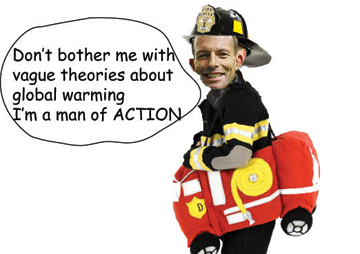 ony Abbott unmoved as UN report finds climate change happening all over the world BERNARD HUMPHREYS AND KATRINA STOKES THE ADVERTISER MARCH 31, 2014
PRIME Minister Tony Abbott has played down a United Nations climate report that predicts a dire future for the Murray-Darling Basin and the Great Barrier Reef, saying that “Australia is a land of drought and flooding rains, always has been and always will be”.
The UN’s Intergovernmental Panel on Climate Change says governments around the world can still avoid the worst of forecast droughts, floods and bushfires, but Mr Abbott says he remains reluctant to link extreme weather events to climate change.
1 This month


Help Aunty Sue Protect Her Land and Sacred Sites From Destructive Rocket Testing.
.

Australians deserve the truth
about
AUKUS – https://aukuspublicinquiry.com/

PETITION – To: Prime Minister Anthony Albanese and the Australian Labor Government

of the week – Australians for War Powers Reform (AWPR)
To see nuclear-related stories in greater depth and intensity

