Tony Abbott’s carbon theories seen as not intelligent
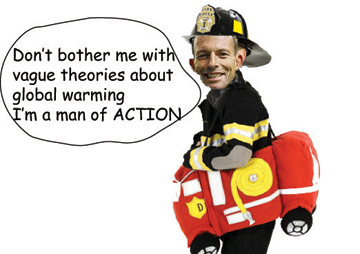 ”He’s now mocked John Howard’s design of an emissions trading scheme,” she said. ”Imagine Tony Abbott at an international meeting talking to Barack Obama and David Cameron – both of whom believe in action on climate change – and telling them that, ‘Look, this is just about the non-delivery of an invisible substance to no one.”’…… Just one in 10 Australians supports the Coalition plan to pay companies to reduce carbon emissions, the survey of 1000 people by JWS Research found
Abbott hit by backlash, The Age, July 16, 2013 Heath Aston, Mark Kenn Tony Abbott’s insistence that Labor’s emissions trading scheme is an expensive exercise in buying and selling an ”invisible substance” has drawn derision from climate experts and industry.
As the Rudd government prepares to detail a path from the carbon tax to an ETS a year earlier than scheduled, the Opposition Leader faces claims he is treading his own path back to the ”politics of climate denial and scepticism”.
Mr Abbott’s assertion that an ETS – to be introduced on July 1, 2014, as the government will announce on Tuesday – was a ”so-called market in the non-delivery of an invisible substance to no one” sparked an immediate backlash, with critics pointing out that former Liberal prime minister John Howard designed a similar scheme. Professor Richard Dennis, an economist at the Australian National University, said Mr Abbott should make it clear whether he thinks radiation was harmful or not. Continue reading
Old men prefer nuclear power, women prefer solar power
 Graph of the Day: Women prefer solar, old men like nuclear http://reneweconomy.com.au/2013/graph-of-the-day-women-prefer-solar-old-men-like-nuclear-48452 By Giles Parkinson on 16 July 2013 Today’s graph of the day comes courtesy of The Climate Institute, and its new publication, Climate of the Nation. The results are from a poll of 1,009 Australians (over 18) taken in the first week of June.
Solar and wind are by far the most popular, and wind gained the most support from the previous year, jumping from 59 per cent to 67 per cent. Coal and nuclear were the least popular, with nuclear falling from 20 per cent to 13 per cent. No fossil fuel gained more than 28 per cent approval, and geothermal and ocean energy have yet to capture the imagination.
But while this graph is self explanatory, there were some interesting findings along gender lines….. Continue reading
Kevin Rudd’s Emissions Trading Scheme is far from satisfactory
 Five reasons why Rudd’s ETS move should make us wince CRIKEY.COM GILES PARKINSON | JUL 15, 2013 Scrapping the carbon tax might push household costs higher rather than lower. That and other problems await the Labor Party as it seeks to wedge Tony Abbott with emissions trading……
There are reasons why the manner of Rudd’s move on the carbon price should make us wince. Here are five of them …
The cost to households……
It’s about politics rather than policy……
A low price is useless for Australia……
A policy without ambition
There is no evidence that Labor is going to aim for a more ambitious emission reduction target……
And what of the opposition?…... http://www.crikey.com.au/2013/07/15/five-reasons-why-rudds-ets-move-should-make-us-wince/
Greens launch energy policy to help farmers
 Greens pledge to help farmers save energy http://www.theaustralian.com.au/national-affairs/climate/greens-pledge-to-help-farmers-save-energy/story-e6frg6xf-1226679846791 BY:SUE NEALES, RURAL REPORTER The Australian July 16, 2013 THE Australian Greens have strengthened their grab for the rural vote at this year’s federal election, pledging $100 million in grants for farmers to save electricity and install solar and wind power.

 Greens leader Christine Milne will release the Greens’ new farm energy policy in a speech to the NSW Farmers annual conference in Sydney today, building on her claim that the Greens are the political party most in tune with the interests of farmers and regional Australia.
Senator Milne said yesterday the $100m farm energy program would become a policy priority pushed by the Greens after this year’s federal election, regardless of who wins power.
She claimed only the Greens were prepared to help farmers switch to cleaner energy sources and cut their power bills.
“That’s because Tony Abbott doesn’t believe in climate change, and Kevin Rudd has to find billions to fund his backflip on carbon pricing,” she said. Continue reading
Ignorance among Australians, even doctors, on the radiation hazard of CT scan
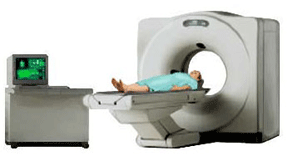 “It’s easier to administer, so it’s used more frequently – and is performed more often on children.
” we were astonished to find that many GPs incorrectly believe that CT scans deliver only a low-to-medium dose of radiation, and that MRIs and ultrasound scans also deliver radiation – they don’t.”
Radiating good health? Health Canal, Karen Green 15 July 13 CT scanning technologies have been simplified, but there are complex issues associated with the procedure, including its unnecessary use and the potential risk to the patient…….
“Australians are very keen to use new technologies. Current generations have different expectations of health care and thehealth system,” says Associate Professor Rachael Moorin, from Curtin’s Centre for Population Health Research……
Although most of us are keen to try medical innovations, Moorin is concerned about our lack of knowledge on some of the technologies we embrace – especially computed tomography, or CT, scanning. Continue reading
Clean Energy Future helping New South Wales’ farmers
A $1 million energy boost for NSW Farmers The Rural, July 15, 2013, NSW Farmers has received funding of $1 million from the Australian Government to deliver an energy innovation program to farmers across the state. Fiona Simson, President of NSW Farmers, said farmers urgently needed support in reducing their energy costs and in making decisions around their investment in energy related equipment.
“Over the past five years energy costs in NSW have risen approximately 60 percent for small to medium sized farming enterprises. Our own surveys and work by our partners in the program showed that farmers can readily achieve savings, but they also need the right advice and technical support,” she said.
Our farm energy innovation program will provide practical tools and advice to help farmers analyse their energy use and identify solutions. In addition, it will conduct pilots across 20 representative farms, involving the development of detailed strategies for intensive and broad acre operations. Continue reading
Australia must adopt an independent policy on Iran

 Will Australia erode or build trust with Iran? Guardian UK, NAJ Taylor, 15 July 13 The way forward is clear: Australia must adopt an independent foreign policy towards Iran on the nuclear question, as well as commit to dialogue Iranians now comprise the largest cohort of those seeking asylum in Australia each year. The tendency to dehumanise and securitise them is not only deeply disturbing, it is also beset, in part, by a paradox of our parliament’s own making: Australia has imposed sanctions on Iran since 2008. Continue reading
Aborigines’ 8 year battle against nuclear waste dumping
“We’ve been arguing for a long time that the Northern Territory was targeted because it was a politically weaker jurisdiction.
“Obviously it was easier for the Commonwealth to override any local opposition to the plan, which is what they’ve done.
“We want the Territorian Senators to actually stand up for the interests of the community, and not just roll over and say that we’ll accept Canberra’s waste dump plan.”
Dust-up over nuclear waste dump hits eight years http://www.abc.net.au/news/2013-07-15/opposition-grinds-on-over-muckaty-nuclear-waste-dump-plans/4820806 Jul 15, 2013 A Northern Territory traditional owner has vowed to keep fighting federal government plans for a radioactive waste dump on her land.
Dianne Stokes is in Melbourne today for a scheduled Federal Court directions hearing on the Muckaty waste dump.
Today also marks eight years since the Federal Government announced a plan to dump nuclear waste in the Territory. Continue reading
Australian science adds to knowledge on radiation risks of CT scans
Another recent study from Australia by John Matthews and colleagues, published in BMJ, helps give us a bit more perspective….The peril was greater for children exposed at younger ages and was linked to many different types of malignancies — including cancers of the brain, skin, blood and gut…….
Dr. Dustin Ballard: Examining the trade-offs with CT scans marinij.com By Dr. Dustin Ballard 07/15/2013 IN MEDICINE, like in life, there are almost always trade-offs. Most treatments, even unassuming ones like oxygen, have side effects. And most medical tests hold the potential of unintended consequences.
Consider the recent evidence about the long-term effects of CAT Scan (CT) radiation in children. But, before we get there — please don’t flip out — CTs can be valuable tools, so please don’t decide that you will boycott them entirely.
That said, it’s undeniable that there’s been an explosion in the use of CTs, and that this is a concerning trend. Mounting evidence shows that CT exposure in childhood results in a small but real increased risk of cancer later in life……. Continue reading
Sunshine Council – an Australian first – to have council solar farm
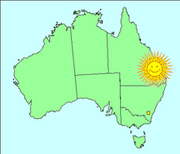 Sunshine Coast Council To Go Solar http://www.energymatters.com.au/index.php?main_page=news_article&article_id=3837 14 July 13, Queensland’s Sunshine Coast Council is planning to build a solar farm that would supply half of its electricity needs. Mayor Mark Jamieson says it would be the first council in Australia to have a utility scale solar farm constructed.
“The $24-30m solar farm proposed to be built at Valdora near Coolum would meet half of council’s electricity needs for at least the next 30 years,” he said. “Over the next three decades council is expected to pay in excess of $110m for electricity, and the solar farm would have the potential to reduce that by many millions of dollars.”
Council believes it will save around $10 million over the expected life of the project.
The solar farm project would inject $10 million into the local economy over the next 10 years and create 40 jobs during construction.
One of the reasons Sunshine Coast Council believes now is the right time to invest is energy contract re-negotiation with current retailers is due in 2014. It also recognises solar panel prices are currently very low; something that could change given fluctuations in the Australian dollar and other factors.
The solar farm would help develop the Sunshine Coast’s cleantech industry hub and skills developed during construction could be deployed to similar projects within Queensland and elsewhere in Australia; helping to further diversify the local economy.
“This project has the potential to transform the Sunshine Coast. It would become the embodiment of everything we stand for; a region which is economically, environmentally and socially sustainable,” said Councillor Mark Jamieson. “It would save money, reduce our carbon footprint and take us another step closer to becoming the most sustainable region in Australia”
Council will call for Expressions of Interest to design and build the solar farm in the next few weeks and hopes construction will commence in 2014.
Doom and gloom in Australia’s uranium investment sector
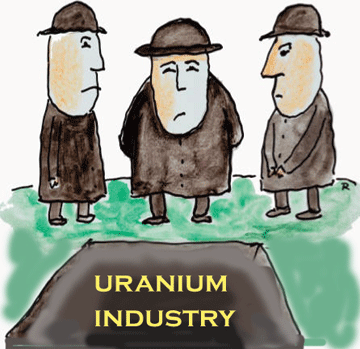 Uranium, rare earths miners in doldrums BY:ROBIN BROMBY The Australian July 15, 2013 A FEW years ago, talking up a well-balanced portfolio of uranium and rare earth elements assets would have been a mouth-watering come-on for investors. Not now, of course.
You’ve got Toro Energy (TOE) with most of its ducks in a row including finance and government approvals to develop Western Australia’s first uranium mine.
All except the rather important duck of a spot uranium price somewhere in the vicinity of $US70 a pound that would make the mine viable; it’s stuck with $US39.50/lb.
A few years ago, the average resources punter would have sold their children to raise money for buying such a share, but Toro languishes at just 9c.
And there was disappointment on Friday for Aura Energy (AEE), French nuclear giant Areva pulling the plug on plans to partner up with the Australian junior in its Haggan uranium project in Sweden, one of the largest undeveloped uranium projects in the world (389,000 tonnes)…..
PolitiFact – Fact Checker finds Coalition’s carbon price claims are false
 Coalition’s $15b carbon price claim ‘mostly false’ (includes videos) The Age, July 15, 2013 Peter Martin Economics correspondent What’s in a fact check?
Peter Martin explains how Fairfax’s fact-checking collaboration with PolitiFact, and reports back on its first target, the Coalition’s $15b carbon pricing claim.
The Coalition’s claim that moving swiftly to a floating carbon price would cost the budget up to $15 billion has been rated “mostly false” by the fact-checking service PolitiFact, which partners with Fairfax Media from Monday.
During the 40 days leading up to the election, PolitiFact will publish a checked fact a day on The Sydney Morning Herald and The Age websites.
The claim the change would mean “a black hole of up to $15 billion in the budget” was made by shadow treasurer Joe Hockey on the Channel Seven Sunrise program on Friday, June 28, two days after Kevin Rudd retook the Labor Party leadership…….More details are available at politifact.com.au. http://www.theage.com.au/federal-politics/federal-election-2013/coalitions-15b-carbon-price-claim-mostly-false-20130714-2py81.html#ixzz2ZA7evzxO
Greens’ Christine Milne strikes a positive note for Australia’s clean energy revolution
 Greens urge creation of clean energy map for the community http://www.theaustralian.com.au/national-affairs/election-2013/greens-urge-creation-of-clean-energy-map-for-the-community/story-fn9qr68y-1226678708055 BY:SID MAHER The Australian July 13, 2013
THE Greens will today propose the creation of new economic zones to speed the development of renewable energy as part of an election campaign roadmap to cut the nation’s reliance on fossil fuels.
Greens leader Christine Milne will unveil a policy allocating $2 billion to a task group within the Department of Energy to map Australia’s clean energy resources, involve local communities in planning energy projects and run a competitive tender to link clean energy hotspots to the national energy grid.
The policy argues “where our world-beating clean energy resources and genuine community support align”, renewable energy development zones should be established with quicker approval processes for clean energy projects. Continue reading
Australian Renewable Energy Agency sharing knowledge on industry development
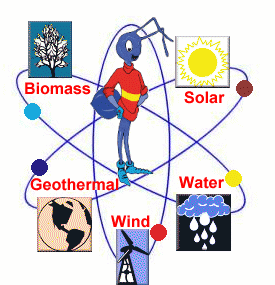 Supporting renewable energy knowledge EcoGeneration — July/August 2013 As the Australian Renewable Energy Agency approaches its one-year anniversary, it is consulting with Australia’s clean energy industry to devise best practices for sharing project knowledge, in order to assist with the overall expansion of the industry.
In November 2012, the Australian Renewable Energy Agency (ARENA) released a consultation paper on its Supporting High-Value Australian Renewable Energy (SHARE) Knowledge Initiative in order to seek input from the clean energy industry in designing and implementing the initiative.
In particular, ARENA sought views on the extent to which project-specific information should be shared for the growth of the sector; the key issues the program should aim to address; and the questions the initiative should aim to answer.
Sharing industry information
SHARE is intended to disseminate knowledge from ARENA projects, and offer funding for strategic knowledge development that addresses key knowledge gaps and increases awareness and acceptance of renewable energy technologies. ARENA hosted one-on-one meetings with companies involved in developing utility- and large-scale projects as part of its consultation on designing and implementing SHARE. The Agency also sought input from stakeholders involved in smaller-scale projects, such as research projects, and noted the importance of information, data and knowledge from these smaller projects.
Its aim is to maximise the value of supporting individual projects, for both industry participants and the general community.
“Given ‘learning by doing’ is a key aspect of many ARENA-funded projects, this additional value can come in the form of information, data and knowledge that can lead to a cascade of new projects,” the Agency said in its SHARE consultation paper
The industry responds…… http://ecogeneration.com.au/news/supporting_renewable_energy_knowledge/082503/
Renewable energy is revolutionising Australia’s power generation sector
 Renewable Energy Making Its Presence Felt In Australia http://www.energymatters.com.au/index.php?main_page=news_article&article_id=3836, 12 July 13 Once disregarded as being any sort of threat to the energy status quo; renewable energy is rapidly changing the power generation sector in Australia.
According to a new report from the Energy Supply Association of Australia (ESAA), new renewable and gas power stations now account for more than 90 per cent of planned energy investment in the country.
Wind farms made up half of all new large-scale generation investment in 2012-13, compared to just 11 per cent in 2002-03.
The ESAA has acknowledged renewable energy has reined in the average wholesale price of electricity; but believes this isn’t necessarily a good thing. Others might argue the energy gravy train losing a little of its bloat is a very good thing indeed. The number of instances where the wholesale cost of electricity jumped above $300 per megawatt hour have greatly decreased in recent times. The consumer is yet to see any benefit as any savings have been overshadowed by network cost increases.
The ESAA raises the spectre of reliability issues possibly resulting from a sustained lower wholesale electricity price, but it has noted reliability in Australia’s electricity supply improved in 2011/12 according to the Australian Financial Review. The ESAA also says the value of the National Electricity Market has shrunk by more than $4 billion, or 40 per cent, in the last four years.
In its public statement regarding the report, the ESAA has avoided directlydemonising home solar. A previous discussion paper on energy in Australia released by the organisation was criticised as being riddled with myths in this regard.
ESAA’s membership includes AGL, Origin, Energy Australia and other Big Energy participants.
The marked increase in renewable energy in Australia has also played a role in reducing power generation related carbon emissions. The pitt&sherry Carbon Emissions Index indicates electricity generation in the National Electricity Market (NEM) 2011-12 to 2012-13 decreased by 2.2 percent while emissions were down by 12.2 million tonnes carbon dioxide equivalent -equivalent to just under seven percent for the first full year under the carbon tax.
1 This month
17 October, Free Public Talk on Nuclear Issues in South Australia
David Noonan will speak on public interest concerns over the new Roxby Downs Indenture Act 2026 on BHP copper-uranium mining and ore processing in SA, and on how AUKUS may face SA with a High-Level nuclear waste agenda.
Dr Jim Green will discuss international developments in the field of nuclear power including ‘small modular reactors’ and Generation 4 ‘advanced’ nuclear reactor concepts.


Help Aunty Sue Protect Her Land and Sacred Sites From Destructive Rocket Testing.
.

Australians deserve the truth
about
AUKUS – https://aukuspublicinquiry.com/

PETITION – To: Prime Minister Anthony Albanese and the Australian Labor Government

of the week – Australians for War Powers Reform (AWPR)
To see nuclear-related stories in greater depth and intensity

