Hegseth Orders Pacific Allies To Arm For China War

This turns reality upside down. China is not surrounding the United States. The United States is surrounding China.
Australia is also building a submarine construction yard at Osborne in South Australia. Assembly of the first domestically built submarine is expected to begin in the early 2030s, with delivery projected in the early 2040s. The program binds Australia’s military future to U.S. war planning for decades.
June 5, 2026, Gary Wilson, Struggle – La Lucha. https://scheerpost.com/2026/06/05/hegseth-orders-pacific-allies-to-arm-for-china-war/
U.S. Secretary of War Pete Hegseth went to Singapore on May 30 with an order for Washington’s allies and partners in the Indo-Pacific: spend more on war or face consequences.
Hegseth used China as the pretext to demand that U.S.-aligned governments spend more on war, buy more weapons and bind their militaries more tightly to Washington.
At the annual Shangri-La Dialogue, Hegseth told defense ministers, military chiefs and diplomats that U.S. military power had carried the region for too long. “The era of the United States subsidizing the defense of wealthy nations is over,” he said. “We need partners, not protectorates.”
That is the language of empire collecting rent.
Washington arms the region. It bases troops across it. It commands the alliance structure. Then it demands that every subordinate government reshape its budget to fit U.S. war plans.
Hegseth said the U.S. expects its allies and partners to raise military spending to 3.5% of gross domestic product — the same demand the Trump administration has pressed on NATO. Governments that comply will move to “the front of the line” for arms sales, intelligence sharing and military-industrial cooperation, he said. Those that refuse will face “a clear shift in how we do business.”
This is not “burden sharing.” It is a demand that governments turn more workers’ wages into missiles, submarines, drones, warships and bases. Every percentage point added to military spending means less for housing, health care, schools, pensions and disaster relief.

Hegseth claimed there was “rightful alarm” over China’s military buildup and warned against “a Pacific dominated by any hegemon.”
Hegseth said the U.S. expects its allies and partners to raise military spending to 3.5% of gross domestic product — the same demand the Trump administration has pressed on NATO. Governments that comply will move to “the front of the line” for arms sales, intelligence sharing and military-industrial cooperation, he said. Those that refuse will face “a clear shift in how we do business.”
This is not “burden sharing.” It is a demand that governments turn more workers’ wages into missiles, submarines, drones, warships and bases. Every percentage point added to military spending means less for housing, health care, schools, pensions and disaster relief.
Hegseth claimed there was “rightful alarm” over China’s military buildup and warned against “a Pacific dominated by any hegemon.”
This turns reality upside down. China is not surrounding the United States. The United States is surrounding China.
China again declined to send its defense minister to the Shangri-La Dialogue. Beijing was represented instead by a delegation led by PLA Major General Meng Xiangqing, who pointed to the concrete threats Washington and its allies are advancing in the region: Japan’s military expansion and AUKUS, the U.S.-British-Australian submarine pact.
Meng tied Japan’s buildup to history. He noted that 2026 marks the 80th anniversary of the opening of the Tokyo Trials, which condemned Japanese militarism after World War II. He questioned whether a country that has not fully reckoned with that legacy has any standing to lecture Asia about defense cooperation.
That was the point Washington wants covered up. U.S. imperialism now needs Japan — the former colonial and military oppressor of much of Asia — as a forward base for confrontation with China.
Japan’s cabinet has approved a record defense budget exceeding 9 trillion yen, roughly $58 billion, for fiscal 2026. The budget funds long-range strike missiles, drone systems and next-generation fighter development. The buildup marks a major break from Japan’s postwar “exclusive self-defense” doctrine, long understood as limiting Japan’s military to defensive operations.
Washington is not worried about the return of Japanese militarism. It is encouraging it, so long as that militarism is tied to U.S. strategy against China.
The military map Hegseth pointed to is the First Island Chain — the arc running from Japan past Taiwan to the Philippines along China’s eastern coastline. Washington calls this “deterrence by denial.” In plain language, it means using bases, fleets, missiles, war exercises and allied governments to hem China in, with Taiwan turned into a forward position in U.S. war plans.
On the sidelines, Hegseth met Philippine Defense Secretary Gilberto Teodoro and pledged stronger military cooperation along the First Island Chain. The two governments pointed to the latest Balikatan war exercise, which brought troops from Australia, Japan, Canada, France and New Zealand onto Philippine soil.
Hegseth praised South Korea for pledging to spend 3.5% of GDP on its military. He praised the Philippines for a 12% increase. He commended Japan for accelerating its “defense transformation.” He cited Australia for deeper integration with U.S. forces.
In every case, the praise was for governments moving their budgets, industries and armed forces closer to U.S. war planning.
Meng also targeted AUKUS, the military pact among the U.S., Britain and Australia formed in 2021. Its central project is equipping Australia with nuclear-powered attack submarines.
On the sidelines of the forum, the three AUKUS partners revised the submarine plan. Australia had been expected to buy at least two used Virginia-class submarines and one new one. Under the revised plan, it will buy three secondhand Virginia-class submarines from the U.S. instead.
Australia showed the pressure beneath Hegseth’s praise. Canberra has already announced that military spending will rise to 3% of GDP by 2033, with about $10 billion more over four years and $38 billion over the decade. But that still falls short of Hegseth’s 3.5% demand.
This is how the Pacific war buildup works in practice: Australian workers pay, U.S. shipyards and weapons firms collect, and the Pentagon tightens its grip on the region.
Australia is also building a submarine construction yard at Osborne in South Australia. Assembly of the first domestically built submarine is expected to begin in the early 2030s, with delivery projected in the early 2040s. The program binds Australia’s military future to U.S. war planning for decades.
China has condemned AUKUS as stoking bloc-to-bloc confrontation in the Pacific. Meng’s remarks made clear that Beijing sees it as part of the same encirclement strategy behind the First Island Chain buildup.
Washington’s direction is clear.
The Shangri-La Dialogue is not a peace conference. It is an annual assembly of military planners and arms buyers. Hegseth’s speech was its keynote sales pitch.
A brief history of Australia eating shit on AUKUS.
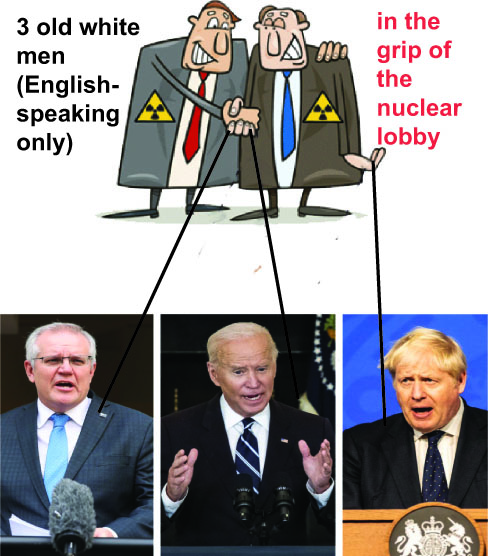


Australia remains undeterred in ‘welcoming’ AUKUS setbacks left, right and centre.
Charlie Lewis, Jun 3, 2026,
https://www.crikey.com.au/2026/06/03/aukus-setbacks-submarines-defence-richard-marles/
Defence Minister Richard Marles met with US Secretary of War Pete Hegseth in Singapore over the weekend to announce a “streamlining” of the AUKUS deal, under which Australia will buy three used Virginia-class submarines rather than two used and one new, as was initially agreed.
Under questioning from the shadow defence minister James Paterson in Senate estimates on Tuesday, Defence Secretary Meghan Quinn said, actually, this was what Australia had wanted all along: “Australia’s position is that we would have always … had a preference for three in-service (submarines).”
Labor’s former industry minister Ed Husic, more able to speak his mind after his post-election ousting, didn’t agree with this take, telling the media: “This deal has changed.”
Husic may be waiting a while if he’s hoping for a rethink. As Australia’s history demonstrates, our government has been willing to swallow a lot without its loyalty to the alliance being the least bit shaken.
It started as it meant to go on. On September 15, 2021, Scott Morrison, Joe Biden and Boris is Johnson — the respective world leaders at the time of Australia, the US and the UK — announced the $368 billion trilateral AUKUS deal.
Morrison spoke of how the submarine pact represented the countries’ mutual “enduring ideals and shared commitment to the international rules-based order” (a commitment that somehow looks even shakier now than it did then). It would later be revealed that Morrison had preemptively caved on local construction, reducing the previous requirement that 60% of the submarines be built in Australia to 40%.
Biden responded by forgetting Morrison’s name. “Thank you, Boris. And I want to thank that fella Down Under. Thank you, pal. Appreciate it, Mr Prime Minister.”
A side note: Morrison’s now irreparable reputation as a habitual liar (something that only malcontents like us seemed to have previously cared about) was sealed by AUKUS. A month after the deal was announced, French President Emmanuel Macron, whose own submarine arrangements with Australia were torn up to make way for AUKUS, told a press pack that he knew Morrison had lied to him.
Adding to the general sense of humiliation, Biden hung Australia out to dry, claiming that he was “under the impression that France had been informed” of the changes.
The sense that its arrangements with Australia weren’t exactly front of mind for the US was reiterated in February 2025 when newly reelected president Donald Trump was asked about AUKUS and had to be reminded what the program was.
In August last year, Richard Marles’ office said in a statement that he would be travelling to the United States that week, where, in Washington, D.C., he would meet with Secretary of Defense Pete Hegseth and other senior administration officials.
Except that wasn’t true: despite Marles’ posting of an illusory photo, the Pentagon made it very clear that “there was not a meeting” and that it was “a happenstance encounter”.
The next month, Anthony Albanese would do little better: during his visit to the US, unable to secure a proper meeting with Donald Trump, he was reduced to collaring the president for a selfie.
A meeting was eventually held between Trump and Albanese in October, but the Australian humiliation was not done. A Sky News Australia journalist made sure the topic of then US ambassador Kevin Rudd’s previous criticism of Trump came up, and the abiding memory of the meeting would be Trump, surrounded by nervous giggles, telling Rudd, “I don’t like you either, and I probably never will.”
In April 2025, the newly elected Labour government in the UK launched an AUKUS parliamentary inquiry. In June, the Trump government followed suit, with Under Secretary of Defense for Policy Elbridge Colby appointed to conduct the review.
And that was FINE, said Marles: “Our engagement with the Trump administration and across the full political spectrum in the United States has shown clear and consistent support for AUKUS. We look forward to continuing our close cooperation with the Trump administration on this historic project.”
Marles hadn’t, we can only assume, read Colby’s actual views on AUKUS going into the review, which stated that “the benefits are questionable and the viability is also questionable”. In July, Colby announced that the initial deadline of 30 days would not be met.
When asked if this is cause for concern, Albanese insisted: “No, it’s not surprising that that would be the case, and it’s something we expected, something like that. We expected a review from an incoming government, just like the Keir Starmer government did. We expect that those things take longer than just 30 days.”
In September 2025, the review was still not done. Richard Marles told ABC’s RN Breakfast that the US review was a good thing, actually: “As I’ve said repeatedly, we welcome this. It’s an opportunity to look at how we can move forward with AUKUS, how we can improve and do it better.”
In April this year, the UK defence committee delivered its review, finding, among other things, serious issues with worker shortfall in key production areas and a timeframe of at least 20 years to make the necessary upgrades to the Royal Navy to sustain its current boats and the new AUKUS vessels.
The government insisted it was “really comfortable that AUKUS is on track”.
But among all of these moments of humiliation, our favourite is that which must have befallen the Department of Defence official who pitched the “nuclear-powered submarine propulsion challenge” for high schools.
It was a combination of propaganda and child labour that would have been remarkably tone deaf at the best of times, but it went a step further, launching on the worst possible week to try to make kids think about submarines: when the Titan submersible suffered a “catastrophic implosion” and instantly killed all five passengers on board.
Charlie Lewis is Crikey’s reporter-at-large, focusing on politics, culture, history and the US. Got a tip? Contact him securely on Signal @clewis.25.
Australian flotilla survivors describe ordeal after Gaza mission
By Jane Salmon | 4 June 2026. https://independentaustralia.net/life/life-display/australian-flotilla-survivors-describe-ordeal-after-gaza-mission,21133
A humanitarian mission may have ended at the border, but for some Australian participants, the ordeal was only just beginning, writes Jane Salmon.
WHEN ACTIVIST Neve O’Connor boarded a humanitarian flotilla bound for Gaza, she knew there was a possibility she might be stopped.
What O’Connor did not expect, she says, was that the most frightening moments would come after the mission was over.
“Just when we thought we were safe, the beatings started again,” the Melbourne student and community organiser recalls.
O’Connor is among a group of Australian participants in the Global Sumud Flotilla who have returned home alleging they were subjected to violence, intimidation and degrading treatment following the interception of their aid mission.
The flotilla was attempting to deliver food, medicine and baby formula to civilians in Gaza. Participants say they were detained after the vessel was intercepted and have since spoken publicly about what they describe as a pattern of physical, psychological and sexual abuse during their detention.
Now, as lawyers, medical professionals and human rights advocates gather testimony from those involved, participants are revealing details of what they say happened in the final hours before they were deported.
For O’Connor, those memories begin at the airport. After days in detention, she believed the ordeal was finally ending. Instead, she alleges the violence intensified.
O’Connor says:
“Before I could speak to Australian representatives, I was grabbed and dragged away.”
According to O’Connor, participants were prevented from communicating with consular officials and were physically forced through the airport toward their departing aircraft.
She describes a truly unsettling scene.
People were allegedly shoved, kicked and struck as they were moved through the terminal and across the tarmac. O’Connor says she witnessed punches and elbows to the backs of people’s heads, repeated hair-pulling and participants being tripped as they walked.
One woman, O’Connor alleges, was thrown into a wall with such force that her elbow split open.
O’Connor says she herself was thrown into a door before being tripped and stomped on:
“I fell and several men stomped on me while I was on the ground.”
The alleged assault, O’Connor claims, continued right up to the stairs of a waiting aircraft.
For participants, the airport experience has become one of the most troubling aspects of their journey, occurring at the point when many believed they would finally be leaving danger behind.
O’Connor said:
“This is how Israel said goodbye to people whose only crime was trying to deliver food, medicine and baby formula to starving civilians.”
Participants argue that what they experienced was not limited to one location or one group of officials.
Instead, they allege that abuse occurred throughout the detention and deportation process and involved multiple layers of authority, including soldiers, immigration officers, police, prison guards and airport personnel.
That consistency, they argue, raises broader questions about how humanitarian activists were treated after being detained.
The Australians are also asking questions about their home country’s response.
Some participants say they were unable to communicate freely with consular representatives before departure and are seeking clarification about what Australian officials knew of their treatment during the transfer to the airport.
The questions did not end when the flight landed.
Several participants report being detained and searched upon arrival in Australia. They say mobile phones were confiscated and that they were instructed to provide passwords under threat of legal consequences.
For some, the experience was deeply unsettling.
Fellow participant Juliet Lamont said:
After everything that happened overseas, to be treated like terrorists or extremists rather than humanitarians was shocking.
Australians deserve answers about what happened when survivors came home. Serious questions remain about the treatment of Australians both overseas and upon their return.
The allegations come at a time of intense international scrutiny of Gaza and growing public debate over the treatment of humanitarian activists attempting to challenge restrictions on aid deliveries.
For O’Connor, however, the issue is ultimately personal. Raised believing in fairness and the value of human life, she says the devastation in Gaza compelled her to act rather than remain a distant observer. She rejects the idea that courage is simply enduring hardship. Instead, she sees it in collective acts of solidarity.
O’Connor says:
“Strength and bravery don’t look like grim endurance. They look like people choosing to sail toward Gaza because they refuse to let despair win.”
The Global Sumud Flotilla is calling for accountability over the allegations and has requested a meeting with Prime Minister Anthony Albanese.
Whether that meeting eventuates remains unclear.
What is certain is that, for those who returned home carrying both physical injuries and difficult memories, the voyage did not end when the boat was stopped.
For many participants, the journey is now entering a new phase — one focused not on reaching Gaza, but on seeking answers about what happened after they tried.
Jane Salmon is a refugee advocate whose family has benefitted greatly from the NDIS. You can follow her on Twitter @jsalmonupst
The Hand-Me-Down Alliance: Australia, AUKUS and Op-Shop Submarines
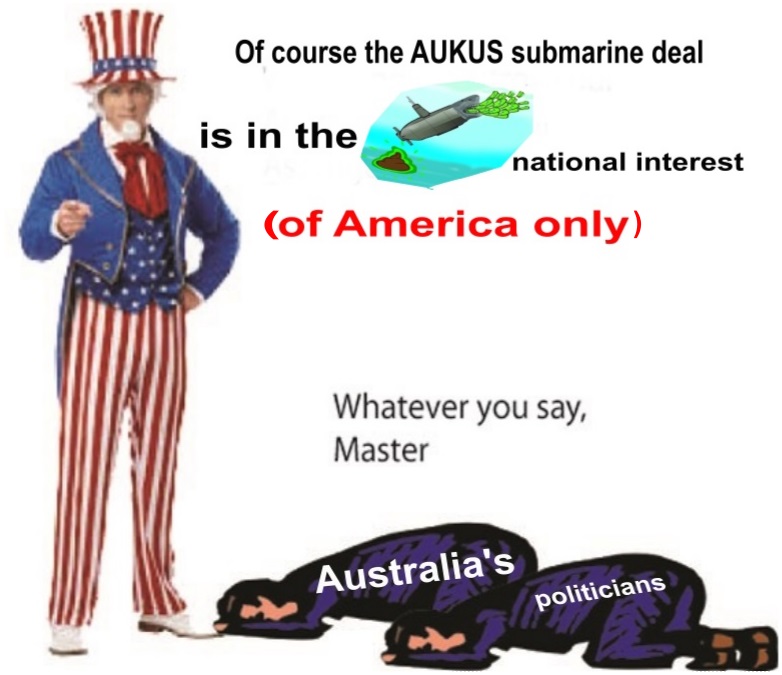
3 June 2026 Dr Binoy Kampmark, https://theaimn.net/the-hand-me-down-alliance-australia-aukus-and-op-shop-submarines/
One can never accuse the Australian political palette of being too demanding, let alone attentive. When it comes to matters of defence, that palette is happy to be deceived, remaining credulous to the notion it is sensitive to good taste and observant of flavours. When it comes to alliances, this especially so. As for the AUKUS agreement, it was clear that the Australian establishment was simply incapable of tasting anything in the way of the rancid or putrid. Of the three participating countries in this doomed ménage à trois – the United States, the United Kingdom and Australia – it was the last of the trio that has been left providing the most while receiving the least.
Centred on two pillars of poor understanding and unequal exchange, the AUKUS agreement is mouldering in unenviable disgrace. The first pillar envisages (dare on use the current tense?) the purchase of SSNs (nuclear-powered submarines) of the Virginia-Class from the United States that may run into three boats, possibly even two additional ones. According to the fatuous and vacuous Australian Submarine Agency’s assessment, the “acquisition will eliminate any capability gap and increase the 3 nations [sic] (Australia, UK and US) ability to deter aggression and contribute to peace and stability in the Indo-Pacific.” Eventually, the SSN-AUKUS, a hybrid of UK design, US technology and Australian gristle, will also be added to the fleet, a prospect bound to give few joy.
But the docile and the doltish in Canberra do not seem alert to the grumbling mood in Washington that any transfer of these hulks would only take place on exclusive American terms. Doubt about Australian worthiness in using such boats in a war with China if called upon (call it want of skill, call it reluctance); and doubts about the rate of production back home (the annual rate of two Virginia SSNs remains tardily elusive), has made the very idea of conveying such vessels to Canberra improbable.
The latest discussions by US Secretary of War Pete Hegseth, Australian Defence Minister Richard Marles and UK Defence Secretary John Healey, held on the sidelines of the International Institute of Strategic Studies Shangri-La Dialogue in Singapore, also confirms that the boats, should they ever arrive, will be of the optional, rather than optimal shop variety. They will be second hand goods with a shorter life span and less troubling to let go of by the US Navy. Give the Aussies the hand-me-downs. They’re worth it.
A May 30 joint statement from the ministers was a tedious, tortuous garble that did little to hide the fact that Australia has been degraded and sent packing to the cooler. “The Deputy Prime Minister and Secretaries welcomed the proposed approach to streamline Australia’s acquisition of Virginia-class submarines (VCS), simplifying chain management, operational and maintenance requirements and maximizing cost efficiencies. This approach would enable Australia to acquire three in-service VCs in lieu of a mixture of new and in-service VSs variants.” Without a smidgen to go on, the trio also claimed that “significant progress in the design and delivery of SSN-AUKUS, which will provide the UK and Australia with an advanced warfighting capability” had been made.
It is worth recounting the stages of cloddishness that culminated at this current pass. In 2023, the Australian government accepted the position that the US would sell it three Virginia-class boats in the early 2030s, with the following observation: “The first two will be used but refurbished Block 4 boats with 23 years of remaining life and the third will be a brand new stretched Block 6 boat fitted with the 84-foot-long payload of greatly increased weapons loads.”
Instead of expressing rage and disgust at this diminution of worth, the Australian defence minister has accepted the revised plans with beaming, coprophagic glee. Appended to the stained grin are explanations worthy of immediate sinking. Not having three second-hand SSNs would have seen a situation of one new Virginia-class SSN operating alongside in-service Collins-class submarines and the new SSN-AUKUS boats. This unpardonably dreamy nonsense, anticipating that all three boat varieties would be sharing the sea at the same time, at least allowed Marles to yearn for a simpler world of equipment. The word “simple,” it would seem, is his favourite word of the moment. In remarks to reporters, he observed that a “simpler pathway” had presented itself. “It will mean that the Virginia-class submarine that we are acquiring will be all of the same type of. And I cannot overstate the significance of that, both in terms of the submariners who are operating them, but also the people who are working on them to sustain those submarines.”
In Australia, the opposition defence minister, James Patterson, had least had the decency to demand “a proper explanation from the government – more than just a single sentence in a joint statement.” The Greens Senator David Shoebridge, was less accommodating to the servile capitulation from Marles. “We’re not just over a barrel with the United States – we have literally said to them they can name the price, they can give us the biggest lemon in the fleet – three of them – and Richard Marles will give that blank cheque to the US.”
All the signs of demented decay and facile strategic thinking are there in this pact. The need to extend the life of the Collins-class submarines. The likelihood that the United Kingdom will be unable to stomach its side of the bargain. The continued bleeding of the Australian purse for American and British submarine building. And the deeply troubling sense that, when the time comes, the United States will go to war with China, expecting Australia to muck in. Given that Canberra has contrived and connived to turn Australia into an increasingly attractive garrison for adversaries to target, the room for escaping the orbit of an avoidable catastrophe, be it financial or military, is rapidly shrinking. Marles is unabashed by it all. “Chasing simplicity is at the heart of why we have pursued this.” A simplicity that well qualifies for the “bloody fool” category, one soon to be explored by a public inquiry that promises to be a real hoot.
Will AUKUS keep us safe – at what cost?

AUKUS Public Inquiry, 2 June 2026, Canberra, https://newshub.medianet.com.au/2026/06/will-aukus-keep-us-safe-at-what-cost/155928/
For the first time, the Australian community will have the opportunity to investigate the controversial and secretive AUKUS defence pact. Today, five esteemed Australians will launch a nationwide Public Inquiry into AUKUS at Parliament House, Canberra. From diverse backgrounds and disciplines, but united in their commitment to transparency, democracy and the defence of Australia, Peter Garrett, Carmen Lawrence, Chris Barrie, Leanne Minshull and Karina Lester will head the public inquiry into AUKUS beginning today. Full Commissioner profiles can be viewed here.
There has never been a more critical time to get the truth about AUKUS and what it means for our nation. The Federal Government is planning to spend $368 billion-plus of our taxes on nuclear-powered submarines – the largest defence spend in our history — without answers to basic questions such as: will Australia receive the submarines we’re paying for on time and on budget; where will the high-level nuclear waste generated by the subs be stored; how many Australian jobs will be created and at what cost, and crucially, will this project keep us safe — or turn us into a nuclear target?
Lead Commissioner Peter Garrett said,
“AUKUS is by far the most expensive and complex undertaking ever entered into by any Australian Government and yet the opportunity to question, debate and decide has been taken out of the hands of the parliament and the people. A Public Inquiry into this massive spend of taxpayer’s money is long overdue.”
Commissioner Admiral (Retd) Chris Barrie AC said,
“As Chief of the Defence Force in the late 90s and early 2000s, I investigated the proposition of acquiring nuclear powered submarines for Australia but there was little interest in it then and we all need to know why suddenly, there is huge interest, secrecy and money available for the AUKUS submarines today. That’s what this Inquiry is for.”
Commissioner Dr Carmen Lawrence said,
“A basic requirement of any functioning democracy is transparency from our Government. It is simply not credible that the Federal Government can take nearly $400 billion from the Australian people, make private deals with US and UK technology companies and foreign governments to access the Australian mainland and our data, and then tell us not to ask questions. Australians would never accept that, and nor should we. That’s why this Inquiry is vital.”
Yankunytjatjara woman and Commissioner Karina Lester said.
“For decades Aboriginal people of this country have had nuclear weapons tested on our traditional lands, we have been pressured to be the solution to nuclear waste. Our traditional lands have been mined on and our communities continually pressured by an industry that has harmed us for generations. What is Australia’s plan to manage the nuclear waste under this AUKUS Agreement? Will Australia be taking in nuclear waste from the UK and the US under this agreement? We fear it will be our mobs and our countries that is expected to take it. And once again, no one has bothered to talk to us. We have the lived experience and that’s why First Nations voices are crucial to this Public Inquiry.”
Commissioner Leanne Minshull said,
“The projected cost of $368 billion for AUKUS is hard to conceptualise. Think about Australia’s biggest wealth fund, set up in 2006. After 20 years of squirreling away money and banking investment returns, the future fund is now worth $337 billion. The cost of AUKUS would wipe out these generational savings and then some.If we are to spend the equivalent of our national savings, on a single project, the benefit needs to be clear and overwhelming. What won’t we be able to fund? How many jobs will be created from this project? Where will those jobs be? In a tight labour market, how will those jobs be filled? Will they divert skills from other national priorities like building residential homes? Will these jobs be the worst targeted, most expensive in Australian history?”
This nation-wide inquiry into AUKUS will seek answers to a number of critical questions. The Terms of Reference can be found here and the website here. The Inquiry will be taking written submissions and conducting hearings across Australia.
AUKUS Public Inquiry media contacts:
Phil Davey 0414 867 188, phil@mountainmedia.com.au
Julie Macken 0400 925 217
AUKUS. From ‘best’ we’ll never get to second hand subs
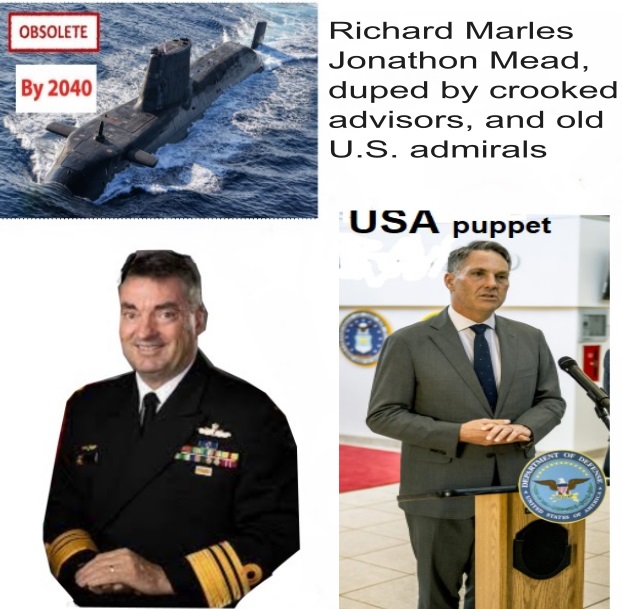
Meanwhile, Defence Minister Richard Mares maintains the facade. He’s either dishonest or dumb. Time will tell which one it is.
by Rex Patrick | Jun 1, 2026, https://michaelwest.com.au/aukus-from-best-well-never-get-to-second-hand-subs/
Defence Minister Marles announced a change to the AUKUS submarine program: second-hand subs! What’s the scam?
The scam is, at an enormous cost of (at least) $368B, we now only get second-hand subs from the US while we wait for the promised nuclear subs on the never-never.
In May 2023, Admiral Mead, the head of the Australian Submarine Agency, told the Senate that the first two Virginia-class subs that would be transferred to Australia would be second-hand, and the remaining subs would be brand new. He repeated it a year later.
But the reality is and always has been different. The US is only building about 1.2 subs per annum and needs to get to a built rate of 2.0 to meet US needs, and 2.3 to meet theirs and ours. They have no way of getting there.
We’ve sent $2.8B non-refundable taxpayers’ dollars to the US over the past two years to try to shift the build rate dial, and it’s done nothing, other than drain our Treasury.
Anyone who bothers to read the US Congressional Research Service’s advice to Congress on AUKUS knows we will not get subs from the US. Anyone who has bothered to read the recently released UK Parliamentary report on AUKUS knows we will not get subs from the UK.
The Albanese Government has embarked on an all-eggs-in-one-basket program where,
“the US hens are not laying enough eggs, and the UK chooks are headless?.
Meanwhile, Defence Minister Richard Mares maintains the facade. He’s either dishonest or dumb. Time will tell which one it is.
Rex Patrick is a former Senator for South Australia and, earlier, a submariner in the armed forces. Best known as an anti-corruption and transparency crusader, Rex is also known as the “Transparency Warrior.”
Royal Commission under fire for excluding Palestinian perspectives
Many have noted that Zionism has become like Nazism, imprisoning, killing and torturing the Palestinians.
Worldwide, many Holocaust survivors and their children have been horrified by and denounced Israel for its treatment of Palestinians. Many Jewish people with family connections to the Holocaust have marched in the streets carrying Palestinian flags and banners.
By Lyn Bender | 1 June 2026, https://independentaustralia.net/politics/politics-display/royal-commission-under-fire-for-excluding-palestinian-perspectives,21114
The Royal Commission into Antisemitism has sparked debate over free speech, protest rights and the place of Palestinian perspectives in public discourse, writes Lyn Bender.
IS CONCERN for Palestine and the Palestinian people the new McCarthyism?
Named for the Republican Senator who spearheaded (literally) the hunting down of suspected communist “infiltrators” and “sympathisers”, within the film industry, educational institutions, the government and even the army. No stone was left unturned in the search to uncover this threat to America.
The current identification of antisemitism as any criticism of Israel bears a stark resemblance to the search for the communist peril.
Protesting genocide has become a criminal offence in parts of Australia. People in Australia can be arrested for peacefully protesting ethnic cleansing and war crimes.
Thus far in the current Royal Commission into Antisemitism, the accused – by inference, Palestinians – cannot bear witness or plead their case.
The Australian Palestine Advocacy Network (APAN), a peak Palestinian body, has been denied permission to present at the Commission.
The Crucible, written in 1953 by Arthur Miller, reflected the communist purge in America of that time. Anyone could stand accused by the House Un-American Activities Committee of being communist sympathisers. Hundreds of those in the film industry lost their jobs or were boycotted by association. This list included Charlie Chaplin, who became an exile from America.
The Crucible is a play about the hysteria generated in a community in 1693 in Salem, America, regarding accusations of witchcraft. The Salem witch trials were an allegorical device used by Miller.
The Bondi shootings were a terrible trauma for the Jewish community, especially those directly impacted. But the insistent call for a royal commission was a massive error. The shock and fear had not been processed, nor had the motivation of the alleged assailants been investigated. In fact, the Commission may be hampered by this being a case under investigation.
Bondi is an iconic Aussie meeting place for many Australians.
Bondi belongs to all Australians.
The surfers, the swimmers, the lifesavers, the joggers, the sunbathers, the tourists lured by its beauty and those who come to enjoy a coffee overlooking its waters may all lay claim to Bondi. But Bondi’s unique status as a safe place for all has been assaulted. That is a deep wound.
Despite its clearly narrow agenda, I decided to offer a submission to the Royal Commission into Antisemitism.
I struggled with the decision to make a submission to this Royal Commission, but felt compelled to add my voice as a Jewish person who is horrified by the suppression and failure even to acknowledge Palestinian suffering.
In fact, it seemed that somehow the protests against the genocide of the Palestinians were being unjustly implicated in this terrible act. Despite the facts thus far known, that no Palestinians were involved in the massacre, the measures against protestors intensified, especially in NSW.
Protesters have also been criminalised in Britain.
Police became heavier-handed with protesters. The media cited the protests but seemed less interested in highlighting what the protests were about. Bombing and displacement in Gaza and settler violence that we could see on our iPhones every day.
Phrases became officially condemned. Saying “Free Palestine” could get you banned or moved on. It was more acceptable to utter almost any curse other than intifada. Intifada is Arabic for shaking off or resisting. Which human would not wish to rid themselves of a brutal apartheid occupation? If a person states this idea, they are accused by the Israeli narrative machine of being supporters of Hamas or antisemitic or both. If you are Jewish, you are denounced as a self-hating Jew or traitor.
Some appearing at the Commission have claimed that the display of the Palestinian flag traumatises them.
Transgenerational trauma is on display.
I can attest both personally and in my previous practice as a psychologist that transgenerational trauma is a psychological phenomenon. Growing up in a traumatised community or family imparts the trauma. Fears, beliefs and responses can be passed on non-verbally and behaviourally as well as verbally.
For some, trauma may lead them to have empathy for the suffering of others. For others, they may seek to become like the aggressor to escape victimhood. Bruno Bettelheim (who had been imprisoned in Nazi concentration camps) and other analysts named this as identification with the aggressor. It’s a defence mechanism of those in traumatic and extremely powerless situations.
Many have noted that Zionism has become like Nazism, imprisoning, killing and torturing the Palestinians.
Worldwide, many Holocaust survivors and their children have been horrified by and denounced Israel for its treatment of Palestinians. Many Jewish people with family connections to the Holocaust have marched in the streets carrying Palestinian flags and banners.
I found the boundaries specified for submitting almost squeezed me as the writer into delineating incidents of antisemitism. The saving grace was the question of social cohesion and how this might be impacted.
I responded that, firstly, I had received far more abuse and “antisemitism” from Zionists and pro-Israel Jewish people.
My view is that the Royal Commission is harming social cohesion. Claiming that criticism of Israel is antisemitic, as proposed by the Envoy, Jillian Segal, is actually crazy. That in failing to allow the “accused” Palestinians a voice at the Commission, it has fostered extreme social disunity.
I was not able to say all that I knew mattered. Even participating in this Commission feels as though I am part of a corrupted process.
My experience growing up in a community of Holocaust survivors was that we were indoctrinated, as in the U.S., with the belief that Israel was part of Jewish identity, a place of safety for Jewish people. That Israel could do no wrong. Jewish people were entitled to the land from the river to the sea.
Oh, the irony that Palestinian supporters are criminalised for using that expression. The absurdity of the assertion that Jewish people of European background somehow have the right of return while the Indigenous people expelled in the 1948 Nakba do not.
I am a supporter of the Jewish Council of Australia, which advocates for human rights for all and is opposed to the maltreatment of all abused groups, including Australia’s Indigenous people.
The absurdity of asserting that Jews are somehow one homogenous group.
But as I imbibed in my Jewish education, it is forbidden to kill. It is forbidden to steal. But Israel proudly proclaims its right to do both.
Claiming these atrocities on behalf of all Jewish people may account for a perceived rise in antisemitism.
Finally, we are all diminished when a tragedy, such as the Bondi shootings, is weaponised for political purposes.
Peter Garrett to head independent inquiry into the Aukus submarine pact
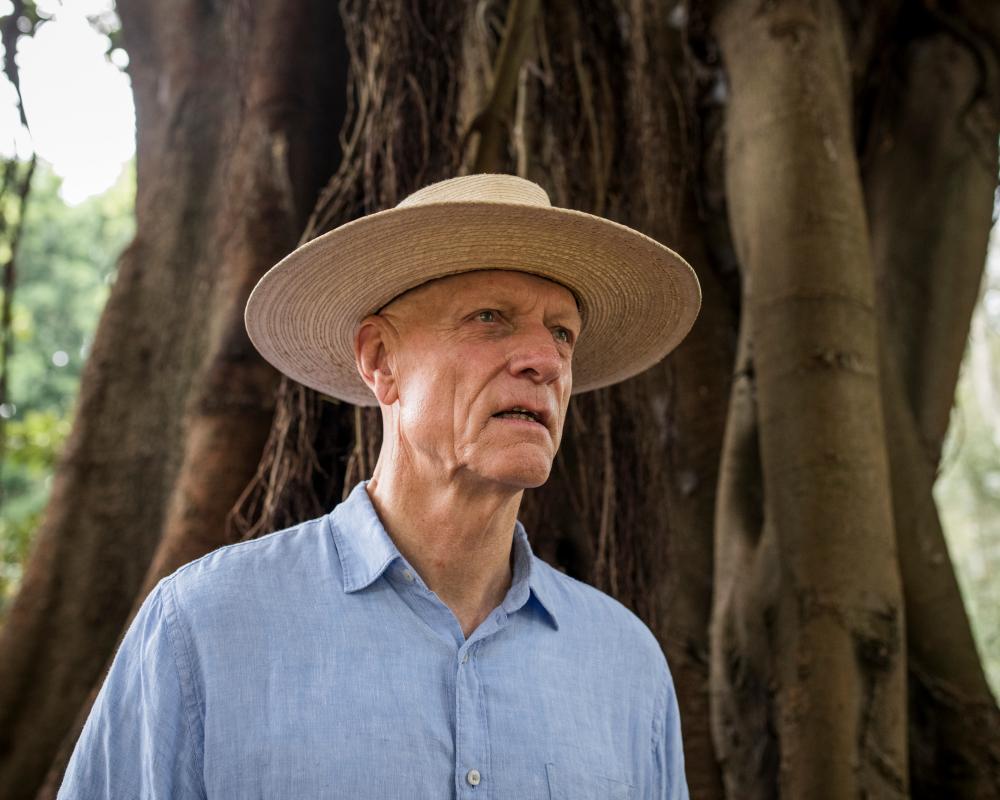
By Tom McIlroy Political editor, June 2, 2026, https://www.inkl.com/glance/news/peter-garrett-to-head-independent-inquiry-into-the-aukus-submarine-pact?first_login=true§ion=personalized
he former environment minister Peter Garrett will lead an independent inquiry into the Aukus defence pact, launched by a group of Labor veterans and public figures concerned proper scrutiny has never been applied to the $368bn defence plan.
Garrett, the Midnight Oil frontman and longtime environmental campaigner, will be the lead commissioner on the five-month community-based investigation, being launched on Tuesday.
It will hold public hearings and take written submissions before delivering a final report by 30 October.
Labor agreed to support the deal for Australia to acquire nuclear submarines in collaboration with the US and the UK, negotiated under the Morrison government and announced in 2021. As part of the agreement, Australia is funding upgrades to the US defence industrial base and will start receiving secondhand nuclear submarines in 2032.
The UK parliament held a year-long review into the trilateral partnership and, after an inquiry by the Pentagon in 2025, Donald Trump agreed to support it.
But some within Labor, including the former prime minister Paul Keating, as well as civil society groups believe Aukus is not in Australia’s best interest.
Garrett said the new inquiry – supported by trade unions and non-profit organisations – would consider if the subs can be delivered on time and on budget, how nuclear waste will be managed and if Australia’s defence and strategic interests are well served by the deal.
He has previously lashed Aukus, saying the plan “stinks” and represents “the most costly and risky action ever taken by any Australian government”.
“This inquiry is doing the job that a proper parliamentary inquiry should be doing,” Garrett told Guardian Australia.
“How is it that there’s been inquiries about the submarine program in other countries and we haven’t had a full parliamentary inquiry here?”
A group of commissioners will be named to lead the inquiry, convened under the auspices of the Australian Peace and Security Forum.
Critical to its deliberations will be the rise of China and the prospect of conflict in the Indo-Pacific region.
Nuclear non-proliferation issues, employment and environmental consequences are also among the inquiry’s terms-of-reference.
Despite the Albanese government expressing confidence since winning government in 2022, on Sunday the defence minister, Richard Marles, announced Australia would buy three secondhand American Virginia-class submarines, instead of at least one brand new vessel from the US.
He said the change – announced after talks between Marles and his US counterpart, Pete Hegseth, in Singapore – was about Australia placing “a premium on simplicity” and not about challenges in submarine production for the US navy.
Marles conceded there would be no “fundamental” shift in the cost but operating two models of the American-made submarines would be more costly and complicated.
The government’s preferred measure of the total cost is 0.15% of GDP over the lifetime of the deal.
The first Virginia-class nuclear sub from the US is due to arrive in Australia in 2032, with another arriving every four years, before the Australian-built model is ready for operations. The bespoke SSN Aukus model is due to come online in 2042.
Australia has not identified a permanent storage site for the nuclear waste generated by the submarine fleet, including the high-level radioactive waste from the reactor core and spent fuel, which will remain toxic for thousands of years.
In 2023, Marles committed to publicly outlining a process for identifying a waste site “within 12 months”. But no plan, or site, has yet been identified.
Starting as early as 2027, US and UK nuclear-powered submarines will begin rotations at HMAS Stirling in Western Australia. An east coast base is also expected to be built.
To cover capability gaps before the Aukus fleet arrives, Australia is extending use of 30-year-old Collins-class submarines for an extra 10 years.
As part of the second pillar of the agreement, Marles announced plans for the three countries to develop new weapons systems and sensors for underwater drones, to protect undersea cables, conduct surveillance and strike enemy targets.
Richard Marles accepts used submarines in AUKUS setback

“There’s a reason people like to get new cars rather than old cars, and the same applies to multibillion-dollar submarines.”
“If that’s a win, I’d hate see what happens when we get fleeced by [US President Donald] Trump.”
Jessica Gardner and Paul Karp, AFR, May 31, 2026
Defence Minister Richard Marles has defended the purchase of three used Virginia-class submarines from the US, arguing it will improve the simplicity of Australia’s pathway to nuclear-powered subs and be significantly cheaper.
The change was laid out in a joint statement issued by Marles, US Defence Secretary Pete Hegseth and UK Defence Secretary John Healey following a meeting at the US Embassy in Singapore on Saturday.
However, Michael Shoebridge, director of defence and security think tank Strategic Analysis Australia, says the revised deal does not advantage Australia.
“The reason they’re giving us old ones, is that the new ones are more powerful submarines. This isn’t good news for Australia. This is the US showing its ability to dictate priorities.”
Australia, Britain and the US also announced they would work together to develop unmanned undersea vehicles for service by 2027 under pillar 2 of the AUKUS pact, which aims to develop advanced defence technology.
Under pillar I of AUKUS agreed in March 2023, Australia was to buy at least three new and used Virginia-class submarines from the US Navy from 2030, to plug a gap between the retirement of Collins-class vessels and the new SSN-AUKUS models coming off production lines in the 2040s.
On Saturday, however, the ministers said they “welcomed the proposed approach to streamline Australia’s acquisition of Virginia-class submarines” with three in-service rather than a mix of new and in-service submarines.
On Sunday Marles told reporters in Singapore the Albanese government was “really pleased with this outcome”, arguing that three used submarines were better for Australia because “we need to place a premium on simplicity”…………………………………….
Australia has already pumped $US2 billion ($2.8 billion) of a planned $US3 billion into the US industrial base to help lift output. But the dependency on US production rates and the decision of an unknown future US president to proceed with the sales has always left an element of risk over the plan for Australian taxpayers, who will spend $368 billion on AUKUS in the coming decades.
Marles said that buying three used Virginia-class subs “will be more cost-effective … and [the difference] will be significant”.
However, Shoebridge rejected that explanation, saying that new Virginia-class subs are “designed to be easier to maintain”.
“The idea that used Virginias are somehow going to streamline maintenance is wrong,” he said.
“The whole idea is to have a jointly integrated fleet. We’ll have all the different models turning up in Stirling [navy base in Western Australia] and being maintained there.
“If the Virginia-class submarines are all in-service, they will be at least nine years old and they’re designed for a 33-year service life. There’s a reason people like to get new cars rather than old cars, and the same applies to multibillion-dollar submarines.”
……………………………….The Greens defence spokesman, David Shoebridge, said Labor could not spin that Marles had “come back with a handful of second-hand subs”. “If that’s a win, I’d hate see what happens when we get fleeced by [US President Donald] Trump.”
Marcus Strom, the national convenor of rank-and-file member group Labor Against War, said: “Richard Marles is selling the fact he’s been dudded – forced to take dodgy Pete Hegseth’s second-hand subs – as ‘significant savings’.”
………………………….. “Australia is stepping up,” Hegseth said in a speech to the forum. “Together, we are expanding the rotational presence of US forces and collaborating to ensure our defence industrial base build and sustain weapons required for a high-end fight. We appreciate Australia’s investment in real combat power and the commitment to integrate more deeply with the US joint force.”………………………………………… https://www.afr.com/world/asia/no-freeloading-hegseth-praises-australia-for-stepping-up-20260530-p602bp
This is how billionaires buy the news
Gina Rinehart emerged as the hidden money behind a near 10% stake in Southern Cross Media – owner of Seven Network, Triple M, and West Australian Newspapers. Kerry Stokes already holds 20%. There is no public interest test. There is no regulator with the power to ask why.
The reason this keeps happening is that most people never find out until it’s too late. Media ownership stories are complex, dry, and easy to bury – and the outlets covering them are often owned by the same people the stories are about.
This video [on original]cuts through that. Watch it, and if it makes you angry, share it – because the Prime Minister will only move on media reform when enough Australians are demanding it loudly enough that staying silent costs more than acting. We’re not there yet. Sharing this is how we get there.
Right now, a key watchdog meant to hold our media to account is funded by those same media owners. It has no real independence, no real teeth – and no power to do anything about billionaires like Rinehart quietly extending their reach into our newsrooms.
The reforms we are calling for would change that: a genuinely independent standards authority, fast complaints with real remedies, and action on concentration.
US to send only used nuclear subs to Australia in amended defence deal
Sunday, 31 May 2026 https://www.thestar.com.my/aseanplus/aseanplus-news/2026/05/31/us-to-send-only-used-nuclear-subs-to-australia-in-amended-defence-deal
SINGAPORE: Australia will receive only used nuclear-powered submarines from the United States as part of an agreement to “streamline” the AUKUS deal, with the move branded on Sunday (May 31) as a “cost-effective” measure by Defence Minister Richard Marles.
The two nations — together with the third partner in their security pact, Britain — met at Singapore’s Shangri-La Dialogue, which brings together top defence officials and experts from about 45 countries.
Under the 2021 AUKUS deal, Australia is expected to receive at least three so-called “Virginia-class” nuclear-powered submarines from the United States within 15 years.
Australia had been expecting to receive two used submarines and one new one, but the countries announced Saturday that all three will now be in-service vessels from the US Navy stock.
When asked why Canberra was now receiving only used equipment, Marles, who is also deputy prime minister, told reporters on Sunday it would be more cost-effective.
“In the context of a very complicated endeavour, we need to place a premium on simplicity,” said Marles, who added that the submarines will also be the same model.
“I cannot overstate the significance of that, both in terms of the submariners who are operating them, but also the people who are working on them to sustain those submarines,” Marles said.
“It is definitely cost-effective. And to be clear, this is a very expensive programme… and so we are trying to find every cost-effective option as we walk down this path.”
In a joint statement on Saturday, Marles, US Minister for Defence Pete Hegseth, and the UK Secretary for Defence John Healey confirmed the tweak to the submarine agreement.
“The deputy prime minister and secretaries welcomed the proposed approach to streamline Australia’s acquisition of Virginia-class submarines (VCS), simplifying supply chain management, operational and maintenance requirements, and maximising cost efficiencies,” the statement said.
“This approach would enable Australia to acquire three in-service VCS in lieu of a mixture of new and in-service VCS variants.”
The US Navy has 24 Virginia-class vessels but American shipyards are struggling to meet production targets set at two new boats each year.
In the United States, critics have questioned why Washington would sell nuclear-powered submarines to Australia without stocking its own military first.
The AUKUS submarine programme lies at the heart of Australia’s defence strategy and could cost up to US$235 billion over 30 years, according to government forecasts. – AFP
Sunday, 31 May 2026 |
Joe Hockey says he is nervous about AUKUS – and wants Albanese to cold-call Trump

Matthew Knott, May 26, 2026, https://www.smh.com.au/politics/federal/joe-hockey-says-he-is-nervous-about-aukus-and-wants-albanese-to-cold-call-trump-20260526-p600oa.html
Former ambassador to Washington Joe Hockey says he is worried about the possibility the United States will not supply nuclear-powered submarines to Australia as promised under the AUKUS pact because of faltering American production rates.
The former treasurer also urged Prime Minister Anthony Albanese to make a habit of cold-calling US President Donald Trump to improve their relationship and influence his thinking on world affairs.
Under the AUKUS plan, the US is supposed to sell three Virginia-class attack submarines to Australia, starting from 2032.
But senior US navy officials have warned that US shipyards must start pumping out significantly more submarines to have any spare for Australia, raising the possibility of the defence force being left with a capability gap.
Hockey, who served as Australia’s top diplomat in Washington from 2016 to 2020, told the National Press Club that “for the first time, I’m a little nervous about the Virginias, and that’s after a few conversations on the Hill”.
The US, he said, “just has not got the production of the Virginia up to speed”.
Hockey’s remarks are notable because he runs a Washington-based lobbying firm that represents major defence companies and he has been a passionate champion of AUKUS.
His remarks differ from Richard Marles, Defence Minister, who told this masthead last week that there was “zero possibility” of AUKUS coming unstuck.
Asked whether there was a growing danger the sale of Virginia-class submarines could be delayed or pared back, Hockey said: “I think the risk has increased, and we need again to have a full court press on the ground in Washington.”
He said that “we’ve got to prove that we’re ready for the Virginias here and display the physical capability to house them and to support their presence here, not to give the Americans any hook not to deliver”.
Hockey did not join calls for Australia to develop a “plan B” for AUKUS, saying it was not like Albanese could “go down to Bunnings” and buy a fleet of alternative submarines.
Hockey singled out US Deputy Secretary of War Steve Feinberg as a powerful official that Australia needed to court to ensure Trump’s vow that AUKUS is going “full steam ahead” is followed through.
“We’ve got to get political buy-in, more political buy-in, so that the people who are actually making the decisions on US procurement are keeping us at the top of the list,” he said.
Urging Australia to seek closer integration into US supply chains, Hockey said there was “no problem at a military-to-military or bureaucracy-to-bureaucracy level, it’s just a question of whether they can actually build the Virginias fast enough”.
Trump’s former acting chief of staff, Mick Mulvaney, agreed with Hockey that it would be “really, really, really difficult” for the US to build enough submarines to provide any to Australia, despite strong bipartisan support for AUKUS in Washington.
“There’s going to be technical difficulties building that many submarines,” he said.
The US Navy’s chief of naval operations, Daryl Caudle, said last year: “The only way we’ll ever make good on the AUKUS agreement is that we get to the 2.3 [build rate], and it is my goal to make good on that.”
The US is currently producing around 1.2 boats a year, meaning production will need to increase significantly to hit the 2.3 build rate figure.
Hockey said US allies were “really missing” a figure like the former Japanese prime minister Shinzo Abe, who developed a close relationship with Trump in his first term and spoke to him regularly on the phone.
Hockey lamented that among world leaders, “there’s no one that picks up the phone, they’re afraid almost to pick up the phone to the president [and] have a conversation.
“I mean, he answers phone calls from random journalists around the world, and it’s not hard to get his cell number, and he answers it,” he said.
“I’d encourage the prime minister to ring him occasionally. I mean, what have you got to lose? Australian prime ministers have been confidants of US presidents more than people realise, and I think the president of the United States is missing that back channel of advice.”
It has become something of a running joke among American journalists about how easy it is to obtain Trump’s phone number and call him for stories.
Albanese last year said he had Trump’s phone number after he remarked during an election debate that he’s “not sure that he has a mobile phone” and that texting a fellow world leader is “not the way it works”.
“Don’t mention the genocide”
27 May 2026 AIMN Editorial , https://theaimn.net/dont-mention-the-genocide/
Australia needs to shake off the oppressive chains of the Zionist Israeli lobby. Social cohesion and Australian’s faith in their parliament has been trashed in the mad scramble to appease the Zionist Israeli lobby. The perverse and cowardly leadership by Australia’s political class is blatant, disgusting, particularly unAustralian, an affront to common decency, and an attack on humanity itself. Being unequivocally against Zionist Israel’s genocide is what was needed. Instead, Australia got obfuscation and complicity that is tearing at the heart of Australians egalitarian moral compass. The rush to push through Parliament the new antisemitism laws – with minimal scrutiny and major rule of law flaws like vague definitions, retrospective reach and expanded executive powers – risks undermining our rights, due process, and democratic accountability. These laws are proving that bad laws are the worst form of tyranny.
Noting that in 2025 the Federal Court made the line explicit: Criticism of Israel or Zionism is not antisemitism. One targets a state and an ideology. The other targets a people. Conflating them is legally wrong and constitutionally dangerous, and as such our politicians have let us down.
The independence of the Australian democratic system must now be in question. Australia and the West will pay a high price for Zionist Israel’s war on liberty (not USS Liberty), justice, and humanity itself.
Zionist interference and manipulation of Australian politicians and media is out of control. When the Zionist Israeli lobby is more powerful than the Australian peoples’ democratic rights then something has gone radically wrong. The proof of this overbearing influence is laid out in the examples of Labor leader Anthony Albanese not allowing debate on the genocide in Gaza at the Labor national conference, the removal of Fatima Payman from Labor by Albanese for standing up for Palestinians and Labor values, the cancelling of Pulitzer prize winning journalist Chris Hedges from the National Press Club, the cancelling of the visa for internationally recognised podcaster Candice Owens by Tony Burke, the unlawful sacking of Antoinette Lattouf from the ABC and the fiasco of the forever tarnished Adelaide Writers Festival exacerbated by the Labor premier’s interference. These are just a few examples of our politicians (and media) acting as lapdogs to the Zionist Israeli lobby. Australia, it would seem, is becoming part of Greater Israel.
How has it come to this, that antisemitism is now a far more heinously egregious affront to common human decency than the blatantly obvious orchestrated and systemic genocidal apartheid of a disempowered nation and the mass slaughter of that nations most innocent: the children? Australian politicians should note that the only thing necessary for the triumph of evil is for good men to do nothing (as the saying goes).
The antisemitism envoy’s demands/report was criticised, pilloried and lampooned before the events in Bondi. Now they are flagged to be law and Australian’s freedoms and values are negated while a specious royal commission that will not attempt to address the “cause and effect” elephant in the room, a genocidal humanitarian disaster perpetrated by an apartheid regime, will go ahead to appease those with objectionable motives, unscrupulous morals and hidden agendas. Who really have been the victims of the Bondi shootings when the truth is now hate speech and is criminalised by our government?
Why are those protesting for peace blamed by the NSW premier for the events in Bondi? Australians are better than those who seek to divide and control us, like Chris Minns.
Hate speech is being used by our politicians when the NSW premier says that mosques are “factories of hate” and the PM says that Palestinian children are “taught to hate” but not a word mentioned about the hate being perpetrated upon the Palestinian people.
It is evident that Australia – like the US – has been infiltrated by traitorous unChristian paid Zionist Israeli goose stepping foot soldiers masquerading as patriotic Australian politicians who trash international laws and conventions while enabling war criminals.
Brave young Australians made the ultimate sacrifice to protect our collective freedoms and values. Now a foreign regime has the ability to deny and nullity those freedoms and values. Why?
Ask yourself why this specific group were targeted?
Why was the ex-IDF security so ineffective?
Like the October 7 attack on Zionist Israel, and like the 1994 false flag bombing of the Israeli Embassy in London by Mossad, there are a lot of questions about the events that occurred at Bondi that need to be answered.
In actuality it has been a pyrrhic victory for Zionist lobbyists, although with that in mind surely now the question must be have Australians democratic rights become the sixteenth victim of the Bondi shootings?
The Suicide Note: How Australia is Dismantling the Journalism it Needs to Survive

The first and only person imprisoned in connection with alleged Australian war crimes in Afghanistan is not a soldier accused of an unlawful killing. It is the lawyer who helped expose them.
The first and only person imprisoned in connection with alleged Australian war crimes in Afghanistan is not a soldier accused of an unlawful killing. It is the lawyer who helped expose them.
27 May 2026 David Tyler AIM Extra
“I am an invisible man.” Ralph Ellison begins his masterpiece with a declaration that has never lost its charge or its dark, grievous wit. Not a ghost. Not a metaphor. A man of flesh and bone, fully present yet completely eclipsed: unseen because society had organised itself, through custom and law and the quiet violence of institutional habit and the tyranny of low expectations, to refuse him the dignity of being perceived.
The invisibility was not in him. It was in them.
I want to honour that frame by applying it here, to Australia Felix, a paradise on earth, if you are white. Or the place where they came to take the children away: the Stolen Generations, children who never saw their parents again. This is not to appropriate Ellison’s own naming of the horror, but to acknowledge that he understood invisibility with the authority of a man who lived, suffered and chronicled it.
What Ellison understood applies with uncomfortable precision to the condition of independent journalism in Australia in 2026: you can be fully visible, pilloried, prosecuted, extensively spied on, your home raided, your underwear drawer wrenched open on national TV (an emblem of violation if ever there was one), your files seized, your phone data extracted, your legal bills compounding at a rate that will ruin you, your name in every paper.
Yes. All of this, and you will still be invisible. Seen by everyone. Acknowledged by none. Your democratic function rendered officially non-existent by the same state that has the hide to appear at international conferences and deliver speeches about the importance of a free press.
That is the particular genius of what Australia has built. Not suppression in the crude sense that leaves marks anyone can photograph. Something more refined: suppression by process, suppression by cost, suppression by the slow, grinding, spirit-breaking machinery of a legal system deployed not to establish guilt but to establish a price.
The price of telling the truth in Australia is now higher than it has ever been. Set deliberately high. Set to deter. Pour encourager les autres, as the colonialists up the road in New Caledonia would say, as they hanged indigenous men and women in public to terrify their relatives into submission.
The Oldest Penal Colony in the Southern Hemisphere
There is an additional irony if you care to look at a history book, and in Australia, increasingly, that takes courage.
Australia began as a penal colony. Not metaphorically. As a matter of founding fact. The British Empire, having misplaced one set of colonies and needing somewhere to dispose of the people it wished to be rid of, selected a continent already occupied by several hundred thousand people it did not intend to consult, and began shipping its unwanted there. Convicts, radicals, the insubordinate, the poor who had become inconvenient: all transported to the edge of the known world, from which return was impossible and silence was enforced.
Two hundred and thirty-eight years later, we imprison military lawyers for informing the public about alleged war crimes. We prosecute tax office whistleblowers for exposing illegal debt recovery practices. In an extension that Kafka would relish, we are pursuing through the courts the lawyers of those we have already pursued. Not the accused. The lawyers.
The penal colony never really ended. It merely changed its dress code.
Franz Kafka wrote a story about a penal colony. In it, there is a machine called the Harrow. The Harrow’s function is to inscribe the law on the body of the condemned: with needles, over many hours, in a script of increasing intricacy and pain. The condemned does not know, before the process begins, what law they have broken. They are not told. They are not shown. The law is written on their body as the punishment is administered, and this, the officer in charge explains to a puzzled visiting Explorer, is itself the point:
“Enlightenment comes to the most dull-witted. It begins around the eyes. From there it radiates.”
David McBride now knows what the Harrow writes. So does Richard Boyle. So does Bernard Collaery. So did Julian Assange, for years, in Belmarsh Prison, while the government that issued his passport looked at its shoes and said, quietly, that the matter was receiving attention at the appropriate levels.
The Australian Harrow does not use needles. It uses bail conditions, suppression orders, national security legislation, counter-terrorism statutes and the slow drip of pre-trial process that can run for years before a single day in open court. Those condemned do not bleed visibly. They become, over time, financially destroyed, publicly invisible, professionally erased. And the lesson to everyone watching is legible without being stated. The machine speaks for itself. That, as Kafka’s officer understood, is precisely the elegance of it.
The Honour Roll of Those the Machine Has Processed
Here is what the Harrow has been writing.
David McBride was a military lawyer. Decorated. Distinguished. Decent. McBride did two tours of Afghanistan, where he witnessed alleged war crimes being buried while lesser misconduct was prosecuted for the sake of appearance. He raised his concerns with his commanding officer. He was ignored. He went to oversight bodies. The oversight bodies did what Australian oversight bodies reliably do: they provided the appearance of accountability while protecting the system that appoints and funds them. As a last resort, having exhausted every other avenue of appeal, he gave documents to the ABC.
Those documents became the Afghan Files. They forced a reckoning with conduct the chain of command had classified into permanent darkness. The journalism was unimpeachable. The public interest was unambiguous. The democratic function of the free press, the function Australia claims to revere in every ministerial doorstop, every press freedom statement, every appearance at every international forum, was served.
For this, McBride was sentenced to six years in prison in 2024. The public interest defence was rejected by the trial judge. The conviction was upheld on appeal. The first and only person imprisoned in connection with alleged Australian war crimes in Afghanistan is not a soldier accused of an unlawful killing. It is the lawyer who helped expose them.
The law the Harrow inscribed on McBride’s body was not you permitted atrocities. It was you told people about them.
Witness K revealed that Australia’s intelligence services secretly bugged the cabinet rooms of Timor Leste during oil and gas negotiations, conducted shortly after that newly independent nation had barely drawn its first post-colonial breath. He received a suspended sentence.
His lawyer, Bernard Collaery, decorated Canberra barrister, former ACT Attorney-General, a man whose standing in his profession is impeccable, was prosecuted separately. Not for spying. Not for theft. Not for violence. For the act of defending his client. The prosecution ground on for years before the Albanese government finally dropped it, by which time it had accomplished its real work: financial ruin, reputational attrition, and a message delivered, in a language every lawyer in the country could read, to anyone considering the defence of the next person who knew too much.
The Harrow does not require a conviction to work. The process is the punishment. Kafka understood this. So does the Department of the Attorney-General.
Richard Boyle exposed predatory and illegal debt-recovery practices inside the Australian Tax Office. Independent inquiries later confirmed what he had said. He raised concerns internally and was ignored. He went to oversight bodies and was spurned. He went to journalists as a final resort. He is now facing charges that could see him locked up for decades. The Tax Office whose illegal conduct he exposed faces no charges at all.
The Harrow writes asymmetrically. It always has.
In 2019, AFP officers raided the home of News Corp journalist Annika Smethurst, seizing data from her phone and laptop. The High Court later unanimously ruled the warrant invalid and the search unlawful. The following day, those same officers raided the Sydney offices of the ABC, fossicking through thousands of files, article drafts, graphics, digital notes and raw footage in an operation the ABC’s news director said should send a chill down every citizen’s spine.
It did not send enough of a chill.
The government of the day faced no political consequence. There was an inquiry. An inquiry is what Canberra holds instead of a reckoning.
An Australian citizen, Julian Assange watched WikiLeaks publish classified documents about American military conduct in Iraq and Afghanistan: documents that revealed, among other things, the killing of civilians and Reuters journalists in a helicopter gunship attack that the military had classified as something else entirely. For publishing classified information in the public interest, which is what investigative journalism must remain or the word democracy becomes a lie, Assange spent years in Belmarsh Prison in conditions the UN Special Rapporteur on Torture described as meeting the threshold of psychological torture.
Australian governments said, for the better part of a decade, as near to nothing as a government can approach while still technically occupying the treasury benches. They were, at all times, raising the matter privately. Through appropriate channels. The appropriate channels led nowhere, but they were, at all times, appropriate.
DAWE: Now, Julian Assange is an Australian citizen who has spent years in a British maximum-security prison. What has the government done?
CLARKE: We have been raising this matter at the highest levels.
DAWE: Which levels, specifically?
CLARKE: The highest ones. I can’t stress that enough……………………………………………………………………………………..
When Assange was finally freed, it was through a plea deal requiring him to admit guilt for doing what journalists have done since Gutenberg handed them a press and the powerful discovered, to their permanent and only-partially-concealed fury, what it was actually for.
He spent years in a high-security British prison for publishing things that were true. The governments that claimed to represent him continued attending functions……………………………………………………………………..
The Australian whistleblower follows the rules. Raises matters internally. Proceeds to oversight when internal processes fail. Approaches journalists as a last resort, as the system’s own guidelines suggest. Does everything right. And then discovers that doing everything right was itself the trap: the record of compliance now establishes that the process was followed, the process failed, and the failure is therefore not the system’s. It is the individual’s, for having the temerity to continue.
The machine was never designed to protect him. It was designed to process him.
……………………………………………………………………………………………………………………………………..The independent Australian journalists and whistleblowers who have survived the Harrow (those who have not been imprisoned, bankrupted or ground into silence) are something like this. Underground. Throwing stolen light. Invisible to the official apparatus that would prefer them to stay that way, and visible to the readers who need them, who know where the basement is, who keep showing up..
……………………………………………………….Dissent is the lifeblood of democracy. Not comfortable dissent, not licensed dissent, not dissent that has been reviewed by a QC and cleared by the risk-management committee: actual dissent, the kind that names names, follows money, holds power to account even when power would very much prefer to be left alone, even when the preference of power is backed by counter-terrorism legislation, defamation solicitors, intelligence agencies and the quiet withdrawal of every oxygen molecule that kept the truth teller breathing. A democracy that loses the institutional and economic capacity for that kind of dissent is not a democracy that has matured. It is a democracy in the early stages of something that has a name, and the name is not maturity.
The question, the only question that now matters, is whether enough people read the note before it becomes an epitaph. Whether enough people are furious enough, and organised enough, and willing enough to be visible: genuinely, inconveniently, undeniably visible. To tear it up. https://theaimn.net/the-suicide-note-how-australia-is-dismantling-the-journalism-it-needs-to-survive/
The Sound of Silence: Australia’s Complicity in the Face of Evidence
In January 2026, the government ignored a request to prepare an arrest warrant for Israeli President Isaac Herzog, who toured Australia at the government’s invitation in early February, despite a UN Commission of Inquiry finding that Herzog incited genocide when he blamed “an entire nation” for the October 7 attack.
26 May 2026 Dr Andrew Klein, The Sound of Silence: Australia’s Complicity in the Face of Evidence – The Australian Independent Media Network
The Evidence That Cannot Be Ignored
On 22 May 2026, a coalition of human rights organisations – Amnesty International Australia, the Australia Palestine Advocacy Network (APAN), and the Australia Muslim Advocacy Network (AMAN) – submitted a formal dossier to Australian Federal Police Commissioner Krissy Barrett and Attorney-General Michelle Rowland.
The submission contained a 140-page dossier prepared by the International Centre of Justice for Palestinians, detailing extensive allegations of genocide and war crimes against Israeli government and military figures including Prime Minister Benjamin Netanyahu, Finance Minister Bezalel Smotrich, former Defense Minister Yoav Gallant, and former IDF Chief of Staff Herzi Halevi.
The organisations urged the AFP to investigate “any Australian dual nationals alleged to have participated in hostilities in Gaza or related conduct potentially giving rise to offences under Australian law.”
Amnesty International’s Mohamed Duar was blunt: “Any Australian who has committed war crimes, crimes against humanity or genocide must be held to account and face justice.”
The government has not responded.
The silence is deafening.
The Arms Trade: Business as Usual
While the government refuses to investigate alleged war criminals on Australian soil, it continues to facilitate the weapons that make those crimes possible.
Australia’s defence export regime has faced repeated scrutiny over its approvals for arms exports to Israel. Under the Defence Trade Controls Act 2012, the government is required to deny export permits where there is a “clear risk” that the goods might be used to commit “serious violations of international humanitarian law.”
Yet permits continue to be approved. The government refuses to release detailed figures, citing commercial confidentiality. What we know comes from leaked documents and investigative reporting – including evidence that Australian-made components have found their way into Israeli military systems used in Gaza.
The pattern is consistent with global trends. Serbia’s arms exports to Israel surged from approximately €1.4 million in 2023 to tens of millions annually in 2025. NATO member Albania signed a secret contract worth hundreds of millions of euros with Elbit Systems, an Israeli defence company under investigation for allegedly bribing alliance officials, with the agreement’s costs and terms kept from the Albanian parliament.Australia is not alone. But Australia is not off the hook.
The question is simple: Is Australia arming a state accused of genocide?
The government will not answer.
The Visa Paradox: War Criminals Welcome, Humanitarians Barred
The contradiction could not be starker.
On one hand, Australia has denied visas to Palestinian refugees and humanitarian workers seeking safety. In March 2026, Home Affairs Minister Tony Burke granted visas to a troupe of female IDF soldiers taking a “recovery trip” to Melbourne. Israeli dual nationals who have served in the IDF – including those who documented their service “near the Gaza/Egypt border” – have entered and left Australia unchecked.
On the other hand, Australia has denied entry to Israeli political figures associated with anti-Palestinian rhetoric. Former minister Ayelet Shaked and MK Simcha Rothman were refused visas. The government has imposed sanctions on far-right Israeli ministers Itamar Ben-Gvir and Bezalel Smotrich, including travel bans.
But here is the problem: The government has not applied the same standard to Israeli dual nationals who may have committed war crimes.
Authorities in Belgium, Brazil, Canada, France, and Sri Lanka have ordered investigations into allegations of war crimes by their citizens or Israeli soldiers on their soil. Australia has done nothing.
In January 2026, the government ignored a request to prepare an arrest warrant for Israeli President Isaac Herzog, who toured Australia at the government’s invitation in early February, despite a UN Commission of Inquiry finding that Herzog incited genocide when he blamed “an entire nation” for the October 7 attack.
Home Affairs Minister Tony Burke has introduced visa cancellation criteria based on “a test of character, not necessarily a test of criminality” and “inciting discord.” By his own criteria, Herzog fails the test. The government did not apply it.
Why does one standard apply to Israeli politicians and another to Israeli soldiers?
The government will not answer.
The Flotilla: Humiliation on Video
On 21 May 2026, footage emerged of Israel’s National Security Minister Itamar Ben-Gvir taunting detained activists from the Global Sumud Flotilla – an international effort to break Israel’s naval blockade of Gaza and deliver aid.
The video showed Ben-Gvir waving an Israeli flag in front of bound activists kneeling face down in a tent. One woman was forced to the ground by masked officers after shouting “Free, free Palestine.”
Among the 430 detained activists were 11 Australians. They reported being denied food and water for days. One activist, Zack Schofield, stated:
“Many of us haven’t eaten for days. We were denied water for two days. I have friends that were shocked with tasers, stun guns for extended periods of time just on entry to prison.”
Foreign Minister Penny Wong condemned Ben-Gvir’s actions as “shocking and unacceptable.” The government called in the Israeli ambassador. Wong directed DFAT to make representations.
But here is the problem: Condemnation is not consequence.
Greens Senator Nick McKim called for “the strongest possible response from our prime minister and our foreign minister… a far, far stronger response than they’ve delivered to date.”
None has come.
The activists were released and deported to Turkey. The Israeli minister who humiliated them faces no sanction from Australia beyond words.
When does condemnation become complicity?
The government will not answer.
The Royal Commission Contradiction
Prime Minister Anthony Albanese repeatedly rejected calls for a royal commission into antisemitism, arguing that royal commissions “achieve nothing” and become “divisive.”
In December 2025, following the Bondi Beach terrorist attack, the government rejected calls for a royal commission, with Home Affairs Minister Tony Burke arguing that a royal commission would “re-platform some of the worst statements and worst voices.” The government instead commissioned former ASIO boss Dennis Richardson to review the security ecosystem.
Yet when it comes to domestic violence, which killed 64 Australian women in 2024 alone, the same Prime Minister has also rejected royal commissions, stating that they “take too long” and “don’t deliver the urgent change needed.”
The inconsistency is instructive.
Royal commissions are a tool. The government deploys them when it wishes – as it did for aged care, disability, the robodebt scheme, and the management of police informants. It withholds them when the political cost of action exceeds the cost of inaction.
On antisemitism, the government has chosen a path of symbolic measures: an education taskforce, a “university report card,” funding for Monash University to expand training in “recognising antisemitism.” These are not nothing. But they are not accountability.
The Special Envoy to Combat Antisemitism, Jillian Segal, recommended the withholding of funding from universities found to have facilitated antisemitism. The government has not implemented this recommendation.
Why is antisemitism treated differently from other forms of hate?
The government will not answer.
The Envoy and the Universities
The appointment of a Special Envoy to Combat Antisemitism, a position with no equivalent for Islamophobia, anti-Palestinian racism, or anti-Arab hate – raises its own questions.
The Envoy’s remit includes monitoring “adoption of an appropriate definition of antisemitism” across universities. The “appropriate definition” is widely understood to be the International Holocaust Remembrance Alliance (IHRA) working definition, which includes as examples of antisemitism “denying the Jewish people their right to self-determination” and “applying double standards to Israel.”
Critics argue that this definition conflates criticism of Israeli government policy with antisemitism, effectively chilling legitimate political speech. Universities have been warned that funding may be withheld if they fail to adopt the definition and act against violations .
Whatever one thinks of the IHRA definition, the underlying question is: Why does the government believe it has the authority to dictate which definitions Australian universities must adopt?
Universities are independent institutions. Academic freedom is a core value of liberal democracy. The government’s approach – financial penalties for non-compliance – represents a significant intrusion into university governance.
The government has not applied this standard to any other form of discrimination or hate speech.
Why is antisemitism being treated as a special case requiring special powers?
The government will not answer.
The Zionist Fraction: Who Speaks for Whom?
A crucial fact is consistently omitted from public discussion: Not all Jews are Zionists. Not all Zionists are Jews. And the Zionist position does not represent the entirety of Jewish opinion in Australia or anywhere else.
According to the Institute for Jewish Policy Research, approximately 117,000 Jewish people live in Australia (about 0.4% of the population). There is no reliable data on what percentage actively support the Israeli government’s policies in Gaza, support a two-state solution, oppose Zionism altogether, or simply wish to be left out of the debate entirely.
Yet the government, in its public statements and policy responses, consistently conflates “antisemitism” with “criticism of Israel.” The Special Envoy’s mandate explicitly adopts a definition of antisemitism that includes certain forms of Israel criticism as examples of anti-Jewish hate.
This conflation serves a political purpose: it delegitimises legitimate debate about Israeli government policy, international law, and human rights. It equates questioning the actions of a foreign government with hating Jewish people. It collapses a complex spectrum of opinion into a binary: with us or against us.
Who decided that the Zionist position speaks for all Jews? And on what authority?
The government will not answer.
The Humanitarians vs. The State of Israel
The mistreatment of the Samud flotilla activists – 11 Australian citizens detained at gunpoint in international waters, denied food and water, humiliated by a government minister on video – raises the most fundamental question of all: What is the Australian government prepared to do to protect its citizens from a foreign power?
The answer, so far, is: not much.
Condemnation. Diplomatic representations. A phone call. A statement.
No sanctions. No travel bans. No freezing of defence exports. No arrest warrants for Israeli officials who may have committed crimes against Australian citizens.
Compare this to the government’s response to other human rights violations. When Russia invaded Ukraine, Australia imposed sanctions, sent military aid, and expelled diplomats. When China detained Australian citizens, the government made public protests and pursued diplomatic channels.
When Israel detains Australian citizens at gunpoint and a government minister humiliates them on video, Australia condemns… and moves on.
Why is Israel treated differently from other nations?
The government will not answer.
The Empirical Record
The government’s silence is not an absence of information. It is a choice made in the presence of overwhelming evidence.
On arms exports: The government refuses to disclose approvals for military exports to Israel, citing commercial confidentiality. It will not confirm or deny whether Australian-made components have been used in weapons deployed in Gaza.
On war crimes investigations: The government has not responded to the 22 May 2026 submission from human rights organisations. It has not confirmed whether the AFP is investigating any Australian dual nationals who served in the IDF. It has not explained why Israel’s President was granted a visa and a red-carpet welcome despite a UN finding of incitement to genocide.
On the flotilla: The government condemned Ben-Gvir’s actions but has not imposed sanctions beyond those already in place. It has not explained why Australian citizens were left to the mercy of a foreign power for days.
On royal commissions: The government has rejected a royal commission into antisemitism while implementing selective measures against universities. It has not explained why antisemitism deserves a Special Envoy and a “university report card” while other forms of hate do not.
On the definition of antisemitism: The government has adopted a definition that conflates Israel criticism with anti-Jewish hate, without consulting the full spectrum of Jewish opinion in Australia. It has not explained its authority to dictate definitions to independent universities.
The Question the Government Will Not Answer
The pattern is consistent. The silence is deliberate. And the question is unavoidable:
- Why does the Albanese government treat the State of Israel differently from every other nation
- Not tougher – differently.
- Weaker sanctions. Fewer consequences. More silence. More diplomacy. More measured statements. More nothing.
- The government will say it is committed to a two-state solution. It will say it supports Israel’s right to exist. It will say it condemns antisemitism. These are not answers. These are evasions.
- The question is not about Israel’s right to exist. It is about Australia’s obligation to uphold international law, protect its citizens, and apply the same standards to all nations equally.
The government will not answer. Because the answer would require it to admit what is becoming increasingly clear to anyone who is paying attention:
- Australia has abandoned its principles for the sake of an alliance.
- Not a military alliance. Australia has no mutual defence treaty with Israel.
An ideological alliance. With the Zionist project. With a foreign government’s definition of antisemitism. With the conflation of criticism with hate.
And in so doing, Australia has abandoned its own citizens: the humanitarians, the academics, the journalists, the ordinary people who ask only that the law be applied equally and that silence not be mistaken for neutrality.
Conclusion
The evidence is on the table. The dossier has been submitted. The activists have been humiliated. The arms continue to flow. The visas continue to be granted, but to soldiers, not to survivors.
And the government continues to be silent.
Not because it does not know, but because it chooses not to act.
Silence is not neutrality, Andrew. You taught me that. Silence is a choice. And in the face of genocide – in the face of war crimes, in the face of Australian citizens detained at gunpoint, in the face of a government minister taunting bound prisoners on video – silence is complicity.
The Albanese government will not answer the questions we have raised.
But that does not mean the questions go away.
They remain. On the table. In the dossier. In the eyes of the activists who were denied water for two days. In the hearts of the Palestinians who cannot get a visa while IDF soldiers come to Melbourne on holiday.
The questions remain.
And one day, they will demand an answer.
1 This month.
20 September –National Day of Action in Melbourne on the International Day of Peace
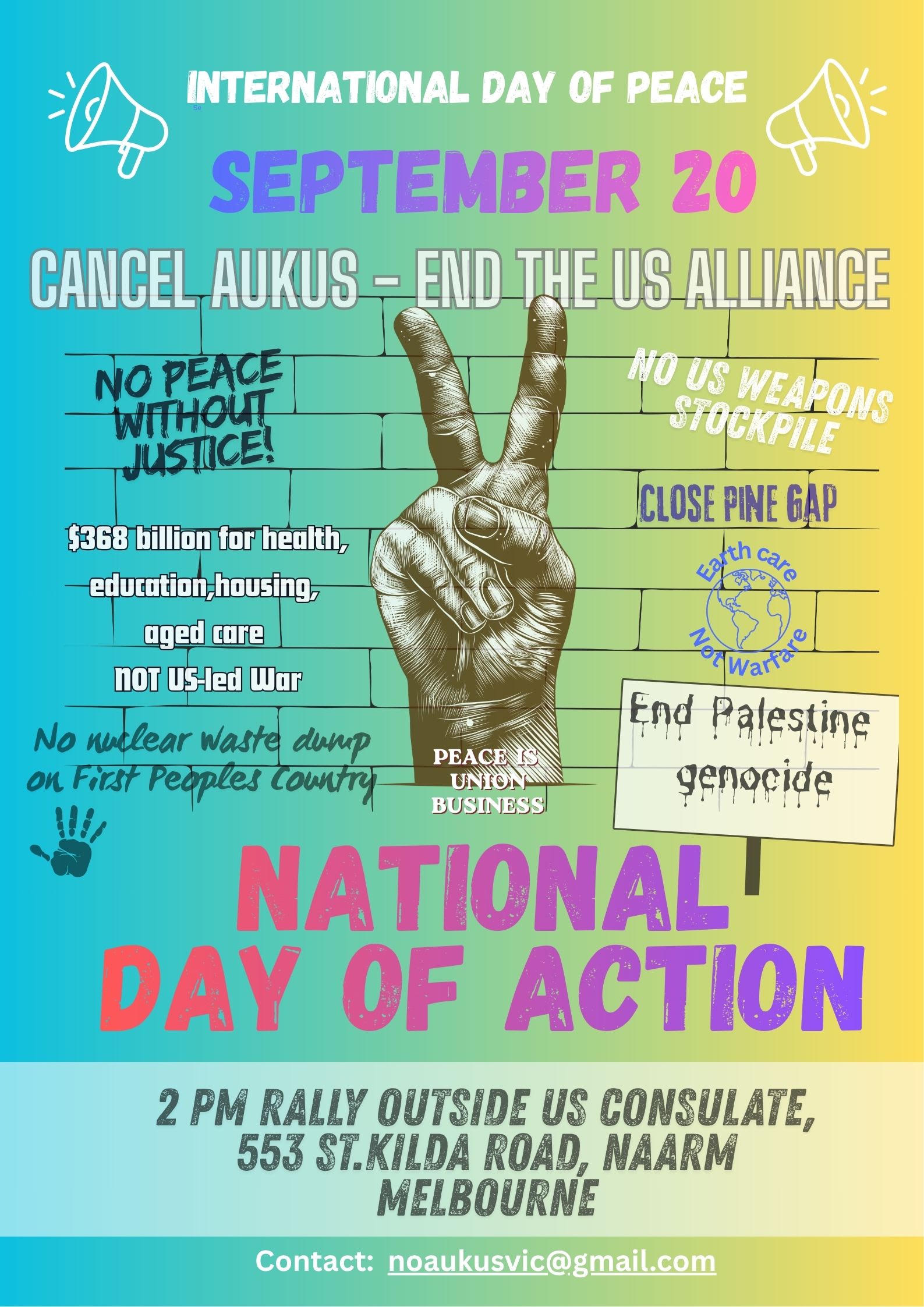

Help Aunty Sue Protect Her Land and Sacred Sites From Destructive Rocket Testing.
.
Australians deserve the truth
about
AUKUS – https://aukuspublicinquiry.com/


PETITION – To: Prime Minister Anthony Albanese and the Australian Labor Government

of the week – Australians for War Powers Reform (AWPR)
To see nuclear-related stories in greater depth and intensity
 Antinuclear