The Independent and Peaceful Australia Network (IPAN) steps up drive to keep U.S. military expansion out of Australia
By Bevan Ramsden | 26 October 2023 https://independentaustralia.net/politics/politics-display/ipan-steps-up-drive-to-keep-us-military-expansion-out-of-australia,18020
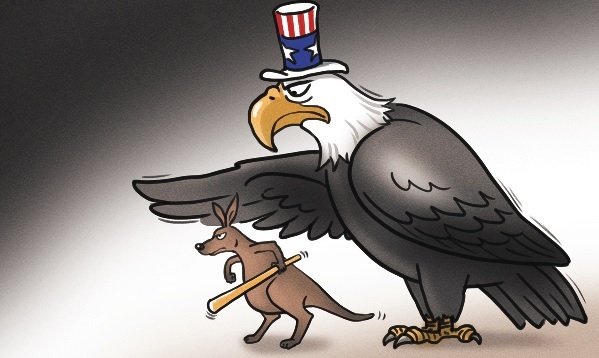
The Independent and Peaceful Australia Network (IPAN) has produced a petition opposing the Force Posture Agreement (FPA) which is enabling U.S. militarisation of Australia in preparation for the U.S. to support/launch war from the Australian continent against China.
The e-petition to Parliament is an instrument for peace calling for the termination of the FPA.
It can be signed HERE.
The devastation of war, currently in Ukraine and in Palestine, confronts us on TV on a daily basis. All peace-loving people cry out for a ceasefire on both war fronts to enable, hopefully under United Nations auspices, conferences of all affected parties to find solutions that meet the security needs of all parties and free non-combatants from the horrors of war.
But concern about these wars should not blind us to the preparations for war occurring on our own continent under the auspices of the United States and with the enthusiastic complicity of successive Australian governments.
When defence matters are discussed, much is made of the U.S.-Australia alliance. But when the U.S. militarisation of Australia is considered, the alliance pales into insignificance compared to the U.S.-Australia FPA. It emerged as a concept from former President Barack Obama’s “Pivot to Asia” of the U.S. armed forces, in which he announced the stationing of U.S. marines in Darwin each year to train for war with our Defence Force.
The “Pivot” was a strategy designed to “contain” China and maintain U.S. hegemony in the Asia/Pacific area. President Obama’s concept was enthusiastically received by all politicians of both major parties.
Subsequently, the Gillard and Abbott Governments, in conjunction with their U.S. defence counterparts, produced a greatly expanded concept, the FPA, providing “an operational posture” for U.S. forces in Australia, a gateway for U.S. militarisation of Australia. It was signed by the Abbott Government and the United States Government in 2014.
The FPA:
- facilitates the stationing in Darwin, for six months each year, of up to 2,500 U.S. Marines; they are trained and equipped for immediate deployment and while in Australia, train for war in exercises with the Australian Defence Force. They are not under the control of the Australian Government. They are under the control of the U.S. Indo-Pacific Command;
- facilitates unimpeded access to Australia’s airfields and airport facilities for U.S. fighter planes and bombers including the stationing of up to six B-52 bombers at RAAF Base Tindall. B-52 bombers were used to devastate Vietnam in that war and some are capable of carrying nuclear weapons;
- facilitates unimpeded access to Australia’s seaports for U.S. naval vessels including their nuclear submarines at HMAS Stirling in WA;
- facilitates the establishment of storage facilities for aircraft fuel, spare parts and munitions under U.S. military control. This includes huge fuel storage facilities at East Arm, Darwin and logistics facilities for storage of equipment, munitions and spare parts at Bandiana in Victoria;
- opened the door for the embedding of U.S. military intelligence operatives within the Australian defence intelligence organisation now called the Combined Intelligence Centre — Australia; and
- under the FPA, a U.S. command centre has been established in Darwin to control U.S. aircraft operations and another command centre in Darwin to control U.S. marine operations.
In short, the U.S. could launch and control military operations from Australia.
I have stressed the words “unimpeded access” because they are the words used in the Agreement.
Article IV of the FPA states:
…United States Forces and United States Contractors shall have unimpeded access to and use of Agreed Facilities and Areas for activities undertaken in connection with this Agreement.
Australia hereby grants to the United States operational control of Agreed Facilities and Areas…
Part 4 of Article VII states:
‘As mutually determined by the Parties, aircraft, vehicles, and vessels operated by or for United States Forces shall have access to aerial ports and seaports of Australia and other locations, for the delivery to, storage and maintenance in, and removal from the territory of Australia of United States Forces’ prepositioned materiel.’
Activities under Article IV include:
‘…training, transit, support, and related activities; refuelling of aircraft; bunkering of vessels; temporary maintenance of vehicles, vessels, and aircraft; temporary accommodation of personnel; communications; prepositioning of equipment, supplies, and materiel; deploying forces and material; and such other activities as the Parties may agree.’
Summing up, the FPA, with the enthusiastic support of the Australian Government, is facilitating increased U.S. militarisation of Australia to support U.S. military operations in the Indo-Pacific from which it could launch or support a war against China. This has been done with the agreement of both major political parties.
The FPA lasts 25 years from the date of signing but has a clause facilitating termination if either party gives one year’s notice.
IPAN is campaigning to have this FPA terminated. This would be a strong step in the direction of keeping Australia out of another U.S. war. And this time, one which would have a catastrophic impact on the Australian people.
If you wish to join this campaign, IPAN has a parliamentary e-petition which is open until 15 November 2023 for signature and it can be accessed by using your mobile phone and this QR code. [on original] #nuclear #antinuclear #NoNukes
Australians Call to End Long Persecution of WikiLeaks’ Julian Assange.
ROBIN ANDERSEN, 25 Oct 23 https://fair.org/home/australians-call-to-end-long-persecution-of-wikileaks-julian-assange/
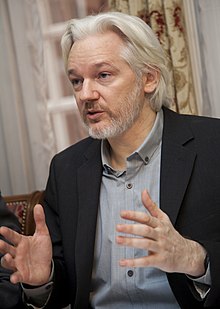
As WikiLeaks founder and Australian citizen Julian Assange has nearly exhausted his appeals to British courts against a US extradition order, Australia has ramped up its advocacy on his behalf. Six Australian MPs held a press conference outside the US Department of Justice on September 20 to urge the Biden administration to halt its pursuit of Assange (Consortium News, 9/20/23).
They came representing an impressive national consensus: Almost 80% of Australian citizens, and a cross-party coalition in Australia’s Parliament, support the campaign to free Assange (Sydney Morning Herald, 5/12/23). Opposition leader Peter Dutton joined Prime Minister Anthony Albanese in urging Assange’s release.
The day before, an open letter to the Biden administration signed by 64 Australian parliamentarians appeared as a full-page ad in the Washington Post. It called the prosecution of Assange “a political decision” and warned that, if Assange is extradited, “there will be a sharp and sustained outcry” from Australians.
Given what is at stake for freedom of the press in the Assange case, and the intensified pressure from Australia—a country being wooed to actively enlist in the US campaign against China by spending $368 billion on nuclear submarines and supersonic missiles (Sydney Morning Herald, 8/10/23)—we ought to expect coverage from the Washington Post, New York Times and major broadcast networks. But coverage of the press conference was virtually absent from US corporate media.
Prosecuting publishing
The US has been seeking to extradite Assange from Britain on charges relating to the leaking of hundreds of thousands of documents to international media in 2010 and 2011, many of which detailed US atrocities carried out in the Afghanistan and Iraq wars and other human rights violations, such as the torture of detainees at Guantánamo Bay (Abby Martin, 3/10/23).
In 2019, President Donald Trump’s administration brought Espionage Act charges against Assange for obtaining and publishing leaked documents, a dramatic new attack on press freedom (FAIR.org, 8/13/22). Assange could face 175 years in a supermax prison if convicted under the Espionage Act, “a relic of the First World War” meant for spies (American Constitution Society, 9/10/21), and not intended to criminalize leaks to or publications by the press. The Biden administration has rolled back much of the legal mechanism used by Trump to attack journalists, but President Joe Biden has reaffirmed the call to extradite Assange.
Assange also coordinated with international news outlets to publish other material known as Cablegate about the “inner-workings of bargaining, diplomacy and threat-making around the world” (Intercept, 8/14/23). Indeed, the New York Times (e.g., 11/28/10) published many articles based on the WikiLeaks documents, which had been sent to Assange by US army whistleblower Chelsea Manning.
US officials have repeatedly justified their case by charging that Assange put lives at risk; to date, no evidence has surfaced that any individuals were harmed by the leaks (BBC, 12/1/10; Chelsea Manning, Readme.txt, 2022). As the Columbia Journalism Review (12/23/20) admonished, don’t let the Justice Department’s
misdirection around “blown informants” fool you—this case is nothing less than the first time in American history that the US government has sought to prosecute the act of publishing state secrets, something that national security reporters do with some regularity.
US officials have repeatedly justified their case by charging that Assange put lives at risk; to date, no evidence has surfaced that any individuals were harmed by the leaks (BBC, 12/1/10; Chelsea Manning, Readme.txt, 2022). As the Columbia Journalism Review (12/23/20) admonished, don’t let the Justice Department’s
misdirection around “blown informants” fool you—this case is nothing less than the first time in American history that the US government has sought to prosecute the act of publishing state secrets, something that national security reporters do with some regularity.
In failing health after suffering a stroke, Assange has been held in London’s high-security Belmarsh Prison since he was removed from the Ecuadorian Embassy in April 2019. He had sought asylum at the embassy in London in 2012 to avoid being sent to Sweden for questioning over sexual assault allegations, because Sweden would not provide assurances it would protect him from extradition to the US. Sweden dropped charges against Assange in November 2019 (BBC, 11/19/19), after he was in British custody.
International condemnation
The Australian diplomatic mission coincided with the convening of the UN General Assembly in New York City, where President Lula da Silva of Brazil condemned the prosecution of Assange, offering yet another opportunity for US corporate media to cover the strong international opposition to Assange’s treatment.
A video (9/19/23) of Lula speaking at the opening of the UN General Assembly was widely circulated on social media. “Preserving press freedom is essential,” Lula declared. “A journalist like Julian Assange cannot be punished for informing society in a transparent and legitimate way.”
Former British ambassador Craig Murray commented about Lula’s reception at the UN (Twitter, 9/17/23):
It is really not normal for the hall at the UN General Assembly to break into this kind of spontaneous applause. The US has been losing the room internationally for a decade. The appalling treatment of Julian is a focus for that.
US media absence
Yet, with a few exceptions (Fox News, 9/20/23; The Hill, 9/21/23; Yahoo News, 9/21/23), none of this made the major US news outlets.
Over a week later, Business Insider (10/1/23) ran a long piece that featured an interview with Gabriel Shipton, Assange’s half-brother. It pointed out that Assange had become an obstacle to US plans to involve Australia in its aggression toward China, quoting the PM. But the piece also hashed through a number of long-debunked claims, including one that reminded readers that Mike Pompeo once called Assange “a fugitive Russian asset” (FAIR.org, 12/03/18; Sheerpost 2/25/23), and another that repeated US assertions that WikiLeaks releases would put the US at risk.
The New York Times has been conspicuously absent from the coverage of Assange. Though the Times signed a joint open letter (11/28/22) with four other international newspapers that had worked with Assange and WikiLeaks, appealing to the DoJ to drop its charges, the paper has remained almost entirely silent on both Assange and the issues raised by his continued prosecution since then.
As FAIR pointed out, during the Assange extradition hearing in London, the Times
published only two bland news articles (9/7/20, 9/16/20)—one of them purely about the technical difficulties in the courtroom—along with a short rehosted AP video (9/7/20).
There were no editorials on what the case meant for journalism. FAIR contributor Alan MacLeod noted that the Times seemed to distance itself from Assange and WikiLeaks, and its own reporting on the Cablegate scandal, coverage that boosted the papers’ international reputation.
Other opportunities for coverage have been missed by the Times. For instance, Rep. Rashida Tlaib wrote a letter (4/11/23), signed by six other members of the Progressive Caucus, calling for the DoJ to drop the charges against Assange. Tlaib cited support from the ACLU, Amnesty International, Reporters Without Borders, the Committee to Protect Journalists, Defending Rights & Dissent and Human Rights Watch, and many others, stating that his prosecution “could effectively criminalize” many “common journalistic practices.” The letter was covered by The Nation (4/14/23), the Intercept (3/30/23), Fox News (4/1/23), The Hill (4/11/23) and Politico (4/11/23), but the Times and other major newspapers were conspicuously silent.
When Assange lost his most recent appeal against extradition in June, a few outlets reported the news online (e.g., AP, 6/9/23; CNN, 6/9/23), but not a single US newspaper report could be found in the Nexis news database. (Newsweek‘s headline framed the news as a “headache for Biden”—6/8/23—rather than a blow for press freedom.) The Times only vaguely referred to the news (Assange “keeps losing appeals”) two weeks later in a feature (6/18/23) on the late whistleblower Daniel Ellsberg, who had criticized Biden’s decision not to drop the case against Assange.
The world is watching
A huge collective breath is being held as the world watches to see what will happen to Assange, the most famous publisher on the globe. Will he be returned to his country and his family by Christmas, as the Australian MPs have requested? Or will Britain and the US continue to slowly execute him?
Assange’s case is expected to be discussed during Prime Minister Albanese’s current visit to the US, which includes a state dinner hosted by Biden on October 25. MP Monique Ryan, part of the pro-Assange delegation, told news outlets: “Our prime minister needs to see this as a test case for standing up to the US government. There are concerns among Australians about the AUKUS agreement, and whether we have any agency” (Business Insider, 10/1/23).
As Common Dreams (9/19/23) quoted from the delegation’s letter:
We believe the right and best course of action would be for the United States’ Department of Justice to cease its pursuit and prosecution of Julian Assange…. It is well and truly time for this matter to end, and for Julian Assange to return home.
South Australia takes another bold leap into deep green energy future
There is little doubt that South Australia is leading the world on the
integration of wind and solar. Now, it’s about to take an even bolder
leap into a deep green energy future through its hydrogen jobs plan.
The state has sourced more than 70 per cent of its electricity demand from wind
and solar over the past year, and when RenewEconomy interviewed state
energy minister Tom Koutsantonis on Sunday afternoon for its Energy
Insiders podcast, it was nearing the end of a 60-hour period where it
average more than 100 per cent wind and solar. Earlier that day, the state
had reached a stunning new peak of 264 per cent “potential” wind and
solar, the combination of renewable energy actually produced, and the
renewable energy curtailed by the lack of a market.
South Australia response to the this excess of green energy is to encourage even more, with
another bold step that it hopes will make it a global leader in green
hydrogen, just as it has done with renewables.
Renew Economy 25th Oct 2023
Australian Submarine Agency stated Osborne, South Australia for building nuclear submarines, – but Osborne is totally unsuitable!

25 Oct 23
The latest reliable information is that Osborne, South Australia, is unsuitable for the construction of the new hybrid nuclear power submarines in that it is far too small.
Besides it in its inherent size, being too small without any capacity for expansion, the submarines building
facility will require two concentric buffer zones for which there is simply no room based on the reports in
InDaily.
The first of these buffer zones will be immediately surrounding the Osborne complex and will be a “
shoot to kill“ buffer zone for high security.
The external buffer zone surrounding the first one will be fairly substantial and is to ensure complete
environmental and similar protection
It is therefore daydreaming to put up Osborne for the construction of the hybrid nuclear powered
submarines
From INDAILY 11 October 2023, Radiation monitoring at SA nuclear subs: – “In a written response to InDaily, a spokesperson from the Australian Submarine Agency said they had informed the State Government, Port Adelaide Enfield Council, and the PortnAdelaide residents Environment Protection group of the environmental baseline contamination assessment at Osborne.
“This assessment will determine existing levels of non- radiological contaminants and background radiation on the preferred site for the Submarine Construction Yard and surrounding areas,” the spokesperson said.” –
This is at first instance no more than a good political photoshoot based on ignorance .
It seems that as pointed out by Rex Patrick the government has failed to learn anything from the ill fated and expensive Kimba situation
Having regard to the warnings by ANSTO it also seems that yet again there is no consensus by the various organs of the federal government
Finally it is interesting that Susan Close who is the deputy premier of South Australia and is ostensively regarded environmental scientist has had little to say on this situation which is similar to her stance on Kimba.
Both the federal and state governments should heed the excellent study entitled RESET OF AMERICA’S NUCLEAR WASTE MANAGEMENT Strategy and Policy by Professor Rod Ewing and his assembled experts to properly understand the implications and requirements of the possible start of a nuclear installation such as in this instance.
The work now being undertaken should immediately start a safety case for full community consultations which seems most appropriate since media polls suggest that more than 70% of South Australia’s population is against any nuclear activity
This situation is just another black mark for the International Atomic Energy Agency (IAEA) for not approving the implementation of AUKUS under the nonproliferation treaty
Albanese’s nuclear submarine plans in disarray as he visits USA in the midst of a Republican Congressmen’s brawl
Congressional brawl threatens to overshadow Anthony Albanese’s US trip
The Age David Crowe. October 20, 2023
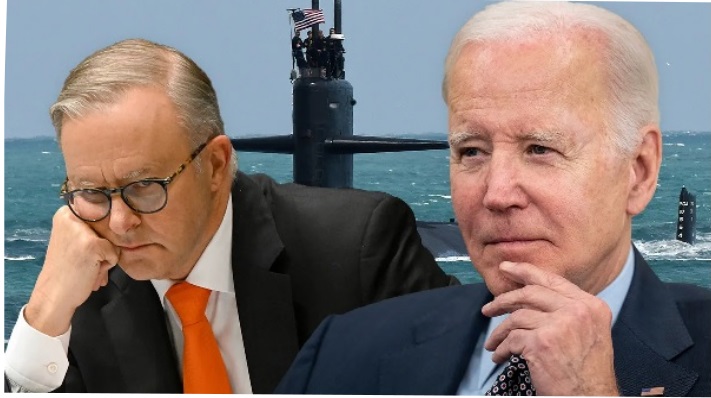
A political brawl in the United States is hurting Australian plans to persuade legislators to support the AUKUS pact on nuclear-powered submarines by casting doubt over whether Prime Minister Anthony Albanese will be able to meet senior Congressional leaders next week.
Albanese is due to fly to Washington DC on Sunday to hold talks with US President Joe Biden on the alliance and broader security issues as well as attending a state dinner at the White House on Wednesday night, the first for an Australian leader in four years.
The agenda for the state visit includes stronger cooperation on climate change, critical mineral supplies as well as the sharing of nuclear secrets for the AUKUS plan, which needs Congress to approve changes to the International Traffic in Arms Regulations, or ITAR, to allow the export of US knowledge and technology.
But the upheaval in the US capital, with the Republicans in disarray over whether Jim Jordan of Ohio should become Speaker of the House of Representatives, means there is no authority to approve an address to Congress and limited time for Albanese to meet top leaders…………..
Albanese is seeking meetings with Congressional leaders and the Australian ambassador to the US, Kevin Rudd, is planning a formal opening of the new embassy on Scott Circle, with guests including political and corporate leaders, and a business delegation from Australia.
While former prime minister John Howard addressed a joint sitting of Congress in 2005 and Julia Gillard did the same in 2011, a similar event appears unlikely for Albanese given the challenges with the Republican leadership…………………………………………………………………………..
Albanese is also due to meet Biden in the Oval Office and join the president in a meeting with cabinet secretaries at the White House, as well as meeting Secretary of State Antony Blinken at the State Department. https://www.theage.com.au/politics/federal/congressional-brawl-threatens-to-overshadow-anthony-albanese-s-us-trip-20231020-p5eds1.html
—
Antipodean Nuclear Free Zones: Testing Times for Antarctica and the South Pacific
October 19, 2023 https://nonproliferation.org/antipodean-nuclear-free-zones-testing-times-for-antarctica-and-the-south-pacific/
Australia and New Zealand have historically promoted strong anti-nuclear policies at both a global, regional, and sub-regional level. They joined with the United States and the other original parties to the 1959 Antarctic Treaty to make Antarctica nuclear free.
Both countries also took France to the International Court of Justice in 1973 in order to bring about a halt to France’s nuclear testing program in the South Pacific, and actively promoted the South Pacific Nuclear Free Zone in the 1985 Treaty of Rarotonga.
However, in 2021 Australia along with the UK and US announced the AUKUS initiative, which in March 2023 was finalized in San Diego. Australia will eventually acquire AUKUS nuclear-powered submarines during the 2030s.
This has placed a spotlight on Australia’s anti-nuclear credentials and its international law commitments and has attracted criticism from within the Asia Pacific, including from New Zealand, Pacific island states, and China. This seminar considers these issues through the lens of international law.
VIDEO – on original
Chapters:
00:00:00 Moderator: Avner Cohen, Professor, Nonproliferation and Terrorism Studies, Middlebury Institute of International Studies
00:01:44 Speaker: Donald R. Rothwell, Professor of International Law, ANU College of Law, Australian National University
00:57:07 Q&A
Australia needs ‘drastic’ renewables boost as nuclear not an option for decades, says centre-right thinktank
Blueprint Institute says nuclear ban should be lifted, but disagrees with Coalition opposition to green energy rollout
Guardian Adam Morton, 20 oct 23
A centre-right thinktank is calling for “drastically accelerated deployment” of renewable energy, batteries and electricity transmission infrastructure and acknowledged there is no prospect of nuclear energy playing a role in Australia before 2040.
The report by the Blueprint Institute, not yet released but seen in draft form by Guardian Australia, says the ban on nuclear energy should be repealed and argues small modular nuclear reactors (SMRs) could play a “small but vital role” in minimising costs in reaching net zero emissions in the power grid by 2050.
The report, due to be published soon, is set to land during a polarised debate about the future of energy and the pace of decarbonisation.
The Coalition and parts of the media have attacked the Albanese government’s renewable energy policy and have called for the rollout to be slowed, a position at odds with scientific warnings that emissions cuts need to accelerate. The opposition leader, Peter Dutton, has suggested SMRs could be built on the site of old coal plants.
The Blueprint Institute report says reaching the government’s target of 82% renewable energy by 2030 will be a major challenge, but does not provide support for those challenging the goal. It says the country has “no choice, at least in the short-term”, but to “double down on renewable energy” and proven “firming” technology to avoid “calamitous blackouts” as old coal plants close.
“This means a drastically accelerated deployment of batteries, solar, onshore wind, pumped hydro, and gas, along with a corresponding build out of transmission infrastructure,” the report says.
The report says the potential role of nuclear energy in Australia is “strictly limited to a decade or more from now – specifically, from 2040”……………………………….
Bruce Mountain, director of the Victoria Energy Policy Centre, said the report’s findings had “no great policy weight” because it was impossible to accurately predict the cost of cutting emissions from the grid in the long-term given technological change was happening so rapidly…………………..
He said nuclear energy was not well suited to playing a minor role in a grid already overwhelmingly running on renewable energy, and its introduction would be “likely to require the abandonment of a good deal of already existing renewable generation”………………….. more https://www.theguardian.com/environment/2023/oct/19/australia-needs-drastic-renewables-boost-as-nuclear-not-an-option-for-decades-says-centre-right-thinktank
Australian Red Cross calls on the Australian Government to sign and ratify the Treaty on the Prohibition of Nuclear Weapons.

Black Mist and the Ban
On the 70th anniversary of the first nuclear weapon test on mainland Australia, we support the call for a nuclear weapons ban.
On the 70th anniversary of the first nuclear weapon test on mainland Australia at Emu Field on Anangu Pitjantjatjara Yankunytjatjara (APY) lands, and at a time when people in Australia consider deeply new ways to address realities in the experience of First Nations people, we support the call for Australia to urgently join the Treaty on the Prohibition of Nuclear Weapons.
On 15 October 1953, the first nuclear weapons testing on mainland Australia took place at Emu Field as part of Operation Totem. This was only one in a series of twelve major nuclear weapons tests and the hundreds of smaller-scale trials conducted in Australia from 1952 to 1963. Today, First Nations People continue to suffer long-term and inter-generational effects from these blasts, impacting their health, communities, and homelands.
The devastating legacy of nuclear weapons testing in Australia cannot be undone, it must never be forgotten and we, as Australians, must do everything in our power to right these wrongs. These actions include compensating affected communities, remediating contaminated lands, and recommitting to the fight in ensuring that these weapons are never used again.
The Treaty on the Prohibition of Nuclear Weapons (TPNW), as the first and only treaty to comprehensively ban these bombs, recognises their disproportionate impact on Indigenous communities. The Treaty, which also provides for victims’ assistance and environmental remediation, is the clear path forward to addressing these weapons’ destructive force in Australia.
Australian Red Cross calls on the Australian Government to sign and ratify the TPNW. We endorse the “Black Mist and the Ban” Statement, released by the International Campaign to Abolish Nuclear Weapons and co-drafted by Karina Lester, Yankunytjatjara Anangu woman and second generation survivor of the Emu Field nuclear tests, urging the Government to take swift action towards the complete elimination of nuclear weapons.
Radioactive instrument missing at South Australian steel plant
The West Australian, Neve Brissenden and Jacob Shteyman AAP, Thu, 19 October 2023
Authorities are scratching their heads after a piece of radioactive material went missing at a steel plant in South Australia.
The Environmental Protection Authority was called to the Liberty OneSteel site on the Eyre Peninsula three weeks ago with reports of a missing industrial bin level gauge – a measuring instrument containing a small radiation source.
Despite a combined effort of the Australian Radiation Protection and Nuclear Safety Agency, police, firefighters and steelworkers, the device – which is about the size of a domestic gas BBQ cylinder – is yet to be found.
The EPA said there was no risk to the public and the 35-year-old device had low levels of radioactivity.
…………………………………….A spokesman for ARPANSA said a team of experts with specialised detection equipment were performing “extensive radiological searches for the missing item”.
He said repercussions would be determined by the regulator and the missing devices were not unusual. https://thewest.com.au/news/radioactive-instrument-missing-at-sa-steel-plant-c-12256768
‘Cottage industry’: Gurus say nuclear no match for solar energy

Professor Green described nuclear as “pie in the sky” – including the small modular reactor technologies that have enthused the British government and the opposition in Australia as countries race to transition to green energy.
Hans van Leeuwen https://www.afr.com/companies/energy/cottage-industry-gurus-say-nuclear-no-match-for-solar-energy-20231013-p5ebxp
Hans van Leeuwen covers British and European politics, economics and business from London. He has worked as a reporter, editor and policy adviser in Sydney, Canberra, Hanoi and London. Connect with Hans on Twitter. Email Hans at hans.vanleeuwen@afr.com
London | The debate on nuclear power is a distraction from solar, which is about to tip into exponential growth that will sweep aside all other energy sources, say Australia’s much-garlanded pair of leading solar inventors.
Andrew Blakers and Martin Green, often dubbed the “fathers of photovoltaics”, described nuclear energy as “a cottage industry”, with no chance of reaching economies of scale in any useful timeframe.
Solar, though, “is going to take over energy it is in a way that will be utterly astonishing for most people”, Professor Blakers said.
“It is going to do it as fast as we went from film photography to digital photography. In the space of 20 years, basically we’re going to flip from solar being a few per cent to solar being everything but a few per cent. It really is the fastest energy change in all of history by a large margin,” he said.
The two men were in London to collect the latest in a string of prizes for their work on PERC solar photovoltaic technology, which has brought down the cost of solar panels by 80 per cent in the past decade.
At Buckingham Palace on Thursday (Friday AEDT), the King awarded them and their colleagues Aihua Wang and Jianhua Zhao with the Queen Elizabeth Prize for Engineering.
Professor Green described nuclear as “pie in the sky” – including the small modular reactor technologies that have enthused the British government and the opposition in Australia as countries race to transition to green energy.
“They are going to have a few prototypes up by 2030, but it really needs the economy of volume to get the prices down to where they’re projecting,” he said. “So you need to be selling hundreds of these things, not just a few sample ones.”
He also said that the history of power generation had been about reducing costs by making things bigger. “It’s going against historical trend, I think, imagining that you can do things cheaply by making a lot of [smaller ones].”
Professor Blakers said nuclear was simply not in the net-zero race. “This year, it looks like the world will do about 500 gigawatts of solar and wind – maybe 400 gigawatts of solar, 100 gigawatts of wind. Hydro will do about 20 gigawatts, nuclear will do approximately one, gas and coal maybe 50,” he said.
“Solar has been growing at 20 per cent a year for a long time. If it continues to grow at this level, we will completely decarbonise the world by the early 2040s. This is how fast it’s happening. It’s so cheap compared with anything else.”
Nuclear, meanwhile, had not increased its capacity in the past 13 years, he said, adding no more than a gigawatt a year.
“You cannot grow an industry from one to multi-thousand gigawatts, which is what you’d need per year, in any reasonable timeframe. It’s impossible unless you put it on a war footing,” he said.
“You just don’t have enough engineers, scientists, raw materials, the factories, the factories to build the factories, the factories to build the factories to build the factories – it just doesn’t happen.”
Grids: the big hurdle
Both men were convinced that battery technologies and costs would continue to fall, driving increasingly rapid growth. The one big obstacle in Australia was transmission.
“Basically, you need a lot of new transmission to bring the new solar and wind into cities. And we’re not building it,” Professor Blakers said.
“Transmission only becomes important once you get up to 30, 40 per cent solar-wind. We’re currently 33 per cent solar-wind, and we will be 75 per cent by 2030. We don’t have a transmission problem yet. But in two years’ time, we’ll have a major one, and everyone can see that.”
He said initiatives to increase compensation to land owners should overcome the remaining community resistance.
Professor Green said the growth of solar energy use would not unseat China’s dominance of the supply chain for solar panels.
“Solar is basically going to demolish the market for coal and gas. And the geopolitical question is whether India, Europe and the US would tolerate having 80 or 90 per cent of the global solar industry coming out of China,” he said.
“It’s very hard to see other countries competing with China. The momentum they’ve got.”
He said India might become a major manufacturer, but its industry’s development would not be as co-ordinated and co-operative as China’s had been.
China, though, would have to address the demand of its customers for higher environmental and social standards – creating an opportunity for Australia to become a player in providing green-friendly metallurgical-grade silicon.
No charges or fines for Western Australia’s wayward radioactive capsule
Perth Now, Neve Brissenden, AAP, October 12, 2023
An investigation into the disappearance of a potentially deadly radioactive mining capsule in outback Western Australia has concluded with no charges or fines laid.
The item, measuring 8mm by 6mm, fell out of a density gauge while being trucked from a Rio Tinto mine in the Pilbara region to Perth in January.
Search crews spent six days scouring a 1400km route amid warnings the caesium-137 in the capsule could cause radiation burns or sickness if handled, and potentially dangerous levels of radiation from prolonged exposure.
The capsule was eventually found two metres from the Great Northern Highway by specialist equipment designed to pick up emitted radiation.
The truck arrived in the Perth suburb of Malaga on January 16 but it was not until nine days later that a technician realised the capsule was missing.
-ADVERTISEMENT-
The missing capsule sparked international headlines and national media coverage in addition to widespread interest in WA.
An investigation by WA’s Radiological Council found no charges or fines should be laid………………………
“Recommendations have been made about areas for improvement in gauge design and assessment and in transport of radioactive sources in WA,” the council’s chair Andrew Robertson said.
Under the Radiation Safety Act, the council said it could not release details of the investigation to “maintain security and public safety”.
“The incident was a rare event which has implications for other radiation safety bodies,” Dr Robertson said.
The Department of Health said it was sharing the findings with other jurisdictions to ensure the incident did not happen elsewhere.
Under WA laws, the maximum fine for failing to safely store or transport radioactive material is $1000.
In February, WA Health Minister Amber-Jade Sanderson said the government was looking at increasing the outdated and “unacceptably low” penalty……………………………………………. more https://www.perthnow.com.au/business/mining/no-charges-or-fines-for-was-wayward-radioactive-pill-c-12183902
Australian government funds pro nuclear propaganda in schools – (even making it “fun”)

Education project focused on engaging next-generation nuclear science professionals in Australia and Japan.
ANSTO 11th October 2023 by ANSTO Staff
ANSTO has recently concluded up a successful cross-cultural nuclear science education project between Australia and Japan.
In collaboration with the Japan Atomic Energy Agency (JAEA) and the University of Tokyo, the project brought together 200 university students, 180 secondary school students and 40 schoolteachers across the two countries.
Participants learned about the history, cultural perspectives, career opportunities and applications of nuclear science in Australia and Japan in interactive presentations, demonstrations and discussions.
Engaging next-generation nuclear science professionals in Australia and Japan was funded by the Australian Department of Foreign Affairs and Trade’s 2022-23 Australia-Japan Foundation grant.
Dr Bridget Murphy, Education Manager (Secondary) at the Discovery Centre, was the ANSTO lead on the project.
“University students from both Australia and Japan were very interested in future career opportunities in nuclear science. They also had a broad range of questions about communicating science to the public effectively, radiation safety, the use of nuclear energy in combating climate change, and international collaboration in nuclear,” Dr Murphy said………….
Teachers from both Australia and Japan valued a cross-cultural perspective on the methods for teaching this subject in the classroom, using videos, hands-on and data-based approaches to instruction in nuclear science.
Professor Takeshi Iimoto of the University of Tokyo emphasised the role of project-based learning and suggested that even humour can make nuclear more understandable for school students.
ANSTO is pleased to continue professional development with teachers in Asia, building on past experience working with teachers internationally through the International Atomic Energy Agency (IAEA)………. https://www.ansto.gov.au/news/education-project-focused-on-engaging-next-generation-nuclear-science-professionals-australia
The case of Yaroslav Hunka, and its echoes in Australia’s history
Jayne Persian 9 Oct 23 https://overland.org.au/2023/10/the-case-of-yaroslav-hunka-and-its-echoes-in-australias-history/?fbclid=IwAR3fq-DqIxk7y61nKGzy77tlYkYp9vU9JaywMHQdzsQEcC6nrbU5dzrIrFk
Dr Jayne Persian is a Senior Lecturer at the University of Southern Queensland and the author of Fascists in Exile: Post-War Displaced Persons in Australia, forthcoming with Routledge Studies in Fascism and the Far Right.
On 22 September, during a visit to the Canadian Parliament by Ukrainian President Volodymyr Zelenskyy, Speaker Anthony Rota publicly introduced ninety-eight-year-old Yaroslav Hunka as a constituent ‘who fought for Ukrainian independence against the Russians’ as part of the First Ukrainian Division during the Second World War. He was ‘a Ukrainian hero, a Canadian hero, and we thank him for all his service.’ Hunka received a standing ovation from all present.
This scene was reported two days later by an antifascist site on Twitter, who pointed out that the First Ukrainian Division was also known as the Waffen-SS Galizien Division. Canadian academic Ivan Katchanovski linked to a veterans’ webpage in which Hunka wrote that he had been a volunteer recruit to the Galizien Division in 1943. Hunka had also uploaded photographs showing him in uniform with the ‘boys’.
The Kremlin immediately reacted, with spokesman Dmitry Peskov arguing that ‘such sloppiness of memory is outrageous.’ Opposition Leader, Pierre Poilevre, described this incident as the worst diplomatic embarrassment in Canada’s history. Rota resigned, and Prime Minister Justin Trudeau was forced to apologise unreservedly.
These embarrassing episodes continue to occur in countries that resettled the post-war displaced persons of Central and Eastern Europe. This mass of around one million people had refused to return to homes that were under Soviet control. As well as concentration camp inmates and forced labourers, these political refugees included soldiers who had fought in German military units, as well as civilian collaborators. Security screening was difficult and there was also some sympathy from the Allied military authorities for veterans on the losing side. Whole cohorts were resettled in Britain, including 8,000 Ukrainian members of the Waffen-SS Galizien Division. Ukrainian nationalist declarations were also treated seriously. While all Ukrainian displaced persons held either Polish or Soviet Union citizenship, they were treated as a separate group quite quickly.
Many of these men should have been charged with war crimes. The German-led Holocaust had relied on the firepower and administrative skill of non-German Central and Eastern Europeans, including Ukrainians. Ukrainian anti-Soviet and anti-Polish nationalists were initially involved in individual and group paramilitary acts, including voluntary local pogroms and/or acts of murder before or beside the German occupation. One of the pogroms, which involved the massacre of 12,000 Jews, was named Aktion Petliura after the Ukrainian nationalist leader Symon Petliura, who had been assassinated by a Ukrainian Jew (this assassination itself framed as retaliation for earlier pogroms) in 1926.
After the initial wave of pogroms, Ukrainians became progressively involved with an institutionalised German genocidal machinery. Ukrainians joined a Ukrainian Auxiliary Police Force (Schutzmannschaft), the German security police (Sicherheitspolizei, SiPo) and the intelligence agency (Sicherheitsdienst des Reichsführers-SS, SD). Others hunted Jews in their forest warden jobs. Local policemen were empowered to kill anyone the Germans defined as enemies of the state, including Jews; indeed, the Germans relied on the dramatically increased numbers of local forces to do the dirty work of the Holocaust, including the shooting of children. Between 1941 and 1944, 1.6 million Jews had been murdered in Ukraine. In 1943, 100,000 of these men volunteered to join the Waffen-SS Galizien Division. In this capacity, they have been accused of murdering Polish civilians.
The United Nations’ International Refugee Organisation resettled the displaced persons in the United States, Australia, Canada, and the United Kingdom. The western world was eager to use the labour of these healthy, white, and stridently anti-communistic young men. Australia resettled 170,700 displaced persons including Poles, ‘Balts’ (Estonians, Latvians and Lithuanians), Yugoslavs, Ukrainians and Hungarians. There was immediate criticism by Jewish groups and sections of the press that the new migrants included war criminals but these were roundly dismissed as Soviet communist propaganda.
Decades later, all four of the main resettlement countries instituted judicial processes against the alleged perpetrators of the Holocaust who were now resident in their countries. In Australia, such men were guaranteed a fair criminal trial: the evidence, for crimes that occurred over forty-five years before, had to include documentary and material evidence and, ideally, eyewitnesses to the alleged individual perpetrator carrying out a war crime. Of course, the nature of the Holocaust was such that very few eyewitnesses to genocide survived in order to testify against individual killers.
After a flawed investigative process, only three men were charged. All three were Ukrainians who had resettled in Adelaide. Ukrainian auxiliary policeman Mikolay Berezowsky was accused of being party to a mass murder of 102 Jewish villagers. Henry Wagner, an ethnic German liaison officer between the German and Ukranian auxiliary police force, was charged with being party to two mass murders, including the shooting of nineteen part-Jewish children. Forest warden Ivan Polyukhovich was accused of hunting and killing Jews under the German occupation, and in taking part in a mass shooting. However, the evidence bar was so high that there were no convictions.
Immediately after the unsuccessful war crimes trials, Ukrainians again attracted attention with an award-winning novel by Helen Demidenko, purporting to be written by a Ukrainian-Australian and based on the life story a member of that community. To the great embarrassment of the Australian literati, Demidenko was soon unmasked as English-Australian Helen Darville, who had attended the Polyukhovich trial with a young man who was noticed to be repeatedly muttering ‘Jews’.
Many responses to Ivan Katchanovski’s tweets shedding light on this unsavoury history — one that Canada and Australia share — claimed that this was not the time to be critiquing Ukraine or Ukrainian nationalists. Ukraine was, of course, invaded by Russia in 2022 and that war is ongoing. Most in the West sympathise with, and support, Ukraine’s fight. And Russia has attempted to smear all Ukrainians with accusations of Nazism, which is simply not true. Dismissing inconvenient histories and the problematic pasts of individual migrants to both Canada and Australia, however, is not useful.
The complicity of the West in assisting perpetrators to escape justice should be acknowledged, and we must be wary of any attempt to normalise fascist views and actions in the public sphere.
Coalition are ‘climate charlatans’ making false claims about Australia’s nuclear power potential, energy minister says
Chris Bowen describes the opposition’s promotion of the banned energy source as an attempt to ‘continue the culture climate wars’
Adam Morton Climate and environment editor. Guardian, Tue 10 Oct 2023
The climate change and energy minister, Chris Bowen, has accused the Coalition of using “the rightwing playbook of 2023 – populism, polarisation and post-truth politics” in making false claims about the potential for nuclear power in Australia.
Speaking on Tuesday, Bowen said the opposition’s suggestion the country could embrace the banned energy source to meet climate targets was the “latest attempt at deflection and distraction now that outright denial is less fashionable” and an attempt to “continue the culture climate wars in Australia”…………(registered readers only) ………..more https://www.theguardian.com/australia-news/2023/oct/10/coalition-making-false-claims-about-australia-nuclear-power-says-energy-minister-chris-bowen?fbclid=IwAR1CU7royDx89hZP5FAfRgkj3ioG6SrbFIQmvDyDNaovfVAGKf3HWqxH0W4
Radiation monitoring at SA nuclear subs site starts – but community consultation is lacking.
The first steps in monitoring radioactive contamination at the state’s new nuclear-powered submarine shipyard and nearby dolphin sanctuary is starting, sparking calls for far greater consultation with residents.
Belinda Willis, In Daily 11 Oct 23
New documents released under the Freedom of Information Act reveal details of an 18-month contract to collect soil, groundwater and marine water samples at the future subs site and the nearby sanctuary to establish a baseline for checking future radiation levels.
Documents released to former federal senator and submariner Rex Patrick show samples will be delivered to the Australian Nuclear Science and Technology Organisation “for radiological analysis”.
The test findings will be used to build an Environmental Contamination Baseline Assessment so radioactive activity where the nuclear-powered submarines are built or docked can be closely monitored.
Patrick said the papers raised new concerns about South Australians not being consulted about regulations and the handling of operational nuclear waste at the $2 billion shipyard, saying there “is absolutely no community engagement, there’s no attempt to establish social licence” about having nuclear reactors on site.
“(The monitoring is) in order to be able to understand the magnitude of a leak or the nature of a problem that might develop in the future,” Patrick said, adding that people living in Port Adelaide and Osborne “probably aren’t aware that this activity is taking place”.
Sadly, the Defence Department is not interested in being open and transparent about what they are doing around nuclear stewardship and safety,” Patrick said.
“There is no community engagement and there is no social licence being developed. It’s a foolish approach noting that ANSTO has warned defence of the need for social licence.
“Perhaps they’re setting themselves up for another ‘Kimba’ style court case.”
Patrick was referring to a recent court decision that led to the dumping of a site for a low-level radioactive waste site at Kimba in South Australia despite years of consultation and the more than $100 million spent on the process………………………………………………..
Under the AUKUS deal with the United States and United Kingdom, Australia is obtaining eight nuclear-powered submarines at an estimated taxpayer cost of $268-$368 billion.
Defence Minister Richard Marles has said submarines will be built at Osborne and also that waste from spent nuclear reactors from the submarines will be stored on defence land.
Port Adelaide Enfield Mayor Claire Boan said the local council “has not been briefed on the specifics of this matter i.e. management of radioactive materials”, but said council staff has had an initial meeting with defence staff regarding the environmental impact assessment for this development required under federal and state regulations. ……..
The documents released to Patrick show the Submarine Construction Yard will span about 75 hectares and is made up of four distinct areas.
Nearby is the 12,000-hectare Adelaide Dolphin Sanctuary which is the home of up to 60 bottlenose dolphins and is visited by another 400 to feed and nurse their calves in the Port Adelaide River and Barker Inlet.
Mutton Cove Conservation Reserve is also nearby.
South Australia’s Defence Minister Susan Close, who is also Port Adelaide’s member of parliament, did not respond to questions about whether people living in her electorate have been consulted about work at the nuclear-powered submarine construction site.
The Minister and Premier Peter Malinauskas have been vocal supporters of the project, the Premier having flown to the United Kingdom to meet with the UK submarine builders. https://indaily.com.au/news/2023/10/11/secrecy-surrounds-radiation-monitoring-at-sa-nuclear-subs-site/
1 This month

of the week – Australians for War Powers Reform (AWPR)
To see nuclear-related stories in greater depth and intensity
 Antinuclear