Port Kembla no place for a nuclear subs base, say local campaigners
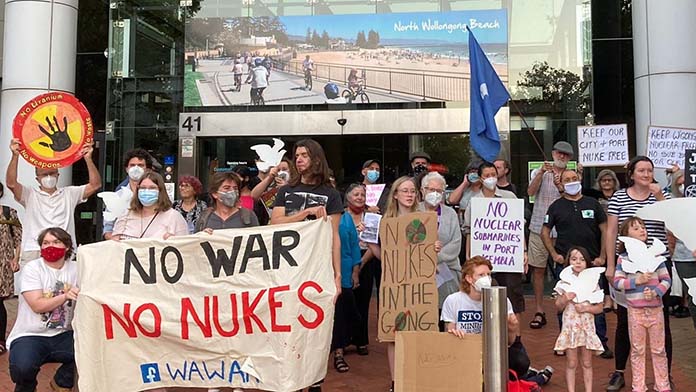
Activists in Wollongong are organising against plans for nearby Port Kembla to host the East Coast base for the AUKUS nuclear submarines. Solidarity spoke to Alexander Brown from Wollongong Against War and Nukes about local opposition and how unions have dedicated this year’s May Day march to opposing the plan
The cost is around $10 billion for an East Coast submarine base. The Treasurer says they can’t afford the $24 billion required to increase Centrelink payments above poverty levels and yet they can afford to spend $10 billion on a war base. And that’s a small part of the overall $368 billion dollars for AUKUS. It’s a gross waste of money.
The strategic justification for it doesn’t make any sense. That’s being picked apart even within the Labor Party by people like Paul Keating and Bob Carr. We’re now seeing current sitting MPs start to express criticism. The submarines may arrive in between ten to 30 years, when their supporters in ASPI and the Sydney Morning Herald say we’re about to have war with China in the next three years. If so the subs are not going to be much use.
More importantly, it’s a ridiculous approach to peace making in the region to say we will arm ourselves to the teeth and that will deter China. China and its regime have many problems but they’re not a military threat to Australia now and they’re unlikely to be in the future. And if these subs are supposed to be to defend shipping, we are shipping most of our exports to China anyway, so who are we defending it against?
We need to build people-to-people solidarity with ordinary people in China to ensure peace and democracy in the whole region—not get drawn into a US provocation and starting a regional arms race.
What kind of actions have you taken to build opposition?
When Scott Morrison suggested that Port Kembla could be a site for an East Coast submarine base there was a protest called by the Student Association at Wollongong University, and different groups and individuals including unions and local councillors came to that.
We started organising a dedicated campaign group called Wollongong Against War and Nukes (WAWAN) and held a successful rally about a year ago to support the local council renewing the declaration of Wollongong as a nuclear free zone, which goes back to 1980.
We held a public meeting with former Greens Senator Scott Ludlam and the South Coast Secretary of the Maritime Union.
We had a rally here two weeks ago, because some local business interests held a defence industry conference and want to build a war industry down here.
This year when the Labor government so fully endorsed continuing AUKUS, after I think many people hoped they might back away, it created shock.
Then there was also a report in the ABC that Port Kembla was firming up as the most likely location for the submarine base. So the campaign has really picked up in the last two months.
The local South Coast Labor Council endorsed a motion to oppose having a nuclear base here.
Unions like the maritime union have put a lot of work into trying to plan for a renewable energy industry here to survive the big shocks that are coming in terms of the decline of coal and steel. They’re interested in expanding offshore wind and potentially green steel through hydrogen.
WAWAN has a community meeting in Port Kembla on 29 April, and we are calling for everyone who can get there to come and support the South Coast May Day march on Saturday 6 May, which will include opposition to the nuclear base alongside the slogan of “Peace, Jobs and Justice”.
Wollongong and Port Kembla steel works have been hotbeds of militancy since the beginning of last century and that tradition continues. The Dalfram dispute in the 1930s saw waterside workers refuse to load pig iron bound for Japan, because they knew that it would be used to make bombs and bullets for the Japanese invasion of China. Pig iron exports to Japan more or less stopped after that struggle.
In the Vietnam War there was a strong movement here and in the 1980s the anti-nuclear movement was really big in Wollongong and the unions were a major part of that. A lot of people in Wollongong have seized the opportunity to say that fighting unionism needs to look beyond the workplace at the environment that workers are going to be living in and creating.
We are wasting money and resources on the defence industry when we could be spending that money on addressing climate change and jobs through a Green New Deal.
Unions back renewable energy jobs over nuclear subs
The South Coast Labour Council, which represents unions in and around Wollongong, is opposing the submarine base as a threat to alternative jobs in the area.
Port Kembla has been assessed as an ideal spot for offshore wind developments, due to wind conditions, grid connections and the working harbour. The area is one of the NSW government’s priority Renewable Energy Zones, with at least two companies already carrying out scoping work for multi-billion dollar offshore wind projects.
Even NSW Ports and the Port Kembla Chamber of Commerce have warned that the Outer Harbour site is needed for wind turbine assembly as well as a new container port, and should not be taken by defence. This is also the likely site for the submarine base. Even the two offshore wind projects already proposed would create thousands of jobs in construction as well as over 500 ongoing jobs.
March against the nuclear base in Port Kembla
12pm Saturday 6 May, Wentworth St, Port Kembla, more details here
Sign up for travel from Sydney here
Australia pays former US defence chiefs $7000 a day for advice

By Matthew Knott, April 27, 2023 https://www.smh.com.au/politics/federal/australia-pays-former-us-defence-chiefs-7000-a-day-for-advice-20230427-p5d3lh.html
The federal government is paying retired senior American military officials up to $7500 a day for advice on major defence projects such as the AUKUS nuclear-powered submarine pact.
The government this week announced that, following its sweeping defence strategic review, retired United States Navy vice admiral William Hilarides would be hired to lead a snap review of the Royal Australian Navy’s surface fleet.
The review, to be handed to the government later this year, will examine whether planned fleets of Australian-made frigates and patrol vessels should be cut to free up money for smaller and more nimble vessels.
Hilarides has previously charged the Australian government US$4000 ($6000) a day for his consulting services, according to US Navy documents first reported by The Washington Post.
Hilarides has won naval consulting contracts from the federal government worth up to $1.6 million ($2.4 million) since 2016, according to figures from the Department of Defence.
Hilarides serves as chair of the Australian naval shipbuilding expert advisory panel and advised the government over the past 18 months while it finalised the deal with the United States and Britain to build a fleet of nuclear-powered submarines.
Defence Industry Minister Pat Conroy defended Hilarides’ appointment to the new navy fleet review this week, saying he had “a long association with Australia” and would do a good job.
In an investigation published last year The Post described Hilarides, a career submariner, as part of a large group of former senior US officials that Australia had relied upon heavily to guide its naval policies.
“To an extraordinary degree in recent years, Australia has relied on high-priced American consultants to decide which ships and submarines to buy and how to manage strategic acquisition projects,” The Post said.
Retired admiral John Richardson, who headed the United States Navy from 2015 to 2019, has received US$5000 ($7570) a day as a part-time consultant to the federal, according to documents released by the Pentagon to the US Congress.
Richardson was hired by the Department of Defence last November to provide advice on the best pathway for Australia to acquire a fleet of nuclear-powered submarines.
According to the documents, Richardson receives travel and lodging expenses to complete his work in Australia.
Richardson, the former US navy chief, told The Post: “I spent most of my life helping to keep America and our allies and partners safe and secure.
It’s a privilege to be invited to be able to use my experience, and help where I can to continue that work.”
Defence Minister Richard Marles on Thursday said outside advice was crucial to ensuring the government makes the correct decisions about significant defence policies.
“When we seek expert advice in relation to critical issues and challenges that we face, we have a global perspective in terms of where we seek that advice from and that’s really important because we want the very best advice,” he said.
“We make no apology for that because the kinds of challenges and decisions we’re making are profoundly important for the future of our country and where we have sought advice from those former officials in the US Navy that has been on issues of profound importance for our nation’s future.”
Greens defence spokesman David Shoebridge said he was shocked that Australia could seemingly not find local experts available to do these jobs.
“If that is true then it’s a pretty extraordinary failure on the part of the government and the ADF,” he said.
“You can only really explain this by Defence’s ongoing dependence on, and deference to, the US.”
He said it was remarkable that the US government had been more transparent than Australian government contracts than the federal government.
AUKUS nuclear submarine cost includes 50% fund for unexpected overruns

SYDNEY, April 28 (Reuters) Reporting by Kirsty Needham; Editing by Robert Birsel– https://www.reuters.com/business/aerospace-defense/aukus-nuclear-submarine-cost-includes-50-fund-unexpected-overruns-2023-04-28/Australia’s defence minister said on Friday the government was being “upfront and transparent” about the cost of its AUKUS nuclear submarine programme, after an analysis showed the forecast A$368 billion cost included a 50% contingency fund.
The Greens party, which commissioned the analysis by the Parliamentary Budget Office, said it showed the “huge” uncertainty over the project.

U.S. President Joe Biden, Australia Prime Minister Anthony Albanese and British Prime Minister Rishi Sunak unveiled details in March of a plan to provide Australia with nuclear-powered attack submarines, a major step to counter China’s ambitions in the Indo-Pacific.
Under the deal, the United States intends to sell Australia three U.S. Virginia class nuclear-powered submarines, which are built by General Dynamics, in the early 2030s, with an option for two more.
In a second phase, Australia and Britain will build an AUKUS class submarine, with Australia receiving its first submarine in the early 2040s. The vessels will be built by BAE Systems and Rolls-Royce.
Australia’s Parliamentary Budget Office has reported the cost estimate over three decades includes a contingency of A$123 billion. A contingency is a future cost not currently known due to delays, budget overruns and other factors.
Greens Senator David Shoebridge said in a statement the scale of the contingency fund was “unprecedented” and highlighted “the huge level of uncertainty in the AUKUS submarine deal”.

Defence Minister Richard Marles said the plan to build a nuclear powered submarine in Australia by the early 2040s was a “massive challenge for the country” and the government was “prudently budgeting here for the unexpected”
“We have sought to be as upfront and transparent as we possibly can be,” he told ABC radio.
The Department of Defence did not release the sale price of the U.S. Virginia Class submarines that Australia will initially purchase, the budget office said.
The report showed most of the cost of the submarine programme will be incurred in the two decades from 2033.
Australia pays Washington swamp monsters for war advice – as they groom us for World War 3
Caitlin Johnstone 27 Apr 23 https://caitlinjohnstone.com/2023/04/27/australia-pays-washington-swamp-monsters-for-war-advice/#
Australia has been paying insiders of the US war machine for consultation on how to run the nation’s military, a massive conflict of interest given that Washington has been grooming Australia for a role in its war agendas against China.
In an article titled “Retired US admirals charging Australian taxpayers thousands of dollars per day as defence consultants,” the ABC reports that according to documents which were provided by the Pentagon to congress last month, “dozens of retired US military figures have been granted approval to work for Australia since 2012.”
For those who don’t speak imperialist, “retired US military figure” generally means “Someone who used to be paid by the US government to advance the interests of the US empire, and is now paid by corporations and/or foreign governments to advance the interests of the US empire.” These corrupt warmongers rotate in and out of the revolving door of the DC swamp, from government to war industry jobs to punditry gigs to influential think tanks and then back again into government, advancing the interests of the US empire the entire time and growing wealthy in the process.
This dynamic allows a permanent constellation of reliable empire managers to continually exert influence around the world in support of the US empire, regardless of who gets voted into or out of office in the performative display of electoral politics. It’s a big part of why US foreign policy remains the same regardless of who’s officially running the elected government in Washington, and it’s a big part of why the media and arms industry which support the US war machine keep playing the same tune as well.
Andrew Greene – “Former US director of National Intelligence James Clapper, who resigned after Donald Trump’s election as president in 2016, was then paid to work for Australia’s new Office of National Intelligence”
Among the American swamp monsters Australia paid for consulting work is the Obama administration’s spy chief James Clapper, who has an established track record of lying and manipulating to advance the interests of the US empire:
- In 2013 Clapper committed perjury by telling the Senate under oath that the NSA does not knowingly collect data on millions of Americans, only to have that lie exposed by the Edward Snowden leaks a few months later.
- In 2016 Clapper played a foundational role in fomenting public hysteria about Russia with the flimsy ODNI report on alleged Russian election interference, which remains riddled with massive plot holes. He would later go on to repeatedly voice the opinion that Russians are “almost genetically driven” toward nefarious and subversive behavior.
- In 2020 Clapper signed the infamous and now fully discredited letter from former intelligence insiders saying the Hunter Biden laptop story was likely a Russian disinfo op, falsely telling CNN that the story was “textbook Soviet Russian tradecraft at work” and that the emails on the laptop had “no metadata” on them.
Also among the American military consultants paid by Australia is a man we just discussed the other day, William Hilarides, who will be telling Australia how to reconfigure its navy because apparently no Australians are available for that job. We now know that according to the released Pentagon documents Canberra has already paid Hilarides almost $2.5 million since 2016 for his consulting work.
This information was originally reported by The Washington Post’s Craig Whitlock and Nate Jones, who last year also broke the remarkable story that a former US navy admiral named Stephen Johnson had actually served as Australia’s deputy navy secretary, a position which needless to say is not normally open to foreigners.
This is just one of the many, many ways that Australia is being interwoven into the US war machine, from our 2023 Defence Strategic Review which further enshrines our position as a US military asset, to our Secretary of Defence Richard Marles saying that the Australian Defence Force is moving “beyond interoperability to interchangeability” with the US military and being suspiciously secretive about who his golfing buddies were in his last trip to the US, to Australian officials angrily dismissing attempts to find out if the US has been bringing nuclear weapons into Australia, to the Australian media pounding Australian consciousness with anti-China hysteria to such an extent that we’re now seeing hate crimes perpetrated against Asian Australians.
I’ve always wondered what it would be like to witness the information environment of Washington’s next military proxy from the inside — what it would be like to be a Ukrainian with an ear to the ground during the lead-up to the 2014 coup or whatever. Well, now I know. Now all Australians with an ear to the ground know.
I’ve been generally dismissive of Australian affairs throughout most of my commentary career despite living here, since my focus is on resisting the disasters that humanity as a whole is headed toward, and Australia has always seemed like a fairly irrelevant player on the world stage because of its impotent subservience to Washington. But it’s becoming clearer and clearer that it is exactly because of Australia’s blind subservience to Washington that Australia is worth paying attention to, since that relationship may well end up giving our nation a front-row seat to World War Three.
Australians are going to have to wake up to what’s being done to us and the abominable agendas our nation is being exploited to advance. We’re being groomed for a military confrontation of unimaginable horror, one which absolutely does not need to take place, all in the name of something as trivial as securing US planetary hegemony. We’ve got to start saying no to this, and we’ve got to start right now.
Defence Minister Richard Marles and former Defence Minister (now weapons lobbyist) to spruik fot militarism at expensive weapons festivity
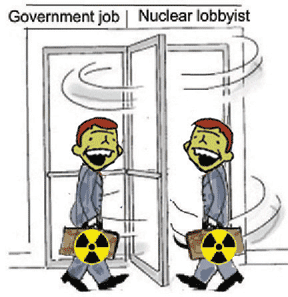
Marles and Pyne: the game of mates plays on as questions on probity count for little
The former and current defence ministers are sparring mates from way back, and that’s worked out well for Christopher Pyne post-Parliament.
DAVID HARDAKER, APR 27, 2023 Crikey,
Is there no end to the Richard Marles-Christopher Pyne double act?
The Albanese government’s defence minister has agreed to speak at a ticket-only networking event hosted by former MP Pyne, Marles’ old sparring partner, who has become one of Australia’s leading defence industry lobbyists. The so-called DSR Summit will be held In Sydney next week, according to an invitation received by Crikey.
For between $500 and $800 defence industry types will be able to rub shoulders with “ministers, thought leaders, and department decision-makers” while hearing from key speakers from government “and other defence sector stalwarts” on the impact of the government’s Defence Strategic Review, released this week……(Subscribers only) https://www.crikey.com.au/2023/04/27/marles-pyne-mates-probity-questions/?su=TlVkbFRSU3Zya0trMlF3M0JHckdPZz09
We are being seduced into war again by the US, this time over Taiwan
China is not a military threat to either the US or Australia. The military threat is trumped up by the US and its acolytes with their own agenda.
There is one critical and urgent thing the Australian Government should do, and that is to make it clear to the US that we will not be involved in any way with a war between China and the US over Taiwan and that none of our facilities can be used for that purpose – Pine Gap, Darwin or Tindal.
By John Menadue, 27 Apr 23 https://johnmenadue.com/we-are-being-seduced-and-trapped-into-war-again-by-the-us-this-time-over-taiwan/
The US must be told that we will not be involved in any way in a war with China over Taiwan.
After Vietnam, Iraq and Afghanistan the signs of our entrapment again in US war planning are everywhere.
The 2014 Force Posture Agreement with the US cedes control of certain military operations from our territory to the US eg Marines in Darwin and US B52’s in Tindal.
The 2021 AUSMIN ministerial meeting endorsed :
- Enhanced air cooperation through the rotational deployment of U.S. aircraft of all types in Australia and appropriate aircraft training and exercises.
- Enhanced maritime cooperation by increasing logistics and sustainment capabilities of U.S. surface and subsurface vessels in Australia.
- Enhanced land cooperation by conducting more complex and more integrated exercises and greater combined engagement with Allies and Partners in the region.
- Establishment of a combined logistics, sustainment, and maintenance enterprise to support high end warfighting and combined military operations in the region.
The 2021 AUKUS agreement was a clear sign to our region that instead of building bridges to our region we have decided to be a spear carrier for the US and UK- the Anglosphere. AUKUS is not to defend Australia but to support US operations against China in the South China Sea.
Our Defence Strategic Review (DSR)released this week has been’ authored’ by the United States Studies Centre(USSC), an arm of the US government. It is a tainted review. Have we no national pride in letting this happen!
Our Washington centric media don’t seem to think that it is unusual or even outrageous for a foreign agency to author an Australian defence review!!
Our seduction by the US is assisted by our Department of Defence with its close links to the Pentagon. It secretly employs US Admirals to advise on submarines. And if that is not enough we are now going to have a retired US Admiral heading the coming Naval Review. What is wrong with our Navy that an Australian can’t do the job? Has integration gone so far that we don’t have a Navy of our own that is worth the name.
And don’t think for one moment in this humiliation that Albanese and Marles thought up this US Admiral. They would have been put up to it by our defence establishment in lock step with the Pentagon.
The ADF has become a unit of the US military machine.
There is more.
The Government has rejected the Australian War Powers Reform proposal that Parliament approve any commitment to war. This is essential because we have an awful history of rushing to war. In 1914, we decided to send troops to WWI before Britain declared war. Menzies committed Australia to war in Vietnam before we even received a request. Howard committed us to the illegal war in Iraq based on false intelligence. Now the Labor Party has committed us to AUKUS in less than 24 hours despite the enormous implications. Albanese says he is proud of how quickly he agreed with Morrison!
Changes to our Defence Act are also being considered which would allow the ADF inter alia to conduct operations below the threshold of war, known as ‘grey zone’ operations. These amendments could have far reaching consequences.
At our universities, Peace Studies are run down in favour of ‘Strategic Studies’ with their US loyalists regularly appearing on our media. Think Tanks like the Australian Strategic Policy Institute are fronts for US defence interests.
Entrapment of our minds in the anti China hysteria is the work in progress of our Main Stream Media. Our fourth estate has been captured and imbedded in the US propaganda machine. The US cultural and media domination is everywhere. Alternative views are shunned. The White Man’s Media is on full display.
The disgraceful ‘Red Alert’ is the tip of a giant iceberg. The anti China propaganda is an every day event in our media including the ABC and SBS .
In the past, the ALP said NO on Vietnam and Iraq even though it was difficult at the time. As Paul Keating put it at the National Press Club recently ‘Labor has invariably got the big international (decisions) right’. But today the ALP has gone AWOL. Concerns about entrapment by the US and loss of sovereignty are brushed aside. What many of us thought were Labor policies and values count for little.
Penny Wong suggests that Keating has not kept up to date and has not had the benefit of Intelligence briefings!! But the reverse is true. The Labor Government is reverting to our colonial past, our colonial cringe – Five Eyes, AUKUS and the Anglosphere.
Wong plays with words to avoid asking or knowing whether B52’s in Tindal will be nuclear armed against China. She tells us that US forces are ‘rotated’ though Darwin and Tindal and not ‘based’ there.
The US is persistently goading China into war over Taiwan. This is consistent with US behaviour over centuries. It is driven by its self righteous belief in its ‘exceptionalism’ and the pressure of its military/industrial/security complex for endless wars. It expects other major powers like China to behave as aggressively as it has. China has no Monroe Doctrine which Americans believe gives them the God given right to interfere in other country’s affairs.
Australia has a sorry history of fighting other empires wars, first with the British and now with the US. The great risk and problem for us is that imperial powers are almost always at war.
Since its founding in 1776, the US has been at war 93% of the time. Since the end of WWI, the US has launched 201 armed conflicts around the world. During the Cold War it tried to change governments 72 times. It assassinated foreign leaders and still assassinates with drones guided from Pine Gap. It has 800 bases around the world, many of them in Japan and ROK directed at China. With our cooperation, US fleets cruise and sight see up and down the Chinese coast. At the same time as criticising China, the US refuses to ratify the UN Convention on the Law of the Sea. The US would have national convulsions if Chinese vessels patrolled off the Californian coast or China established military bases in Mexico!
The US is the most aggressive and violent country in the world . It lurches from one war to another. That violence abroad is mirrored in its violent gun culture at home. There is a pervasive sickness and it is not just Trump!
When we tagged behind imperial powers in the past there was little military risk to Australia. But that is not so today, with the reckless US goading of China over Taiwan. If we were involved in support of the US against China over Taiwan the results could be catastrophic for us.
China is certainly growing in influence and confidence. That is not surprising after over a century of western and Japanese invasion and humiliation. But China is not a military threat to either the US or Australia. The military threat is trumped up by the US and its acolytes with their own agenda.
In brazen mendacity Marles highlights the rapid increase in China’s military spending. But he failed to tell us that the US spends more on defence than the next nine countries combined. The US spends 3.5% of its GDP on defence. China spends 1.6%.
The Stockholm International Peace Institute only a few days ago put military spending in perspective – The United States remains by far the world’s biggest military spender. US military spending reached $877 billion in 2022, which was 39 per cent of total global military spending and three times more than the amount spent by China, the world’s second largest spender.
Surrounded by numerous US bases and the US Fleet -an itinerant naval power in the SCS as described by Paul Keating-it is not surprising that China is increasing its defence spending.
But China is a challenge to US hegemony and the US empire around the globe. The US is unwilling to come to terms with China’s success and share power and responsibility. The US insists on its own rules and domination across the globe. Empires are like that.
How do we break out of the US entrapment, the FPA, AUKUS, AUSMIN and a lot more? How can we cut through this maze of entrapment.
Peter Dutton has warned us that is ‘inconceivable that Australia would not join the US to defend Taiwan’.
There is one critical and urgent thing the Australian Government should do, and that is to make it clear to the US that we will not be involved in any way with a war between China and the US over Taiwan and that none of our facilities can be used for that purpose – Pine Gap, Darwin or Tindal.
For decades we have maintained that Taiwan is part of China.
Paul Keating has said many times that ‘Taiwan is not a vital Australian interest’. Even Defence Minister Marles, ever so close to the US, told ABC Insiders last month that ‘Australia has absolutely not given the US any commitment as part of the AUKUS negotiations that it would join (the US) in a potential war over the status of Taiwan’.
But we need to tell the US explicitly and well in advance of any possible conflict over Taiwan that we will not support the US. In a crisis it will be too late to assert our sovereignty.
Memo to Energy Resources of Australia : You have one job – clean up Kakadu uranium mess
https://www.acf.org.au/memo-to-era-you-have-one-job-clean-up-kakadu 26 Apr 23
Northern Territory and national environment groups have a clear message for Energy Resources Australia at ERA’s annual meeting in Darwin: focus on repair.
ERA is the former uranium mining company that operated the controversial Ranger uranium mine in Kakadu for 40 years, until the cessation of commercial operations in 2021.
The company, majority (86%) owned by Rio Tinto, is now responsible for delivering Australia’s costliest and most complex mine rehabilitation project.
ERA also holds the nearby Jabiluka mineral lease – the site of sustained and successful protest by the Mirarr Traditional Owners and civil society supporters from across Australia and around the world.
Despite Rio’s clear acknowledgement that any possible mining window for Jabiluka is now firmly closed, ERA continues to promote Jabiluka as an asset.
“Rio Tinto has formally accepted there is no credible business case or pathway to advance mining at Jabiluka,” said Environment Centre NT analyst Naish Gawen.
“Rio has stated it will no longer report a Mineral Resource for Jabiluka. It’s time for ERA to do the same.”
Environmentalists inside and outside the meeting will urge the ERA Board to drop the fiction of drilling at Jabiluka and address the fact of required repair at Ranger.
“Repairing the heavily impacted Ranger site is ERA’s legal responsibility,” said ACF’s nuclear policy analyst Dave Sweeney.
“ERA and Rio Tinto will be closely watched and long judged on their performance of this responsibility.”
Larry O’Loughlin’s Submission reminds Senate of the unsolved problem of nuclear wastes, and calls to retain Australia’s nuclear prohibitions.

Environment and Other Legislation Amendment (Removing Nuclear Energy Prohibitions) Bill 2022 Submission 147
There are long-term issues with the use of nuclear materials which create more problems than the
short-term solutions they are alleged to provide
Australia has nuclear medicine as an option for some specific needs and nuclear materials have uses
in diagnostics. Australia has a nuclear reactor to produce some of these materials and in order to
gain international recognition of the reactor and to be part of international nuclear safeguards we
needed a regulations regime which was obtained through ARPANSA.
We do not now need to start developing nuclear power for electricity generation or for propulsion
or nuclear weapons. There are far better options for achieving long-term goals
The main problem with nuclear options is the generation of waste, whether high, medium or lowlevel. Some nuclear waste must be managed for thousands of years; longer than the known life-span
of any human civilization.
There is a need for further research on how to deal with nuclear waste but we do not need to
produce more waste in order to study it. We already have enough and do not have a solution for
that.
There are many sources of information on the costs and problems of nuclear power and I trust that
the Committee will refer to these and that there will be many submissions that provide this detail. I
suggest that particular respect be given to work which looks at the entire timeframe of the waste
that needs to be managed. That is, the economics of nuclear projects must be considered over
thousands of years. We should also consider the durability of maintenance regimes over those years
and the likelihood of further capital input to upgrade and maintain systems which potentially no
longer provide an economic return.
All nuclear options necessarily include a high level of support of public money from government in
order to operate. Governments do not always make good economic decisions. Once they start
something they find it hard to stop.
We should not now be starting on a long-term nuclear pathway which will be expensive, create longterm problems managing dangerous materials, and for which other and better options currently
exist
Please do not develop nuclear power . https://www.aph.gov.au/Parliamentary_Business/Committees/Senate/Environment_and_Communications/Nuclearprohibitions/Submissions
AUKUS submarines “nation building” says Admiral. No they’re not, says Rex Patrick
People are right to question him, no matter the gold aiguillettes he wears on his right shoulder.
Michael West Media, by Rex Patrick | Apr 23, 2023 |
The Chief of Navy, Vice Admiral Mark Hammond, has proclaimed the AUKUS submarine program is a national building endeavour when, in fact, it’s quite the opposite. Rex Patrick pulls apart the Admiral’s claim.
Left kicking myself
About a month before Prime Minister Albanese went to San Diego for his threesome with President Biden and Prime Minister Sunak, I decided to warn Michael West Media readers that, in due course, Defence would roll out the “nation building” slogan in support of AUKUS. But I got distracted and last week the Chief of Navy invoked the phrase. So, I’m left kicking myself.
How did I know the claim was coming? Well, the admiral was singing from a very well thumbed hymn book.
My first recollection of the words “nation building” and “submarines” being used together was in 2010 when former head of the Submarine Institute of Australia, retired Rear Admiral Peter Briggs, was throwing it around in the backchannels. At the time he was pushing for Australia to build a locally designed “Son of Collins” to meet the needs of our future submarine force.
National building quickly became a cliché in Defence circles for those who wanted to sell a grandiose submarine project to government.
By 2013, a decade ago, “nation building” had made its way into the Defence White Paper.
“… the Future Submarine Program represents the largest and most complex project ever undertaken in Australia’s history. This project represents a true nation building endeavour which presents both challenges and significant opportunities for Defence and Australian industry.”
The rhetorical combination has been rolled whenever anyone raises a concern about project cost, like a decoy designed to stop a torpedo hitting its target; “National building” has been deployed a lot in the past decade; South Australia’s Defence Industry Minister before the Senate in July 2014, Defence Minister Linda Reynolds in a November 2020 keynote speech to the Submarine Institute of Australia and now Admiral Hammond.
Admiral Mark Hammond pulled at patriotic heart strings last week when he “implored Australians to see [the AUKUS submarine program] as a nation-building endeavour on par with the original creation of the Snowy Mountains Hydro-electric scheme”.
Unfortunately, his comparison just doesn’t stack up.
Snowy Hydro
The Snowy Mountains scheme was a very large and complex engineering project that diverted the waters of the Snowy River through tunnels in the mountains and stored it in dams, which were then used to create electricity. It involved the construction of nine power stations, 16 major dams, 80 kilometres of aqueducts and 145 kilometres of interconnected tunnels.
Snowy stimulated the Australian economy and created an industrial base for national security after World War Two. The Labor government of that era implemented plans for full employment, created public housing and announced it would take in 70,000 immigrants each year. It harnessed the impetus of wartime manufacturing to encourage post-war industrial production.
It has delivered Australians with an enduring economic workhorse. It’s 33 turbines can generate a maximum of 4,100 megawatts and produce on average, 4,500 gigawatt-hours of renewable electricity each year.
To this day the Snowy Mountains Scheme is still considered to be one of the greatest engineering achievements in the world, however the project is also a story of social, cultural and political changes in Australia.
AUKUS however
By contrast, what we know about AUKUS is that it will provide investment in US shipyard expansion, to be followed at a later date by an investment in UK shipyard expansion.
As Australian politicians point to a 2040 workforce (20,000; far short of that employed in building Snowy) that will purportedly see submarines being built in Australia, General Dynamics Electric Boat in Groton, Connecticut, and Austal USA in Mobile, Alabama, are actively recruiting 5,700 and 1,000 people, respectively, to work on AUKUS right now.
The flow of Aussie dollars to the UK will likely start occurring around the early 2030s about the same time as Collins class submarine workers at Osborne in Adelaide are finding out their jobs are gone, bearing in mind that from 2033 there’ll be no further need to conduct Collins Full Cycle Docking or Life of Type Extension work.
And while that’s all happening, Australian taxpayers will be investing billions in upskilling our engineers and technicians in nuclear technology that will have no use beyond AUKUS. Unlike the US and UK that can amortise and leverage their Defence investment in their civil nuclear industries, we don’t have one of those.
The flow of Aussie dollars to the UK will likely start occurring around the early 2030s about the same time as Collins class submarine workers at Osborne in Adelaide are finding out their jobs are gone, bearing in mind that from 2033 there’ll be no further need to conduct Collins Full Cycle Docking or Life of Type Extension work.
And while that’s all happening, Australian taxpayers will be investing billions in upskilling our engineers and technicians in nuclear technology that will have no use beyond AUKUS. Unlike the US and UK that can amortise and leverage their Defence investment in their civil nuclear industries, we don’t have one of those.
Furthermore, we must expect that US restrictions attached to the use of their submarine nuclear technology will not allow the knowledge gained in the AUKUS program to be used anywhere else in the Australian economy.
AUKUS might be a partnership, but it’s an unequal partnership and it well remain so with Australia as the dependent partner. And all for the price of just $368 billion.
There will of course be some submarines, of an unknown type, an unknown capability, at an unknown date. Does that qualify as nation building?
…………….The truth is that Defence spending is largely a sunk cost. It’s an insurance cost. Admirals, Air Marshalls and Generals would do well to appreciate that, whilst some benefit to the general economy can flow from Defence acquisition and sustainment, Defence projects, the way they are conducted in Australia, do not offer nation building opportunities.
On the other hand …
Nation building would be taking our billion dollar lithium export business and turning it into a trillion dollar battery export business, which we have not done.
National building is investing early into Industry 4.0 to become a manufacturing powerhouse, something Germany has done, but we haven’t.
Nation building is taking royalties from your finite resources and investing in industries that will outlast the resource demand, something the United Arab Emirates has done, and we haven’t.
Nation building would be establishing modern semiconductor manufacturing capability onshore, our two AUKUS allies are actively encouraging development of their onshore industries, sadly again we’re standing idly by.
There’s no plan
In November of 2021 Senator Penny Wong asked the Navy how much money had been allocated to the Nuclear Submarine Task Force; $300m over two years was the answer. For that significant investment we’re seen a ‘Kabuki Show’ in San Diego where no detail on the program were provided and a pathetic nine FAQ sheets uploaded to the government’s AUKUS website.
First and foremost, if a project is going to be truly nation building, the nation needs to know about it, understand it and embrace it. This means there has to be a plan and that plan needs to be publicly available, it cannot be entirely shrouded in secrecy, known only to the select few. As we can see there is no published industrial plan, there are no published workforce plans. Any details on AUKUS beyond top level have had to be extracted from Government under Freedom of Information laws.
Against that backdrop, and in circumstances where most people rightly see the AUKUS program as a completely unjustifiable nation crippling spend of their money, and a spend that, on the best view, only brings us new defence capability in two decades time, Vice Admiral Hammond must be expecting to draw fire for his repeating the inaccurate and misleading characterisation.
People are right to question him, no matter the gold aiguillettes he wears on his right shoulder.
I guess he just really wants his ‘Ferrari’. https://michaelwest.com.au/aukus-submarines-nation-building-says-admiral-no-theyre-not-says-rex-patrick/
New Zealand-Australia testiness over citizenship resolved, but nuclear sensitivities remain
Stuff, Thomas Manch, Apr 24 2023
A thorny trans-Tasman citizenship issue has been resolved, but Prime Minister Chris Hipkin’s Brisbane trip showed nuclear sensitivities are set to linger between New Zealand and Australia.
……………………….questions then centred on an emerging long-term issue – Australia’s planned acquisition of nuclear-powered submarines – questions Albanese was unwilling to answer.
At a joint press conference on Sunday afternoon, after a citizenship ceremony where more than 200 Kiwis pledged allegiance to Australia, Prime Minister Chris Hipkins said he had discussed with Albanese his country’s new Aukus pact.
The pact between Australia, United Kingdom and the United States, will have Australia acquire nuclear-propelled in the coming three decades.
“New Zealand, like Australia, is clear eyed that there is a challenging strategic environment in the Indo-Pacific region,” Hipkins said.
……………….Albanese, asked twice at the press conference about New Zealand’s possible involvement in Aukus, veered away from answering the question, talking instead about the Pacific Island Forum and both countries co-operating on climate change.
New Zealand maintains a strong nuclear-free stance, and Hipkins on Sunday said he welcomed Albanese’s reassurance Australia remained committed to the non-proliferation of nuclear weapons.
Despite this, Defence Minister Andrew Little has said New Zealand was interested in joining a second “pillar” of the Aukus arrangement, that would involve the sharing of non-nuclear defence technologies associated with the submarines.
……………………Hipkins was unwilling to answer a hypothetical question about whether he would deny entry to nuclear-propelled Australian vessels into New Zealand waters, but said New Zealand’s nuclear-free policy, “which includes nuclear-propulsion”, had not changed. https://www.stuff.co.nz/national/politics/131848153/transtasman-testiness-over-citizenship-resolved-but-nuclear-sensitivities-remain—
Timothy Nott Submission to Senate – as a conservative opposes risky, expensive, unsustainable nuclear power
As a conservative, I can’t support highly risky, expensive compared to the options
power provision that is unsustainable and misleading as the whole process cost is
not included for the nuclear option against the others that does include the entire
process.
Environment and Other Legislation Amendment (Removing Nuclear Energy Prohibitions) Bill 2022 Submission 141
As a private citizen of Australia, I support cheap reliable energy and thus can not
support the use of nuclear power. I also understand the costs have not included
disposal of waste which is a vital part of the assessment. If this isn’t included, no
comparison can be made for cost and sustainability. Nuclear power is a risk to
Australian national security as the pollution has no effective and safe disposal and
until the legacy of this risk to human health and safety has a solution, there can be
no way to determine the costs or risks. This is unacceptable to my family.
The current approval system for power providers has lead to ongoing losses of jobs
and prosperity for short-term profit. It is damaging the biophysical basis of humans
existence and thus the system is failing the people of Australia. Until the approval
system is changed to allow the community to maintain health and jobs, it will
continue to be unsustainable and damage Australian sovereignty. Adding nuclear
power options to a biased and unsustainable system will add further pressure and
policy that prioritises short-term profit over life. I can not support the increase in
pressures that is currently damaging the prosperity of Australians and increasing
costs on the community.
Considering Australia is the best placed globally to take advantage of the renewable
energy sector, any competition to this will damage this economic strength and limit
Australia’s competitiveness. Australia’s delay in making a transition to cheaper
energy forms has left us behind other countries and thus we are loosing jobs and
economic opportunities. Adding expensive power options that are unsustainable as
they do not include all stages of the power creation process is opposite to good
economic management. If anything like the current gas system experience, this will
lead to more of Australian wealth going overseas with Australian’s and business
paying a high price so corporations can avoid tax and profitise from the monopoly
position. Any financial subsidies that will be required are in direct opposition to
Australian economic strength and jobs creation. I support Australian jobs for
Australian products so currently can’t support including nuclear power approval.
The long time required for nuclear power creation and short lifespan make the option
unable to repair current limitations in the power system. The ongoing delay to using
the natural competitive advantage has already made the nuclear power option less
competitive and risky. Within a decade, renewable energy will be significantly
cheaper and the cost assessment should clearly articulate this. By the time a nuclear
power station is built, it may already be not viable without the entire costs being
included.
As a conservative, I can’t support highly risky, expensive compared to the options
power provision that is unsustainable and misleading as the whole process cost is
not included for the nuclear option against the others that does include the entire
process.
Please don’t waste money, increase risk of increasing costs and accidents and leave
a legacy of expensive and dangerous materials for the next 100plus generations.
The huge cost and unknowns of managing the waste makes the nuclear option far
inferior. As previously stated, I can not support increasing costs forced onto the
Australian public while increasing risk to health and national security. This proposal
demonstrates the corrupted system as no reasonable person who cares about the long-term prosperity and health of average Australians would support such short
term decision making. https://www.aph.gov.au/Parliamentary_Business/Committees/Senate/Environment_and_Communications/Nuclearprohibitions/Submissions
Grusha Leeman: Submission to Senate – Australia is much too hot for safe nuclear power – let’s not dither with the nuclear distraction

Grusha Leeman. Environment and Other Legislation Amendment (Removing Nuclear Energy Prohibitions) Bill 2022 Submission 136
Retain the ban on nuclear energy.
It is heartwarming to know there is serious consideration being given to replacing the climate destroying fossil fuel power methods, but going back to old failed methods is not the best answer for this sunny windy country.
Australia is much too hot for safe nuclear power
We are in a time of climate crisis. Extreme weather events are inevitable and increasing. We know there will be more heatwaves and droughts and some will be more intense. As nuclear power plants consume a lot of water for cooling, the Australian climate is simply not conducive for safe nuclear power. Nuclear power plants are vulnerable to water stress, the warming of rivers, and rising temperatures, which weaken the cooling of power plants and equipment. Nuclear reactors in an increasing number of countries 1 are being shut down during heatwaves, or see their activity drastically slowed. Overheating can present a major safety risk. We can’t be spraying water on the walls of our nuclear power plants to cool the insides during a heatwave when we are also deep into a drought. As the lakes and rivers that typically supply cooling water become hotter thanks to climate change — and as droughts dry up some water bodies — nuclear power plants aren’t viable. We cannot thermally pollute our seas either. Hotter seas kill the plankton, the seagrasses and the mangroves. Sea Level rise and higher intensity storms mean situating vulnerable nuclear power plants on the coast is becoming less attractive.
We need power that is stable to function during heatwaves. Coal, gas and nuclear are notorious for failing that requirement.
Nuclear is much too expensive.
To protect the climate, we must abate the most carbon at the least cost and in the least time. We must quickly
replace our climate destroying fossil fuel plants with clean electricity. To produce stable affordable electricity we must recognise that the economic factors relating to nuclear rule it out as an option.
Not only is nuclear power greatly more expensive compared with other forms of power, it is essentially
uninsurable. Nuclear power plants depend on large government subsidies to be built, and never has nuclear
energy been profitable. On top of the initial capital costs, the cost of maintaining and decommissioning the plant, there’s the endless safe storage of the radioactive waste. Safe disposal facilities don’t come cheap and nowhere in the country are they wanted.
It is feasible that if we finally got a carbon price, nuclear powered electricity could be better able to compete, butmthe insurance risks would need to be borne by the public as none of Australia’s major insurance agencies are willing to provide cover for nuclear disasters. Indeed, if nuclear power operators were to adequately insure against the risk of nuclear accidents, the insurance premiums would make nuclear power completely uneconomic.
As the CSIRO’s GenCost 2021-22 report points out, solar and wind are the lowest cost way of producing electricity in Australia even when factoring in storage. In addition, whilst renewables are getting cheaper all the time, the costs of building and operating nuclear power plants are increasing.
We would still need to import the fuel rods.
There are currently only a few countries that are allowed to process the yellowcake into nuclear fuel rods and
Australia is likely to continue to be excluded. This would mean we would need to export our raw uranium and then import it once processed into fuel rods at an exorbitant price hike. Just because we have a resource doesn’t mean it will be economic to utilise it.
Nuclear energy is too slow
Stabilising the climate is an urgent emergency. Given the urgency of climate change, we need effective solutions now. It takes only a few years to set up a major wind or solar project, whilst nuclear power is slow. Setting up new plants takes about a decade, but some time blowouts have been extraordinary.
Also we are still waiting for long ago promised new technologies. We can’t afford to wait any longer.
Hypothetical new nuclear power technologies have been promised to be the next big thing for the last forty years, but in spite of massive public subsidies, that prospect has never panned out. That is also true for Small Modular Reactors (SMRs).
Uranium is finite and will run out……………………..
The nuclear fuel cycle produces greenhouse gases
While minimal greenhouse gases are created in the operation of a nuclear reactor, the mining, processing and
transport of uranium and the generation of nuclear waste all produce large amounts of carbon dioxide.
Nuclear power is unhealthy
Uranium mining causes lung cancer in large numbers of miners because uranium mines contain natural radon gas, some of whose decay products are carcinogenic. Uranium miners die of lung cancer at six times the expected rate. Clean, renewable energy does not have this risk because (a) it does not require the continuous mining of any material, only one-time mining to produce the energy generators; and (b) the mining does not carry the same lung cancer risk that uranium mining does.
The nuclear industry already has an immense radioactive waste legacy.
The storage and disposal of nuclear waste pose a serious risk. Waste from nuclear power plants is highly
radioactive and very difficult to dispose of safely. It can take up to 100,000 years for it to become safer. There is currently no agreed international solution for the long-term storage of high-level nuclear waste. Already there are hundreds of radioactive waste sites in other countries that must be maintained and funded for at least 200,000 years.. The more nuclear waste that accumulates, the greater the risk of radioactive leaks, which can damage water supply, crops, animals, and humans.
Nowhere in Australia is a nuclear waste dump wanted and it is unconscionable to inflict such a burden on unborn future generations along with our climate legacy.
Nuclear brings a scary weapons proliferation risk………………….
Meltdown risk is unacceptable.……………………………….
Conclusion: leave the uranium in the ground.
Australia has abundant safe and cheap renewable resources like solar and wind. As we face an increasingly urgent need to take action on climate change, we must focus on solutions that are scalable, cost-effective, and safe.
According to the Climate Council, Australia is one of the sunniest and windiest countries on earth, with enough renewable energy to power resources to power our country 500 times over. Compared to nuclear power plants, we can build large-scale wind and solar farms in Australia cheap and fast.
Frankly, pursuing nuclear power is just a waste of time and resources in Australia’s race against climate change. We need to focus on renewable energy if we’re going to make a dent in our emissions.
Let’s not get distracted by the nuclear debate. There is a very real risk that the delay and distraction posed by
dithering with old failed technologies like nuclear will mean a failure to advance a just energy transition. https://www.aph.gov.au/Parliamentary_Business/Committees/Senate/Environment_and_Communications/Nuclearprohibitions/Submissions
‘Stupidly dangerous’: AUKUS won’t cause a Chernobyl but experts are still worried
The Greens dubbed them ‘floating Chernobyls’. Hyperbole, perhaps, but experts say there are real reasons to fear the nuclear submarines.
It’s the $368 billion friendship bracelet that the Greens suggested would lead to “floating Chernobyls” off the coast of our major cities, and marks the first transfer in history between a nuclear-weapon state of nuclear-powered submarines to a non-nuclear state.
So just how dangerous are the three AUKUS-born nuclear submarines we’re getting from the US, and the eight we plan to build by 2055? And is there enough nuclear material onboard or around for us to be afraid of a meltdown or malfunction?
Following the announcement of the deal in September 2021, Greens Leader Adam Bandt told the ABC it was a “dangerous decision that will make Australia less safe by putting floating Chernobyls in the heart of our major cities”………………..(Subscribers only)
Greens support Barngarla people’s opposition to Kimba radioactive waste dump set to open after 2030

ABC North and West SA / By Nicholas Ward https://www.abc.net.au/news/2023-04-21/greens-affirm-nuclear-dump-opposition-at-kimba-visit/102252440
Greens senators travelled to Kimba on South Australia’s Eyre Peninsula this week to hear from farmers and First Nations groups opposed to the national radioactive waste management facility proposed at Napandee.
Key points:
- Calls are growing for the federal government to drop court action against a First Nations group opposing a nuclear dump
- The local Native Title chair says the government is “not being truthful” about listening to Aboriginal voices
- Greens senators say intermediate-level waste must stay at Lucas Heights until a permanent storage solution is found
SA senator Barbara Pocock said the federal government’s process to determine the site for permanent low-level and temporary intermediate-level waste storage was flawed.
“It didn’t listen to First Nations people, it hasn’t listened to local farmers in the community, and it’s not an appropriate site for intermediate-level waste coming out of Lucas Heights [in Sydney],” Senator Pocock said.
“It results in the double-handling of highly toxic intermediate-level waste, which will be temporarily stored at Kimba, and future generations are going to have to find a long-term solution.
“Bearing in mind the history of nuclear testing in our state, it’s especially important that we … can find a safe long-term solution, not a temporary solution.”
Calls to listen to Aboriginal voices
Jason Bilney is chair of Barngarla Determination Aboriginal Corporation (BDAC), which is fighting the federal government in court to block the current proposal.
He said the government’s continued legal action showed a lack of commitment to listening to Aboriginal voices.
“They’re breaking First Nations hearts by continuing down this path of the Liberals and outspending us 4: 1 in court to put a nuclear waste dump on our country,” Mr Bilney said.
“What does that say about the Statement from the Heart, let alone constitutional recognition?
“It’s about truth-telling and yet they’re not being truthful about listening to our voice.”
Mr Bilney welcomed the senators’ visit to Kimba and said proponents of the waste dump needed to speak honestly about its impact on Barngarla culture.
“It’s always good to come out on country and actually see for themselves where the site is and meet us on country. It’s a very positive step,” he said.
‘Don’t need a court to tell us’
BDAC holds native title over large areas of the Upper Spencer Gulf and Eyre Peninsula, including around Kimba, but not at the specific location of the proposed radioactive storage site at Napandee.
The Greens’ spokesperson for First Nations, Science and Resources, Senator Dorinda Cox, said that did not delegitimise Aboriginal concerns about its placement.
“The Barngarla people have stories, know the songlines, know the importance of birthing places, know the importance of country and practice of their culture in a very strong and traditional way still,” Senator Cox said.
“I don’t think we need a court to tell us that, and unfortunately that is a process they are pushed into.
“There was no free, prior, informed consent.”
Waste at Kimba ‘not expected before 2030’
The Australian Radioactive Waste Agency (ARWA) is overseeing site preparation works at Napandee, while awaiting final approvals to begin construction of the waste facility.
“Construction of the facility can only commence after all necessary siting, construction, nuclear, and environmental regulatory approvals are received,” an ARWA spokesperson said.
“The facility is not expected to be operational before 2030.”
Nuclear power too costly for Australia’s net zero future

Nuclear power plant costs need sharp fall to help Australia reach net zero target, a study finds. By NICK EVANS, RESOURCE WRITER 19 Apr 23 more https://www.theaustralian.com.au/business/renewable-energy-economy/nuclear-power-plant-costs-need-sharp-fall-to-help-australia-reach-net-zero-target-a-study-finds/news-story/d62e6d66e4fa17fba73fd794bf4c37ea 19 Apr 23
The price of building nuclear power plants would need to fall dramatically for it to find a place in Australia’s decarbonisation strategy, and carbon capture will need to play a major role in the nation’s net-zero economy alongside a staggering increase in the rate of renewable energy generation.
Those are among the findings of final modelling in a major expert study of Australia’s path to net zero carbon emissions, conducted by interdisciplinary teams from the University of Melbourne, The University of Queensland, Princeton University’s Andlinger Centre for Energy and Environment, and Nous Group.
The expert group, Net Zero Australia, will release its final modelling on Wednesday, saying the country needs to triple the capacity of the National Electricity Market by the end of the decade to be on track to reach the commitment of being net zero by 2050.
Net Zero Australia released its interim modelling in August last year, after a multi-year effort to model Australia’s possible paths to a near-zero carbon economy, which suggested the country will require wind and solar capacity worth 40 times the capacity of the current NEM to achieve the goal.
Robin Batterham, emeritus professor of engineering at the University of Melbourne – and Australia’s former chief scientist – chaired the steering committee and told The Australian the new figures incorporated the potential use of nuclear power, as well as forecast changes in the cost of installing wind and power generation, to reach its new conclusions.
Among those are the conclusion that nuclear power will have little or no role to play unless costs of building and operating plants fall by at least 30 per cent from current “international best practice”, and the build out of renewable energy generation is significantly constrained – by any one of a range of factors, including policy settings, supply chain issues, or simply the time taken to win environmental and other permits.
“Even if you took the lowest costs that are currently being built in the world now, which is the Korean (reactors) in the Middle East, and then knock 30 per cent off them, nuclear only just gets a look in if you really constrain the renewables build,” he said.
The South Korean-led construction of the Barakah nuclear power plant in Abu Dhabi built four reactors, collectively with a nameplate generation capacity of about 5400MW. Initially tipped to cost $US20bn ($30bn) and be fully operational by 2020, its full cost is now estimated at about $US24bn – and the plant did not have its first unit supplying power until 2021.
Professor Batterham said the updated modelling – intended to be updated on an ongoing basis – also factored in substantial cost inflation in the Pilbara and other parts of northern Australia, downgrading the likely size of solar energy installations, and increasing the proportion of energy expected to be generated by offshore wind farms, particularly in the nation’s southern waters.
“This is quite a message to the states because it says you don’t have to change the numbers much to shift the opportunities around quite a bit,” he said.
But the size of the task in front of the country is still staggering, according to Net Zero Australia’s modelling.
Australian projects will need to attract up $7 trillion-$9 trillion worth of investment to decarbonise the nation’s own electricity market and replace existing export products, and grow renewable energy generation by about 40 times the current NEM generation capacity.
Under the most aggressive renewable energy scenario modelled by Net Zero Australia, the country’s total domestic energy costs would fall from just under 9 per cent of GDP to about 7 per cent by 2050.
And the skilled workforce needed to install and run new generation assets, transmission lines, and associated decarbonisation efforts will need to double to at least 200,000 people by 2030 and reach 700,000-850,000 – most with technical skills – by 2060.
Continue reading1 This month

of the week – Australians for War Powers Reform (AWPR)
To see nuclear-related stories in greater depth and intensity
 Antinuclear