Australia silent, as New Zealand rules out using ‘Kyoto credits’ for Paris
New Zealand rules out using ‘Kyoto credits’ for Paris, Australia shtum, (shtum means silent, non-communicative), Brisbane Times ,By Peter Hannam, 11 December 2018 New Zealand’s Climate Change Minister James Shaw has ruled out his nation using carryover credits to count against its Paris climate target, saying such a move would make it challenging for the world to meet the important goal of reducing emissions.Australia silent
Mr Shaw made the comments to Australasian journalists in a conference call on Tuesday after meeting his Australian counterpart Melissa Price during the climate talks in Katowice, Poland.
As the Herald has reported, Ms Price and her environment department have refused to exclude use of any surplus credit generated during the soon-to-be concluded Kyoto Protocol against Australia’s Paris emissions pledges.
Federal Labor also said it won’t rule out the use of Kyoto credits until it has received advice………
Low ranking
Mr Shaw’s comments come as Australia was named 55th out of 60 nations on a Climate Change Performance Index compiled by Germanwatch, a non-government agency. Saudi Arabia and the US occupied the bottom rankings, while Sweden and Morocco topped the list.
Australia scored particularly poorly for its national climate policy and per capita greenhouse gas emissions – at more than 16 tonnes of CO2 a year – both ranked second-worst.
The Paris target – in which the Abbott government set at reducing 2005 levels of carbon pollution to 26 per cent by 2030 – was rated 12th among the 60 nations.
Australia’s ambassador for environment, Patrick Suckling ridiculed as he joins USA pro coal panel in Poland

A Trump administration presentation extolling the virtues of fossil fuels at the UN climate talks in Poland has been met with guffaws of laughter and chants of “Shame on you”.Monday’s protest came during a panel discussion by the official US delegation, which used its only public appearance to promote the “unapologetic utilisation” of coal, oil and gas. Although these industries are the main source of the carbon emissions that are causing global warming, the speakers boasted the US would expand production for the sake of global energy security and planned a new fleet of coal plants with technology it hoped to export to other countries.
The event featured prominent cheerleaders for fossil fuels and nuclear power, Continue reading
Australia quietly sabotages UN climate change message, in Poland
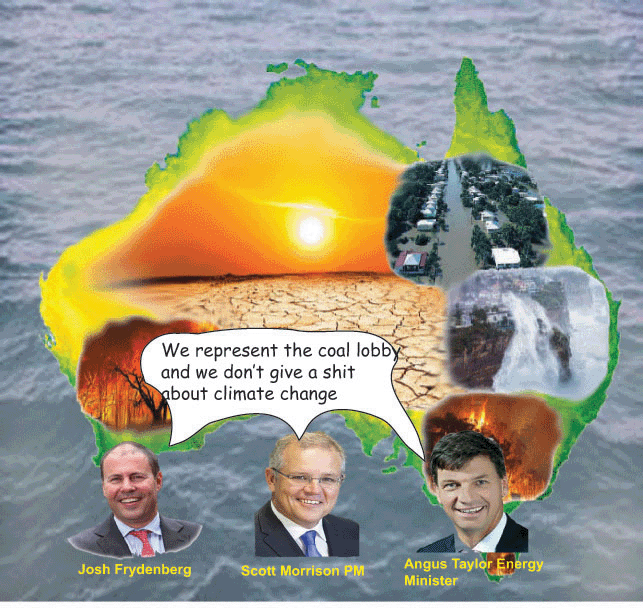 Australia’s silence during climate change debate shocks COP24 delegates, Guardian, Ben Doherty in Katowice, Poland@bendohertycorro, Mon 10 Dec 2018
Country accused of tacitly supporting oil allies’ rejection of the latest science As four of the world’s largest oil and gas producers blocked UN climate talks from “welcoming” a key scientific report on global warming, Australia’s silence during a key debate is being viewed as tacit support for the four oil allies: the US, Saudi Arabia, Russia and Kuwait.
The end of the first week of the UN climate talks – known as COP24 – in Katowice, Poland, has been mired by protracted debate over whether the conference should “welcome” or “note” a key report from the Intergovernmental Panel on Climate Change.
Negotiators spent two and a half hours trying to hammer out a compromise without success.
The apparently minor semantic debate has significant consequences, and the deadlock ensures the debate will spill into the second critical week of negotiations, with key government ministers set to arrive in Katowice.
Most of the world’s countries spoke out in fierce opposition to the oil allies’ position. The push to adopt the wording “welcome” was led by the Maldives, leader of the alliance of small island states, of which Australia’s Pacific island neighbours are members.
They were backed by a broad swathe of support, including from the EU, the bloc of 47 least developed countries, the Independent Association of Latin America and the Caribbean, African, American and European nations, and Pacific countries such as the Marshall Islands and Tuvalu.
Australia did not speak during the at-times heated debate, a silence noted by many countries on the floor of the conference, Dr Bill Hare, the managing director of Climate Analytics and a lead author on previous IPCC reports, told Guardian Australia.
“Australia’s silence in the face of this attack yesterday shocked many countries and is widely seen as de facto support for the US, Saudi Arabia, Russia and Kuwait’s refusal to welcome the IPCC report,” Hare said.
Richie Merzian, climate and energy program director at the Australia Institute, said widespread goodwill across the Katowice talks was being undermined by “a handful of countries” trying to disconnect the science and urgency from the implementation of the Paris agreement.
“It is disappointing but not surprising that Australia kept its head down during the debate … by remaining silent and not putting a position forward, Australia has tacitly supported the US, Russia and Saudi Arabia’s rejection of the latest science on climate change.”
Merzian said Australia’s regional neighbours, including New Zealand and Pacific islands, had voiced strong support for the IPCC’s report, which was a key outcome of the Paris agreement.
“A number of delegates privately shared their frustration that countries like Australia stood on the sidelines while Trump’s, Putin’s and King Salman’s representatives laid waste to the fundamental climate science.”
Hare said the interests of the fossil fuel industry were seeking to thwart the conference’s drive towards larger emissions cuts.
“The fossil fuel interest – coal, oil and gas – campaign against the IPCC 1.5 report and science continues to play out in the climate talks, but even those countries [opposing welcoming the report] are being hit by the impacts of only one degree of warming.
“The big challenge now is for the Polish presidency to set aside its obsession with coal, get out of the way and allow full acknowledgement of the IPCC 1.5C report, and its implications for increasing the ambition of all countries, in the conclusion of COP24 later this week.”
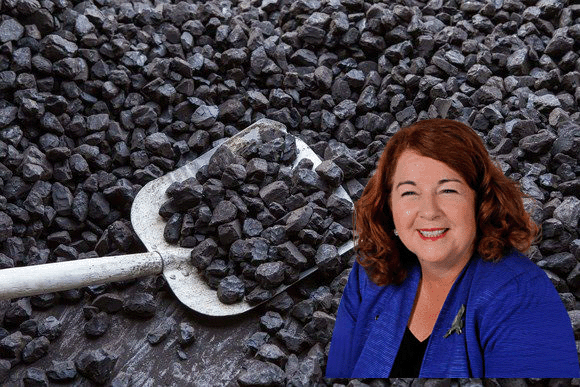 Australia’s environment minister, Melissa Price, arrived in Katowice on Sunday, with negotiations set to resume Monday morning……..
Australia’s emissions, seasonally adjusted, increased 1.3% over the past quarter. Excluding emissions from land use, land use change and forestry (for which the calculations are controversial), they are at a record high. https://www.theguardian.com/environment/2018/dec/10/australias-silence-during-climate-change-debate-shocks-cop24-delegate
Australia’s dirty tricks in Poland: getting away with no reduction in greenhouse emissions
|
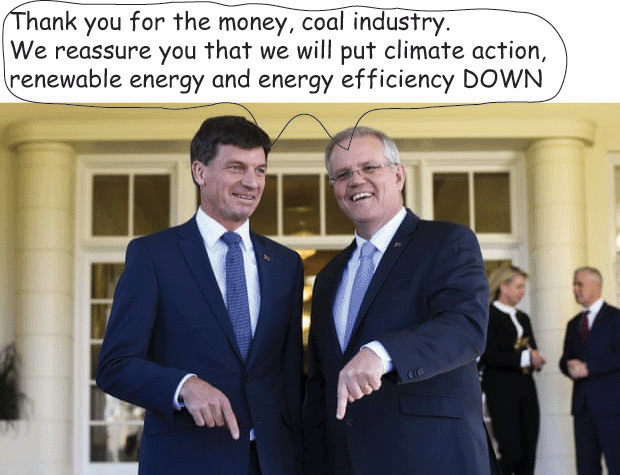
‘Fake action’: Australia’s secret path to hitting Paris climate goals, Brisbane Times, By Peter Hannam,– 10 December 2018 Australia could use a little-known loophole to help meet up to half its Paris climate commitments in a move that analysts warn could undermine the global accord. Neither Environment Minister Melissa Price nor Labor will rule out counting Australia’s expected credits from beating its 2020 goal under the soon-to-be-superseded Kyoto Protocol against its 2030 Paris pledge. The analysts say such a move by Australia would encourage other nations to follow suit. One ex-member of Australia’s negotiating team said the government had considered using the credits for some time even though it went against the spirit of the Paris accord signed in 2015. While not formally on the agenda at the current climate talks in Poland, the issue of Kyoto credits is expected to be discussed in coming days. Continue reading |
Lynas contemplates importing radioactive trash into Australia
 Brokers remain optimistic on Lynas despite Malaysian setbacks, SMH, By Colin Kruger, 6 December 2018 Analysts remain optimistic about the future of ASX-listed rare earths miner Lynas Corp, suggesting there may be ways around the onerous conditions put on the renewal of its operating licence in Malaysia.
Despite this, UBS has valued Lynas on a “business-as-usual basis” on the grounds that the problems are not insurmountable.
There may be grounds for appeal. The ministry is planning to implement a much stricter regime than the independent expert panel was recommending,” UBS analyst Daniel Morgan said in a research note. ….
According to UBS, Lynas may be able to economically ship the radioactive waste to another country – possibly Australia. And in a worst-case scenario, it could sell its concentrate product to China for processing while it restructured its processing.
One option is for Lynas to split out the processing stage that produces the residues that have caused problems in Malaysia.
“Lynas may be able to invest in a cracking and leaching facility in Australia, keeping the [waste] in the country.” Lynas would then ship the concentrate to Malaysia for the final stage of extraction using its existing facilities.
CLSA was also optimistic, saying the low-level radioactivity meant the waste could be shipped in regular shipping containers. And Lynas had access to rehabilitation funds to help pay the bill……..
Outside China, Lynas is the only processor of rare earths, which are crucial for elements of the new economy like mobile phone components, electric cars and batteries.
The miner’s shares shares nearly halved in value in May when Mahathir Mohamad unexpectedly defeated his former ruling party and then announced a review of the Lynas operation as promised……..
Lynas earlier this month flagged a temporary shutdown of its Malaysian processing plant, which could cost the company $16 million in lost revenue, if it doesn’t win local government approvals to lift production caps. safe…….https://www.aljazeera.com/news/2018/12/malaysia-tells-lynas-remove-rare-earths-radioactive-waste-181204085233206.html
Malaysia tells Lynas to remove rare earths radioactive waste
Aljazeera, 4 Dec 18 Decision follows an expert review of the east coast facility’s operations. It has until September to remove the waste.
Decision follows an expert review of the east coast facility’s operations. It has until September to remove the waste. Malaysia has told Lynas, the Australian company operating a rare earth elements processing plant on the country’s east coast, that it must remove the radioactive waste that accumulated as a result of its activities over the past six years if it wants to continue to operate.
The decision on Tuesday follows a review of Lynas operations in Malaysia that was initiated by the government that took power in May’s general election.
The “management of the waste residue from the Lynas Advanced Materials Plant (LAMP) should be given priority to ensure the wellbeing of the community and the environment”, the Ministry of Energy, Science, Technology, Environment and Climate Change said in a statement.
The residue, some of it radioactive, has been building up at an open landfill at the Lynas site near the city of Kuantan since the processing plant started operations in 2012.
“The Ministry is concerned with the increasing risk of arising from the continued accumulation of residue without a viable solution to manage its accumulation in the near-term,” the statement continued.
“For this reason, the Ministry will not allow the unlimited accumulation of residue at LAMP. The accumulated Water Leached Purification (WLP) Residue, which contains radioactive materials must be removed from Malaysia.”
Radioactive waste
While Lynas was considering recycling the waste as a soil conditioner, the ministry said the duration of the studies was too short to reach a conclusion on the plan’s safety. It said the waste would need to be removed from Malaysia by September 2, 2019, when Lynas’ temporary storage licence expires.
The decision is likely to come as a blow to Lynas. The Australian-listed company had been campaigning hard to convince the review committee, government and the public that the plant was safe…….https://www.aljazeera.com/news/2018/12/malaysia-tells-lynas-remove-rare-earths-radioactive-waste-181204085233206.html
Will Scott Morrison drop support for the Iran nuclear deal, in order to curry favour with Donald Trump?

Why do I not do pictures of Scott Morrison? Because I can’t be bothered. Morrison will soon be gone and forgotten
THE RISK OF AUSTRALIA RECONSIDERING NUCLEAR DEALS https://pursuit.unimelb.edu.au/articles/the-risk-of-australia-reconsidering-nuclear-deals
Although Australia is not a party to the Iran nuclear deal, Scott Morrison is reviewing whether Australia should follow Donald Trump’s lead and withdraw its support
Known as the Joint Comprehensive Program of Action (JCPOA), this has significantly curbed Iran’s nuclear activities for at least a decade and potentially longer, while subjecting it to the most intrusive verification system applied to any country undefeated in war.
The Trump administration has renounced the agreement and reapplied economic sanctions to Iran.
The government’s policy review was announced during the October 2018 by-election for former Prime Minister Malcolm Turnbull’s parliamentary seat of Wentworth and was widely considered a ploy, ultimately unsuccessful, to retain the seat for the Liberal Party.
But even now, it’s not clear whether a real review is occurring or whether the Department of Foreign Affairs is simply going through the motions. Regardless, the result is expected this month.
It’s also not clear whether it was Mr Morrison or Mr Trump who raised the issue during their meeting, but the Prime Minister claimed it as “a success”, noting that Trump “very much welcomed the fact that, as a friend and an ally, we have always been ready to re-look at these things”.
This attempt to curry favour with the famously mercurial president is ill-advised. Quite apart from the inaccuracy of the suggestion that Australia is always willing to reconsider its policies just because it is a US ally (that certainly has not occurred over the Comprehensive Nuclear Test Ban Treaty, which the US refuses to ratify), there are significant political and substantive drawbacks for Australia even hinting that its support for the Iran deal is wavering.
Australia has for decades had a bipartisan policy towards preventing the spread of nuclear weapons. It has actively supported the Nuclear Non-Proliferation Treatyand the global nuclear safeguards system run by the International Atomic Energy Agency (IAEA) which verifies compliance with the treaty through on-site inspections and other monitoring.
Australia has also been at the forefront of efforts to strengthen safeguards.
It was the first country to adopt an Additional Protocol, designed to enhance the system after Iraq’s near-acquisition of nuclear weapons in the 1990s, and the first to qualify for the so-called Broader Conclusion about its compliance with the Protocol’s rigorous new requirements.
Although Australia wasn’t involved in the Iran negotiations, it was consulted as the talks proceeded and vocally supported the initiative and outcome. To renege now would cast doubt on our longstanding commitment to nuclear non-proliferation, jeopardise our credibility internationally, including at the IAEA, and call into question our commitment to multilateral, negotiated solutions to international problems.
Although not perfect, the Iran agreement was the product of an extraordinary international diplomatic effort to curb Iran’s nuclear weapon activities through a multilateral verifiable arrangement.
It involved not just the United States, but three other Western allies of Australia, the European Three (France, Germany and the United Kingdom), as well as the European Union, China and Russia – all of which are sticking to the accord.
While the Morrison government might have gained fleeting kudos from the Trump administration, Australia risks confounding not just the other JCPOA parties, but friends and allies which endorsed it subsequently, including Canada, Indonesia and Japan.
The only states pleased by Australia’s move would be Israel and Saudi Arabia.
Perhaps the worst implication of rejecting the JCPOA is to cast doubt on the plausibility of multilateral negotiations to resolve the North Korean nuclear impasse.
Edward Snowden Condemns US Justice Department for Targeting Julian Assange

What IS criminal is the failure of the Australian government do do a damn thing to help Julian Assange
Sputnik News, 18 Nov 18, The former NSA contractor, who faces capital punishment in the US for leaking classified information on numerous US secret surveillance programmes, voiced his support for the WikiLeaks founder after it came to light that US authorities are apparently poised to indict Julian Assange.
Edward Snowden, who has been granted political asylum in Russia, has voiced his concern about the dangerous precedent for stifling press freedom which could emerge from the US Justice Department’s alleged plans to prosecute WikiLeaks founder Julian Assange.
The Freedom of the Press Foundation, where Snowden is a board member, also issued a statement condemning the possible indictment of Julian Assange, whose website published a classified Iraqi dossier revealing that the US killed civilians during the country’s 2003 invasion and subsequent occupation. Trevor Timm, executive director of Freedom of the Press Foundation, cited a profound threat to press freedom if any charges are brought against WikiLeaks for their publishing activities.
“Whether you like Assange or hate him, the theories used in a potential Espionage Act prosecution would threaten countless reporters at the New York Times, Washington Post, and the many other news outlets that report on government secrets all the time. While everyone will have to wait and see what the charges detail, it’s quite possible core First Amendment principles will be at stake in this case,” his statement reads.
Earlier this week, it came to light through what is believed to be an accident that there’s a sealed complaint against Assange, as the US Department of Justice is gearing up to prosecute the whistleblower. It is now “optimistic” about the prospect of securing his release to US authorities, a new report suggests. According to the Wall Street Journal, prosecutors have weighed several types of charges against the journalist, who has resided in self-imposed exile at the Ecuadorian Embassy in London since 2012……….https://sputniknews.com/us/201811171069890725-snowden-assange-whistleblower-prosecution/
Australia-UK agreement on nuclear co-operation and development after UK leaves European Union
This agreement allows the strong links between the UK and Australia in the civil nuclear sector to continue following the UK’s withdrawal from Euratom and provides the basis for future collaboration.
International treaty Gov UK
[CS Australia No.1/2018] UK/Australia: Agreement for Cooperation in the Peaceful Uses of Nuclear Energy Presented to Parliament 12 November 2018
Radioactive pollution problems: Australia’s rare earths mine in Malaysia
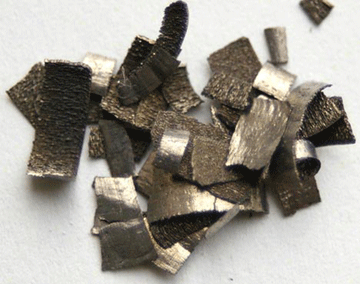 Australian mining plant in Malaysia faces radioactive waste inquiry, As China, the world’s largest producer of rare earth metals, scales back its export operations, the future of Australia’s industry is under a cloud. https://www.sbs.com.au/news/australian-mining-plant-in-malaysia-faces-radioactive-waste-inquiry By Jarni Blakkarly 30 Oct 18, The Chinese government has announced a slashing in the production of rare earth metals, a type of metal used in a range of high-tech products from mobile phones to wind turbines and electric cars.
The country, which is the largest producer and consumer of rare earth metals, has cut its quota for the separation and smelting of rare earths by 36 percent, Reuters reported last week.
China produces roughly 80 per cent of the world’s rare earth metals and the move will likely send global prices skyrocketing. Meanwhile, the joint Australian-Malaysian rare earths operation run by Perth company Lynas, the only major production plant outside of China, is having its own problems.
Earlier this month, the Malaysian government launched a broad parliamentary inquiry into the mine and the management of its radioactive waste.
The Australian company mines rare earth metals in Western Australia before shipping them to Malaysia for processing.
Resources analyst Dylan Kelly from finance group CLSA told SBS News: “It is really critical in a strategic sense as the only real rare earth producer outside of mainland China and one that is high in quality and it is highly sought after in terms of strategic interest, not just for the Japanese, but also the US.”
But questions remain over the management of radioactive waste from the plant and what long-term solutions are in place for its management.
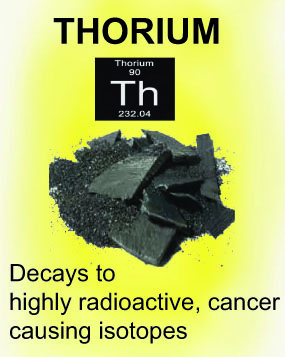 RMIT Professor of environmental engineering Gavin Mudd told SBS News all rare earths processing involves the generation of radioactive thorium and sometimes uranium waste.
The company’s current long-term waste management plans involve repurposing that waste into a soil fertilizer product, but Professor Mudd says not enough has been done yet to guarantee the by-product would be safe.
“Historically the rare earths industry hasn’t got a good track record in being able to demonstrate that safety case,” he said.
While the current government inquiry appears unlikely to shut the processing plant down in its entirety, Professor Mudd says more can be done in terms of increasing environmental reporting and public disclosure around the plant.
Lynas declined to comment to SBS News ahead of the inquiry, but in the past has defended its waste management practices as safe and transparent.
When the plant was approved in 2012 it set a wave of protests by thousands of concerned locals, which was largely ignored by the government.
But with the Opposition coming to power in a surprise election victory in May, the new government is taking a closer look at the plant.
Local Kuantan MP Faziah Salleh says the company needs to develop a new long-term storage plan for the radioactive waste.
“The company has to think about how they dispose of their radioactive waste, because Malaysians, especially people of [the city of] Kuantan, will not except the waste being left … dumped in our backyard, as it is right now,” she said.
The inquiry is due to report back to the government before the end of the year.
As Antarctica thaws, China, Russia and others move in

|
China and Russia are eyeing up Antarctica — and experts say Australia should be more concerned, ABC, 28 Oct 18 By Holly Robertson Australia is spending $2 billion on a new Antarctic icebreaker — the biggest single investment in the history of our Antarctic program.
Key points:
The state of the art RSV Nuyina — which was floated last month — will primarily support Australia’s scientific research team in Antarctica, but it also has another purpose: shoring up our territorial claim to 42 per cent of the icy continent, where countries including China and Russia have been ramping up their presence…….. What is Australia’s role in Antarctica? The Australian Antarctic Territory covers a whopping 5.9 million square kilometres, making it nearly 80 per cent of the size of Australia and the largest Antarctic claim of any country, according to the Australian Antarctic Division. Australia has three year-round research stations on Antarctica, as well as one on Macquarie Island, and conducts dozens of scientific research programs. But in recent years Antarctic experts have been critical of the Australian Government’s commitment to our efforts on the icy continent, both in terms of funding and attention. “Australia’s standing in Antarctic affairs is eroding because of historical underinvestment at a time when new players are emerging in Antarctica,” expert Tony Press warned in a 2014 Government-commissioned report.
Who are the new players and what are they doing there? Six other countries lay claim to parts of Antarctica — Argentina, Australia, Chile, France, New Zealand, Norway, and the United Kingdom — while many more also have research stations there and take part in joint scientific projects. In the past decade, China and Russia in particular have both ramped up their presence in Antarctica. China in particular has become a “leading polar player” in just 10 years and now spends more in Antarctica than any other country, according to a report by Anne Marie Brady, an expert on China and the Antarctic at the University of Canterbury in New Zealand………. there remains a divide between the countries that want to keep it pristine, such as Australia and New Zealand, and the ones that hope to eventually exploit its potential, like China and Russia, as global resources decline and a ban on mining comes up for renegotiation in 2048. But even more crucial, according to Dr Brady, is that Antarctica has emerged as a site of global strategic importance……… What does this mean for Antarctica’s future — and ours? The Antarctic Treaty of 1959 does not necessarily guarantee Australia’s claim to territory on the icy continent, as many people seem to think. In fact, La Trobe University’s Daniel Bray says that the treaty “essentially set aside all claims to Antarctica in order to create a legal [framework] to manage human activity on the continent”.
|
|
Australia losing all credibility with Pacific neighbours, as Morrison pulls out of global climate fund
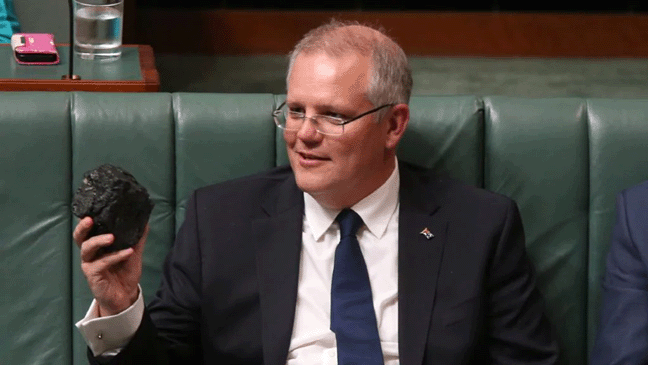 Poor nations castigate Australia for abandoning global climate fund, Canberra Times, By Nicole Hasham, 24 October 2018 Developing nations say a Morrison government snub of the world’s biggest climate change fund hampers efforts to cut global carbon pollution and erodes Australia’s international reputation…… Poor nations castigate Australia for abandoning global climate fund, Canberra Times, By Nicole Hasham, 24 October 2018 Developing nations say a Morrison government snub of the world’s biggest climate change fund hampers efforts to cut global carbon pollution and erodes Australia’s international reputation……
Prime Minister Scott Morrison announced Australia will cease payments to the United Nations-backed Green Climate Fund, a mechanism under the Paris treaty to help poor nations cut emissions and respond to extreme weather and rising seas. Australia’s high per-capita emissions and coal dependence mean it was expected to be a generous benefactor. However, One Nation leader Pauline Hanson has pressured the government to abandon the fund and it is unpopular with conservative Coalition MPs, including Tony Abbott. Australia contributed $200 million in the first funding round and took a leadership role in 2016 when it co-chaired the fund. But in a radio interview last month Mr Morrison, when asked if Australia would be bound to its climate targets under the Paris agreement, said: “No, we won’t … nor are we bound to go and tip money into that big climate fund. We’re not going to do that either. I’m not going to spend money on global climate conferences and all that nonsense.” Fund board member Tosi Mpanu-Mpanu, of the Democratic Republic of Congo, said Australia’s stance was “beyond frustrating”, particularly in the wake of the Intergovernmental Panel on Climate Change report that this month warned of devastating planetary damage without radical action. “This backtracking from [the] previous commitment by Australia is disappointing,” he told Fairfax Media. “Australia is the world’s biggest coal exporter … it has a major responsibility to provide financial support for developing countries to adapt to and mitigate climate change.” Mr Mpanu-Mpanu suggested abandoning the fund was in contravention of the Paris accord and said commitments by developing nations to lower emissions under the treaty relied on financial support from nations such as Australia. Parties to the Paris deal will meet in Poland in December to finalise the rules of the treaty and “this decision by Australia will cast a shadow on the process of reaching an agreement”, he said……. The condemnation from the developing world further cements Australia’s position as a global outlier on climate action after the government indicated it would not ramp up emissions reduction efforts under the Paris treaty and rejected the IPCC’s call for a coal phase-out by 2050. Developed countries originally pledged $US10 billion to the fund but it was left short after US President Donald Trump withheld $US2 billion of the $US3 billion his nation promised…… https://www.canberratimes.com.au/politics/federal/poor-nations-castigate-australia-for-abandoning-global-climate-fund-20181023-p50beh.html |
|
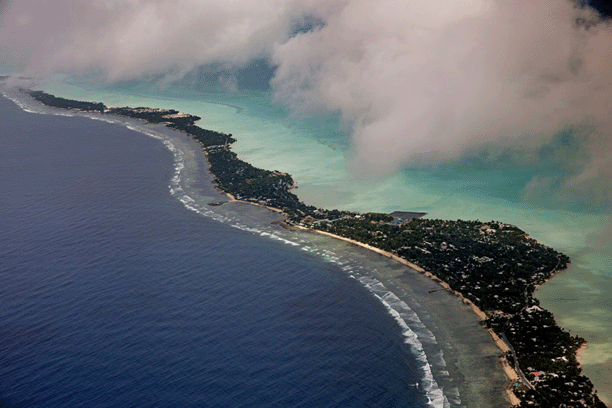
Kiribati’s Anote Tong, (slighted by Minister Melissa Price says Australia must act on climate change
Britain’s exit from European Union- a cause for rejoicement to Australia’s uranium industry?
|
Australia is working on a new deal for selling uranium to the United Kingdom once it leaves the European Union. Australia is working on a new nuclear deal with the United Kingdom once it leaves the European Union.One fifth of Australia’s uranium goes to the UK, but it cannot be used for military purposes, or sold to other countries who use it for their militaries. Dr John Kalish, acting director general of the Australian Safeguards and Non-proliferation Office, says a new deal will have to be done with the UK to mirror the old one with the EU. Under the old deal and the proposed one, the UK can only sell the uranium on to certain countries. “Retransfers can only be made to third parties that have a nuclear cooperation agreement with Australia,” Dr Kalish told a parliamentary committee on Monday. But Dr Kalish could not reveal which countries Australian uranium ends up in, citing “commercial in confidence”. Liberal MP Andrew Wallace can’t understand why. “I’m just trying to work out why the Australian people can’t be informed what third party countries the UK might reassign or retransfer uranium that comes out of this country?” he asked. Dr Kalish said he could give the committee the names of the countries, but they would have to remain secret. Meanwhile, Labor’s foreign affairs spokeswoman Penny Wong gave a speech to the Australian Institute of International Affairs on Monday, in which she called for Australia to take a greater role in banning nuclear weapons. “A Shorten Labor government will seek to muster wide international support, including from the states that possess nuclear weapons, for a ‘No First Use’ declaration,” she said. “For states with nuclear weapons to adopt a ‘No First Use’ policy would constitute a major step forward in reducing tensions and risks of accidental or mistaken use.” Senator Wong says Labor will also use Australia’s strong relationships with nuclear weapons states to push for a reduction in their nuclear stockpiles. “Dismantling 15,000 nuclear warheads and the security arrangements that rest upon them is not going to happen overnight,” she said. |
|

IN New Zealand, both sides of politics agree on action against climate change


 ‘Jaw dropping’: New Zealand offers lessons in tackling climate change, By Peter Hannam, Brisbane Times, 13 October 2018 Scott Simpson, New Zealand’s National Party environment spokesman, stunned a trans-Tasman investment meeting last week by stating that climate action was “too important to be playing politics with”.
Or rather, it was the Australian delegates who were shocked, so used are they to the toxic debates in Canberra.
“It made my jaw drop, that’s for sure,” said Emma Herd, chief executive of the Investor Group on Climate Change.
Also well-received was Mr Simpson’s comment that it was vital “for all of us and our grandchildren that we have a [climate action] framework that is enduring”, coming as it did soon after the UN’s Intergovernmental Panel on Climate Change had issued its latest report warning about the perils of even another half degree of warming.
That Mr Simpson hails from the centre-right opposition party roughly equivalent to our Liberal-National coalition only underscored the contrast between the nations.
New Zealand’s major parties, busy trying to thrash out a Zero Carbon Bill by year’s end, are dismayed by the absence of similar bipartisanship across the Tasman, James Shaw, climate change minister in the Labor-led government told Fairfax Media.
“We do tend to look at what’s going on in Australia politics, in particular in relation to climate policies, and we think, ‘We cannot afford to let this happen in New Zealand’,” Mr Shaw said. “It seems like a pretty strong lesson in what not to do.”……..
In government, the National Party signed up to the Paris climate accord and introduced an emissions trading scheme.
To remove the politics from the negotiations, all sides agreed to take advice on New Zealand’s targets from an independent climate commission. (Australia has a Climate Change Authority but all the original board members have been replaced since it was set up by the Gillard government and its role as an advocate for action has largely disappeared.)……
Mr Shaw (of the ruling Coalition ) said the Opposition could have exploited a potentially divisive policy – agriculture contributes half of New Zealand’s greenhouse gas emissions – but didn’t.
“They are playing an absolute straight bat,” he said. “There’s a genuine best effort to get a consensus outcome.”
New Zealanders, like Australians, have endured an increasing spate of extreme weather events, which the government attributes in part to climate change. These include a record hot year in 2016, droughts and a major forest fire last year.
“We’ve definitely had a lot more extreme rainfall events,” Nava Fedaeff, a climate scientist with the National Institute of Water and Atmospheric Research (NIWA), said. These include damaging ex-tropical cyclones hitting the nation, with the average jumping from less than one a year to three over the last summer season.
Trish Rankin, a dairy farmer managing 440 cows for a Maori-owned co-operative near Hawera in the Taranaki region of the North Island, said climate action “needs to be apolitical – it needs to be able to last over time”.
Ms Rankin said New Zealand farmers realise their social licence depends on them being good custodians of the land, and the principle extends to curbing emissions. Open consultations with experts have also helped.
“If you know they are listening to you, you’re more likely to listen to them,” she said.
Convergence ahead?
Bill Hare, director of Climate Analytics, notes New Zealand’s existing climate policies are insufficient, but the nation appears to be “moving to a much better space”.
Steps already taken include the ban on new offshore oil and gas exploration, and in prospect are five-year interim emissions targets and a more ambitious emissions trading scheme……..
New Zealand’s climate minister, Mr Shaw, says farmers – unlike Australian coal companies – have options.
“People are still going to want to eat in 30 years’ time, so the question is what do you produce and how do you produce it – not whether or not you’re going to produce food,” he said.
“But in 30 years’ time, you can pretty much guarantee no one in the world is going to use coal for anything.” https://www.brisbanetimes.com.au/environment/climate-change/jaw-dropping-new-zealand-offers-lessons-in-tackling-climate-change-20181012-p509di.html
1 This month

of the week – Australians for War Powers Reform (AWPR)
To see nuclear-related stories in greater depth and intensity
 Antinuclear