NZ may lobby Aust on nuclear weapons ban SBS News 27 Feb 18 “……….Australia could be in for a lecture from New Zealand on nuclear weapons disarmament.
NZ Prime Minister Jacinda Ardern will visit Australia for talks with Prime Minister Malcolm Turnbull at the end of the week.
She’ll be accompanied by Deputy Prime Minister Winston Peters, seven cabinet ministers and a business delegation.
Ms Ardern delivered a major foreign policy speech to the New Zealand Institute of Public Affairs on Tuesday and announced her government will reinstate the cabinet position of disarmament and arms control minister.
Last July, 122 countries voted in the United Nations to ban nuclear weapons.
Ms Ardern flagged in the speech her government was looking at an early ratification of the treaty. “In a modern context, the greatest challenge comes from North Korea, situated right here in our region,” she said.
“At a time when risks to global peace and security are growing and the rules-based system is under such pressure, we must recommit ourselves to the cause of non-proliferation and disarmament.”
Australia has refused to sign up to the treaty ban and did not take part in the negotiations.
The country relies on the deterrent protection from the US’s nuclear weapons arsenal.
New Zealand has long adopted a firm line in opposing development of nuclear capabilities, which at times puts the small Pacific nation at odds with some allies.
……… Asked if she’ll raise the issue with Mr Turnbull, Ms Ardern told reporters in Wellington: “I have no qualms having conversations about it.”……. NZ also has an ongoing offer to resettle 150 refugees from Nauru and Manus Island, which has previously been rejected……..https://www.sbs.com.au/news/nz-may-lobby-aust-on-nuclear-weapons-ban
Why is the Australian government giving no help to this Australian citizen?
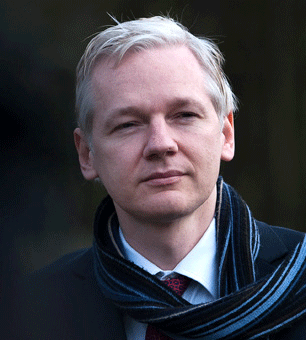
ABC News 14 Feb 18, A British judge has upheld an arrest warrant for Julian Assange, saying the WikiLeaks founder should have the courage to come to court and face justice after more than five years inside Ecuador’s London embassy.
Key points:
Mr Assange can seek to appeal, though his lawyers did not say whether he would
He faces arrest if he leaves Ecuador’s London embassy
His attorney argues that arresting him was no longer proportionate or in the public interest
Judge Emma Arbuthnot rejected arguments by Mr Assange’s lawyers that it is no longer in the public interest to arrest him for jumping bail in 2012 and seeking shelter in the embassy to avoid extradition to Sweden.
Judge Arbuthnot did not mince words in her ruling at Westminster Magistrates’ Court, saying that by jumping bail, Mr Assange had made “a determined attempt to avoid the order of the court”.
She said Mr Assange appeared to be “a man who wants to impose his terms on the course of justice”.
Mr Assange can seek to appeal, though his lawyers did not immediately say whether he would.
Swedish prosecutors dropped their investigation last year, saying there was no prospect of bringing Mr Assange to Sweden in the foreseeable future.
But the British warrant for violating bail conditions still stands, and Mr Assange faces arrest if he leaves the embassy.
His attorney had gone on to argue that arresting him was no longer proportionate or in the public interest.
Lawyer Mark Summers argued the Australian was justified in seeking refuge in the embassy because he had a legitimate fear that US authorities want to arrest him for WikiLeaks’ publication of secret documents.
Judge Arbuthnot dismissed another plank of Mr Assange’s case — a report from a UN working group which said the 46-year-old was being arbitrarily detained.
“I give little weight to the views of the working group,” the judge said, noting that Mr Assange had “restricted his own freedom for a number of years”.
Julian Assange’s bid for freedom
While court hearings for Julian Assange’s bid for freedom are interesting steps in a long running saga, the end game is far more complicated, writes Lisa Millar.
Mr Assange’s lawyer had argued that the five-plus years Mr Assange had spent inside the embassy were “adequate, if not severe” punishment for his actions, noting that he had health problems including a frozen shoulder and depression….
..The ruling leaves the long legal impasse intact. Apart from the bail-jumping charge — for which the maximum sentence is one year in prison — Mr Assange suspects there is a secret US grand jury indictment against him for WikiLeaks’ publication of classified documents, and that American authorities will seek his extradition.
Julian Assange ‘has suffered enough’, his lawyers tell British judge, SMH, Nick Miller, 6 Feb 18, London: Julian Assange has suffered enough and shouldn’t face prison for absconding from justice, his lawyers have told a court.
The Wikileaks editor is depressed, in constant pain from an infected tooth, and has been stuck in the Ecuador Embassy in London’s Kensington far longer than the maximum 12-month jail penalty for breaching bail, his barrister said.
On Tuesday Assange lost a legal bid at Westminster Magistrates Court to quash the arrest warrant that has awaited him since he entered the Ecuador embassy in June 2012.
However his lawyers immediately launched a new push to end the UK government’s attempt to bring him to justice – arguing that it is against the public interest to punish him for refusing to leave the embassy.
It is a criminal offence for someone on bail to refuse to surrender to police without “reasonable cause” – and Assange refused to leave the embassy despite a court order for his arrest.
But Assange’s barrister Mark Summers QC told Judge Emma Arbuthnot that it was not in the interests of “justice and proportionality” to bring an action against Assange.
Assange went into the embassy after he exhausted his line of appeal against a decision to extradite him to Sweden to face rape allegations. Sweden last year ended its investigation into the allegations, and the European arrest warrant against Assange was cancelled. However the British warrant for his arrest still stood – and judge Arbuthnot said she was not persuaded it should be quashed simply because the underlying investigation had stopped.
Mr Summers said Assange was not “thumbing his nose” at justice and his five and a half years in the embassy were “adequate if not severe punishment for the actions that he took”.
Assange had genuine fears – later proved correct – that the US were keen to prosecute him over his work with Wikileaks, Summers said.
If arrested he would face rendition to the USA, treatment similar to that meted out against Wikileaks whistleblower Chelsea Manning – and possible “persecution, indefinite solitary confinement and the death penalty”, Summers said in a written submission……….
Judge Arbuthnot said it was a “very interesting” case.
She will rule on the public interest application on February 13.
Outside court, Assange’s lawyer Jennifer Robinson said whether or not the warrant is quashed Assange would not leave the embassy until he had an assurance he wouldn’t be extradited to the US.
“Mr Assange remains willing to answer to British justice in relation to any argument about breaching bail, but not at the expense of facing injustice in America,” she said.
‘Hallelujah’ moment: Revised TPP to be signed in March Radio New Zealand, 23 Jan 18The revised Trans-Pacific Partnership agreement is to be signed in March, the Trade Minister has confirmed. Australia’s Trade Minister, Steve Ciobo, said the 11 nations, including New Zealand, are “finally at the finish line” following talks between officials in Tokyo………
The rebranded the Comprehensive and Progressive Trans-Pacific Partnership (CPTPP), covers nearly 500 million people and the 11 countries involved make up 14 percent of global economic activity, or about $US10 trillion.
If the trade pact is successfully concluded, lower barriers and standardised rules are expected, making it easier for businesses to sell their goods and services in these markets.
Speaking at the World Economic Forum in Davos, Switzerland, Canada’s Prime Minister Justin Trudeau called the agreement the “right deal”.
The country’s trade minister said it included an improved arrangement on autos with Japan and the suspension of intellectual property provisions that had been a concern…….
Trade specialist Stephen Jacobi said it was a less problematic deal than the initial one.
“It suspends a number of the more problematic areas of TPP, particularly intellectual property provisions and some aspects of the investor state settlement that was very controversial in New Zealand.
“It’s taken the hard edge off TPP … in those areas.”
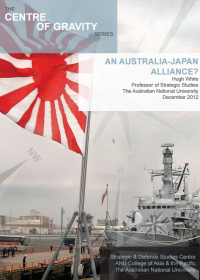
In this Centre of Gravity paper, Professor Hugh White explores the potential and risks of an alliance between Japan and Australia. Japan is one of Australia’s most important economic partners, a close ally of the US and might be prepared to sell Australia a highly advanced submarine fleet. Yet, for all the overlap of values, Professor White cautions that there is not necessarily an overlap of interests. In particular the rise of China poses difficult questions for the long term potential for the relationship, and for Australia’s desire to avoid having to choose between the US and China.
BYTHE WIRE STAFFON19/01/2018The Ministry of External Affairs hopes India’s ‘credentials’ are taken into account as and when a decision is taken (on its NSG application). New Delhi: India on Friday joined the Australia Group which aims to stop the development and acquisition of chemical and biological weapons, a move that may take the country an inch closer to joining the Nuclear Suppliers’ group (NSG).
This is the third multilateral export control group – after the Missile Technology Control Regime (MTCR) and Wassenaar Arrangement – that India has become a member of.
In a press release, the 42-member Australia Group said there had been “very strong support” for India’s membership at its plenary meeting in June 2017. Following that, “consensus was reached intersessionally” to admit India to the club. “India then reaffirmed its intention to join the group,” said the announcement.
The Ministry of External Affairs said that the series of multilateral export control groups that India has joined “helps in establishing our credentials” for joining the NSG. India joined the MTCR in June 2016, followed by the Wassenaar Arrangement in December 2017.
Pacific rift: When nuclear tests made France a dirty word, SMH, Damien Murphy, 1 Jan 18 “…….the 1985 sinking of the Greenpeace vessel Rainbow Warrior by French operatives, union outrage, peacenik panic and maintenance of uranium exports shaped Australia’s response to Paris’ decision to start letting off bombs as far away as possible from La Belle France.
In a June 5 report to cabinet about possible resumption of French tests, the minister for foreign affairs, Gareth Evans and the minister for Pacific Island affairs, Gordon Bilney, said memories of the Rainbow Warrior were strong and New Zealand could be expected to postpone official visits and suspend military-related co-operation with France.
The ministers were concerned about Australia looking as hard-nosed as New Zealand.
“New Zealand will obviously be hoping that Australia’s response is similar to theirs,” the ministers said. “Wellington’s response may have an impact in Australia if it is significantly stronger than ours.”
The ministers advised treading softly so as not to make nuclear testing dominant in the bilateral relationship and stop the French from taking retaliation.
“Three specific areas of current Australian interest could be targeted by the French: Australia’s (United Nation’s) Security Council bid, market access for special Australian products such as kangaroo meat, and Australia’s candidature for the position of secretary-general of the South Pacific Commission.”
On June 13, president Jacques Chirac announced the resumption of nuclear tests in the South Pacific.
The Keating government hardened up its act.
On June 22 cabinet decided to recall Australia’s ambassador and Australian Defence Force staff from Paris, suspend Australian ship and aircraft visits to French territories and ban French ship visits and “not progress” collaboration on military logistics and equipment or exchange classified information.
Cabinet maintained the policy of not negotiating any new uranium contracts with France while it was conducting nuclear tests in the South Pacific.
“These measures are in line with the government’s consistent policy on this issue, which has been to respond in a measured, graduated way, leaving open every avenue for France to respond to South Pacific concerns,” an attachment to a cabinet minute noted.
French nuclear test tensions threatened Olympic Dam expansion plans, declassified Cabinet documents reveal, Peter Jean, The Advertiser, January 1, 2018
THE FRENCH NUCLEAR TESTING
KANGAROO meat and other exports to Europe could be jeopardised if Australia took a hard line against French nuclear testing in the South Pacific, the Keating cabinet feared in 1995.
A ban on uranium exports to France could also have put at risk a potential $1 billion expansion of South Australia’s Olympic Dam.
The resumption of underground nuclear testing in French Polynesia sparked boycotts of French businesses in Australia and plunged the Labor government into a diplomatic and political crisis.
Mr Keating recalled Australia’s Ambassador from Paris and suspended some defence co-operation with France, including ship visits and training arrangements.
In a May cabinet submission ahead of the nuclear tests, Foreign Affairs Minister Gareth Evans and Pacific Island Affairs Minister Gordon Bilney warned that Australia’s interests could be damaged if the Government overreacted.
“Australia’s response should also be shaped so as to limit French retaliation in those sectors of the relationship we wish to see preserved,’’ the submission said.
“Three specific areas of current Au1stralian interest could be targeted by the French: Australia’s Security Council bid, market access for special Australian products such as kangaroo meat, and Australia’s candidature for the position of Secretary-General of the (South Pacific Commission).’’
There were widespread calls for Australia to suspend uranium exports to France but this would have led to the Government having to pay compensation to mining companies with existing contracts.
Australia had already imposed a ban on new uranium export contracts with French companies until France agreed to a comprehensive nuclear test ban treaty.
PM silent on Nobel prize when world needs him to speak up, PETER BOYER, Mercury, Malcolm Turnbull is rarely stuck for words, but the award of the 2017 Nobel Peace Prize to an organisation founded in Australia has left him speechless.
The International Campaign to Abolish Nuclear Weapons, or ICAN, was set up a decade ago in Melbourne. ICAN’s current director, Swedish lawyer Beatrice Fihn, received the award at a gala ceremony in Oslo, Norway last week.
Geneva-based Fihn is one of just three salaried staff — the other two are in Australia — on the ICAN payroll. For an organisation that knows how to survive on almost nothing, the $1.42 million that comes with the prize promises a long future.
In early October, when the prize was first announced, a spokesman for the Prime Minister acknowledged “the commitment of ICAN and its supporters to promoting awareness of the humanitarian consequences of nuclear weapons”, adding that banning these weapons was not the answer. Foreign Minister Julie Bishop, who a fortnight earlier stressed Australia’s commitment to “a world free of nuclear weapons”, made no comment. She and the PM remain silent.
To put ICAN’s achievement into context, five months ago this tiny organisation managed to win the support of enough UN member countries — 122 of them — to vote into existence the legally binding Treaty on the Prohibition of Nuclear Weapons, which aims to eliminate these weapons.
Every Latin American country, including Brazil, Argentina and Mexico, voted for the treaty. So did Ireland, Austria, Switzerland, Finland, nearly all African countries, Kazakhstan, Mongolia and most of the Middle East including perennial antagonists Saudi Arabia and Iran.
Australia facing climate disaster on its doorstep, government’s white paper warns
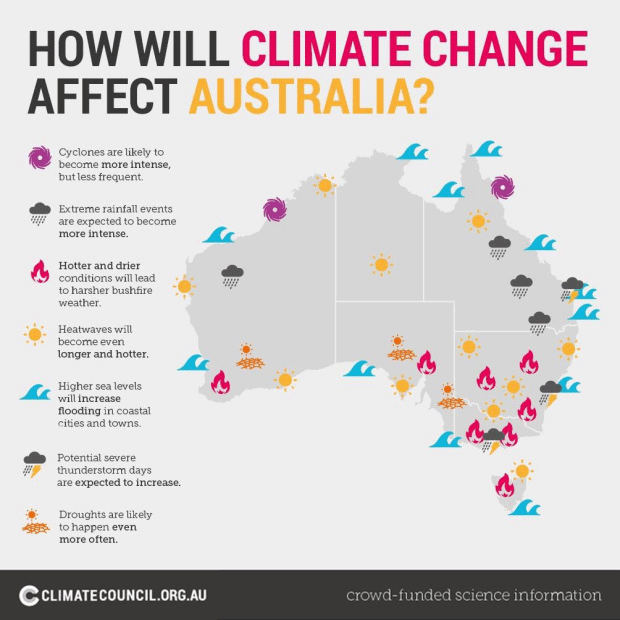
Foreign policy paper says climate-related conflict and migration could put Australia’s economic interests under pressure, Guardian, Katharine Murphy, 23 Nov 17,Climate change is creating a disaster on Australia’s doorstep, with environmental degradation and the demand for sustainable sources of food undermining stability in some countries, especially “fragile states”, according to the Australian government’s first foreign policy white paper in more than a decade.
The new white paper, released on Thursday, contains warnings over the disruptive effects of climate change in Australia’s immediate region, noting that many small island states will be “severely affected in the long term”, and the coming decade will see increased need for disaster relief.
The white paper notes the demand for water and food will rise, with the world’s oceans and forests under intense pressure. It notes climate change and pressure on the environment could contribute to conflict and irregular migration, impacting specifically on Australia’s economic interests.
Pacific Island nations urge world leaders to act as islands expected to sink
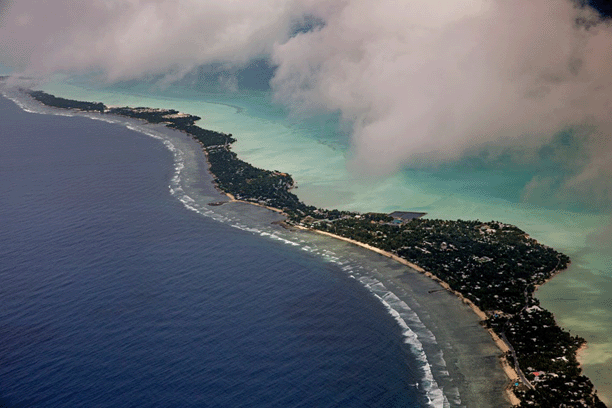
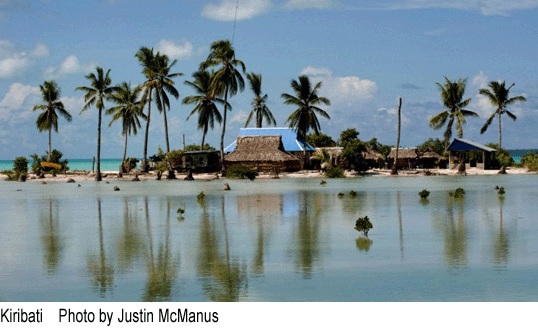
AUSTRALIA’S tropical island neighbours may exist today, but their leaders have urged us to help them from sinking. news.com.au, Matt Young@MattYoung 14 Nov 17 A LARGE swath of Pacific Island nations are slowly being eaten away until residents will be forced to evacuate and the islands eventually sink into the sea — and it’s coming sooner than we think.
This modern-day Atlantis is thanks to sea levels across small island nations that have seen a dramatic rise over the past few decades, a rate of up to 3-4 times larger than the global average. Tuvalu, in the western Pacific Ocean, will reportedly be uninhabitable by 2050, while its island neighbour Kiribati, is expected to be fully submerged by 2100.
The Maldives, which has the lowest elevation in the world and a population of 427,000, may also have sunk by the end of the century.
It has led experts — including Professor Tim Flannery, climate change expert and Professor at La Trobe University — to believe we are “on a trajectory that will see those nations compromised”.
Malcolm Turnbull calls North Korea ‘criminals’, urges Hong Kong to help, SMH, Lindsay Murdoch, 12 Nov 17, Hong Kong: Prime Minister Malcolm Turnbull has accused North Korea of being one of the world’s most “cunning, sophisticated criminals,” involved in many serious crimes, including drug trafficking, in his strongest condemnation yet of the dictator Kim Jong-un.
Paladin has ignored our requests to provide its estimate of the cost of rehabilitating Kayelekera, but we can safely say that the figure will be multiples of the US$10 million bond. Just keeping Kayelekera in care-and-maintenance costs US$10–12 million annually.
As things stand, if Paladin goes bankrupt and fails to rehabilitate Kayelekera, either rehabilitation will be coordinated and funded by the Malawian government (with a small fraction of the cost coming from Paladin’s bond) or the mine-site will not be rehabilitated at all.
It does Australian companies investing in mining ventures abroad no good whatsoever to leave Kayelekera unrehabilitated, a permanent reminder of the untrustworthiness and unfulfilled promises of an Australian miner and the indifference of the Australian government.
The company’s environmental and social record has also been the source of ongoing controversy and the subject of countless critical reports.
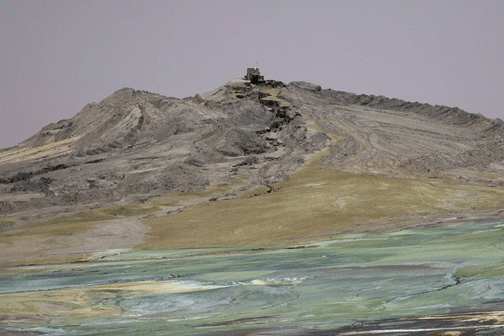
Julie Bishop, the WA government, Paladin and its administrators from KPMG need to liaise with the Malawian government and Malawian civil society to sort the rehabilitation of Kayelekera. An obvious starting point would be to prioritise the rehabilitation of Kayelekera if and when Paladin goes bankrupt and its carcass is being divided up. (picture below shows uranium sludge going to river)
Perth-based uranium mining company Paladin Energy was put into administration in July and the company is teetering on the brink of bankruptcy. Critics of the uranium industry won’t miss the company if it disappears. Other uranium mining companies won’t miss Paladin; in an overcrowded market, they will be pleased to have less competition.
But the looming bankruptcy does pose one major problem. Paladin’s Kayelekera uranium mine in Malawi, the ‘warm heart of Africa’, needs to be rehabilitated and Paladin hasn’t set aside nearly enough money for the job.
Under the leadership of founder and CEO John Borshoff, described as the grandfather of Australian uranium, Paladin has operated two uranium mines over the past decade. The Langer Heinrich mine in Namibia was opened in 2007, and Kayelekera in 2009.
They were heady days ‒ there was an endless talk about a nuclear power ‘renaissance’ and the uranium price tripled between June 2006 and June 2007. Continue reading →
Australia is expected to face renewed criticism when its Pacific Island neighbour Fiji chairs a key UN climate meeting from Monday.
The Conference of the Parties 23rd meeting takes place in the German city of Bonn and will be chaired by Fiji – the first time a Pacific nation has chaired such a major meeting.
Pacific Island leaders are expected to make the most of the global spotlight on the region, which is under threat from rising sea levels.
While Australia has provided a $300 million climate change package for the Pacific, the region’s leaders are demanding a moratorium on new coal mines.
Fiji-based lecturer on international politics Dr Wesley Morgan said he expects the government’s support for the planned Adani coal mine in North Queensland to be a target.
“Australia will be facing a lot of heat. Pacific Island countries and Pacific Island leaders are outraged that Australia, the world’s largest coal exporter, is planning to subsidise the construction of the world’s largest export coal mine.”
The Australia Institute executive director Ben Oquist said the planned Adani coal mine will produce more emissions a year than the Pacific Islands combined.
“I think the controversy surrounding that Adani mine is going to put extra pressure on the Australian Government as those Pacific countries want to see Australia move away from coal, not having a big neighbour in the region effectively subsidising what will be the world’s biggest coal mine,” he said.
Environment Minister Josh Frydenberg is leading Australia’s delegation to the Bonn meeting and will defend the mine. Continue reading →
Yes – it’s true – Australia is sending fossil-fuel-and-nuclear stooge Josh Frydenberg off to Germany to sabotage the UN climate conference!
Ever since Kyoto, 1997, when the Australian delegation kept everybody up until 4 a.m to make sure of watering down climate action, Australia has been ?proudly subverting international climate action.
Frydenberg is adept at twisting things, to make himself look good, while he’s really no more than an agent for the polluting industries. He might find this harder than usual, in Bonn, where the Murdoch media does not hold sway.
Frydenbeg might find that the Pacific Islanders’ case for action on climate will be better received than his advocacy for Australia’s coal industry.
Look – we’re an international disgrace on our punishment of refugees. We’v e long been an international disgrace on our climate inaction.
Here’s hoping that Frydenberg and the rest of the Australian polluting shills don’t succeed again.
IT’S TIME THAT AUSTRALIA JOINED OUR ISLAND NEIGHBOURS AND THE WORLD IN FIGHTING CLIMATE CHANGE




 Policy paper



 Antinuclear