Minister tight-lipped on claims Australia watered down climate change declaration, SBS News, 7 Sept 18 Foreign Affairs Minister Marise Payne is tight-lipped on claims Australia watered down language on climate change in an official Pacific Islands Forum document. Foreign Affairs Minister Marise Payne has defended “robust” discussions with Pacific Island leaders about the security threat posed by climate change.
Some leaders claim Australia watered down language on climate change in an official Pacific Islands Forum joint statement this week.
Boe Declaration Press Conference (Part 1)
Leaders capped off the 18-nation Pacific Islands Forum on Wednesday by signing a “Boe Declaration”, expanding on security themes to include the environment, cybercrime and transnational crime.
As was widely expected, the forum communique said climate change presented “the single greatest threat to the livelihood, security and well-being of Pacific people” and underscored the need for “immediate urgent action”.
Leaders also called on large emitters to fully implement national emissions mitigation targets and for the United States to return to the Paris Agreement on tackling climate change.
However, Tuvalu’s prime minister Enele Sopoaga is reported to have later told media a country whose name started with A – Australia being the only candidate – had raised concerns about some of the language around climate change during talks.
Comment has been requested from the Department of Foreign Affairs and Trade about whether Australia objected to parts of the declaration.
The focus on climate change recognises concerns that have been the key priority for Pacific leaders at the annual meeting.
New Zealand Prime Minister Jacinda Ardern called the Boe Declaration the most significant statement on the region’s security in a generation.
“Modern-day regional security challenges include climate change, cybercrime and transnational crime,” she said.
New Zealand’s foreign ministry, in a statement, said it had supported all climate change clauses in the declaration.
The Australian Conservation Foundation said the signing of the declaration was an important recognition of the issue by the new Morrison government but needed to be followed up with policy.
“This international commitment by our nation must be matched by domestic action,” ACF chief Kelly O’Shanassy said.
“Australia’s climate pollution is rising, and we have observed another collapse of domestic policy to cut emissions from electricity generation.”
Ahead of the forum, Australian ministers tried to ease concerns among Pacific leaders about its seriousness on climate change, saying the government was still committed to its reduction targets despite the recent collapse of its planned emissions legislation.
The Australian Conservation Foundation said the signing of the declaration was an important recognition of the issue by the new Morrison government but needed to be followed up with policy.
“This international commitment by our nation must be matched by domestic action,” ACF chief Kelly O’Shanassy said.
“Australia’s climate pollution is rising, and we have observed another collapse of domestic policy to cut emissions from electricity generation.”
Defence Minister Christopher Pyne on Friday announced the deployment of two Australian AP-3C Orion patrol aircraft in addition to a P-8A Poseidon sent out earlier this year.
A“It is a continuation of our strong stand to deter and disrupt illicit trade and sanctions evasion activities by North Korea and its associated networks,” he said.
The planes will be based out of Japan.
Meanwhile, a New Zealand Air Force Orion P-3K2 would also be carrying out surveillance of international waters in north Asia, New Zealand Foreign Affairs Minister Winston Peters announced separately.
“We welcome the recent dialogue North Korea has had with the United States and South Korea,” he said.
“However, until such time as North Korea abides by its international obligations, full implementation of the United Nations Security Council Sanctions resolutions will be essential.”
In particular, the aircraft would be on the look-out for ship-to-ship deliveries that may contravene Security Council resolutions, he said.
The United States has been using sanctions to put pressure on the hermit kingdom to give up its nuclear weapons program.
In August, it announced penalties against two Russian companies over what is said were transfers of refined petroleum to North Korean ships.
Since US President Donald Trump’s high-profile meeting with North Korean leader Kim Jong-un this year, relations between their countries have cooled.
A diplomatic visit by US Secretary of State Mike Pompeo to North Korea was cancelled last month, with Mr Trump citing a lack of progress on denuclearisation.
New Zealand’s government recently agreed to replace its ageing fleet of six surveillance aircraft with four high-tech Boeing P-8A Poseidons.
Analysts said the purchase signalled New Zealand’s willingness to keep in touch with traditional allies such as the United States and Australia and showed its seriousness about military deployments in the region.
Giles Parkinson, 7 September 2018Well, that didn’t take long. Little more than a week after the elevation of Scott Morrison to the prime minister’s office, Australia has returned to the bad old ways that were a feature of Tony Abbott’s engagement on climate change, and John Howard’s involvement with Kyoto.In separate arena this week, Australia has been accused of attempting to water down the languageof the Pacific Islands Forum declaration on climate change. And in Bangkok it has sided with the Trump administration and Japan in attempting to weaken climate finance obligations in a move that has horrified some observers.
Australia is coming under increasing scrutiny since Malcolm Turnbull announced the country was dumping the emissions obligation proposed for the National Energy Guarantee, and was then dumped by the party’s climate denying conservative wing anyway.
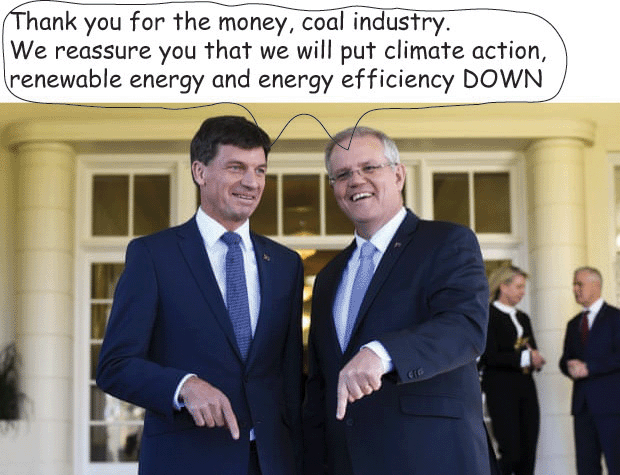
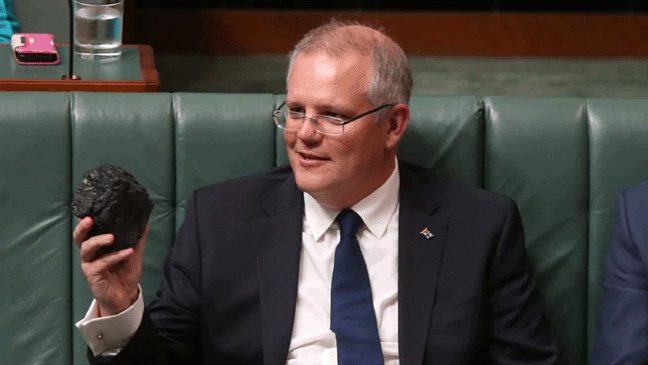
Morrison has shown no interest in climate change, and has instructed new energy minister Angus Taylor to focus only on “bringing down prices” and ensuring the country retains as much “fair dinkum” coal in the system as it can.
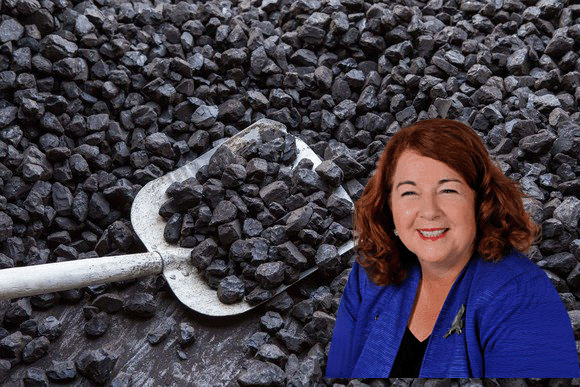
Even environment minister Melissa Price, a former mining company lawyer who is supposed to be responsible for emissions, is talking up the idea of having new coal-fired generators.
The international community is looking on in horror, and so are the main business lobby groups in Australia, such as the Business Council of Australia – who have campaigned vigorosuly for a decade to minimise Australia’s contribution to climate action, but understand the considerable reputational, trade and business consequences of choosing to do nothing.
Morrison has so far resisted calls from the party’s far right to follow Trump out of the Paris climate treaty, but in crucial and complex climate talks in Bangkok this week, sided with the US and Japan in a dramatic attempt to weaken climate finance obligations.
The Bangkok talks were called to give negotiators extra time to put together the so-called “rule-book,” which will provide the fine details of the Paris agreement, particularly as countries gear up to increase their climate targets to try and drag the collective efforts closer to the target of limiting global warming to “well below” 2°C, and possibly 1.5°C.
But little progress has been made in Bangkok, forcing the UNFCCC, which runs the climate talks, to call for the annual talks scheduled this year in Poland to begin a day earlier, in the hope that visiting heads of state have something to work with when they turn up.
One of the biggest road-blocks has been erected by Australia, the US and Japan, who put in a joint submission that seeks to water down climate finance guidelines, and casts doubt that this week’s Bangkok negotiations will deliver the clear climate rules UN leaders have been calling for. Climate campaigners say the proposed text on article 9.7 of the Paris accord, which refers to accounting and is meant to establish rules about how developed countries report what finance they provide to developing countries, serves to muddy the rules rather than clarify them.
The campaigners say that the proposal would allow countries to report whatever items they like – including commercial loans ≠ as climate finance, in contrast to demands of clear financial and technical packages to help them developing countries cope with future extreme weather-related events.
“(This) does not create any meaningful rules on how climate finance is accounted for, and instead it essentially says ‘countries should report what they want,’” Brandon Wu, director of policy and campaigns for ActionAid USA, told Devex.
“This would completely let rich countries off the hook and deprive developing countries of real money for real action,” Wu said. Other campaigners said this meant climate finance could just be re-badged existing aid.
These problems are being felt acutely in the Pacific, where island nations are furious with Australia’s stance on climate, its attachment to coal, and its refusal to act on its declarations that “it takes climate change seriously.”
The current Coalition government still has no policy in place to try and reach what is regarded as a very low interim target of a 26-28 per cent reduction in emissions by 2030. Continue reading →
Australia, New Zealand and Pacific nations have signed a declaration highlighting climate change as “the single greatest threat” to Pacific people, while island nations called on the United States to return to the Paris agreement.
Key points:
The declaration expands the idea of regional security to include environmental issues
It specifically names climate change as the region’s “single greatest threat”
It recognises that the Pacific is “increasingly crowded” in terms of geopolitics
But there was last-minute wrangling over the language on climate change, with some Pacific nations privately accusing Australia of trying to water down the final declaration from leaders.
Australia would also not back a statement from small island states which calls for countries to “urgently accelerate” reductions in carbon emissions.
Tuvalu’s Prime Minister Enele Sopoaga didn’t directly name Australia, but when pressed by journalists confirmed a country “starting with a capital A” had objected.
“The issues are so critical for leaders of smaller island states because of their vulnerability to climate change,” Mr Sopoaga said.
“We appealed to Forum leaders to endorse [the statement] so we can walk the talk.”
Australia and New Zealand also didn’t join a call from other Pacific Island Forum members for the United States to re-join the Paris climate change agreement.
Australia relationship with Pacific on climate change ‘dysfunctional’ and ‘abusive’
Palau’s climate change coordinator says Australia provides aid to region but on world stage undermines attempts to halt global warming, Guardian, Kate Lyons in Koror and Ben Doherty 5 Sep 2018Australia’s relationship with the Pacific region on the issue of climate change has been described as “dysfunctional” and “abusive” – providing aid to the region to deal with the effects of global warming but undermining attempts to halt its progress, according to a climate change representative for the Pacific nation ofPalau.
Xavier Matsutaro, the national climate change coordinator for Palau, a small nation in the north-west Pacific, said Australia’s relationship with the Pacific was “dysfunctional”, adding that Australia was also responsible for diluting the strength of previous regional declarations on climate change.
“Australia is a bit of an anomaly, because on the floor [of climate summits] they’re basically sometimes as far right as Trump in some of their views on climate change, at one point they even denied that it existed … But then on a regional basis they’ve actually given a lot of support to our region,” said Matsutaro.
“Sometimes the way I think about it … it’s like you’re in a relationship and you get abused by your spouse but at the same time they feed you and clothe you and things like that,” he said. “You could say it’s a bit of a dysfunctional relationship.”…….
Matsutaro said Australia, which has historically been the key aid partner for the Pacific region, had supported projects in Palau related to climate change, including a coastal erosion project and research on coral bleaching. Australia even provided research on the impact of climate change on Palau which formed the basis for a section of Palau’s climate change policy.
But when it came time to make commitments on climate change, Matsutaro, who has attended COP meetings on Palau’s behalf for the last five years, said Australia was regularly out of sync with the rest of the region, and was responsible for diluting the strength of resolutions on the environment.
“They’re responsible for making our declarations weaker sometimes in the region. So there’s been forums that were formulated so [Australia] won’t be involved in it, they’re not members, so that whatever language that really reflects our views and our circumstances is actually reflected in the declaration,” he said.
Australia’s authority in Pacific ‘being eroded by refusal to address climate change’
Top climate scientist says leaders disenchanted with Australia’s promotion of coal and slowing down action on meeting Paris targets, Guardian, Ben Doherty, 6 Sept 18 Australia’s regional authority and influence is being eroded by its refusal to addressthe threat climate change poses to many of its Pacific neighbours, according to a pre-eminent climate scientist.
The prime minister of Tuvalu, Enele Sopoaga, said the name of the country seeking qualifications “[started] with capital A”. Australia is the only country in the PIF beginning with A.
Several sources from the PIF forum have corroborated Australia’s efforts to weaken the Boe Declaration. Vanuatu’s minister for foreign affairs Ralph Regenvanu said: “I was there, and can confirm this is true. And unfortunate.”
Asked specifically by Guardian Australia whether Australia had sought to weaken the language of the declaration, Australia’s foreign minister Marise Payne neither rejected nor confirmed the allegation……
Dr Bill Hare, managing director of Climate Analytics and a lead author on the IPCC fourth assessment report, told Guardian Australia that Pacific leaders were growing increasingly disenchanted with Australia’s refusal to commit to cutting carbon emissions, even as their nations faced massive economic, physical and social disruption, even existential threat.
‘Is this a red line for us?’ $15b European trade deal doomed if Australia dodges Paris pledge, SMH, By Nicole Hasham, 31 August 2018 The Coalition’s internal climate war risks damaging the economy after Europe declared it would reject a $15 billion trade deal with Australia unless the Morrison government keeps its pledge to cut pollution under the Paris accord.
Prime Minister Scott Morrison this week reset his government’s course on energy policy, declaring a focus on lowering electricity bills and increasing reliability, while relegating efforts to cut dangerous greenhouse gas emissions.
He has reaffirmed his government’s commitment to the Paris accord despite persistent calls by conservative Coalition MPs, led by Tony Abbott, to quit the agreement.
However there is deep uncertainty over how Australia will meet the Paris goal of reducing Australia’s carbon emissions by 26 per cent by 2030 given the government does not have a national strategy to meet the target.
The policy ructions did not go unnoticed at a meeting of the European Parliament’s Committee on International Trade in Brussels, where the EU’s chief negotiator on the deal, Helena König, faced angry questions from the floor over Australia’s commitment to climate action.
Australia and the EU will in November enter a second round of negotiations over the deal that would end restrictions on Australian exports and collectively add $15 billion to both economies.
In a video of this week’s proceedings, Ms König told the committee that “it’s the [European] Commission’s position … that we are talking about respect and full implementation of the Paris agreement [as part of the trade deal]”.
“No doubt we will see what comes out in the text [of the deal agreement] but that I expect to be the minimum in the text, for sure.”
Her assertion is a clear signal that any failure by Australia to meet its international climate obligations would have serious economic consequences.
Ms König fired off the warning after a question by Klaus Buchner, a German Greens member of the Parliament who said “the intention of the new Australian regime to withdraw from the Paris Agreement unsettles not only Australians”. …….
The EU bloc is Australia’s second largest trading partner, third largest export destination and second largest services market. The EU was also Australia’s largest source of foreign investment in 2017.
…….The Paris climate accord is deeply unpopular with conservative MPs, including Nationals MPs whose electorates would benefit from an EU trade deal. Keith Pitt resigned as an assistant minister last week in protest at the Paris treaty. “I will always put reducing power prices before Paris,” he said.
A 2017 report by the United Nations environment program that found Australia’s emissions were set to far exceed its Paris pledge and government data released in January showed Australia’s annual emissions had risenfor the fourth year running.
Labor’s climate change and energy spokesman Mark Butler said the government had no emissions reduction plan and would fail to meet its Paris goal.
“The Prime Minister might think he can get away with [failing to cut emissions] domestically, but it is clear it will not be accepted by our international trading partners, who rightly have an expectation the Australian government will act to deliver on our international obligations,” he said.
European Australian Business Council chief executive Jason Collins, whose organisation has lobbied for the trade deal, said Europe’s commitment to the Paris agreement was “fundamental”. ……
For Pacific Island nations, rising sea levels are a bigger security concern than rising Chinese influence, The Conversation, Michael O’Keefe, Head of Department, Politics and Philosophy, La Trobe University, August 31, 2018 When the Pacific Islands Forum is held in Nauru from September 1, one of the main objectives will be signing a wide-ranging security agreementthat covers everything from defence and law and order concerns to humanitarian assistance and disaster relief.
The key question heading into the forum is: can the agreement find a balance between the security priorities of Australia and New Zealand and the needs of the Pacific Island nations?
Even though new Prime Minister Scott Morrison is not attending the forum, sending Foreign Minister Marise Payne instead, the Biketawa Plus security agreement remains a key aim for Canberra……….
A focus on climate change as a security issue
One key reason for updating Biketawa is to realign Australia’s security interests with those of Pacific Island countries that have grown more aware of their shared interests and confident in expressing them in international relations. This growing confidence is clear in the lobbying of Pacific nations for climate change action at the United Nations and in Fiji’s role as president of the UN’s COP23 climate talks.
In the absence of direct military threats, the Pacific Island nations are most concerned about security of a different kind. Key issues for the region are sustainable growth along a “blue-green” model, climate change (especially the increasing frequency and intensity of natural disasters and rising sea levels), illegal fishing and over-fishing, non-communicable diseases (NCDs), transnational crime, money laundering and human trafficking. ……..
Climate change adaptation and mitigation must also be elevated to the top of the agenda in Australia’s relations with the region. It is the most pressing problem in the Pacific, but for political and economic reasons, it hasn’t resonated to the same extent with Canberra.
In fact, Australia has recently been identified as the worst-performing country in the world on climate action. This has not gone unnoticed in the Pacific. Fiji’s prime minister, in particular, has been clear in highlighting that Australia’s “selfish” stance on climate change undermines its credibility in the region.
These shifting priorities in the Pacific present a greater challenge for Australia, especially now that there are more players in the region, such as China, Russia and Indonesia. Australia may see these “outsiders” as potential threats, but Pacific nations are just as likely to view them as alternative development partners able to provide opportunities………
Options on energy policy leave Coalition in a sticky situation, Guardian, Katharine Murphy, 1 Sept 18,The government finds itself in a mess after the national energy guarantee was used as a catalyst to evict Turnbull.
We’ve lost another prime minister in the front bar brawl that is Australian politics, but we’ve lost something else as well, something that’s a bit harder to see.
For the last decade or more, a group of people in the political system have been trying to land a bipartisan consensus on energy policy and climate change, persevering through all the dispiriting cycles of trying to achieve that end, hoping that a corner could be turned.
That animating current in politics, and it’s been a significant one, now seems to have hit a dead end. That’s the feeling. We’ve reached a point of no return
If that supposition proves to be correct, this a profound problem for the country, more profound than the revolving door at the Lodge, which is deeply disconcerting, but just one symptom of a deeper malaise.
The Coalition is in a terrible mess on this issue. The national energy guarantee, the last roll of the dice for consensus, was used as a catalyst to blow up a prime minister, just as emissions trading was deployed for the same end, removing the same party leader, in 2009.
As a consequence of that rancid history, the imperative of emissions reduction now hangs over Liberal leaders like the sword of Damocles. Any leader wanting to do something knows they will have to run the gauntlet of the conservatives, and the brains trust of the conservative faction has proven itself so resistant to facts and evidence that it can’t even count numbers for a leadership spill………
The Morrison government is in a position where it is a signatory to the Paris agreement, yet there are no policies to deliver the outcome. There is a talking point doing the rounds that Australia will meet its Paris commitments “in a canter” – but this is complete nonsense.
It is possible (although the Energy Security Board says otherwise) that we could reduce emissions by 26% in the electricity sector without a settled policy to get us there because emissions in the sector are already falling (because ageing coal is leaving the system and the renewable energy target has pulled forward investment).
This government has dithered for years about the imposition of new emissions standards for vehicles. Ministers have not been brave enough to bring forward a concrete proposal because the Coalition party room would limber up for another implosion.
Then there’s agriculture. Many Nationals take it as a personal affront if someone suggests anything be done in agriculture. The fact that their own constituents are now being battered by horrendous drought and hanging on grimly in areas gradually being rendered unviable by inexorable climatic change is an irony that seems lost of many of our elected representatives.
So that’s the outlook on emissions. Now let’s ponder the concept of certainty.
What isn’t on the back burner is the new Morrison government’s need to deliver a fix on power prices once the prime minister has concluded the healing and stability tour. That’s on the front burner. But this is a problem with no easy fix.
The government slapped together a package of measures in the dying days of the Turnbull regime designed to lower power prices – work that would have normally taken months of careful deliberation in a cabinet subcommittee.
So now we have no over-arching mechanism for investment certainty, and a bunch of expedited measures proposed on the fly, including heavy handed market interventions, such as breaking up power companies if they don’t play ball with the government and lower prices.
Samoan Prime Minister Tuilaepa Sailele hits out at climate change sceptics during fiery speech, ABC News 31 Aug 18 By Pacific affairs reporter Stephen Dziedzic Samoan Prime Minister Tuilaepa Sailele has lashed out at climate sceptics and urged Australia to make deeper cuts to carbon emissions to help save Pacific Island nations from the “disaster” of climate change.
Key points:
Mr Sailele says “greater ambition” is needed to stop impact of climate change
He warns geostrategic competition is creating uncertainty for small Pacific countries
Australia, New Zealand and the US have been scrambling to reassert influence in the Pacific
Mr Sailele told the Lowy Institute in Sydney that climate change posed an “existential challenge” to low lying islands in the Pacific, and developed countries needed to reduce pollution in order to curb rising temperatures and sea levels.
“We all know the problem, we all know the solutions, and all that is left would be some political courage, some political guts, to tell people of your country there is a certainty of disaster,” Mr Sailele said.
The Prime Minister’s intervention came as some Coalition MPs press the new Prime Minister Scott Morrison to abandon Australia’s promise to cut carbon emissions under the Paris agreement.
New Foreign Minister Marise Payne is also expected to face questions about Australia’s climate change policies at the Pacific Islands Forum leader’s meeting in Nauru next week.
Senator Payne and Pacific leaders are set to sign the “Biketawa Plus” security agreement, which declares that climate change remains the “single greatest threat to the livelihoods, security and wellbeing of the peoples of the Pacific”.
Several other leaders — including Fiji’s Prime Minster Frank Bainimarama and the Marshall Island’s President Hilda Heine — have also called on Australia to do more to cut emissions.
Mr Sailele told the audience that “greater ambition” was needed to stop the destructive impact of climate change.
All this does not bode well for advocates of climate action. Extreme weather is battering Australia on all fronts: Carbon-warmed oceans are plundering its Great Barrier Reef, and a record-breaking drought is ravaging the country’s well-populated southeast. Yet even its center-right-led, middling attempt at a climate policy is withering on the vine. On Monday, in one of his first public appearances since taking office, Prime Minister Morrison declined to comment on whether climate change is intensifying the country’s drought.
The Global Rightward Shift on Climate Change, President Trump may be leading the rich, English-speaking world to scale back environmental policies. The Atlantic , ROBINSON MEYER, AUG 28, 2018 Last Thursday, Malcolm Turnbull was the prime minister of Australia. By the end of this week, he’ll be just another guy in Sydney.
Turnbull was felled by climate-change policy. His attempt at a moderate, even milquetoast energy bill—which included some mild cuts in greenhouse-gas emissions—proved too aggressive for his co-partisans. On Friday, members of Australia’s center-right Liberal Party voted him out of office…..
Turnbull’s tumble remains a disquieting sign for anyone hoping for an aggressive global climate policy. In Australia—where global warming has contributed to the die-off of half the coralin the Great Barrier Reef since 2016—even a mild climate bill could not pass under a conservative government.
It points to an emerging pattern: Moderate national leaders—on both the center-left and center-right—in some of the world’s richest and most advanced countries are finding it far easier to talk about climate change than to actually fight it.
Simply put: This kind of failure, writ large, would devastate Earth in the century to come. The world would blow its stated goal of limiting atmospheric temperature rise. Heatwaves might regularly last for six punishing weeks, sea levels could soar by feet in a few short decades, and certain fragile ecosystems—like the delicate Arctic permafrost or the kaleidoscopic plenty of coral reefs—would disappear from the planet entirely.
Australia’s recent instability further complicates this unease. The global climate action of 2016 may be producing something like a worldwide climate backlash—especially in countries with powerful fossil-fuel interests, like Australia and Canada. Or—far more worryingly for climate advocates—these changes in policy may be trickling down from the biggest historical emitter of greenhouse gases of them all: the United States.
Richard Glover on climate policy: Australia insignificant? Pathetic and absurd, Brisbane Times By Richard Glover , 24 Aug 18 “……..Australia was a small place of little import, dwarfed by these [overseas] humming centres of real life.
Once you’ve grown up with that idea, as many Australians did, it can be hard to shift gear. That’s why – some years on – I was taken aback when I acquired a copy of the Times Atlas of the World. It had a table listing the great cities of the world, according to the size of their population…….
Australia now has the 13th largest economy in the world, with predictions it will be the 11th largest within a decade. If NSW went it alone, as a separate country, the economy would be the 26th biggest in the world. In military terms, a recent comparison listed the country in 21st position, out of 136.
Do these rankings matter? I think so, if only because the idea of “little ole Australia” is constantly used as an excuse for failure, for accepting the second rate, for shrugging away our responsibilities…..
The latest version of this dire, cringing attitude formed the background to this week’s leadership spill. The Dutton forces kept repeating the same mantra: Australia is so small it has no impact on carbon emissions. We may as well do nothing. Anything else is grandstanding or “virtue-signalling”.
It’s true, of course, that Australia’s emissions are less than those of the United States and China, but that doesn’t mean they are “nothing” or “negligible”, the terms always employed.
Australia was responsible for 1.1 per cent of global emissions in 2016, making us the 16th most polluting country in the world. Per head we’re among the worst.
Then there’s the idea that – due to our size – we should give up the ambition of having a positive impact on the world. Important battles – this is the underlying thought – should be left to others. We can stand on the sidelines and freeload………
It’s the cringe, writ large. It shows neither national pride nor global spirit. It’s also out of step with a balanced understanding of our relatively-significant place in the world.
Radioactive sheep shed light on secret nuclear weapons test, https://nypost.com/2018/08/14/radioactive-sheep-shed-light-on-secret-nuclear-weapons-test/Christopher Carbone, Fox News, August 14, 2018 Newly discovered data from radioactive sheep provides strong evidence that a mysterious “double flash” detected almost 39 years ago near a remote island group was a nuclear explosion.
Ever since the flash was observed by a US Vela satellite orbiting above Earth in September 1979, there’s been speculation that it was produced by a nuclear weapon test by Israel. International researchers in the journal Science & Global Security analyzed previously unpublished results of radiation testing at a US lab of thyroid organs from sheep in southeastern Australia in order to make their determination.
The flash was located in the area of Marion and Prince Edward islands, which are in the South Indian Ocean about halfway between Africa and Antarctica.
“A new publication sheds further light on the Vela Incident of 1979,” said Professor Nick Wilson of Otago University at Wellington, who highlighted the findings but was not involved with the study itself. “[The research] adds to the evidence base that this was an illegal nuclear weapons test, very likely to have been conducted by Israel with assistance from the apartheid regime in South Africa.”
Wilson, an epidemiologist and member of the Australia-based Medical Association for the Prevention of War, said the test would have violated the Limited Test Ban Treaty signed in 1963, and urged the United Nations to mount a full inquiry.
The researchers conclude that iodine-131, which is an unstable radioactive form of the element iodine found in the thyroids of some Australian sheep, “would be consistent with them having grazed in the path of a potential radioactive fallout plume from a [Sept. 22, 1979] low-yield nuclear test in the Southern Indian Ocean.”
Thyroid samples from sheep killed in Melbourne were regularly sent to the US for testing — monthly in 1979 but also in the 1950s and 1980s, researchers say.
According to a report in the New Zealand Herald, the sheep had been grazing in an area hit by rain four days after the flash incident was observed, which would have been in the downwind path from the suspected explosion site.
Researchers also said the detection of a “hydroacoustic signal” from underwater listening devices at the time is another piece of evidence pointing to a nuclear test.
Israel, which has neither confirmed nor denied the existence of a nuclear program, dismissed the claim that it was responsible for the 1979 incident.
srael’s ambassador to New Zealand, Itzhak Gerberg, told the Herald, when asked if Israel was responsible for the explosion: “Simply a ridiculous assumption that does not hold water.”
However, the country’s former Knesset speaker, Avrum Burg, told a conference in 2013 that “Israel has nuclear and chemical weapons” and called for public discussion.
Commenting on the findings, US nuclear weapons expert Leonard Weiss of Stanford University said in the online Bulletin of the Atomic Scientists that the “important” new evidence “removes virtually all doubt” that the flash was a small-yield nuclear explosion.
Weiss added that there was “growing circumstantial evidence” that it was conducted by Israel.
“Israel was the only country that had the technical ability and policy motivation to carry out such a clandestine test,” he said.
On Thursday WikiLeaks Twitter account posted a screenshot of a letter received by some of the residents of no. 18 Hans Cres, London — an apartment building across from the Ecuadorian Embassy that serves as an asylum for Julian Assange. The letter, which has a BBC News logo in its top right corner, asks permission to install permanent cameras outside residents’ apartments so that they overlook the embassy.
The letter was motivated by a desire to better cover Julian Assange’s story and promised to compensate for any disturbances caused. The letter also contains Jonathan Whitney’s email as a contact for those interested in the offer. According to Whitney’s profile, he is a BBC News Deployment Editor.
WikiLeaks chief editor Julian Assange has been living in Ecuador’s UK Embassy since 2012 fearing the UK may extradite him to the US, where he could face prosecution over WikiLeaks’ publication of leaked US military and diplomatic documents. Recently Ecuadorian President Lenin Moreno touched upon the issue of expelling Assange from the embassy, but noted that the UK must first guarantee the activist’s safety.
His statements followed conflicting media reports that Ecuador might revoke Assange’s asylum and that the whistleblower might leave voluntarily to due increasing health issues.
Assange may finally leave Ecuadorian embassy in London as health worsens – report Julian Assange, who has spent more than 2,230 days in the Ecuadorian embassy in London, is expected to leave the building soon with his health deteriorating, sources say.
This latest information about the WikiLeaks founder, who was already expected to leave the embassy “in the coming weeks,” was Wednesday by Bloomberg which cited “two people with knowledge of the matter.” The news agency reported that the whistleblower’s health “has declined recently.”
The news comes days after Ecuadorian President Lenin Moreno announced that Assange must “eventually” leave the embassy. “Yes, indeed yes, but his departure should come about through dialogue,” the Ecuadorian president said in answer to a reporter’s question on whether he will eventually have to leave.
“For a person to stay confined like that for so long is tantamount to a human rights violation,” Moreno said, stressing that Ecuador wants to make sure that nothing “poses a danger” to the whistleblower‘s life.
The whistleblower’s health is deteriorating, according to the Courage Foundation, a group that fundraises for the legal defense of whistleblowers. Assange is in “a small space” and has “no access to sunlight,” the group , adding that this has a serious impact “on his physical and mental health.”
Rape allegations, stemming from Assange’s visit to Sweden in August 2010, were the main reason that he sought refuge in London’s Ecuadorian embassy in 2012 when a warrant was issued for his arrest. Assange maintained that he could be extradited from Sweden to the US, where he would be prosecuted for his whistleblowing and would not receive a fair trial. Swedish prosecutors dropped the investigation in 2017, but a British warrant for violating bail conditions still stands.
Washington simply “wants revenge” for the “embarrassment” WikiLeaks caused it, and wants it to serve “as a deterrent to others,” human rights activist Peter Tatchell told RT earlier in July. “Someone who’s published that information in the same way that the New York Times or the Guardian publish information, I don’t think they should face risk 30 or 40 years in jail in the United States,” Tatchell added.
Launched in 2006, the WikiLeaks project is aimed at exposing government and corporate secrets. It garnered global attention back in 2010 with its massive release of classified US military documents, which included those detailing how American military equipment was deployed in Afghanistan and Iraq. Assange won thousands of admirers, with many applauding his willingness to speak the truth.
David Noonan will speak on public interest concerns over the new Roxby Downs Indenture Act 2026 on BHP copper-uranium mining and ore processing in SA, and on how AUKUS may face SA with a High-Level nuclear waste agenda.
Dr Jim Green will discuss international developments in the field of nuclear power including ‘small modular reactors’ and Generation 4 ‘advanced’ nuclear reactor concepts.