Stuck in the dark ages’: Pacific island leader vents after Australia’s emissions hit record high, The Age, 30 sept 17 Desperate Pacific islands at risk of sinking beneath the sea say Australia is “stuck in the Dark Ages” by relying on fossil fuels, in response to alarming data showing this nation’s energy emissions have hit record highs.
The outcry from Australia’s smallest neighbours comes just weeks after Prime Minister Malcolm Turnbull visited Samoa and reportedly promised Pacific leaders that he understood “very clearly” the threat of sea level rise to low-lying islands.
As Fairfax Media reported on Friday, a national audit prepared for The Australia Institute by energy analyst Hugh Saddler shows Australia’s emissions from energy combustion reached a record high in the year to June, driven largely by petroleum, and specifically diesel, consumption.
The audit showed the increase in Australia’s annual retail diesel emissions in the year to June on its own exceeded the total annual emissions of any Pacific nation.
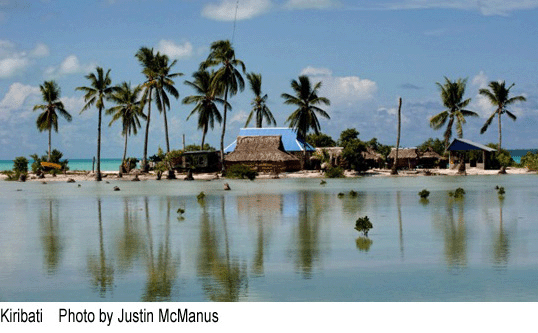
Tuvalu Prime Minister Enele Sopoaga, whose tiny nine-island nation has become the poster child for the threat of sea-level rise, on Friday vented his frustration at the audit findings.
“While the rest of the world is moving ahead to renewable energy, Australia is stuck in the Dark Ages with its reliance on dirty fossil fuels. This is bad news for the Pacific”, he said, adding that Australia’s continued mining of coal was “extremely disappointing”.
Genevieve Jiva, spokeswoman for the Pacific Islands Climate Action Network, said the findings would prompt Pacific leaders to exert further pressure on Australia at international climate talks in Bonn, Germany, in November. Fiji will chair the talks.
Government denies claims it knocked back Chinese climate change offer and reveals ‘joint action plan’ Fergus Hunter SMH, 23 Sept 17
The Turnbull government rejected a landmark Chinese invitation to issue a formal joint statement on climate change earlier this year, Greenpeace has claimed, saying Australia vetoed an unprecedented step in the Asian power’s emerging international role in reducing greenhouse gas emissions.
But the Australian government has denied the claim and revealed the two countries’ energy departments were working on a “joint action plan” on climate change as part of their commitments under the Paris agreement.
According to Greenpeace East Asia senior climate policy adviser Li Shuo, the government quietly knocked back an offer – perhaps the first time the Chinese government had proactively sought such an arrangement – during Premier Li Keqiang’s state visit to Australia in March.
Mr Li said the offer was “very, very significant” because it suggested China had become “diplomatically proactive” after previously being on the receiving end of invitations from the European Union and United States to outline mutual commitments on climate change.
He observed it would have been a concrete political signal for the international community amid the uncertainty triggered by the election of President Donald Trump, who has wound back American leadership on climate change and begun the process of withdrawing the US from the Paris accord.
“The Chinese delegation with Li Keqiang came with the proposal but that didn’t get the green light from the Australian side,” Mr Li said, adding that his awareness of it came from a directly involved figure in the Chinese government.
“It was clearly the intention from the Chinese side to build up international climate momentum. I think the proposed bilateral statement was part of that effort to send a signal back to the rest of the world and primarily the US.”
A spokesperson for the Australian government said it “did not decline an offer from the Chinese government earlier this year to make a joint statement on climate change” and labelled the March leaders’ meeting “highly successful”……..
Previously an advocate for sweeping action on climate change, Mr Turnbull has had to compromise since taking the leadership of a Liberal-National Coalition still internally divided on the issue. A significant portion of his party room are keen supporters of coal-fired power and some do not accept the scientific consensus on climate change.
Under the Paris accord, former prime minister Tony Abbott’s Coalition government committed to reducing emissions by 26-28 per cent from 2005 levels by 2030. His government also renegotiated the Renewable Energy Target in the electricity sector down to 23.5 per cent by 2020.
Australia joins boycott of UN treaty outlawing nuclear weapons
Foreign Minister Julie Bishop joined representatives from the US, Britain, France and others who were absent from the event at the annual United Nations gathering of world leaders overnight.
A total of 51 countries lined up to sign the new treaty.
The treaty was adopted by 122 countries at the United Nations in July following negotiations led by Austria, Brazil, Mexico, South Africa and New Zealand.
None of the nine countries that possess nuclear weapons — the United States, Russia, Britain, China, France, India, Pakistan, North Korea and Israel — took part in the negotiations.
“There remain some fifteen thousand nuclear weapons in existence. We cannot allow these doomsday weapons to endanger our world and our children’s future,” UN Secretary-General Antonio Guterres said as he opened the treaty for signing.
NATO condemned the treaty, saying that it may in fact be counter-productive by creating divisions.
As leaders formally signed on the sidelines of the annual UN General Assembly, Secretary-General Antonio Guterres hailed as historic the first multilateral disarmament treaty in more than two decades.
But Guterres acknowledged that much work was needed to rid the world of its stockpile of 15,000 atomic warheads.
“Today we rightfully celebrate a milestone. Now we must continue along the hard road towards the elimination of nuclear arsenals,” said Guterres.
The treaty will enter into force when 50 countries have signed and ratified it, a process that could take months or years.
“At a time when the world needs to remain united in the face of growing threats, in particular the grave threat posed by North Korea’s nuclear program, the treaty fails to take into account these urgent security challenges,” the 29-nation Western alliance said.
It added: “Seeking to ban nuclear weapons through a treaty that will not engage any state actually possessing nuclear weapons will not be effective, will not reduce nuclear arsenals, and will neither enhance any country’s security, nor international peace and stability.
Rejecting need for nuclear weapons
Foreign Minister Sebastian Kurz of Austria, one of the few Western European nations that is not in NATO, rejected the idea that nuclear weapons were indispensable for security.
“If you look at the world’s current challenges, this narrative is not only false, it is dangerous,” he told AFP.
“The new treaty on the prohibition on nuclear weapons provides a real alternative for security: a world without any nuclear weapons, where everyone is safer, where no one needs to possess these weapons,” he said.
Brazilian President Michel Temer was the first to sign the treaty. Others included South African President Jacob Zuma and representatives from Indonesia, Ireland and Malaysia as well as the Palestinian Authority and the Vatican.
Australia is being dragged into US wars, Green Left TONY ILTIS, September 9, 2017The threat of nuclear annihilation is closer than at any time since the end of the Cold War as two heads of state use nuclear weapons as props in what looks like a fight between two adolescent boys.
On one side is a narcissistic bully, born to inherit great power and with credible reports that his personal life includes indulging in acts of sadism, whose policies in government are driven by a combination of xenophobia, ego and whim and who is threatening nuclear Armageddon if he doesn’t get his way.
On the other side is North Korean dictator Kim Jong-un.
In a situation where Russia’s belligerent President Vladimir Putin is able to play the role of a level-headed voice of sanity, some Western countries are distancing themselves from US President Donald Trump, or at least urging caution. But not Australia……
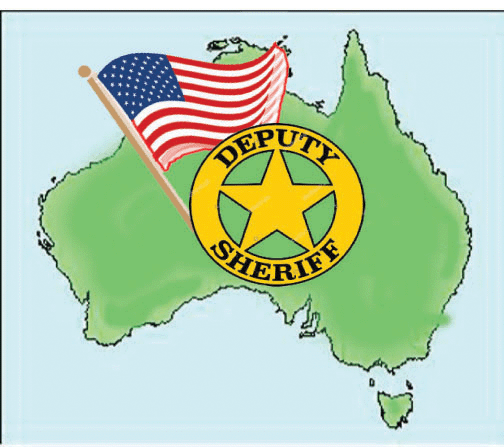
Since the 1940s, Australian governments of both parties have been keen to promote Australia as Washington’s most loyal ally, regardless of the sanity of the incumbent US president. The policy is based on the premise that if Australia unquestioningly follows the US into any war, the US, the world’s most powerful imperialist state, will look after Australian capitalists’ global interests.
This policy has led to Australian involvement in numerous wars, from Korea in the 1950s, and Vietnam in the ’60s and ’70s, to more recent conflicts in Iraq, Afghanistan and Syria. This policy has also allowed Australian mining companies to operate across the globe, from the Democratic Republic of Congo, to Romania and Chile, making huge profits at a horrific cost to the environment, workers and local communities.
The devastation wrought by the Korean War is the reason for the North Korean regime’s xenophobic paranoia. While the media generally portrays Kim Jong-un as mad, and provides no further explanation for North Korea’s nuclear program, the fact that Iran continues to suffer sanctions despite abandoning its nuclear weapons program and Iraq was invaded after getting rid of its weapons of mass destruction, points to some rationality in North Korea’s approach.
It also points to grotesque hypocrisy on the part of the West: the largest nuclear powers declaring that it is unacceptable for other countries to have nuclear weapons. North Korea was not responsible for the atomic bombing of Hiroshima and Nagasaki and it has not used the populations of any Pacific Island nations as guinea pigs in nuclear tests.
On July 8, when the UN General Assembly supported a resolution to ban nuclear weapons, Australia joined the nuclear powers in boycotting the session.
On July 21, Trump announced an escalation of the US presence in Afghanistan. Attempting to portray his policy as distinct from his predecessors’, he said the US role in Afghanistan would now be “killing terrorists” not nation building……..https://www.greenleft.org.au/content/australia-being-dragged-us-wars
Faced with two irrational and aggressive nuclear-armed leaders, deterrence theory is failing. The promise of nuclear attack is meant to keep nuclear states from using their weapons. Is it becoming clearer every week that this fragile structure is not built to last.
North Korea’s 6th nuclear test is alarming, yes, but an unsurprising next move in the war-game with US President Trump. Both Trump and North Korean leader Kim Jong-un are threatening each other with some form of catastrophic “fire”, a thin veil for nuclear war.
Both the US and North Korea are engaging in reckless provocations. Joint US/South Korean military drills on the Korean peninsula and the pursuit of the THAAD missile defence system are continually fueling the fire. Trump and Jong-un are paving the path to nuclear war. Another path exists and we must take it.
On September 20, heads of state and foreign ministers will line up at the United Nations to sign the Treaty on the Prohibition of Nuclear Weapons (TPNW). All states are invited to participate in the signing ceremony. When 50 countries have ratified, the new Treaty will enter into force. The TPNW was negotiated and adopted at the UN by 122 nations earlier this year, and promises to be a powerful tool to de-escalate, de-legitimise and disarm nuclear weapons.
The TPNW categorically rejects nuclear weapons for the instruments of catastrophe that they are. Founded on a deep and detailed understanding of the humanitarian impacts of the weapon, the treaty’s drafters have closed the legal gap by which nuclear possession by some was apparently tolerable.
Now, all three weapons of mass destruction are outlawed by international treaties, and nuclear possession by anyone is declared equally unacceptable. As former UN Secretary-General Ban Ki-moon said, “there are no right hands for the wrong weapon.”
The TPNW prohibits the development, stockpiling, testing, use and threat of use of nuclear weapons. It also prohibits any nations from encouraging, assisting or inducing others to engage in the prohibited activities. The goal of the Treaty is the total elimination of nuclear weapons; and it provides the formal legal channel to facilitate the process.
Prime Minister Malcolm Turnbull’s unqualified support for Trump serves to legitimize and condone his actions. Instead of providing constant approval, Australia is in a position to change the landscape. The ANZUS Treaty doesn’t require us to be “joined at the hip”, as Turnbull suggests, but to consult together. Australia’s interests are not identical to the US’. Shadow Foreign Minister Penny Wong explained in the Lowy Interpreter last October; “being in an alliance does not mean Australia must agree reflexively with every aspect of American policy or make its foreign policy subservient to that of our partner”.
On September 20, the Australian leadership is faced with a choice to support or reject nuclear weapons. If it fails to sign the TPNW, Australia’s commitment to nuclear disarmament is fictional. As a signatory to the treaties banning biological and chemical weapons, anti-personnel mines and cluster munitions, expectations are high. Public opinion is with the Treaty; a March 2017 IPSOS poll found 74 per cent of Australians wanted our government to join the negotiations that led to this landmark agreement.
With every new signatory on the TPNW, the international norm against nuclear aggression will strengthen. The weapon will lose its status and it will be harder for nuclear programs to secure resources for modernization and maintenance. Countries that claim dependence on extended nuclear deterrence, like Australia, will experience increasing pressure to sign on and choose a non-nuclear defence posture.
What right does Turnbull have to criticise the North Korean nuclear program when Australia claims that nuclear weapons are essential for our security? De-escalation is urgently required, and the UN Treaty on the Prohibition of Nuclear Weapons provides a legally sound and feasible alternative to the perilous path we’re currently on.
Australia has uranium export agreements in place with all of the five ‘declared’ nuclear weapons states – the US, Russia, China, France and the UK – although none of these countries take seriously their obligations under the Nuclear Non-Proliferation-Treaty to pursue nuclear disarmament.
IAEA safeguards inspections in the declared weapons states are voluntary and, in general, tokenistic.
Australia, along with the weapons states, boycotted recent negotiations on a Treaty on the Prohibition of Nuclear Weapons, adopted by the United Nations in early July.
Australia has fallen into the trap of bending over backwards to support its allies on an international scale, and subordinating non-proliferation objectives to the commercial interests of the (mostly foreign-owned) uranium companies operating in Australia.
Australia’s contribution to nuclear proliferation risks,Bridget Mitchell and Jim Green, 6 Sept 2017, Online Opinion www.onlineopinion.com.au/view.asp?article=19268&page=0 Once again, the world finds itself in a dangerous place as one mad-man explodes increasingly powerful nuclear weapons and another mad-man threatens North Korea with “fire, fury and frankly power the likes of which this world has never seen before.”
There appears to be no solution to the North Korean problem. Diplomacy, threats and sanctions have not been effective. Military intervention would likely result in the slaughter of hundreds of thousands of people on both sides of the 38th parallel ‒ with or without the use of nuclear weapons.
Australia isn’t to blame for the dangerous and escalating situation in North Korea but it’s worth reflecting on how we ‒ or more to the point, how successive governments ‒ have made the world a more dangerous place.
According to the World Nuclear Association, from the 1950s until the 1970s, Australia’s uranium was “primarily intended for US and UK weapons programs”. Although we no longer supply uranium for weapons production, Australia does contribute to proliferation risks. Continue reading →
North Korea makes another threat to America as Donald Trump and Malcolm Turnbull hold talks, The West Australian , Claire Bickers, Sarah Blake in New York, wires 6 September 2017 Donald Trump’s phone call with Prime Minister Turnbull has been described as warm and constructive.
The two leaders have agreed North Korea poses a grave threat to regional stability and that it is time for the international community to act.
China’s role in putting pressure on Pyongyang to end its nuclear and missile testing program was discussed, along with the emerging threat of Islamic militants in the Philippines.
Earlier, Australian Defence Minister Marise Payne said Australia and its allies sought to avoid a military conflict with North Korea “at all costs”.
The Minister will be travelling to Seoul today to meet with South Korean President Moon Jae-in and to deliver the keynote address at a forum on regional and global security.
“We seek to pursue the sanctions process and to ensure that they are allowed to operate to their fullest effect to send the clearest possible message to the regime in North Korea that their behaviour is unacceptable,” she told ABC radio.
…… There has been speculation North Korea may be planning to fire an ICBM this weekend when the republic celebrates its foundation on September 9. Mr Turnbull told coalition MPs at a partyroom meeting on Tuesday that the action of North Korea was “reckless, dangerous and provocative”.
He echoed the US ambassador to the United Nations Nikki Haley who said the regime seems to be “begging for a war”.
Meanwhile, Opposition Leader Bill Shorten and foreign affairs spokeswoman Penny Wong will meet leaders in South Korea and Japan later in the month. Mr Shorten said he was pleased about the phone call between Mr Trump and Mr Turnbull.
“Australia must use its influence wherever possible to promote a peaceful resolution to this crisis, and I hope this phone call goes some way to achieving this,” Mr Shorten said.
North Korea has attacked Malcolm Turnbull for sending Australian Defence Force personnel to join US-led war games, describing it as a “suicidal act”.
After being singled out by the North Korean regime, the Prime Minister issued a statement late yesterday staring down threats against Australia.
“North Korea has shown it has no regard for the welfare of its own population, no regard for the security and good relations with its neighbours and no regard for international law,” he said.
“We call on all countries to redouble their efforts, including through implementation of agreed UN Security Council resolutions, to bring North Korea to its senses and end its reckless and dangerous threats to the peace of our region and the world.”
North Korea has warned Australia against further aggression in response to the government’s commitment to the Ulchi-Freedom Guardian War Games, which began yesterday.
“Not long after the Australian Prime Minister had stated that they would join in the aggressive moves of the US — even referring to ANZUS which exists in name only — the Australian military announced that they would dispatch their troops to the aggressive nuclear exercises of the US,” said a spokesman from North Korea’s Ministry of Foreign Affairs.
“This is a suicidal act of inviting disaster as it is an illustration of political immaturity unaware of the seriousness of the current situation.”
Defence Minister Marise Payne sent more than two dozen ADF members to join the 10-day war games between the US and South Korea.
Yesterday, defence analysts warned that Australia must “get used to” thuggish threats from the North Korean regime. The director of the International Security Program at the Lowy Institute, Euan Graham, said this would not be the last time Australia was threatened by Pyongyang, as Australia’s participation “matters” to the regime. Continue reading →
Pacific Islanders forced to leave, The Saturday Paper, Chris Woods 18 Aug 17,“Last month,” Ursula Rakova says, “when I returned home just to visit family and talk to the islanders about the situation, it was really, really hard to see a lot of the land being lost to the sea.”
Rakova is from the Carteret Islands, commonly known as Tulun, the horseshoe-shaped scattering of low-lying coral atolls 86 kilometres north-east of Bougainville. “More and more, palm trees are falling, the scarcity of food is becoming a real issue, and the schools close, and close for long periods,” she says.
With an indigenous population of 2700 on seven small islands with a maximum elevation of just 1.5 metres above sea level, there are few other places on Earth where the injustice of global warming is more apparent than on the Carteret Islands.
The Carterets have been on the front line of climate change for decades: one of the islands, Huene, was cut in half by shoreline erosion about 1984. While seawalls and mangroves had been holding the ocean back until this period, further seawater inundation and storm surges over the past few decades had salinated crops and water supplies, intermittently shut down the island’s five schools due to childhood malnutrition, and destroyed homes.
Part of the reason the area is so vulnerable is that, while the Intergovernmental Panel on Climate Change has reported a global sea level rise of about three millimetres per year from 1993 to 2012, the fact that water expands exponentially as heat is applied means that bodies of water that are already hot rise more swiftly. For the western Pacific Ocean, this has meant an increase of about eight to 10 millimetres a year.
“The western Pacific is a lot hotter than the water is in the eastern Pacific – hotter by about five or six degrees – and where the islands are is amongst the hottest ocean water in the world,” says Ian Simmonds, professor of earth sciences at the University of Melbourne. “Hence a warming of one degree there gives you just so much more of a sea level rise.” Simmonds notes that the same is true for the severity of storms in the region: a warmer planet means more moisture, and, therefore, stronger and more frequent storms.
In response to increasingly severe events, Carteret elders initiated a voluntary relocation program in 2006, named Tulele Peisa, or “Sailing the Waves on Our Own” – outwardly a response to failed talks with neighbouring governments dating back to 2001. The group contacted Ursula Rakova, a Huene expatriate who had gone on to direct a Bougainville-based non-government organisation, to lead the initiative. After unsuccessfully applying for land through official channels, she was given four different locations by the Catholic Church in 2007, and relocation to the first of the abandoned plantation sites started that year.
Now, after more than a decade of leading the first recorded example of forced displacement due to global warming, Rakova has almost completed housing for the first group of 10 families. She has successfully established food gardens and a mini food forest, rehabilitated plantations and begun selling crops of cocoa. New education and management facilities have been set up, and both funding and food relief arranged to be sent back to the Carterets.
But the plight of the Carterets is not unique. Three other atolls within the Bougainville area are facing similar challenges with rising sea levels, and extreme weather events have caused internal displacement everywhere from Bangladesh to Syria to Australia.
The Australian government does not, broadly speaking, have the greatest track record on the issue. Not only did then prime minister Tony Abbott refuse to meet a call from Pacific Island leaders in 2015 to reduce emissions – indirectly resulting in Immigration Minister Peter Dutton’s infamous “water lapping at their doors” quip – but the current budget offers the lowest foreign aid in eight years, at $3.82 billion over 2016-17.
Yet Australia has offered a range of targeted, if less publicised, initiatives in the region, largely funnelled through the Autonomous Bougainville Government, in consultation with Papua New Guinea……..
Australia was also a member of the Nansen Initiative, a program launched in 2012 by Switzerland and Norway intended to strengthen the protection of people displaced across borders by disasters and the effects of climate change. Along with 108 other countries, Australia endorsed its Protection Agenda in 2015, leading to a range of partnerships between policymakers, practitioners and researchers as part of the follow-up Platform on Disaster Displacement.
The director of the Kaldor Centre for International Refugee Law, Jane McAdam, has worked with Nansen and similar initiatives for more than a decade, and advocates Nansen’s “toolbox approach”. Solutions range from better supporting disaster risk reduction and climate change adaptation, to developing humanitarian visas in the immediate aftermath of disasters and offering new migration opportunities such as “labour visas, educational visas, bilateral free movements agreements”.
While forced climate migrants are often incorrectly referred to as “climate refugees” – a term that would require persecution – the issues are distinct in a legal sense. The first person to seek asylum on the grounds of climate change, Ioane Teitiota, of Kiribati, lost his New Zealand application in 2015.
McAdam says there is no political appetite to change the United Nations’ refugee convention definition. While there is scope to expand the definition of refoulement, governments are better suited to developing new migration opportunities.
“It’s interesting that both the Lowy Institute and the Menzies Research Centre – two think tanks, one more conservative, the other less conservative – along with the World Bank, all in the last six months or so, have each recommended that Australia enhance migration opportunities from the Pacific,” she says.
“They say this would really make a huge difference to development and assistance generally, livelihoods generally, than would humanitarian assistance – it would cost us a lot less, and it would yield a lot more.”
While Labor offered more overt leadership on the issue while in opposition in 2006, specifically in terms of training islanders for skilled migration programs, neither Coalition nor Labor governments have since restructured our migration system to the extent McAdam recommends……..
Despite Rakova’s work, which led to a Pride of PNG award in 2008, the Carteret group is struggling to fund homes for the final two families, who are sharing houses, let alone start resettling the remaining 1700 volunteers meant to migrate over the next five years. She says the delay, exacerbated by intercultural challenges and the emotional toll of abandoning ancestral homes, is causing anxiety……..https://www.thesaturdaypaper.com.au/news/immigration/2017/08/19/pacific-islanders-forced-leave/15030648005088
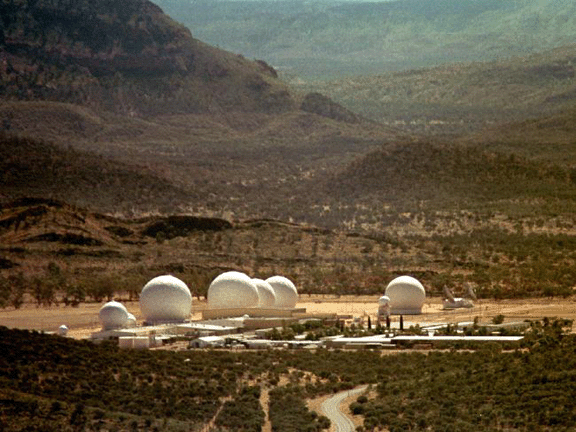
Pine Gap hardwires Australia into a Korean war https://www.echo.net.au/2017/08/pine-gap-hardwires-australia-korean-war/ Whether we like it or not, Australia would be dragged into a conflict on the Korean Peninsula because of the critical role of Pine Gap in US military operations against North Korea.
Given the geography of Korea and the decades of military preparations of both sides, we could become a participant in a war likely to result in the deaths of hundreds of thousands of Koreans, with a high likelihood of uncontrollable escalation to involve regional conflict.
Informed commentators recognize that there is no military solution to this conflict, and talking is the only option to avoid unimaginable horror.
Difficult though it is to negotiate with North Korea, there is good reason to believe that its leaders are not bent on suicide. There are indications that negotiations could be possible, but they need to be genuine to have any chance of avoiding war.
The Australian government’s strategic response has for a long time been compliance with whatever constitutes United States policy of the day.
In the hands of President Trump, this places the future of both the Korean Peninsula and Australia in the hands of a deeply delusional narcissist who is incapable of comprehending the consequences of his actions.
The Joint Defence Facility Pine Gap will play a critical role in both conventional and nuclear-armed U.S. attacks on North Korea.
Pine Gap hardwires Australia into US combat operations in Northeast Asia. Pine Gap’s tasking will now be very actively focussed on North Korea.
The logic of nuclear weapons, epitomized by the United States’ nuclear posture, and fully supported by compliant Australian governments, has led to North Korea’s successful path to nuclear weapons state status.
Its goal has clearly been to deter US from attempting regime change, rather than suicidal nuclear aggression.
It is time for Australia to take an independent stance urging the utmost caution on its nuclear-armed ally as well as on North Korea, and actively oppose any action leading to what would be a catastrophic outbreak of war.
But equally, the present crisis makes clear that doctrines of nuclear deterrence – by any country – hold the whole world to ransom, with deterrence failure inevitable in the long run.
It is clear that only the abolition of nuclear weapons will offer any chance of planetary safety.
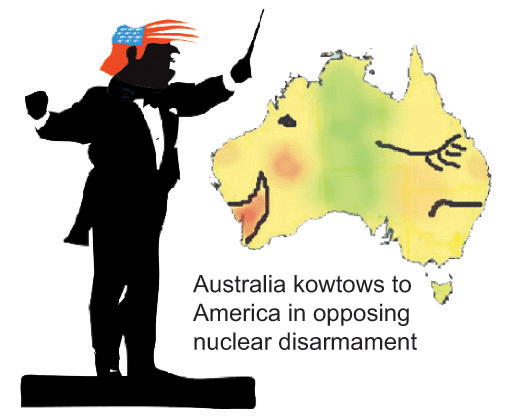
The Australian government’s craven acceptance of US demands that its allies boycott the treaty to prohibit nuclear weapons adopted at the United Nations indicates that we have no independent foreign policy.
Professor Richard Tanter, senior research associate at the Nautilus Institute and honorary professor in the School of Political and Social Sciences at Melbourne University.
Professor Tanter will address the issue ‘What would an independent Australian foreign policy look like?’ during the upcoming Independent and Peaceful Australia Network National Conference in Melbourne over the weekend of 8-10 September.
Will Australia join in the war if Trump’s USA attacks North Korea?
Australia will join the conflict if North Korea attacks the US: Malcolm Turnbull, SMH Fergus Hunter, 11 Aug 17, Prime Minister Malcolm Turnbull has declared Australia would invoke the ANZUS security treaty for only the second time in its history in response to any attack by North Korea against the United States.
Mr Turnbull also pushed back against calls – including from former prime ministers Tony Abbott and Kevin Rudd – for Australia to develop a missile defence shield to protect the mainland from the threat of North Korea’s nuclear weapons and long-range missile program.
The Prime Minister’s commitment to assist the US caps off days of escalating tensions, with US President Donald Trump threatening to unleash “fire and fury” on the rogue state and the North Korean regime warning it would attack the US Pacific territory of Guam.”The United States has no stronger ally than Australia. We have an ANZUS agreement and if there is an attack on Australia or the United States … each of us will come to the other’s aid,” Mr Turnbull told Melbourne radio station 3AW on Friday……
After invoking ANZUS in 2001, Mr Howard said Australia would consult with the US and consider any requests “within the limits of its capability”.
A month later, the government committed Australian troops to the US-led invasion of Afghanistan.
Opponents have criticised the treaty, arguing it unnecessarily places Australia’s security at risk.
Greens leader Richard Di Natale said: “The last thing we need here is a Prime Minister backing an unhinged and paranoid leader into a conflict that could potentially end life on Earth as we know it.”
He accused Mr Turnbull of putting a target on Australia’s back and called on him to tell the US President to “back off”.
“If there was ever a clearer example of why Australia needs to ditch the US alliance and forge an independent, non-aligned foreign policy, this is it. Malcolm Turnbull now needs to pick up the phone, he needs to talk to Donald Trump and urge him to de-eascalate.”
The Japanese city of Hiroshima of around 350,000 people, was the first city to be attacked with a nuclear weapon when a single bomb was dropped by the USA on August 6, 1945 towards the end of World War 2.
The bomb and its firestorm destroyed two-thirds of the city, with an estimated 70,000 ordinary people killed immediately and a similar number over the next five years. These deaths resulted from the immediate explosion, burns, radiation and cancers.
The city was devastated with destruction of most buildings. Photos appear to show a scene from hell with the city burned out, and civilians with horrendous burns and injuries.
Nuclear proliferation has ensued internationally since then, with an estimated 19,000 nuclear weapons now in existence, all much more powerful than the bomb dropped on Hiroshima. The threat of nuclear war was strongly present throughout the Cold War, and is again rising today.
The cost of nuclear weapons is enormous with an estimated $40 billion spent annually by the US alone.
Countries known to possess nuclear weapons are Russia, USA, UK, France, China, India, Pakistan, Israel and North Korea — not necessarily all reliable international citizens whom we would trust to have a finger on the nuclear trigger, particularly in view of recent inquiries confirming that unreliable information led to the recent war in Iraq with ongoing consequences.
Some countries such as Australia without nuclear weapons choose to be under the US “nuclear umbrella”.
Today, the use of nuclear weapons would result in extraordinary numbers of immediate deaths, devastation of medical facilities to care for those injured, and destruction of infrastructure of a city on a much larger scale than seen in Japan.
It is also predicted that the atmospheric debris from a limited regional nuclear war could cause global cooling and prolonged worldwide famine.
The good news is that a new Treaty on the Prohibition of Nuclear Weapons has been adopted by the United Nations in July this year.
This treaty prohibits states from developing, testing, possessing, transferring or deploying nuclear weapons under any circumstances.
This treaty was passed by 122 nation, unfortunately not Australia, as our government decided not to attend these discussions. Unsurprisingly, those countries with nuclear weapons are also non-participants.
Nuclear weapons will now join the list of banned weapons such as chemical and biological weapons and cluster bombs, which seems highly appropriate given that they are designed primarily to indiscriminately cause death to massive numbers of civilians. In a recent poll about 75 per cent of Australians support nuclear disarmament.
Our government believes that the US nuclear umbrella provides protection for Australia.
Australia’s official view is that a “building block approach” is required towards improving global nuclear weapon safety, with the initial step being increased transparency regarding nuclear stockpiles among those possessing them, which seems highly unlikely to happen given the secrecy surrounding military matters.
Somewhat ironically, international nuclear weapon treaties until now have made it legal for those signatories with nuclear weapons to continue to have them, but illegal for non-nuclear countries to manufacture or buy them.
The current international situation with escalating conflict between North Korea and the US and their respective leaders, illustrates what a precarious situation the world is in with the threat of nuclear weapons being used again very real. There is also the possibility of terrorist groups gaining nuclear weapons.
Nuclear weapons are abhorrent to a civilised society. Whilst in existence they are a threat to all.
Their cost is enormous. The existence of nuclear weapons cannot enhance international safety
The only winners in the nuclear arms race are the arms manufacturers. Australia still has an opportunity to participate in this current UN nuclear abolition treaty, and truly make our country — and our planet — safer.Sally Atrill is Tasmanian GP and the Tasmanian convener for the Medical Association for Prevention of War.
Australia doesn’t ‘get’ the environmental challenges faced by Pacific Islanders http://theconversation.com/australia-doesnt-get-the-environmental-challenges-faced-by-pacific-islanders-81995 Steven Cork, Adjunct Associate Professor, Crawford School of Public Policy, Australian National University, Kate Auty, Vice Chancellor’s Fellow, University of Melbourne, August 7, 2017 What actions are required to implement nature-based solutions to Oceania’s most pressing sustainability challenges? That’s the question addressed by the recently released Brisbane Declaration on ecosystem services and sustainability in Oceania.
There once was an Island
Compiled following a forum earlier this year in Brisbane, featuring researchers, politicians and community leaders, the declaration suggests that Australia can help Pacific Island communities in a much wider range of ways than simply responding to disasters such as tropical cyclones.
Many of the insights offered at the forum were shocking, especially for Australians. Over the past few years, many articles, including several on The Conversation, have highlighted the losses of beaches, villages and whole islands in the region, including in the Solomons, Catarets, Takuu Atoll and Torres Strait, as sea level has risen. But the forum in Brisbane highlighted how little many Australians understand about the implications of these events.
Over the past decade, Australia has experienced a range of extreme weather events, including Tropical Cyclone Debbie, which hit Queensland in the very week that the forum was in progress. People who have been directly affected by these events can understand the deep emotional trauma that accompanies damage to life and property.
At the forum, people from several Pacific nations spoke personally about how the tragedy of sea-level rise is impacting life, culture and nature for Pacific Islanders.
One story, which has become the focus of the play Mama’s Bones, told of the deep emotional suffering that results when islanders are forced to move from the land that holds their ancestors’ remains.
The forum also featured a screening of the film There Once Was an Island, which documents people living on the remote Takuu Atoll as they attempt to deal with the impact of rising seas on their 600-strong island community. Released in 2011, it shows how Pacific Islanders are already struggling with the pressure to relocate, the perils of moving to new homes far away, and the potentially painful fragmentation of families and community that will result.
Their culture is demonstrably under threat, yet many of the people featured in the film said they receive little government or international help in facing these upheavals. Australia’s foreign aid budgets have since shrunk even further.
As Stella Miria-Robinson, representing the Pacific Islands Council of Queensland, reminded participants at the forum, the losses faced by Pacific Islanders are at least partly due to the emissions-intensive lifestyles enjoyed by people in developed countries.
Australia’s role
What can Australians do to help? Obviously, encouraging informed debate about aid and immigration policies is an important first step. As public policy researchers Susan Nicholls and Leanne Glenny have noted, in relation to the 2003 Canberra bushfires, Australians understand so-called “hard hat” responses to crises (such as fixing the electricity, phones, water, roads and other infrastructure) much better than “soft hat” responses such as supporting the psychological recovery of those affected.
Similarly, participants in the Brisbane forum noted that Australian aid to Pacific nations is typically tied to hard-hat advice from consultants based in Australia. This means that soft-hat issues – like providing islanders with education and culturally appropriate psychological services – are under-supported.
The Brisbane Declaration calls on governments, aid agencies, academics and international development organisations to do better. Among a series of recommendations aimed at preserving Pacific Island communities and ecosystems, it calls for the agencies to “actively incorporate indigenous and local knowledge” in their plans.
At the heart of the recommendations is the need to establish mechanisms for ongoing conversations among Oceanic nations, to improve not only understanding of each others’ cultures but of people’s relationships with the environment. Key to these conversations is the development of a common language about the social and cultural, as well as economic, meaning of the natural environment to people, and the building of capacity among all nations to engage in productive dialogue (that is, both speaking and listening).
This capacity involves not only training in relevant skills, but also establishing relevant networks, collecting and sharing appropriate information, and acknowledging the importance of indigenous and local knowledge.
Apart from the recognition that Australians have some way to go to put themselves in the shoes of our Pacific neighbours, it is very clear that these neighbours, through the challenges they have already faced, have many valuable insights that can help Australia develop policies, governance arrangements and management approaches in our quest to meet the United Nations Sustainable Development Goals.
This article was co-written by Simone Maynard, Forum Coordinator and Ecosystem Services Thematic Group Lead, IUCN Commission on Ecosystem Management.
Donald Trump’s environment boss Scott Pruitt heading to Australia, ABC News , Exclusive by defence reporter Andrew Greene, 4 Aug 17, A climate science critic and one of the most controversial figures in the Trump administration will soon tour Australia in a visit environmental activists are likely to target with protests.
Key points:
Critics accuse Pruitt of trying to weaken the EPA
Liberal backbencher Craig Kelly says Australia should welcome Pruitt “with open arms”
Greenpeace says visit could spark protests and is not helpful for Australia as it tackles climate change policy
Critics accuse the former Oklahoma attorney-general of trying to weaken the EPA since assuming his role as administrator in February.
The ABC has confirmed the Republican politician is scheduled to fly to Australia this year, joining other Trump administration figures who have already made the journey, including Vice-President Mike Pence, Secretary of State Rex Tillerson and Secretary of Defence James Mattis.
Federal Government backbencher and climate change sceptic Craig Kelly has welcomed Mr Pruitt’s impending visit……..
What is more pressing for the Canberra apparatchiks is what a base like Pine Gap does in the context of spats with other powers which Australia shares ties with. The China rise is particularly problematic, given the teeth-gnashing belligerence being shown over maritime disputes.
Even as Chinese nationals purchase Australian real estate, tremors between Washington and Beijing can be felt as the base celebrates its half-century. A happy birthday it would have been, but only for some.
The Pine Gap Anniversary Partyhttps://intpolicydigest.org/2017/07/30/pine-gap-anniversary-party, Blony Kampmark /30 JUL 2017It all happened without much fuss, since fuss was bound to be the enemy. Dignitaries, guests and various partners lined up for a gathering at Alice Springs in Australia’s Northern Territory on Saturday, commemorating the secret base’s half-century.
The Alice Spring News Online described it, not inaccurately, as a “stealth party.” The Convention Centre hosting the dinner was tight lipped throughout the week about the guest list. “Unfortunately the details of this weekend’s event are not available for public release.” Not for residents in Alice Springs; not for the electors, or even the politicians. This would be an imperial, vetted affair.
A sense about how the base functions in a defiant limbo, one resistant to Australian sovereignty, can be gathered in various ways. The local federal member, Chansey Paech, whose constituency hosts the base, was not invited. Senator Nigel Scullion’s query about the exclusion of media from the event was rebuffed by the Defence department, with the Defence Minister keen to hold the line against her own colleague.
The Institute for Aboriginal Development (IAD), charged with supplying the indigenous “welcome to country” gathering at such bashes, seemed less than pleased to supply details. When the intrepid Alice Springs News Online dared ask, the CEO Kerry Le Rossignol responded with a dismissive “No comment.”
On July 25, a Defence spokesperson insisted that, “The Joint Defence Facility Pine Gap is proud to commemorate its 50th anniversary. However, celebrations are restricted to site personnel and invited guests only.” Power without perusal; might, without scrutiny. Continue reading →








 Antinuclear