Australian public supports UN talks towards a ban on nuclear weapons, but the Australian government is not listening.
Nuclear test survivor Sue Coleman-Haseldine International Campaign to Abolish Nuclear Weapons look what Aunty Sue Coleman-Haseldine said to 115 Governments assembled at the UN to ban nuclear weapons!
Australia has consistently maintained that as long as nuclear weapons exist, it must rely on the American nuclear umbrella, the protection of the deterrent effect of the US’s nuclear arsenal, the second largest in the world.
But political sentiment in Australia appears to support the ban treaty negotiations.
The Australian Senate passed a motion Monday urging the government to participate in the talks, and polling shows nearly three-quarters of Australians want Australia to be part of negotiations on a nuclear weapons ban treaty.
proponents say a nuclear weapons ban will create moral suasion – in the vein of the cluster and landmine conventions – for nuclear weapons states to disarm, and establish an international norm prohibiting nuclear weapons’ development, possession and use.
 Negotiations to ban nuclear weapons begin, but Australia joins US boycott https://www.theguardian.com/world/2017/mar/28/negotiations-to-ban-nuclear-weapons-begin-but-australia-joins-us-boycott At least 113 countries meet at UN to discuss ban, but US ambassador says the world is too unsafe for the US not to have nuclear weapons, Guardian, Ben Doherty, 28 Mar 17, Negotiations on a treaty to outlaw nuclear weapons have begun in New York, but have been publicly condemned by the United States, which is leading a coalition of more than 40 countries – including Australia – boycotting the talks.
At least 113 countries are part of the negotiations which have begun at UN headquarters in New York this week, aiming to negotiate a “legally binding instrument to prohibit nuclear weapons, leading towards their total elimination”.
But, Nikki Haley, appointed as the United States’ ambassador to the UN by Donald Trump in January, spoke outside the meeting saying the world was too unsafe for the US not to have nuclear weapons……
France and the UK, fellow nuclear weapons states, also spoke against the ban treaty negotiations, saying they would not assist in disarming nuclear states.
Support for a ban treaty has been growing steadily over years, with frustration at the ineffectiveness of the nuclear non-proliferation treaty in reducing nuclear arsenals. More than 123 nations – the majority of nations at the UN – voted in favour of negotiations to outlaw nuclear weapons.
But a ban treaty has no support from the states that actually have nuclear weapons. The nine known nuclear states – the US, China, France, Britain, Russia, India, Pakistan, Israel and North Korea – all oppose a ban treaty.Of the non-nuclear states opposing the ban treaty, Australia has been one of the most outspoken. Continue reading
Australian government is wrong to boycott UN conference on banning nuclear weapons
The only true guarantee to save humanity from its own destructive ability is to completely rid the world of nuclear weapons stockpiles. Much as we have become inured to the danger over the years since Hiroshima and Nagasaki, and the heightened tension of the Cold War, there is no managing this risk. Too many atomic bombs remain ready to fire at a moment’s notice; there are too many chances for human error that would see a catastrophic mistake.
At a time when the temperament of many leaders is rightly questioned, this should be the time to redouble efforts for nuclear disarmament, rather than trust the luck of the last 70 years will hold.
In that spirit, on Monday, negotiations will commence in New York for a new treaty that would outlaw nuclear weapons – not regulate, but ban the bomb outright. More than 120 countries have pledged to participate. Regrettably, however, Australia is not among them.
The Turnbull government has decided to stand apart from the negotiations believing that the proposed treaty is not “practical”.
The declared nuclear-armed powers, the US, Russia, France, Britain and China, have refused to participate, nor will the rogue nuclear states, Pakistan, India, Israel and North Korea, who have developed atomic weapons in the face of international law.
But a proposed ban on nuclear weapons offers the chance for the rest of the world to declare, forthrightly, that it has tired of living under the ever-present threat of annihilation.
Australia’s boycott sends a poor signal about this nation’s commitment to disarmament, especially as a crucial player in the nuclear industry as a supplier of uranium. Such a treaty would carry moral force, to pressure the nuclear-armed powers to fulfil the obligations of what the government presumably does see as a practical agreement, the 1968 Nuclear Non-Proliferation Treaty.
The genius of that document was to strike a grand bargain between the nuclear-armed countries and the rest of the world; forgo the pursuit of the bomb, and in turn, the nuclear powers agreed to eliminate their own over time. For nations such as Australia, this swayed a decision not to pursue an independent nuclear weapon capacity.
The non-proliferation treaty has been extraordinarily successful, in that no signatory (other than North Korea, who withdrew as a party to the treaty) has developed a nuclear weapon. But the pledge by the nuclear powers to work towards disarmament has been fitful at best and at worst cynical, as the trend appears to be the opposite.
Under the guise of a modernisation program, the United States is actually increasing the destructive yield of its nuclear arsenal, while Donald Trump complains about past disarmament deals with Russia. Meanwhile, Vladimir Putin has belligerently pushed the flight path of Russia’s strategic bombers closer to European nations in blatant provocation.
The conundrum to solve has always been one of trust. How can anyone be sure that a country would truly surrender its nuclear weapons, and who will have the faith to move first? Australian defence planners may feel a need to rely on the nuclear arsenal of its US ally for deterrence, but that deterrence is only required as long as nuclear weapons exist.
Australia stands out- in self-imposed exile from global summit on treaty to ban nuclear weapons
 Tim Wright, the Asia-Pacific director of the International Campaign to Abolish Nuclear Weapons, said Australia was turning its back on the UN at a time when multilateral cooperation was more important than ever. He accused Australia of “taking orders from the Trump administration”.
“Every country in south-east Asia and nearly all countries in the Pacific have declared their strong support for the upcoming UN negotiations. Australia will be sitting in self-imposed exile from one of the biggest and most important international treaty-making initiatives in recent history.
“This will be the first time that Australia has ever boycotted disarmament negotiations.
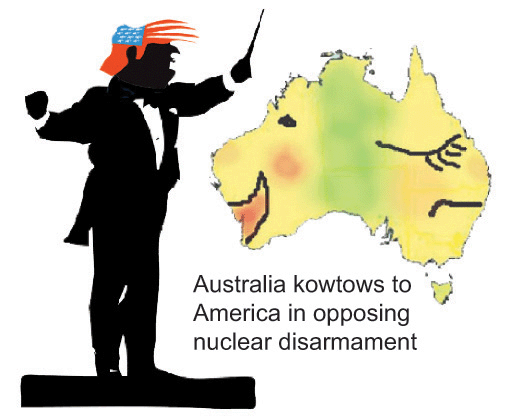
Australia to boycott global summit on treaty to ban nuclear weapons https://www.theguardian.com/world/2017/feb/17/australia-to-boycott-global-summit-on-treaty-to-ban-nuclear-weapons
Anti-nuclear campaigners accuse Australia of turning its back on the UN and ‘taking orders from the Trump administration’, Ben Doherty, Australia will boycott global negotiations on a treaty to ban nuclear weapons at the United Nations next month.
The global summit, to be held in New York on 27 March, will go ahead with Australia out of the room. Continue reading
A responsible global citizen would not sell uranium to Ukraine
 7 Feb 17 Selling Australian uranium to Ukraine would increase the risks of war, civil unrest and corruption in the eastern European country, the Australian Conservation Foundation said today.
The Joint Standing Committee on Treaties today recommended the conditional ratification of the nuclear co-operation agreement with Ukraine even though the committee’s own investigation conceded existing safeguards were ‘not sufficient’ and there was a risk Australian nuclear material would disappear off the radar in Ukraine.
“Australia, the nation that fuelled Fukushima should not sell uranium to the country that gave us Chernobyl,” said ACF’s Dave Sweeney.
“The treaties committee’s report found ‘Australian nuclear material should never be placed in a situation where there is a risk that regulatory control of the material will be lost’ (2.53), yet that is exactly what could happen under the inadequate checks and balances that apply to exported Australian uranium.
“The committee’s report clearly states the Australian government must undertake a detailed and proper risk assessment and develop an effective contingency plan for the removal of ‘at risk’ Australian nuclear material.
“There can be no justification for seeking to fast-track uranium sales based on this report.
“Australia should be very cautious about contributing nuclear fuel to an already tense geo-political situation in eastern Europe. Tensions recently flared again in Ukraine.
“Ukraine’s nuclear sector is plagued by serious and unresolved safety, security and governance issues.
“Two-thirds of Ukraine’s aging fleet of 15 nuclear reactors will be past its design lifetime use-by date in just four years.
“This is an insecure and unsafe sector and a risky sales plan.
“ACF calls on the federal government to be a responsible global citizen and not to advance uranium sales to Ukraine.”
Chief Scientist Alan Finkel warns of Trump’s Stalin-like attack on science
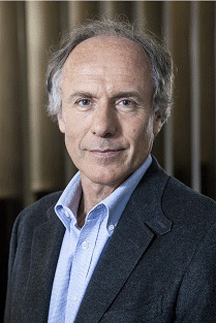 Australia’s chief scientist compares Trump to Stalin over climate censorship
 Alan Finkel warns that forcing EPA data to undergo political review before publication will ‘cause long-term harm’, Guardian, Gareth Hutchens, 7 Feb 17, Australia’s chief scientist has slammed Donald Trump’s attempt to censor environmental data, saying the US president’s behaviour was comparable to the manipulation of science by the Soviet Union.
Speaking at a scientific roundtable in Canberra on Monday, Alan Finkel warned science was “literally under attack” in the United States and urged his colleagues to keep giving “frank and fearless” advice despite the political opposition.
“The Trump administration has mandated that scientific data published by the United States Environmental Protection Agency from last week going forward has to undergo review by political appointees before that data can be published on the EPA website or elsewhere,” he said.
“It defies logic. It will almost certainly cause long-term harm. It’s reminiscent of the censorship exerted by political officers in the old Soviet Union.
“Every military commander there had a political officer second-guessing his decisions.”
Last month Trump’s administration mandated that any studies or data from scientists at the EPA undergo review by political appointeesbefore they can be released to the public.
The communications director for Trump’s transition team at the EPA, Doug Ericksen, said the review also extended to content on the federal agency’s website, including details of scientific evidence showing the Earth’s climate was warming and human-induced carbon emissions were to blame.
Finkel compared the Trump administration’s attempt to censor science to the behaviour of Soviet dictator Josef Stalin.
“Soviet agricultural science was held back for decades because of the ideology of Trofim Lysenko, who was a proponent of Lamarckism,” he said……..https://www.theguardian.com/science/2017/feb/06/australias-chief-scientist-compares-trump-to-stalin-over-climate-censorship
Trump’s military power – timr for Australia to re-evaluate its US bases
Australia urgently needs to re-evaluate its American bases and promote steps that defuse rather than intensify regional tensions. Having senior Australian defence personnel integrated into the US defence force hinders Australia acting independently. Do we want Australia to be capable of making strategic decisions in the national interest? New Zealand clearly acts in its own interest and remains an ally.
With Trump now the new US Commander-in-Chief, is it wise that we allow ourselves to be so automatically tied to American foreign policy? War in our region would be a humanitarian catastrophe for all involved.
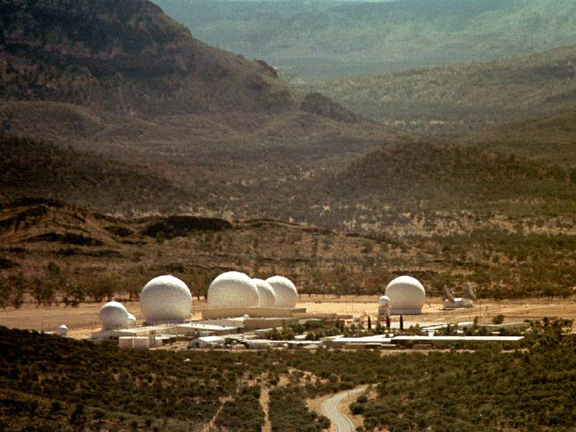
With Donald Trump in power, Australia urgently needs to re-evaluate its US bases http://www.smh.com.au/comment/with-donald-trump-in-power-australia-urgently-needs-to-reevaluate-its-us-bases-20170131-gu2qph.html, Margaret Beavis
Recent changes to the US National Security Council should be ringing loud alarm bells in Canberra.
By demoting the highest-ranking military officer and the highest-ranking intelligence officer, and appointing political adviser Stephen Bannon as a permanent member of the NSC, Donald Trump has seriously escalated the risk of the US launching into ill-advised conflicts. Bannon comes from a role as chairman of the racist, Islamophobic website Breitbart.com, and is reported as having been in charge of writing the recent executive order that has banned US entry for refugees and citizens from seven Muslim-majority nations.
It is no secret that Australian foreign policy and defence forces are closely enmeshed with the US. Since Trump has taken office he has loudly proclaimed an “America first” foreign policy, and his Secretary of State, Rex Tillerson, talks of denying China access to artificial islands in the South China Sea. Any such blockade is likely to be seen by the Chinese as an act of war. Continue reading
Australian company in Greenland’s battle over uranium and rare earths mining
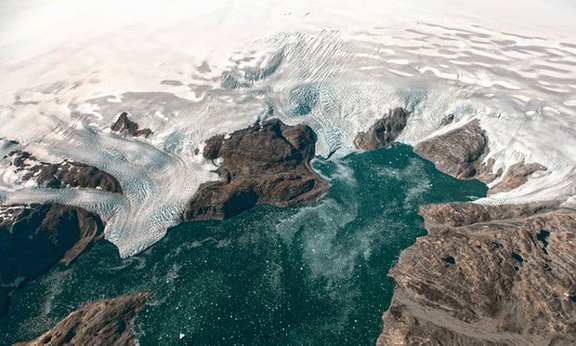 You can’t live in a museum’: the battle for Greenland’s uranium, Guardian, Maurice Walsh, 28 Jan 17 A tiny town in southern Greenland is fighting for its future. Behind it sits one of the world’s largest deposits of uranium. Should a controversial mine get the green light?
But uranium has made Kvanefjeld the most controversial project, and the focus of a debate about whether this is the economic path that Greenland should pursue. (The most common argument raised against is the danger that radioactive dust will fall on neighbouring settlements and farmland.) An Australian-owned company, Greenland Minerals and Energy (GME), has spent nearly £60m developing a plan for an open pit mine here. It was due to submit an environmental impact assessment by the end of 2016, but the deadline has been extended……….
In a move that sounds counterintuitive, GME is promoting its mine as a contribution to the new global green economy. According to the company, 80% of the commercial deposits in Kvanefjeld are rare earth minerals, commonly used in wind turbines, hybrid cars and lasers; uranium accounts for only 10%. “The market for rare earth minerals is deciding this,” says operations manager Ib Laursen. “Everybody is looking for them. Instead of Greenland being a passive receiver of global warming from the western world, it could contribute to green technology.”
It is a clever pitch. Greenland’s ice sheet has become the benchmark measurement for the march of global warming; research published in September showed that ice loss is accelerating more rapidly than previously feared. Greenland is also the emblematic victim of climate change: Inuit hunters and fishermen are called on in international conferences, to describe how their traditional lifestyles are being destroyed by warming seas.
But what the rest of the world see as creeping ruination, local politicians see as an opportunity. The melting ice sheet will make some minerals more accessible, and reveal others that are so far unknown.
……….Most of the world’s rare earth minerals come from China (six state-owned enterprises control nearly 90% of the planet’s supply), and the scale of environmental degradation there has given open pit mining a bad reputation. Concerned locals in Greenland invoke images of wasted landscapes and pools of toxic and radioactive waste, gleaned from a Google search. Similarly, the history of uranium mining has been one of blithe disregard for the environment……
Laursen.presents his mine as an environmentally friendly alternative to Chinese mines, modelled on international standards of best practice. He says the fears of radioactive dust floating over south Greenland are groundless. The crushed rock discarded once the minerals have been extracted, known as tailings, will be turned into slurry and carried in a pipeline to the bottom of a nearby lake. “It would never surface as dust,” Laursen says: the lake will be sealed in perpetuity by an impermeable dam……..
Frederiksen (sheep farmer) was alert to the dangers of radioactive dust because he had studied sheep farming in Norway in the mid-90s, when animals there were still affected by the fallout from Chernobyl. The scientists said they would remove dust from the mine by sprinkling it with water. “Well, water is usually frozen here in the winter,” Frederiksen tells me now, “so I asked them, ‘How are you going to have water to sprinkle then?’ And they said they would answer that when the environmental impact assessment arrived. When someone asked if it was possible to have no pollution in a mining area, the elderly man told us there had never been mining without pollution.” Frederiksen and Lennert believe most of the sheep farmers oppose the mine, but they avoid too many conversations about it just in case: polarisation risks harmony, and they might need each other in difficult times……….
In the past two elections, the people have decided, by voting for parties that support the uranium mine. Now, Qujaukitsoq says, it is a decision for the government. “Are we hesitant? No. We have no reservations about creating jobs.” For him it is the only way of saving Narsaq from stagnation. Whatever image the rest of the world cherishes, one thing is clear: Greenland will make its own way in the age of climate change.
• Maurice Walsh travelled as part of the Arctic Times Project, an international team exploring the transformation of the Arctic.more https://www.theguardian.com/environment/2017/jan/28/greenland-narsaq-uranium-mine-dividing-town
Good riddance to the Trans Pacific Partnership: it could have furthered nuclear waste import plans
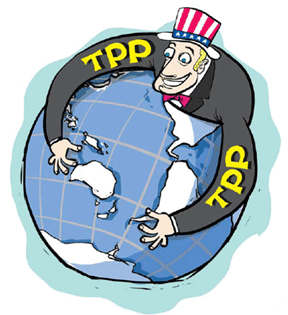 Paul Waldon, Fight To Stop Nuclear Waste Dump In Flinders Ranges SA, 25 Jan 17
CIA feared that Australian govt would close Pine Gap
 CIA documents reveal Pine Gap fears http://www.dailytelegraph.com.au/news/cia-documents-reveal-pine-gap-fears/news-story/78dd781a58fe89fd6b7d455a662c8596 22 Jan 17 TENSION over world wheat prices led to fears by the US Government that Australia could shut the secret spy facility at Pine Gap.
A memo prepared by the Central Intelligence Agency’s Office of East Asian Analysis shows the Americans were nervous Australia could lash out and use US-Australian joint facilities as a “bargaining chip” during the wheat prices stand-off in 1986.
It is among more than 900,000 documents, some of which were previously top secret, released by the CIA this week.
The briefing document says then-prime minister Bob Hawke was under political pressure from “militant farmers” to stand up for their interests as the US prepared to extend its “export enhancement program” to include the Soviet Union and China, which was expected to drive down wheat prices worldwide.
According to the memorandum, the Americans did not take the threats to close joint facilities seriously “but if the Senate proposal becomes law, tensions will be high and thoughts of making such threats will remain just below the surface”. “Our worst case scenario, on the other hand, would have the Australians refusing to negotiate a new ten-year agreement for the Joint Defense Space Research Facility at Pine Gap near Alice Springs in the Northern Territory (thus the facility would be subject to closure after October 1987 with a year’s notice),” the document read.
It said wheat farmers were the most vocal primary producers “and protest most often in Canberra”.
“Hawke undoubtably believes he cannot afford to ignore wheat farmers’ pleas to use his claimed ‘special relationship’ with the US administration to win them relief,” the memorandum read.
With an election looming, domestic pressure was on the prime minister to prove he could exert influence with the Americans. “In our judgment, the current US Senate proposal, if it becomes law, would confirm Australian farmers’ suspicions that Hawke is powerless to win relief from the US government and that Australia’s faithfulness to its responsibilities in the ANZUS alliance is meaningless to the US administration,” the document said.
Trump’s USA could drag Australia into a nuclear war with China
US ‘threatens to involve Australia in war with China’: Paul Keating condemns US secretary of state nominee’s comments, The Age, Fergus Hunter, 14 Jan 17
 Former prime minister Paul Keating has rounded on President-elect Donald Trump’s secretary of state nominee, accusing him of threatening to bring on war with China and making “ludicrous” comments on the tense South China Sea dispute.
In a statement released on Friday, Mr Keating warned the Australian government to reject Rex Tillerson’s declaration this week that a “signal” needed to be sent to Beijing that the construction of artificial islands in the contested region must stop and “access to those islands also is not going to be allowed”. The remarks from the former chief of Exxon Mobil, in which he also called for regional allies “to show backup”, have set the stage for sharply increased tensions between the US and China as the Asian superpower builds up its military presence on the islands to defend against competing territorial claims from neighbouring countries.
According to Mr Keating, Mr Tillerson’s testimony to his US Senate confirmation hearing “threatens to involve Australia in war with China”. And he has urged the Australian people to “take note” and recommended the government tell the Trump administration, which will take over on January 20, “that Australia will not be part of such adventurism, just as we should have done in Iraq 15 years ago”. “That means no naval commitment to joint operations in the South China Sea and no enhanced US military facilitation of such operations,” the former Labor prime minister said.
“Tillerson’s claim that China’s control of access to the waters would be a threat to ‘the entire global economy’ is simply ludicrous. No country would be more badly affected than China if it moved to impede navigation. On the other hand, Australia’s prosperity and the security of the world would be devastated by war.”……… http://www.theage.com.au/federal-politics/political-news/us-threatens-to-involve-australia-in-war-with-china-paul-keating-condemns-us-secretary-of-state-nominees-comments-20170113-gtqy0k.html
UK government avoids the question on nuclear waste going to Aboriginal land
 Radioactive Waste:Written question – 46886
Margaret Henry Fight To Stop Nuclear Waste Dump In Flinders Ranges SA
HERE IS THE ANSWER –
“There is a very small quantity of Australian owned radioactive waste currently stored in the UK. We anticipate that this will be returned to Australia in due course in line with contractual commitments. The location of any storage and disposal facilities for this waste will be a matter for the Australian authorities.
Any shipment of radioactive material out of the UK will comply with all relevant international laws and use ships which meet national and international requirements.” https://www.facebook.com/groups/344452605899556/
British and Australian governments wash their hands of radioactive contamination of Aboriginal lands
Bronwyn Lucas Fight To Stop Nuclear Waste Dump In Flinders Ranges SA, 30 Dec 16 I heard that the British did an absolutely appalling job of cleanup at Maralinga … it was hardly worth the effort, as I understand it. I heard stories of hot winds blowing, dust everywhere, a cursory undertaking. One would think we still had Menzies at the helm. The Dark Side is in this together … if we think our government is taking care of us, I’d say to think again.Margaret Henry Fight To Stop Nuclear Waste Dump In Flinders Ranges SA, 30 Dec 16 In the UK parliament in January 2016, they were asked if the Government will issue an apology to the indigenous people of Australia for British nuclear tests carried out on their land in the 1950s and 1960s.
ANSWER-
“In 1968, Australia signed an agreement with the UK confirming that the clean-up of all test sites had been completed satisfactorily. As announced to the House on 10 December 1993,(Official Report, column 421), the Government agreed to make an ex gratia payment of £20 million to the Federal Government of Australia as a contribution to the cost of the further clean-up of the Maralinga site. A copy of the note giving effect to this agreement was placed in the Library of the House. The note also records that the Government of Australia indemnified the Government of the UK against claims from Australian nationals or residents. The Government now regards the matter as closed.” https://www.facebook.com/groups/344452605899556/
Australia must stop undermining the nuclear disarmament process
To realise the full significance of this, consider the fact that other weapons of mass destruction – chemical weapons, biological weapons, landmines, cluster bombs – have all been prohibited by their respective treaties, and the threats posed by these weapons dramatically reduced as a result. But for nuclear weapons, which literally threaten life on Earth, there is currently no equivalent.
One might have expected that our Foreign Minister, Julie Bishop, who likes spruiking Australia’s commitment to a “rules-based international order”, would welcome the imminent closure of this legal anomaly. On the contrary, however, Australia has been leading the charge to undermine the process.
Australia claims that the ban treaty process has not taken into account the security needs of “all nations” (for which read the US), a curious claim given that our ally stands out as more vulnerable than most to a nuclear weapons attack. In any event, is she really suggesting that the security needs claimed by the nine nuclear-armed nations outweigh the right of the other 187 of us to be rid of this diabolical threat?
That’s a bit like cutting President Bashar al-Assad some slack over his alleged use of chemical weapons in Syria because he has “security needs”. Weapons of mass destruction are not somehow more acceptable because a handful of nations claim that they, and only they, must have them. But, the ban treaty critics say, nuclear weapons are different, and the countries with the weapons will just thumb their collective noses at it.
Not according to a letter in October from the US mission to NATO to its European allies, urging that they oppose the treaty. With an air of desperation to sabotage the whole thing, the US stated that efforts to delegitimise nuclear weapons are at odds with its policy of nuclear deterrence, including extended deterrence for its allies (such as NATO members and Australia). Further, horror of horrors, it “could make it impossible to undertake nuclear planning or training”. Well, yes, that’s the general idea, to delegitimise every aspect of nuclear weapons possession and planning; and all indications are that that goal will be achieved, regardless of who signs the treaty. So much for the toothless tiger notion.
Nevertheless, Australia presses on with its defence of US nuclear weapons, including their possible use on our behalf, not veering from its chosen “progressive” approach to disarmament. This consists of a number of steps that have progressed more slowly over decades than a drunken snail.
The Comprehensive Test Ban Treaty has languished since it was completed in 1996, with little prospect of ever coming into force, and the Fissile Material Cut-off Treaty has been moribund for even longer. In other words, we are told that a stagnant business-as-usual agenda is the way to go, even as 15,000-plus nuclear weapons – 1800 of them still on hair-trigger alert – continue to threaten human suffering of the most grotesque proportions, and all warnings point to increasing risk of their use.
Australia will have to decide very quickly whether we support the majority of nations that have come to their senses and are about to outlaw nuclear weapons, or the Trumps and Putins of this world with their chilling Cold War-style ravings. For a nation that boasts commitment to a “rules-based international order”, the choice hardly seems difficult.
The reality of moving one big step closer to stigmatising, prohibiting and eliminating the most destructive, inhumane, indiscriminate devices ever created is cause for celebration. However, there is another cause for celebration, and that is the capacity of civil society – without which the nuclear weapons ban would not be happening – to mobilise, organise, work with supportive governments and set the agenda for a better world. As the politics of violence, division and hatred loom large on many fronts, such capacity is desperately needed for the huge challenges ahead.
Dr Sue Wareham is a board member of ICAN (Australia), the International Campaign to Abolish Nuclear Weapons.
Australian government OK about dealing with corrupt firms – whether coal or nuclear
DCNS Opens New Australia-Based Office to Support Country’s Submarine Replacement Project http://blog.executivebiz.com/2016/12/dcns-opens-new-australia-based-office-to-support-countrys-submarine-replacement-project/on: December 22, 2016 France-based naval shipbuilder DCNS has established a new headquarters for its Australian subsidiary that will design the future submarine of Australia’s navy as part of an intergovernmental agreement between the two countries.
DCNS said Wednesday its Adelaide Future Submarine Facility is scheduled to begin operations in early 2017 and will support activities such as the transfer of technology from France to Australia, development of a supply chain and design of a shipyard in Adelaide.
“This facility, and our local Adelaide workforce starting with 50 people in 2017, marks the beginning of our relationship as part of the community,” said Herve Guillou, DCNS Group chairman and global CEO.
The Australian government selected DCNS in April to provide design services for the country’s estimated $38.7 billion SEA 1000 Future Submarine Program.
Marise Payne and Jean-Yves Le Drian, respective defense ministers of Australia and France have signed an agreement that establishes a framework for the two countries on the development of the Australian navy’s fleet of submarines.
France’s submarine sales firm DCNS is notorious for corruption
 “DCNS’s operations face questions across almost the entire globe, including in Pakistan, Malaysia, India, Saudi Arabia and Chile, with bribes and kickbacks reportedly comprising 8 per cent to 12 per cent of DCNS’s entire budget.”

 French subs builder’s record of corruption, The Saturday Paper, HAMISH MCDONALD, 30 Apr 16 “…….The Defence Department has been dazzled by promises from shipbuilder DCNS of ultra-quiet pulse-jet propulsion, a powerful sonar array from Thales, a comfortable space for the crew, and a very long range. Now all that has to be done is design the new boat, replacing the nuclear reactor in the Barracuda with diesels, batteries and fuel cells, and fitting in fuel tanks.
As the Hong Kong-based website Asia Sentinel has pointed out, “DCNS’s operations face questions across almost the entire globe, including in Pakistan, Malaysia, India, Saudi Arabia and Chile, with bribes and kickbacks reportedly comprising 8 per cent to 12 per cent of DCNS’s entire budget.”
No doubt our politicians and officials are aware of all this, and will be ready to account for any largesse. Perhaps they should automatically knock off 8 to 12 per cent of any price quoted by DCNS. https://www.thesaturdaypaper.com.au/world/north-america/2016/04/30/french-subs-builders-record-corruption/14619384003178
1 This month
17 October, Free Public Talk on Nuclear Issues in South Australia
David Noonan will speak on public interest concerns over the new Roxby Downs Indenture Act 2026 on BHP copper-uranium mining and ore processing in SA, and on how AUKUS may face SA with a High-Level nuclear waste agenda.
Dr Jim Green will discuss international developments in the field of nuclear power including ‘small modular reactors’ and Generation 4 ‘advanced’ nuclear reactor concepts.


Help Aunty Sue Protect Her Land and Sacred Sites From Destructive Rocket Testing.
.

Australians deserve the truth
about
AUKUS – https://aukuspublicinquiry.com/

PETITION – To: Prime Minister Anthony Albanese and the Australian Labor Government

of the week – Australians for War Powers Reform (AWPR)
To see nuclear-related stories in greater depth and intensity

