Australia’s Federal Government welcomes Iran nuclear deal (Video and Audio)
 Iran nuclear deal welcome: Australia http://www.sbs.com.au/news/article/2015/07/15/iran-nuclear-deal-welcome-australia (AUDIO and Video) The federal government has welcomed the landmark nuclear deal Iran thrashed out with major international powers.
“It settles the issue with respect to Iran’s nuclear ambitions to ensure there isn’t an opportunity for Iran to develop nuclear weaponry,” he told ABC radio on Wednesday.
Central Europe correspondent Kerry Skyring speaks to SBS Radio from Vienna:
Australian uranium miners’ toxic track record in Africa
[Paladin’s] Langer Heinrich Uranium mine[Namibia] …
Craton Mining and Exploration [copper] is a subsidiary of Australian-based International Base Metals…..
Rio Tinto owns Rössing Uranium Mine…
[Australian] Deep Yellow Limited (DYL) the Aussinanis uranium project.
Aussies in toxic trail By Shinovene Immanuel, Ndanki Kahiurika 10 July 15 http://www.namibian.com.na/indexx.php?id=28936&page_type=story_detail&category_id=1#sthash.TJSxEgQV.P3bN2nwk.uxfs&st_refDomain=blogs.icerocket.com&st_refQuery=/search?tab=buzz&fr=h&q=uranium+Australia NAMIBIA, a mining frontier for decades, continues to struggle with mining companies which subject workers to dangerous working conditions.
That mining in Africa provokes controversy, even violence, is not new. Chinese companies receive regular criticism. Canada, too, has been forced to confront allegations of violence and even slavery linked to its mining companies.
The ICIJ investigation looked at Australia’s increasing role in exploring and developing mining projects on the African continent because it has been less examined.
TROUBLING
What ICIJ uncovered and pieced together suggests a troubling track record on the part of Australian companies in the rush for Africa’s minerals, including practices that would be impermissible, even unthinkable, in Australia and other parts of the developed world. Continue reading
World’s poorest country, Malawi, ripped off by Paladin in tax avoidance?
 Australian miner accused of dodging tax in world’s poorest country, The Age, July 11, 2015 –Heath Aston Political reporter
Tax avoidance tactics of multinational companies have angered Australians, but an Australian mining firm used such methods in Malawi. Tax avoidance tactics of multinational companies have angered the public and placed pressure on the Abbott government to prevent profits being exported offshore.
But an Australian uranium miner is defending the use of identical methods to reduce its tax bill in the world’s poorest country, Malawi.
Between 2009 and 2014, Paladin Energy moved $US183 million out of Malawi to a holding company in the Netherlands and then on to Australia.
A 15-page report by London-based ActionAid has found the Dutch transfers and a special royalties deal – in which Malawi’s mining minister agreed to drop the initial tax rate applied to the uranium mine from 5 per cent to 1.5 per cent – have cost the Malawi public $US43 million.
In Africa’s poorest nation, where per capita GDP is just $US226 a year and life expectancy 55, that money could provide the equivalent of 39,000 new teachers or 17,000 nurses, according to the aid group……..
Paladin’s tax-free transfers to the Netherlands were a combination of management fees and interest payments on loans initiated in Australia. The company loaded its African subsidiary up with huge debts, leaving the Kayelekera uranium mine in northern Malawi with an 80:20 debt to equity ratio – a financing structure known as “thin capitalisation”.
The Dutch structure allowed Paladin to avoid paying a 15 per cent withholding tax to the Malawi government due to a tax treaty between Malawi and the Netherlands which expired in 2014, saving the company $US7.3 million. Paladin closed the mine in February 2014, citing a “sustained low uranium price”.
ActionAid has accused the company of “treaty shopping” and shortchanging the Malawi people. The country’s nursing ranks have the equivalent of four nurses to every 100 in Australia, despite 10 per cent of Malawi’s population being infected with HIV/AIDS……..http://www.theage.com.au/federal-politics/political-news/australian-miner-accused-of-dodging-tax-in-worlds-poorest-country-20150710-gi6uzv.html
Litigation in Malawi against Australian uranium miner Paladin
“There is a very strong perception that when Australian mining companies come here they take every advantage of regulatory and compliance monitoring weaknesses, and of the huge disparity in power between themselves and affected communities, and aim to get away with things they wouldn’t even think of trying in Australia,”
Australian miners linked to hundreds of deaths, injuries in Africa, SMH, July 11, 2015 -Will Fitzgibbon Australian mining companies are linked to hundreds of deaths and injuries in Africa, which can go unreported at home. Some of the Australian Securities Exchange-listed companies include state governments as shareholders. One company recorded 38 worker deaths over an eleven-year period.
 In Malawi, litigation continues against Paladin Africa Limited, a subsidiary of Perth-based Paladin Energy, and its subcontractor after an explosion disfigured one worker with such heat that his skin shattered when touched by rescuers. Two others died in the same incident.
Other allegations include employees in South Africa hacking a woman with a machete and Malian police killing two protesters after a mine worker reportedly asked authorities to dislodge a barricade on the road to the mine.
An investigation by the International Consortium of Investigative Journalists, in collaboration with 13 African reporters, uncovered locally-filed lawsuits, violent protests and community petitions criticising some Australian companies. Continue reading
Pro Nuclear Expert John Carlson warns on selling uranium to India
 Expert warns SA that uranium supply deal with India could end up in its nuclear weapons, Perth Now June 28, 2015 TORY SHEPHERD Sunday Mail (SA) SOUTH Australians should be concerned that uranium from their backyard could end up in Indian nuclear weapons, one of Australia’s top experts says.
John Carlson was director general of the Australian Safeguards and Non-Proliferation Office, in the Department of Foreign Affairs, until 2010 and has held other posts on safeguarding radioactive elements.
Mr Carlson, who is pro-nuclear, told the Sunday Mail that the treaty being worked out for Australia to sell uranium to India was flimsy, and said South Australia’s people and companies should be concerned about where the state’s uranium ended up. ndia has huge demand for cheap energy, which Australian uranium can provide, but it is not a signatory to the Nuclear Non-Proliferation Treaty and is developing weapons.
Mr Carlson said India had a history of disregarding commitments it had made, had refused to meet safety standards and “is actually increasing its nuclear arsenal”.
“This agreement is very different to all our other agreements. There’s much less detail in it. Only India, Pakistan and North Korea are producing weapons … you’d have to think this would be a watertight agreement (but) it’s very weak.
“I think there’s a reputational issue for the industry. There’s a problem for South Australian citizens.”…….http://www.perthnow.com.au/news/national/expert-warns-sa-that-uranium-supply-deal-with-india-could-end-up-in-its-nuclear-weapons/story-fnii5yv8-1227418016005
Trans Pacific Partnership – putting Australia’s democracy in a noose

Critics of the TPP recognise it is not so much aimed at promoting free trade but more at limiting government rights to deal with present and emerging problems, especially those associated with climate change and the environment. The TPP and the bilateral FTAs are seen as a sham, designed to facilitate the growth of the corporate state at the expense of the welfare state.
The vehicle for this rollback is the section dealing with Investor-State Dispute Settlement. The ISDS rules, administered by secret, ad hoc tribunals – whose members may alternate between judging disputes and advocating on behalf of corporations seeking compensation for future losses resulting from legislative change or court decisions – trump local democracy and law, according to the Chief Justice of the High Court…..
The Trans-Pacific Partnership is bad for Australia. SMH June 29, 2015 Kenneth Davidson Senior columnist at The Age The Productivity Commission appears to have tried to convince the government not to put Australia’s head into a noose via the TPP.
President Barack Obama now has the authority to negotiate the Trans-Pacific Partnership agreement without Congressional interference. The Abbott government is reluctant to challenge even the most odious provisions of the agreement, which pretends to be a regional trade pact involving the US and 11 other countries. It is in fact a push for US regional dominance with particular relevance to its rivalry with China. Continue reading
The dangerous flaw in the Trans Pacific Partnership
Investor-State Dispute Settlement (I.S.D.S.)-style provisions may once have made sense. But they’re now outdated and unnecessary. And including them in trade agreements undermines the broader case for free trade, by making it look like exactly what people fear—a system designed to put corporate interests above public ones.
Trade-Agreement Troubles, MULTUM NON MULTA BY JAMES SUROWIECKI, 19 June 15, In 2012, Australia implemented tough anti-tobacco regulations, requiring that all cigarettes be sold in plain, logo-free brown packages dominated by health warnings. Philip Morris Asia filed suit, claiming that this violated its intellectual-property rights and would damage its investments. The company sued Australia in domestic court and lost. But it had another card to play. In 1993, Australia had signed a free-trade agreement with Hong Kong, where Philip Morris Asia is based. That agreement included provisions protecting foreign investors from unfair treatment. So the company sued under that deal, claiming that the new law violated the investor-protection provisions. It asked for the regulations to be discontinued, and for billions in compensation.
The case has yet to be decided, but the concerns it raises help explain President Obama’s embarrassing setback last week, when the House failed to give him fast-track authority over one of two big trade agreements that had been envisaged as a key part of his legacy. Both agreements—the Trans-Pacific Partnership, with eleven Asian and Pacific countries, and an agreement with Europe called the Transatlantic Trade and Investment Partnership—include provisions very like the ones at the heart of Australia’s fight with Big Tobacco. Known as Investor-State Dispute Settlement (or I.S.D.S.) provisions, they typically allow foreign investors to sue governments when they feel they have not received “fair or equitable treatment,” and to have their cases heard not by a domestic court but by an international arbitration tribunal made up of three lawyers.
These provisions have been opposed by an unusual coalition of progressives and conservatives, who contend that they will let multinationals override government policy, and, as Senator Elizabeth Warren put it, “undermine U.S. sovereignty.”………. Continue reading
Asia Pacific Greens Federation Congress condemns Australia’s backward action on climate chnage
Delegates expressed strong opposition to plans to roll out more nuclear power stations in Korea, Japan and Taiwan, and sought the help of Greens parties worldwide in that effort. All want greater efforts in promoting energy efficiency and renewable energy. The Greens are well placed to break through and win seats in upcoming elections in Korea and Taiwan……..
Just as corporations are global, so too the Greens are a global force
 Christine Milne: Australia ‘universally condemned’ at regional Greens meeting, Guardian 15 June 15 Too often, the concerns of Pacific Island nations are jettisoned in favour of bigger nations’ interests. The Asia Pacific Greens congress aims to change that . Green parties around the world have been working for decades to address global warming. Australia’s Pacific Island neighbours are already suffering extreme weather events, storm surges, and adverse impacts on their health and livelihoods, with their ability to grow food constrained by salt water incursion into fresh water lenses. At every UN climate meeting they ask for help, and in spite of all the sympathetic talk, their concerns are jettisoned in favour of national sovereignty arguments from more powerful nations like Australia. This has to change. Continue reading
Julie Bishop (happy to export radioactive materials), but warns about ISIS getting radioactive materials.
 ISIS may have collected radioactive materials for nuclear ‘dirty’ bomb, says Australian Foreign Minister, First Post, Jun 11, 2015 Melbourne: The Islamic State is believed to have collected radioactive material from hospitals and research establishments in cities it has captured in Iraq and Syria which it could use to build a large “dirty” bomb, Australian Foreign Minister Julie Bishop has warned.
ISIS had declared its ambition to develop weapons of mass destruction in the most recent edition of its propaganda magazine Dabiq, stating that there is an “infinitely” greater chance of the cash-rich group smuggling its first nuclear weapon from Pakistan to attack the US within a year.
Bishop told The Australian that NATO was deeply concerned about the theft of radioactive material.
“The insurgents did not just clear out the cash from local banks,” she was quoted as saying.
In a speech in Perth last week, Bishop warned that the Islamic State may be developing poison-gas weapons.
Julie later told the daily that her speech was based on reports from the Defence Department and the Department of Foreign Affairs and Trade………http://www.firstpost.com/world/isis-may-have-collected-radioactive-materials-for-nuclear-dirty-bomb-says-australian-foreign-minister-2291388.html
Australia trashes its international reputation, in its adoration of coal
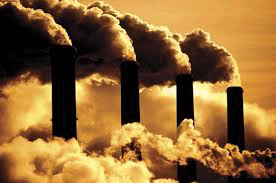 Australia stands out as a major recipient of overseas public finance for coal and coal seam gas projects, grabbing some $3.96 billion of public financing from overseas governments.
Through Australia’s own Export Finance and Investment Corporation, the country financed some $1.39billion between 2009 and 2014 for coal industry projects.
But as Paris draws nearer, is Australia willing to sacrifice its international reputation and the future state of its own climate on the alter of coal?
Will Australia continue to sacrifice its international reputation on the altar of coal?, Guardian 7 June 15 Graham Readfearn Arguments that coal is the answer to poverty are based on “implausible economics with unsubstantiated evidence” says report led by Kofi Annan. We’re now well passed the halfway point on the long road to Paris and a new global climate agreement to cut greenhouse gas emissions.
Australia took its turn to defend its domestic policies and targets during United Nations talks in Germany yesterday,
You can hear the whole exchange on the UN website but in short, Australian representatives insisted that it had the policies in place to meet its “not credible” target to cut emissions by five per cent by 2020 from 2000 levels.
Just to be clear, the Australian delegation didn’t describe the target as “not credible” – that came from the government’s own Climate Change Authority back in 2013.
Australia also talked-up its Direct Action climate policy – a measure that asks taxpapers to pay for emissions reductions and leaves fossil fuel companies unaffected.
Australia’s real self-interest Continue reading
Paladin – the ugly Australian in Malawi faces opposition, as its uranium pollution takes its toll
“It’s shocking that Paladin has disposed of millions of tons of radioactive and chemically hazardous waste on a plateau with very negative geological and hydrogeological characteristics,”
On the shores of Malawi’s lake of stars, activists raise uranium fears, Guardian, Santorri Chamley, 3 June 15
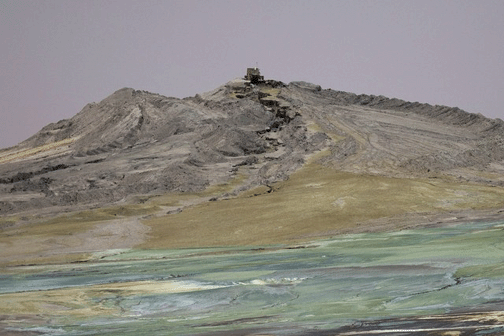
When dead fish were washed ashore in northern Malawi, activists and residents looked to a nearby uranium mine for answers – the latest battle in a protracted conflict with Paladin, the mine’s Australian owners “……For many of the tens of thousands of people living in Karonga, a lakeside district in northern Malawi, life revolves around fishing. So when dead fish began to wash ashore, they were worried. Some blamed pollution from the nearby Kayelekera uranium mine, the country’s biggest foreign investment.
“People are fearful because there are a lot of fish dying in the lake, so people are suggesting that they are dying because of the discharge from the Kayelekera mine,” said Harry Hudson Mwanyembe, the chairman for health and environment on Karonga’s district council.
The Australian company that owns the mine, Paladin Energy Ltd, says it has complied with all its environmental obligations and routinely monitors aquatic life in the Sere River and elsewhere. It denies any responsibility for the dead fish but its operation in Kayelekera has been beset by controversy since it was openedby the late president Bingu wa Mutharika in 2009.
The disputes, legal battles and public concern over the mine go to the heart of what many call Africa’s resource curse. As one of the continent’s poorest countries – ranking 174 of 187 countries in the UN human development index – Malawi desperately needs foreign exchange, as well as employment and infrastructure. But its pursuit of extractive wealth has been stymied by a lack of adequate regulation and transparency as well as by corruption, activists say.
In Kayelekera, the pitfalls associated with launching a multi-million dollar enterprise, with government backing, in an area where people lack access to both information and power, are evident in the many rumours, claims and counter-claims surrounding the mine’s operations……
resident of Kayelekera, Philip Simbowe, said the government had sold the lives of Malawians for cash. Continue reading
Australian govt pushing for international financial deregulation in Trade Agreement – Wikileaks reveals
 WikiLeaks reveals new trade secrets, SMH June 4, 2015 Philip Dorling
Highly sensitive details of the negotiations over the little-known Trades in Services Agreement (TiSA) published by WikiLeaks reveals Australia is pushing for extensive international financial deregulation while other proposals could see Australians’ personal and financial data freely transferred overseas.
The secret trade documents also show Australia could allow an influx of foreign professional workers and see a sharp wind back in the ability of government to regulate qualifications, licensing and technical standards including in relation to health, environment and transport services.
In its largest disclosure yet relating to the TiSA negotiations, WikiLeaks has published seventeen documents including draft treaty chapters, memoranda and other texts setting out the overall state of negotiations and individual country positions in a secret bargaining on banking and finance, telecommunications and e-commerce, health, as well as maritime and air transport.
The leaked documents were to be kept secret until at least five years after the completion of the TiSA negotiations and entry into force of the trade agreement. Continue reading
America’s long term push to make Australia accept nuclear waste
 US pressed Canberra to play ball on nuclear waste by: PAUL CLEARY http://www.theaustralian.com.au/in-depth/wikileaks/us-pressed-canberra-to-play-ball-on-nuclear-waste/story-fn775xjq-1227373417008 May 29, 2015
 US government cables from 1978 reveal Washington had a long-term strategy to make Australia acknowledge its “responsibility” to accept nuclear waste.
This pressure coincided with parliament’s approval on June 8 that year of a six-part regime to facilitate the mining, milling and exporting of uranium oxide.
Senior US officials began raising the waste issue in June when the two countries began high-level talks over a nuclear co-operation agreement, cables posted on the WikiLeaks website reveal.
A US embassy cable reported that Australia shared the US government’s views about uranium enrichment but “was unreceptive to questions about waste disposal in the Australia-Pacific area”.
When in September that year the Mirror editorialised against Australia’s accepting nuclear waste, US embassy officials told the Department of Foreign Affairs Australia should expect the US to “nudge” it about this issue.
The editorial was brought to the attention of the US embassy by Ron Walker, who headed the defence and nuclear division in the department. US officials bluntly told him Australia was essentially ignoring the problem of nuclear waste. “We replied by telling Walker he and other GOA (government of Australia) officials should assume that during the course of the next several decades there will inevitably be speculation about potential sites for nuclear waste storage,” the US officials wrote in the cable.
“We added that while we read GOA views ‘loud and clear’, the GOA should assume there will be continuing discussion about storage sites for nuclear wastes and in fact we would probably from time to time even go as far as to nudge the GOA about its responsibility in helping to find appropriate, safe and secure storage areas.”
The following week, two officials from the Australian embassy in Washington, described as “Starr and Knight”, asked the US State Department for guidance on talking points to respond to media reports. State Department officials said Australia should mention the US government’s policy of encouraging international co-operation in storage and processing of spent fuel.
One week later, an embassy official asked the State Department if the Australian government could use a form of words at the next Pacific Forum that said it was “highly unlikely” the US government would ask Pacific countries to accept spent nuclear fuel.
The US officials said Australia should not use this language.
The nuclear agreement referred to was signed by the Fraser government in 1979, but the Hawke government ended the plan to develop nuclear enrichment technology when it dismantled Australia’s laboratory-scale centrifuge enrichment plant.
Japan keen to make Australia’s new submarines
Japan Security Council Approves Bid to Build Australian Submarines DEFENSE STUDIES. FOCUS ON DEFENSE CAPABILITY DEVELOPMENT IN SOUTHEAST ASIA AND OCEANIA 22 Mei 2015 The Japanese proposal for the 4200-tonne Soryu would involve using contractors Kawasaki Heavy Industries and Mitsubishi Heavy Industries, with the bid competing against TKMS’s 4000-tonne Type 216 and a conventional version of DCNS’s 5000-tonne nuclear-powered Barracuda. (photo : Nosint)
Japan is to exploit the easing of its postwar ban on arms exports by entering the race to jointly develop and build a new generation of submarines for the Australian navy.
Members of Japan’s security council this week approved the country’s participation in the bidding process, months after the Australian prime minister, Tony Abbott, abandoned plans to buy Soryu-class submarines from Japan under pressure from ruling party and opposition politicians.
Instead, Japan will join non-nuclear submarine developers from Germany and France in Canberra’s “competitive evaluation process” to decide who builds the Australian navy’s next fleet of submarines.
South Australian government and defence industry representatives have gone to Europe to convince companies bidding to build Australia’s next fleet of submarines to do the work in Adelaide.
Yoshihide Suga, Japan’s chief cabinet secretary, confirmed that the security council had decided Japanese firms should join the process “in light of the importance of defence cooperation between Japan and Australia”.
Suga told reporters that the decision was in line with Japan’s revised rules on the transfer of arms and defence technology……….
USA ‘Missile Defense’ is Destabilizing the Region
‘Missile Defense’ is Destabilizing by Bruce K. Gagnon http://space4peace.blogspot.com.au/“….The Global Network will carry this with us to Kyoto, Japan from July 29-Aug 2 for our 23rd annual space organizing conference that is being hosted by peace activists from across the Kyoto Prefecture.
The US recently deployed a ‘missile defense’ radar in Kyoto Prefecture and the Ukawa village has been resisting the deployment for some time. During the conference we will take a side trip to join the villagers in a protest against the radar that is being aimed at China.
The US is now deploying “missile defense’ systems throughout the Asia-Pacific on land and on-board Navy Aegis destroyers. These interceptors play an important role in US first-strike attack planning.
They are now deployed in Taiwan, South Korea, Japan, Okinawa, Guam, Australia, and the Philippines. Taken together these interceptor systems serve as a loaded gun pointed at the head of China. Beijing has responded by building more nuclear weapons to ensure they have a “survivable retaliatory capability” and have moved many of their more vulnerable land-based nuclear weapons onto submarines so they are harder to hit in a possible Pentagon first-strike attack.
The US Space Command has been annually war gaming such a first-strike attack on China and Russia for many years. In the computer war game the US fires weapons from space and through space in order to take out the “enemy” nuclear forces. Then when China or Russia attempt to fire their remaining retaliatory forces the US ‘missile defense’ systems are used as a shield against them giving the Pentagon a theoretical successful first-strike.
Since the US withdrew from the ABM Treaty the US has been encircling both Russia and China with the destabilizing systems.
1 This month

of the week – Australians for War Powers Reform (AWPR)
To see nuclear-related stories in greater depth and intensity
 Antinuclear