Despite warnings, Malcolm Turnbull, in Turkey, announces uranium deal with India
 Australia – India Civil Nuclear Deal Finalised Amidst Warnings, Australia Network News, 17 Nov 15 In 2014, India and Australia signed the civilian nuclear cooperation agreement during then Australian PM Tony Abbott’s visit to New Delhi. Now, his successor, Australian PM Malcolm Turnbull, told PM Narendra Modi on Sunday that procedure for the deal had been completed and could now be implemented…….The significant part of the civil nuclear cooperation agreement was that Australia agreed to become “a long-term reliable supplier of uranium to India.”…..
However, a Huffington Post piece suggests it was only around two months ago that the Joint Standing Committee on Treaties delivered a well-considered report into Australia’s controversial plan to sell uranium to India. The government-controlled Committee identified a number of practical steps & recommendations needed to address safety, security and legal uncertainty around the deal.
According to Dave Sweeney, earlier this week, the government chose to ignore these recommendations — emphatically stating that “the Government does not accept the Committee’s recommendation that exports of uranium to India should be deferred.” http://www.australianetworknews.com/australia-india-civil-nuclear-deal-finalised-amidst-warnings/
Malcolm Turnbull assures India they can now buy uranium from Australia
India, Australia nuclear deal to come into force, Indian Express, by Shubhajit Roy | Antalya November 16, 2015 A year after India and Australia signed the civilian nuclear cooperation agreement during then Australian PM Tony Abbott’s visit to New Delhi, his successor, Australian PM Malcolm Turnbull told PM Narendra Modi Sunday that procedure for the pact has been completed and can now be implemented…..

“The PM thanked the Australian PM and said the nuclear agreement is a milestone and a source of trust and confidence. With the completion of procedures, including administrative arrangements, the Civil Nuclear Agreement will now enter into force,” he said.
This was Modi’s first meeting with Turnbull after he took over. Sources described the meeting to be “very constructive” and pointed out to the result-oriented conversation in their first-ever bilateral meeting.
It may be recalled that former Australian PM Julia Gillard paid a state visit to India in October 2012. The decision of Australian government to supply uranium to India was taken during her time and on September 5, 2014, India and Australia signed a MoU for “Cooperation in the Peaceful Uses of Nuclear Energy” during Abbott’s visit.
The significant part of the civil nuclear cooperation agreement was that Australia agreed to become ‘a long-term reliable supplier of uranium to India’……..http://indianexpress.com/article/india/india-news-india/india-australia-nuclear-deal-to-come-into-force/
Australia two-faced at OECD discussions on coal and climate change
 In addition, taking a blocking position at the OECD has the potential to damage Australia’s credibility in other international negotiations and particularly as its role as co-chair of the Green Climate Fund. Overall, to address climate change, our policies on energy and climate change will need to align. As the US, EU and China step up their leadership on climate change, Australia will come under increasing pressure to reconcile its different positions.
OECD coal discussions highlight tensions in Australia’s position on climate change, The Conversation, Katherine Lake November 13, 2015 While the UN Paris talks approach at the end of November, attention is currently focused on another forum, the Organisation of Economic Cooperation and Development (OECD), where member countries are negotiating a deal to limit public finance to overseas coal projects in emerging and developing countries.
Australia and South Korea are reportedly opposed to an agreement struck by the US and Japan and supported by other member countries, notably Germany and France, to prevent public finance to all but the very cleanest power plants.
How will these discussions at the OECD impact on the UN Paris negotiations? Australia’s approach to these international meetings would seem to be inconsistent……..
Australia is walking a fine line in climate diplomacy
Are Australia’s positions on climate change in the UN and the OECD inconsistent?
On the one hand, Australia supports the objective of keeping the global temperature rise within 2℃ and is willing to make some domestic emission reductions to assist in achieving this.
On the other hand, it is not yet willing to place any real limits on its coal exports to developing countries. It justifies this position on the basis that coal is required by developing countries to alleviate poverty and that it is not for Australia to decide how other countries allocate their public finance. Continue reading
Australian govt: slap in the face for its own Standing Committee, on uranium sales to India
Australia Ignores Red Light On Uranium Exports To India, http://www.huffingtonpost.com.au/dave-sweeney/government-fails-india-ur_b_8547542.html?utm_hp_ref=australia Huffington Post, Dave Sweeney 13/11/2015, The federal government has delivered a stiff slap in the face to due process and evidence-based policy development by ignoring an unambiguous red light on planned uranium sales to India.

It was only two months ago that the Joint Standing Committee on Treaties delivered a well-considered report into the controversial plan to sell Australian uranium to India. The government-controlled Committee identified a number of practical steps needed to address safety, security and legal uncertainty around the deal.
Importantly the committee’s report clearly recommended against uranium sales at this time or under the current terms of the Australia-India Nuclear Co-operation Agreement, and outlined a series of pre-conditions required before any future sales to India.
These include the full separation of military and civil nuclear facilities, the establishment of an independent nuclear regulatory authority, a review of the adequacy and independence of the regulatory framework, IAEA verification that inspections of nuclear facilities are of best practice standard, improved decommissioning and radioactive waste planning and more.
But, earlier this week, the government chose to ignore these recommendations — emphatically stating that “the Government does not accept the Committee’s recommendation that exports of uranium to India should be deferred.” Continue reading
Trans Pacific Partnership final text confirms fears of critics
 TPP Environment Fears Confirmed By Final Text https://newmatilda.com/2015/11/06/tpp-environment-fears-confirmed-by-final-text/
By Thom Mitchell on November 6, 2015 The content of the TPP is finally known, and it appears to be as bad as critics feared. Thom Mitchell reports.
The Trans Pacific Partnership leaves the door open for corporations to inhibit the ability of governments to legislate for environmental protection, critics of the biggest free trade deal in history said after the release of the final text yesterday.
Like many trade deals, the TPP includes ‘Investor State Dispute Settlement’ clauses which allow multinational corporations to sue governments in trade tribunals outside of national judiciaries if laws are passed that risk their profits. According to Dr Mathew Rimmer, a Professor of Intellectual Property and Innovation law at the Queensland University of Technology, “They have given foreign investors very broad ranging powers to go into investment tribunals to make complaints about decisions by government that affect their foreign investments.”
“There are some clauses there dealing with protection of the environment…and the right to regulate, but they aren’t absolute defences,” Dr Rimmer said.
The Executive Director of America’s influential Sierra Club, Michael Brune, said the fact that “the words ‘climate change’ don’t even appear in the text [is] a dead giveaway that this isn’t a 21st-century trade deal”.
“It sets us back further, empowering fossil fuel corporations to challenge our public health and climate safeguards in unaccountable trade tribunals while increasing dirty fossil fuel exports and fracking,” Brune said.
Over more than half a decade, the deal was negotiated in secret between 12 ‘Pacific Rim’ countries, including Australia, the United States, Canada, Japan, Malaysia, Mexico, New Zealand, Peru, Chile, Singapore, Vietnam and Brunei.
Indonesia to deny nuclear waste ship access to Indonesian waters
 Nuclear Waste Ship will be Denied Entry to Indonesian Waters http://www.globalindonesianvoices.com/23422/nuclear-waste-ship-will-be-denied-entry-to-indonesian-waters/ 05 Nov 2015 By : Leo Jegho
“Our investigation has found that the vessel had ever entered our seawaters when sailing to France. And now we are monitoring its travel back to Australia,” Bakamla Chief Vice Admiral Desi A Mamahit told reporters at his office in Jakarta, according to Detik.com.
Transporting the nuclear waste is BBC Shanghai, an Antigua & Barbuda-flagged general cargo ship. Admiral Desi mentioned two reasons why Indonesian authorities disallow BBC Shanghai passing through Indonesian waters on its way to Australia. The first reason is that the Indonesian seawaters are not part of the routes allowed for foreign vessels traveling from Europe to Australia and vice versa. The second reason is that BBC Shanghai carries nuclear waste.
BBC reported that BBC Shanghai is due to reach Australia by 27 November and that it is now in Africa. France-based nuclear company Areva sent the nuclear waste back to Australia.
The waste reportedly derives from the spent nuclear fuel sent from Australia to France in 1990s and early 2000s. French law obliges such nuclear waste to be sent back to Australia.
Too good to be true? Greg Hunt’s new found enthusiasm for renewable energy
 Hunt Talks Up Australian Renewables In Shanghai http://www.energymatters.com.au/renewable-news/hunt-australian-renewables-em5168/ November 4, 2015 Energy Matters Australia’s Minister for the Environment, Greg Hunt, provided a glowing report on the state of renewable energy in Australia at the Bloomberg New Energy Finance Future of Energy Conference in Shanghai yesterday.
Minister Hunt didn’t want to discuss the not-so-glorious recent past for renewables under ex-Prime Minister Tony Abbott’s reign, stating he wished to focus on “the positive agenda that the Australia has in place to harness energy innovation, support renewables and reduce emissions.”
Mr. Hunt told those gathered Australia boasts 2.4 million solar power and solar hot water systems, and has the highest proportion of households with solar panels globally at 15 per cent. This growth has been supported by programs such as the Solar Credits subsidy, which is still available. Additional incentives such as a tax deduction for asset purchases valued up to $20,000 are available for small business.
The Minister said renewables currently make up approximately 13 per cent of Australia’s electricity generation, a figure that will rise to 23.5 per cent by 2020 under the Renewable Energy Target.
Mr. Hunt was also optimistic about the future of home battery storage, quoting Morgan Stanley research estimating up to a million Australian households could have solar + storage in place by 2020.
The Minister was also very positive about the efforts of the Clean Energy Finance Corporation (CEFC) and the Australian Renewable Energy Agency (ARENA); agencies the Abbott government attempted to axe.
” Australia also excels in the development and deployment of renewable energy technologies through the Renewable Energy Target and investments made by the Australian Government through the Australian Renewable Energy Agency and Clean Energy Finance Corporation,” he said; also detailing some of the projects both agencies have been involved with.
The Minister also mentioned the CEFC and ARENA working together to jointly support the deployment of large scale solar with a $350 million package.
Reading over his comments, it’s hard to believe that a short time ago Australia’s renewable industry was facing a major threat from a government-led attack that saw investment in large scale projects plummet. With a change of leadership, the attitude towards renewables seems to have changed for the better.
The transcript of Minister Hunt’s speech can be downloaded here (PDF).
On uranium sales to India, Malcolm Turnbull should heed Parliament’s Joint Standing Committee on Treaties
Malcolm Turnbull should pay heed to the findings of the JSCOT report and not be rushed by those with poor track records and overt atomic agendas.
Nuclear ambitions must put safety first, http://www.brisbanetimes.com.au/comment/nuclear-ambitions-must-put-safety-first-20151030-gkmqtm.html Dave Sweeney, It’s now three years since then-Premier Campbell Newman back-flipped on a ‘crystal clear’ commitment and opened the door for the uranium industry in Queensland. The decision, made without consultation, evidence or any independent analysis was explained on the basis of a potential uranium sales deal with India.
Since this time – and to their considerable credit – the re-elected Labor government has reinstated the state’s long-standing and popular ban on uranium mining.
As the uranium lobbyists and former LNP mines minister Andrew Cripps continue to beat the radioactive drum it is useful to look at the risks and roadblocks that mean there will be no smooth passage to India for any Australian uranium.
In September the federal Parliament’s Joint Standing Committee on Treaties completed a detailed examination of the proposed sales deal and its implications. Despite strong personal support for the sales plan by then PM Tony Abbot the government controlled committee took a far more considered and cautious approach.
The committee’s report identified a range of serious and unresolved nuclear safety, security and regulatory concerns with the proposed sales deal – as well as questioning its uncertain legal basis. Continue reading
Fijian PM slams Turnbull for giving in to climate denialists
 Fiji PM decries Australia’s ‘climate change deniers’ in Turnbull cabinet, Guardian, Oliver Milman, 28 Oct 15, Frank Bainimarama says: ‘The Australian government, in particular, seems intent on putting its own immediate economic interests first’ The prime minister of Fiji has delivered a blistering broadside at his Australian counterpart, Malcolm Turnbull, over the “climate change deniers” in his government who are helping doom Australia’s “unlucky island neighbours”.
Frank Bainimarama criticised Australia and New Zealand for failing to back Pacific island nations over climate change, claiming that the entire region risked being wiped out by rising sea levels, extreme weather and ruined agriculture.
“The Australian government, in particular, seems intent on putting its own immediate economic interests first,” Bainimarama said in a speech delivered in Nadi, Fiji. “The ‘lucky country’ determined to stay lucky, at least for the short term, at the expense of its unlucky island neighbours.
“To Malcolm Turnbull, the new Australian prime minister, I want to send a special plea. Make good on your previous strong stance in favour of deep and binding cuts in carbon emissions. Do not do deals with those who have enabled you to gain high office and betray your principles and our position.”
Bainimarama said Turnbull should halt new coalmines in Australia and embrace an economy based on clean energy. Such a ban has been proposed by a coalition of Pacific nations in the recent Suva declaration. Continue reading
Hallelujah! Political Oblivion for climate villains Abbott and Harper
 Canada’s Harper follows fellow “climate villain” Abbott into political oblivion, REneweconomy, By Giles Parkinson on 20 October 2015
It is good news for the upcoming Paris climate change talks. Both countries, under their former leaders, ranked at the bottom of the 34 countries in the Organisation for Economic Co-operation and Development (OECD) for their efforts on climate change. Among G20 countries, only Saudi Arabia ranked lower than them.
Since their elections – Harper in 2006, and Abbott in 2013 – they had applied the brakes on climate change and renewable energy policy, despite some strong efforts at sub-national levels (the provinces in Canada and states and territories in Australia).
During a visit to Canada last year, Abbott and Harper decided to create a “conservative alliance among ‘like-minded’ countries” to try to dismantle global efforts on climate change.
At a press conference, Harper applauded Abbott’s efforts to dump Australia’s carbon tax. Indeed, Abbott had borrowed the “axe the tax” slogan from an earlier Canadian campaign.
Now, both have gone…….http://reneweconomy.com.au/2015/canadas-harper-follows-fellow-climate-villain-abbott-into-political-oblivion-43745
AUSTRALIA’S SHAME: getting UN climate draft to drop action to help climate refugees
UN drops plan to help move climate-change affected people, Guardian, Oliver Milman, 7 Oct 15 Australia opposed the plan for a group to assist migration, and it has been left off the draft agreement for UN climate talks in Paris Australia’s opposition to the creation of a body to help people escaping the ravages of climate change appears to have paid off, with the idea dropped from the draft agreement for the crucial UN climate talks in Paris.
A previous draft of the deal to be thrashed out by nations included a “climate change displacement coordination facility” that would provide “organised migration and planned relocation”, as well as compensation, to people fleeing rising sea levels, extreme weather and ruined agriculture.
However, this reference has been removed in a revised text ahead of the December climate conference negotiations. Australia opposed the facility, although Guardian Australia understands the prime minister, Malcolm Turnbull, has shown interest in the issue of displacement.
“Australia does not see the creation of the climate change displacement coordination facility as the most effective or efficient way to progress meaningful international action to address the impacts of climate change,” a Department of Foreign Affairs and Trade spokesman said. “Australia is already working closely with our Pacific partners on these important issues.”
Australia had spent more than $50m in climate resilience projects in the Pacific and contributed another $200m to the Green Climate Fund.
Opposition to the coordination facility is not shared by Australia’s traditional allies, with representatives from the US, British and French governments indicating they were open to the idea……..
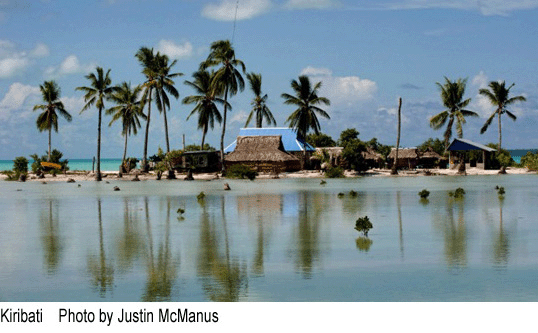
The impact of climate change is anticipated to displace up to 250 million people worldwide by 2050, including many in low-lying Pacific islands such as Tuvalu, the Solomon Islands and Kiribati.
In areas of the Pacific, sea level is rising by 1.2cm a year, four times faster than the global average. For coral-based islands two to three metres above sea level this has resulted in communities being relocated, and drinking water and crops are threatened by salt water inundation. Recent research suggests islands will not be submerged but will change shape and height, posing difficulties for fixed infrastructure.
“Why on earth would Australia not support a coordination facility?” said Phil Glendenning, president of the Refugee Council. “We are talking about the most vulnerable people on the planet who are facing threats to their food security, seeing their water supplies diminish and their entire cultures at risk.
“The world is going to have to deal with this displacement. We need to get on the front foot. Australia can’t say we are doing enough. People in Kiribati and Tuvalu are the canaries in the coalmine and they are looking to Australia.”
Last year the Kiribati government bought 20 sq km of land on Vanua Levu, one of the Fiji islands, in case its people cannot be moved internally. It has a policy called “migration with dignity” if its cluster of 33 coral atolls becomes inhabitable…….
Relocation of people is occurring across the Pacific region. Dozens of villages in Fiji will be moved, and 2,000 people from the Carteret atoll of Papua New Guinea will be transferred to mainland Bougainville, a three-hour trip on a wooden boat, because of salt intrusion and destructive tides. http://www.theguardian.com/environment/2015/oct/07/un-drops-plan-to-create-group-to-relocate-climate-change-affected-people
Trans Pacific Partnership’s Investor-State Dispute Settlement [ISDS] provisions bad for environment
 Trans-Pacific Partnership bad for the environment, green groups say October 7, 2015 Peter Hannam Environment Editor, The Sydney Morning Herald “……Greens Senator Peter Whish-Wilson said the Investor-State Dispute Settlement [ISDS] provisions of the pact will allow large corporations to challenge any efforts to tighten environmental regulation.
“This is a watershed moment for the Liberals and the mining industry in their continuing assault against environmental protections in Australia,” Senator Whish-Wilson said. “ISDS will provide a massive chilling effect against improvements in environmental law at a local, state and federal level.”
Kelly O’Shanassy, chair of the Australian Conservation Foundation, said it was “a very silly idea to lock in restrictions to future policy in this country”.
Corporations could now have a look at a proposed policy change and if it threatened their ability to make profit, they would go to the courts as they did to oppose the Gillard government’s plain packaging laws to curb tobacco marketing.
“It could be the plain packaging fiasco for climate change,” Ms O’Shanassy said.
With the Paris climate summit now looking increasingly likely to fall short on locking in sufficient cuts to greenhouse gas emissions to limit global warming to 2 degrees, governments will need to make regular revisions of their targets beyond this year’s summit.
The TPP is likely to limit nations’ ability to take those necessary additional steps, she said: “It means governments won’t be bold and ambitious as they should be.”http://www.theage.com.au/environment/transpacific-partnership-bad-for-the-environment-green-groups-say-20151006-gk2bga.html#ixzz3o10RNuqa
Coming refugee crisis as sea levels rise on Pacific Islands
 Fiji PM Warns Of Syria-Style Refugee Crisis If Rich Nations Don’t Do More On Climate, Thom Mitchell, New Matilda, 2 Oct 15 Frank Bainimarama has taken aim at advanced nations for ignoring the plight of Pacific Islanders in pursuit of short-term economic growth. Thom Mitchell reports.
The Fijian Prime Minister Frank Bainimarama has hit out at developing nations for their “unacceptable” progress in reducing carbon emissions as part of a speech to the United Nations General Assembly, in which he warned of a humanitarian refugee crisis on the scale of the current migration out of Syria if more is not done.
The talks come as Foreign Minister Julie Bishop seeks a place for Australia on the UN Security and Human Rights Councils, but Bainimarama warned that developed nations like Australia are not listening to the voice of Pacific Island nations, whose human rights are threatened by rising seas and hostile weather patterns.
“It is simply not acceptable for advanced economies to build a high standard of living on the degradation of the earth and the seas,” Bainimarama said.
The choices we face may be politically difficult in the short run, but the consequences we are already seeing – environmental degradation, unbearable heat, drought, powerful tropical storms and unpredictable weather patterns – are simply unacceptable,” he said.
“[Fiji] plans to move some 45 villages to higher ground, and we have already started.
“We have committed to resettle people from other low-lying, South Pacific Island States that face the prospect of being swallowed up by the rising ocean and falling inexorably to oblivion.
“Should that happen, the people of those Island States would be refugees as desperate and lost as the hundreds of thousands fleeing conflict in Syria and Iraq,” he said.
As New Matilda reported in June, experts in migration law, like those at the University of New South Wales’Kaldor Centre for International Refugee Law, are already warning that the “disasters on steroids” climate change will bring is likely to create a need for special refugee visas.
It is clear by now that international pledges nations have made through the United Nations climate change process will not be enough to keep the global rise in temperature to less than two degrees, which is the level accepted as ‘safe’ by Australia and around 200 other nations: https://newmatilda.com/2015/10/01/fiji-pm-warns-syria-style-refugee-crisis-if-rich-nations-dont-do-more-climate#sthash.hk0kghO3.dpuf
Uranium deal with India is bad for Australian business
 Australia-India nuclear deal http://www.lowyinterpreter.org/post/2015/09/14/Reader-riposte-Australia-India-nuclear-deal.aspx
Besides its collateral damage to Australia’s security, commercial and diplomatic interests, the soon-to-be ratifiedAustralia-India nuclear cooperation agreement notably fails to meet its objectives.
The aim was to give a green light to Australian uranium exports to India. Two objectives were to be served, one commercial, the other diplomatic. A vast new market was to be opened for Australian uranium exporters and India was to be convinced Australia was a reliable partner, worthy of a closer relationship.
Instead, as has been exposed in the Joint Parliamentary Committee, the Australian side gave away so much in the course of the negotiations on safeguards against nuclear proliferation and left open such loopholes for Australian uranium to end up in bombs or otherwise help their manufacture, that this proposed treaty does not do what Australia’s 23 existing nuclear safeguards treaties do.
Unlike them, it does not give Australian exporters legally watertight guarantees that the trade will be subject to effective controls against misuse of the uranium in ways Australian companies neither want nor could afford. So many deficiencies in the proposed treaty have been exposed it amounts at best, not to a greenlight but to a blinking yellow one. Not ‘all is guaranteed safe’ but ‘proceed carefully at your own peril’. And JSCOT’s main recommendation is a red light: no uranium exports to be permitted for the foreseeable future.
How Australian companies will respond and what risks they will be prepared to take remains to be seen, but no responsible government would have placed them in this situation.
The Indian Government has every reason to feel it too has been dudded. Instead of a reliable supply, there is a big element of precariousness. As for a demonstration of the Australian Government’s trustworthiness as a close partner, the contrary impression is conveyed of a bumbling inability to manage our own end of the deal.
Joint Standing Committee on Treaties (JSCOT) shows big hurdles in selling uranium to India
Miles to go: exporting uranium to India http://www.onlineopinion.com.au/view.asp?article=17665, By M V Ramana – 11 September 2015 Plans to export uranium from Australia to India may have hit their most significant hurdle so far in the form of Report 151 of the federal Parliament’s influential Joint Standing Committee on Treaties (JSCOT). After much deliberation and expert testimony, the Committee has put forward a number of recommendations that India has to abide by before Australian uranium is sold to India. The history of India’s nuclear programme and the country’s stand in various diplomatic fora suggest that there is little chance of India agreeing to these conditions.
The first three recommendations laid out in the JSCOT report are particularly important. The first and second recommendations pertain to India acceding to the Comprehensive Test Ban Treaty (CTBT) and negotiating a fissile material cut-off treaty as well as a nuclear arms limitation treaty for the Indian subcontinent region. The third recommendation is focused on the safety and efficacy of the safeguards and standards of nuclear facilities in India arguing that a series of key checks and balances must be put into practice and proven to work before any uranium sales. If taken seriously, these recommendations will make it all but impossible for the Australian government to sell any uranium to India. Continue reading
1 This month
17 October, Free Public Talk on Nuclear Issues in South Australia
David Noonan will speak on public interest concerns over the new Roxby Downs Indenture Act 2026 on BHP copper-uranium mining and ore processing in SA, and on how AUKUS may face SA with a High-Level nuclear waste agenda.
Dr Jim Green will discuss international developments in the field of nuclear power including ‘small modular reactors’ and Generation 4 ‘advanced’ nuclear reactor concepts.


Help Aunty Sue Protect Her Land and Sacred Sites From Destructive Rocket Testing.
.

Australians deserve the truth
about
AUKUS – https://aukuspublicinquiry.com/

PETITION – To: Prime Minister Anthony Albanese and the Australian Labor Government

of the week – Australians for War Powers Reform (AWPR)
To see nuclear-related stories in greater depth and intensity

