Australia’s lost credibility in international climate talks, thanks to Tony Abbott
Ultimately, Australia’s diminished influence could have an impact on its economy, in ways that the Australian public, and the Australian media, did not understand. (Indeed, RenewEconomy has been the only Australian media at the last three climate talks, Doha, Warsaw and Lima).
 Abbott throwing away Australian influence at climate talks, report says, REneweconomy, By Giles Parkinson on 25 March 2015
The Lowy Institute report – written by Howard Bamsey, Australia’s former special envoy on climate change, and Kath Rowley, the general manager of reviews at the Climate Change Authority – says climate change negotiations should be at the top of Australia’s priorities. If not, Australia risks losing the ability to influence the shape of a new global climate treaty that could have major consequences for its own economy. Continue reading
Abbott government leads resistance to Obama’s efforts to combat climate change
 Abbott government resists US moves against coal power, The Age March 26, 2015 – Lisa Cox, Mark Kenny The Abbott government has again put itself on a collision course with US President Barack Obama, this time over government funding for coal-fired power plants.
The revelations call into question Canberra’s readiness to cooperate with other major economies in the lead-up to global climate talks in Paris in December.
Environment groups believe Australia is running interference in order to protect its own coal export markets in Asia……..the Australian government is arguing that limiting financial assistance to non-coal based power plants would send the wrong message to developing economies………
>Doug Norlen, a senior economic policy manager with Friends of the Earth, US, said the Abbott government was putting itself at odds with President Obama, who was using international forums to push other world leaders to reduce fossil fuel use in the lead-up to the Paris talks.
“This is interesting in several contexts, including in the recent context of the G20 where President Obama gave a very strong speech on the need to protect the Great Barrier Reef from damage from fossil fuel exportation,” he said.
“As we go forward, the Paris meetings become an important place where countries need to stand up and declare their seriousness about climate change or shirk their responsibility.”……..http://www.theage.com.au/federal-politics/political-news/abbott-government-resists-us-moves-against-coal-power-20150326-1m7mxr.html
Australian government downplays climate change, invites sceptic to talk on foreign aid
 Critics concerned as government invites climate ‘policy sceptic’ Bjorn Lomborg to address aid staff, The Age March 23, 201 Markus Mannheim One of the world’s most prominent climate contrarians will address Australian diplomats and aid staff on Monday – an invitation that has rankled the opposition and environmental activists……Dr Lomborg is best known for his books
“climate-change alarmists” of focusing on worst-case scenarios and ignoring more positive data……Labor’s foreign affairs spokeswoman, Tanya Plibersek, questioned Dr Lomborg’s involvement.
“It’s up to Julie Bishop to explain why she made this choice,” she said.
“In particular, what kind of message does it send to our Pacific Island neighbours, who say dealing with the effects of climate change are some of the biggest challenges they face?”…….
Climate Council chief executive Amanda McKenzie also opposed the government’s decision to invite Dr Lomborg, saying he had “a history of downplaying the consequences of climate change and also of cherry-picking data”. http://www.theage.com.au/federal-politics/political-news/critics-concerned-as-government-invites-climate-policy-sceptic-bjorn-lomborg-to-address-aid-staff-20150322-1m4tor.html
Asia Pacific Greens call for a nuclear free region
 Green Parties call for a nuclear free region on anniversary of Fukushima, Global Greens 10 March, 2015 “……The Green Parties of the Asia Pacific region offer our sincere condolences for the tragedy suffered, and our solidarity with the people and Green Party of Japan.
We use this anniversary to remind the Governments of the world, that it is the responsibility of all nations to ensure the safety of our planet.
There is no doubt, the suffering for the Japanese people has been immense, especially for those living in and around Fukushima, and it is not yet over. The world has already witnessed suffering following nuclear disasters in Chernobyl (Ukraine), Khystym (Russia), Sellafield (United Kingdom), and Three Mile Island (USA). However, there are currently 71 new nuclear plants under construction around the world, the majority of which are in the Asia Pacific region (China 26, Taiwan 2, India 6, Japan 2, Pakistan 2, South Korea 5). (3)
It is time we fully committed to a nuclear-free world.
Whether your country is listed as one of these constructing further nuclear plants or not, we are all implicated in the nuclear supply chain – through uranium mining, refining, power generation, radioactive waste, nuclear weapons, or through complicity by not discouraging the practice of our trading partners.
 Green Parties around the globe oppose the expansion of nuclear power and are working to rapidly phase it out. Nuclear energy is not the emissions-free solution that the world needs to address climate change, in fact, it is a net producer of greenhouse gases.(4)
As we have seen with Fukushima, the human and planetary costs are too high, and when examining the nuclear supply chain, it is simply ineffective at reducing emissions.
We need to stay focused on transitioning to clean renewable energy sources – these are not only safer, but offer a more equitable solution. We can achieve economic development with genuine quality of life through a sustainable smart green economy. Examples of this kind of development include community-based, co-operative, renewable energy operations complemented by reduced energy consumption through electricity saving government policies.
At this critical moment, we ask the people Asia Pacific to call on their governments to:
- Commit to a nuclear-free world.
- Move to clean equitable renewable energy solutions for your country
- Provide democratic process in citizens’ referenda on nuclear power.
- Ensure information transparency, participatory democracy, social and environmental justice for residents living near power plants and nuclear waste fields.
- Prioritise in decision-making the wellbeing of our planet and future generations.
Signatories:
The Asia-Pacific Greens Federation (APGF) Coordination Committee
The APGF’s members are:
- Australia: Australian Greens
- India: Uttarakhand Parivartan Party (UKPP)
- Indonesia: Sarekat Hijau (Indonesian Green Union)
- Japan: Greens Japan
- Korea, Republic of: Green Party Korea
- Mongolia: Mongolian Green Party
- Mongolia: Civil Will Green Party of Mongolia
- Nepal: Nepali Greens (Green Civil Society)
- New Zealand: Green Party of Aotearoa New Zealand
- Pakistan: Pakistan Green Party
- Taiwan: Green Party Taiwan http://www.globalgreens.org/news/green-parties-call-nuclear-free-region-anniversary-fukushima
India’s renewable energy revolution: what does it mean for Australia?
 India has detailed a radical shake-up in energy policy which has ramifications for Australia.
India’s intrepid and well-articulated energy policy stands in stark relief to Australia. If our national energy policy were actually articulated, it might be “let’s keep on digging ever bigger holes in the ground, cross our fingers and hope for the best”.
By 2020, the country aims to have electrification of the remaining 20,000 villages, including by way of off-grid solar.
In its plan to increase renewable energy capacity by 175GW by 2022 (from its current 34GW), the Indian budget is targeting 100GW of solar, 60GW of wind, 10GW of new biomass and 5GW of run-of-river hydro installs.
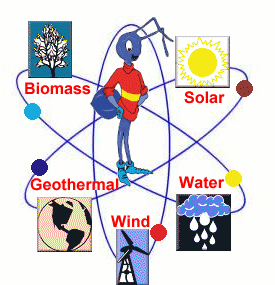 The sun isn’t shining on ‘old energy’ sectors, The Age, March 9, 2015 Michael West Business columnist “.…..Electricity prices have run too high. Renewable energy is rapidly getting cheaper, more efficient, and power companies are desperately trying to lock in customers and stave off the incursion from renewables………
Deutsche Bank released a research report last month which predicted solar energy was well on its way to replacing conventional fuels as the major source of energy in the world, generating $5 trillion in revenue by 2030. That’s $5000 billion.
At the moment, there are 130GW of solar installed; 1 per cent of the $2 trillion annual global electricity market.
By 2050, Deutsche said, solar would have captured 30 per cent of the market.
The rise in renewable efficiency has been spectacular. “Grid parity” is nigh; Continue reading
Liberal and Labor MPs want Canada involved in Royal Commission – (pity about Canada’s nuclear corruption)
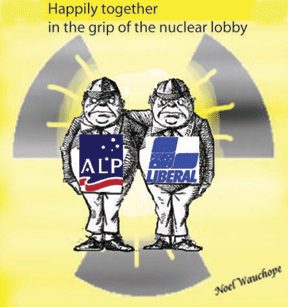 South Australia to tap Canada’s nuclear know-how THE AUSTRALIAN SA Bureau Chief Adelaide MARCH 07, 2015 SOUTH Australian Labor Treasurer Tom Koutsantonis has met Canadian government officials to push for their participation in his state’s royal commission into the nuclear industry.
Michael OwenSOUTH Australian Labor Treasurer Tom Koutsantonis has met Canadian government officials to push for their participation in his state’s royal commission into the nuclear industry.
The news came as federal Liberal MP Rowan Ramsey, whose electorate covers a vast area of South Australia’s remote far north, said he hoped a potential site for a national nuclear dump could be found inthe region, and would consider one on his 2400ha farm……..
Mr Koutsantonis, also the state’s Energy Minister, is a strong proponent of developing a nuclear energy industry in South Australia.
He was in Canada this week for the world’s largest mining convention, the annual Prospectors and Developers Association of Canada International Convention.
He told The Weekend Australian that South Australia’s planned royal commission into nuclear power was a hot topic in meetings at PDAC, held in Toronto with more than 25,000 attendees from 100 countries………
Mr Koutsantonis met senior government officials, in particular those from the provinces of Saskatchewan and Ontario, to talk about the potential of the nuclear fuel cycle in South Australia…….
Mr Koutsantonis said the reaction to Premier Jay Weatherill’s announcement of a royal commission had been “overwhelmingly positive”. He said that federal Trade Minister Andrew Robb, also in Canada promoting Australian mining interests, had reaffirmed the Abbott government’s support for the royal commission.
AUDIO: EU wants USA, China, Australia to join global climate agreement

 AUDIO: EU pressures US and China to join global climate agreement ABC Radio, The World Today ,David Mark reported this story on Thursday, February 26, 2015 ELEANOR HALL: The European Union (EU) has ratcheted up pressure on the United States and China to join a global climate agreement.
Overnight the EU released its target for greenhouse gas reductions ahead of a meeting later this year in Paris.
It’s committing to reducing emissions by at least 40 per cent over 1990 levels by 2030 as David Mark reports.
DAVID MARK: The US and China made some commitments to greenhouse gas reduction targets at the APEC (Asia-Pacific Economic Cooperation) meeting in Brisbane last year.
Now the EU has announced specific targets – its member countries will reduce greenhouse gas emissions by 40 per cent by 2030 over 1990 levels.
Overnight the EU released its target for greenhouse gas reductions ahead of a meeting later this year in Paris. It’s committing to reducing emissions by at least 40 per cent over 1990 levels by 2030 as David Mark reports.
DAVID MARK: The US and China made some commitments to greenhouse gas reduction targets at the APEC (Asia-Pacific Economic Cooperation) meeting in Brisbane last year.
Now the EU has announced specific targets – its member countries will reduce greenhouse gas emissions by 40 per cent by 2030 over 1990 levels……
ERWIN JACKSON: Well, I think the momentum is towards having a core agreement in Paris which is legally binding, which does ensure that countries come forward and have national targets………
Australia sleep-walking into a bad deal with the secretive Trans Pacific Partnership
An Australian National University study of the US-Australia Free Trade Agreement found there was very little in it for Australia. A recent US department of agriculture study found it would deliver a zero economic benefit to Australia and a zero economic benefit to the United States. For smaller nations the economic benefits are bigger which may explain why they are eager to join and why the US is driving a hard bargain on intellectual property and the rights of its pharmaceutical industry
 Trans Pacific Partnership. What’s the deal being negotiated in our name?, SMH, February 21, 2015 Peter Martin When The Lancet and the Australian Medical Journal editorialise against Australia’s next free trade agreement it’s a fair bet they are concerned about more than just trade.
The Trans Pacific Partnership is the biggest free trade agreement hardly anyone’s ever heard of. Bubbling along below the radar for half a decade, it’s about to become solid. It is set to deliver much more money and power to US pharmaceutical companies, to criminalise the use of technology in ways that presently don’t attract jail time and to set up outside tribunals to reconsider decisions already made by Australian courts. Continue reading
Australia’s treaty to sell uranium to India is ‘not fit for ratification’ – pro nuclear experts say
 Australia-India nuclear treaty ‘not fit for ratification Financial Review : 19 FEB 2015 BY GEOFFREY BARKER A parliamentary committee is being urged to reject ratification of the proposed nuclear cooperation treaty with India because it is “bad for our security”. Experts say Australia would be seen as having “caved in” over non-proliferation standards if the ratification of the treaty Australia-India nuclear co-operation proceeds.
Australians unaware of what they will lose with the Trans Pacific Partnership
Australia’s imminent TPP disaster: Crowning corporations, Independent Australia Dr Matthew Mitchell 13 February 2015, The controversial top-secret Trans-Pacific Partnership is due to be signed very soon and is likely to have negative impacts upon many areas of ordinary Australian’s lives without any financial gain whatsoever, writes Dr Matthew Mitchell.

The Trans-Pacific Partnership (TPP) is a global trade agreement being pushed by the United States onto nations around the Pacific. What is so disturbing about the TPP compared with other trade agreements is that it covers so many areas. Its breadth means it will affect many aspects not only of Australian business, but also of everyday Australian life. Continue reading
Top nuclear experts pilloried terms of Australia-India uranium sales plan
Ronald Walker – a former chairman of the global nuclear regulator, the International Atomic Energy Agency – reiterated Mr Carlson’s concerns.
Mr Walker warned the committee that the deal’s terms would injure Australia’s international reputation on nuclear safety.
Nuclear experts put government on notice http://thenewdaily.com.au/news/2015/02/10/nuclear-experts-put-abbott-govt-notice/ Feb 10, 2015 GEORGE LEKAKIS Financial Services Editor A Parliamentary Committee is considering whether to support a criticised uranium pact between Australia and India. Prime Minister Tony Abbott’s quest for a free trade agreement with India has been dealt a potentially fatal blow after two of the world’s most respected nuclear safety experts pilloried the terms of the uranium deal negotiated with the Indian government in 2014. Continue reading
Legal problems may stall Australia- India uranium sales deal
It is not clear whether that agreement will have been finalised before Mr Roy’s committee is due to report its findings to government at the end of March.
The committee is expected to conduct public hearings next month.
India uranium deal faces legal challenge, New Daily, Jan 14, 2015 GEORGE LEKAKIS Financial Services Editor The Australian government’s controversial agreement to sell uranium to India may face a legal challenge from a conservation group. The agreement is controversial because India will be the first country permitted to buy Australian uranium without being a signatory to the Nuclear Non-Proliferation Treaty.
“We will look at those legal options available to us and explore what we think are pretty clear legal inconsistencies between the terms of the agreement with India and Australian laws,” Mr Sweeney said.
“The ACF has real concerns that the wording of the agreement is inconsistent with sections of the Nuclear Non-Proliferation Safeguards Act and Australia’s obligations under the South Pacific Nuclear Free-Zone Treaty that was signed by the Hawke government.” Continue reading
Tony Abbott completely out of touch: China about to launch a national carbon market
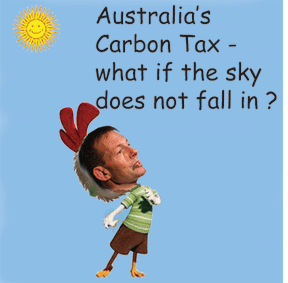 Tony Abbott denies China’s carbon trading plan shows he is out of step, Guardian, ‘More and more countries are going down the direct action path,’ prime minister says of grants aimed at lowering emissions. Oliver Milman @olliemilman 6 February
Tony Abbott has denied that China’s plan to launch a national carbon trading market shows he is out of step internationally on climate change, claiming his Direct Action policy is getting “more and more support” in Australia and abroad.
On Wednesday a Chinese government official said a national carbon market was likely to be launched by the middle of next year, along with an emissions cap for six sectors: power generation, metallurgical, nonferrous metal, building materials, chemicals and aviation………Abbott dismissed the suggestion that China’s actions showed the Coalition decision to dump Australia’s carbon pricing scheme in favour of his Direct Action plan ran against the tide of international efforts to reduce emissions…….
China, by comparison, has launched seven regional carbon markets since 2013, with Qingdao, a city of 9 million people, planning to join the scheme. It’ i estimated the pilot carbon markets cover around a third of China’s overall emissions, although the lack of a unified national system has led to variations in each of the markets.
The plan to introduce a national scheme will unify these regional markets, subject to approval by Chinese state authorities. The national market would eclipse the EU’s emissions trading scheme, which is now the world’s largest.
In September China put its name to a list of 73 countries that signalled support for putting a price on carbon. This list includes Germany, France, Britain, South Africa and New Zealand. It also includes US states such as California and Massachusetts, as well as more than 1,000 businesses.
Australia, which was the first country in the world to repeal a carbon price, is now working out its position on emissions cuts beyond 2020. Crunch UN climate talks in Paris this year will set out a new global deal on lowering emissions, with the aim of avoiding more than 2C of warming compared with pre-industrial times.
Analysis conducted by the CSIRO and Bureau of Meteorology states that Australia could warm by up to 5.1C by 2100 unless action is taken to curb emissions. This level of warming would have major ramifications for agriculture, human health owing to increased heatwaves, and coastal infrastructure owing to rising sea levels and extreme weather events.http://www.theguardian.com/environment/2015/feb/06/tony-abbott-denies-chinas-carbon-trading-plan-shows-he-is-out-of-step
Australian Parliament should scrutinise the unsatisfactory deal on selling uranium to India
India nuclear deal needs serious parliamentary scrutiny, The Interpreter, John Tileman,
Ostensibly about selling uranium to India, the key intent of the treaty is to remove Australia’s implied slight of not according India the same status as a nuclear cooperation partner that we have already accorded the five nuclear weapon states recognised under the Nuclear Non-Proliferation Treaty (NPT).
………JSCOT’s scheduling: it has put aside two hours to hear from four non-government witnesses on 9 February, and 45 minutes to hear government witnesses on 11 February.
……………………. we need a policy discussion that builds on the excellent analyses of the safeguards and legal issues raised in the submissions to JSCOT, especially those of the former head of the Australian Safeguards and Non-proliferation Office, John Carlson, and the ANU arms control expert Kalman Robertson.
A starting point would be for JSCOT to understand how Australian agencies came to the conclusion that there is no risk that providing uranium to India will enhance India’s nuclear weapons arsenal. The National Interest Statement does not make that case.
JSCOT could also seek clarification that the public and confidential provisions of the treaty are or will be consistent with those negotiated by our major partners in the uranium trade. The Government presumably has legal advice that the treaty is compatible with existing obligations. But can it assure industry that challenges will not arise?……….
the questions for JSCOT are numerous: just what priority will be given to this dialogue? What resources will be devoted to it? At what level will it be conducted? When is the next round scheduled? How will outcomes be reported? http://www.lowyinterpreter.org/post/2015/02/03/India-nuclear-deal-needs-serious-parliamentary-scrutiny.aspx?COLLCC=3260990079&
Recalling the Liberal Party’s push for importing foreign nuclear wastes
the previously secret deal followed the Liberal Party’s federal council meeting in June at which it unanimously supported an international waste dump being built in Australia.
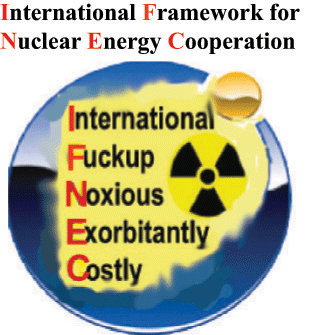 Australia next ‘nuclear dump’ http://www.sbs.com.au/news/article/2007/07/20/australia-next-nuclear-dump The Wilderness Society has warned a deal between Prime Minister John Howard and US President George W Bush to join an exclusive global nuclear club would ensure Australia became the dumping ground for the world’s nuclear waste. Source: 20 JUL 2007 UPDATED 22 AUG 2013
The ministers for foreign affairs and resources had urged Mr Howard to announce the joint nuclear energy plan during the Asia-Pacific Economic Cooperation visit in Sydney in September, Fairfax newspapers reported.
The statement
“The proposed action plan would help to open the way for valuable nuclear energy co-operation with the United States,” the briefing note says.
“It would also be consistent with the government’s strategy for the nuclear industry in Australia. Continue reading
1 This month

of the week – Australians for War Powers Reform (AWPR)
To see nuclear-related stories in greater depth and intensity
 Antinuclear