Paladin’s Malawi uranium mine of little benefit to the country, and now threatening pollution of Lake Malawi
Government officials in Malawi are upset about the situation. “I am very shocked with the situation I have seen after monitoring the mine here and all my questions to the Paladin boss have not been answered satisfactory”
Meanwhile international experts are starting to question the benefits of the Kayelekera mine
 Australian Uranium Mining Company Accused of Contaminating Lake Malawi By Mayu Chang……Global Research, January 29, 2015 CorpWatch Paladin Energy, an Australian mining company, has been accused of discharging uranium-contaminated sludge into Lake Malawi, which supports 1.7 million people in three countries – Malawi, Mozambique and Tanzania. The company began uranium mining operations in Malawi in 2009 although it suspended operations last year after ore prices fell.
“It is rumored that Paladin secretly have started discharging the so called purified water. Reports from the Beach Village Chairman indicates that this started in late November,” wrote Rafiq Hajat of Malawi’s Institute for Policy Interaction on Facebook. “[At] a radius of 35 km from the Boma, you will be shocked to see fish of different species dead with some communities along the lakeshore collecting [the fish].”……………“Uranium is radioactive and that with open-pit mining, like the one to be conducted at Kayelekera, the soil drains into rivers and contaminates the water,” Titus Mvalo, a lawyer representing several civil society organizations in Malawi, told Inter Press Service in 2007. “When humans drink the water, it damages kidneys and causes cancer.”
At the time, the activist groups warned that the mine would pose a threat to Lake Malawi, Africa’s third largest freshwater lake, which is a major source of drinking water and fish for the country. Continue reading
No real safeguards against India using Australian uranium for nuclear weapons
India will share the Indo-US formula on resolving the nuclear liability issue with France to resolve the issue of liability with the latter as well, sources said — this has come in the way of nuclear commerce with Areva, the French nuclear supplier.
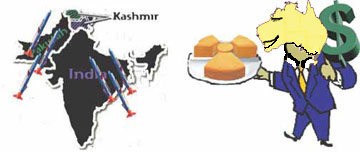 With Australia, the sources said, India will share the template of its administrative arrangements with Canada — and now the US — so that uranium from Australia can be supplied without further delay. India signed an uranium supply agreement with Australia last September, when Prime Minister Tony Abbott visited the country.
……….The US is said to be no longer insisting on tracking these supplies, required under its rules to ensure it is not being used for military purposes. -……http://indianexpress.com/article/india/india-others/india-looks-to-use-us-formula-to-convince-france-and-australia/
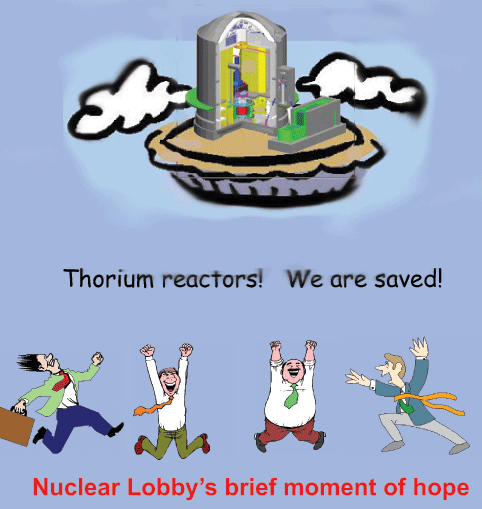
Australian government funding research in China into dodgy thorium nuclear reactors
 Isn’t this just dandy? The Australian government can’t afford to fund services to the needy in health, education, and is doing its darndest to kill clean energy, but is quietly promoting nuclear energy. And not conventional nuclear energy, which is bad enough, but the untested, hugely costly thorium experiment – the same one that was tried and found unviable 50 years ago
 ANSTO-SINAP Joint Research Centre, 16 Jan 15 In December 2012, ANSTO signed a memorandum of understanding with the Shanghai Institute of Applied Physics (SINAP) for cooperation in the area of materials research and development.
Pope Francis takes a leadership role for global action on Climate Change
 he has been invited by Ban Ki-moon, Secretary General of the United Nations, to address the general assembly of the UN on the issue.
The impact of this on Australian politics is hard to predict. A number of senior Coalition ministers are Catholic, yet their climate credentials are less than impressive. Tony Abbott’s claim that coal is “good for humanity” is the antithesis of the likely papal message. Now his opponents will be able to quote chapter and verse of a papal encyclical calling his policies into question.
Climate-change encyclical may lay ground for UN progress http://www. canberratimes.com.au/comment/climatechange-encyclical-may-lay-ground-for-un-progress-20150113-12n3u2.html January 14, 2015 Neil Ormerod This is the year the Catholic Church will join the battle to save the planet; as Bishop Marcelo Sánchez Sorondo, chancellor of the Pontifical Academy of Sciences, stated, “2015 could be a decisive year in history”.
From the start of his pontificate Pope Francis indicated his intention to publish an encyclical on the environment. Encyclicals are the most authoritative documents a pope can issue, and it has become increasingly clear that global warming will be its central theme.
Previous popes – both John Paul II and Benedict XVI – referred to the environment and climate change in various communications, and committed the Vatican City to being carbon neutral, but this will be the first time a pope will have dedicated an entire encyclical to it. Continue reading
Toro Uranium company’s Vanessa Guthrie appointed by Abbot to represent Australia in India n top business group
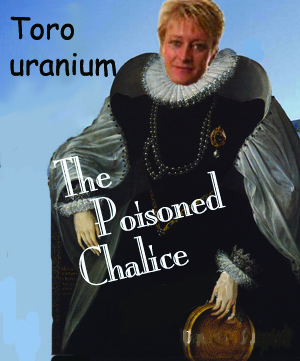 Toro Energy CEO chosen to represent Australia in India, Australian Mining 12 January, 2015 Vicky Validakis Prime Minister Tony Abbott has appointed the head of uranium developer Toro Energy to the Australia-India CEO forum.
The CEO Forum is a high level business group jointly appointed by Abbott and the Indian Prime Minister, Shri Narendra Modi, to help drive the bilateral economic relationship between Australia and India.
The forum will be made up of 10-15 business leaders who will provide advice to both Prime Ministers on issues of trade, investment and economic development.
It comes after Abbott signalled he was keen to secure a free trade agreement with India this year.
CEO of Toro Energy Vanessa Guthrie said she was “honoured” to accept the appointment……..Guthrie will join Trade and Investment Minister Andrew Robb in India this week to attend the Australia Business Week in India, an event which promotes Australian opportunities to increase trade and investment markets with the country.
The Ugly Australian, Paladin, has another radioactive spill at its Malawi uranium mine
Uranium miner announces spill, Australian Miner, 8 January, 2015 Vicky Validakis Just days after uranium miner Paladin Energy denied it discharged polluted water into a river, the company announced a tank failure at its Kayelekera mine has resulted in a spill.
Paladin told the ASX a 20-minnute high-intensity storm resulted in around 25mm of rain falling at the mine site, located in northern Malawi.
As a result, a surge of stormwater caused the liner in the plant run-off tank to rupture, releasing 500 cubic metres of material to the bunded areas of the site, the company said.
Up to 50 litres of the material “overtopped” one of the containment bunds………..
On Monday Paladin denied claims it released toxic water from the mine into a local river system………
Kayelekera mine has been in care and maintenance since February 2014 due to the depressed price of uranium.http://www.miningaustralia.com.au/news/uranium-miner-announces-spill
Australian companies uranium miner Paladin, and OceanaGold will be forced to come clean on tax matters
 Canada transparency laws force ASX companies to disclose tax bills, The Age December 26, 2014 Georgia Wilkins Business reporter Two Australian mining companies will be forced to disclose how much tax they pay in every country around the world by new transparency laws introduced in Canada.
Paladin Energy and OceanaGold, both dual-listed in Australia and Canada, will have to comply with new Canadian laws requiring all oil, gas and mining companies to report payments they make to governments overseas, including taxes, royalties, bonuses, regulatory charges and licence fees.
The Australian government is being pushed to introduce similar rules. Continue reading
The Ugly Australian: Paladin uranium miner discharging radioactive sludge into Lake Malawi?
The lake provides water for drinking and domestic use to millions of Malawians. Part of the lake is protected as a national park, and it is inhabited by more than 850 cichlid fish species found nowhere else on Earth.
Malawi: Paladin Accused of Discharging Uranium-Contaminated Sludge in Lake Malawi http://allafrica.com/stories/201412301012.html A coalition of Malawi civil society organisations (CSOs) has accused Paladin Energy Ltd, a company that is mining Uranium ore at Kayerekera in the northern district of Karonga over reports the mining company is secretly discharging into Lake Malawi uranium contaminated sludge from the tailings dam at the mining site.
Renowned human rights activist, Rafiq Hajat shared a report compiled by a members of the Natural Resources Justice Network (NRJN) in which it is alleged paladin is discharging uranium sludge from Kayerekera into Lake Malawi.
“A radius of 35 km from the Boma, you will be shocked to see fish of different species dead with some communities along the lakeshore collecting [the fish]. Collectiong as part of their relish. The cause not yet known. Reports from the Beach Village Chairman indicates that this started in late November but Government was not forth coming (sich)” reads part of the post. Continue reading
PM Tony Abbott close to signing the secretive Trans Pacific Partnership
 Will Tony Abbott to stand up for Australia on the TPP? http://action.sumofus.org/a/australia-tpp/2/2/ Abbott’s government has confirmed they’re getting ready to crack down on internet freedom to comply with the TPP — including a “three strikes” provision that forces ISPs to monitor and police our activity online.
Tony Abbott’s trade minister is about to sign a secret, global pact to allow corporations to sue the Australian government for billions — just for passing laws to protect our health or the environment.
Tony Abbott wants us to believe the 12-country Trans-Pacific Partnership (TPP) is all about getting a better deal for ordinary Australians. But the truth is that it could end up being one of the biggest corporate power grabs in a generation.
Abbott and his cronies are refusing to make the deal public (although corporate lobbyists seem to be getting the inside track) — making it hard to know just what’s in the TPP. But leaks so far indicate this is bad news. That’s why Tony Abbott wants it to stay confidential — he’d prefer to quietly sign away our rights without a big fuss.
This deal is too important to leave to the politicians: it could affect the lives of Australians for generations to come. Continue reading
Zambia’s Green Party strongly opposing Australian uranium mining project
the uranium mining issue a symptom of an extremely serious malaise affecting Zambia.
ZEMA and Zambia are woefully unqualified to deal with the environmental effects of the proposed uranium mining upstream of the Park and the management of the radiation and its very serious genetic impacts on people.
The Green Party of Zambia and the Lower Zambezi National Park Preserving the Zambezi ecosystem Ian Manning 16 Dec 14,The leader of the Green Party of Zambia, Peter Sinkamba, has set out their platform for the Presidential elections of 20 January 2015: to cancel the mining licence issued to Australia’s Zambezi Resources Limited for the Lower Zambezi National Park. Reading this, the electorate will wonder what could possibly be so important about the proposed mining of a National Park. And why do the Greens consider it the single most important issue facing Zambia today?
Ukrainian President revs up cold war talk: Russia warns of doubtful security of Ukraine’s nuclear industry
Ukrainian President Petro Poroshenko warns new Cold War is looming The Age December 12, 2014 – David Wroe National security correspondent Visiting Ukrainian President Petro Poroshenko has warned Europe is sliding towards a new Cold War and urged the world to stand up to Russia for the sake of global law and order.
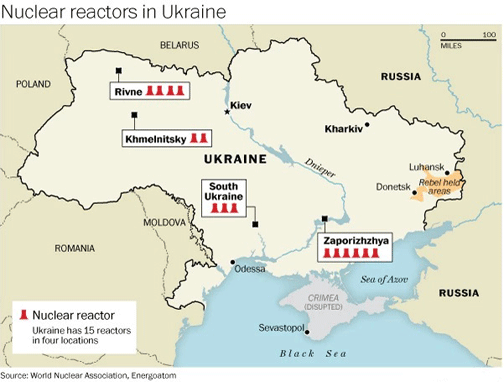
Speaking in Sydney during a three-day tour as part of closer relations with Prime Minister Tony Abbott in the wake of the MH17 disaster, Mr Poroshenko also vowed that any Australian uranium sold to his country under a possible deal would be safely used.
But Russia – whose dominance of energy exports to Ukraine would be undermined by any deal between Canberra and Kiev – has already raised doubts about the prospect of Australian uranium sales, which Mr Abbott and Mr Poroshenko flagged on Thursday.
A spokesman for Moscow’s embassy in Canberra branded talk of a uranium deal a “political statement” and warned that given the conflict in eastern Ukraine, nuclear material could “fall into the wrong hands” – though Kiev’s adversaries in the conflict are rebels backed by Russia itself……….
Russian embassy spokesman Alexander Odoevskiy said Australia should bear in mind that eastern Ukraine was “a conflict zone”.
“Given Ukraine’s current geopolitical situation, can it provide enough security for this nuclear industry and safeguards so [uranium] doesn’t fall into the wrong hands? I’m not sure about whether the government institutions in Ukraine are capable of providing these stringent controls.”http://www.theage.com.au/federal-politics/political-news/ukrainian-president-petro-poroshenko-warns-new-cold-war-is-looming-20141212-12636m.html
Is it a good idea to sell uranium to conflict zone Ukraine, with its ongoing Chernobyl pollution?
PM talks uranium sales to Ukraine THE AUSTRALIAN AAP DECEMBER 11, 2014 AUSTRALIA is considering selling uranium to Ukraine, home to the world’s worst nuclear disaster.

UKRAINIAN President Petro Poroshenko raised his country’s energy security needs with Prime Minister Tony Abbott when the pair met in Melbourne on Thursday for talks focused on the MH17 disaster.
- “There is the possibility for Ukraine to buy Australian uranium for our nuclear power stations,” he told reporters.Energy security is a vital issue for Ukraine, which relies heavily on its hostile neighbour Russia for gas and has difficult shoring up supplies of uranium and coal.Mr Abbott said Australia was an energy superpower and wanted to help Ukraine address its vulnerabilities…….
Any uranium sales to Ukraine will prove controversial given the legacy of the 1986 explosion at the Chernobyl nuclear power plant, about 100km from the capital Kiev.It remains the worst nuclear accident in terms of lives and cost in history………http://www.theaustralian.com.au/news/latest-news/ukraine-australia-hold-nuclear-talks/story-fn3dxiwe-1227152259883
Audio: Abbott cuts foreign aid, again, transfers money to UN climate fund
 AUDIO: Green fund contribution comes at expense of aid budget ABC Radio PM David Mark reported this story on Wednesday, December 10, 2014 1 MARK COLVIN: There’s been a tentative welcome for the Australian Government’s announcement that it would contribute $200 million to the UN’s climate fund.
The catch is that the money will come from Australia’s international aid budget.
The announcement by the Foreign Minister, Julie Bishop, in Lima came on the same day that a coalition of aid groups implored the Federal Government not to cut the aid budget any more.
Australia’s foreign aid budget has already been cut by $7 billion over the next five years and the fear is there could be more to come in the mini-budget.
David Mark reports. DAVID MARK: They came together in Melbourne to demand the Federal Government stop cutting foreign aid. A mass meeting of businessmen and women, the chairmen and CEO’s of Australia’s major aid organisations.
And one by the likes of Gerry Hueston, the former president of BP Australia and chairman of Plan Australia, George Savvides, the CEO of Medibank Private and chairman of World Vision Australia and Simon McKeon, the former Australian of the year, chairman of AMP and chairman of Global Poverty Australia, spoke out.
GERRY HUESTON: As someone who’s worked internationally all my life, I find it inconceivable that one of the richest countries in the world can’t do at least its bit in foreign aid, you know, when you’re supporting some of the poorest people in the world.
GEORGE SAVVIDES: The Australian aid budget has already been cut twice, it already has contributed well above its weight in terms of a fiscal responsibilities in front of us and also in terms of the consideration by government. But really its purpose isn’t to save dollars, its purpose is to save lives.
SIMON MCKEON: These are times to be very careful about what we spend and what we don’t spend, but I’ve got to say as an Australian I am struggling at the moment with the possibility that the aid cuts that were announced earlier this year may well be further cut in the New Year……..http://www.abc.net.au/pm/content/2014/s4146238.htm
Tough scrutiny now needed on uranium deal between Australia and India
Doubts over uranium deal between Australia and India, The Age December 9, 2014 Daniel Flitton The treaty to sell uranium to India will face tough scrutiny after the former chief atomic watchdog warned the deal lacked safeguards to ensure Australia did not inadvertently fuel India’s nuclear bombs.
The treaties committee of Parliament must endorse the deal, signed by Prime Minister Tony Abbott in September, before uranium exports can start.
But John Carlson, the former chief of Australia’s nuclear safeguards organisation, has told the committee India’s nuclear weapons program is expanding and has complex links to civilian reactors.
The warning is likely to rattle Labor’s lukewarm support for sales, the party having opposed uranium exports to India initially and scotched a Howard-era proposal……….
In a detailed submission to the committee, Mr Carlson said that under the proposed deal Australia could not definitively track uranium used in India’s nuclear program and what happened subsequently to fuel reprocessed into plutonium.
Nor would Australia have the right to demand the return of uranium should the agreement be breached, as it can with 41 other countries covered by similar export deals.
India is estimated to have between 90 and 110 nuclear weapons and has refused to sign international disarmament treaties. Several Indian nuclear reactors are designated “dual use” for civilian energy and military needs.
The deal would not be the first on uranium to run afoul of the treaties committee, with the Russia deal held up almost two years over concerns that yellowcake could be diverted into nuclear weapons.
Labor MP Kelvin Thomson said the committee had received detailed submissions expressing concern not so much at the idea of supplying uranium to India but about the provisions of the agreement……..
several other submissions, including one from Ron Walker, a former governor of the International Atomic Energy Agency, expressed concern.
The committee is expected to hold public hearings before reporting in February or March.
Labor foreign affairs spokeswoman Tanya Plibersek said last month that any exports to India must be with the highest possible level of safeguards.
Mr Carlson was in charge of the Australian Safeguards and Non-Proliferation Office for more than 20 years until 2010 and was criticised during that time by anti-nuclear campaigners for facilitating uranium exports.
He said there were good reasons for concluding a nuclear co-operation agreement with India, “but not this agreement”……..http://www.theage.com.au/federal-politics/political-news/doubts-over-uranium-deal-between-australia-and-india-20141208-121zoi.html
Australia pushed to nuclear deal with India, by USA strategic interests – Wikileaks reveals
WikiLeaks shows US push behind Australia-India nuke deal, Green Left November 30, 2014By Linda Pearson A deal to sell Australian uranium to India has been signed, despite opposition from most people in Australia.
In September, Prime Minister Tony Abbott signed an agreement which will allow sales of Australian uranium to India for the first time.
India has consistently refused to sign the Nuclear Non-Proliferation Treaty (NPT) and has manufactured up to 110 nuclear warheads, but has been given a free pass to take part in international nuclear trade by virtue of its new strategic relationship with the United States.
The Australia-India deal conflicts with Australia’s obligations under the South Pacific Nuclear Weapons Free Zone Treaty, as well as the NPT.
As Greens Senator Scott Ludlam said in September: “Australia will now be directly complicit in a nuclear arms race in South Asia, with India moving to lock in foreign uranium supplies for power generation so it can preserve its domestic uranium for weapons production.”
The deal is the culmination of a bipartisan shift in policy that began under the Howard government, stalled during the Rudd years, and was completed by the Gillard government in 2011.
As US diplomatic cables published by WikiLeaks illustrate, this shift took place despite most people in Australiaopposing uranium sales to India. It was pushed by governments bending to US interests.
New strategic partnership
In the three decades after India’s first successful nuclear test in 1974, relations between the US and India were cool. By the early 2000s, however, US policy-makers looking to maintain US dominance in Asia came to view India as a potential counterweight to China.
In January 2004, President Bush and India’s Prime Minister Bihari Vajpayee announced they had signed what would become known as the Next Steps in Strategic Partnership (NSSP) agreement.
Under the NSSP, the US and India pledged to take a series of reciprocal steps towards greater co-operation on civilian nuclear activities, space programs and high-technology trade.
The NSSP was hailed as a milestone in US-India relations. However, strong opposition within India threatened to derail the agreement.
When it became clear that a dramatic change in nuclear policy would be needed to win Indian support for the new strategic relationship, the US obliged. So did Australia……..https://www.greenleft.org.au/node/57915
1 This month

of the week – Australians for War Powers Reform (AWPR)
To see nuclear-related stories in greater depth and intensity
 Antinuclear