Tony Abbott does not have the international clout to keep Climate Change off G20
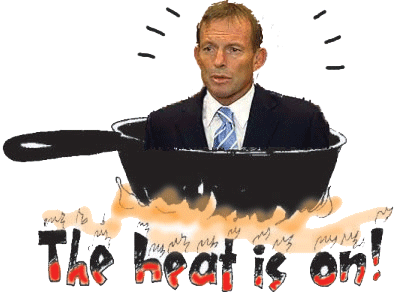 Australian opposition ‘unlikely’ to keep climate off G20 agenda RTCC 20 August 2014, Australia lacks gravitas to cast off climate talk, with US and China likely to put pressure on Tony Abbott By Sophie Yeo
Climate change is likely to be discussed at the G20 summit in Brisbane, despite Australia’s decision to leave it off the agenda. This is the finding of a new report, released this week by the centre-right think-tank Committee for Economic Development in Australia (CEDA).
Australia lacks the diplomatic weight to dismiss the issue while heavyweights such as China and the US are ramping up their own efforts to combat carbon pollution, say the authors.
“As a middle-power economy, Australia’s leadership and influence may be limited,” writes Sarah-Jane Derby, senior economist at CEDA, in the report.
“For example, members may be receptive to Australia introducing new ideas and changing the agenda, but without the support of players who are more powerful, these ideas may not be taken seriously.”
Climate criticism
Australia prime minister Tony Abbott has faced heavy criticism from environmentalists over his decision to axe many of the country’s flagship climate policies, such as the tax on carbon.
Reports from Australia suggest he knocked climate change off the G20 agenda as it did not fit with the summit’s focus on economic growth……. This year’s G20 takes place two weeks before a major UN summit on climate change takes place in the Peruvian capital, Lima.
The UN meets annually to work towards a solution on climate change, but the G20 provides opportunities for “open discussions” between the world’s major economic players that are not possible during international meetings, says the report.
It adds that the tight economic focus of the Brisbane summit could add value to climate change discussions, by considering the financial risks and consequences of heating the planet……
In June, the US ambassador to Australia said that Obama planned on raising climate change during the leaders’ summit and at “every international forum”, as it was a critical issue “not only to Americans but to the world”. – See more at: http://www.rtcc.org/2014/08/20/australian-opposition-unlikely-to-keep-climate-off-g20-agenda/#sthash.Gl6EU0Jf.dpuf
Australian uranium sales to India could breach international obligations
 19 Aug 14 News that Australian officials have concluded a deal to sell uranium to India raises concerns the federal government may have violated its international nuclear non-proliferation obligations, the Australian Conservation Foundation said today.
“India’s nuclear industry has many continuing and unresolved safety and security problems,” said ACF’s nuclear free campaigner Dave Sweeney.
“In 2012 the Indian Auditor General released a damning report warning of ‘a Fukushima or Chernobyl-like disaster if the nuclear safety issue is not addressed’.
“ACF is concerned a uranium export deal with India would violate the 1995 nuclear non-proliferation (NPT) Review and Extension Conference commitment to require full-scope safeguards as a condition of supply, and Article IV of the Treaty of Rarotonga – the South Pacific Nuclear Weapons Free Zone Treaty – which obliges signatories to not supply equipment or material to countries not under full scope safeguards. India is not under full scope safeguards.”
The former head of the national security advisory board in India, K. Subrahmanyam, said in 2005: ‘Given India’s uranium ore crunch and the need to build up our … nuclear deterrent arsenal as fast as possible, it is to India’s advantage to categorise as many power reactors as possible as civilian ones to be refuelled by imported uranium and conserve our native uranium fuel for weapons-grade plutonium production’.
“Clearly, Australian uranium would boost India’s nuclear weapons capacity,” Dave Sweeney said.
“Australian uranium in India will free up India’s uranium stockpiles to be used in its nuclear weapons program.
“Australian uranium is definitely fuelling radioactive waste and risk. It is also potentially fuelling the spread of nuclear weapons. Neither is desirable or acceptable.
“Before PM Tony Abbott inks a deal with New Delhi, the federal government must show that any bilateral agreement requires India to take measureable disarmament actions and does not breach international agreements to which Australia is a party.” For context and comment contact: Dave Sweeney, 0408 317 812
Solar employs, Nuclear destroys: still time to halt India uranium deal
Scott Ludlam Greens spokesperson for Nuclear Senator for WA S August 18, 2014 Australia will be directly complicit in fuelling the nuclear arms-race between India and Pakistan if reports are confirmed that a uranium deal with India is on the cards.
Prime Minister Abbott seems set to continue his high-profile series of international gaffes, missteps and humiliations, this one for the sole benefit of the mortally wounded uranium sector.
India’s scandal-prone nuclear industry has been plagued with accidents and near-misses at reactor sites; events including fires, floods, partial reactor collapses and more recently the construction of two Russian-designed plants in the tsunami-zone in the south of Tamil Nadu.
- Subrahmanyam, former head of the National Security Advisory Board in India, said: ‘it is to India’s advantage to categorise as many power reactors as possible as civilian ones to be refuelled by imported uranium and conserve our native uranium fuel for weapons-grade plutonium production’.
India first produced weapons-grade plutonium from a Canadian-supplied reactor it pledged to use only for ‘peaceful purposes’. Instead of fuelling this arms race, Australian industry should be partnering with India’s vibrant solar sector
Australia is declared a military threat, by China

 China Declares Australia a Military Threat Over US Pact http://www.therealnewsmatters.com/2014/08/china-declares-australia-military.html By Joshua Philipp, Epoch Times , 17 Aug 14 China’s state-run media have declared Australia a threat to its national security, after Australia finalized a 25-year military pact with the United States.
The United States currently has 1,200 troops from the Marine Corps and Air Force training with Australian troops for humanitarian and disaster relief. The defense agreement will increase the number of U.S. troops at Darwin in northern Australia to 2,500.
The Chinese regime is none too pleased about the agreement, however.
Li Jie, rear admiral of China’s People’s Liberation Army Navy, told Want China Times that Australia could pressure China’s supply lines in the Strait of Malacca in a conflict over the South China Sea.
“Australia is therefore likely to become a threat to China’s national security,” it states.
Global Times reported that if a war broke out between China and Vietnam or the Philippines, the United States could deploy submarines and aircraft from Australia….
http://www.theepochtimes.com/n3/877760-china-declares-australia-a-military-threat-over-u-s-pact/
Economic cost to Australia of imposing sanctions on Russia
Imposing sanctions on Russia will result in economic heartache for Australia, former ambassador warns ABC News 10 Aug 14 A former Australian ambassador to Moscow and Ukraine says imposing sanctions on Russia will only result in economic heartache for Australia.
The Government has signalled it might apply tougher sanctions against Moscow over the Malaysia Airlines flight MH17 plane tragedy and Russia’s decision to ban food imports from Australia.
Foreign Minister Julie Bishop has threatened banning the sale of uranium to Russia if troops crossed into Ukraine.
But former Australian ambassador to Russia and Ukraine, Cavan Hogue, says it is not constructive for Australia to be entering into a tit-for-tat trade ban with Russia.
“What’s in it for us? It’s essentially a European problem. We seem to be doing it because we want to go along with Europe and North America,” he said.
“So I think we would have probably been better served by just keeping our big mouths shut…………
Russia’s defence ministry overnight said it had finished military exercises in southern Russia which the United States had criticised as a “provocative” step amid the Ukraine crisis. http://www.abc.net.au/news/2014-08-09/former-ambassador-moscow-ukraine-warns-against-russian-sanctions/5659946
Abbott and Bishop bullying the “bully” Putin?
 Russia told ban on sale of uranium, heavier sanctions are ‘on the table’, SMH August 9, 2014 Lakita Bourke Australia has urged President Vladimir Putin against crossing into Ukraine under the guise of a “humanitarian mission”, with Foreign Minister Julie Bishop warning further sanctions could involve bans on the sale of uranium.
As Prime Minister Tony Abbott labelled Russia a bully and warned Moscow not to interfere in Ukraine’s internal affairs, Ms Bishop said Australia had found a new status in world affairs, had proved itself capable of shifting global opinions and of influencing events in the national interest… http://www.smh.com.au/federal-politics/political-news/russia-told-ban-on-sale-of-uranium-heavier-sanctions-are-on-the-table-20140808-3de5t.html#ixzz39vz8Gngx
Uranium sanctions on Russia? Julie Bishop informs Putin on how to be a world leader
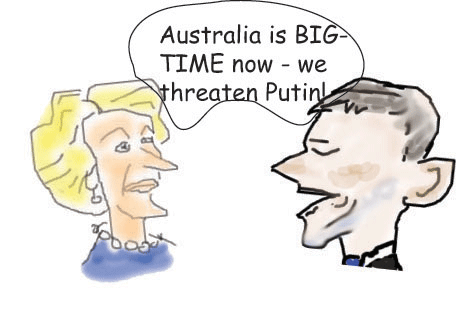 Uranium sanctions next, Julie Bishop warns Russia, as part of ‘broader, deeper’ response over MH17, SMH August 8, 2014 Latika Bourke
National political reporter Further Russian intervention in Ukraine would invite Australian sanctions including on the sale of uranium says Foreign Minister Julie Bishop who has declared “everything’s on the table” if Moscow fails to accept responsibility for downed Malaysia Airlines flight MH17.
Ms Bishop’s stern warning came as Prime Minister Tony Abbott, speaking in Sydney on Friday afternoon, called on Russia to hold back its forces, currently massing on the Ukraine border. He said any crossing would constitute an “invasion”.
“I want to say very clearly that we are working towards stronger sanctions,” he said.
“I say to President Putin, if he wants to be regarded as a world leader, as opposed to becoming an international outcast: hold your forces back. Stay behind the border, let the business of Ukraine be sorted out by Ukranians.”…….If Russia does seek to intervene in Ukraine, there would be consequences” Ms Bishop warned……..Russia announced its own retaliatory sanctions on Australia and other Western nations overnight, which include banning foodstuffs, including meat, fruit and vegetables.
Ms Bishop played down their impact on the Australian economy and said it was more “petulance” from Russia, which has refused to accept responsibility for MH17. http://www.smh.com.au/federal-politics/political-news/uranium-sanctions-next-julie-bishop-warns-russia-as-part-of-broader-deeper-response-over-mh17-20140808-3ddf2.html#ixzz39vw7gvb6
Australia’s farming export sector will suffer from sanctions against Russia
Sanctions are good – tell that to Australian farmers iT Wire 8 Aug 14, Australia has two major export sectors and technology is not one of them. Aside from mining, food accounts for about $30 billion of this country’s national exports. Now, thanks to our good friends in Washington and our insipidly compliant lapdog Government we’ve just lost a reliable $500 million customer and moved a step closer to a senseless war. Following on from my previous article about MH17, the downed Malaysian airliner over Ukraine, after showing remarkable restraint in the face of a series of increasingly humiliating and totally unjust sanctions, Russia has finally responded with sanctions of its own. The difference is that Russia’s sanctions actually mean something. They hit us where it hurts – in the bread basket……..
In the coming year, Australian food producers would have been on track to sell a potential $500 million of produce to Russia. Particularly hard hit will be the dairy industry, which will now be forced to wipe about $100 million off its previously projected $575 million of exports. Russia was one of the Australian dairy industry’s shining star growth markets and this will be a big and needless hit.
While mining and resources have received all the glory in recent years for Australia’s recent and unprecedented lengthy economic boom, our food export business has been a relatively quiet achiever in contributing to this country’s continuing prosperity. Australian produce is second to none in its quality and purity. There are no GMO vegetables and fruit grown in Australia. Our dairy products are pure and radiation free, unlike those in Europe. Our grains are also largely GMO free and our meat produce is also generally high quality. …….http://www.itwire.com/opinion-and-analysis/beerfiles/65017-sanctions-are-good-%E2%80%93-tell-that-to-australian-farmers
With current Ukraine crisis should Australia be selling uranium to Russia?
 Should we be selling uranium still to Russia?, Independent Australia Dave Sweeney 4 August 2014, Australia’s treaty watchdog refused to endorse the treaty to sell uranium to Russia due to security issues. Dave Sweeney, theAustralian Conservation Foundation’s nuclear-free campaigner, calls for the treaty to be reviewed in the aftermath of the MH17 tragedy. IT IS appropriate that Australia takes strong action to send a clear message to Moscow in the aftermath of the MH17 tragedy. Not welcoming Russian president Vladimir Putin to the G20 summit in November would be one step.
Immediately halting Australian uranium sales would be another.
Uranium is a dual use fuel. It provides the power fuel for nuclear reactors and the bomb fuel for nuclear weapons — and the distinction between the two sectors is more one of political convenience than practical effect……….
In 2007 and again in 2008, Russia threatened Poland with nuclear strikes from missiles it would base at its enclave of Kaliningrad following Polish approval for U.S. missile defence bases in Poland. Today, as clashes continue along the Ukrainian border, we can be sure Moscow’s missiles are on high alert………
JSCOT, to its considerable credit, recommended a mix of caution and action in relation to Australian uranium sales to Russia. It called for any sales to be linked to Russian compliance with a set of essential pre-conditions including a detailed analysis of Russia’s nuclear non-proliferation status; the complete separation of Russia’s civil and military nuclear sectors; reductions in industry secrecy; independent safety and security assessments of Russian nuclear facilities; and action on nuclear theft and smuggling concerns.
None of these have been realised and as the crackdown on EcoProtection! shows, the Russian nuclear sector is becoming even less transparent. Continue reading
Transport of toxic chemical and radioactive wastes – France says NO to Orica
 For a long time, I’ve been posting away about radioactive waste, as if it were the only pollution problem. But of course it’s not. Indeed the same stupid white males who brought us radioactive wastes also bring us chemical wastes – in a sort of mindless onslaught on the very ecosystem we need for our survival.
I thought it ironic that France is now refusing to accept toxic chemical wastes from Australia.
Meanwhile a few very greedy business individuals, and a few not very bright worthies like Bob Hawke, Martin Ferguson, Alexander Downer – are advocating that Australia import radioactive wastes from France and everybody else.
The French have woken up now to the danger and diseconomics of nuclear power, and they’ve also woken up to the dangers of transporting chemical wastes. These wastes are best stored near the point of origin. The same goes for radioactive wastes.
Fortunately, most Australians reject the idea of importing radioactive wastes. The Abbott government and the Labor opposition are forced by public opinion to pretend that they oppose this too. However, under the power of their corporate funders, both parties would be ever so amenable to a business idea like that – anything to get corporate and media support to be in office.
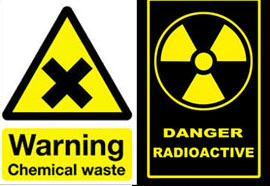 French reject Orica’s toxic waste, SMH July 27, 2014 Natalie O’Brien More than 100 tonnes of highly toxic waste will have to remain at Botany after the French government vetoed plans by chemical giant Orica to ship it from Sydney to France for incineration.
Environmentalists across the world have applauded the decision after angry protests during the Tour de France bicycle race and a petition with 23,746 signatures was collected calling for the shipment to be stopped.
French Ecology Minister Segolene Royal said she would not back the plan to send the Hexachlorobenzene (HCB) waste to an area in south-east France because of fears something could go wrong to the ship which could cause marine pollution.
“The transport of dangerous waste … is an environmental aberration,” she was reported as saying.
She also said such waste “should be treated near their source of production”. ……..
It is Orica’s third attempt to ship the HCB, a carcinogenic pollutant banned in Europe since 1981, from Botany to an overseas destination for incineration. Protests stopped its planned export in 2007 to Germany and in 2010 to Denmark. Experts have said that the longer it remains at Botany the more waste is generated because it has to be repackaged every four years to keep it secure.
Objections had also been made to the Australian government from numerous lobby groups including Doctors for the Environment Australia, Friends of the Earth, the Nature Conservation Council, The National Toxics Network, Greenpeace Australia, International POPs Elimination Network, and the Basel Action Network (the Global Alliance for Incineration Alternatives).
Dr Mariann LLoyd-Smith from the National Toxics Network, said they shared Ms Royal’s concerns about transporting such a large amount of toxic waste by sea to France and they were also concerned about the repeated engineering failures and toxic emissions of the intended French incinerator.
“Now as a matter of urgency, we need to bring all the parties together and decide on a suitable non-combustion destruction technology not only for Orica’s HCB wastes but also to address current and future toxic waste,” she said.
“We then need to start the process to allow the Australian community to select an appropriate site where we can deal with our own hazardous waste in an environmentally sound way in line with Australia’s international obligations.” : http://www.smh.com.au/environment/french-reject-oricas-toxic-waste-20140725-zwd3k.html#ixzz38oF7vOkW
World criticism of Australia repealing the carbon tax
Australia’s carbon tax abolition draws international criticism Oliver Milman Guardian, 18 July 14 Al Gore calls it a ‘disappointing step’ and European Union says world is moving towards carbon pricing initiatives Australia’s repeal of the carbon price has provoked a largely negative reaction overseas, with former US vice president Al Gore calling it a “disappointing step”.
Gore said Thursday’s abolition of the mechanism means that “Australia is falling behind other major industrialised nations in the growing global effort to reduce carbon emissions and ensure a clean and prosperous future”.
“[It is] a disappointing step for a country that continues to experience the worsening consequences of the climate crisis.”
Gore, who appeared alongside Clive Palmer in a bizarre press conference in June to iterate the Palmer United party’s position on the carbon price, said be was encouraged by the support for the Renewable Energy Target, the Clean Energy Finance Corporation, the Australian Renewable Energy Agency and the Climate Change Authority.
“These programs are examples of Australia’s long and continued excellence in combating the climate crisis, and must continue,” Gore said. He added that he was “hopeful” that Australia would adopt an emissions trading scheme (ETS), as advanced by Labor and, in a radically watered down form, by Palmer.
Connie Hedegaard, the European Union’s climate commissioner, also voiced disappointment at the carbon price repeal.
“The European Union regrets the repeal of Australia’s carbon pricing mechanism just as new carbon pricing initiatives are emerging all around the world,” she said.
“The EU is convinced that pricing carbon is not only the most cost-effective way to reduce emissions, but also the tool to make the economic paradigm shift the world needs.
“This is why the EU will continue to work towards global carbon pricing with all international partners.”
The European Union has had an emissions trading scheme in place since 2005. The scheme, which covers around 45% of total greenhouse emissions from the 28 EU countries, was due to be linked to Australia’s own emissions trading scheme, but this will now not happen………http://www.theguardian.com/environment/2014/jul/18/australia-carbon-tax-abolition-international-criticism
Conservative British Lord Deben attacks Tony Abbott’s ‘reckless’ climate policies
Carbon tax repeal: UK politician Lord Deben attacks Tony Abbott’s ‘reckless’ plan to scrap carbon tax, ABC Lateline 9 July 14 One of the UK’s leading Tory politicians has attacked Tony Abbott’s plan to scrap the carbon tax, accusing the Prime Minister of “recklessly endangering” the future of the world…….the unlikely voice of Lord Deben, who remains Britain’s longest serving environment minister. Lord Deben, a former head of the Conservative Party who served under Margaret Thatcher and John Major, is now the head of the UK Committee on Climate Change.
He has issued a statement saying the Abbott Government “appears to be more concerned with advancing its own short-term political interests” than dealing with global warming……..Australia is changing Britain’s climate as we are changing yours. It is not just a national matter. We are all in this together and Mr Abbott is recklessly endangering our future, as he is Australia’s,” the statement said.
Lord Deben, formerly John Selwyn Gummer, has told Lateline the Abbott Government is sending Australia backwards.
We all know [Tony Abbott] and his Government do not take this seriously, where the rest of the world, 80 per cent plus of emitters, are taking it so seriously that we find it very upsetting that Australia should be slapping us in the face and saying we don’t care about the climate.
“In Britain we have an independent body which is apart from party politics which sets the targets, sets the budget, and independently assesses how well the government has done,” he said.
“Mr Abbott has got rid of his independent group, he won’t have independent assessment, nobody outside his party thinks that his policy is going to deliver and he will not listen to the rest of the world……….
Australia ‘slapping us in the face’ on climate change
The Government says its $2.5 billion Direct Action plan will reduce emissions and allow Australia to reach its target of a 5 per cent reduction in emissions by 2020.
But Lord Deben – whose government has a binding target to cut emissions by 80 per cent by 2050 – says that is a “miserable” target.
“A 5 per cent target by 2020 is out of kilter even if you choose the most favourable base that you like with the rest of the world,” he said……
we all know he and his Government do not take this seriously, where the rest of the world, 80 per cent plus of emitters, are taking it so seriously that we find it very upsetting that Australia should be slapping us in the face and saying we don’t care about the climate, you can get on with it, we are not doing our part.”…….http://www.abc.net.au/news/2014-07-08/abbott-endangering-future-on-climate-lord-deben/5582902
Rare Earths: background to arrest and release of Australian activist Natalie Lowrey
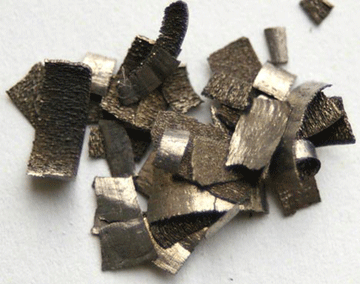 Crikey Clarifier: what’s all the fuss about rare earths? http://www.crikey.com.au/2014/07/01/crikey-clarifier-whats-all-the-fuss-about-rare-earths/ by Crikey Intern Bondi resident Natalie Lowrey was suddenly released without charge on Friday night after five days’ detention in a Malaysian prison. Lowrey, who was born in New Zealand, was arrested last week in Kuantan, Malaysia, for protesting against the processing of rare earths by Australian minerals giant Lynas Corp. We delve into some of the issues surrounding the case.
What are rare earths?
Rare earths are chemical elements found in the earth’s crust that are vital to many modern technologies, including electronics such as speakers, computers, hybrid cars and wind turbines. Rare earths have unique magnetic, luminescent, and electrochemical properties that help technologies perform more efficiently. They are particularly valuable for use in smartphones, and are in high demand.
What is Lynas Corp, and what is it doing in Malaysia?
Lynas Corporation Ltd is an ASX 100 listed company based in Sydney, Australia. It is currently constructing the Lynas Advanced Materials Plant (LAMP), a rare earth processing plant at Gebeng, near Kuantan, Malaysia.
Lynas’ rare earth project has sparked protests in Australia and Malaysia over fears about possible negative health, environmental and economic impacts once the plant begins its operation, as it will produce radioactive material as a waste product. Although the rare earths are extracted in Western Australia, the potentially hazardous processing will take place in Malaysia.
Is there any evidence processing rare earths is dangerous?
Mitsubishi Chemicals Asian Rare Earths, a plant in Bukit Merah, Malaysia, was shut down in the 1992 after at least eight cases of leukaemia and a sudden surge in birth defects and miscarriages in the area. The plant was finally closed after an eight-year battle and is currently undergoing the largest clean-up in the rare earth industry at a cost of US$100 million. Cleaning up requires digging up the entire area of contamination and entombing it inside a mountain.
A spokesperson from Lynas told Crikey: “The Asian Rare Earth plant used the waste from tin mining as its raw material. Lynas raw material contains naturally low levels of thorium, which are 30-40 times lower than rare earth concentrates from tin mine tailings. By all international standards, the Lynas raw material is classified as safe, non-toxic and non-hazardous.”
But Dr David KL Quek, former president of the Malaysia Medical Association, has said:
“Thorium is an acknowledged waste product from the planned Lynas refinery of rare earth ores. Due to the various refining processes thorium will be enriched and concentrated to levels which could reach quantities that are difficult to contain or be safely sequestrated.
“Based on the preliminary Environmental Impact Agency report, thorium residues would lead to a sizeable radioactivity dose of some 62 Becquerel per gram. For 106 tonnes this would be an enormous quantity of radioactive residual thorium.”
Wastes from production will include radioactive thorium and uranium and their radioactive decay products such as radium and radon. Australian authorities have explicitly refused to allow the wastes to be shipped back to Australia for safe disposal.
Why Malaysia?
The Malaysian government has been more open to rare earths processing than the Australian government.
Phua Kai Lit, an associate professor of the Jeffery Cheah School of Medicine and Health Sciences at Monash University in Malaysia, told Crikey: “The Prime Minister, as well as the Chief Minister of the state of Pahang, are both strong supporters of the project. Similarly, political appointees such as the various ministers from ministries involved with the project echo the government’s line. The head of the main regulatory body, the Atomic Energy Licensing Board, also echoes the government’s line.
A spokesperson told Crikey Lynas plans to recycle the waste from the LAMP refining process into co-products such as plaster boards and cement. Two out of three of these products have been certified as non-radioactive by the Malaysian Atomic Energy Licensing Board.
The AELB is in charge of approving and monitoring radioactive industries and received an undisclosed sum by Lynas Corp in 2011. However the AELB denied the sum was a requirement.
Australia’s Climate Denialism: the Age of Abbott
 How Rupert Murdoch created the world’s newest climate change villain, Salon Australia was once a leader on climate action. Thanks to American conservative powerhouses, that’s no longer true ALEXANDER WHITE 21 June 14, Australia, the sunburned country, is uniquely vulnerable to the dangers and risks of global warming. Whether it is the severe effects of flooding, unseasonal heat waves, devastating bush fires or decade-long droughts, Australia’s people, economy and natural environment have all keenly felt the impact of extreme weather and climate change.
Australia’s national scientific organizations have been raising the alarm for more than a decade, and the previous government accepted that scientific consensus and enacted a cap-and-trade scheme in 2012. But after a divisive election last year — one that saw native-born Rupert Murdoch exercise his considerable influence in Australian media markets to disastrous effect — the country is now governed by a deeply unpopular Liberal-National government, crafted in the image of the most climate-denying elements of the Tea Party. And its position on climate change has significant impacts on global efforts to reduce carbon emissions: Australia is not only the chair of the G-20 group of nations, but also holds a place on the U.N. Security Council.
The rest of the world saw this ideology on full, embarrassing display with the recent visit by Prime Minister Tony Abbott to Canada and the United States. Continue reading
Tony Abbott and Julie Bishop determined to keep Climate Change OFF the G20 Agenda
 Audio: Julie Bishop confirms climate change won’t be high on G20 agenda ABC Radio. Te World Today Rachael Brown reported this story on Friday, June 20, 2014 TANYA NOLAN: After weeks of speculation, the Federal Government has today confirmed it won’t be making climate change a priority during November’s G20 summit in Brisbane. The issue dogged Prime Minister Tony Abbott on a recent overseas trip, where he met world leaders, including US president Barack Obama who supports a cap and trade scheme and wants the issue on the G20 agenda.
But the Foreign Minister, Julie Bishop, says it’s not the right forum to discuss climate change.
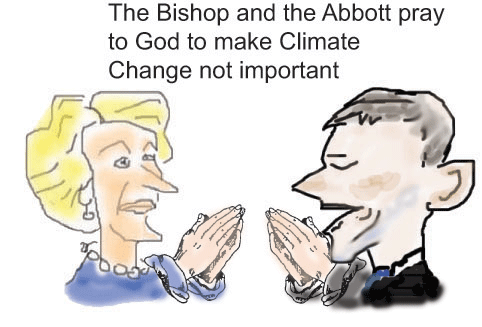
She’s made the comments at Melbourne’s C20 forum, a grouping of civil society organisations, which say the Federal Government is missing an opportunity to make climate change a top priority.
But the World Wildlife Fund says climate change is an economic issue………. Julie Bishop says the summit has to stick to a strong and focused economic agenda.
But the World Wildlife Fund says climate change is an economic issue. http://www.abc.net.au/worldtoday/content/2014/s4029630.htm
1 This month

of the week – Australians for War Powers Reform (AWPR)
To see nuclear-related stories in greater depth and intensity
 Antinuclear