Australia’s Treasurer, Joe Hockey, tries to put the world on a treadmill to climate disaster
Climate change is no impediment to economic growth, says Joe Hockey, SMH November 16, 2014 Latika Bourke Climate change is not an impediment to economic growth, the Treasurer, Joe Hockey, said on Sunday as the Federal Government hit back at Barack Obama’s speech aimed at forcing climate change to the fore of the G20 summit in Brisbane……..Mr Hockey said he had not seen the President’s speech because the finance ministers are “the ones doing the hard work on the treadmill’.

Final deal on uranium to India will not be signed during PM Narendra Modi’s visit to Australia
 Pact to operationalise nuclear deal won’t to be signed during PM Narendra Modi’s visit to Australia Indian Express by Shubhajit Roy | New Delhi November 13, 2014
Two months after India and Australia signed the bilateral civil nuclear cooperation agreement, a pact on the administrative arrangements — key to operationalising the uranium supply deal — is not likely to be signed when Prime Minister Narendra Modi visits Australia from November 14 to 18. However, officials said the two sides are aiming to conclude the deal in the first-half of 2015.
The pact on administrative arrangements is important for the Australian government to put it before the Australian parliamentary committee on treaties. After the committee examines the civilian nuclear deal and the administrative arrangements and prepares a report, it goes to the Australian parliament for approval. Only after the parliamentary nod can the Australian companies get into commercial negotiations with Indian counterparts for uranium supply………http://indianexpress.com/article/india/india-others/pact-to-make-n-deal-with-australia-operational-wont-be-signed-this-time/
International pressure on Abbott, over his climate sceptic policies
Abbott continues to allow vested interests and narrow definitions of Australia’s business priorities to control the agenda. These priorities emphasise protecting mining and resource companies, no matter what the long-term costs, even when they are becoming less successful with their largest client.
US–China emissions deal puts pressure on Abbott Macro Business Cross-posted from The Conversation: Unconventional Economist November 14, 2014 | While most of the world is celebrating the US–China pact on climate change, the deal puts pressure on the Australian government and resources companies to rethink relations with China.by Kerry Brown, Executive Director, China Studies Centre at University of Sydney
The deal, signed at the APEC summit in Beijing this week, includes agreement to cut emissions and work together to mitigate the impact of climate change. For the first time China has set 2030 as the year in which its emissions are expected to peak. The deal creates a common framework with the United States, the other largest greenhouse gas producer in the world, to take action.
Chinese President Xi Jinping started the APEC summit hoping for blue skies in the capital. With this deal, he is showing he is prepared to take action to achieve this.
For Australia this means that environmental compliance costs in China will rise. Australian companies will have additional costs of doing business there. Meanwhile Chinese companies will drive a harder bargain as their cost base lowers. Continue reading
C20 critical of G20 Agenda, and demands climate change as a stand alone item
 C20 calls on G20 to act on inequality, tax avoidance and climate change ABC News By AM business editor Peter Ryan Mon 10 Nov 2014, The C20 (Civil Society 20) is calling on G20 leaders to take action this weekend to improve the lives of the most vulnerable in society.
C20 chair Tim Costello said the group was looking for an outcome on Sunday that clearly demonstrates G20 leaders’ commitment to fairness by taking concrete, measurable action to reduce inequality and address climate change.
“It will be a sad legacy of the Australian presidency if we go backwards in the fight against poverty by failing to tackle growing inequality,” Mr Costello said.
“The G20’s Brisbane Action Plan must build on the formal commitment made in St Petersburg last year for inclusive growth to be a central focus of G20 decision making.
“Otherwise meeting the 2 per cent growth target will be a hollow achievement and leaders will be judged as indifferent to those most in need.”………
The C20 also argues that climate change is a critical economic issue confronting the G20 and must be discussed as a standalone item on the G20 agenda.
Mr Costello condemned the decision by the Australian presidency to ignore the impact of climate change on the global economy as a retrograde and damaging step.
“This G20 will ultimately be judged by the fairness test,” he said.
“Whether that’s fairness to future generations by facing up to climate change; fairness to the bottom 20 per cent of poorest households; fairness to 75 million young people unemployed worldwide; or fairness to taxpayers by declaring tax havens immoral.”
The Australian C20 Steering Committee comprises representatives of international and domestic civil society organisations including World Vision Australia, ACOSS, WWF, Oxfam, Transparency International, the National Council of Churches, and the National Employment Services Association. A number of individuals are also involved in the C20.
The C20 has focused its engagement with the G20 around the four key areas of:
- Inclusive Growth and Employment;
- Infrastructure;
- Climate and Resource Sustainability; and
- Governance (including tax and financial transparency).http://www.abc.net.au/news/2014-11-10/c20-calls-on-g20-to-act-on-inequality-tax-avoidance-and-climate/5879784
Tony Abbott to tell G20 that cutting payments to unemployed will boost economic growth
 Cuts to jobless benefits will boost economic growth, Australia tells G20, SMH November 10, 2014 Tom Allard National Affairs Editor The Australian government has cited controversial cuts to unemployment benefits as one of the key structural reforms that will increase economic activity by 2 per cent, according to a draft of its growth strategy to be submitted to the G20 leaders’ summit.
The reference to the jobless reforms – which include a measure preventing unemployed people under 30 from accessing welfare payments for up to six months – comes even though the changes have been blocked in the Senate.
The objective of boosting economic growth by 2 per cent “above what is currently expected” during the next five years is the main goal of the G20 meeting, to be held in Brisbane at the weekend.
Each of the countries that make up the G20 is required to submit action plans to boost growth ahead of the meeting.
“Employment welfare reforms” is ranked as the No 2 commitment, and notes that the changes will “strengthen participation and activation strategies”.
By cutting payments entirely to some unemployed and requiring jobseekers to search for more jobs to qualify for payments, the government argues it will spur the unemployed to look for work rather than live on welfare, thereby boosting economic activity……….
According to its draft action plan for growth, the government’s first key commitment to expanding economic activity is infrastructure spending, including its “asset recycling initiative” – encouraging state governments to privatise assets and then plough the proceeds into new projects. The other key commitments are “cutting red tape”, “contributing to global trade liberalisation” and “creating self-reliant industries”. http://www.smh.com.au/federal-politics/political-news/cuts-to-jobless-benefits-will-boost-economic-growth-australia-tells-g20-20141109-11jcy5.html#ixzz3IhoCFbZR
Prime Minister Tony Abbott an international embarrassment on climate chnage
Abbott takes Australia to last place on global climate change leadership, Independent Australia 21 October 2014, Australia has plummeted alarmingly down Global Green Economy Index under the Abbott Government, reports Alan Austin. AUSTRALIA HAS BEEN EMBARRASSED ABROAD by the Abbott Government yet again on the environment.
This time on clean energy, by the annual survey from US-based green economy consultancy Dual Citizen.In its fourth Global Green Economy Index(GGEI) released yesterday, Dual Citizen places Australia at 37th out of 60 countries on clean energy performance. And last on global leadership………
Australia has the ignominy of being easily bettered by Colombia (ranked 14), Peru (16), Kenya (17), Zambia (24), Ethiopia (26), Rwanda (27) and the Philippines (32).
The previous GGEI released in 2012 showed Australia ranked 10th on performance, out of 27 nations then evaluated. …….
This latest humiliation for Australia follows more than nine earlier embarrassments on the world stage caused by inept decisions, actions or inactions by the Abbott Government on environmental issues.
These include:
- Obstructing the UN climate meeting in Warsaw last November with damaging ‘bad behaviour’.
- Allowing three million cubic metres of dredged seabed to be dumped in the Great Barrier Reef Marine Park to make way for the Abbot Point coal export facility.
- Logging Tasmania’s endangered forests.
- Repealing Australia’s modest carbon tax/price.
- Abbott’s call for an alliance with Canada and others in June to oppose the global climate initiatives of US President Obama. The Canadian Star ridiculed this folly with the heading,‘Climate disdainers Canada and Australia form Axis of Weasels’.
- Abbott’s refusal to attend UN Secretary General Ban-Ki-Moon’s climate summit in New York in September.
- Recalcitrance at that UN climate summit in New York by the Australian representatives who did attend.
- Earning Australia the title ‘world’s dirtiest nation’ in The Slate. The influential US journal headlined its analysis: ‘The Saudi Arabia of the South Pacific: How Australia became the dirtiest polluter in the developed world’.
- Cutting the renewable energy targets.
Those episodes created the strong impression worldwide that the Abbott Government was failing Australia’s people, their local environment, the global community and the planet. This report shows with rigorous research that this highly negative impression is indeed sound.
This further undermines Australia’s once proud reputation as a good global citizen. The GGEI report has received prominent media coverage worldwide, including in Denmark, the USA, Brazil,Spain and Argentina…………http://www.independentaustralia.net/environment/environment-display/abbott-takes-australia-to-last-place-on-global-climate-change-leadership,7019
Tony Abbott about to sign away Australia’s environmental controls to USA big business
 “The agreement poses a very real risk to the environment,” says Professor Jane Kelsey, an expert on globalisation and economic regulation from the University of Auckland in New Zealand. “If Australia signs an agreement with these mechanisms in place it will make it harder for the government to put new regulations in place.”
That includes any subsidies we might put on renewable energy, or protection we might put in place to save an endangered species.”
Kelsey. “The Abbott government is basically be binding the hands of all future governments on environmental issues.”
So what is the likelihood of Australia ending up signing the agreement as it stands? Prime Minister Tony Abbott has indicated he’s extremely supportive of signing the deal, and Andrew Robb, has stated that negotiations are in the final stages and the treaty is“ready to be sealed”.
TPP: the free-trade threat to Australia’s environment, ABC 24 Oct 14 FIONA MACDONALD Australia is preparing to sign an agreement that would give international corporations the power to go over the government’s head on environmental issues. Here’s what you need to know about the Trans-Pacific Partnership Agreement.
STRETCHING WIDE, blue and deep, the St Lawrence River in Canada drains America’s Great Lakes to the sea. Along its shores, painted weatherboard cottages cradled by vibrant autumnal trees take in the view of the vast body of water.
This peaceful scene belies the legal battle for what lies underground along this river basin. The Canadian state of Quebec is being sued for CAD$250 million of taxpayers’ money after putting a pause on fracking.
To be clear, Quebec hasn’t decided to ban fracking, it’s simply asked for time to conduct environmental studies to find out whether the process is safe — but mining company Lone Pine Resources has taken the government to an international court, claiming it’s lost millions of dollars in profits as a result of the snap decision.
And if previous trials are anything to go by, there’s a good chance Lone Pine will win, even if it turns out fracking is dangerous to the environment and public health.
It sounds crazy, but it’s legal. And under an agreement Australia is set to sign within 12 months, companies operating in Australia will be able to sue the Government if it makes decisions that hurt their profits — for example, putting in new policies to protect the environment. Continue reading
How America and Britain crushed the government of Australia
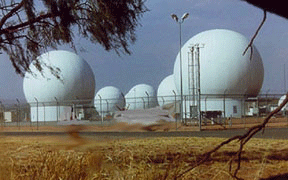 Whitlam demanded to know if and why the CIA was running a spy base at Pine Gap near Alice Springs, a giant vacuum cleaner which, as Edward Snowden revealed recently, allows the US to spy on everyone.
On 11 November – the day Whitlam was to inform Parliament about the secret CIA presence in Australia – he was summoned by Kerr. Invoking archaic vice-regal “reserve powers”, Kerr sacked the democratically elected prime minister. The “Whitlam problem” was solved, and Australian politics never recovered, nor the nation its true independence.
THE FORGOTTEN COUP Little Darwin, John Pilger 24 Oct 14 – How America and Britain crushed the government of Australia Across the political and media elite in Australia, a silence has descended on the memory of the great, reforming prime minister Gough Whitlam, who has died. His achievements are recognised, if grudgingly, his mistakes noted in false sorrow. But a critical reason for his extraordinary political demise will, they hope, be buried with him.
Australia briefly became an independent state during the Whitlam years, 1972-75. An American commentator wrote that no country had “reversed its posture in international affairs so totally without going through a domestic revolution”. Whitlam ended his nation’s colonial servility. He abolished Royal patronage, moved Australia towards the Non-Aligned Movement, supported “zones of peace” and opposed nuclear weapons testing. Continue reading
IAEA finds Lynas rare earths plan unsatisfactory – no proper radioactive waste plan

 IAEA reports no long-term plan for Lynas waste, Malaysian Insider 17 October 2014 The International Atomic Energy Agency (IAEA) on Friday gave a passing safety grade to a controversial Malaysia rare earths plant, but raised concerns that there was no long-term plan for properly disposing of the plant’s potentially radioactive waste.
The rare earths processing plant in the state of Pahang has generated opposition from green groups who fear radioactive contamination and have accused authorities and Lynas of overriding public concern.
In a report, the IAEA said it saw little risk of contamination due to the low-level radiation involved, and that its investigators were “not able to identify any instances of non-compliance” with international standards. “Lynas needs to demonstrate that the disposal of solid waste can be carried out in a safe manner over the long-term,” the report said.
It recommended that Malaysian authorities require Lynas to come up with a plan.
“There is a lack of a plan for managing the waste from the decommissioning and dismantling of the plant at the end of its life,” it said……
However, it also appeared to underscore environmentalists’ concerns that Australian miner Lynas Corp has no long-term plan for the disposal of waste from the plant.- http://www.themalaysianinsider.com/malaysia/article/iaea-teams-says-lynas-plant-generates-low-level-radioactive-waste-bernama#sthash.JEFk1poD.dpuf
A worry for the govt when John Carlson gets worried about the India nuclear deal
Nuclear deal with India compromised by ‘vague’ details on keeping track of uranium The Age October 5, 2014
Daniel Flitton Senior Correspondent “…….Prime Minister Tony Abbott signed such a deal with India last month, a ‘‘treaty for co-operation in the peaceful uses of nuclear energy’’. But there is a worry that this difficult agreement, years in the making, might not have the same careful protections as Australia’s other arrangements.
This concern hardly comes from a usual left-of-field suspect, stridently opposed to anything nuclear. Instead, the alarm is from the former chief of Australia’s atomic watchdog and, in assessing the India deal, he used words like vague and meaningless.
John Carlson headed the Australian Safeguards and Non-Proliferation office for more than two decades until 2010. Continue reading
John Carlson calls for full parliamentary scrutiny on Australia-India nuclear deal
Australia-India nuclear deal: The need for full parliamentary scrutiny, The Interpreter, John Carlson, 1 Oct 14 In a previous post, I pointed out how the Australia-India nuclear cooperation agreement departs from Australia’s longstanding safeguards requirements. In particular, there is a risk that the follow-on ‘administrative arrangement’ could deprive Australia of the ability to track and account for Australian uranium supplied to India.
It is not too late to address this problem in a way that ensures the agreement is meaningful and can command bipartisan support in Australia. There will be a crucial role here for the Australian Parliament’s Joint Standing Committee on Treaties (JSCOT), which will have the opportunity to scrutinise the agreement and to ask the necessary and difficult questions about the administrative arrangement.
Here there are two practical issues: the administrative arrangement has not yet, as far as we know, been negotiated, so it will not be available when JSCOT commences its review of the agreement; and in any case it is the usual practice to treat administrative arrangements as being confidential.
The Abbott Government should proceed no further with the agreement unless it can give an assurance that all of Australia’s longstanding safeguards requirements will be met. Continue reading
John Carlson, former head of Australian Safeguards, condemns uranium deal with India
 See below a very strong critique of the Australia-India nuclear cooperation agreement from John Carlson, former head of the Australian Safeguards and Non-Proliferation Office, who worked tirelessly for many years to weaken safeguards standards …
It is not good enough to simply say that we trust India because it has an ‘impeccable’ non-proliferation record (and India’s record in any case is not ‘impeccable’).The reporting procedures are not optional; they are fundamental to Australia’s ability to confirm that our safeguards conditions are being met. They have long applied to close and trusted partners such as the US, the EU, Japan and South Korea. There is absolutely no case to waive them for India.
Is the Abbott Government abandoning Australia’s nuclear safeguards standards for India? John Carlson AM is a Nonresident Fellow at the Lowy Institute. He was Director General of the Australian Safeguards and Non-Proliferation Office and its predecessor the Australian Safeguards Office from 1989 to 2010. Lowy Interpreter, 1 October 2014http://www.lowyinterpreter.org/?COLLCC=737147385&
The signing last month of a civil nuclear cooperation agreement between Australia and India has been greeted as an important step towards closer relations between the two countries, as well as bringing India into the global nuclear energy mainstream. These are worthy objectives, but not at any cost. Continue reading
French company AREVA will get to have 51% interest , later more, in joint uranium venture with Toro Energy
 Toro signs NT deal with AREVA https://au.news.yahoo.com/thewest/business/wa/a/25132512/toro-signs-nt-deal-with-areva/ The West AustralianSeptember 29, 2014 Toro Energy has signed a farm-in and joint venture agreement with French uranium and nuclear power giant AREVA in the Northern Territory.
The agreement covers a 2292sqkm tenement package in the Wiso Basin, southwest of Tennant Creek.
“Toro believes that its relatively unexplored Wiso Basin tenement package is ideally placed for exploring for a sandstone-hosted uranium mineralising system of a size and scale not unlike those found in Kazakhstan, where six of the world’s top 15 producing uranium mines are currently in operation,” the company said in a statement.
Toro’s managing director Dr Vanessa Guthrie said the company was excited to have AREVA participate in a substantial exploration portfolio at a time when few companies were actively exploring for uranium in Australia.
“We look forward to adding value to our NT exploration targets through a long and beneficial relationship with one of the world’s most respected uranium groups,” she said. Under the terms of the agreement, AREVA will spend $500,000 within two years of to earn a 51 per cent interest in the joint venture properties.
Upon reaching 51 per cent, AREVA will then have the option to spend another $1.5 million over four years for a further 29 per cent interest for a total 80 per cent stake.
Drilling is expected to begin in the first half of 2015.
Toro shares closed steady at 9.1 cents.
Australia is in blatant violation of the Nuclear non Proliferation Treaty (NPT)
A BLATANT VIOLATION OF Nuclear Non Proliferation Treaty–SEPTEMBER 26, 2014 By Eurasia Review By Yusra Mushtaq Amongst the various accords of Arms Control and Disarmament, the Nuclear Non Proliferation Treaty (NPT) has widely been adhered to by most of the countries, which gives testament to the worth of this treaty. Nevertheless, it also has been the fate of being violated again and again by its own signatory members — most recently by Australia which signed a uranium deal with India, ade-facto, but non-signatory state. Previously, the US a big proponent of NPT, paved the way for this kind of illegal nuclear cooperation with the non-NPT state of India by signing a deal back in 2005. The blatant violation of NPT left no room for India to sign this treaty because it already enjoys full benefits as if it were a NPT member state without any restricted conditions.
Largely based on the three pillars of Non-Proliferation, Disarmament and Peaceful Uses of Nuclear Energy, the NPT serves as a central bargain. “The NPT non-nuclear-weapon states agree never to acquire nuclear weapons and the NPT nuclear-weapon states in exchange agrees to share the benefits of peaceful nuclear technology and to pursue nuclear disarmament aimed at the ultimate elimination of their nuclear arsenals”. There are 190 states which have joined the NPT club. It is extended for indefinite period of time which reflects its obligatory status. In order to make Global Nuclear Non Proliferation and NPT particularly more fruitful, many substantive initiatives have been taken. They are dominated by export controls regime like Nuclear Suppliers Group and enhanced verification measures of IAEA Additional Protocols. The sole aim of all efforts is to end every possible mean to acquire nuclear weapons. Within this context, success becomes a far off cry as NPT is in a fix between global and national interests of respective states.
Australia signed a deal to sell uranium to India to coin the natural blessing of one third of world’s uranium reserves for the sake of national interests. It is the first non-NPT signatory nation with whom Australia has inked a nuclear deal. Australia is the tenth country in the world that has signed a nuclear deal with India. Both the states are joining hands happily while violating the norms of NPT so blatantly. There is a sheer absence of handwringing editorials at the international news desks. Between the celebrations of this so-called triumph, no one is talking of the sanctity of international arms treaties…….
an irony for the Global Non Proliferation Regime that there are high voices for NPT to be adhered to, but at the same time its own vocal members have optimized national interests over the security of the whole globe. All are quiet on the sheer violence on this international violation of a treaty because it’s a matter of great powers vested national interests with a de facto state. For this Lao Tzu, a Chinese philosopher stated; “The more laws and order are made prominent, the more thieves and robbers there will be.” Yusra Mushtaq is a scholar on the issues of defense and security. http://www.eurasiareview.com/26092014-blatant-violation-npt-oped/
Australia vilified at New York Climate Summit
 Australia’s climate stance savagely condemned at New York summit SMH September 27, 2014 Nick O’Malley US correspondent for Fairfax Media “…….in his address to the General Assembly, Leonardo DiCaprio sought to buttress his call for drastic and immediate action to reduce carbon emissions with a voice harder to challenge than his own.
The speech was well given and well received, but it turned out that his prediction was not entirely correct. Australia did not have to wait for history, it was vilified for its stance on climate change on the spot…….”I’m disappointed but not surprised with Australia,” Pa Ousman Jarju, Gambia’s Climate Change Minister who represents the 54 least developed nations at UN climate talks, told the Responding to Climate Change analysis website later. “What the Foreign Minister [Julie Bishop] said was as good as not coming. It’s nothing… as good as not attending.”Indeed Tony Abbott did not attend Tuesday’s meeting, though many attendees detected a reference to Australia – among a handful of other notable recalcitrants – in Barack Obama’s keynote speech……..
it was Australia and to an extent Canada that were subject to most of the opprobrium, in part because they have already enjoyed the economic benefits of carbon emissions, in part because China is perceived to be on the brink of significant action.
One of the successes of Tuesday’s meeting was China’s announcement for the first time ever that it would set an emissions target, aiming to reduce its emissions of carbon per unit of GDP by 45 per cent by 2020, compared with levels in 2005.
“As a responsible major country, a major developing country, China will make even greater effort to address climate change,” Vice-Premier Zhang Gaoli said.
“All countries need to follow the path of green and low carbon development that suits their national conditions, [and] set forth post-2020 actions in light of actual circumstances.”
An adviser who attended a meeting of small island states that excoriated Australia’s inaction on climate said the group now viewed China’s commitments optimistically.
The reaction to Australia’s presence could not have been more different. Tony de Brum, the Foreign Minister of the Marshall Islands, told Fairfax that small islands states were frustrated and baffled by Australia’s stance, especially as they had regarded the nation as a “big brother down south” and advocated for its seat on the United Nations Security Council.
Asked if “betrayal” was too strong a word, he paused and said, “Now it is, maybe not soon.”
On Tuesday the Pulitzer Prize-winning climate change news website Inside Climate News published a story about the “Canada-Australia axis of carbon”. It suggested that not only were the two nations not willing to pull their weight, but that they were seeking to derail the binding agreement on emissions reductions at next year’s talks in Paris that many view as the world’s last best hope to prevent catastrophic climate change.
“Neither the prime ministers of Canada nor Australia will speak at the summit, and the subordinates they have sent will not be offering the kind of “bold” new steps that UN Secretary-General Ban Ki-moon is seeking on the way to a treaty in Paris late next year,” it reported.
“Instead, these two governments, with their energy-rich domains sprawling across opposite ends of the earth, will present strikingly similar defences against what much of the rest of the world is offering. And their stance is earning them opprobrium among advocates of strong and immediate action.”
The online magazine Slate published a story headlined, “The Saudi Arabia of the Pacific, How Australia became the dirtiest polluter in the developed world.”
It charted Australian climate politics since the last election – noting for an international audience Australia’s history as a leader in solar technology, the creation and then scrapping of a carbon trading scheme, the promotion of climate change sceptics to key advisory roles, the attacks on the solar industry, the scrapping of the mining tax, the failed bid to expand logging in Tasmanian wilderness.
“Let’s hope that the rapacious policies of the current government represent only a temporary bout of insanity,” Slate concluded. “If the Australian people cannot recover some of their earlier regard for their environment they may find in time that their great land is no longer merely apathetic toward their residence there but openly hostile.” http://www.smh.com.au/world/australias-climate-stance-savagely-condemned-at-new-york-summit-20140926-10mc0x.html#ixzz3Eac7HHfN
1 This month
17 October, Free Public Talk on Nuclear Issues in South Australia
David Noonan will speak on public interest concerns over the new Roxby Downs Indenture Act 2026 on BHP copper-uranium mining and ore processing in SA, and on how AUKUS may face SA with a High-Level nuclear waste agenda.
Dr Jim Green will discuss international developments in the field of nuclear power including ‘small modular reactors’ and Generation 4 ‘advanced’ nuclear reactor concepts.


Help Aunty Sue Protect Her Land and Sacred Sites From Destructive Rocket Testing.
.

Australians deserve the truth
about
AUKUS – https://aukuspublicinquiry.com/

PETITION – To: Prime Minister Anthony Albanese and the Australian Labor Government

of the week – Australians for War Powers Reform (AWPR)
To see nuclear-related stories in greater depth and intensity

