Australia to work with United Arab Emirates in developing nuclear technology
| UAE declares launch of nuclear energy cooperation deal with Australia | |||
|
|||
|
ABU DHABI, April 14 (KUNA) — The United Arab Emirates said on Monday that an agreement on the use of nuclear energy for peaceful means signed with Australia in 2012 has come into force.
The announcement was made in an official statement published on state news agency, WAM, which mentioned that the decision for the move was made during a meeting between Foreign Minister Sheikh Abdullah bin Zayed Al-Nahyan and Australia’s visiting Minister of Trade and Investment Andrew Robb. The Emirati foreign minister said that enacting the agreement will “provide broader opportunities for cooperation between state institutions and businesses operating in the nuclear energy field.”…….. According to the report, the discussions also touched upon enhancing existing economic and trade ties, and encouraging joint investments.
Sheikh Abdullah went on to stress the importance of exchanged visits in supporting bilateral cooperation and assessing the levels development and growth in each of the two countries…… The Australian minister, for his part, commended the level of cooperation between the two sides, emphasising the need to further these ties.
He also noted to the high reputation the UAE has managed to make for itself on the international scene, through providing a lucrative location for international businesses. (end) asa.sd http://www.kuna.net.kw/ArticleDetails.aspx?id=2372272&language=en |
Julie Bishop is out of step with Australian opinion on nuclear weapons
 Julie Bishop says banning nuclear weapons impractical ABC Radio National, Tanya Nolan reported this story on Friday, April 11, 2014 TANYA NOLAN: Foreign Minister Julie Bishop is representing Australia at a 12 nation summit in Hiroshima today discussing global efforts to eliminate nuclear weapons. Disarmament activists in Hiroshima are lobbying hard for agreement to be reached on a global ban on nuclear weapons.
But Australia is one of a group of countries that is unlikely to support any such push: Ms Bishop says banning weapons won’t get rid of them and any global treaty would be impractical without the support of the world’s nuclear armed states – something unlikely to be achieved.
The International Campaign to Abolish Nuclear Weapons say Australia’s position is out of step with the views of most Australians. 
It’s released a survey of 1,500 Australians who were asked whether they think the Government should support a global ban on nuclear weapons. I spoke to Dr Tillman Ruff, co-chairman of the campaign who is in Hiroshima for the Non-Proliferation Disarmament Initiative.
So the International Campaign to Abolish Nuclear Weapons, ICAN has released its poll showing 84 per cent of Australians think the Government should support a global treaty banning nuclear weapons. Don’t you think it would have been more accurate to pose the question would a global ban on nuclear weapons be effective without the support of those countries that have nuclear weapons?
TANYA NOLAN: But Foreign Minister Julie Bishop has a point doesn’t she, that any global ban on nuclear weapons won’t be effective if you can’t get the nuclear armed states on board?
TILLMAN RUFF: Well, of course the elimination of nuclear weapons is going to require the states that have them to do that. I mean I think that’s obvious, but what we’ve seen essentially over the last 70 years is a failure of the nuclear armed states to live up to their legally binding obligation under the non-proliferation treaty to disarm.
There are currently no negotiations underway and arguably our, the danger of nuclear weapons being used, many experts are suggesting is actually increasing. Proliferation is certainly not under control so it’s hard to claim that business as usual is getting us very far, very fast.
So, you know, the states that have the weapons have so far shown really no serious intent to get rid of their nuclear weapons. ……….
Australia-Japan joint military exercises (China won’t like that)

 Abe, Abbott agree on joint research on submarine technology, Kyodo News International April 7, 2014 Global Post Prime Minister Shinzo Abe and Australian Prime Minister Tony Abbott agreed Monday to conduct joint research on submarine-related technology as part of efforts to bolster bilateral security ties under Japan’s new policy on defense equipment.
The agreement reached during a summit between the leaders in Tokyo came nearly a week after Japan relaxed its arms export ban by adopting new principles and guidelines for the first time in nearly 50 years.
Abe and Abbott picked marine hydrodynamics used for submarines as the first area of bilateral cooperation. The Japanese and Australian defense and foreign ministers will meet in Tokyo in June and work out details. “We confirmed that we will expand practical cooperation to include joint exercises,” Abe told reporters after the summit. …….http://www.globalpost.com/dispatch/news/kyodo-news-international/140407/abe-abbott-agree-joint-research-submarine-technology
Tony Abbott to share advanced military technology with Japan (Will China mind?)
Tony Abbott moves to strengthen defence ties with South Korea DAVID CROWE SEOUL THE AUSTRALIAN APRIL 08, 2014 TONY Abbott has moved to tighten defence ties with South Korea by laying out plans to conduct more joint exercises and share more military technology, helping to mend a bruising row two years ago over a cancelled weapons deal.
Blasting North Korea as an “outlaw state” that must give up its nuclear weapons, the Prime Minister used high-level talks in Seoul to assure his Korean counterpart about future defence collaboration.
The plans come one day after Mr Abbott formally launched negotiations with Japan to share advanced military technology and one day before he arrives in China, which has objected in the past to Australia’s defence declarations with Japan………
Australia’s Dr Helen Caldicott in Japan threatened with death for speaking out about nuclear power
 KPFA: Dr. Helen Caldicott threatened with death while in Japan for speaking about nuclear power — Students being charged with disturbing the peace for handing out flyers (AUDIO) http://enenews.com/kpfa-dr-helen-caldicott-threatened-death-japan-speaking-about-nuclear-power-students-charged-disturbing-peace-handing-flyers-audio?utm_source=feedburner&utm_medium=email&utm_campaign=Feed%3A+ENENews+%28Energy+News%29
KPFA Flashpoints, Mar. 10, 2014
Steve Zeltzer, reporting from Japan: We went to Osaka […] we were told there’s continuing repression. Activists here are being threatened, including Professor Shimoji who was arrested for handing out leaflets. The government is trying to suppress opposition to nuclear power by passing the secrecy law which just passed the parliament and also by intimidating antinuclear activists and saying they have to keep quiet. […] We also learned from Dr. Helen Caldicott that she was threatened. She spoke at a meeting in Kyoto on the 8th and it was reported at the meeting that she had been threatened by right-wingers with death for speaking out about the dangers of nuclear power. (correction – Dr Caldicott referred to previous incidents in USA, not Japan)
Full Flashpoints broadcasts available here
USA govt did not like nuclear disarmament statement, so Australia obeyed USA
Nuclear Weapons Ban: Secret Documents Reveal Australia Blocking New Zealand-Led Campaign International Business Times, By Reissa Su | March 10, 2014 The Australian government was reportedly leading secret attempts to block New Zealand’s push for nuclear disarmament based on the released documents under the freedom of information laws. The documents contained declassified information on ministerial communications, cables and emails from the Department of Foreign Affairs and Trade and revealed the efforts of Australian diplomats working in secret. The documents said that the Australian government relies on U.S. nuclear forces to prevent a nuclear attack in the country.
In October 2013, shortly after the Coalition won the seat of power, Australia had refused New Zealand in its request to endorse a joint statement signed by 125 countries at theUnited Nations which highlighted the effects of nuclear weapon use. Australia had reportedly found the statement declaring that it is in the best interest of mankind not to use nuclear weapons “under any circumstances.” Reports said that 16 countries including New Zealand, Malaysia, Mexico andSouth Africa are working together to put the spotlight on the use of nuclear weapons and its humanitarian consequences.
The nuclear disarmament campaign will lay the foundation for negotiating an agreement to ban nuclear weapons. The diplomatic campaign seeks to put nuclear weapons in the same category as chemical and biological weapons which are already considered illegal under international law……..
Among the documents revealed included Foreign Affairs and Trade head Peter Varghese’s statement that New Zealand’s push for nuclear disarmament goes against the security interests of Australia.
The diplomatic image of Australia has been hit with the Japan’s consent to sign the New Zealand-led initiative through Japanese Foreign Minister Fumio Kishida. Australian diplomats had conferred with the U.S. State Department over the matter. Declassified information revealed the email exchanges between the two parties, including Washington reprimanding Tokyo for its decision to sign the nuclear disarmament statement. http://au.ibtimes.com/articles/542532/20140310/australia-nuclear-weapons-disarmament-new-zealand.htm
Abbott govt to weaken safety regulations on uranium sales to India
There are indications that the Abbott government might be willing to dilute some of Australia’s monitoring safeguards
Australia seeks to draw India into tighter embrace with nuclear deal TNN | Feb 17, 2014, CANBERRA: Australia, which in the past has expressed serious reservations about New Delhi’s nuclear programme, appears extremely keen to close a deal to supply uranium to India. “We see it as a priority and want to move as quickly as possible. The political will certainly exists within this government,” Australia’s foreign minister Julie Bishop told reporters here even as the two countries were in the middle of their fourth round of talks for a civil nuclear cooperation agreement. …..
While she would not elaborate, the South Pacific Nuclear Free Zone Treaty, of which Australia is a member, is said to be one of them. (There’s also a narrower self-interest in finding a new market for Australia’s uranium producers.) …………..
At last! Notorious (Australian) Paladin uranium mine in Malawi shuts down
 Paladin uranium mine shuts, PAUL GARVEY, THE AUSTRALIAN FEBRUARY 08, 2014 PALADIN Energy has bowed to persistently low uranium prices and moved to stop production at its Kayelekera mine in the southern African nation of Malawi.
The mine, which has been in production since 2009, has been bleeding money in recent years……
- Last month Paladin sold a 25 per cent stake in its flagship Langer Heinrich mine in Namibia to China National Nuclear Corporation for $US190m, as well as debt refinancing.
Tony Abbott’s pathetic performance at Davos, on climate change
there is a growing view among business leaders and mainstream economists who see global warming as a force that contributes to lower gross domestic products, higher food and commodity costs, broken supply chains and increased financial risk.
 Shipping Oars,The Australian Independent Media Network BY KAYE LEE on JANUARY 26, 2014 Tony Abbott’s brief sojourn in Davos left most of us cringing and somewhat bemused as to the purpose of his journey. He met with some Australian big business leaders and delivered a speech that had nothing to do with the stated priorities of the forum – the problem of increasing income inequality and the economics of climate change. Le Figaro noted Abbott’s address as a footnote, quoting him as calling for more free trade, an idea that was a long way from the agenda – très loin de la thématique – of earlier gatherings. In fact, Tony left before any of these meetings took place.
But he did fit in a few personal meetings.
Apparently the Dutch Prime Minister also requested a meeting. Tony suggested it was a meet-and-greet but I suspect there was a bit more to it than that. Continue reading
Trans Pacific Partnership a global-scale corporate power grab
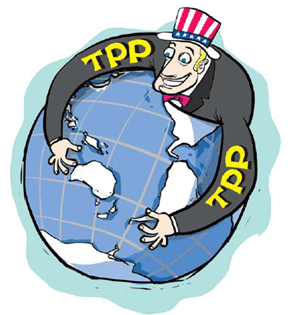
Last week, Wikileaks released a draft environment chapter of the TPP. Surprise: it is neither strong nor enforceable.
Stop the Trans-Pacific Partnership http://www.theecologist.org/blogs_and_comments/commentators/2249519/stop_the_transpacific_partnership.html 23rd January 2014 The TPP – Trans-Pacific Partnership – is far more than just a trade agreement. It is a global-scale corporate power grab – anti-people, anti-environment and anti-democratic. And it must be stopped, writes Chris Lang. The Trans-Pacific Partnership is a proposed international trade agreement, involving 12 countries and covering a range of topics including intellectual property, the environment and workers’ rights. The TPP has been negotiated in secret for almost four years. Continue reading
Australia is letting down Pacific Islanders on Climate Change
 But he and Pacific nations like Palau have won no favours from their big neighbour, Australia. Palau has publicly expressed disappointment with Australia’s and Canada’s climate change position.
He recently told Radio Australia the Pacific is disappointed about the Australian government’s moves to abolish the Climate Change Council and the Climate Change Authority, as well as the carbon tax.
Marshall Islands’ President Christopher Loeak says it’s not too late for climate action to save the Pacific http://www.abc.net.au/news/2014-01-21/an-climate-change/5210462 Is it too late to save low-lying Pacific nations from being lost forever because of rising sea levels?
The President of Marshall Islands, Christopher Loeak, doesn’t think so and he’s been on a relentless campaign to get the world to listen to his message.
He does concede time is running out, but has been encouraged by news that a number of nations recently announced they’d signed up to the Majuro Declarationto cut emissions. “We were really happy that the United States agreed to join and also European Union and in the United States, Hawaii also has agreed to join,” he told Radio Australia. Continue reading
Wikileaks reveals weak wobbly wording of Trans Pacific Partnership’s secret environment plans
 Secret draft of TPP talks on environment show few enforcement measures SMH, January 17, 2014 Peter Martin Economics correspondent A secret draft of what would be Australia’s biggest trade agreement shows it will be toothless in enforcing environmental agreements.
The draft environment chapter of the twelve-nation Trans Pacific Partnership agreement published by WikiLeaks proposes next to no enforcement  mechanisms with those that are suggested opposed by each of the 12 nations other than the United Stastes.
A summary on the WikiLeaks website says the draft makes use of the ‘get out clause’ approximately 43 times, using language such as: “Where possible and appropriate, the Parties shall seek to complement and utilise their existing cooperation mechanisms and take into account relevant work of regional and international organisations.”
The word “may” is also found 43 times in the 23-page draft.
 Governments are urged to “…make every effort to arrive at a mutually satisfactory resolution…”, “…take measures to prevent…”, “…make best efforts…”, “…exercise restraint in taking recourse…”, and retain “the right to make decisions…”.
WikiLeaks says other favourite words are “enhance” (12), “consider” (12), “encourage” (11), “address” (10), “endeavour” (9) and “seek” (9).
A report from the chairpersons of the environment section of the agreement despairs at ever getting meaningful agreement saying the so-called “red line” or non-negotiable positions appear irreconcilable.”Many of the red lines for some parties were in direct opposition to the red lines expressed by other parties,” it says.
“It bears emphasising that it is these differences that have prevented the environment working group from reaching agreement on all aspects of the chapter.”
Australia is siding with Brunei, Canada, Chile, Japan, Malaysia, Mexico, New Zealand, Peru, Singapore and Vietnam in opposing US moves to give the resolutions of biodiversity, climate change, fisheries and conservation more force.
The environment chapter is the second published by WikiLeaks. The first, on intellectual property showed the US with Australian support attempting to impose on other countries tougher rules that would have strengthened the hand of copyright owners in disputes with consumers.
Each of the negotiating parties has resolved to keep the draft chapters secret until the negotiations are completed, meaning the chapters published by WikiLeaks are the only parts of the agreement in the public domain. http://www.smh.com.au/federal-politics/political-news/secret-draft-of-tpp-talks-on-environment-show-little-enforcement-measures-20140117-30y8f.html#ixzz2qmVF0V00
Australia voted with USA against Declaration for Rights of Indigenous Peoples
TPPA Environment Chapter & Chair’s Commentary Posted by WikiLeaks Issues for NZ 1Professor Jane Kelsey 16 January 2014 (NZDT) The consolidated draft text of the Environment chapter of the Trans-Pacific partnership Agreement and the accompanying chair’s commentary have been posted in Wikileaks (http://wikileaks.org/tpp-enviro). The documents are dated 24 November 2013, the final day of the Salt Lake City round in November…..
The most egregious threat to the environment is the investment chapter, in particular the prior consent by all countries except Australia to investor-state dispute settlement (ISDS). The vast majority of investment arbitrations under similar agreements involve natural resources, especially mining, and have resulted in billions of dollars of damages against governments for measures designed to protect the environment from harm caused by foreign corporations. The US is also demanding that contracts between investors and states that involve natural resources also have access to ISDS.
Chapters that may impact on environmental measures, with some examples, include:…..
Austrlalian Government colluded with British to deny justice to Maralinga Aborigines and veterans
Independent senator for South Australia Nick Xenophon plans to step up pressure this year to ensure those affected by the nuclear tests can be compensated properly.
 UK opposed compensation for Maralinga nuclear victims BRENDAN NICHOLSON DEFENCE EDITOR THE AUSTRALIAN JANUARY 01, 2014 THE Anangu Aboriginal people who inhabited the Maralinga area of South Australia called it ”puyu” or ”black mist” the dirt that rolled across the landscape and sickened, blinded and killed them.
As the Hawke government faced growing pressure for fair compensation for those affected by fallout from the British nuclear bomb test program at Maralinga and Emu fields and the Monte Bello Islands between 1952 and 1963, it ran into strong opposition from United Kingdom officials. Continue reading
How Australia caved in to Britain, in not properly cleaning up Maralinga bomb sites
 Why cabinet sought only a partial clean-up of British nuclear test site Archives give new insight into Hawke government’s response to royal commission on weapons testing in Maralinga region Paul Chadwick theguardian.com, Wednesday 1 January 2014
 Gareth Evans, the energy minister at the time, said ‘a non-confrontational approach’ had been adopted in dealing with the Thatcher government.
The complete rehabilitation of areas of Australia used to test British nuclear weapons may not be possible, the Hawke cabinet was advised in 1986.
Cabinet was warned that a full clean-up may have been more expensive than the British government would be willing to contemplate, according to documents released this week by theNational Archives.
They provide new insights into the Hawke government’s response to the recommendations of the McClelland royal commission into British nuclear tests in Australia. Continue reading

1 This month
17 October, Free Public Talk on Nuclear Issues in South Australia
David Noonan will speak on public interest concerns over the new Roxby Downs Indenture Act 2026 on BHP copper-uranium mining and ore processing in SA, and on how AUKUS may face SA with a High-Level nuclear waste agenda.
Dr Jim Green will discuss international developments in the field of nuclear power including ‘small modular reactors’ and Generation 4 ‘advanced’ nuclear reactor concepts.


Help Aunty Sue Protect Her Land and Sacred Sites From Destructive Rocket Testing.
.

Australians deserve the truth
about
AUKUS – https://aukuspublicinquiry.com/

PETITION – To: Prime Minister Anthony Albanese and the Australian Labor Government

of the week – Australians for War Powers Reform (AWPR)
To see nuclear-related stories in greater depth and intensity

