Danger in Australia selling uranium to undemocratic Middle Eastern regime
Australia’s plan to sell uranium to the UAE is ill-considered. It essentially requires us to turn a blind eye to the UAE’s poor democratic form and strikes a blow to the goal of a nuclear-free Middle East. It also fails to apply adequate scrutiny and attention to Australia’s corner cutting uranium trade – an industry described by a Senate report as needing urgent changes in order to protect the environment and people from ‘serious or irreversible damage’
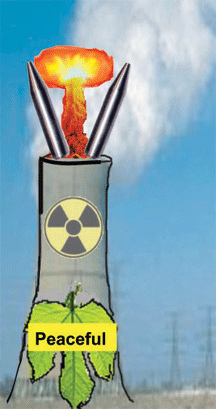 Why Australia shouldn’t sell uranium to the UAE Online opinion, By Dave Sweeney , 17 June 2013 For most Australians nuclear issues are the concern of other nations, largely because we don’t, and are most unlikely to ever have, domestic nuclear reactors. But as home to one third of the world’s uranium Australia is a significant player in the global nuclear game and we are playing an increasingly irresponsible hand.
Today in Canberra representatives from the Australian Conservation Foundation, Friends of the Earth, the Medical Association for the Prevention of War and the International Campaign to Abolish Nuclear Weapons will have a rare window of opportunity to put their case to a Parliamentary committee as to why Australia should not sell uranium to the United Arab Emirates (UAE).
The UAE is country with an illiberal government situated in one of the world’s most insecure regions. The commercial interests of multi-national uranium producers have been prioritised over the wider national interest. Instead of industry assurances it is now time to test the claims – and examine the costs – of Australia’s uranium industry.
The value of the employment and economic contribution made by the Australian uranium sector is consistently exaggerated while its risks and liabilities are routinely played down. When it comes to jobs and dollars uranium is a small contributor to Australian export revenue and employment, but when it comes to global impact and risk Australian uranium is in the major league.
From 2002 to 2011, uranium sales averaged $627 million annually and accounted for only 0.29 per cent of all national export revenue: small beer, but with a big hangover…… Continue reading
Australia half-hearted about removing corruption in oveseas mining operations
Tougher standards to fight corruption in the resources industry ABC News 26 May 13 By resources reporter Sue Lannin More of the world’s governments have signed up to measures designed to reduce corruption in the global resources industry.
Around 3.5 billion people live in poor countries that are rich in resources but they do not see the trillions of dollars that flow from their mineral and energy reserves.
Last week, the United Kingdom and France joined the Extractive Industries Transparency Initiative (EITI), which requires countries to fully disclose taxes, royalties and other fees they receive from oil, gas and mining income.
About 40 countries have now implemented the voluntary scheme and about $US1 trillion in revenue has been disclosed.
Australia has launched a pilot EITI scheme but is not yet fully compliant.
Despite recent reforms in the US and the European Union, Australia does not require mining and energy companies to publicly reveal the taxes and royalties they pay to governments around the world for natural resources.
Federal Minister for Resources and Energy Gary Gray said in his written speech prepared for the EITI conference in Sydney last week that transparency for transparency’s sake was not necessarily the best policy.
“While I recognise the benefit for governments to better understand and negotiate market conditions, exposure of sensitive project, contract and other market information will distort market competitiveness,” he said in the speech.
But the senior policy manager for extractive industries at Oxfam America, Ian Gary, says investor pressure is mounting in Australia for more openness…..
NGO says EITI merely symbolic
However, NGOs would like to see the standards tightened further as some of the new rules merely “encourage” countries to increase disclosure.
Environmental NGO, Global Witness, has called EITI a “totemic reformers club”, saying corrupt countries such as Nigeria are members…….
Australia hosts the first World Indigenous Network conference in Darwin.
 Native voices join together at conference Border Mail, By Rick Feneley May 27, 2013 “….. Australia hosts the first World Indigenous Network conference in Darwin.
Launched on Sunday, it is a rainbow connection of about 1200 of the world’s indigenous rangers and land and sea managers. It will hear the mangrove people of Bangladesh on the challenge of climate change. The forest people of Madagascar and the Republic of Benin will talk about ecotourism. It will hear from the Bedouin of Egypt, the Maori and indigenous delegates from Brazil, Mexico, Tanzania, Kenya, South Africa, Mongolia, the Solomon Islands, Indonesia, Papua New Guinea and more countries……
Arnhem Land traditional owners used the event’s launch to celebrate the creation of Australia’s first government-recognised indigenous protected area over the sea. The new Dhimurru IPA will extend 40 kilometres out to sea from the Gove Peninsula and cover 450,000 hectares of water around the north-western tip of the Gulf of Carpentaria.
With the support of the federal and Northern Territory governments, the Dhimurru Aboriginal Corporation will manage the conservation of the sea territory in collaboration with quarantine, customs and fisheries authorities.
”It’s important because, in our culture, we have to look after the land and the sea,” says Dhimurru ranger Lisa Dhurrkay, 25. Their responsibility doesn’t stop at the shoreline, she says.
Four IPAs covering more than 85,000 square kilometres were declared in Western Australia’s Kimberley last week…. http://www.bordermail.com.au/story/1528298/native-voices-join-together-at-conference/?cs=7
Report shows that Malawi gets a raw deal from Paladin’s KAYELEKERA URANIUM MINE
THE CASE OF PALADIN’S KAYELEKERA URANIUM MINE: REPORT RELEASED ON THE REVENUE COSTS AND BENEFITS TO MALAWI, Mining in Malawi, 23 May 13 The Australian mining company Paladin Energy and its subsidiaries along with the Malawi-based Kayelekera Uranium Project, in which it has an 85% stake, were the subject of much discussion this evening in Lilongwe at the launch of the report The Revenue Costs and Benefits of Foreign Direct Investment in the Extractive Industry in Malawi: The Case of Kayelekera Uranium Mine. The report explores what it describes as Malawi’s largest Foreign Direct Investment* and the extent to which Malawi is benefiting. It concludes that ”Malawi is getting a raw deal from the mining and exploitation of uranium by Kayelekera Mine”…….
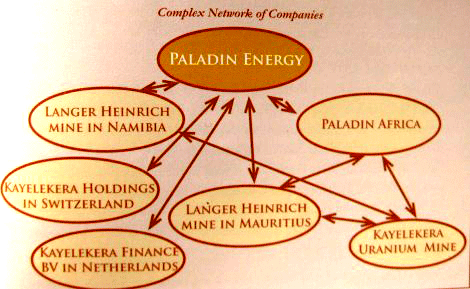
At the launch of the report, Dalitso Kubalasa and Collins Magalasi, the executive directors of MEJN and AFRODAD respectively, spoke briefly before AFRODAD’s Tafadzwa Chikumbu presented the research findings. This paved the way for a lively question and answer session with questions raised about whether or not parliament is ready to renegotiate the terms of the agreement with Paladin, what has happened to the man who lost his sight due to “kayelekera radiation” and if mining revenue in Malawi therefore “dirty money”.
This discussion was followed by the official launch of the report by the Second Deputy Speaker of Parliament Juliana Mphande who exclaimed that she was “appalled to note that incentives offered to Paladin have severe implication to Government revenue and require attention of parliament”. She outlined the areas requiring parliamentary investigation and debate…..
Below is a summary of the main findings: Continue reading
Lack of health regulation for workers in Australia’s overseas uranium mines?
 Comment on article Man loses sight due to Kayelekera radiation rshaba , 20 May 13, Does this mean that Paladin does not offer protective clothing including protective glasses to its employees? This is a no-brainer for someone dealing with radioactive substance business. I am shocked! It seems Paladin is taking advantage in people’s ignorance by not investing in appropriate protection especially for its front-line employees doing the “dirty” work. I could understand if it were a Chinese or Indian based company,
BUT Australian & Canadian based, my foot! Where are the government regulators? This should be a basic issue on their “checklist”: no protection and insurance cover for front-line staff, no business, simple and straight forward. The problem is that once someone has been exposed to radioactivity then whoever or whatever they come into contact with, will indirectly be exposed to radioactivity. Does the Government run regular radioactive on water, foods etc around the area? http://www.bnltimes.com/index.php/sunday-times/headlines/national/15108-man-loses-sight-due-to-kayelekera-radiation

Paladin Energy blames sub-contractor for poor working conditions at Kayelekera uranium mine
 Man loses sight due to Kayelekera radiation, SUNDAY TIMES, 19 MAY 2013 KAREN MSISKA It is all doom and gloom for a Kayelekera Uranium Mine ex-employee who has lost his sight, his job and any means of eking out a leaving to fend for his extended family.
On July 7, 2010, Abraham Siliwonde started working as a labourer at [Australian] Paladin Africa’s Kayelekera Mine in Karonga bubbling with hope that he would use the remuneration to improve living standards in his household.
But less than three years later, the 31-year-old, along with his six children and five wards from his deceased relatives, is a mere dependent on a small banana business his wife conducts at Karonga town market.
He lost sight in July 2012 and medical examinations have linked his condition, uveitis or inflammation of the uvea – the part of the eye that contains the iris and ciliary body and choroid – to exposure to radioactive chemicals.
Uranium ore is known to be highly radioactive.”In February 2012, I was moved to spotting. This is where one stands and guides the dumpers on where to drop the uranium ore from the pit as it is set to get into the crusher, the first point in uranium processing,” said Siliwonde on Friday.
“I was guiding dumpers carrying high grade uranium ore; the other grades are low and medium. I could feel intense heat from lumps of uranium ore and the next day I would be passing yellowish urine and feeling malarial symptoms.” He said regardless of the gear one puts on while at spotting, they feel the heat being emitted by the uranium ore, stressing “the situation is worsened by supervisors who keep people there longer than more productive.”
He said he was drafted into driving dumpers in January 2012 but by July, he had lost his vision and instead of working, he was a continuous visitor to health facilities seeking to restore his vision. “After a series of visits to the mine clinic at Kayelekera, I was referred to Karonga district hospital where I was further referred to Mzuzu central hospital on 30 November 2012,” he added.
“At Mzuzu Central Hospital, they asked whether I had an eye operation before because they said my eyes had cracks. I underwent strenuous tests but after telling them the environment I was working in, they identified exposure to radiation as the possible cause and referred me to Kamuzu Central Hospital.”
According to medical documents The Sunday Times has seen, Siliwonde’s reference to Kamuzu Central Hospital’s Lions Sight First Eye Hospital was “to determine if patient’s condition may indeed be due to uranium dust exposure.” His situation was not improving even with spectacles. A reference report dated April 15, 2013 indicates that Siliwonde’s acuity (sharpness of vision) for both eyes had slightly improved to 6/36 from 6/60.
A report signed by Dr J Msosa, Chief Ophthalmologist at Lions Sight First Eye hospital, confirms exposure to radiation as the possible cause.
Part of the report reads: “The vitritis (posterior uveitis) may indeed be due to exposure to radiation. It is well known that all radioactive substances can cause radiation retinopathy which appears like posterior uveitis………
“The only source of income is a small banana business my wife conducts. It’s a pity that the situation at Kayelekera is not closely monitored. A lot of people are suffering because they are exposed to radioactive dust blowing from the pit area since the surface is not kept wet as per agreement.”
However, Paladin officials pushed the bucket to one of their contractors. In response to an emailed questionnaire, Paladin Energy Limited’s General Manager – International Affairs, Greg Walker, said Siliwonde was employed by one of their contractors at the mine. He added that the issue has not been brought to Paladin’s attention……http://www.bnltimes.com/index.php/sunday-times/headlines/national/15108-man-loses-sight-due-to-kayelekera-radiation
Australia should not lock in to selling uranium in the highly unstable Middle East region
 The UAE is a collection of seven emirates including Abu Dhabi and Dubai and has one of the least participatory political systems in the world. In the most recent national election in 2006, only 6889 people – less than 1 per cent of the population were entitled to vote, and they were hand-picked by the national rulers.
The uranium sale treaty currently before the Federal Parliament’s joint standing committee on treaties, states that the agreement “shall remain in force for an initial period of thirty years
The treaty would lock us in to supply uranium to the UAE irrespective of political changes or upheavals in the region
Think again, minister, on uranium deal with Emirates http://www.smh.com.au/comment/think-again-minister-on-uranium-deal-with-emirates-20130513-2jh5d.html#ixzz2TDVaKzxm May 13, 2013 Dave Sweeney
It might surprise many Australians to know that Foreign Minister Bob Carr is moving forward with a deal to sell Australian uranium to the United Arab Emirates – a country with an illiberal government situated in one of the most volatile and insecure regions in the world. Continue reading
Time to stop the exploitation of poverty-stricken Niger by rapacious foreign uranium companies
the grievances expressed by representatives of local populations in the mining zones and pastoral peoples as well as government representatives. Concerns relate to radioactive pollution, water resource depletion, work-related diseases for mine workers, and the appropriation of land and water resources, including legally enshrined common property regimes and pastoral territories, without required compensation.
It is widely acknowledged among government staff that the Nigerien government is not able to properly implement its environmental legislation and monitor the uranium mining industry.
Niger: Development Cooperation Must Support the Environmental Governance of Uranium Mining THE ISN BLOG, Rasmus K Larsen 2 May 2013 Niger’s new development strategy, the Economic and Social Development Plan, is also intended to guide international development cooperation. Environmental governance of uranium mining, the country’s by far largest single economic activity, appears hitherto to have constituted a ‘blind spot’ for environmentally oriented development cooperation. It is now time to remove the blinkers and include support to strengthen environmental governance of the mining sector in new programmes to assist Niger in meeting its development challenges
Niger is well known in international media as one of the world’s poorest countries, struggling with chronic structural hunger and malnutrition. UNDP ranks Niger 186 out of 187 countries in the Human Development Index, and in 2011, five million people (33% of Niger’s population) were at ‘high risk’ to food insecurity.
What is less well known is that Niger also hosts the fourth largest uranium production in the world. Export values totalled over EUR 348 million in 2010, representing more than twice the total development assistance finance received during the same year. However, the state retains less than one fifth of the value of the uranium ore that is exported. The exploitation of the mineral wealth by international investors is expanding, with granted and requested mining concessions comprising close to 10% of the national territory…….
Attention to environmental impacts or risks associated with the mining sector goes seemingly without mention in the guiding documents of the principal development partners, including the EU, the World Bank, the UNDP, and the African Development Bank.
Severe environmental governance issues Continue reading
Uranium mining company Paladin – seen as The Ugly Australian, in Malawi
 Of the profits made, Paladin, for instance rakes in about 80% and has a paltry 1.5% for the Malawi nation
Paladin says in one breath it paid over U$5.6 million in taxes to the Malawi government, and in its other breath through its published annual report, indicates it paid about U$9.3 million in taxes.
the British silently stole our uranium and left when their projections did not add up to their whims, and now we have the Aussies who are refusing to deal fairly.
Killing Malawians through the rotten extractives deals: The case of Paladin’s uranium mining http://www.nyasatimes.com/2013/04/24/killing-malawians-through-the-rotten-extractives-deals-the-case-of-paladins-uranium-mining/ Patricia Masinga, April 24, 2013 Malawi has in the few weeks been engaged by a plethora of stakeholders discussing strategies to revive, or more on the ground, reclaim the benefits that Malawians are been milked of by the so-called extractive industry multi-national corporations.
They call themselves investors, and government believes that the Malawi Development Goals (MDGs – who cares if it’s the second phase) will be boosted, particularly that mining alone through Kayerekera of Paladin Energy Limited group of companies (trading as Paladin (Africa) Ltd in Malawi?) could provide a large economic base.
But that is all a fat lie. Paladin and many other foreign multinational mining countries are least interested to contributing to the Malawi economic growth. They are here to milk the country – exploiting all that it has rich in minerals and dump us when the time is right even poorer.
Imagine, to screw Malawians of their rightful economic gains, the company, incorporated in Australia first listed on the Australian Stock Exchange (ASX) on March 29, 1994 under code ‘PDN’, and quickly changed its name from Paladin Resources NL to Paladin Resources Ltd in 2000 and listed under the Toronto Stock Exchnage (TSX) in Canada April 29, 2005, and again changed its name to Paladin Energy Ltd in November 2007 and listed on the Namibian Stock Exchnage on February 2008.
By such trends, one is compeled to question the motive, Continue reading
Nuclear war risk heightened by USA ”Air Sea Battle” concept in the Pacific
 Why Australia Fears the United States The Disaffected Lib, 14 April 2013 Since coming into existence in 1776, the United States has enjoyed just 21 “war free” years. The last four of those were under president Jimmy Carter who didn’t see much point in blowing other people, their kids and all their stuff into smithereens just to make a point. No wonder he was so reviled.
Since Bush/Cheney rode into Washington, the United States has become our world’s only true Warfare State. Obama, despite his claims to the contrary, has kept the tradition alive and well.
When Canadians consider our country’s relationships with America, we too readily forget that it is a true, warfare state. That affects the way it works, the way it deals with other countries like our own, and the decisions it takes for the future. If you have any doubt about this, read Andrew Bacevich’s The New American Militarism reviewed here and here and here.
USA’s military strategy in the Pacific could lead Australia into a nuclear war
|
|
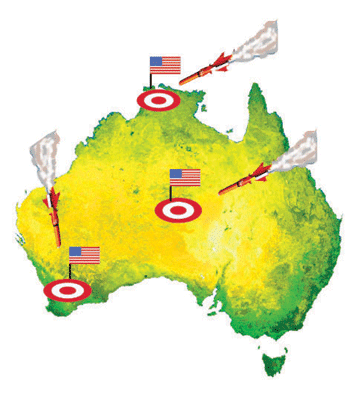 US strategy could result in nuclear war,
The concept risks making the Chinese military an enemy.
The paper, written by the institute’s senior analyst for defence strategy, Benjamin Schreer, urges the Australian government to keep a cautious distance from the plan for now. Australia would likely play a role in the strategy, particularly with US Marines stationed in Darwin. The plan assumes any conflict between the US and China – most likely over Taiwan or Chinese skirmishing with Japan – would remain below the level of nuclear strikes.
But Dr Schreer writes that “such an outcome is far from certain”. Part of any US plan to strike at China would involve “blinding” the People’s Liberation Army by hitting its surveillance, intelligence and command systems.
This could provoke panic on the Chinese side and “consequently increase the chances of Chinese nuclear pre-emption”, he writes.
“AirSea Battle thus raises the spectre of a series of miscalculations on both sides if Beijing perceives conventional attacks on its homeland as an attempt to disarm its nuclear strike capability.”
The paper coincides with rising tensions between China and Japan over territorial disputes in the East China Sea, and between China and Vietnam in the South China Sea.
US military planners are developing the AirSea Battle plan in response to the shift in the strategic balance as China’s growing military might threatens to end more than half a century of US dominance on the western Pacific rim.
China’s long-range missiles, submarines and stealth bomber squadrons could soon threaten US bases and aircraft carrier groups in the region, potentially deterring the US from coming to the aid of Taiwan or Japan in the event of a conflict.
The plan sees US forces withstanding the first round of Chinese attacks, then carry out their “blinding” campaign. US carrier battle groups would then hit Chinese missile launchers. Meanwhile, US submarines and long-range missiles would strike at the Chinese airforce. The US could also blockade oil supplies and other resources – likely with Australian help.
While Australia would inevitably be drawn into any such conflict, the institute urges the government not to publicly endorse the plan for now, but rather demand a clearer explanation of how Washington would enact the plan, and its political goals. “[It] risks making the Chinese military an enemy” when the US, Australian and allied grand strategy is ”aimed at integrating Beijing in a co-operative Asian security order”.
Australian uranium company Paladin will now have to renegotiate its deal with Malawi
 Malawi to renogotiate with Paladin on the Kayerekera uranium deal http://www.malawitoday.com/news/128733-malawi-renogotiate-paladin-kayerekera-uranium-deal 14 April 2013, ZODIAK RADIO Malawi has finally succumbed to pressure from activists to start re-negotiating with Paladin Africa Limited on the Kayerekera Uranium deal in a last ditch attempt to create a win-win situation.
First on the proposal is to remove the confidentiality clause on the agreement such that it be made public before rectifying other strings within the deal.
Minister of Mines Mr John Bande confirmed that discussions are underway with Paladin Africa Limited on the matter.
“We are working out on modalities to discuss in public the agreement between Kayerekera and the Malawi Government,” said Bande.
Bande blamed the previous regime for putting a confidentiality clause on the license. “Now government is working to remove that clause so that the deal can be discussed in public,” said Bande.
Critics have continuously called on government to re-negotiate the license, saying Malawi is getting a raw deal from it.
Issued in 2009 the Kayerekera uranium mine license is for a period of 15 years and is subject to renewal.
The license among others also allowed the miner to open an off-shore account.According to the deal, Malawi was meant to be collecting a meager US$ 100 million in taxes annually from the deal.
Necessity for Australia to promote a nuclear free Middle East zone
How, then, are we to explain Australia’s relative inaction when it comes to supporting moves to denuclearise the Middle East? The only plausible explanation is the close relationship with the United States. Australia’s political leaders appear unwilling to say or do anything that might be construed in Washington as conflicting with US priorities and preferences.
What might a more independent Australia do to promote a Middle ……East WMD-free Zone? Four modest but important initiatives suggest themselves. The first would be a prime ministerial statement strongly supporting the establishment of such a zone and explaining how this objective is in line with Australia’s security and economic interests…….
11 April 2013 Joseph Camilleri and NAJ Taylor
Despite Australia’s obvious national interests in the Middle East, our leaders have been strangely silent about the alarming security threats in that region, write Joseph A Camilleri and NAJ Taylor.
Weapons of mass destruction – biological, chemical and nuclear – are once again buzz words in the international corridors of power. In Australia, North Korea has attracted media headlines, but the more disturbing and far less predictable situation unfolding in the Middle East has yet to receive the attention it deserves.
The unresolved Israeli-Palestinian conflict, the Iran nuclear dispute, Western-led interventions, popular uprisings, conflict in Syria, and actual and potential regime changes have combined to create a highly volatile and dangerous security environment in that region. Continue reading
North Korea’s declaration about a nuclear attack
With the world on alert, experts say North Korea does potentially have the capability of hitting Australia with a missile – but only if they’re very lucky.
University of NSW Professor of International Security Alan Dupont recently told defence correspondent Ian McPhedran that North Korea had only a “rudimentary” intercontinental ballistic missile system.
“The capability is pretty rudimentary and has more to do with pretence than substance,” he said.
North Korea declares it has given approval for a nuclear attack on the United States VIDEOSand GRAPHICS
- From: News Limited Network http://www.news.com.au/world-news/north-korea-gives-final-approval-for-nuclear-attack-on-united-states/story-fndir2ev-1226612136732
- April 04, 2013
- North Korean army says it has ‘final approval’ for nuclear attack
- United States to move anti-missile system to Guam
- Two advanced missile destroyers moved closer to North Korea
-
NORTH Korea says it has approved a nuclear attack on the United States in its latest threat as US Defence Secretary Chuck Hagel warned Pyongyang to back down. Continue reading
Discontent in Malawi over Australian uranium company Paladin’s mining deal
There is growing belief among some sections of the society that Malawi is losing out on the Kayerekera mining and have since called on the government to renegotiate the deal.
Leader of Malawi’s opposition People’s Transformation Party (Petra) Kamuzu Chibambo — who is also a prominent lawyer— said unless the deal were renegotiated, Malawi would continue to lose out in the mining sector and called upon all Malawians to galvanise their voices to press government to enter into negotiation with the miners.
Paladin has MK3.9bn environmental bond for Malawi uranium mine -Walker, Nyasa Times, 3 April 13, Australian Miner Paladin Energy Limited, operators of the Kayerekera Uranium Mine in Karonga district have a US$10 million Environmental Performance Bond with two commercial banks in Malawi to among other things cater for rehabilitation costs for signs of default during and after mine life.
“Paladin has a MWK 3.9 Billion (US$10 Million) Performance Bond in place to satisfy the environmental obligations of Clause 18.14(a). This comprises a US$ 5 Million Performance Bond with Standard Bank Limited and US$ 5 Million Performance Bond with Nedbank Malawi Limited,” Paladin General Manager for International Affairs Greg Walker toldNyasa Times in an email response.
The bond, in the form of irrevocable letters of credit, will deal with issues like water and environment contamination and the eventual clean up.
A letter of credit is a letter from a bank guaranteeing that a buyer’s payment to a seller will be received on time and for the correct amount. In the event that the buyer is unable to make payment on the purchase, the bank will be required to cover the full or remaining amount of the purchase.
The bond further obliges the company to sensitize people on the potential dangers associated with radioactive substances and prevention procedures. Continue reading
1 This month
17 October, Free Public Talk on Nuclear Issues in South Australia
David Noonan will speak on public interest concerns over the new Roxby Downs Indenture Act 2026 on BHP copper-uranium mining and ore processing in SA, and on how AUKUS may face SA with a High-Level nuclear waste agenda.
Dr Jim Green will discuss international developments in the field of nuclear power including ‘small modular reactors’ and Generation 4 ‘advanced’ nuclear reactor concepts.


Help Aunty Sue Protect Her Land and Sacred Sites From Destructive Rocket Testing.
.

Australians deserve the truth
about
AUKUS – https://aukuspublicinquiry.com/

PETITION – To: Prime Minister Anthony Albanese and the Australian Labor Government

of the week – Australians for War Powers Reform (AWPR)
To see nuclear-related stories in greater depth and intensity

