Radioactive colonialism – Autralian company Lynas’ rare earths plant in Malaysia
 This little news item from THE AUSTRALIA barely touches on the salient points about Australian company Lynas’ planned rare earths processing plant in Malaysia. It should not be forgotten that:
- Lynas was well into building the plant before it obtained the necessary permissions from teh Malaysian government
- The plant is in a highly populated area (unlike the rare earths plant in China, which radioactively polluted a huge area)
- Lynas wanted to go ahead with no plan for the permanent disposal of its radioactive wastes
- No doubt the waste disposal problem was Lynas’ reason for not planning the rarenearths processing plant in Australia. As with Australian uranium mining companies in Nigeria, Tanzania etc – another example of radioactive colonialism. – Christina Macpherson
Lynas licence decision date set for Malaysian plant, THE AUSTRALIAN, BY: ROSS KELLY January 05,“………Malaysian authorities have indicated the Atomic Energy Licensing Board will meet January 30 to decide whether Lynas should be granted a temporary operating license, Lynas said in a statement to the Australian Securities Exchange. The decision is then expected to be tabled to a full session of the Malaysian cabinet. …
Rare earths typically occur in deposits that contain uranium and thorium, meaning radioactive waste is present in tailings that require safe disposal. Activists and some politicians have actively campaigned against the Malaysian processing plant, prompting authorities to ask the International Atomic Energy Agency to review the $232 million
development that’s almost complete.
A report by the IAEA in June largely backed the plant, while recommending Lynas deliver a plan for dealing with its waste.
A temporary license will allow the company to ramp up production at the Malaysian facility to nameplate capacity and sell its products, Lynas said. If Lynas complies with the strict monitoring and government oversight requirements of the temporarily license, a permanent operating licence can be issued within two years. …
http://www.theaustralian.com.au/business/mining-energy/lynas-plant-license-decision-set/story-e6frg9df-1226237278015
Australia should rethink policy on uranium sales to India – safety and corruption risks
 Australian senator slams India’s nuclear sector, Australia network news, 27 Dec 2011 An Australian Greens Senator has said India’s nuclear sector is set to become more irresponsible, and wants Australia to rethink its policy to sell uranium to the country. Senator Scott Ludlum made his comments after India announced plans to replace its independent nuclear regulator with a government-controlled body.
The decision comes just weeks after Australia announced it would begin selling uranium to India’s civilian nuclear program. Senator Ludlum told Connect Asia after Japan’s nuclear disaster in March this year, governments around the world were having second thoughts about how to regulate uranium.
“Because the technology is so unforgiving, and when things go wrong they go so seriously wrong, you need to have an exquisite safety culture to maintain this equipment,” the Western Australian Senator said.
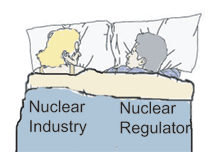 Corruption risk The Atomic Energy Regulatory Board will be replaced with a safety authority answerable to government ministers, which Senator Ludlum said could suffer from government interference. “On a day to day basis they will actually have the ability, from the prime minister down, to direct the regulator, force it to investigate or not investigate certain kinds of activities and, I think, quite improper use of national interest tests to decide what the regulator should do.
“Not just in India, but everywhere around the world where this technology is used, you need to be completely at arms length and you need have a fiercely independent regulator to stick its nose in wherever it thinks it’s appropriate,” he said.
“The last thing you want is something that’s just a puppet of the top tiers of government and that’s what the Indian movement and Indian officials are telling us is occurring here,” the senator said. http://australianetworknews.com/stories/201112/3398569.htm?desktop
Greens Senator helping Julian Assange, amid silence from Australian government on Assange’s human rights
Scott Ludlam (left) in Europe to ‘protect Julian Assange’s human rights’ Herald Sun, : AAP December 26, 2011 SWEDISH officials have met an Australian senator to discuss the future of WikiLeaks founder Julian Assange. As extradition proceedings against the 40-year-old Australian continue in London, Greens Senator for Western Australia Scott Ludlam has
embarked on a European mission to secure guarantees about Assange’s human rights, should he be extradited to the Nordic nation. Swedish prosecutors want Assange in Stockholm for questioning over allegations that he sexually assaulted two women in the capital inAugust 2010.
Assange denies the claims and is refusing to return to Sweden, fearing that the country will hand him over to the United States, where his secret-leaking website is the subject of a major investigation……
From February 1, Assange will face a panel of seven British supreme court justices for a two-day hearing where he will appeal the rulings of lower courts that he should be extradited to Stockholm.
Senator Ludlam plans to take the information he has learned in Stockholm to the Australian Parliament and seek cross-party support for the Government to do “everything possible to prevent this
extradition”. http://www.heraldsun.com.au/news/world/greens-senator-scott-ludlum-in-europe-to-protect-julian-assanges-human-rights/story-e6frf7lf-1226230346843
 Experts said the evidence may open Assange to a charge of conspiracy to commit espionage. Assange to face US spy charges Courier Mail, December 25, 2011 JULIAN Assange may face spying charges in the US for his alleged role in stealing military documents. During this week’s hearing into the Private Bradley Manning case at
Fort Meade, Maryland, lawyers produced online chat logs which purport to show that the 40-year-old Australian coached Mr Manning on how to break passwords and gain anonymous access to military computer networks, The (London) Times reported. Continue reading
Australian Conservation Foundation calls on Labor to reverse decision to sell uranium to India
And none of this was clear or apparent at the time that 55, only 55 per cent of delegates at the ALP national conference put their hand in the air and said let’s sell uranium to India.
India has given nothing away and in return India has eroded global will, including Australia’s, and has been welcomed into the nuclear fraternity. …
 ACF concerned by change in India’s nuclear regulation, http://www.abc.net.au/worldtoday/content/2011/s3397198.htm ABC Radio – The World Today Samantha Donovan reported this story , December 23, 2011
TANYA NOLAN: Environmentalists are urging the Federal Government to reverse its decision to sell uranium to India after that country announced it will dismantle its independent nuclear watchdog. The Australian Conservation Foundation says it’s to be replaced by a new government-run body.
Samantha Donovan reports. SAMANTHA DONOVAN: The Indian parliament is considering legislation to replace the expert panel that acts as its nuclear watchdog with a body largely made up of government ministers and chaired by the prime
minister.
It’s only a couple of weeks since Labor’s national conference voted to overturn its longstanding ban on selling uranium to the subcontinent and the Australian Conservation Foundation’s national nuclear campaigner Dave Sweeney says he’s deeply concerned by India’s plans.
DAVE SWEENEY: It is a troubling development. It is a development that has a material bearing and interest on the decision made by the Australian Labor Party narrowly at the start of December to open the door to uranium sales to India. We have started the month with the Australian Government opening the door to uranium sales; we’ve ended the month with the Indian government closing the door on nuclear
scrutiny. Continue reading
Australia backing India for U.N. Security Council, despite India’s nuclear weapons boom
Can you believe it? Australia is now likely to lose its bid for a seat on the United Nations Security Council, because it has decided to disregard India’s nuclear militarism – in particular, India’s refusal to sign the Nuclear Non Proliferation Treaty.
But hey, the Australian governmnet now has the gall to back India, even as India is ramping up its long range nuclear missile production, – to back India’s bid for a seat on the U.N. Security Council.
This is likely to be seen as two militaristic nations backing each other. – Christina Macpherson

 Aus supports India’s claim for permanent UNSC seat, The Economic Times, 8 DEC, 2011, NEW DELHI: Australia supported India’s claim for a permanent seat in an expanded UN Security Council and said the decision of its ruling party on supplying Uranium to New Delhi has removed any “potential irritant” in their growing bilateral relationship.
On a three-day visit to India, Australian Defence Minister Stephen Smith said the two countries have also agreed to look into prospects of enhancing practical military cooperation by holding bilateral naval exercises in future. … http://economictimes.indiatimes.com/articleshow/11032000.cms
Contrary to Ziggy Switkowski’s dreams, Australia must not sell uranium to Pakistan
Why Australia must not sell uranium to Pakistan, The Conversation, Peter Meyer 7 December 2011  Predictably, Pakistan is seeking equal treatment with India on uranium sales from Australia……The activities of the AQ Khan network in selling equipment and technology to other states show Pakistan to have been an active proliferator (as Adrian Levy and Catherine Scott-Clark point out in their book, Deception: Pakistan, the United States and the Global Nuclear Weapons Conspiracy). And the military establishment under whose wings Khan – the father of Pakistan’s nuclear programme – operated still dominates public affairs in Pakistan, even under an elected government…..
Ziggy Switkowski spruiks for Australian uranium sales to Pakistan
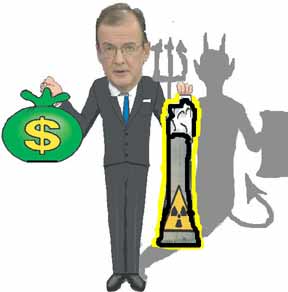 Pakistan a potential uranium customer, says Australian nuclear expert, The Nation, 6 Dec 11 An Australian nuclear expert Dr Ziggy Switkowski said that Australia will have to consider selling uranium to Pakistan in the future after agreeing to export it to India…..over time, as they gain the confidence of the international community and the civilian nuclear program builds, they will need to be considered.”
Earlier, Pakistan’s High Commissioner to Australia, Abdul Malik Abdullah said if Australia is willing to export uranium to India then it should sell it to Pakistan as well.
Abdullah said, “If Australia is going to lift the ban on a country which has not signed NPT (Nuclear Non-Proliferation Treaty) it is much hoped that will also apply to Pakistan the same way.” Australia’s ruling Labour Party voted to overturn a decades-old ban on uranium sale to India, paving the way for Canberra to supply yellowcake to a nation outside the NPT.
Sell uranium to us, too, says Pakistan to Australia
 Pakistan says it should get Australian uranium News.com.au , 5 Dec 11 PAKISTAN’S High Commissioner to Australia says if the Federal Government sells uranium to India it would be discriminatory for it not to sell it to Pakistan as well. Yesterday, the ALP overturned its ban on the sale of uranium to India after a divisive and passionate debate at the party’s national conference in Sydney.
Abdul Malik Abdullah said Australia should sell uranium to Pakistan as well, as India has not signed the nuclear Non-Proliferation Treaty (NPT). “If, after the ALP’s decision, the Australian Government is going to change the policy, all we would like to have is an equitable and non-discriminatory decision,” Mr Abdullah told ABC Radio.
“If Australia is going to lift the ban on a country which has not signed NPT it is much hope that will also apply to Pakistan the same way.”…. http://www.news.com.au/business/breaking-news/pakistan-says-it-should-get-australian-uranium/story-e6frfkur-1226213787193#ixzz1ffbvy7PN
Kevin Rudd now denies plan for India, USA, Australia defence pact
Australia government denies backing India, U.S. security pact, Dec 2, 2011 (Reuters) – Australia denied on Friday it was pushing for a joint security pact with India and the United States, a tie-up that would likely add to China’s fears that wary neighbors were trying to encircle it.
Foreign Minister Kevin Rudd was quoted in an interview with the Australian Financial Review newspaper this week as backing the idea of a trilateral security pact. But a Rudd spokeswoman said he had been misinterpreted and had been responding to a question on the likely overturning soon of an Australian ban on uranium exports to India……
India’s foreign ministry spokesman said in a statement on the ministry website that New Delhi was “not aware of any such proposal”, while China’s military denounced the United States and Australia for recently upgrading military ties, warning such moves could erode trust and fan Cold War-era antagonism.
China is Australia’s biggest trading partner, with two-way trade in 2010 worth A$105 billion ($107 billion), up almost 24 percent on the previous year and driven by energy-hungry Chinese demand for Australian resources….. http://www.reuters.com/article/2011/12/02/us-china-us-australia-idUSTRE7B10BB20111202
Australia to join USA-India defence pact – antagonising China
 U.S. officials have been particularly pushing Canberra to commit additionally to construction of a new fleet of 12 powerful missile submarines — possibly of U.S. design — in what would be the country’s largest sole defence acquisition.
URANIUM SALES TO INDIA…Rudd told the Australian Financial Review that a looming weekend vote and expected approval by Australia’s ruling Labor Party to drop a longstanding ban on uranium sales to non-Nuclear Proliferation Treaty countries like India could help clear the way for formation of a new pact.
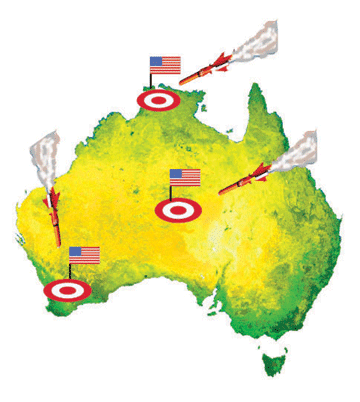 Australia backs security pact with U.S., India, By Rob Taylor, Additional reporting by Sui-Lee Wee in Beijing, Editing by Ed Davies and Jonathan Thatcher), CANBERRA | Wed Nov 30, 2011 (Reuters) – Australia’s foreign minister on Wednesday backed the formation of a security pact with India and the United States, a tie-up that could fuel China’s worries of being fenced in by wary neighbors.
It is the latest move by Australia to take a bigger role in the region’s security. Earlier this month, it agreed to host a de facto U.S. base in the north of the country which would provide military reach into southeast Asia and the South China Sea, where China has disputes with several other states over sovereignty…..
It was unclear why Rudd, a Mandarin-speaking Sinophile, would risk irritating Australia’s top trade partner China which is already nervous that Obama’s latest diplomatic push into the Asia-Pacific is part of broader U.S. policy to encircle it…..
prominent Chinese military commentator, People’s Liberation Army Major General Luo Yuan, said this week that Washington was clearly trying to fence in Beijing. Continue reading
Australia has now weakened its case to get on the United Nations Security Council
Opposition was led by Norway, Austria, and Mexico, with powerful support from the Cluster Munition Coalition, the International Committee of the Red Cross (ICRC), and a large number of UN agencies, notably the UN Development Program, the Office for the Coordination of Humanitarian Affairs and the Office of the High Commissioner for Human Rights.
Which got me to thinking about Australia’s bid for a seat on the UN Security Council.
It its core pitch document, Australia prioritises active participation in “international peace and security” as it’s second highest contribution to the UN over its 65 year history. ….
Australia:…
- initiated the Canberra Commission on the Elimination of Nuclear Weapons and, more recently with Japan, the International Commission on Nuclear Non-Proliferation and Disarmament
Arguably, enough has been done in November to all but unravel Australia’s UN Security Council message that proudly states, ”Australia: We do what we say”.
Obama’s Darwin naval base ….
Cluster munitions ratification
…..the provision in the legislation explicitly permitting stockpiling will remain, and many are rightly worried that a future – or present – government may reneg on their stated commitment. Labor under Rudd and Gillard have, certain WikiLeaks cables have revealed, taken an active role behind the scenes to dilute the standard limiting the production, trasnfer and use of cluster munitions…….
Gillard’s about-turn on uranium ….
..Most worryingly, if approved, this action would go completely against the Australian-sponsored International Commission on Nuclear Nonproliferation and Disarmament report in 2009:……
Wither Australia’s normative leadership Combined with a perceived level of indifference for the rule of law during the 2003 invasion of Iraq, and the Gillard governments voting against Palestine’s UNESCO membership, it is inconceivable that Australia may reasonably pitch themselves as principled and responsible international citizens at this time
India’s nuclear future now shaky – might not need Australia’s uranium
In the shadow of increasingly fierce grassroots opposition, India’s nuclear ambitions – and Australia’s future uranium cash cow – are looking decidedly less promising.
 India’s nuclear ambitions come up against people power, BY:AMANDA HODGE, IDINTHAKARAI, TAMIL NADU :The Australian . November 26, 2011 1 India’s Koodankulam nuclear power project is like the proverbial cockroach in an atomic storm. It has survived the fall of the Soviet Union, the assassination of an Indian prime minister and the Boxing Day tsunami, when waves surged over the site where it now stands.
The first of six reactors to be built on the shore of India’s southernmost tip in Tamil Nadu was to have been switched on next month, 23 years after Mikhail Gorbachev and the slain Rajiv Gandhi signed off on the friendship project.
Instead it has hit another obstacle – an emerging national anti-nuclear campaign that has gained serious momentum since Japan’s Fukushima meltdown in March. Continue reading
Radiation health effects from rare earths plant – a warning for Australian company Lynas
 Industrial health expert T Jayabalan told FMT that he lived in Bukit Merah for three years during the 1980s, “collecting data” on the residents there. According to him, Lai Kwan and Cheah were only two of the many people he studied before presenting his findings to Malaysian courts. “Birth defects still exist,” he said, “and the number of miscarriages is incredibly high. Even if a foetus survives, it can still be born with leukemia and brain damage.”
“I’ve seen it happen with my own eyes. I’ve seen the suffering of these people. The only good thing about Lynas is that it hasn’t happened yet.”
 (includes VIDEO) Inside the world of a radiation victim, Free Malaysia Today Patrick Lee, November 24, 2011 VIDEO Tan Chui Mui’s short documentary is also about a mother’s undying love. Cheah was born in 1983, a year after Lai Kwan worked as a bricklayer at the Mitsubishi rare earth plant in Bukit Merah, Perak.
Cheah has multiple congenital defects, including a hole in the heart. He is also mentally deficient and virtually blind. And Lai Kwan is beside her son nearly every hour of her life, as portrayed in a short film entitled “Lai Kwan’s Love”…..
she tells the camera that she had no idea that the rare earth plant where she worked was handling toxic materials. Continue reading
Australia’s discriminates in favour of India, on uranium sales
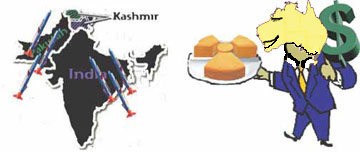 India is not a party to the NPT, has never been, has developed a nuclear weapons capability as a non-member of the Treaty, and accordingly, is in an entirely different position from China vis a vis Australian uranium export policy..
Surely the more appropriate sequence would have been to have the Cabinet discussion first, and make a fully-informed decision as to whether or not a change in the policy is desirable, and what its ramifications are, then take the matter to the party if needs be, armed with the support of a properly considered Cabinet decision…… Once she has made an exception for India, what is she going to say to our allies in Pakistan and her dear friends in Israel?
Nuclear policy and process dumped at the drop of a hat, The Drum, Paul Barratt, 21 Nov 11 The announcement by the Prime Minister that she intends at the forthcoming ALP National Conference to seek a change in the Party’s Platform to permit the export of uranium to India is of concern on three grounds: the content of the policy change; the apparent failure to extract anything in return for what is by any measure a major policy shift; and the extraordinary decision-making process by which this change is to be brought about.
The change has been presented publicly as little more than an administrative matter designed to correct an anomaly in our current export policy. The narrative runs that the policy discriminates against India because we are prepared to export uranium to China, a nuclear weapon state, but not to India for peaceful use. This is arrant nonsense. Continue reading
Australia will now be expected to sell uranium to Pakistan
Like India, Pakistan is a nuclear armed state that refuses to sign the NPT. There is no doubt the Islamabad will be keeping a close eye Canberra and on Darling Harbour come Labor’s National Conference in December.
Inevitably, if Labor moves to sell uranium to India then Pakistan will make a political and diplomatic point of being the next cab in the radioactive rank.
If Australia sells uranium to India, will Pakistan be next?, November 18, 2011 Crikey , Dave Sweeney Uranium is both common and controversial in resource rich Australia. It is tricky stuff as it can be used to produce electricity or to fuel nuclear bombs. And India has both…….
A recent high level UN report makes the nuclear power and weapons connection clear and has a special relevance against the current backdrop of pro-sales positioning.
In the shadow of the continuing Fukushima nuclear crisis the September 2011 UN report plainly states: “Nuclear science and technology can also be used to develop nuclear weapons. Compliance with international legal instruments, such as the Treaty on the Non-Proliferation of Nuclear Weapons, other bilateral and multilateral non-proliferation agreements and safeguards agreements with the IAEA, is therefore an essential element of the responsible use of nuclear power.”
Australia, as a significant global uranium supplier, has a responsibility to act responsibly. Different rules should apply to uranium supply than to other less destructive and divisive exports. Continue reading
1 This month

of the week – Australians for War Powers Reform (AWPR)
To see nuclear-related stories in greater depth and intensity
 Antinuclear