Australia’s major parties ignore climate change and renewable energy

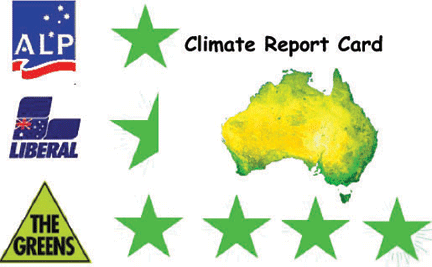 Despite efforts by some media to bring climate change to the forefront – as witnessed by the SMH editorial today – such pleas are likely to fall on deaf ears in the current campaign.
Neither Treasurer Chris Bowen nor Opposition spokesman Joe Hockey mentioned climate change or a clean energy transition in their hour-long debate on Monday, focusing instead on an absurd argument about revenue and budget forecasts in forward estimates – a complete irrelevance to everyday Australians and the major issues confronting the country.

 Renewables future no more costly than fossil fuels REneweconomy, By Giles Parkinson on 21 August 2013“……..The consideration of future costs is a crucial point in the current federal political debate, where policies such as high emission reduction targets and high renewables scenarios – as proposed by The Greens – are seen as reckless, dangerous, marginal or fringe policies.
The frustration is that while such targets form part of the mainstream policy discussion in most other countries, each of the big parties in Australia are as keen as the other to put as much distance between themselves and the Greens. So while most other countries debate how quickly they should be moving to decarbonise the economy, the overall theme in Australia is how slowly it should be done.
The common reason for this is cited as cost to the consumer, but the reality is that the cost to consumer is no greater in these ambitious scenarios than it is under the more modest transitions modeled by Treasury. And if other environmental costs are included, such as the health impacts of fossil fuels, then the numbers change again. Continue reading
Tony Abbott keen to sell uranium to India, but Kevin Rudd is not

 Australia and the great Indian uranium sale debate By Geoff Hiscock, CNN August 20, 2013 “…….Both the Labor and Liberal parties have a policy that they will sell Australian uranium to energy-starved India. So on paper, it looks like a bipartisan position.
But Rudd is a reluctant helmsman for his party’s policy, believing India must accept stringent conditions before it gets Australian uranium for its power plants. In his first stint as prime minister in 2007-2010, he was adamant that because India was not a signatory to the nuclear non-proliferation treaty, uranium sales to it were precluded.
He said this was not a policy directed against India, but one that applied globally.
When Julia Gillard, the deputy prime minister who overthrew Rudd for the leadership in June 2010 (before herself being ousted in June this year by Rudd), decided to push through a Labor Party policy change on the uranium issue in late 2011, Rudd was not consulted.
Rudd has said that India does not need to source uranium from Australia. It gets most of its supply now from Russia, France and Kazakhstan.
Abbott’s Indian ambitions
In contrast, Abbott is happy to see Australian uranium shipped to Indian nuclear power plants. At the India Australia Friendship Fair in Sydney last year, he said: “Yes, we will sell uranium to India because we know that India is one of the world’s great democracies.”……
If Abbott wins office on September 7, expect Australia to give even more priority to India. If Rudd retains office, it will be a case of “steady as she goes.”
Ahead of his last visit to India in 2009, Rudd noted that like most of Australia’s relationships, the one with India “has some bumps in the road” occasionally. “But we can work our way through them,” he said. Uranium likely will continue to be one of those bumps. http://edition.cnn.com/2013/08/19/business/australia-election-india-uranium/
Under Abbott’s “Direct Action” climate policy, the tax-payer pays the polluters
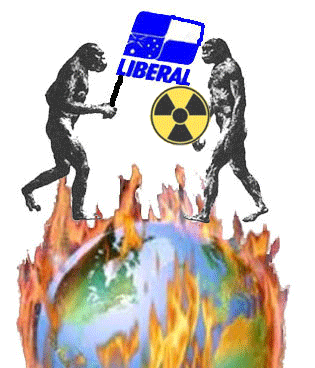 The Coalition’s climate change policy: it’s the public, not polluters, who pay The shortcomings of the Direct Action Plan are striking. If the Coalition is serious about tackling climate change, then it must offer voters a credible alternative to the carbon price The Guardian, Lisa Caripis 19 Aug 13
You don’t have to be a policy expert to realise that if the Coalition is serious about climate change, it will have to take its Direct Action Planback to the drawing board.
Having spent time analysing the parties’ climate change policies for the University of Melbourne’s Election Watch, I’m disappointed that yet another speech by Greg Hunt, the shadow minister for climate action, failed to answer key questions about the Coalition’s climate policy. As it stands, the Direct Action Plan falls short as a policy model for climate action: it’s questionable whether it will enable us to control and reduce our emissions at all, let alone to do so in a way that’s cost effective and fair.
The Coalition has said it accepts the climate science and is committed to Australia’s internationally binding target to cut emissions by 5-25% by 2020. The climate science makes it clear that without good policy intervention, the concentration of greenhouse gases in the atmosphere will continue to rise far above safe levels.
The first move of a Coalition government would be to repeal the laws establishing the current carbon price policy and replace them – by the middle of next year at the earliest – with a policy called Direct Action……..
The Coalition’s policies also jeopardise investment in renewable energy. It has promised to scrap the Clean Energy Finance Corporation, the $10bn body set up to stimulate private investment in renewable and clean energy technologies, and to review the Renewable Energy Target (RET) in 2014. According to the chair of the peak body for the clean energy sector, the uncertainty created by the prospect of a second review of the RET in two years is deterring investment in renewable energy. Coupled with abolition of the carbon price, this uncertainty will make it more expensive to meet the RET.
Some have pointed out that at best Direct Action is a short-term model that is not viable in the long run. Yet the shortcomings of the Direct Action Plan as it stands are striking. If the Coalition is serious about tackling climate change, then it must offer voters a credible alternative to the carbon price. The various iterations of Direct Action the Coalition has presented to us so far simply don’t cut it. http://www.theguardian.com/commentisfree/2013/aug/20/coalition-climate-change-direct-action
Australia’s unbalanced election debate – the environment is left out
One of the Australian economy’s strongest comparative advantages has been the wealth of the nation’s natural environment. Weak laws allow state governments and industry to further undermine this increasingly vulnerable natural resource base. Northern Australia is being targeted for a new era of dam building and agricultural industrialisation. But state water management regimes across the north are a shambles.
Australia’s environment and economy are bound together. Good economic management will protect and replenish our natural wealth. Bad economic management will destroy it.
When the federal election zoo closes down on September 7 the environment and economy will still be bound together. Question is, will the next federal government have noticed?
Environment lost in election zoo http://www.smh.com.au/comment/environment-lost-in-election-zoo-20130819-2s6du.html August 19, 2013 Paul Sinclair Australia’s environment is being held captive in a viewing cage in the federal election zoo.
The environment policy enclosure is located in a dilapidated, hard-to-find part of the zoo.
 (At left, false economic thinking – environment is last consideration )The “economy” is the zoo’s premiere exhibit. The economy spends all day pacing a little square of synthetic grass in a deep, concrete-lined enclosure.
The poor thing is disconnected from every other living thing that has shaped what it is and could be. (At right – true economic thinking, with environment as the resource base)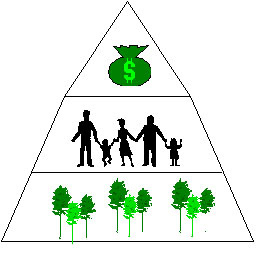
By putting the economy and environment in separate cages Australia fails to properly manage either. Continue reading
What an Abbott government would do to Renewable Energy
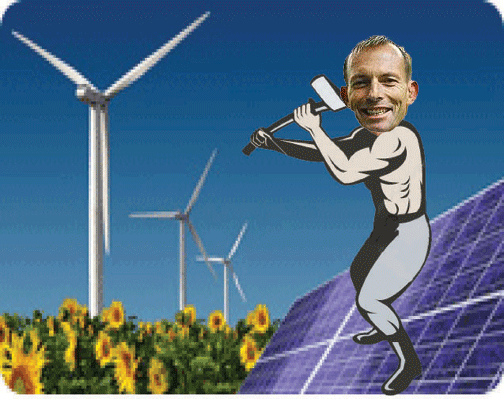
 Election could leave Australia with AUS$4 billion clean energy funding gap http://www.pv-tech.org/news/election_could_leave_australia_with_aus4_billion_clean_energy_funding_gap 20 Aug 13 Liberal Leader Tony Abbott’s climate approach could cut funding and policy incentives for renewable energy. Image: Flickr/TonyAbbott
If the Coalition defeats the current Labor government in Australia’s general election on 7 September, it could create an AUS$4 billion (US$3.7 billion) gap in funding for the renewable energy sector and other carbon cutting measures, research claims.
The centre-right Coalition, which currently leads opinion polls, would repeal the AUS$10 billion (US$9.2 billion) Clean Energy Finance Corporation, a state-backed financing vehicle, but supports the AUS$3 billion (US$2.7 billion) research focussed Australian Renewable Energy Agency, according to a report by the Climate Institute think-tank. Continue reading
Coalition election win would mean $4 billion in private funding sucked away from Australia’s renewable energy industry
Climate of uncertainty August 19, 2013 SMH, Ben Cubby, Tom Arup About $4 billion in private funding would be sucked away from Australia’s solar power and renewable energy industries over the next three years if the Coalition wins government, confidential data obtained from banks and financial analysts shows. Continue reading
Abbott and Rudd’s rush to Northern Territory – destructive to Aboriginal culture
 Rudd and Abbott charge the north Eureka Street Dean Ashenden | 19 August 2013 Kevin Rudd has now joined Tony Abbott in a charge to the North. The common idea is that a substantial fraction of Australia’s population and economic activity can be pushed up and across the northern half of the continent. The assumption is that northern Australia is ours to do as we like with. In fact, it’s not.
Much of Australia’s Aboriginal population lives in northern Australia, and Aboriginal people make up a far higher proportion of the population there than anywhere else. They own or co-own, in both Western legal terms and in customary law, vast tracts of land, many of which are open to non-Aboriginal people only with Aboriginal permission. In northern Australia, Aboriginal people have constructed a distinctively Aboriginal way of life, as different from the mainstream as it is from ‘traditional’ Aboriginal society.
What the major parties are proposing is not necessarily a bad thing from Aboriginal points of view. What is bad is the assumption about our prerogatives. Official Australia has long looked at the north as a tabula rasa awaiting ‘development’, an unmissable opportunity and an infuriating failure. And apparently it still does………
Comment: Nearly forty years ago our family witnessed the process of European take over Aboriginal lands for mining and national parks. This was top end NT – where ‘consultation’ was a token one way talk in condescendingly broken English (‘leaders’ were largely identified by the Europeans as those closest to European culture) and trinkets were offered in the form of land tenure ‘privileges’ and co investments in mining, tourism amongst others along with employment opportunities and western education. I say ‘trinkets’ because most of this was as meaningless as the shiny mirror of eighteenth century. Today, little has changed except perhaps a few more Europeanised Aboriginal people are accepting opportunities on western terms and that makes the statistics look good for those who need them. Definitive statements on health and education policies and employment prospects are announced – ultimate solutions to persistent commitment to Country and cultural bewilderment leading to too many profound personal tragedies. How familiar these ‘new’ solutions are – nothing new, nothing new. The Top End has a very tough climate: towns are airconditioned refuges more often than not, surrounded by comforting gardens of southern or British plants. It is inhospitable to agriculture (we are to be the next ‘food bowl’ – check out the amount of sprays and fertilisers used to grown western foods). And it is only truly understood as an environment and as a living entity in its own right. – Jane .http://www.eurekastreet.com.au/article.aspx?aeid=37087#.UhP0g9Jwo6I
.http://www.eurekastreet.com.au/article.aspx?aeid=37087#.UhP0g9Jwo6I
What exactly IS the Coalition’s “Direct Action” climate policy?
 The Coalition’s climate change policy: it’s the public, not polluters, who pay The Guardian, Lisa Caripis 19 Aug 13 “….. Essentially, Direct Action is a scheme that rewards entities that voluntarily reduce their emissions. So, if you’re an emitter you can propose an emissions reduction project to the government − it might be to improve your energy efficiency, store carbon in the soil or plant trees. The government compares your proposal to other project proposals, and picks the ones that will be the cheapest to implement. If it picks yours, you enter into an agreement to cut your emissions and are paid once you’ve delivered the emissions cuts.
You don’t have to be a policy expert to see where major cracks could form in this policy model. First and foremost, if the cash reward is to be the driving incentive, how large would the pool of funds need to be to drive the level of emissions reductions necessary to meet our 5-25% target? A report published last week estimates that, depending on the level of Australia’s 2020 target, it would cost $4-15bn more than the Coalition has currently budgeted. In fact, the report claims that the funding the Coalition has pledged is so inadequate that emissions would rise by 8-10% by 2020.
Under Direct Action it is the public, not polluters who pay. Is that fair? Unlike under a carbon price, there’s no cost, no disincentive, to keep polluting at the same rate. Indeed, Hunt recently suggested that the Coalition no longer even intends to penalise polluters that increase their emissions. So, Direct Action (ie taxpayer) funded projects would need to cut enough emissions to offset the emissions of non-participants.
Predicting and controlling the trajectory of Australia’s emissions under Direct Action would be quite a challenge. Without an annual cap on emissions or price per tonne of emissions as is in place under carbon price models, how would a Coalition government ensure that we are on track to meet our international obligations and reduce emissions to safe levels? What happens if projects fail to deliver the cuts as promised? Can we afford a policy that could leave our health, communities and property exposed to the substantial risks posed by climate change? …. http://www.theguardian.com/commentisfree/2013/aug/20/coalition-climate-change-direct-action
Australian renewable energy jobs at risk, due to political uncertainty
Climate of uncertainty August 19, 2013 SMH, Ben Cubby, Tom Arup “………The renewables sector, which now employs more people than Australia’s car industry, is nervously awaiting the election result.

”Australia’s significant clean energy potential is being held back by seemingly endless rounds of review and, like the rest of the energy industry, our main need is for policy stability to drive investment in major projects,” said the chief executive of industry group the Clean Energy Council, David Green.
It comes as a survey of businesses found uncertainty about the future of the carbon price has had a negative impact on more than half the responding firms. The survey by consultants AECOM covered 180 leading companies, firms having to pay the carbon price and members of the group Business for a Clean Economy.
It found 65 per cent of businesses supported an emissions trading scheme, while 29 per cent supported a carbon tax. Just 7 per cent of businesses supported the Coalition’s direct action policy.The Business for a Clean Economy group – which was set up to endorse carbon pricing – includes energy giant AGL, furniture retailer IKEA, Westpac and multi-national Unilever.
A spokesman for the group, Andrew Petersen, said: ”While businesses across all sectors are getting on with the job of transitioning to a clean economy, substantial investment is being delayed due to the uncertainty around retention of the carbon price.” : http://www.smh.com.au/federal-politics/federal-election-2013/climate-of-uncertainty-20130818-2s55k.html#ixzz2cYRJLlFn
Confusion in the Liberal camp over climate policy
Liberal candidate unable to explain Coalition’s climate change policy http://www.abc.net.au/news/2013-08-19/liberal-candidate-unable-to-explain-coalition27s-climate-chang/4896078 20 Aug 13,
A Liberal candidate in the northern Adelaide seat of Wakefield has admitted he does not know anything about the Coalition’s climate change policy.
In a debate between Liberal candidate Tom Zorich and Labor member Nick Champion, mediator Peter van Onselen asked Mr Zorich to explain how the Coalition’s Direct Action plan would work.
Mr Zorich told the audience he was not across the issue and did not have an answer.
“I will say to you as the candidate, as a candidate, as a candidate and a businessman I’m not across everything. My opponent has already acknowledged that. I’m sorry Pete, I haven’t got much to tell you about that,” he said.
Mr Zorich’s response was met with jeers from the crowd. Continue reading
Australia’s Major Political Parties fail their Nuclear Test
Major Parties fail their nuclear test, Beyond nuclear, 19 Aug 13, The federal Liberal and Labor parties have scored poorly on a nuclear policy assessment released today by national environment, disarmament and medical groups.Beyond Nuclear Initiative, Friends of the Earth, International Campaign to Abolish Nuclear Weapons and Medical Association for Prevention of War have collaborated to produce an election policy scorecard and website (see attached) to help inform voters about party positions on a range of nuclear issues ahead of the September 7 federal election.Issues canvassed included uranium mining and export, support for nuclear weapons and nuclear power and radioactive waste management.The Coalition received one tick and Labor two while Australian Greens policies scored ten out of ten.“The major parties are out of step with many Australians and failing badly when it comes to responsible and evidence based nuclear policies. Many Australians have considered and continuing concerns and opposition that are not being recognised or reflected in policy,” said Dr Jenny Grounds from the Medical Association for Prevention of War.“Against the backdrop of Fukushima, continuing international nuclear insecurity and the need to grow clean and sustainable energy sources the major parties simply fail the nuclear test,” said Gem Romuld from the International Campaign to Abolish Nuclear Weapons.Beyond Nuclear Initiative coordinator Natalie Wasley said “While the major parties do not openly supports an international radioactive waste dump, they both actively support the controversial plan for a national dump at Muckaty in the NT. The Muckaty plan is inconsistent with industry best practice and Australia’s international treaty obligations and is being challenged in the Federal Court. Radioactive waste lasts longer than any politicians promise and it is time for Canberra to do things differently and better”.Dr Jim Green from Friends of the Earth added, “It is a disgrace and an outrage that the major parties support selling uranium to countries that have not even signed the Nuclear Non-Proliferation Treaty. It is a disgrace and an outrage that both major parties support uranium sales to Russia when they know that safeguards inspections are very nearly non-existent.”Further information and comment:Dr Jenny Grounds 0407 287 684Gem Romuld 0421 955 066Natalie Wasley 0429 900 774Dr Jim Green 0417 318 386

Coalition government would mean $4 billion lost from renewable energy funding
Clean energy faces $4b hit, The Age, 19 Aug 13, About $4 billion in private funding would be sucked from Australia’s solar power and renewable energy industries over the next three years if the Coalition wins government, confidential data obtained from banks and financial analysts shows.
The Coalition’s climate change plan is also about $4 billion short of the funding required to meet its pledge for a 5 per cent cut in greenhouse emissions by 2020, and is instead on track for a 9 per cent increase by then, according to analysis commissioned by the independent think tank The Climate Institute.
Although the Coalition rejects that analysis, major investors are planning for the impact if Opposition Leader Tony Abbott wins power and axes the carbon price and dismantles the clean energy finance system. They expect about $4.1 billion in private funding would be directed away from large-scale renewable power – starving the sector of capital – due to regulatory uncertainty and a lack of solid returns……
The renewables sector, which now employs more people than the car industry, is nervously awaiting the election result.
Clean Energy Council chief executive David Green said: ”Australia’s significant clean energy potential is being held back by seemingly endless rounds of review … our main need is for policy stability to drive investment.”
A major survey of businesses has found uncertainty about the future of the carbon price has had a negative impact on over half the responding firms. The survey by consultants AECOM found 65 per cent of businesses supported an emissions trading scheme, 29 per cent backed a carbon tax and just 7 per cent supported the Coalition’s direct action. http://www.theage.com.au/federal-politics/federal-election-2013/clean-energy-faces-4b-hit-20130818-2s5b9.html#ixzz2cSGq1933
Liberal and Labor pander to mining industry in plan for tax favours to Northern Territory
Greens leader Christine Milne says Labor’s vision for the north panders to the wishes of the mining lobby.
 Gone Troppo: Northern visions just ‘pie in sky’ ABC News, Staff reporters Aug 16, 2013 A respected independent think tank says both major parties are pursuing the worst idea in decades with their plans for tax incentives to encourage investment in northern Australia.
The Australia Institute executive director Richard Denniss says Labor and the Coalition are pursuing bad policy in a bid to win a handful of seats north of the Tropic of Capricorn. “The idea that the national debate should revolve around shifting billions, tens of billions of infrastructure up away from Sydney, Melbourne and Brisbane to chase a few seats up north is politics gone mad,” he said…..
Dr Denniss says it is worrying that there is bipartisan support for the ideas. “There is bipartisan consensus that people in the southern states should continue to pay taxes at the same rate so that we can build new infrastructure, so that people can pay less tax up there,” he said.
“Sydney and Melbourne are creaking under the weight of rapid population growth, and we want to build infrastructure for imaginary cities.” Continue reading
Renewable energy for a positive economic future in New South Wales Coastal Region
“Solar power, sustainable crop waste biomass and energy efficiency are big employers. Pushing the change rapidly lays the basis for a jobs-rich export industry.
“Both the major parties are captured by the fossil fuel lobby.
“The next federal election is make or break for the climate and for jobs in this electorate,”
 Energy future: gas or renewable? http://www.camdencourier.com.au/story/1710272/energy-future-gas-or-renewable/?cs=704 Aug. 16, 2013, The Greens are promoting their plan to make NSW’s electricity supply 100 percent renewable, citing the environmental, health and employment benefits for the Lyne electorate. Greens NSW MP John Kaye will be in Taree and Port Macquarie this Saturday 17 August to talk about the party’s plans for a 100% renewable energy future within 15 years.
Despite the propaganda from the coal seam gas industry and the big energy companies, Dr Kaye will be explaining why all fossil fuels and new transmission lines are unnecessary for keeping the lights on and growing the economy.
Dr Kaye, who will be joined by Ian Oxenford who is contesting the seat of Lyne in the upcoming federal election for the Greens, will outline how a transition to 100% clean green energy technologies will benefit the communities on the Mid North Coast. Continue reading
Tony Abbott’s election gamble – preferencing Labor ahead of Greens
 Tony Abbott to banish the Greens from the lower house SIMON BENSON STATE POLITICAL EDITOR THE DAILY TELEGRAPH AUGUST 14, 2013 OPPOSITION Leader Tony Abbott will today direct the Liberal Party to preference the Greens behind Labor in all seats across the country in a bid to ensure the party is wiped from the lower house of parliament.
It will mean the Greens’ only current lower house MP, Adam Bandt, will almost certainly lose his seat of Melbourne on September 7 – in an election gift to the ALP.
It will also guarantee that Deputy Prime Minister Anthony Albanese keeps his inner-city Sydney seat of Grayndler, which Labor holds with just a 4 per cent margin against the minor party. Continue reading
1 This month
To see nuclear-related stories in greater depth and intensity
– go to https://nuclearinformation.wordpress.com/


 Antinuclear