Australian politicians not keeping up with the renewable energy trend
 Australia’s large-scale renewables ambition dashed by policy vacuum REneweconomy, By Giles Parkinson on 24 July 2013 If the Australian renewables industry was looking for affirmation from Australia’s two mainstream parties at the industry’s major annual conference this week, then it might have been disappointed. Instead, it appears destined for yet more uncertainty and a less ambitious conclusion.
An industry that is craving some level of “policy certainty” may have to wait another year or 18 months, depending on the result of the upcoming election, and there is growing concern that the ability of Australia to meet its minimum 20 per cent renewable energy target is becoming increasingly difficult. So much so that some in the industry appear ready to accept a delay in the target’s deadline.
Over the next seven years, more than $20 billion is expected to be spent on new wind farms, solar farms and other large-scale renewable energy projects – not counting the billions of dollars that are expected to be invested by households in rooftop solar.
All this was to be built to meet the fixed renewable energy target of 41,000GWh, which is supposedly a bi-partisan goal. Right now, however, while households continue to invest heavily in rooftop solar because it saves them money from their electricity bills, a lot of the large-scale investment is at a standstill.
This is due to the uncertainty created by the upcoming election, the insistence of the Coalition in having yet another review of the renewable energy target in 2014, and the failure of Labor to legislate for that review to be held in 2016 – as was recommended by the Climate Change Authority’s review of the RET, which was completed just seven months ago.
Further adding to the problems for renewables is the decision to move more quickly to an emissions trading scheme, which will result in a higher price for renewable energy certificates, and a complication of the politics around renewables, if the carbon price stays low…….
David Green, the CEO of the Clean Energy Council, said earlier that the two-year review was a recipe for instability for the market. One wonders if the industry regrets not pushing Labor to take on the Opposition and put the four-year review to a parliamentary test, given the uncertainty that is now created, and the growing possibility that a target will be diluted or deferred.
But Green, and Fraser, noted how the energy industry is changing – mostly as a result of the rooftop solar and the growth of “distributed generation”.
“The structure of the energy industry is changing,” Green said. It was moving from large-scale investment in pipes and poles to more active engagement with consumers, and more smaller-scale investments, embedded in the system. “We are beginning to shift the way we use electricity and the other fuels in the industry,” he said.. http://reneweconomy.com.au/2013/australias-large-scale-renewables-ambition-dashed-by-policy-vacuum-26250
Tony Abbott wrong, Kevin Rudd running scared, on climate change

 Dancing to Abbott’s tune SARA PHILLIPS ABC Environment 16 JUL 2013 Opposition leader Tony Abbott is wrong when he says the world is moving away from pricing carbon.
Abbott’s climate statements are incorrect and Rudd seems to be running scared on climate. Meanwhile the majority of voters still want a leader who is strong on climate change.”……It always surprised me that Abbott, as leader of the party that champions the power of a free market, would be opposed to a mechanism for reducing greenhouse gases that aims to harness this power.
And then there’s his comment that everyone else in the world has moved away from carbon pricing.
This statement is flatly incorrect. First there’s the European Union’s emissions trading scheme, which has been running since 2005 and encompasses 15 nations. Then there’s South Korea, New Zealand, India, parts of China and California (whose economy is bigger than most countries). Meanwhile a separate group of US states have come together with the aim of building an emissions trading scheme. Even Kazakhstan has an emissions trading scheme.
The World Bank released a report (pdf) in May which said “Regional, national and sub-national carbon pricing initiatives are proliferating. Despite weak international carbon markets, both developed and developing countries are mainstreaming carbon pricing initiatives in national climate change and development strategies.”……http://www.abc.net.au/environment/articles/2013/07/16/3803539.htm
Abbott’s comments on carbon dioxide as being an “invisible substance” appeal to those who don’t believe that greenhouse gases are a problem. But the majority of Australians care about the climate and are prepared for action on climate to be taken.
Rudd should remember that he was propelled to power in 2007 partly because of his stronger stance on climate change than John Howard. His expulsion from the top job was in part because he softened his climate approach.
Moving faster to the ETS looks like running scared, when Australians have historically rewarded those who have stood firm on climate.
By dancing to Abbott’s tune, Rudd tangos to a man whose climate statements are incorrect. It’s not a good look for either of them.
Family First Senate candidate Bob Day is keen for Australia to build nuclear submarines
“Informed defence opinion tells us we need, as a minimum, three nuclear powered and six diesel powered subs. …..Australia should consider entering a joint venture with the UK to build our own nuclear powered submarines in the UK with the inclusion of South Australian labour”. Family First federal chairman and SA Senate candidate Bob Day quoted in – Australian Conservative, 17 July 13
Study finds that the Coalition’s carbon storage plan is not viable
Coalition’s soil carbon plan ‘unviable’, study finds SMH, uly 17, 2013 Peter Hannam Carbon economy editor The Coalition’s plan to store carbon dioxide in soil as a central plank of its climate policy has been thrown into further doubt by new research showing Australian soils are unlikely to offer low-cost emissions cuts.
A University of Melbourne survey of hundreds of Australian studies going back three decades found that using the country’s soils to offset a significant proportion of national greenhouse gases “is technically limited and economically unviable at the present time”. Published in the journal Nature Scientific Reports, it suggests farmers would lose out through soil-carbon projects at carbon prices backed by both the government and the opposition.
Report co-author Rick Roush, the Dean of the Melbourne School of Land and Environment, said most active soil scientists thought it would be “a stretch” for farmers to use the Carbon Farming Initiative – a policy that encourages soil-carbon projects and is backed by both major parties……
Sequestering carbon would likely be restricted to the top 10 centimetres of soil, and be limited by low-nutrient levels and water scarcity. Application of fertiliser would boost the sink capacity of soils but at a rising cost to farmers, Professor Roush said.
Better investment Carbon is slow to accumulate in the soil, and the agricultural methods mostly likely to encourage it, such as no-till farming, are already widely used, he said.
While the survey focused on Australian studies, Professor Roush said carbon bio-sequestration may not have much greater promise overseas. “Our gut suspicion is that it will also be disappointing even in areas that have better rainfall and better soil fertility to start with, for the same reasons,’’ he said. ‘‘It’s difficult to keep soil carbons accumulating when you continue to plough and cultivate annual crops.”http://www.smh.com.au/environment/climate-change/coalitions-soil-carbon-plan-unviable-study-finds-20130717-2q3e3.html#ixzz2ZQw8eNMA
Tony Abbott’s carbon theories seen as not intelligent
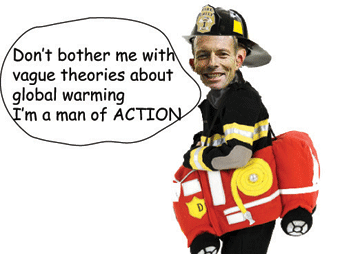 ”He’s now mocked John Howard’s design of an emissions trading scheme,” she said. ”Imagine Tony Abbott at an international meeting talking to Barack Obama and David Cameron – both of whom believe in action on climate change – and telling them that, ‘Look, this is just about the non-delivery of an invisible substance to no one.”’…… Just one in 10 Australians supports the Coalition plan to pay companies to reduce carbon emissions, the survey of 1000 people by JWS Research found
Abbott hit by backlash, The Age, July 16, 2013 Heath Aston, Mark Kenn Tony Abbott’s insistence that Labor’s emissions trading scheme is an expensive exercise in buying and selling an ”invisible substance” has drawn derision from climate experts and industry.
As the Rudd government prepares to detail a path from the carbon tax to an ETS a year earlier than scheduled, the Opposition Leader faces claims he is treading his own path back to the ”politics of climate denial and scepticism”.
Mr Abbott’s assertion that an ETS – to be introduced on July 1, 2014, as the government will announce on Tuesday – was a ”so-called market in the non-delivery of an invisible substance to no one” sparked an immediate backlash, with critics pointing out that former Liberal prime minister John Howard designed a similar scheme. Professor Richard Dennis, an economist at the Australian National University, said Mr Abbott should make it clear whether he thinks radiation was harmful or not. Continue reading
Kevin Rudd’s Emissions Trading Scheme is far from satisfactory
Five reasons why Rudd’s ETS move should make us wince CRIKEY.COM GILES PARKINSON | JUL 15, 2013 Scrapping the carbon tax might push household costs higher rather than lower. That and other problems await the Labor Party as it seeks to wedge Tony Abbott with emissions trading……There are reasons why the manner of Rudd’s move on the carbon price should make us wince. Here are five of them …
The cost to households……
It’s about politics rather than policy……
A low price is useless for Australia……
A policy without ambition
There is no evidence that Labor is going to aim for a more ambitious emission reduction target……
And what of the opposition?…... http://www.crikey.com.au/2013/07/15/five-reasons-why-rudds-ets-move-should-make-us-wince/
Greens launch energy policy to help farmers
 Greens pledge to help farmers save energy http://www.theaustralian.com.au/national-affairs/climate/greens-pledge-to-help-farmers-save-energy/story-e6frg6xf-1226679846791 BY:SUE NEALES, RURAL REPORTER The Australian July 16, 2013 THE Australian Greens have strengthened their grab for the rural vote at this year’s federal election, pledging $100 million in grants for farmers to save electricity and install solar and wind power.

 Greens leader Christine Milne will release the Greens’ new farm energy policy in a speech to the NSW Farmers annual conference in Sydney today, building on her claim that the Greens are the political party most in tune with the interests of farmers and regional Australia.
Senator Milne said yesterday the $100m farm energy program would become a policy priority pushed by the Greens after this year’s federal election, regardless of who wins power.
She claimed only the Greens were prepared to help farmers switch to cleaner energy sources and cut their power bills.
“That’s because Tony Abbott doesn’t believe in climate change, and Kevin Rudd has to find billions to fund his backflip on carbon pricing,” she said. Continue reading
PolitiFact – Fact Checker finds Coalition’s carbon price claims are false
 Coalition’s $15b carbon price claim ‘mostly false’ (includes videos) The Age, July 15, 2013 Peter Martin Economics correspondent What’s in a fact check?
Peter Martin explains how Fairfax’s fact-checking collaboration with PolitiFact, and reports back on its first target, the Coalition’s $15b carbon pricing claim.
The Coalition’s claim that moving swiftly to a floating carbon price would cost the budget up to $15 billion has been rated “mostly false” by the fact-checking service PolitiFact, which partners with Fairfax Media from Monday.
During the 40 days leading up to the election, PolitiFact will publish a checked fact a day on The Sydney Morning Herald and The Age websites.
The claim the change would mean “a black hole of up to $15 billion in the budget” was made by shadow treasurer Joe Hockey on the Channel Seven Sunrise program on Friday, June 28, two days after Kevin Rudd retook the Labor Party leadership…….More details are available at politifact.com.au. http://www.theage.com.au/federal-politics/federal-election-2013/coalitions-15b-carbon-price-claim-mostly-false-20130714-2py81.html#ixzz2ZA7evzxO
Silverton wind farm delayed on fear of Coalition election
Reviews of the renewables policy should occur every four years, rather than every two years, to give investors more confidence, according to a December recommendation from the Climate Change Authority, which is advising the government.
AGL Delays Australian Wind Farm on Government Policy Concern http://www.bloomberg.com/news/2013-07-11/agl-delays-australian-wind-farm-on-government-policy-uncertainty.html By James Paton – Jul 10, 2013 AGL Energy Ltd. (AGK), Australia’s largest developer of renewable energy projects, said it delayed a A$550 million ($509 million) wind farm because of uncertainty over government policy to boost investment in the industry.
AGL will defer hiring an engineering and construction contractor for the proposed Silverton wind farm in Australia’s New South Wales state and review its position in 2014, the Sydney-based company said today in an e-mailed statement.
“This decision does not indicate reduced enthusiasm for the project,” Nigel Bean, the head of power development at AGL, said in the statement.While Australia’s opposition coalition said in March that it’s committed to the nation’s 2020 renewable energy target, it called for a review of the policy in 2014 if it wins this year’s election, which must be held by Nov. 30. Australia plans to generate at least 20 percent of its electricity from renewable energy by the end of the decade as it seeks to reduce its dependence on coal.
Prime Minister Kevin Rudd’s return to the leadership in Australia has sparked a surge in support for Australia’s Labor government, with a poll showing the party has closed the gap with Tony Abbott’s opposition. Labor rose to its highest level on a two-party preferred basis in almost nine months and is tied on 50 percent with the Liberal-National coalition, the Newspoll published July 9 in The Australian showed. Continue reading
Victorian city of Ballarat could be powered by 100% renewable energy – Greens candidate
 Greens’ renewable energy plan outlined http://www.thecourier.com.au/story/1619753/greens-renewable-energy-plan-outlined/?cs=62 By PATRICK BYRNE July 5, 2013, THE Australian Greens candidate for Ballarat believes the city can one day be powered by 100 per cent renewable energy. Stephanie Hodgins-May yesterday announced a long-term plan to have Ballarat and the surrounding region invest more heavily in renewable energy.
She also slammed the federal opposition leader and Liberal members of parliament for denying the existence of climate change.
Ms Hodgins-May said the possibility of the region relying only on renewable energy was completely achievable.“When you look at a town like Daylesford, that whole town can be powered by only two wind turbines at the Hepburn wind farm,” she said.
“There is no reason why a city like Ballarat cannot one day rely solely on renewable energy.”
She said that both the Labor and Liberal parties needed to commit to a renewable future, instead of avoiding the issue and, in some instances, flatly denying the existence of climate change.“The Labor and Liberal parties are creating uncertainty with possible changes to the price on pollution and clean energy investment,” Ms Hodgins-May said.
Ms Hodgins-May announced plans for a “clean energy roadmap” that would help to one day power the city.The roadmap includes plans to increase the current renewable energy target, aiming to achieve 90 per cent renewable energy by 2030.The current government energy target is for at least 20 per cent of Australia’s electricity to come from renewable energy by 2020.
Tony Abbott to remove carbon tax, but keep the compensation. Strange politics?
Tony Abbott’s vow to abolish the carbon tax but keep the compensation smacks of populist politics at its finest PAUL SYVRET THE COURIER-MAIL JULY 02, 2013 “…………On the carbon front, emissions from the electricity sector have been reduced by 7 per cent, although other factors, such as demand, contribute to this, while renewable energy use is up 30 per cent. Most of the new-generation energy being planned is renewable or gas fired, indicating the carbon price is doing what it is designed to do in terms of shaping long-term investment.
Not a bad effort, Australia. Take a bow.
Still Abbott perseveres (straight-faced) with his claim the looming election will be a referendum on carbon, despite polls indicating only one in three voters support the removal of the tax and its replacement by the Coalition’s nebulous “Direct Action” scheme.
In short, a price on carbon, which was Abbott’s preferred policy option until he saw a chance to use it as a wedge in his plot to topple former Liberal leader Malcolm Turnbull, is seen by all but a handful of economists as the most efficient way of reducing emissions.
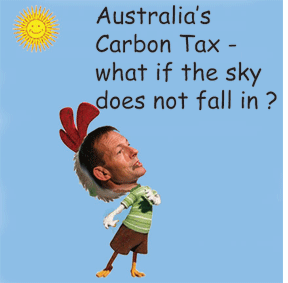
It is a “Pigovian tax”, designed to change behaviour by penalising companies that generate what are called negative externalities, in this case, spewing greenhouse gases into an already warming globe.
As Harvard Professor of Economics Greg Mankiw put it in a 2009 paper: “The economics here is straightforward: emitting carbon into the atmosphere entails a negative externality. In absence of any policy, people will emit too much. The Pigovian policy response is to impose a tax on carbon emission. This will induce households and firms to internalise the carbon externality when deciding, for example, how much to drive, what kind of car to buy, how much electricity to use, what kind of electric power plant to build and so on.”
But no, the Abbott response is to declare again on national television over the weekend that not only would he axe the tax, but Australians would keep the compensation, the sort of addle-headed populism that must have more financially literate members of his team screaming in silent anguish……
This is at the same time the rest of the world is moving to price carbon, with some markets, such as Europe, already well established. Just last week US President Barack Obama took America a big step down the road with a decision to cap emissions for US power plants. California, with a larger economy than Australia, already has a cap-and-trade scheme.
What about here? We may well be left with a “policy” that is based on little more than blood oath obduracy and dog-whistling for the deniers. http://www.couriermail.com.au/news/opinion/tony-abbott8217s-vow-to-abolish-the-carbon-tax-but-keep-the-compensation-smacks-of-populist-politics-at-its-finest/story-fnihsr9v-1226672519966
Tony Abbott keen to rush coal development, stifle renewable energy
Abbott to fast-track coal mines, in competition for ideas REneweconomy By Giles Parkinson on 1 July 2013 Tony Abbott has given his clearest indication yet that he intends to fast-track approval for large thermal coal mining projects, saying his new “one stop” shop for environmental approvals will ensure quick decisions on project approvals.
Abbott’s move, along with his party’s policy platform that has effectively suspended most investment in large scale renewables, comes as newly restored Prime Minister Kevin Rudd seeks to take the wind out of Abbott’s sails by proposing a more rapid transition to a (low) market price for carbon, as first foreshadowed on this website last Thursday morning, and the Greens push for even more ambition – proposing a 90 per cent renewables target by 2030.
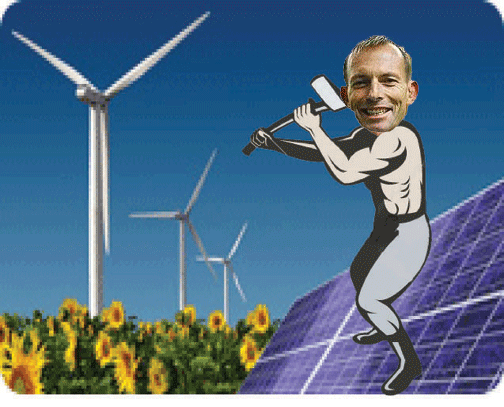
This could be the 2013 climate change election
Australia got its price on carbon under the prime ministership of Julia Gillard. Gillard, whatever you think of her, was remarkable in her ability to forge consensus in a hung parliament. The Greens party and independent MPs supported the Clean Energy Future Act, which in most ways was similar to Rudd’s carbon reduction scheme, albeit with more investment in renewable energy.
During this time, as I’ve written about earlier, the conservative opposition leader, Tony Abbott, ran an unrelenting fear campaign against the carbon price. Support for the carbon price from 2010 to 2012 fell sharply, until July last year when it came into effect. Since then, public support in Australia has increased for the carbon price.
Kevin Rudd’s return could herald a second Australian climate election http://www.guardian.co.uk/environment/southern-crossroads/2013/jun/28/kevin-rudd-australian-climate-election The Labor leader’s return to the Australian prime ministership could see a repeat of 2007’s ‘climate change election’ Rudd was elected in 2007 saying that climate change was the “the greatest moral, economic and environmental challenge of our generation”. In many ways, 2007 was the climate change election.

The first act Rudd took as prime minister was to ratify Kyoto, a symbolic break from the lead-footed conservative government under John Howard. A price on carbon was the major policy that the new Labor government saw to reduce carbon emissions, called the carbon pollution reduction scheme.
The scheme was defeated in the Senate in 2009 after the Greens party refused to support it, and voted with the Liberal and National parties to oppose it. Then the dismal efforts of Copenhagen further dampened efforts for climate action. Rudd’s final climate act as prime minister in 2010 was to announce that the carbon pollution reduction scheme would be shelved. Continue reading
Australia’s Clean Energy Finance Corporation launches investment, but Coalition opposes it
 The Coalition has vowed to axe the CEFC, along with the carbon price.
It has also written to the corporation saying any contracts it signs will not be honoured by the Coalition if it forms government.
Clean Energy $100m deal gets Coalition cold shoulder http://www.theage.com.au/environment/clean-energy-100m-deal-gets-coalition-cold-shoulder-20130628-2p2q9.html#ixzz2XgCLAQWO June 29, 2013 Tom Arup Environment editor, The Age Australia’s Clean Energy Finance Corporation has launched its first investment, committing to a joint $100 million energy efficiency loan program with the Commonwealth Bank.
The deal sets up a stand-off with the Coalition which has vowed not to honour any contracts signed by the $10 billion corporation if it wins office later in the year.
The corporation’s chief executive, Oliver Yates, said on Friday it would co-finance loans for medium-sized businesses for energy efficiency projects such as energy saving lighting, solar panels, and cogeneration and trigeneration plants.
The CEFC and the Commonwealth Bank will each chip in $50 million to the program, which will hand out loans between $500,000 to $5 million. It builds on an existing scheme put in place by another government agency, Low Carbon Australia – now folded into the CEFC – which has so far delivered $10.2 million to projects in manufacturing firms.
The CEFC is also working on a number of other larger deals, and it is understood some could be introduced as early as next week. It is reportedly negotiating to help New Zealand company Meridian Energy increase its debt in the massive Victorian Macarthur wind farm with a $100 million-plus loan, before it sells its share in the project. Continue reading
Giles Parkinson on Kevin Rudd, renewable energy, and the carbon tax
Will Rudd get to axe the tax before Abbott? REneweconomy By Giles Parkinson 27 June 2013 Good luck guessing what the extraordinary drama played out in Canberra last night means for climate change and renewable energy policies in Australia. From a Starbucks café in the Mojave Desert, a short drive from the 392MW Ivanpah solar power tower project (an extraordinary sight that must represent Australia’s energy future, but more on that later), the events make as little sense as they would do from inside Parliament House. Or from inside the office of an investor contemplating putting money into new energy technologies…….
It’s pretty clear that the hung parliament may well remain the pinnacle of policy making in Australia, at least in the short term. The current suite of policies – carbon pricing, renewable energy target, the Clean Energy Finance Corporation, and the Australian Renewable Energy Agency – make Australia one of the most attractive destinations in the world (were it not for the imminent threat of repeal).
The only thing missing has been a national energy efficiency plan, and a recognition by the states that it is time to move forward.
Now, the principal actors that made this possible are stepping back. Gillard has paid the price for the manner of her appointment, a poisoned chalice that was amplified by an intolerance of having a woman in the top job. Like many others, she saved her best for her resignation speech, when she was no longer a politician……eaves only Greens leader Christine Milne, who faces marginalisation if her party loses the balance of power. The prospect of that, though, will recede if Rudd succeeds in rescuing Labor’s electoral prospects, even if he doesn’t win. This would be disastrous for the renewable energy industry. The last time a Coalition government trod on renewable developments, the only thing that saved the industry were supportive state governments. They no longer exist.
Good climate change and renewables policies were put in place because of the tenacity of a few strong individuals willing to act on principle. That drove the factions and the mainstream media mad. The reaction of the factions was entirely predictable. The reaction of the media has been a crushing disappointment……. Quite where we go from here in the policy perspective is impossible to say. Rudd championed climate change in 2007 and got himself elected on the strength of it. But then he used it as a political wedge rather than a public policy pursuit. In the end his CPRS was an unsavoury compromise with the Opposition, and was ditched after pressure from Julia Gillard and Wayne Swan.
Rudd says now that he regrets the decision to dump his climate policies. But frankly, it is unclear whether Rudd sees that mostly in the prism of his own career or as a public policy issue. Renewable energy supporters would rather he didn’t keep saying “let’s get cooking with gas”…….
n the short term, however, most interest will be on the fate of the CEFC, and the numerous projects which are under consideration. An early election call – depending on the flow of events today – would mean that the caretaker period would start immediately, and the board of the CEFC would not be able to make any new decisions.
In the event of an Abbott victory, it would probably have to wait until after the election to make those announcements and continue on. It cannot stop work until its supporting legislation is repealed, and that is unlikely until next July. The CEFC is absolutely sure of its legality, but the rhetoric (and frankly the ignorance) of the Opposition might suggest some sort of challenge. But they may have other fish to fry. http://reneweconomy.com.au/2013/will-rudd-get-to-axe-the-tax-before-abbott-24216
1 This month

of the week – Australians for War Powers Reform (AWPR)
To see nuclear-related stories in greater depth and intensity
 Antinuclear